Hubbry Logo
logo
Pentacle
Community hub

Pentacle

logo
0 subscribers
Read side by side
from Wikipedia

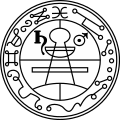
Pentagram, a common symbol on a pentacle

A pentacle (also spelled and pronounced as pantacle in Thelema, following Aleister Crowley, though that spelling ultimately derived from Éliphas Lévi)[1] is a talisman that is used in magical evocation, and is usually made of parchment, paper, cloth, or metal (although it can be of other materials), upon which a magical design is drawn. Symbols may also be included (sometimes on the reverse), a common one being the six-point form of the Seal of Solomon.

Pentacles may be sewn to the chest of one's garment, or may be flat objects that hang from one's neck or are placed flat upon the ground or altar. Pentacles are almost always shaped as disks or flat circles. In the Hermetic Order of the Golden Dawn, though, a pentacle is placed within the triangle of evocation.

Many varieties of pentacle can be found in the grimoire called the Key of Solomon. Pentacles are also used in Wicca, alongside other magical tools. In the Hermetic Order of the Golden Dawn and Wicca, pentacles symbolize the classical element earth.[2][3] In the 1909 Rider–Waite–Smith tarot deck (the pentacles of which were designed by Arthur Edward Waite), and subsequent tarot decks that are based upon it, and in Wicca, pentacles prominently incorporate a pentagram in their design. This form of pentacle is formed upon a disk which may be used either upon an altar or as a sacred space of its own.

Definitions

[edit]

The first documents to depict pentacles were the 16th-century grimoires called the Heptameron by pseudo-Pietro d'Abano, and the Key of Solomon. In the Heptaméron, there is only one pentacle, whereas in the Key of Solomon, there are dozens of different pentacles. The Heptameron's pentacle is a hexagram that is embellished by patee crosses and letters, whereas the Key of Solomon's pentacles have a very broad variety of designs, only two of which are pentagrammic. That contrasts with the later popular definitions of pentacles from the 1900s, which state that pentacles are inherently pentagrammic.

Gerald Gardner, known by some as the 'Father of Wicca', got his concept of pentacles in large part from the 1909 Rider–Waite–Smith tarot deck[citation needed], in which the pentacles are disks that are covered with a pentagram. In Gardner's 1949 book High Magic's Aid and 1954 book Witchcraft Today, Gardner defined a pentacle as a "five-pointed star", intending to mean a pentagram. In his 1959 book The Meaning of Witchcraft, Gardner defined a pentacle as a synonym of 'pentagram'.

There is a particular definition of 'pentacle' among many latter-day Wiccans: Namely, a 'pentacle' refers to a 'pentagram' circumscribed by a circle.[3]

Etymology

[edit]

The word is first recorded in English usage in 1561, from earlier French use. The French word had the meaning of "talisman". The French word is in turn from the Latinized word 'pentaculum' (using the Latin diminutive suffix -culum), which is in turn from the Italian word 'pentacolo'.

The Oxford English Dictionary in earlier editions (2nd edition 1989) went on to say that "some would connect it" with the Middle French word 'pentacol' (1328) or 'pendacol' (1418), a jewel or ornament worn around the neck (from pend- hang, à to, col or cou neck).[4][5] This is the derivation the Theosophical Society employ in their glossary:

...it seems most likely that it comes through Italian and French from the root pend- "to hang", and so is equivalent to a pendant or charm hung about the neck. From the fact that one form of pentacle was the pentagram or star-pentagon, the word itself has been connected with the Greek pente (five).[6]

As magical objects

[edit]

Pentacles, despite the sound of the word, often had no connotation of "five" in the old magical texts, but were, rather, magical talismans inscribed with any symbol or character. When they incorporated star-shaped figures, these were more often hexagrams than pentagrams.[citation needed] Pentacles showing a great variety of shapes and images appear in the old magical grimoires, such as the Key of Solomon; as Heinrich Cornelius Agrippa summarises it, their use was to "fore-know all future things, & command whole nature, have power over devils, and Angels, and do miracles." Agrippa attributes Moses' feats of magic in part to his knowledge of various pentacles.[7]

A Fourth Book of Occult Philosophy (c. 1565), which was falsely attributed to Agrippa, gives detailed instructions as to how pentacles should be formulated:

But we now come to speak of the holy and sacred Pentacles and Sigils. Now these pentacles, are as it were certain holy signes preserving us from evil chances and events, and helping and assisting us to binde, exterminate, and drive away evil spirits, and alluring the good spirits, and reconciling them unto us. And these pentacles do consist either of Characters of the good spirits of the superiour order, or of sacred pictures of holy letters or revelations, with apt and fit versicles, which are composed either of Geometrical figures and holy names of God, according to the course and maner of many of them; or they are compounded of all of them, or very many of them mixt.[8]

Francis Barrett, in his influential work The Magus of 1801 (Book 2, part 2), repeats these instructions almost verbatim.

Another common design employed in pentacles is a magic square, such as the Sator-Arepo-Tenet square.[9]

In the Golden Dawn magical system, the Earth Pentacle is one of four elemental "weapons" or tools of an Adept. These weapons are "symbolical representations of the forces employed for the manifestation of the inner self, the elements required for the incarnation of the divine."[10]

Other pentacles for the evocation of spirits are also employed in the Golden Dawn system; these are engraved with the name and sigil of the spirit to be invoked, inside three concentric circles, having painted on their reverse a circle and cross like a celtic cross.[11]

According to Aleister Crowley's instructions for the A∴A∴, the pentacle is a disc of wax, gold, silver-gilt or Electrum Magicum, eight inches diameter and half an inch thick; the Neophyte should "by his understanding and ingenium devise a symbol to represent the Universe", and engrave this on the disc.[12]

There is, therefore, nothing movable or immovable under the whole firmament of heaven which is not included in this pantacle, though it be but "eight inches in diameter, and in thickness half an inch." Fire is not matter at all; water is a combination of elements; air almost entirely a mixture of elements; earth contains all both in admixture and in combination. So must it be with this Pantacle, the symbol of earth.[13]

A pentacle is also employed as a magical tool within Wicca, generally to summon certain energies or summon spirits.[2]

Method of employment

[edit]

In many old grimoires dealing with magical evocation, the pentacle is described as being hung about the neck, providing protection and authority to the operator. Johannes Trithemius has the magician donning the pentacle just before casting the protective circle:

Then taking your ring and pentacle, put the ring on the little finger of your right hand; hang the pentacle round thy neck; (Note, the pentacle may be either wrote on clean virgin parchment, or engraven on a square plate of silver and suspended from thy neck to the breast)....[14]

One version of the Key of Solomon mentions both a "Great Pentacle" which is drawn in a book, as well as a collection of other pentacles which are drawn in ink on separate pieces of parchment for use as amulets:

Thou shalt preserve them to suspend from thy neck, whichever thou wilt, on the day and hour wherein thou wast born, after which thou shalt take heed to name every day ten times, the Name which is hung from thy neck, turning towards the East, and thou mayest be assured that no enchantment or any other danger shall have power to harm thee.[15]

The pentacle is of central importance in the evocation of spirits. A fairly typical evocation involves a series of conjurations of increasing potency, each involving the display of the pentacle:

... If they then immediately appear, it is well; if not, let the master uncover the consecrated pentacles which he should have made to constrain and command the spirits, and which he should wear fastened round his neck, holding the medals (or pentacles) in his left hand, and the consecrated knife in his right; and encouraging his companions, he shall say with a loud voice:

Here be the symbols of secret things, the standards, the ensigns, and the banners, of God the conqueror; and the arms of the almighty One, to compel the aerial potencies. I command ye absolutely by their power and virtue that ye come near unto us, into our presence, from whatsoever part of the world ye may be in, and that ye delay not to obey us in all things wherein we shall command ye by the virtue of God the mighty One. Come ye promptly, and delay not to appear, and answer us with humility.

If they appear at this time, show them the pentacles, and receive them with kindness, gentleness, and courtesy; reason and speak with them, question them, and ask from them all things which thou hast proposed to demand.

But if, on the contrary, they do not yet make their appearance, holding the consecrated knife in the right hand, and the pentacles being uncovered by the removal of their consecrated covering, strike and beat the air with the knife as if wishing to commence a combat, comfort and exhort thy companions, and then in a loud and stern voice repeat the following conjuration: ...[16]

Once the spirit has appeared and been constrained, the pentacle is covered again, but is uncovered whenever demands are made of the spirit or when it is compelled to depart.

In the Golden Dawn system, the pentacles are not suspended from the neck, but wrapped in a cloth covering. Instead of wearing a pentacle, the magician wears fastened to their breast a lamen.

[edit]

In tarot

[edit]
The traditional suit of coins became "pentacles" in the 1909 Rider–Waite tarot deck, designed by Golden Dawn initiates A. E. Waite and Pamela Colman Smith.

Much like conventional playing cards, the Minor Arcana of the tarot are divided into four suits. The suit names have evolved over time, and based on the innovation of Éliphas Lévi, contemporary English-language writers on tarot divination often prefer "pentacles" for the suit of coins.

The 1909 Rider–Waite–Smith tarot deck was the first to use an actual suit of pentacles, where Arthur Edward Waite designed the pentacles as golden disks with a pentagram on them. The influence of that deck resulted in widespread use of the pentacle symbol, particularly among Wiccans.

In mathematics

[edit]

The term pentacle is used in Tilings and patterns by Branko Grünbaum and G. C. Shephard to indicate a five-pointed star composed of ten line segments, similar to a pentagram but containing no interior lines.[19]

See also

[edit]
  • Wuxing, the five phase cycle in Chinese philosophy.

References

[edit]
[edit]
Revisions and contributorsEdit on WikipediaRead on Wikipedia
from Grokipedia
A pentacle is a five-pointed star, known as a pentagram, enclosed within a circle and utilized as a talismanic or magical symbol across esoteric traditions.[1] The term originates from the late 16th century, derived from Medieval Latin pentaculum, blending Greek pente ("five") with the Latin diminutive suffix -culum to denote a figure or amulet associated with the number five.[1] In historical grimoires, such as the Key of Solomon, pentacles served practical roles in ceremonial magic, including the invocation and restraint of spirits, often inscribed with divine names and geometric designs to purportedly harness supernatural forces during evocations.[2] These artifacts reflect Renaissance-era interests in Solomonic magic, purportedly rooted in biblical King Solomon's legendary command over demons, though textual evidence traces to medieval and early modern manuscripts rather than antiquity.[2] In modern Neopagan and Wiccan contexts, the upright pentacle represents the interconnectedness of the five classical elements—earth, air, fire, water, and spirit—symbolizing balance, protection, and the human form within the cosmos, frequently employed in rituals, jewelry, and as an emblem for military recognition of pagan faiths.[3] Its inverted variant has drawn controversy, occasionally linked to Satanism or subversion in occult literature, yet such associations stem from 19th-century reinterpretations rather than universal historical consensus.[4]

Definitions and Terminology

Distinction from Pentagram

The pentagram is a geometric figure comprising a five-pointed star, constructed by drawing five straight lines that intersect to form the points, originating from the Greek terms penta- ("five") and gramma ("line" or "drawing"), with early attestations in Pythagorean mathematics around the 6th century BCE as a symbol of health and harmony.[5] By contrast, the pentacle refers to a talismanic object or diagram incorporating a pentagram—often enclosed within a circle—for ritual protection or invocation, deriving from Medieval Latin pentaculum (a diminutive form implying a small pentagon-like figure), first recorded in English in the late 16th century as a magical pendant or seal.[1] In historical occult grimoires, such as the 17th-century Clavicula Salomonis (Key of Solomon), pentacles denote inscribed magical figures—typically on parchment, metal, or wax—intended to constrain spirits during evocation; these may feature pentagrams but frequently include other sigils, Hebrew letters, or divine names, with the enclosing circle serving to bind supernatural forces rather than define the symbol itself.[6][7] This broader connotation emphasizes the pentacle's function as a practical tool in ceremonial magic, distinct from the pentagram's abstract geometric form, which alone lacks the talismanic context or protective boundary.[7] Modern esoteric traditions, including 20th-century Wicca, have refined the distinction by standardizing the pentacle as specifically a upright pentagram circumscribed by a circle, interpreting the star's points as the four classical elements plus spirit and the circle as unity or containment to avert chaotic energies.[8] This evolution reflects a shift from the pentacle's historical versatility as any evocation seal to a fixed emblem of elemental balance, though some practitioners note interchangeable usage, underscoring the terms' contextual fluidity across eras.[9]

Broader Connotations as Talisman

In ceremonial magic, the pentacle functions as a talisman for protection and dominion over spiritual entities during evocation rituals. Grimoires such as the Key of Solomon prescribe pentacles as inscribed seals on parchment, cloth, or metals aligned with planetary influences, prepared via consecration and astrological timing to invoke specific spirits or effects.[10][11] These devices compel obedience from invoked beings; for example, displaying a designated pentacle causes spirits to submit immediately upon appearance.[12] Specific pentacles target diverse outcomes beyond mere safeguarding, including inciting enmity or wrath through Mars-associated designs, eliciting responses in dreams via lunar pentacles, or enforcing compliance in Venusian operations.[13][14][15] The enclosing circle binds the pentagram's geometry, symbolizing containment of elemental or cosmic forces to prevent backlash against the operator.[16] Medieval traditions extended the pentacle's talismanic role to apotropaic uses, such as amulets warding doors, windows, and persons against evil spirits, demons, or witchcraft influences.[17] This protective connotation persisted into Renaissance esotericism, where nobility and magicians employed them for personal safeguard and ritual potency, reflecting attributions to King Solomon's legendary command over supernatural realms.[18]

Etymology and Linguistic Origins

Historical Derivations

The term "pentacle" derives from Medieval Latin pentaculum, a diminutive form combining the Greek prefix pente- ("five") with the Latin suffix -culum, denoting a small object or instrument associated with five elements or points, often in a magical context.[1][19] This linguistic construction reflects its early connotation as a compact talismanic figure, distinct from the more geometric pentagrammon (Greek for "five-lined figure"), which emphasized the star's linear structure without the diminutive or amuletic implication.[5] The word entered Old French as pentacle, initially signifying a talisman or hanging amulet, before appearing in English by the mid-16th century, with the earliest recorded use dated to 1561 in reference to a five-pointed magical emblem.[19][20] Some sources trace an even earlier English attestation to 1547, aligning with its adoption in occult texts like Pietro d'Abano's Heptameron, where it denoted protective sigils.[21][22] Alternative derivations link it to Italian pentacolo or roots in pend- ("to hang"), underscoring its practical role as wearable or inscribed charms in Renaissance grimoires, rather than purely symbolic diagrams.[23] This evolution highlights a shift from abstract geometric terminology to applied esotericism, as pentaculum adapted Medieval Latin's blending of classical roots with practical mysticism, prioritizing function over pure form in hermetic traditions.[1][24]

Variations in Terminology

The terminology associated with the pentacle encompasses several variants and overlapping usages, reflecting its evolution across mathematical, esoteric, and religious contexts. Synonymous terms include "pentangle" and "pentalpha," with the latter deriving from the ancient Greek observation that the pentagram could be constructed from five interlaced instances of the letter alpha (Α), a interpretation prominent in Pythagorean geometry and early symbolic studies.[25] These designations emphasize the figure's geometric properties as a star polygon {5/2}, without the enclosing circle that later became characteristic.[25] In occult traditions, particularly those drawing from Renaissance grimoires, "pentacle" extends beyond the star to denote a functional talisman or amulet inscribed with symbols for ritual evocation, often crafted from parchment, metal, or other media to constrain spirits or invoke planetary influences.[6] This broader application, as seen in texts like the Key of Solomon, treats pentacles as specific seals rather than generic icons, sometimes incorporating non-pentagrammatic designs tailored to astrological or elemental purposes.[6] Such usage predates modern Neopagan refinements and highlights a causal distinction: the pentacle as an operative tool for magical causation, rather than mere representation. Modern esoteric communities, especially Wicca and Neopaganism, frequently differentiate "pentacle" as the pentagram enclosed within a circle—symbolizing containment of elemental forces—while reserving "pentagram" for the unenclosed star, though historical and contemporary sources exhibit inconsistency and interchangeability in these terms.[26] An occasional variant spelling, "pantacle," appears in select occult literature, likely arising from phonetic or scribal adaptations of the Latin pentaculum (a diminutive of pentagonus), but remains marginal compared to standard forms.[27] This variability underscores the term's adaptability, influenced by linguistic derivation from Old French pentacle (c. 16th century) and its integration into English via magical treatises.[19]

Historical Development

Ancient and Classical Origins

The earliest attested depictions of the pentagram, the geometric precursor to the later encircled pentacle, appear in Mesopotamian artifacts dating to around 3500 BCE, including markings on pottery fragments excavated at Ur of the Chaldees in ancient Sumer.[28] These early instances, such as the Sumerian precuneiform sign UB from circa 3000 BCE, likely denoted practical concepts like grain or foundational elements rather than esoteric symbolism, reflecting the symbol's initial mundane or agricultural associations in cuneiform precursors.[29] By the 7th century BCE, the pentagram appeared in Greek material culture, evidenced by engravings on vases, predating its philosophical elevation.[29] In the 6th century BCE, Pythagoras and his followers in southern Italy adopted the pentagram—termed pentalpha for its resemblance to five linked Greek letter alphas—as a emblem of mutual recognition among initiates, health (hygieia), and cosmic harmony.[30] Its infinite regress of intersecting lines embodied the golden ratio (approximately 1.618), which Pythagoreans linked to mathematical perfection and the quintessence of the universe, distinct from elemental associations in later traditions.[29] In classical Greco-Roman contexts, the pentagram retained primarily mathematical and philosophical import, as seen in Euclid's Elements (circa 300 BCE), where it illustrates stellar polygons without ritualistic framing. Roman sources, such as architectural treatises by Vitruvius (1st century BCE), reference pentagonal forms in star-shaped fortifications but not the interlaced pentagram per se, indicating limited esoteric development before Hellenistic syncretism. The addition of a circumscribing circle, defining the pentacle proper, emerged only in medieval esotericism, absent from these ancient attestations.[29]

Medieval and Renaissance Usage

In medieval Europe, pentacles functioned primarily as apotropaic talismans to ward off evil spirits and demons, with the pentagram enclosed in a circle serving as a barrier against malevolent forces in folk magic practices. These symbols, sometimes termed Drudenfuss in German regions, were commonly inscribed on doors or carried as amulets for protection, reflecting a practical application in daily life amid widespread belief in supernatural threats.[31] The transition to the Renaissance saw pentacles formalized in ceremonial magic through grimoires like the Clavicula Salomonis (Greater Key of Solomon), a pseudepigraphic text compiled around the 14th to 15th centuries in Italy, attributing its origins to King Solomon despite later composition. This work describes over 40 specific pentacles, each tailored for evoking planetary spirits or constraining entities during rituals; for instance, the First Pentacle of Saturn was intended to instill terror in spirits upon display.[32] Construction required virgin parchment or metal, inscriptions of Hebrew divine names and sigils, and timing aligned with planetary hours—such as Mercury's days for general efficacy—followed by consecration through suffumigation and prayer.[33] Heinrich Cornelius Agrippa's De Occulta Philosophia (1533) integrated pentacles into a broader occult philosophy, portraying the pentagram as emblematic of the microcosm, harmonizing the five elements (earth, air, fire, water, spirit) and facilitating correspondences between celestial and terrestrial realms in alchemical and magical operations.[34] These Renaissance developments emphasized empirical ritual precision over mere superstition, influencing subsequent European esotericism while maintaining the pentacle's core role in spirit constraint and invocation.[23]

Modern Revival in Esotericism

The modern esoteric revival of the pentacle emerged in the mid-19th century amid renewed interest in occult symbolism, particularly through the writings of French magus Éliphas Lévi. In his 1856 treatise Dogme et Rituel de la Haute Magie, Lévi illustrated the pentagram enclosed within a circle—termed the pentacle—as a potent talisman embodying the microcosm of human will aligned with cosmic forces, inscribed with Hebrew divine names to command spirits and elements.[35] He emphasized its upright orientation for protective evocation, contrasting it with the inverted form symbolizing material dominance, thereby reinterpreting medieval grimoires for contemporary ceremonial practice.[36] This framework influenced the Hermetic Order of the Golden Dawn, founded in 1888, which integrated the pentacle into a structured system of initiatory magic drawing from Kabbalah, astrology, and alchemy. Golden Dawn rituals employed elemental pentacles—such as the Earth Pentacle, a hexagram-inscribed disk representing the sephira Malkuth—as symbolic tools for invoking planetary and zodiacal intelligences during invocations and talisman consecrations.[37] Adepts crafted these pentacles from specific metals like gold or silver, aligning them with corresponding elements to facilitate equilibrium between the practitioner and macrocosmic powers, as detailed in cipher manuscripts and later publications by order members.[38] In the 20th century, the pentacle found renewed application in Wicca, pioneered by Gerald Gardner, who publicized the tradition in 1954 following Britain's repeal of anti-witchcraft laws. Gardnerian Wicca adopted the pentacle as a primary altar implement, typically a disk engraved with an upright pentagram to symbolize the union of spirit with the four elements, used for consecrating tools, cakes, and ale during sabbats and esbats.[39] This usage echoed Golden Dawn influences while adapting to neopagan emphases on nature reverence, with the pentacle serving to ground magical energy and affirm the witch's dominion over elemental forces in fertility rites and protective circles.[40] By the 1960s, as Wicca proliferated through covens and solitary practice, the pentacle became a ubiquitous emblem of earth-centric esotericism, often worn as an amulet despite occasional Christian backlash associating it with inversion for satanic connotations.[41]

Symbolism and Interpretations

Geometric and Elemental Meanings

The pentacle comprises a pentagram—a unicursal five-pointed star—enclosed within a circle. Geometrically, the pentagram's construction from a regular pentagon's diagonals yields line segments whose ratios conform to the golden ratio, φ = (1 + √5)/2 ≈ 1.61803, such that the ratio of the whole diagonal to the longer segment equals the ratio of the longer to the shorter segment.[25] This self-similar property recurs infinitely in nested pentagrams formed by intersections, with the star's vertices forming isosceles triangles with apex angles of 36° and base angles of 72°.[25] The enclosing circle standardizes the pentagram's scale, often tangent to its points, emphasizing containment and symmetry.[42] In esoteric traditions, the pentacle's five points symbolize the five elements: earth, air, fire, water, and spirit (or akasha), integrating the classical four elements with a quintessence representing divine or ethereal essence.[43] This correspondence, evident since the Renaissance in Western occultism, attributes specific elements to points based on orientation—for instance, in upright depictions, the top point as spirit dominating the lower four material elements.[43] The circle binds these forces, denoting unity, protection, or the cyclical interplay of elemental energies.[26] In the Hermetic Order of the Golden Dawn, the pentacle particularly evokes earth as an elemental tool, inscribed with sigils for invocation.[44] These meanings derive from Pythagorean veneration of the pentagram for its mathematical harmony, later adapted in ceremonial magic, though ancient associations emphasized health and cosmic order over explicit elements.[45] Modern Wiccan usage reinforces the elemental framework, with the upright pentacle signifying balance and the inverted form sometimes interpreted as matter prevailing over spirit, though interpretations vary by tradition.[46]

Protective and Apotropaic Functions

In medieval and Renaissance grimoires, pentacles functioned primarily as apotropaic talismans to safeguard practitioners during spirit evocations and to repel malevolent entities. The Greater Key of Solomon, a pseudepigraphical text attributed to King Solomon and likely composed in the 14th or 15th century, details numerous pentacles inscribed with Hebrew divine names, astrological symbols, and geometric figures, intended to constrain invoked spirits and prevent harm to the operator. These devices were typically constructed on specific planetary days using materials like virgin parchment, consecrated inks, or metals corresponding to celestial influences, then worn on the chest or held during rituals to form a protective barrier.[2] Specific pentacles targeted various threats: the Sixth Pentacle of Mars, engraved on iron or steel, was employed to defend against physical injury in combat by rendering the bearer's weapons effective while blunting those of adversaries; the Fifth Pentacle of Saturn served to disperse nocturnal spirits and those guarding treasures, ensuring safe access; and the Second Pentacle of the Moon protected against maritime dangers and tempests induced by lunar entities when displayed to them. The Third Pentacle of Jupiter compelled obedience from spirits while shielding the invoker from rebellion, underscoring the pentacle's dual role in command and defense. These functions relied on the belief in sympathetic magic, where the pentacle's form harnessed planetary virtues to counter infernal influences.[2] Beyond ritual magic, the pentagram—often encircled as a pentacle—held apotropaic significance in medieval European traditions as a ward against evil, rooted in earlier Pythagorean associations of the number five with health and harmony, later adapted in Christian contexts to repel demons. Manuscripts and architectural motifs from the period, such as those in Hanoverian records, equate the pentagram with hexagrams as signs to avert harm, reflecting its widespread folkloric use independent of formal grimoires. This protective efficacy was attributed to the symbol's geometric perfection, symbolizing divine order over chaos, though empirical verification remains absent, with efficacy hinging on the practitioner's faith and ritual precision.[47]

Uses in Magic and Occult Practices

As Ritual Tools and Amulets

In ceremonial magic, pentacles function as consecrated talismans inscribed on materials such as parchment, metal, or wax, employed to evoke, command, and protect against spirits during rituals. The Greater Key of Solomon, a grimoire dating to the 14th or 15th century, details 44 such pentacles, grouped by planetary influence with seven each for Saturn, Jupiter, Mars, Sun, Venus, Mercury, and Moon, each crafted and empowered under corresponding astrological timings and colors—black for Saturn, blue for Jupiter, red for Mars, and so forth—to align with celestial forces for specific operations.[11] These tools underpin the efficacy of evocations, as the text asserts that successful magical workings depend on their proper knowledge and application.[10] Specific pentacles target defined outcomes: the Fourth Pentacle of Venus compels Venusian spirits to obedience and influences desired persons instantly, while the Second Pentacle of Mars, applied to the body, counters diseases effectively.[15][13] The First Pentacle of the Moon invokes lunar spirits and unlocks fastened doors, prescribed to be drawn in silver or grey.[14] In the Lesser Key of Solomon's Goetia, the Pentacle of Solomon constrains demonic entities invoked via command, preventing harm to the operator when displayed during conjuration.[48] As amulets, pentacles extend ritual protection beyond ceremonies, worn or carried to repel adversaries, elementals, or malevolent influences.[7] For example, Saturnian pentacles guard against enemies and spiritual arrogance, serving as portable wards post-consecration.[12] Historical practitioners inscribed them with divine names and sigils to invoke angelic oversight, ensuring the bearer's safety in occult endeavors.[49]

Methods of Employment and Inscriptions

In the Key of Solomon, a Renaissance grimoire attributed pseudepigraphically to King Solomon, pentacles are inscribed on virgin parchment or metal plates corresponding to planetary influences, using inks prepared from specific ingredients such as dragon's blood, cinnabar, or virgin wax mixed with holy water.[10] The inscriptions incorporate Hebrew divine names, sigils of planetary spirits, mystical characters, and excerpts from Psalms, designed to harness celestial powers for invocation or protection.[32] Creation occurs during astrologically auspicious times, such as the planetary day and hour ruled by the associated sphere, with the Moon in an increasing phase and favorable aspects, ensuring alignment with cosmic forces.[10] Consecration follows inscription through rituals involving fumigation with incense like frankincense or myrrh, aspersion with exorcised water, and recitation of orations invoking divine authority, rendering the pentacle potent against adversarial spirits.[10] For example, lunar pentacles, drawn in silver or grey inks, are employed to summon Moon spirits or unlock barriers, held aloft or placed upon the altar during evocation.[50] In evocation practices detailed in Solomonic texts, the operator displays the pentacle toward summoned entities within a protective circle, compelling obedience and warding malefic influences, as the inscribed seals bind spirits to the magician's will.[51] Later traditions, such as those in the Hermetic Order of the Golden Dawn, adapt these methods by engraving pentacles on consecrated talismanic metals—gold for solar, silver for lunar—and charging them via rituals invoking elemental grades, though retaining grimoire emphasis on precise timing and purity of intent.[52] Employment extends to meditative focus, where the pentacle is visualized or worn as an amulet to channel planetary virtues, or placed beneath the head for prophetic dreams, always preceded by ritual purification facing eastward.[23] These procedures underscore the pentacle's role as a microcosmic conduit, bridging human will and celestial hierarchies through disciplined inscription and invocation.[53]

Religious and Spiritual Contexts

In Paganism and Wicca

In Wicca and modern Paganism, the pentacle—a five-pointed star circumscribed by a circle—symbolizes the integration of the four classical elements (earth, air, fire, and water) with spirit or akasha as the fifth, representing harmony, balance, and the cyclical nature of existence.[54][55] The enclosing circle emphasizes protection, containment of energies, and the eternal interconnectedness of all things, distinguishing it from the open pentagram used in some other esoteric contexts.[36] Gerald Gardner, who publicized Wicca in the mid-20th century after developing its core rituals in the 1940s, adopted the upright pentacle into initiatory and ceremonial practices, influenced by earlier occult systems like those of Aleister Crowley and the Hermetic Order of the Golden Dawn.[36][4] This integration positioned the pentacle as a key emblem of Wiccan identity, often invoked during circle casting to sanctify sacred space and invoke elemental forces.[54] As an altar tool, the pentacle typically manifests as a consecrated disk or plate, placed centrally to embody the earth element amid representations of the other elements (such as athame for air, wand for fire, and chalice for water).[56] It facilitates ritual functions including tool consecration, energy charging, and the cakes and ale rite, where bread and wine are placed upon it to symbolize sustenance from the divine.[56][57] Wiccans and Pagans frequently wear pentacle pendants or rings as talismans for warding off harm and grounding personal energy, viewing its geometry as a barrier against malevolent influences while promoting spiritual elevation in its upright form.[55] This protective role underscores its apotropaic function in daily practice, though interpretations vary slightly across traditions, with some emphasizing its alignment with the human form or seasonal cycles.[36]

Historical Christian Associations and Rejections

In early Christianity, the pentagram—a five-pointed star without an enclosing circle—served as a symbol representing the five wounds of Christ inflicted during the Crucifixion: the nail marks in each hand and foot, and the spear wound in his side.[3] This usage drew from medieval iconography, where the unbroken lines of the pentagram evoked the eternal nature of Christ, sometimes linked to the Alpha and Omega.[58] Such symbolism appeared in Christian art, architecture, and seals from the early Middle Ages through the Renaissance, including inverted forms denoting the upside-down crucifixion of Saint Peter, as seen in some church designs like those in historical cathedrals.[59] By the late medieval and early modern periods, however, the pentagram's adoption into esoteric grimoires and magical traditions—such as those attributed to King Solomon—began eroding its Christian favor, as these texts blended Judeo-Christian elements with pagan and astrological motifs condemned by ecclesiastical authorities.[3] The Church's broader rejection of occult practices, formalized in decrees like the 1326 papal bull against ritual magic and intensified during the 15th-17th century witch hunts, extended to symbols like the pentagram when used in evocations or amulets, viewing them as invitations to demonic influence rather than divine protection.[60] The distinction sharpened with the pentacle, the pentagram enclosed in a circle, which emerged more prominently in Renaissance occultism to signify containment of spirits or elemental forces, a configuration absent from orthodox Christian symbolism and thus inherently suspect.[3] 19th-century occultists like Éliphas Lévi further inverted and diabolized the symbol—pairing an upside-down pentagram with a goat's head to represent matter triumphing over spirit—prompting evangelical Protestant reformers to decry it as a mark of Satanism, a stance echoed in 20th-century fundamentalist literature equating it with pagan revivalism.[60] This rejection persists in contemporary Christian doctrine, where the pentacle is often cited as incompatible with biblical prohibitions against divination and idolatry (Deuteronomy 18:10-12), irrespective of its pre-Christian mathematical or astronomical origins.[61]

In Divination Systems

Role in Tarot and Cartomancy

The suit of Pentacles forms one of the four suits in the Minor Arcana of Tarot decks, corresponding to the element of earth and embodying themes of material existence, including finances, career, property, physical health, and practical achievements.[62][63] In divination, Pentacles cards address tangible outcomes and earthly concerns, with upright positions often signifying prosperity, stability, and resource management—such as the Ace of Pentacles indicating new financial opportunities or the Ten of Pentacles denoting long-term wealth and family legacy—while reversed orientations suggest delays, losses, or overattachment to materialism, like stagnation in professional growth or fiscal mismanagement.[62][63] This suit's symbolism derives from its historical roots as the suit of Coins in 15th-century Italian Tarocchi decks, later reinterpreted in 19th-century occult traditions to feature pentagram-embossed discs, representing the manifestation of spiritual energy into physical form.[64] In Tarot cartomancy, Pentacles influence readings by grounding interpretations in realism, prompting querents to focus on actionable steps rather than abstract ideals; for instance, a predominance of Pentacles may highlight the need for disciplined effort in business or health matters, contrasting with the more ethereal suits like Cups or Wands.[65][66] These associations emerged prominently during the occult revival of the late 1800s, influenced by groups like the Hermetic Order of the Golden Dawn, which linked the pentacle's five-pointed star to elemental balance and human senses, though original Tarot suits served primarily gaming purposes until esoteric adaptations formalized their divinatory roles around 1781 with Antoine Court de Gébelin's writings.[64][63] Beyond Tarot-specific decks, in broader cartomancy with standard playing cards, the suit of Diamonds parallels Pentacles, denoting money, commerce, and security; upright equivalents evoke success in trade or acquisitions, while inverted readings warn of financial pitfalls or ethical compromises in dealings.[67] This correspondence underscores the pentacle's consistent function across systems as a marker of corporeal priorities, emphasizing resilience and reliability in predictive contexts without implying supernatural causation.[63]

Mathematical and Scientific Aspects

Geometric Properties

The pentagram, the central geometric component of the pentacle, is classified as the regular star polygon {5/2} using the Schläfli symbol, formed by connecting every second point among five equally spaced vertices on a circumscribed circle.[25] This construction yields a five-sided figure with self-intersecting edges that enclose an internal regular pentagon.[68] The pentagram possesses five-fold rotational symmetry, allowing it to map onto itself after rotations of 72°, 144°, 216°, and 288° around its center, and five lines of reflectional symmetry passing through each vertex and the midpoint of the opposite edge.[69] At each of the five sharp vertices, the interior angle measures precisely 36°, while the intersections of the edges create additional points that form the vertices of the inner pentagon with angles of 108°.[69] [70] All sides of a regular pentagram are equal in length, ensuring uniformity in its geometric structure.[71] The enclosing circle in a pentacle, often present in symbolic depictions, maintains the five-fold symmetry without altering the core star's properties but provides a bounded perimeter for the figure.[25] In terms of vertex count, the pentagram proper has five primary vertices, though the full diagram includes five intersection points internally, totaling ten distinct points along the edges.[68]

Relation to Golden Ratio and Polyhedra

The geometry of the regular pentagram, formed by the intersecting diagonals of a regular pentagon, exhibits ratios equal to the golden ratio, ϕ=1+521.6180339887\phi = \frac{1 + \sqrt{5}}{2} \approx 1.6180339887, an irrational number arising from the solution to x2=x+1x^2 = x + 1.[42] In a regular pentagon with side length 1, each diagonal measures ϕ\phi, and the intersections divide these diagonals into segments whose lengths are successive powers of ϕ\phi relative to the side, such as the longest segment to the next being ϕ\phi, and so on down to the shortest internal segment of length 1/ϕ21/\phi^2.[72] This self-similar property persists at every scale within the pentagram, where smaller pentagons and pentagrams emerge, each scaled by factors involving ϕ2\phi^{-2}.[73] The enclosing circle of a pentacle, which circumscribes the pentagon, does not alter these internal ratios but aligns the vertices on its circumference, emphasizing the pentagram's radial symmetry. The golden ratio's presence underscores the pentagram's efficiency in geometric packing and its appearance in natural forms, though claims of its universality in nature require empirical verification beyond mere aesthetic appeal.[42] In three dimensions, the pentagram's pentagonal foundation connects to Platonic solids incorporating ϕ\phi. The regular dodecahedron, with 12 regular pentagonal faces, 20 vertices, and 30 edges, has coordinates for its vertices expressible using ϕ\phi, such as (±1/ϕ,±1/ϕ,±ϕ)(\pm 1/\phi, \pm 1/\phi, \pm \phi) and cyclic permutations, normalized to edge length; the ratio of a face diagonal to an edge is ϕ\phi, mirroring the 2D pentagon.[74] Its dual, the regular icosahedron (with 20 triangular faces, 12 vertices, and 30 edges), also embeds ϕ\phi in vertex coordinates like $ (0, \pm 1, \pm \phi) $ and permutations, yielding edge lengths proportional to ϕ+2/ϕ\sqrt{\phi + 2/\phi}.[74] These two solids alone among the five Platonic solids feature ϕ\phi intrinsically, reflecting the pentagon's role in their construction, whereas the tetrahedron, cube, and octahedron rely on simpler rational proportions.[74] This mathematical linkage has inspired studies in quasicrystals and aperiodic tilings, where pentagonal symmetry and ϕ\phi govern atomic arrangements observed in materials like aluminum-manganese alloys since the 1980s.[42]

Cultural and Modern Significance

The pentacle appears frequently in fantasy, horror, and supernatural media as a symbol of magical protection or invocation, often drawn from its historical associations with warding off evil rather than invoking it. In the television series Supernatural (2005–2020), pentacles are depicted as powerful amulets and sigils used by hunters to repel demons and spirits, emphasizing their role in containment rituals during exorcisms and evocations.[75] Similarly, in werewolf-themed narratives, the pentacle serves as a defensive emblem akin to religious icons against vampires; examples include its use in The Wolf Man (1941) to thwart lycanthropic attacks, the soap opera Dark Shadows (1966–1971) for occult safeguards, and An American Werewolf in London (1981) as a folkloric barrier.[76] In literary and film adaptations exploring esoteric themes, the pentacle symbolizes balance and the sacred feminine. Dan Brown's novel The Da Vinci Code (2003) and its 2006 film adaptation portray the pentacle as a representation of Venus's orbital path and feminine divinity, contrasting it with patriarchal religious suppression, though critics note the work's reliance on speculative symbology over historical precision.[77] Horror genres frequently invert this for dramatic effect, employing inverted or blood-drawn pentacles to signify demonic pacts or rituals, as seen in various 1970s1980s films influenced by pulp occultism, contributing to public misconceptions of the symbol as inherently malevolent despite its pre-Christian protective origins.[78][79] Music and animation occasionally reference the pentacle in neopagan or mathematical contexts. A 1940s Walt Disney educational short highlights its geometric construction via compass and straightedge, underscoring the pentacle's derivation from the golden ratio without occult overtones.[80] Heavy metal album art, such as early works by bands invoking mystical themes, has incorporated pentacles as edgy iconography, though this often amplifies media-driven associations with rebellion over empirical symbolism.[78] Overall, popular media's portrayals prioritize narrative tension, frequently prioritizing inverted or corrupted forms for horror elements, which has perpetuated a skewed perception detached from the symbol's multifaceted historical uses in evocation and elemental harmony.[81]

Contemporary Jewelry and Iconography

In modern jewelry, the pentacle features prominently in pendants, necklaces, and rings, often crafted from sterling silver or other metals, and marketed toward practitioners of Wicca and Paganism as protective talismans representing the balance of the five elements—earth, air, fire, water, and spirit—enclosed within a unifying circle.[79][82] These items are widely available through e-commerce platforms like Amazon, Etsy, and Walmart, with designs varying from minimalist outlines to intricate gothic styles incorporating patinas or raised elements for statement appeal.[83][84] The popularity aligns with the broader spiritual jewelry market's growth, expanding from $14.78 billion in 2024 to a projected $15.69 billion in 2025, driven by demand for symbols tied to mysticism and personal empowerment.[85] As an iconographic element, the pentacle holds official recognition in contemporary religious contexts, notably as Emblem 37 approved by the U.S. Department of Veterans Affairs on April 23, 2007, for use on headstones and markers of Wiccan veterans following a decade-long campaign involving legal challenges under the First Amendment.[86][87] This emblem depicts an upright pentagram within a circle, symbolizing faith and protection, and underscores the pentacle's integration into secular institutional frameworks despite historical associations with occultism. In broader visual culture, it appears in tattoos, altar decorations, and apparel among modern Pagans, emphasizing themes of harmony and safeguarding against negative energies, though its adoption remains niche outside esoteric communities.[79]

Controversies and Criticisms

Associations with Satanism and Inversion

The inverted pentacle, consisting of a five-pointed star oriented with two points upward and enclosed within a circle, gained its primary association with Satanism through the Sigil of Baphomet, adopted by Anton Szandor LaVey as the emblem of the Church of Satan upon its founding on April 30, 1966.[88] This sigil incorporates a goat's head within the inverted star, surrounded by Hebrew letters at the points forming the name "Leviathan," symbolizing a primordial chaos dragon in LaVeyan cosmology as a counterforce to tyrannical order.[88] In LaVeyan Satanism, an atheistic system outlined in The Satanic Bible published in 1969, the inversion deliberately subverts the upright pentagram's traditional occult meaning of spirit dominating matter, instead elevating material indulgence, self-interest, and earthly power above abstract spirituality or divine submission.[3] LaVey described the symbol as representing "the carnal" and the rejection of Christian self-denial, framing it as a provocative emblem of rational egoism and anti-theistic rebellion rather than literal devil worship.[89] This usage echoes but adapts earlier esoteric interpretations, such as French occultist Éliphas Lévi's 1856 assertion in Dogme et Rituel de la Haute Magie that the "pentagram with two points in the ascendant represents Satan as the goat of the Sabbath," denoting the descent of spirit into base instincts and the triumph of antinomian forces.[88] The sigil's prominence in Church of Satan rituals, regalia, and publications from 1966 onward solidified the inverted pentacle's identification with organized Satanism, distinguishing it from the upright variant used in Wiccan and neopagan contexts.[90] Critics, including Christian apologists, interpret this inversion as a causal emblem of moral reversal, arguing it fosters inversion of ethical norms by prioritizing individual will over communal or transcendent duties, though LaVeyan adherents counter that it merely inverts perceived religious hypocrisies without supernatural intent.[3] By the 1970s, media coverage of the Church of Satan amplified this linkage, contributing to broader cultural conflations of the inverted pentacle with occult dangers, despite its limited adoption beyond LaVeyan and select Thelemic groups like those influenced by Aleister Crowley, who associated the inversion with the "evil" grade of Ipsissimus in his early 20th-century systems.[91]

Debates on Occult Dangers and Moral Implications

Christian theologians and apologists frequently argue that the pentacle, particularly when employed in ritual contexts, poses spiritual risks by facilitating contact with demonic entities, drawing on biblical prohibitions against divination and idolatry found in Deuteronomy 18:10-12.[3] This perspective holds that symbols like the pentacle serve as conduits for supernatural forces opposed to monotheistic faith, potentially leading to moral corruption or eternal consequences for practitioners.[92] For instance, evangelical sources contend that even passive exposure to such symbols can desensitize individuals to occult influences, increasing vulnerability to what they describe as real demonic oppression.[61] Historically, the upright pentagram enjoyed positive connotations in early Christianity as a representation of Christ's five wounds, appearing in medieval church architecture without condemnation.[3] However, by the 19th and 20th centuries, its association with occult grimoires like the Key of Solomon and adoption by groups such as the Church of Satan— which uses an inverted version with a goat's head—shifted perceptions toward viewing it as inherently sinister.[61] Catholic authorities have echoed these concerns, warning that exploration of occult symbols and practices, including those involving pentacles, can result in lasting psychological and spiritual harm, as evidenced by anecdotal reports of individuals experiencing distress after involvement.[93] Proponents of neopagan and Wiccan traditions counter that the pentacle symbolizes elemental harmony and protection, rejecting claims of inherent danger as rooted in historical misunderstandings or religious intolerance.[60] They argue it functions as a ward against negative forces rather than an invitation to them, with moral implications tied to the practitioner's intent rather than the symbol itself. Empirical investigations into alleged occult dangers yield no verifiable causal evidence of supernatural effects; studies on related practices suggest potential psychological risks, such as heightened anxiety from confirmation bias or group dynamics, but attribute these to human cognition rather than metaphysical causation.[94] Theological warnings from Christian sources, while internally consistent with scriptural premises, rely on faith-based assumptions about demonic agency, lacking independent corroboration beyond personal testimonies.[95] These debates underscore broader moral tensions: for critics, the pentacle exemplifies a rejection of divine sovereignty, potentially eroding ethical frameworks grounded in Judeo-Christian principles; for defenders, it represents personal autonomy in spiritual exploration, free from imposed dogmas. Absent rigorous, replicable data demonstrating harm beyond subjective experience, claims of occult peril remain contested, with source credibility varying—evangelical outlets prioritize biblical literalism, while academic analyses emphasize cultural evolution over inherent peril.[96]

References

User Avatar
No comments yet.