Hubbry Logo
Flying ointmentFlying ointmentMain
Open search
Flying ointment
Community hub
Flying ointment
logo
8 pages, 0 posts
0 subscribers
Be the first to start a discussion here.
Contribute something
Flying ointment
Flying ointment
from Wikipedia

Preparation for the Witches' Sabbath by David Teniers the Younger. Note on the left an older witch reading from a grimoire while anointing the buttocks of a young witch about to fly to the sabbath upon an inverted besom with a candle upon its twigs
A Witches' Sabbath by Frans Francken the Younger. Note on extreme right pots of magic ointment and older witch applying ointment to back of naked younger witch

Flying ointment is a substance described in European folklore and early modern witch trials as enabling witches to fly, often on broomsticks. These ointments were believed to contain hallucinogenic plants and were linked to the superstition of witches flying at night to Witches' Sabbaths.

Name

[edit]

The ointment is known by a wide variety of names, including witches' flying ointment, green ointment, magic salve, or lycanthropic ointment. In German it was Hexensalbe (lit.'witch salve') or Flugsalbe (lit.'flying salve'). Latin names included unguentum sabbati lit.'sabbath unguent'), unguentum pharelis, unguentum populi (lit.'poplar unguent') or unguenta somnifera (lit.'sleeping unguent').[1][2]

Composition

[edit]
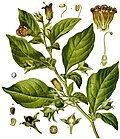
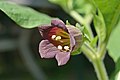
Ingredient: Deadly Nightshade, Atropa belladonna
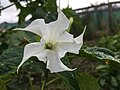
Ingredient: Black Henbane, Hyoscyamus niger
Witches flying to the Sabbath: Capricho No. 68: Linda maestra (Pretty teacher) by Francisco Goya – from the series Los Caprichos

Poisonous ingredients listed in works on ethnobotany include: belladonna,[3] henbane bell, jimson weed, black henbane, mandrake, hemlock, and/or wolfsbane,[4][5][6] most of which contain atropine, hyoscyamine, and/or scopolamine.[7] Scopolamine can cause psychotropic effects when absorbed transdermally.[8] These tropane alkaloids are classified as deliriants in regards to their psychoactive effects.

Francis Bacon (attributed as "Lord Verulam") listed the ingredients of the witches ointment as "the fat of children digged out of their graves, of juices of smallage, wolfe-bane, and cinque foil, mingled with the meal of fine wheat."[9]

Extreme toxicity of active ingredients

[edit]

With the exception of Potentilla reptans, the plants most frequently recorded as ingredients in Early Modern recipes for flying ointments are extremely toxic[10] and have caused numerous fatalities when eaten,[11] whether by confusion with edible species[12][13] or in cases of criminal poisoning[14] or suicide.[15]

The historian, occultist and theosophist Carl Kiesewetter [de] of Meiningen, author of Geschichte des Neueren Occultismus in 1892 and Die Geheimwissenschaften, eine Kulturgeschichte der Esoterik in 1895, was one such casualty.[16]

Bodily flight versus flight in spirit

[edit]

He little knows the Devil who does believe that witches and wizards can be borne through the air at wondrous speed to far distant places and there hold revels, dances and suchlike with folk of the same type[17]

the mediaeval witch-ointments...brought visionary beings into the presence of the patient, transported him to the witches' sabbath, enabled him to turn into a beast.[18]

Magic ointments...produced effects which the subjects themselves believed in, even stating that they had intercourse with evil spirits, had been at the Sabbat and danced on the Brocken with their lovers...The peculiar hallucinations evoked by the drug had been so powerfully transmitted from the subconscious mind to consciousness that mentally uncultivated persons...believed them to be reality.[19]

It has been a subject of discussion between clergymen as to whether witches were able physically to fly to the Sabbath on their brooms with help of the ointment, or whether such 'flight' was explicable in other ways: a delusion created by the Devil in the minds of the witches; the souls of the witches leaving their bodies to fly in spirit to the Sabbath; or a hallucinatory 'trip' facilitated by the entheogenic effects of potent drugs absorbed through the skin.[20][21] An early proponent of the last explanation was Renaissance scholar and scientist Giambattista della Porta, who not only interviewed users of the flying ointment, but witnessed its effects upon such users at first hand, comparing the deathlike trances he observed in his subjects with their subsequent accounts of the bacchanalian revelry they had 'enjoyed'.[22] (book II, chapter XXVI, "Lamiarum vnguenta,")

Body in coma and riding on beasts

[edit]
Witches prepare a magic salve. Note naked witch top left riding through the air mounted upon a goat. (woodcut, 1571)

anointing themselves with certain unguents...they are carried by night through the air to distant lands to do certain black magic...but nothing of this is true, though they think it to be...while they are thus dead and cold, they have no more feeling than a corpse and may be scourged and burnt; but after the time agreed upon...their senses are liberated, they arise well and merry, relate what they have done, and bring news from other lands.[Italics not original][23]

Dominican churchman Bartolommeo Spina of Pisa gives two accounts of the power of the flying ointment in his Tractatus de strigibus sive maleficis ('Treatise on witches or evildoers') of 1525. The first concerns an incident in the life of his acquaintance Augustus de Turre of Bergamo, a physician. While studying medicine in Pavia as a young man, Augustus returned late one night to his lodgings (without a key) to find no one awake to let him in. Climbing up to a balcony, he was able to enter through a window, and at once sought out the maidservant, who should have been awake to admit him. On checking her room, however, he found her lying unconscious – beyond rousing – on the floor. The following morning he tried to question her on the matter, but she would only reply that she had been 'on a journey'.

Bartolommeo's second account is more suggestive and points toward another element in the witches' 'flights'. It concerns a certain notary of Lugano who, unable to find his wife one morning, searched for her all over their estate and finally discovered her lying deeply unconscious, naked and dirty with her vagina exposed, in a corner of the pigsty. The notary 'immediately understood that she was a witch' (!) and at first wanted to kill her on the spot, but, thinking better of such rashness, waited until she recovered from her stupor, in order to question her. Terrified by his wrath, the poor woman fell to her knees and confessed that during the night she had 'been on a journey'.[24]

Light is cast on the tale of the notary's wife by two accounts widely separated in time but revealing a persistent theme in European Witchcraft. The first is that of Regino of Prüm whose De synodalibus causis et disciplinis ecclesiasticis libri duo (circa 906 C.E.) speaks of women who 'seduced...by demons...insist that they ride at night on certain beasts [italics not original] together with Diana, goddess of the pagans, and a great multitude of women; that they cover great distances in the silence of the deepest night...'[25] (See also Canon Episcopi).[26]

The second account dates from some 800 years later, coming from Norway in the early 18th century and is the testimony, at the age of thirteen, of one Siri Jørgensdatter. Siri claimed that when she was seven her grandmother had taken her to the Witches' Sabbath on the mountain meadow Blockula ('blue-hill'): her grandmother led her to a pigsty, where she smeared a sow with some ointment which she took from a horn, whereupon grandmother and granddaughter mounted the animal and, after a short ride through the air, arrived at a building on the Sabbath mountain.[27]

Alleged sexual element in application

[edit]

The hallucinations are frequently dominated by the erotic moment...in those days, in order to experience these sensations, young and old women would rub their bodies with the 'witches' salve'.[28]

the witches confess that...they anoint a staff and ride on it to the appointed place or anoint themselves under the arms and in other hairy places...[Italics not original to text].[29]

in rifleing the closet of the ladie [Alice Kyteler], they found a pipe of oyntement, wherewith she greased a staffe, upon which she ambled and galloped through thick and thin, when and in what manner she listed.[30]

Some sources have claimed that such an ointment would best be absorbed through mucous membranes, and that the traditional image of a female witch astride a broomstick implies the application of flying ointment to the vulva.[31] The passage from the trial for witchcraft in Ireland of Hiberno-Norman noblewoman Alice Kyteler in 1324 quoted above is, while not explicit, certainly open to interpretations both drug-related and sexual. It is also a very early account of such practices, pre-dating by some centuries witch trials in the early modern period. The testimony of Dame Kyteler's maidservant, Petronilla de Meath, while compromised by having been extracted under torture, contains references not only to her mistress's abilities in the preparation of 'magical' medicines, but also her sexual behaviour, including at least one instance of (alleged) intercourse with a demon.[32][33] According to the inquisition ('in which were five knights and numerous nobles') set in motion by Richard de Ledrede, Bishop of Ossory, there was in the city of Kilkenny a band of heretical sorcerers, at the head of whom was Dame Alice Kyteler and against whom no fewer than seven charges relating to witchcraft were laid. The fifth charge is of particular interest in the context of the 'greased staffe' mentioned above:

In order to arouse feelings of love or hatred, or to inflict death or disease on the bodies of the faithful, they made use of powders, unguents, ointments and candles of fat, which were compounded as follows. They took the entrails of cocks sacrificed to demons, certain horrible worms, various unspecified herbs, dead men's nails, the hair, brains, and shreds of the cerements of boys who were buried unbaptized, with other abominations, all of which they cooked, with various incantations, over a fire of oak-logs in a vessel made out of the skull of a decapitated thief.[34][page needed]

Possible opiate component

[edit]
Opium Poppy: Papaver somniferum

One possible key to how individuals dealt with the toxicity of the nightshades usually said to be part of flying ointments is through the supposed antidotal reaction some of the solanaceous alkaloids have with the alkaloids of Papaver somniferum (opium poppy).[35] This antagonism was claimed to exist by the movement of Eclectic medicine. For instance, King's American Dispensatory states in the entry on belladonna: "Belladonna and opium appear to exert antagonistic influences, especially as regards their action on the brain, the spinal cord, and heart; they have consequently been recommended and employed as antidotes to each other in cases of poisoning" going on to make the extravagant claim that "this matter is now positively and satisfactorily settled; hence in all cases of poisoning by belladonna the great remedy is morphine, and its use may be guided by the degree of pupillary contraction it occasions."

The synergy between belladonna and poppy alkaloids was made use of in the so-called "twilight sleep" that was provided for women during childbirth beginning in the Edwardian era. Twilight sleep was a mixture of scopolamine, a belladonna alkaloid, and morphine, a Papaver alkaloid, that was injected and which furnished a combination of painkilling and amnesia for a woman in labor. A version is still manufactured for use as the injectable compound Omnopon.

There is no definite indication of the proportions of solanaceous herbs vs. poppy used in flying ointments, and most historical recipes for flying ointment do not include poppy. Furthermore, a reputable publication by the former UK Ministry of Agriculture, Food and Fisheries (now DEFRA) states specifically that, in cases of poisoning by Atropa belladonna – far from being antidotes – 'Preparations containing morphine or opiates should be avoided as they have a synergic action with atropine', an appropriate antidote being, by contrast, the acetylcholinesterase inhibitor physostigmine salicylate.[36]

Historical documents

[edit]

The first mention of an unguent in relation to a popular belief of orgiastic flying occurs in Roland of Cremona's theological summa, written in the 1230s.[37] The use by witches of flying ointments was first described, according to known sources, by Johannes Hartlieb in 1456[citation needed]. It was also described by the Spanish theologian Alfonso Tostado (d. 1455) in Super Genesis Commentaria (printed in Venice, 1507), whose commentary tended to accredit the thesis of the reality of the Witches' Sabbath.[citation needed] In 1477, Antoine Rose confessed while being tortured that the devil gave her a stick 18 inches in length on which she would rub an ointment and with the words "go, in the name of the Devil, go" would fly to the "synagogue" (an alternative name for Witches' Sabbath).[38]

Modern interpretation

[edit]

Modern writers have speculated that such ointments and "broomsticks" were actually used for masturbation, to evoke altered states of consciousness, or both.[39][40][41]

[edit]

Drama

[edit]

There is, in the work of the playwright Francisco de Rojas Zorrilla (1607–1648) of Toledo, an exchange concerning the flying ointment, the (following) passage occurring in the play Lo que quería el Marqués de Villena ('What the Marquis of Villena Wanted').[42]

Marquis: Others believe that witches can fly.

Zambapalo: And can't they?

Marquis: Certainly not, you ignorant fellow.

Zambapalo: Since I'm no specialist in these matters, I must ask you what happens.

Marquis: They all rub themselves with ointment.

Zambapalo: And then what?

Marquis: The ointment, which is an opiate made of henbane given them by the Devil, sends them to sleep, and they dream such a dream that they think they are not dreaming at all. And since the Devil has great power to deceive, he makes them all dream the same dream. And that is why they think they are flying through the air, when they are really fast asleep. And although they never fly at all, they think, as soon as they wake, that they have all been to see the calf, and all visited the fields at Baraona. When, by God, in reality, more than two of them have been seen sleeping in their rooms with the ointment on them.

Literature and film

[edit]
1-Water hemlock, sweet flag, cinquefoil, bat's blood, deadly nightshade and oil.
2-Baby's fat, juice of cowbane, aconite, cinquefoil, deadly nightshade and soot.

Music

[edit]

'and belladonna, to make your eyes like a...beast's!

To anoint the body and make it shine,

To drink and make thyself divine,

To choose another's form and make it...thine!'

  • The title track of British Goth band Inkubus Sukkubus’ album Belladonna and Aconite is a song wholly about the flying ointment and features the following lyrics:

‘Belladonna and aconite

Give to me the gift of flight

Take me up, airborne in the night’

— From the opening verse

‘As a screaming horde

We cut the scape… The Devil's Apple exacerbates

To the sabbath on demon steed I ride’

— From the second verse

‘Hemlock, Henbane, Aconite, Belladonna Opium, Thornapple, Cinquefoil, Mandragora’

— From the closing chant

[edit]

See also

[edit]

References

[edit]
[edit]
Revisions and contributorsEdit on WikipediaRead on Wikipedia
from Grokipedia
![Hexen bereiten eine magische Salbe zu][float-right] Flying ointment, known historically as unguentum populeum or witches' , is a psychoactive topical preparation associated with practices from the medieval period through early modern witch trials, primarily composed of hallucinogenic plants from the family such as belladonna (Atropa belladonna), henbane (), and sometimes () or (), which are rich in tropane alkaloids like atropine, , and . These alkaloids, when absorbed through the skin—often applied to sensitive areas or via a greased broomstick for enhanced mucosal uptake—induce characterized by realistic hallucinations, dissociation from the body, and perceptual distortions mimicking or "flight" to sabbaths, rather than literal . The preparation typically involved infusing the toxic plant materials in or oil, sometimes with additives like soot or baby fat in accounts, to create a base for delivery, exploiting the lipophilic nature of the alkaloids for systemic effects including , dry mouth, , and profound sensory alterations that trial confessions described as enabling nocturnal journeys. Historical references appear in grimoires and inquisitorial records, such as those compiled by Della Porta in the , though many accounts stem from coerced testimonies, underscoring the need for caution in interpreting them as of widespread use. Pharmacologically, the ointments' properties stem from muscarinic receptor antagonism, producing a spectrum of effects from euphoric disembodiment to hazardous toxicity, with overdoses risking or death, as documented in toxicological studies of tropane-containing flora. Notable aspects include its role in explaining witchcraft lore through naturalistic pharmacology rather than supernaturalism, influencing modern entheogenic recreations despite persistent dangers, and controversies over recipe authenticity given the blend of folk tradition and inquisitorial exaggeration; empirical analysis confirms the plants' potent psychoactivity but highlights variability in potency and absence of verifiable "flying" beyond hallucinatory experience.

Etymology and Terminology

Origins of the Name

The name "flying ointment" stems from longstanding and demonological accounts portraying such salves as instrumental in enabling witches to achieve flight, typically to sabbaths or demonic convocations. These narratives describe the ointment—often a fat-based applied to the skin—as inducing a state where practitioners could soar through the air, either bodily or in spirit, mounted on broomsticks, staffs, or animals. This association with aerial mobility directly informs the , distinguishing it from other medicinal or magical unguents; the English term translates equivalent phrases in Romance and , such as French onguent à voler ("ointment for flying") or German Flugsalbe ("flying salve"), which emphasize the volitant effect. An early literary attestation appears in Martin Le Franc's Les Champions des dames (c. 1440–1442), a moralistic poem critiquing female vices, wherein the author depicts women anointing themselves with a "grease" (graisse) that grants bird-like flight to infernal gatherings, marking one of the first explicit links between an ointment and magical in . By the mid-15th century, similar motifs recur in trial records and treatises, such as the 1456 reference to a or ointment bestowed by the devil for flight, reinforcing the nomenclature amid rising witch persecution. Demonologists like in (1563) further codified recipes purportedly yielding these effects, embedding the "flying" descriptor in compendia of lore. While historical sources frame the name in terms, contemporary analysis attributes the reputed flight to hallucinations from alkaloids in common ingredients like belladonna and henbane, producing out-of-body dissociation misinterpreted as literal transport in pre-modern contexts. However, references to ointments explicitly for flying remain sparse in primary documents prior to the , suggesting the term's crystallization owes as much to literary amplification and inquisitorial projection as to widespread folk practice; systemic biases in coerced confessions and elite-authored tracts likely exaggerated such details to demonize herbalism.

Linguistic Variations Across Europe

In German-speaking regions of , the preparation was commonly termed Hexensalbe, translating to "witch's ointment," a designation rooted in medieval and early modern accounts of practices. An alternative appellation, Flugsalbe or "flying salve," highlighted its reputed capacity to induce sensations of aerial travel, as described in pharmaceutical and folkloric analyses of historical recipes. In French traditions, the substance bore the name onguent volant, or "flying ointment," linked to descriptions of hallucinogenic salves enabling trance-like voyages in sorcery lore. This phrasing paralleled the functional emphasis on flight, appearing in botanical and historical surveys of medieval herbalism. Spanish folklore employed ungüento volador, directly signifying "flying ointment," in narratives of brujería where such mixtures facilitated supposed nocturnal flights during sabbats. These Iberian references, drawn from inquisitorial records and ethnobotanical studies, underscore a shared motif of mobility across Romance-language contexts. Across these linguistic domains, consistently evoked either the practitioners (Hexensalbe) or the effect (Flugsalbe, onguent volant, ungüento volador), reflecting convergent folk beliefs in psychoactive aids for ecstatic rituals despite regional variances in phrasing. Latin precursors like unguentum sabbati (sabbath ointment) influenced vernacular adaptations, bridging classical texts with local dialects.

Historical Context

Accounts in Witch Trials

Accounts of flying ointments appear in confessions from early modern European witch trials, typically describing their use to induce sensations of flight to sabbaths, though such testimonies are sparse and often extracted under duress or leading interrogation. In the Vauderie d'Arras trials of 1459–1460 in , multiple accused individuals confessed to applying an ointment—provided by the or prepared from ritual substances—to a broomstick, staff, or pole before experiencing being "carried up into the air" to attend nocturnal gatherings. These admissions formed part of broader narratives of demonic pacts and sabbatic attendance, but trial records emphasize the ointment's role in facilitating perceived aerial transport rather than detailing composition. Later continental trials echoed similar motifs, albeit infrequently. Dominican inquisitor Giordano de Bergamo, drawing from confessions around 1465, reported that witches anointed wooden implements with devil-supplied unguents, enabling flight to sabbaths where they engaged in profane rites. In Polish witch hunts, such as a 1688 case in Nowy Wiśnicz, testimonies referenced elderflowers as an ingredient in ointments purportedly used for flight, though integrated into folk healing and magical practices rather than standalone flight mechanisms. Scholars note these accounts' scarcity across thousands of trial documents, suggesting amplification by demonologists over verbatim evidence, with ointments more commonly linked to healing or than . Confessions' reliability is compromised by , , and inquisitorial scripting, casting doubt on whether accused witches genuinely believed in or used such substances for hallucinatory flight. English and Scottish trials rarely mention flying ointments explicitly, favoring spectral flight via demonic aid over pharmacological means; for instance, in 1612 described spirit transport without unguents. Where referenced, as in some cases, ointments appear in post-confession demonological interpretations rather than core testimonies. Overall, while these accounts fueled witch-hunt prosecutions by substantiating flight as of maleficium, their evidential basis remains contested, with modern analysis attributing reported effects to suggestion, , or fabricated narratives rather than consistent psychoactive application.

Folklore and Medieval References

In , flying ointment, known variably as unguentum volans or Hexensalbe, was purportedly used by witches to induce sensations of flight, enabling attendance at nocturnal sabbaths. This belief posited that the salve, applied to the body or broomstick, facilitated aerial travel to gatherings involving demonic rituals. Such accounts often intertwined with tales of transformation or demonic , reflecting a blend of pre-Christian night-flight motifs and emerging . Late medieval texts provide early articulations of these ideas, though primarily from clerical perspectives rather than direct folk traditions. Johannes Nider's Formicarius (1435–1438), a key demonological work based on inquisitorial inquiries in , describes witches engaging in nocturnal flights to remote locations for malefic gatherings, attributing the phenomenon to demonic illusions or pacts rather than physical ointments. Nider's accounts, drawn from trial testimonies, emphasize collective flights but lack specific recipes, focusing instead on the theological implications of such travels. The (1486), authored by , offers more detailed references to ointments enabling flight. Kramer asserts that witches anoint wooden staffs or brooms with a salve composed of fat, herbs, and soot, allowing them to traverse great distances to sabbaths; he claims this occurs at the devil's instruction, with the ointment rendering bodies lightweight or inducing ecstatic visions mistaken for literal flight. These descriptions, intended as prosecutorial guidance, influenced subsequent by codifying the ointment as a tool of maleficium, though Kramer provides no empirical verification beyond confessional accounts obtained under duress. Primary source evidence for actual ointment use remains scarce in medieval records, with most references emerging in early modern trial transcripts influenced by these texts; historians note that while preserved the motif, inquisitorial literature amplified it as part of anti-witchcraft , potentially exaggerating rare folk practices involving psychoactive plants.

Key Primary Sources and Documents

The trial confession of Matteuccia di Francesco, recorded during her 1428 interrogation and execution in , , provides one of the earliest detailed accounts of a flying ointment. Under questioning by Franciscan friars, she described preparing a mixture of 16 ingredients—including fat from executed children, bat blood, vulture grease, and herbs like and sowbread—boiled into a salve that, when applied to her body and a small staff, enabled transformation into a and flight to the witches' sabbath on a demon's back. This document, preserved in local ecclesiastical records, exemplifies early 15th-century Italian witch trial testimonies linking ointments to aerial travel, though extracted via threats of , raising questions of coerced fabrication. Martin Le Franc's Les Champions des dames (composed 1440–1441), a French moralistic poem, references women applying "oitement" (ointment or grease) to staffs for flight to nocturnal gatherings, depicting the process as transformative and enabling swift passage through the air. This literary source, drawing from contemporary Basle council discussions on , integrates into verse without specifying ingredients, portraying the practice as a deceptive artifice rather than demonic pact alone; its credibility stems from Le Franc's role as a papal secretary observing anti-witchcraft debates, though poetic license may embellish details. Heinrich Kramer's (first printed 1487), a key demonological treatise co-attributed to Jacob Sprenger, compiles inquisitorial evidence asserting witches concoct flying ointments "at the devil's instruction" from desiccated child fat, herbs, and animal remains, applied to armpits or broomsticks to induce illusory flight to sabbaths. Citing unnamed confessions from German dioceses, it emphasizes satanic causation over , reflecting the authors' biased agenda to justify prosecutions amid late medieval panics; empirical testing was absent, and the text's influence amplified unverified claims across . Johann Weyer's (1563), a skeptical of prosecutions, reproduces a purported witches' recipe from earlier confessions—incorporating water hemlock juice, baby fat, soot, and fine —claiming it causes soporific and vivid dreams mistaken for flight. Weyer, a physician influenced by personal experiments, attributes effects to natural toxicity rather than aid, countering demonologists like Kramer; sourced from trial extracts, it highlights pharmacological realism but relies on secondhand reports prone to exaggeration under duress. Andrés de Laguna's 1576 pharmaceutical commentary examines an ointment seized from suspected witches near , identifying it as unguentum populeum (poplar bud salve with narcotics like and ) rather than a diabolic flying agent, noting its sleep-inducing properties could mimic visions. As a Spanish botanist's firsthand analysis, it prioritizes empirical dissection over inquisitorial narratives, underscoring how mundane medicinals were misconstrued in biased records.

Composition and Preparation

Primary Plant Ingredients

The primary plant ingredients in historical accounts of flying ointments were tropane alkaloid-rich species from the family, particularly Atropa belladonna (deadly nightshade), (henbane), and (mandrake). These plants were combined in bases to facilitate absorption, producing hallucinogenic effects interpreted as enabling flight in . Direct recipes from primary sources are absent, with compositions inferred from witch trial testimonies and early modern reports, such as physician Andrés Laguna's 16th-century description of an ointment containing henbane, mandragora, (a nightshade), and hemlock. Atropa belladonna contributed atropine, , and , inducing , dry mouth, , and vivid delusions. Its berries and leaves were potent sources, with historical use linked to due to the plant's and psychoactive profile, though lethal doses varied widely based on preparation. , containing similar alkaloids including hyoscyamine, was widespread in Europe and frequently cited for its and properties, often harvested for seeds and leaves in unguents. provided analogous tropanes but was more regionally limited to , valued in medieval herbals for effects despite risks of overdose. Other plants occasionally mentioned include (thornapple or jimsonweed), which yields high levels, and non-tropane species like hemlock (), though their inclusion likely stemmed from confessional exaggerations rather than consistent . Variability in recipes reflects regional availability and trial-induced narratives, with no standardized formula verified in contemporaneous documents predating the 15th-century witch hunts. Empirical analyses confirm dominance for the reported ecstatic and states, distinguishing these from mere poisons.

Extraction of Tropane Alkaloids

Traditional preparation of flying ointments involved extracting tropane alkaloids from Solanaceae plants by simmering chopped foliage, seeds, or roots in animal fats such as lard. This lipid infusion method, described in early modern European accounts, typically entailed boiling materials from henbane (Hyoscyamus niger), deadly nightshade (Atropa belladonna), or thornapple (Datura stramonium) in hog fat for 3 to 4 hours before straining the mixture to obtain a salve base. The process leveraged the partial lipophilicity of alkaloids like atropine, hyoscyamine, and scopolamine, enabling their concentration in the fat for subsequent transdermal application, often via broomstick handles or thin-skinned areas. Empirical analysis of analogous folk techniques has revealed limited extraction efficiency for fat-based methods. A 2022 quantitative study using Scopolia carniolica—a tropane-rich relative—tested preparations in , finding that even 30-minute infusions yielded only 15.3% , with 37.7% atropine and 38.6% remaining bound in the plant residue after re-extraction. In contrast, alcoholic tinctures achieved 67.2% atropine and 71.4% recovery, while water infusions extracted up to 50%. These results indicate that historical fat extractions, though culturally attested, solubilized insufficient alkaloids for potent effects without substantial plant volumes or adjuncts like chimney soot to enhance potency. Variations in traditional recipes occasionally incorporated acidic additives or prolonged maceration to improve yield, but primary reliance on and constrained overall transfer compared to modern solvent techniques like extraction or microwave-assisted methods, which routinely exceed 70% efficiency in laboratory settings. Despite inefficiencies, the topical vector allowed through mucous membranes, aligning with reported outcomes in testimonies from the 16th and 17th centuries.

Traditional Application Methods

Traditional accounts from early modern European witch trials and demonological texts describe the flying ointment being applied topically to the skin to induce its effects, with emphasis on areas featuring thin or high for efficient absorption of alkaloids. Primary sites included the armpits, , wrists (pulse points), and inner thighs or genital regions, as these facilitated quicker entry into the bloodstream compared to thicker-skinned areas. In Francesco Maria Guazzo's (1608), a demonologist's compendium drawing from trial testimonies, a witch in , , reportedly instructed an observer to anoint pulse points before experiencing sensations of flight, mirroring her own practice of self-application prior to departing for the . Similar confessions, such as those documented in 16th-century Spanish and Italian inquisitorial records, recount witches rubbing the salve under the arms or on the before mounting a broomstick or staff, after which they claimed to soar to gatherings. Some accounts specify the flying implement itself—typically a , staff, or —rather than or in addition to the body, with the object then straddled or held against sensitive areas to combine mechanical with pharmacological uptake through mucous membranes. This method appears in Norman Cohn's analysis of documents from the 15th to 17th centuries, where the ointment's soporific qualities reportedly induced trance-like states interpreted as aerial , though Cohn notes such details often stemmed from leading questions or torture-induced narratives of questionable veracity. Empirical reconstruction of pharmacokinetics supports skin application over , as oral routes risk degradation by acids, reducing .

Pharmacological Effects

Mechanisms of Tropane Alkaloids

alkaloids, such as , atropine (a of hyoscyamine and its ), and , are the primary active compounds in plants like Atropa belladonna, , and used in traditional flying ointments. These alkaloids feature a bicyclic ring structure derived from the ornithine and tropic acid, enabling their pharmacological activity. They function primarily as competitive antagonists at muscarinic receptors (mAChRs), subtypes M1 through M5, by binding to the orthosteric site and preventing acetylcholine from eliciting parasympathetic responses. This antagonism inhibits G-protein-coupled signaling pathways, reducing phosphoinositide hydrolysis (via M1, M3, M5) or cyclic AMP modulation (via M2, M4), which disrupts normal cholinergic transmission in both peripheral and central nervous systems. In the peripheral , alkaloids block muscarinic receptors on effector organs, leading to unopposed sympathetic activity: via M2 blockade in the heart, and from M3 inhibition in the eye, reduced glandular secretions causing , and urinary retention due to relaxation. Atropine exhibits highest affinity for M1 receptors but non-selectively antagonizes all subtypes at therapeutic doses, while shows greater , facilitating rapid blood-brain barrier penetration and pronounced central effects. , the levorotatory form predominant in plants, mirrors atropine's potency but is more biologically active than its dextro counterpart. These peripheral effects onset within minutes of absorption, with duration varying by : atropine 4-6 hours, up to 24 hours for CNS actions. Centrally, alkaloids induce by antagonizing M1 receptors in the and hippocampus, impairing cognitive processing, , and perception, often manifesting as vivid hallucinations, disorientation, and . Scopolamine's enhanced CNS penetration—due to its tertiary amine structure—produces more intense psychotomimetic effects compared to atropine, including motion sickness amelioration via blockade but also higher risk of confusional states. This central blockade disrupts acetylcholine's role in and sensory integration, contributing to the "flight" sensations reported in historical accounts, though empirically attributable to imbalance rather than causes. Overdose escalates to seizures or from widespread receptor saturation.

Physiological and Psychological Impacts

The alkaloids atropine, , and in flying ointments competitively inhibit muscarinic receptors, producing peripheral effects such as , , dry mouth, , , flushed skin, , and diminished gastrointestinal motility. These manifestations align with the classic mnemonic for toxicity: "blind as a " for ocular effects, "dry as a " for xerostomia and anhidrosis, "red as a beet" for cutaneous flushing, "hot as a " for fever, and "full as a flask" for distension. Skin application, as in traditional ointments, facilitates absorption, potentially delaying onset but prolonging exposure compared to oral . Central nervous system penetration of these lipophilic alkaloids, particularly scopolamine and hyoscyamine, yields psychological effects including dose-dependent hallucinations, delirium, agitation, confusion, and memory impairment. Delirium often presents as hyperactive, with patients exhibiting incoherent speech, visual or tactile hallucinations, and behaviors like picking at imaginary objects or "flailing in the air," which may underpin historical reports of perceived flight or levitation. In severe cases, these progress to coma or seizures, though milder exposures could induce dissociative states mimicking out-of-body experiences without full toxicity. Empirical poison control data confirm these patterns from accidental exposures to tropane-containing plants, underscoring the alkaloids' capacity for profound psychoactive disruption rather than genuine physical alteration.

Toxicity Risks and Lethal Outcomes

The toxicity risks of flying ointments arise primarily from tropane alkaloids—atropine, hyoscyamine, and scopolamine—extracted from plants such as Atropa belladonna, Hyoscyamus niger, and Datura stramonium. These compounds competitively inhibit muscarinic acetylcholine receptors, leading to anticholinergic syndrome with initial symptoms including xerostomia, mydriasis, blurred vision, tachycardia, hyperthermia, flushed skin, and diminished bowel sounds. Progression involves central nervous system effects like confusion, hallucinations, agitation, and delirium, often exacerbated by urinary retention and ileus. Overdose risks are amplified by the narrow therapeutic window and variability in alkaloid concentrations across plant parts, growth conditions, and seasons, rendering traditional preparations unpredictable. Absorption via topical application to abraded or mucous membranes increases compared to oral routes, potentially causing rapid onset of severe effects within 30-60 minutes. Complicating factors include individual tolerance variations, concurrent substance use, and delayed recognition of symptoms, which can lead to , rhabdomyolysis, or secondary injuries during hallucinatory states. Lethal outcomes, while infrequent with prompt supportive care like physostigmine administration and ventilation, stem from respiratory failure, cardiac arrhythmias, seizures, or coma. Estimated adult lethal doses are approximately 10 mg for atropine and 2-4 mg for scopolamine, achievable through modest plant material ingestion or high-absorption dermal exposure. Documented fatalities include a 2016 case of Datura poisoning inducing fatal cardiac dysrhythmia and historical series where A. belladonna intoxications yielded about 12% mortality prior to modern intensive care. Case reports confirm rare but severe outcomes from intentional or accidental exposures, emphasizing the virulent potential of these alkaloids.

Interpretations and Explanations

Folklore Perspectives on "Flight"

In early modern , flying ointments were reputed to confer the ability to traverse the skies to witches' sabbaths, clandestine nocturnal gatherings featuring worship, communal rituals, and revelry. These beliefs, embedded in demonological and trial testimonies from the 15th to 17th centuries, held that the —typically a fat-based of potent herbs—activated aerial transvection when smeared on the body, especially pulse points or mucous membranes, or onto staffs and broomsticks used as mounts. Flight was envisioned as swift and unhindered, spanning miles to sites like mountain peaks or sacred trees, underscoring the ointment's perceived diabolic potency. Prominent accounts include Johannes Nider's Formicarius (1437), which recounts women applying ointments to fly to in the Heuberg mountains, lapsing into deep sleep suggestive of spirit departure while their bodies remained inert. The 1428 confession of Italian healer Matteuccia di Francesco described herself to into a and journey to Benevento's walnut tree for sabbath attendance, blending transformation with travel. Scottish witch Isobel Gowdie's 1662 testimony detailed brewing an ointment to grease broomsticks, enabling physical flight to where participants danced and feasted under demonic auspices. Demonological compendia reinforced these motifs; Francesco Maria Guazzo's (1608) depicts witches daubing themselves with unguents before voyages, portraying the practice as integral to malefic pacts. narratives often distinguished corporeal flight—body and implement soaring through the air—from astral variants, where the alone ventured forth, leaving the flesh comatose, yet both were attributed to the ointment's arcane virtues mediated by infernal powers. Such tales, disseminated via inquisitorial records and popular lore, framed flight as emblematic of witchcraft's transgression against divine order.

Empirical and Skeptical Analyses

Empirical analyses of flying ointment effects attribute reported sensations of "flight" to the properties of alkaloids such as atropine, , and , derived from plants like Atropa belladonna and . These compounds competitively inhibit muscarinic receptors, disrupting function and leading to excitation manifested as , visual and tactile hallucinations, and altered . Users in documented cases of intoxication describe feelings of or , akin to floating or flying, resulting from impaired sensory integration rather than any physical propulsion. This physiological mechanism aligns with first-hand accounts of accidental poisoning, where doses as low as 0.5-1 mg of induce disorientation and euphoric detachment from the body within 30-60 minutes of absorption, peaking at 1-2 hours. Skeptical examinations challenge the historicity of widespread ointment use for inducing flight, noting that primary evidence derives from 15th-17th century witch trial transcripts, often extracted under torture or leading questions, rendering them unreliable for causal inference. No archaeological residues of such formulations have been identified in European sites associated with accused witches, and contemporary pharmacological recreations confirm the ointments' lethality—lethal doses overlap therapeutic ranges, with LD50 for atropine estimated at 100-200 mg orally but lower via dermal absorption enhanced by animal fats. Analyses of folklore texts, such as those by Johann Weyer in 1563, reveal "flying" motifs predating known tropane recipes, suggesting cultural archetypes of shamanic journeying retrofitted onto herbal lore rather than empirical practice. Controlled studies on alkaloids, including dermal application models, demonstrate no capacity for supernatural or ; effects are confined to neurochemical disruption, with EEG patterns showing dominance indicative of states, not transcendence. Claims of ointment-enabled attendance fail , as simpler explanations—sleep , ergotism from contaminated grains, or coerced fantasies—account for visions without invoking unverified pharmacology. Mainstream academic narratives, often influenced by 20th-century countercultural revivalism, overstate the ointments' prevalence, conflating rare medicinal salves with mythic flights despite sparse pre-1800 recipes lacking consistent "flying" intent. Modern warns against replication, citing irreversible toxicity, including (up to 200 bpm), , and , observed in 2022 case series of exposures mimicking historical doses.

Distinction Between Physical and Astral Effects

The physical effects of flying ointment arise from the properties of alkaloids such as atropine, scopolamine, and hyoscyamine, which block muscarinic receptors in the central and peripheral nervous systems, leading to , vivid hallucinations, and a characteristic sensation of bodily lightness or often interpreted as flight. These effects manifest as distorted perceptions of motion, , and immersive sensory experiences driven by altered activity, verifiable through pharmacological studies of intoxication rather than external causation. In contrast, astral effects pertain to subjective claims of out-of-body experiences or travel, as recounted in historical testimonies and modern recreations, where users report traversing spiritual realms or attending sabbaths unbound by physical form. Such interpretations stem from and confessional accounts, often elicited under duress during early modern witch trials, but lack empirical validation beyond the drug-induced hallucinatory state. No controlled evidence supports disembodied consciousness or verifiable remote perception independent of the brain's compromised under influence. The distinction hinges on causal realism: physical effects are measurable physiological disruptions—e.g., , , and cortical hyperactivity producing realistic yet confabulated visions—while astral attributions represent pre-scientific misreadings of as metaphysical transit, unsubstantiated by repeatable observation or physiological markers of extrasensory phenomena. Historical analyses of trial records reveal that ointment-induced "flights" aligned closely with documented symptoms, such as the sensation of soaring derived from vestibular and proprioceptive illusions, rather than genuine transcendence. Modern pharmacological recreations confirm these as endogenous hallucinations, not dualistic separations of body and spirit.

Controversies

Debates on Historicity and Prevalence

Scholars debate the of flying ointments, with many arguing that claims of their use derive primarily from demonological treatises rather than reliable trial records. Early references appear in 15th-century texts like the Formicarius (1452) by Johannes Nider, which describe witches applying greases to enable flight, but these accounts stem from inquisitorial narratives emphasizing demonic pacts over pharmacological effects. Actual confessions under , such as those in the 16th-century trials, rarely specify hallucinogenic ingredients like tropane-containing plants, and when ointments are mentioned, they are often portrayed as empowered by rather than natural agents. Historians like Michael Ostling contend that no verified instances link solanaceous plants to flight-inducing salves in primary sources, attributing the association to later 20th-century interpretations by anthropologists such as , who hypothesized entheogenic explanations without robust archival support. The prevalence of such ointments in European witchcraft practices appears minimal, as analyses of trial transcripts from over 40,000 documented cases reveal only sporadic references to any salves, let alone those enabling "flight." In regions like and , where witch hunts peaked between 1560 and 1630, ointment allegations surface in fewer than 1% of records, often as formulaic elements elicited by leading questions rather than spontaneous testimony. Demonologists like documented recipes in works such as (1563), incorporating plants like henbane and belladonna, but these were speculative or derived from medical , not direct evidence from accused witches. Critics note that the unreliability of coerced confessions undermines claims of widespread use, with empirical tests of purported recipes yielding inconsistent hallucinogenic results insufficient to explain mass delusions or sabbat visions. Proponents of historicity, including author Thomas Hatsis, argue that scattered trial mentions and folk herbalism indicate a suppressed of psychoactive salves, potentially explaining ecstatic experiences misattributed to devilry. However, this view faces critique for overreliance on secondary demonological sources and neglect of contextual biases, such as inquisitors' predisposition to interpret folk remedies through a lens of maleficium. Skeptics emphasize causal realism: without archaeological residues or non-elicited accounts, the narrative aligns more with constructed than verifiable practice, reflecting elite anxieties over popular rather than authentic prevalence. Modern recreations, while experiential, fail to bridge evidentiary gaps, perpetuating a romanticized detached from historical rigor.

Claims of Opiate or Sexual Components

Some historical accounts and modern interpretations have posited the inclusion of opiate components, such as extracts from the opium poppy (Papaver somniferum), in flying ointment recipes to induce profound sedation or dream states mimicking flight. For instance, certain reconstructed "traditional" formulations listed opium poppy alongside tropane alkaloid plants like henbane and belladonna, purportedly to deepen the soporific effects that early skeptics of witchcraft attributed to the unguents rather than supernatural agency. However, primary early modern recipes documented in trial records or demonological texts, such as those from the 16th-17th centuries, overwhelmingly emphasize anticholinergic plants from the Solanaceae family, with opiate elements appearing only sporadically and often as later additions in 19th-20th century esoteric literature rather than verifiable historical practice. Empirical analysis of surviving recipes, including those analyzed in pharmacological studies, confirms that tropane alkaloids were the dominant active agents, rendering opiate claims marginal and unsubstantiated by direct evidence from period sources. Regarding sexual components, claims arise primarily from the hallucinatory profile of tropane alkaloids, which could produce vivid erotic visions or sensations of ecstasy during , sometimes interpreted in as encounters at involving orgiastic rites. Literary references, such as in 17th-century texts drawing on trial confessions, describe ointment-induced states yielding "sexual fantasies" amid aerial journeys and demonic gatherings. Additionally, some hypotheses suggest deliberate application to genital or perineal areas to exploit mucosal absorption for intensified psychoactive and purportedly effects, with one scholarly examination proposing vaginal use of hallucinogenic mixtures as a means to evoke autonomous ecstatic experiences outside patriarchal control. These interpretations, however, stem from speculative reconstructions rather than consistent historical attestation; trial testimonies often conflated deliria with coerced fantasies of sabbath lewdness, while physiological evidence indicates toxicity more likely caused disorientation and than targeted erotic enhancement. No primary recipes reliably document dedicated aphrodisiac ingredients like cantharides or exotic , and such claims frequently reflect 20th-century psychoanalytic or feminist reinterpretations over empirical recipe analysis.

Modern Myth-Making vs. Evidence

Contemporary accounts in neopagan and literature frequently depict flying ointment as a deliberate hallucinogenic preparation used by historical witches to achieve astral flight or shamanic ecstasy, often drawing on texts like those of for recipes involving tropane-rich plants such as belladonna and henbane. These narratives, popularized since the 1970s by anthropologists like , retroactively frame the substance as an akin to , emphasizing broomstick application for absorption and mystical transport. Such interpretations, however, constitute a modern invention, projecting 20th-century psychedelic paradigms onto fragmented without primary evidence of widespread production or use among accused witches. Historical references to ointments enabling "flight" appear sporadically in 15th- and 16th-century trial records and theological treatises, such as the 1428 confession of Matteuccia di Francesco or accounts in Johannes Nider's Formicarius (1437), but these stem from coerced testimonies amid inquisitorial pressures, rendering them unreliable as empirical accounts of practice. No archaeological residues or self-authored witch documents corroborate systematic ointment-making for transvection, and claims of ingredients like infant fat reflect anti-heretical stereotypes rather than verifiable recipes. Skeptical , including work by Michael Ostling, argues that the "flying ointment" trope evolved from distorted folk —where plants induced accidental —into a fabricated narrative amplified by early modern , lacking direct linkage to organized . Pharmacological evidence attributes reported "flying" sensations to the action of alkaloids like atropine and , which disrupt signaling, yielding symptoms of , vivid , and perceptual distortion but no controlled out-of-body states or validation. Clinical confirms these effects as toxic overload, with historical self-experiments (e.g., Albert Peuckert's 1920s trials) producing incapacitating visions rather than repeatable mystical insights, and modern recreations risking , , or fatality due to variable alkaloid concentrations in wild . Thus, while modern myth-making sustains the ointment's allure as a gateway to other realms, empirical data reveal it as a hazardous aligned with poisoning , not causal evidence for metaphysical flight.

Modern Developments

Recreations in Contemporary Practices

In contemporary and neopagan circles, recreations of flying ointments are pursued by a minority of practitioners seeking to replicate historical trance-inducing effects, often through topical application of plant-based salves to mucous membranes or skin. These efforts typically involve solanaceous herbs such as Atropa belladonna (deadly nightshade) and (henbane), rendered in animal fat or modern bases like , with dosages calibrated to avoid lethal atropine or poisoning—levels that historically caused , dry mouth, and vivid hallucinations mistaken for flight. Documented cases, such as those described in practitioner accounts from the onward, emphasize micro-dosing and testing for individual tolerance, but of widespread use remains anecdotal and limited to fringe groups, with no large-scale surveys confirming prevalence. Safer adaptations predominate, substituting toxic plants with milder alternatives like (mugwort) or essential oils of lavender and to evoke mild dissociation or meditative states during rituals, avoiding the cardiovascular risks and potential for overdose inherent in originals. These modified recipes, popularized in online pagan resources since the early , align with ethical shifts in modern and eclectic , where figures like dismissed authentic flying ointments as obsolete by the mid-20th century. Scholar Thomas Hatsis, in his 2015 analysis, contends that such recreations perpetuate a constructed narrative from 20th-century anthropologists like , who reframed medieval trial confessions—often coerced—as shamanic , despite sparse pre-15th-century evidence and pharmacological inconsistencies in inducing sustained "flight" without coma. Scientific scrutiny of these practices highlights inefficacy and hazards; a 2022 pharmacological review of folk hallucinogens found that even controlled recreations yield unpredictable absorption, with absorption rates varying by 50-200% based on skin preparation and site, often resulting in therapeutic failure or toxicity rather than reliable . Regulatory warnings from bodies like the classify key ingredients as Schedule I poisons, restricting sales and underscoring that contemporary uses prioritize experiential symbolism over verifiable causation, with no peer-reviewed trials demonstrating equivalence to historical claims.

Scientific Research and Warnings

Scientific investigations attribute the purported "flying" sensations from historical flying ointments to the effects of alkaloids, including atropine, , and , derived from plants such as Atropa belladonna (belladonna) and (henbane). These compounds function as antagonists, inducing anticholinergic syndrome with symptoms like dry mouth, , , confusion, vivid hallucinations, and perceptual distortions that may mimic or flight in . Pharmacological analyses confirm enhanced bioavailability when alkaloids are suspended in animal fats, facilitating absorption through skin or mucous membranes, as described in early modern recipes. Empirical testing of similar folk preparations has demonstrated dose-dependent rather than controlled hallucinations, with effects onset within 15-30 minutes via topical application and lasting 4-12 hours, varying by concentration. Historical and modern toxicological data reveal no evidence of safe, repeatable "" without risking overdose, as content in wild plants fluctuates widely (e.g., belladonna leaves contain 0.1-1.2% total tropanes). Peer-reviewed case studies document poisonings from inadvertent ingestion or handling, underscoring the narrow where medicinal doses (e.g., 0.5-1 mg atropine) border lethal ones (10-20 mg in adults). Warnings from poison control centers and clinical emphasize the severe risks of recreating such ointments, including respiratory depression, , seizures, , and , with fatalities reported from as little as 10 berries of belladonna or equivalent henbane foliage. Even topical use can cause systemic via dermal absorption, particularly in sensitive areas, and no standardized formulations exist for safe application; contemporary attempts often result in emergency interventions for or organ failure. Vulnerable populations, such as children or those with cardiovascular conditions, face amplified dangers due to heightened sensitivity to anticholinergics. Regulatory bodies classify these plants as toxic, prohibiting non-medical handling in many jurisdictions, and experts advise against any experimentation given the absence of for severe tropane overdose beyond supportive care. The primary ingredients in traditional flying ointments, such as Atropa belladonna, , and , are not classified as controlled substances under major international drug schedules like those of the DEA in the United States or equivalent bodies in Europe, allowing legal cultivation in regions including , Southern and , and . However, extracts, tinctures, or concentrated preparations containing alkaloids like atropine, , and are subject to regulations due to their high ; for instance, belladonna-derived products often require medical prescriptions or are restricted to pharmaceutical use, with unauthorized distribution potentially violating or hazardous substance laws. In the , alkaloids are monitored as contaminants in food and feed, with maximum residue limits enforced to prevent accidental exposure, reflecting concerns over their presence in unregulated herbal products rather than outright bans on the plants themselves. Modern recreations of flying ointments face indirect legal scrutiny through general prohibitions on reckless or distribution of harmful substances; intentional application for hallucinogenic effects has led to documented cases of treated as medical emergencies, with authorities issuing warnings against self-experimentation due to the narrow and overdose risks, including , convulsions, and . Ethically, the use raises concerns over and harm potential, as tropane alkaloids induce unpredictable toxicity—manifesting as , , and —without established safe dosing protocols outside clinical settings, prompting calls for rigorous in any therapeutic or ritualistic application. Historically, accusations of employing flying ointments contributed to the legal of alleged witches during European trials from the 15th to 17th centuries, where such preparations were cited as of maleficium in inquisitorial proceedings, often amplifying superstitious fears without empirical verification of their or effects. In contemporary contexts, ethical debates parallel broader discussions on entheogens, emphasizing the to prioritize verifiable safety data over anecdotal spiritual claims, given the alkaloids' capacity for severe, non-reversible harm and the absence of peer-reviewed supporting controlled, beneficial use in non-medical scenarios. Practitioners advocating recreations bear responsibility for mitigating these risks, though systemic underreporting of adverse events underscores the need for toward unsubstantiated traditional recipes.

References

Add your contribution
Related Hubs
Contribute something
User Avatar
No comments yet.