


Community hub
Recent from talks
Contribute something
Nothing was collected or created yet.
Perfusionist
View on Wikipedia | This article needs additional citations for verification. (October 2018) |

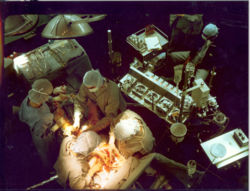
A cardiovascular perfusionist, clinical perfusionist or perfusiologist, and occasionally a cardiopulmonary bypass doctor[1][2] or clinical perfusion scientist,[3] is a healthcare professional who operates the cardiopulmonary bypass machine (heart–lung machine) during cardiac surgery and other surgeries that require cardiopulmonary bypass to manage the patient's physiological status.[4] As a member of the cardiovascular surgical team, the perfusionist helps maintain blood flow to the body's tissues as well as regulate levels of oxygen and carbon dioxide in the blood, using a heart–lung machine.[4]
Duties
[edit]Perfusionists form part of the wider cardiovascular surgical team which includes cardiac surgeons, anesthesiologists, and residents.[5] Their role is to conduct extracorporeal circulation as well as ensure the management of physiologic functions by monitoring the necessary variables. The perfusionist provides consultation to the physician in selecting appropriate equipment and techniques to be used.[6]
Other responsibilities include administering blood products, administering anesthetic agents or drugs, measuring selected laboratory values (such as blood cell count), monitoring circulation, monitoring blood gases, surveil anticoagulation, induction of hypothermia, and hemodilution.[4][6] Sometimes, perfusionists are granted administrative tasks such as purchasing supplies or equipment, as well as personnel and departmental management.[6]
Involved procedures
[edit]Perfusionists can be involved in a number of cardiac surgical procedures, select vascular procedures and a few other surgical procedures in an ancillary role.[4]
Perfusionists may participate in curative or staged palliative procedures to treat the following pediatric pathologies:
- atrial septal defects,
- ventricular septal defects,
- tetralogy/pentalogy of Fallot,
- truncus arteriosus,
- transposition of the great vessels,
- cardiac transplants,
- lung transplants,
- coarctation of the aorta,
- interrupted aortic arch,
- hypoplastic left/right heart,
- subaortic membrane,
- mitral valve repair/replacement,
- aortic valve disorders,
- anomalous/single coronary artery,
- vascular ring,
- extracorporeal membrane oxygenation (ECMO)
Adult surgical procedures may include:
- coronary artery bypass,
- aortic valve replacements,
- mitral valve repair/mitral valve replacement
- tricuspid valve repair
- aortic root replacements
- atrial myxomas
- dissections/aneurysms/trauma of the aorta (ascending, arch & descending)
- renal cell carcinoma/obstructive vena cava
- veno-venous bypass (e.g. during liver transplants)
- cardiac/lung transplants
- implants of ventricular assist device and ECMO.
Select ancillary procedures in which perfusion techniques and/or perfusionists may be involved include isolated limb perfusion, intraperitoneal hyperthermic chemoperfusion and tracheal resection/repair.
Training and certification
[edit] | This section needs additional citations for verification. (November 2016) |
United States
[edit]In the United States, a four-year bachelor's degree is a prerequisite for admission into an accredited perfusion program, typically with a concentration in biology, chemistry, anatomy and physiology, varying depending on specific perfusion program.[7] As of 2025, there are 23 accredited perfusion training programs, of which 18 are master's degrees, 3 bachelor's degrees, and one certificate program[8] Training typically consists of two years of academic and clinical education.[9] A perfusion student will typically begin his or her training in a didactic fashion in which the student will closely follow instructions from a certified clinical perfusionist in the confines of a cardiac surgery procedure. Academic coursework may be concurrent or precede this clinical instruction. Early in their clinical training, the perfusion student may have little involvement outside of an observational role. However, as time progresses, more tasks may be incrementally delegated to them. Upon graduating from a perfusion program, the graduate must begin the certification process. In the interim, the perfusion graduate is typically referred to as board-eligible, which is sufficient for employment in cardiac surgery with the understanding that achieving certified status is required for long-term employment. Most employers have stipulations on the duration of board-eligible status.
To become certified as a certified clinical perfusionist, a perfusionist must undergo a two-part exam administered by the American Board of Cardiovascular Perfusion. The first part is the Perfusion Basic Science Exam and the second part the Clinical Applications in Perfusion Exam. The exam process is open to a perfusion student that has graduated or about to graduate from an accredited perfusion education program. In addition, a perfusion student must have participated in a minimum of 75 perfusions during the course of their training before sitting for the Perfusion Basic Science Exam and performed 40 independent perfusions after graduation before sitting for the Clinical Applications in Perfusion Exam.[10] Upon passing the Clinical Applications in Perfusion Exam, the perfusionist is designated a certified clinical perfusionist.
Following certification, perfusionists must be recertified every year by attaining minimum clinical and educational requirements.[11] Proof of fulfillment of these recertification requirements must be submitted to the American Board of Cardiovascular Perfusion and are mandatory to maintain certified status to use the designation.

As of February 2010, there were 3,766 certified perfusionists in the United States and approximately 300 certified perfusionists in Canada.[12]
Canada
[edit]In Canada, there are three training programs: Burnaby in Western Canada, Toronto and Montreal in Eastern Canada. British Columbia Institute of Technology in Burnaby offers an advanced specialty certificate in cardiovascular perfusion to graduates of its two-year program. Applicants must be certified respiratory therapists, critical care nurses, or cardiac professionals with two years or more of current experience in cardiac critical care. Applicants to the Michener Institute program in Toronto must have a bachelor's degree at minimum, with or without respiratory therapy, nursing or other clinical certification. The master's program is two years. The perfusion program of the Université de Montréal is a three-year bachelor's degree of 90 credits in biomedical science of which 27 credits are specific to clinical perfusion and in addition a diplôme d’études supérieurs spécialisées (DESS) of 30 credits in clinical perfusion of one-year at the master level.
United Kingdom and Ireland
[edit] | This article may be confusing or unclear to readers. In particular, is the training course prior to or whilst a trainee perfusionist?Which parts are paid?. (February 2017) |
In the United Kingdom and Ireland, a bachelor's degree in a science subject (usually life or clinical sciences) is a prerequisite to enrolment on the two-year perfusion training course. Trainees must complete a two-year MSc program at the University of Bristol while employed as a trainee perfusionist by a sponsoring hospital trust. This post is paid as an annex U AfC band 7. They complete academic assessments (essays and exams), while in the workplace moving from a purely observational role to one in which they are capable of managing the patient while they are on cardiopulmonary system with minimal supervision. Once a trainee has been the primary perfusionist in 150 clinical procedures, they must undertake a practical exam. For this exam, the candidate is observed by two external examiners whilst building and priming a cardiopulmonary circuit, then using it during a surgical operation. After the practical exam, trainees must complete a 40-minute viva voce exam, which tests their academic knowledge. After this is successfully completed, they are awarded an MSc in Clinical Perfusion Science and the status of accredited clinical perfusion scientist. They must maintain this by performing a minimum of 40 clinical procedures per year.
Australia and New Zealand
[edit]In some states of Australia and New Zealand, a perfusionist must have at least a science degree (usually in health sciences) as an entry requirement before training. Further didactic training is in a practical format at a hospital whilst doing a three-year course via correspondence and e-learning, with the Australian and New Zealand College of Perfusionists (ANZCP). The final examination for a clinical perfusionist is administered by the ANZCP over two days. This involves three hours of written assessment, two hours of multiple choice questions, and four half-hour viva voce. Perfusion training is determined by the hospital at which the perfusionist is employed and may involve a hospital accredited training program which is determined by the health department to be the equivalent of ANZCP certification program.
In Australia perfusion can also be provided by a medically trained physician who has undertaken additional subspecialty training.[13]
India
[edit]In India, there are different programs for educating perfusionists. A three-year bachelor's degree program (most common) with one-year internship, a two-year post-graduate diploma are available. Bachelor's and master's degree in some reputed institutions (i.e. PGI Chandigarh, AIIMS New Delhi, jipmer, Gandhi Medical College, Bhopal, naryana groups Bangalore, Sawai Mansingh Medical College Jaipur, Sher-e-Kashmir Institute of Medical Sciences, Srinagar). Recently, the Board of Cardiovascular Perfusion of India introduced certification.[clarification needed]
Other countries
[edit]In China, Egypt, and some South American countries, a clinical perfusionist is a medical doctor who has completed subspecialty training.[citation needed] In Argentina, a perfusionist is a medical doctor, usually a cardiologist, who has undertaken additional sub-specialty training. They are often referred to as hemodinamistas (hemodynamics specialists).
In Europe, perfusionist education standards are set by the European organisation of perfusion, EBCP (The European Board of Cardiovascular Perfusion) and has been implemented in many European countries. The length of the eduacation and training varies between 1 and 4 years, depending on requirements for entering the program.[14] In the northern countries of Europe, Scandinavia including Sweden, Denmark and Norway, perfusionists are educated at Aarhus University at the Scandinavian School of Cardiopulmonary Technology.[15] Most perfusionist candidates are educated intensive care nurses/anaesthetic nurses and the education includes a Master Thesis in Cardiopulmonary Technology.[16]
In the Dominican Republic, there is a master's program in perfusion from the Latin American Perfusion Association (ALAP), endorsed by the Universidad Nacional Pedro Henríquez Ureña.[17] Graduates can also opt for certification from the Latin American Perfusion Board, a voluntary regional accreditation designed to guarantee professional standards.[18]
References
[edit]- ^ "Yuri Ganushchak". eacts.org. European Association for Cardio-Throacic Surgery. Retrieved 1 April 2019.
- ^ Gulielmos, Vassilios, ed. (31 October 2008). Beating Heart Bypass Surgery and Minimally Invasive Conduit Harvesting. Springer Science & Business Media. p. 179. ISBN 978-3-7985-1399-0.
- ^ "Clinical perfusion science". healthcareers.nhs.uk. Health Education England. 2015-03-25. Retrieved 1 April 2019.
- ^ a b c d "What is a Perfusionist?". Texas Heart Institute. Texas Heart Institute. Retrieved 6 May 2019.
- ^ Fleming, M; Smith, S; Slaunwhite, J; Sullivan, J (February 2006). "Investigating interpersonal competencies of cardiac surgery teams". Canadian Journal of Surgery. 49 (1): 22–30. PMC 3207507. PMID 16524139.
- ^ a b c "Perfusion". Commission on Accreditation of Allied Health Education Programs. Retrieved 6 May 2019.
- ^ "Perfusionist". Explorehealthcareers.org. Liaison International. Retrieved 12 February 2019.
- ^ "Commission on Accreditation". CAAHEP. CAAHEP. Retrieved 12 February 2019.
- ^ "Career Perfusionist: [2] Training & Education". Perfusion.com. 28 March 2012. Retrieved 22 April 2020.
- ^ "Certification". American Board of Cardiovascular Perfusion. Retrieved 1 April 2019.
- ^ "Recertification- Professional Activity". Retrieved 1 April 2019.
- ^ "Clinical Perfusionists Currently Certified by the American Board of Cardiovascular Perfusion through December 31, 2010". American Board of Cardiovascular Perfusion. Archived from the original on February 13, 2010. Retrieved 2010-02-15.
- ^ "Overview - Overview — MDHS Study". mdhs-study.unimelb.edu.au. Retrieved 2019-08-12.
- ^ Wahba, A.; Milojevic, M.; Boer, C.; De Somer FMJJ; Gudbjartsson, T.; Van Den Goor, J.; Jones, T. J.; Lomivorotov, V.; Merkle, F.; Ranucci, M.; Kunst, G.; Puis, L.; EACTS/EACTA/EBCP Committee Reviewers (2020). "2019 EACTS/EACTA/EBCP guidelines on cardiopulmonary bypass in adult cardiac surgery". European Journal of Cardio-Thoracic Surgery. 57 (2): 210–251. doi:10.1093/ejcts/ezz267. hdl:2336/621346. PMID 31576396.
- ^ "The Scandinavian School of Cardiovascular Technology - Aarhus Universitetshospital".
- ^ "Scientific Thesis - Aarhus Universitetshospital".
- ^ ALAP. "Asociación Latinoaméricana de Perfusión". asociacionalap.
- ^ ALAP. "Board Latino Americano de Perfusion". Board ALAP.
External links
[edit]
Perfusionist
View on GrokipediaOverview and History
Definition and Role
A perfusionist is a specialized healthcare professional trained to operate extracorporeal circulation equipment, such as the heart-lung machine, which temporarily assumes the functions of the heart and lungs during surgical procedures.[8][9][10] This role emerged in the mid-20th century alongside advancements in cardiac surgery, enabling complex open-heart operations by providing artificial support to vital organ systems.[11] In their primary capacity, perfusionists maintain physiological balance for patients undergoing cardiopulmonary bypass, ensuring adequate oxygenation, regulated blood flow, and controlled body temperature to support tissue viability throughout the procedure.[8][12][13] They monitor and adjust parameters like blood gases, electrolytes, and hemodynamics in real time to mimic natural circulation and prevent complications such as ischemia or coagulopathy.[12][2] Perfusionists integrate seamlessly into the cardiovascular surgical team, collaborating closely with surgeons, anesthesiologists, and nurses to coordinate care and respond dynamically to intraoperative needs.[9][14][15] This teamwork is essential for optimizing patient outcomes, as the perfusionist provides critical input on bypass strategies and equipment management during high-stakes operations.[14][16] At its core, perfusion refers to the process by which blood delivers oxygen and nutrients to tissues while removing waste products, a fundamental concept that underscores the perfusionist's expertise in sustaining organ perfusion artificially when native circulation is interrupted.[17][18]Historical Development
The origins of perfusion trace back to early 19th-century experiments in maintaining circulation outside the body, with James Phillips Kay of Edinburgh conducting the first documented practical perfusion studies on animals in 1828 by withdrawing arterial blood from the carotid artery and reinfusing it into the jugular vein.[19] These initial animal studies laid foundational concepts for extracorporeal circulation, though clinical application remained elusive for over a century. Advancements accelerated in the 1930s when aviator Charles Lindbergh, collaborating with surgeon Alexis Carrel, developed a pioneering perfusion pump in 1935 to sustain organs ex vivo, using a sterile, pulsating flow system that kept tissues viable for extended periods and foreshadowed modern organ preservation techniques.[20] A pivotal milestone occurred in 1953 when American surgeon John H. Gibbon Jr. invented the first successful heart-lung machine, enabling the world's inaugural open-heart surgery on an 18-year-old patient with an atrial septal defect at Jefferson Hospital in Philadelphia.[21] This breakthrough shifted perfusion from experimental to clinical practice, allowing surgeons to temporarily bypass the heart and lungs during intricate procedures. The post-1950s era saw rapid adoption tied to expanding cardiac surgery worldwide, with initial operators often serving as "pump technicians" trained on the job. Professionalization gained momentum in the 1960s and 1970s in the United States, marked by the founding of the American Society of Extra-Corporeal Technology (AmSECT) in 1964 to standardize training and promote knowledge exchange among practitioners.[22] This was followed by the establishment of the American Board of Cardiovascular Perfusion (ABCP) in 1975, which assumed responsibility for certification to ensure competency and public safety.[23] Globally, the profession spread to Europe and Asia alongside cardiac surgery growth; in Europe, early adoption began in Britain in 1953, evolving into formalized training with the first school opening in Rome in 1973 and the European Board of Cardiovascular Perfusion forming in 1991.[24][25] In Asia, cardiac programs emerged in the 1950s, such as in China where cardiovascular surgery developed as a specialty by 1965, and in South Asia with India's first open-heart surgery in 1961, initially relying on technicians who transitioned to certified perfusionists by the 1980s as education and regulation advanced.[26][27] By the 1980s, the role had evolved from ad hoc pump operation to a recognized allied health profession requiring formal qualifications worldwide.[28]Responsibilities and Procedures
Core Duties
Perfusionists begin their core responsibilities with thorough preoperative planning to ensure safe and effective cardiopulmonary bypass (CPB). This involves reviewing the patient's medical history, including comorbidities, allergies, and prior surgical interventions, to anticipate potential challenges during the procedure. They calculate priming volumes for the CPB circuit based on the patient's estimated blood volume and body surface area, typically aiming to minimize hemodilution while selecting appropriate circuit components such as oxygenators, pumps, and tubing to match the surgical needs. Additionally, perfusionists compute and communicate predicted post-dilutional hemoglobin levels to the surgical team prior to initiating CPB, facilitating informed decisions on blood product use.[29][30] During surgery, perfusionists prime the CPB circuit with a crystalloid or colloid solution to remove air and achieve adequate flow rates upon initiation of bypass, a critical step performed in a sterile environment. They then initiate CPB by gradually increasing pump flow to full support, typically 2.2-2.4 L/min/m² of body surface area, while monitoring and adjusting hemodynamics such as arterial blood pressure, central venous pressure, pH, electrolytes, and activated clotting time to maintain patient stability. Real-time adjustments to perfusion parameters are essential, including fine-tuning flow rates to match metabolic demands and managing temperature via the circuit's heat exchanger—employing normothermic conditions (around 37°C) for certain procedures or hypothermic strategies (below 34°C) for myocardial protection during ischemic periods, such as in coronary artery bypass grafting.[31]33346-X/pdf) Perfusionists also oversee the administration of medications, blood products, and anticoagulants to sustain circuit patency and physiological balance throughout CPB. They follow heparin dosing protocols, typically starting with a 300 units/kg bolus and additional doses guided by activated clotting time (ACT) targets of 400-480 seconds, in collaboration with the surgical team to prevent thrombosis or excessive bleeding. Blood products, such as packed red cells or platelets, are transfused as needed based on ongoing assessments of coagulation and hemoglobin levels. Weaning from CPB involves progressively reducing pump flow while diverting blood back to the patient's circulation, monitoring for hemodynamic stability, and reversing anticoagulation with protamine before decannulation.[32][33][34][4]Specific Procedures and Techniques
Perfusionists play a central role in managing cardiopulmonary bypass (CPB) during open-heart surgery, where they assemble and prime the extracorporeal circuit to temporarily take over the heart and lungs' functions. The circuit setup involves connecting components such as venous and arterial cannulas, an oxygenator, heat exchanger, reservoir, pumps, and tubing, with the perfusionist ensuring sterility and air-free connections before initiating bypass.[11] Venous cannulation typically uses single- or two-stage approaches, such as right atrial or superior/inferior vena cava insertion, to drain deoxygenated blood into the reservoir, while arterial cannulation occurs via the ascending aorta or femoral artery to return oxygenated blood, requiring activated clotting time (ACT) levels above 300-400 seconds for safe insertion.[11] The oxygenator, often a membrane type, facilitates gas exchange by allowing oxygen diffusion into blood and carbon dioxide removal through a semipermeable barrier, minimizing blood trauma compared to older bubble oxygenators.[11] Beyond cardiac procedures, perfusionists apply their expertise in non-cardiac contexts, including isolated limb infusion (ILI) for treating extremity tumors like melanoma. In this technique, they manage a simplified extracorporeal circuit using percutaneous femoral catheters to isolate the limb's circulation, delivering high-dose chemotherapy agents such as melphalan and dactinomycin under hyperthermic conditions (around 37-39°C) for 30 minutes, followed by washout to limit systemic exposure.[35] For extracorporeal membrane oxygenation (ECMO) support in respiratory or cardiac failure, perfusionists oversee circuit management, including percutaneous or surgical cannulation (e.g., femoral vein for drainage and artery for return in venoarterial ECMO), pump speed adjustments to maintain 3-4 L/min flow, and anticoagulation monitoring to keep ACT at 180-220 seconds.[36] During ventricular assist device (VAD) implantation for advanced heart failure, perfusionists coordinate the transition from CPB to device support, ensuring stable hemodynamics through close collaboration with the surgical team while weaning bypass flows.00085-2/fulltext) Advanced techniques employed by perfusionists enhance safety and efficiency in CPB. Autologous priming involves displacing crystalloid prime with the patient's own blood via retrograde flow before full bypass, reducing hemodilution and allogeneic transfusion needs by up to 50% in adult cases without compromising outcomes.[37] Vacuum-assisted venous drainage applies regulated negative pressure (-10 to -60 mmHg) to a sealed hard-shell reservoir, augmenting venous return with smaller cannulas and shorter lines, which is particularly beneficial in minimally invasive or pediatric surgeries to minimize prime volume and transfusion risks.[38] Myocardial protection strategies, such as cardioplegia delivery, are managed by perfusionists who administer potassium-enriched solutions (15-35 mEq/L) anterograde via the aortic root or retrograde through the coronary sinus, monitoring flow rates (300-500 mL initial dose), temperatures (cold for arrest, warm for reperfusion), and pressures to induce quiescence and prevent ischemia during aortic cross-clamping.[39] Equipment selection impacts procedural outcomes, with perfusionists choosing between centrifugal and roller pumps based on case needs. Centrifugal pumps, which use constrained vortex flow, cause less hemolysis and platelet activation than roller pumps' occlusive compression, though they require larger prime volumes; both maintain non-pulsatile flow during CPB but centrifugal models are preferred for longer procedures to reduce blood trauma.[40] Monitoring tools like near-infrared spectroscopy (NIRS) enable real-time cerebral oximetry by measuring regional oxygen saturation (rSO2) in the frontal cortex via forehead sensors, alerting to desaturations below 50% or 20% from baseline during bypass to guide interventions like flow adjustments or pH management.[41]| Pump Type | Mechanism | Advantages | Disadvantages |
|---|---|---|---|
| Centrifugal | Constrained vortex impeller | Lower hemolysis, safer for prolonged use | Larger prime volume, requires kinetic energy monitoring |
| Roller | Occlusive rollers on tubing | Smaller prime, provides slight pulsatility | Higher blood trauma, potential for tubing wear |