Hubbry Logo
FalasarnaFalasarnaMain
Open search
Falasarna
Community hub
Falasarna
logo
8 pages, 0 posts
0 subscribers
Be the first to start a discussion here.
Falasarna
Falasarna
from Wikipedia
Stone quay and mooring stones from military harbor of Falasarna
Baths of Hellenistic period excavated at Falasarna

Key Information

Falasarna or Phalasarna (Ancient Greek: Φαλάσαρνα) is a Greek harbour town at the west end of Crete that flourished during the Hellenistic period. The currently visible remains of the city include several imposing sandstone towers and bastions, with hundreds of meters of fortification walls protecting the town, and a closed harbor, meaning it is protected on all sides by city walls. The harbor is ringed by stone quays with mooring stones, and connected to the sea through two artificial channels. Notable finds in the harbor area include public roads, wells, warehouses, an altar, and baths. Most of these structures were revealed by excavations that began in 1986.

The acropolis is built on a cape that rises 90 meters above the harbor and juts into the sea. The acropolis has many remains, including a temple dedicated to goddess Dictynna, fortification towers, cisterns, wells, and watchtowers that could have been used to guard sea routes.[1]

Today Falasarna is an agricultural area and tourist attraction.

The valley is filled with olive groves and greenhouses cultivating mainly tomatoes; there are also scattered family-run hotels and restaurants. The seaside has long sandy beaches and crystal clear waters that are popular both with residents of the province of Chania and visitors from Greece and abroad. Falasarna beach was voted, in a CNN poll, among the best 100 beaches of the world.[2]

Beach of Falasarna, with acropolis of ancient site in background.


Climate

[edit]

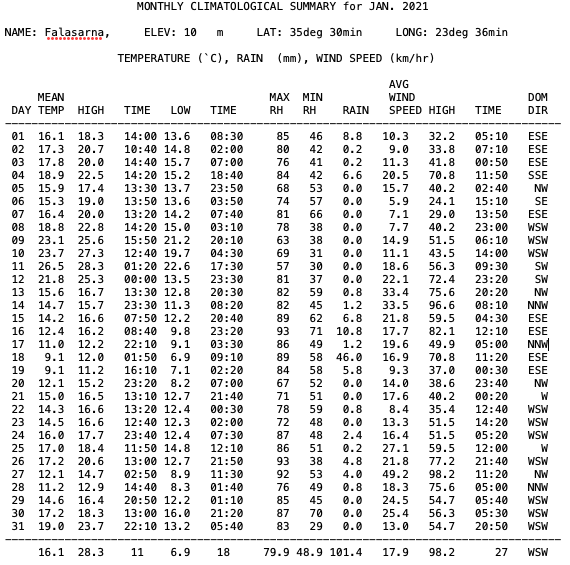
Falasarna has a hot-summer Mediterranean climate (Csa in the Köppen climate classification). It has hot dry summers and exceptionally mild winters. On the night of January 11, 2021 the World Meteorological Organization station in Falasarna recorded an impressive temperature of 28.3 °C due to strong foehn winds while the minimum temperature for that day was 22.6 °C marking both the highest January temperature during a night and the highest January minimum temperature ever recorded in Greece.[3][4] On the night of March 16, 2025 Falasarna recorded a stunning night temperature of 31.7 °C. [5] On the night of May 25, 2025 Falasarna recorded an equally stunning night temperature of 37.4 °C.[6] Falasarna falls in 11a hardiness zone.[7]

Climate data for Falasarna 10 m a.s.l. (2010-2024)
Month Jan Feb Mar Apr May Jun Jul Aug Sep Oct Nov Dec Year
Record high °C (°F) 28.3
(82.9)
28.9
(84.0)
32.6
(90.7)
36.6
(97.9)
39.8
(103.6)
38.7
(101.7)
41.4
(106.5)
41.3
(106.3)
39.6
(103.3)
36.9
(98.4)
33.0
(91.4)
29.4
(84.9)
41.4
(106.5)
Mean daily maximum °C (°F) 16.1
(61.0)
16.8
(62.2)
18.3
(64.9)
21.4
(70.5)
24.9
(76.8)
28.7
(83.7)
31.7
(89.1)
31.6
(88.9)
28.9
(84.0)
24.9
(76.8)
21.7
(71.1)
17.9
(64.2)
23.6
(74.4)
Daily mean °C (°F) 13.6
(56.5)
14.2
(57.6)
15.4
(59.7)
18.0
(64.4)
21.3
(70.3)
25.0
(77.0)
28.0
(82.4)
28.3
(82.9)
25.8
(78.4)
22.2
(72.0)
19.1
(66.4)
15.5
(59.9)
20.5
(69.0)
Mean daily minimum °C (°F) 11.1
(52.0)
11.6
(52.9)
12.5
(54.5)
15.2
(59.4)
18.0
(64.4)
21.3
(70.3)
24.2
(75.6)
24.9
(76.8)
22.7
(72.9)
19.4
(66.9)
16.5
(61.7)
13.0
(55.4)
17.5
(63.6)
Record low °C (°F) 1.6
(34.9)
4.1
(39.4)
4.2
(39.6)
8.3
(46.9)
11.1
(52.0)
16.2
(61.2)
19.6
(67.3)
20.8
(69.4)
16.6
(61.9)
12.9
(55.2)
9.7
(49.5)
3.9
(39.0)
1.6
(34.9)
Average rainfall mm (inches) 110.5
(4.35)
79.7
(3.14)
46.1
(1.81)
13.8
(0.54)
11.9
(0.47)
5.4
(0.21)
1.8
(0.07)
5.4
(0.21)
23.4
(0.92)
64.7
(2.55)
69.9
(2.75)
102.1
(4.02)
534.7
(21.04)
Source 1: National Observatory of Athens Monthly Bulletins (Apr 2010 - Mar 2024) [8]
Source 2: Falasarna N.O.A station [9] and World Meteorological Organization[10]

Ancient history

[edit]

Falasarna was mentioned by the ancient historians and geographers Scylax,[11] Strabo,[12] Polybius,[13] Livy,[14] Pliny,[15] Dionysius Kalliphontis,[16] and the anonymous geographer known as Stadiasmus.[17] The ancient geographers took note of the artificial closed port carved out of a lagoon and ringed with fortification walls and towers. Falasarna was a maritime power; the harbor was the reason for the city's existence, the source of its wealth, and led to its recognition. A city-state with its own laws and minting its own coins, Falasarna provided military advisers and thousands of mercenaries for a war under the Macedonian king Perseus against the Romans (Livy).

Falasarna was involved in two major wars with neighboring city-states during the Hellenistic period. The first was with Polyrrhenia, probably triggered by land disputes. It started in the late fourth century and ended around 290 BC, following mediation by Cleonymus of Sparta. The peace treaty was inscribed on a stone tablet which is today in the museum of Kissamos.[18] A second war was fought with Cydonia around 184 BC and the disputes were finally resolved through Roman intervention (Polybius).

The city-state prospered through its maritime affairs, evidenced by the remains of monumental buildings and artwork. The treaty with Polyrrhenia gives evidence that in the third century BC the inhabitants of Falasarna were engaged in piracy, a common practice of the Cretan city-states.[19] In 69-67 BC the Romans sent forces to eliminate piracy from the eastern Mediterranean, stormed Phalasarna, blocked its harbor with massive masonry, and destroyed the whole city, probably killing its citizens. No ancient sources testify directly to these events, but evidence of burning and the harbor blockage itself suggest the tentative conclusions of the excavators.[20][21]

The location of the city was then forgotten, and Falasarna appears in Venetian records only as a lost city. The site was rediscovered in the 19th century by British explorers Robert Pashley and Captain T. A. B. Spratt. Spratt, of the Royal Navy, noted in 1859 that the former harbor of the deserted site was now 100 yards from the sea, and that the ancient sea coast must have risen at least twenty four feet. Modern excavation has confirmed this judgment, and also has shown that the harbor rapidly silted up after the Roman attack.[22] Radiocarbon dating of fossil algae along the ancient sea level mark on the cliffs around Falasarna estimates the sudden sea level change at some time more than sixteen centuries ago. A probable event was the great earthquake and tsunami of 21 July A.D. 365, which wreaked catastrophic damage on all the coasts of the eastern Mediterranean and was recorded by Ammianus Marcellinus[23] and others. An ancient fish basin with two flights of steps carved into the coastal rocks near the harbor entrance has been cracked in half, probably during the same earthquake.[24]

Excavations

[edit]
Pelike excavated at Phalasarna showing Eros chasing a Maenad. 330 BC.
Ancient throne from Phalasarna

Rescue excavations at the cemetery of Falasarna began in 1966 directed by the Ephor of the Department of Classical Antiquities in Chania, Dr. Yannis Tzedakis,[25] and continued under Vanna Niniou-Kindeli. Over 70 graves were uncovered, some of them pithos burials, and others cist graves. The early excavations were important, proving the site to have been inhabited in the 6th century BC. Since then, a small additional part of the cemetery has been excavated and many beautiful artifacts have been recovered, among them a 4th-century pelike showing Eros chasing a Maenad. In the area of the necropolis there stands a two-meter high throne carved from stone, probably dedicated to the Phoenician goddess Astarte.[26]

Research excavations began in 1986 under Dr. Elpida Hadjidaki of the Greek Archaeological Service of Chania.[27] From 1988 through 1990 they were done in collaboration with Frank J. Frost of the University of California, Santa Barbara,[28] and have continued under the direction of Hadjidaki. Major items excavated to date include five towers that were part of the fortifications encircling the harbor. All of them have a distinctive rounded molding (Ancient Greek: κυμάτιον) at a point where the foundation narrows to support the upper part of the monument. One tower is circular, preserved to a height of 4.5 m (15 ft), strengthened inside by two cross-walls filled with rubble, and connected through a 50 m-long (160 ft) curtain wall to a rectangular tower. The other fortification towers surrounding the port are also rectangular, and the stones of their exterior faces have drafted edges. A fortified gate was connected to walls that in one direction surround a secondary basin behind the main military harbor, and in another direction extend towards the acropolis. This wall ends in another rectangular tower. From this point a paved road departs for the acropolis, and right next to it is a room filled with stone baths. The secondary basin is lined by a quay 30 m (98 ft) long with a slipway at one end, and a row of structures at the other that the excavator suggests may be more slipways.

Long sections of the quays in the military harbor have been excavated with six bollards in situ, still bearing rope marks from mooring ships. An artificial channel connected the military harbor to the sea, and it was possible to close the channel using a chain. A carved stone structure at the channel entrance, excavated in 2013 and still displaying traces of bronze, supports this view.

A merchant's house has partly been excavated at the foot of the acropolis, revealing imported goods of the early Hellenistic period from around the Mediterranean, particularly from Cyrenaica in North Africa. Finally, a winery and adjoining warehouses excavated between 2008 and 2012 provide evidence of production for export.[29]

The excavations have uncovered a wide variety of ceramic vessels, coins, jewelry, and sculpture, revealing well developed culture of the inhabitants of ancient Phalasarna. Many of these are on display in the museums of Kisamos and Chania.

Situated Simulation

[edit]

Between 2010 and 2015, Gunnar Liestøl of the University of Oslo in collaboration with Elpida Hadjidaki developed a quasi-mixed reality simulation of ancient Falasarna. It contains three visual layers: one for the present day, one recreating Phalasarna as it appeared when constructed in 333 B.C., and one describing the Roman attack of 69 B.C.[30] [31] [32]

LCT wreck

[edit]

At the point where the ancient channel entrance to the Hellenistic port meets the sea, there is a wreck from the Second World War of a Mark 1 Landing Craft, Tank. It was sunk on 28 May 1941 during the Battle of Crete. The history of this vessel, partly based on interviews of local residents of Falasarna and the Captain, John Sutton, has been described by Michael Bendon.[33] A preview of a situated simulation depicting the sinking of this Landing Craft has been prepared by Gunnar Liestøl, Michael Bendon, and the Director of Falasarna excavations Elpida Hadjidaki.[34][35]

References

[edit]
Revisions and contributorsEdit on WikipediaRead on Wikipedia
from Grokipedia
Falasarna, also known as Phalasarna, is an harbor town situated at the western extremity of , on Cape Koutri at the base of the Peninsula, approximately 60 km west of . Archaeological evidence indicates continuous habitation from the period (c. 3500 BC), with recent excavations (2025) revealing a temple dedicated to and prehistoric layers. Inhabited since the Minoan period, it emerged as an independent and in the late , renowned for its engineered closed harbor, extensive fortifications, and role in regional trade and naval activities. The site, covering about 1.5 by 0.5 km, includes well-preserved ruins such as towering walls, cisterns, and an , which highlight its strategic importance during the Hellenistic era before its destruction by Roman forces around 68 BC. The city's strategic location between two protective bays made its harbor—measuring roughly 100 by 75 meters—a vital asset for sheltering ships and facilitating commerce with regions like , while its skilled archers and mercenary contributions underscored its military prowess. Fortifications, constructed from local in the second half of the , extended over 550 meters with four towers and reached heights of up to 5 meters, enclosing the harbor and to defend against invasions. Archaeological evidence, including from the 3rd to 2nd centuries BC and coinage minted onsite, attests to its prosperity as a Hellenistic with its own laws and cultural output, such as sculptures and vases. Falasarna's decline began with the Roman conquest of ; around 68 BC, during the campaign led by Quintus Caecilius Metellus Creticus, the harbor entrance was deliberately blocked with stones, rendering it unusable and leading to the town's abandonment. Subsequent tectonic uplift, notably around 6.5 meters during the AD 365 earthquake, further elevated the harbor above sea level, contributing to silting and isolation. Excavations since the 1980s, led by archaeologist Elpida Hadjidaki, have uncovered key structures like the south tower's freshwater cistern and north tower remnants, alongside artifacts such as Megarian bowls dated 225–175 BC, providing insights into daily life and engineering feats. Today, the site serves as a major archaeological attraction, offering views of its submerged WWII wreck nearby and illustrating 's ancient maritime heritage.

Geography

Location and Setting

Falasarna is an ancient site located in the municipality of , Prefecture, on the island of , , at coordinates 35°30′37″N 23°34′03″E. The position places it at the northwestern tip of , along the coast at the base of the Gramvousa Peninsula. The site lies approximately 53 km west of modern and 15 km west of , with nearby ancient Polyrrhenia situated about 10 km to the southeast. This regional placement positions Falasarna as a key coastal point in western , accessible via the E65 national road from , followed by local routes toward the peninsula. Access to the ruins involves driving on paved roads from the main coastal highway, then proceeding along a 2 km dirt path suitable for most vehicles, which branches off near agricultural fields. The surrounding area features modern infrastructure integrated with the landscape, including olive groves that dominate the valleys and greenhouses supporting local farming, creating a blend of historical preservation and contemporary rural life. As both an ancient harbor town and a modern coastal area, Falasarna's setting highlights its enduring geographical significance along 's western shore, where the site overlooks the current shoreline shifted by tectonic activity.

Physical Features

Falasarna is situated on the northwestern cape of , featuring a prominent perched on Cape Koutri, a rocky promontory rising approximately 90 meters above the ancient harbor and extending into the sea. This elevated terrain provided a natural stronghold, with the flat area at the base of the measuring about 100 by 75 meters and now standing roughly 7 meters above current due to tectonic uplift. The site's topography includes high rocky outcrops surrounding the central basin, which was engineered into a fortified . The ancient harbor was an artificial closed basin carved from a coastal lagoon, equipped with quays along its perimeter, a 120-meter-long main channel connecting to the sea, and breakwaters formed by extensions of the city walls. Fortification walls, constructed in isodomic style from local ashlar sandstone, spanned about 550 meters with double lines and three bastions, integrating seamlessly with the harbor defenses. Sandstone towers, including a circular southern tower approximately 4.5 meters high and a rectangular northern tower around 5 meters high, flanked the harbor entrance, while cisterns—such as a plastered one within the southern tower—supported water storage needs. Today, the harbor lies silted and approximately 200 meters inland, elevated by about 6.6 meters from tectonic activity in 365 AD, rendering it dry and filled with sediments. Visible ruins among the key landmarks include a temple dedicated to the Dictynna on the summit, constructed in Doric style on the natural rock with surviving column elements. Public infrastructure remnants encompass paved roads, wells, warehouses for trade storage, an , and bath complexes, all integrated into the lower town's layout near the harbor. These structures highlight the site's engineering prowess in adapting the rugged landscape for urban and maritime functions. In the modern landscape, Falasarna blends ancient ruins with surrounding agricultural fields dominated by olive groves, transitioning southward to expansive sandy coastal zones and beaches that extend along the western Cretan shore. This integration of fertile inland areas with the maritime edge underscores the site's enduring environmental context.

Environment

Climate

Falasarna experiences a hot-summer Mediterranean climate classified as Csa under the Köppen-Geiger system, characterized by dry, hot summers and mild, wetter winters typical of western Crete's coastal regions. The region's annual average temperature is approximately 17.2°C, with monthly means ranging from 11.5°C in to 25.8°C in , based on long-term observations from nearby stations. Average daily highs peak at 29.4°C in and , while lows dip to 9.2°C in and . Extreme temperatures have been recorded at a high of 44.5°C in Voukolies ( prefecture) on June 13, 2024, reflecting intense summer heatwaves, though coastal proximity moderates severe cold. Annual averages around 550 mm over the 2010–2024 period, primarily concentrated in the winter months from to , with typically the wettest at around 120 mm and fewer than two rainy days per summer month. The National Observatory of (NOA) monitors these trends via its Falasarna station, noting seasonal distribution that supports vegetation but limits summer drought impacts. This facilitates the ancient site's preservation through moderate humidity and infrequent frosts, while mild winters enable year-round access. However, prolonged summer heat above 35°C can complicate archaeological excavations by increasing worker fatigue and dryness.

Geological History

Falasarna lies on the western coast of , part of the zone where the African tectonic plate subducts beneath the Eurasian plate at a rate of approximately 3-5 cm per year, generating intense seismic activity and variable vertical movements including both uplift and . The site occupies an extensional back-arc domain behind the outer , characterized by normal faulting that has produced contrasting tectonic regimes, with dominating in the coastal lowlands during the late . Sedimentary reveal a pattern of episodic small-scale subsidences, each 10-25 cm, occurring over three millennia prior to the AD, resulting in a cumulative relative sea-level rise that promoted harbor silting through increased marine incursions and sediment deposition. A pivotal geological event was the magnitude 8.3-8.5 on July 21, 365 AD, centered near western , which triggered co-seismic uplift of 6-9 meters along the coastline, elevating the ancient harbor basin above modern and permanently isolating it from tidal influences. This uplift was accompanied by a destructive that inundated the coastal plain up to several kilometers inland, as evidenced by anomalous sediment layers containing marine , shell fragments, and fining-upward deposits identified in core samples from the harbor area. The tsunami's passage likely contributed to initial harbor blockage through debris and sediment redistribution before the subsequent uplift sealed its fate. From the late onward, around 67 BC, gradual tectonic superimposed on eustatic sea-level fluctuations led to a net relative sea-level rise of about 1.6 meters over subsequent centuries, exacerbating harbor infilling with fluvial and marine sediments and contributing to the site's progressive abandonment. Post-365 AD, additional minor events, including 1.25 ± 0.05 meters after the late Venetian period around AD 1600, have further altered the coastal morphology, with modern GPS and tide-gauge data indicating ongoing relative sea-level rise at rates of 1-2 mm per year in western due to a combination of isostatic adjustments and global eustatic increases. These long-term changes directly undermined the harbor's functionality, curtailing ancient Falasarna's maritime prosperity. Recent studies since 2020 underscore how anthropogenic intensifies geological vulnerabilities at Falasarna, with increased frequency of extreme events—up 20-30% in the region including Falasarna from 2015-2020 compared to earlier decades—triggering enhanced landslides and that threaten the site's stability. Projections under RCP8.5 scenarios suggest accelerated shoreline retreat of up to 50 meters by 2100 in western Cretan lowlands, compounding tectonic through rising sea levels and storm surges.

Ancient History

Founding and Prosperity

Falasarna, located on the Grambousa Peninsula in western , was inhabited from Minoan times and developed into a by the , during the period of Dorian settlement in . Ancient sources such as Pseudo-Scylax describe it as a key coastal site with a closed harbor, emphasizing its strategic maritime position just a day's from the mainland. further notes its placement at the western extremity of , near prominent capes that facilitated navigation and defense. During the Hellenistic period (4th–2nd centuries BC), Falasarna reached its peak as a prosperous and , bolstered by an artificial harbor basin measuring approximately 100 by 75 meters, fortified with quays, towers, and walls to support naval operations. The city minted its own silver and bronze coins, often featuring symbols like a , , and a female head possibly representing a local , reflecting economic and networks with Dorian states in the and Ptolemaic . Its economy centered on maritime commerce, including the export of and wine—evidenced by production facilities such as presses and workshops—alongside a reputation for supplying mercenaries, as noted by in accounts of regional alliances. In 171 BC, Falasarna contributed 3,000 mercenaries, led by general Sosos, to support King against , underscoring its military export role and integration into broader Hellenistic conflicts. Culturally, the city featured a temple dedicated to Dictynna (a local form of ), the goddess of hunting and the sea, situated on the for panoramic oversight of the harbor. The urban layout included paved roads, likely sacred processional routes leading to public buildings and the , as well as like wells, cisterns, and warehouses that supported daily life and trade.

Conflicts and Decline

Falasarna's Hellenistic prosperity was marred by territorial disputes with neighboring city-states, particularly Polyrrhenia to the east. A prolonged conflict, likely initiated over land boundaries in the and lasting until around 290 BC, involved Falasarna allying with Cydonia, , and other Cretan poleis against Polyrrhenia; this war concluded with a preserved in an inscription depicting a , marking a temporary resolution but highlighting ongoing rivalries. Subsequently, around 184 BC, Falasarna engaged in another war with Cydonia, its former ally, over disputed territories; Roman commissioner Appius Claudius intervened to mediate, enforcing a settlement that underscored Rome's growing influence in Cretan affairs. By the late , Falasarna had evolved into a notorious pirate base, leveraging its fortified military harbor—lacking a dedicated commercial port—to support raiding operations that disrupted Mediterranean trade routes. This piracy, possibly sustained by the city's earlier mercenary traditions, provoked Roman retaliation as part of broader efforts to secure sea lanes. In 67 BC, during the conquest of , Roman forces under Caecilius Metellus Creticus destroyed the city to eliminate pirate strongholds; archaeological evidence includes layers of burning in structures and the deliberate blocking of the harbor entrance with massive blocks to render it unusable. Following the destruction, Falasarna was abruptly abandoned, with no evidence of Roman resettlement or reconstruction, leading to rapid silting of the harbor due to natural sedimentation and tectonic uplift. The site faded from active use, mentioned only peripherally in later ancient texts by historians like in the context of Roman campaigns and by in his geographical descriptions of . By the Byzantine and Venetian periods, its location was entirely forgotten, appearing in medieval records solely as a legendary with no traceable remains.

Archaeology

Excavation Timeline

Archaeological interest in Falasarna began with rescue excavations in 1966 at the site's cemetery, directed by Yannis Tzedakis, the Ephor of the Department of Classical Antiquities in Chania, with contributions from Vanna Niniou-Kindeli of the Ephorate of Antiquities. These initial efforts focused on surface surveys and grave documentation to salvage artifacts threatened by modern development, employing basic stratigraphic analysis to establish burial chronologies spanning the Hellenistic and Roman periods. Systematic excavations commenced in 1986 under the auspices of the Greek , led by Elpida Hadjidaki of the Ephorate of Antiquities, with Frank J. Frost of the , joining as co-director from 1988 onward. The work targeted the ancient harbor, , and urban sectors, utilizing stratigraphic excavation techniques, surface surveys for mapping unexcavated areas, and limited to investigate submerged harbor features preserved by tectonic uplift. Vanna Niniou-Kindeli continued her involvement in overseeing aspects of the site's preservation during this phase. These efforts proceeded intermittently through the and early , revealing the site's Hellenistic fortifications and infrastructure. Post-2015, excavations resumed with renewed intensity, including surveys in 2015 that explored multiple sectors around the waterfront and towers using targeted stratigraphic digs. Seasons from 2015 to 2017, directed by Hadjidaki, incorporated advanced methodologies such as geophysical mapping to identify subsurface structures in the harbor and urban zones. In 2024, excavations on the acropolis uncovered a Neolithic layer dating to approximately 3500 BCE, marking the earliest evidence of occupation at the site. Recent work extended through 2025, with geophysical surveys employing ground-penetrating radar in 2023 to delineate geoarchaeological patterns in the harbor basin, alongside ongoing surface and stratigraphic analyses on the acropolis, including excavations at the temple of Demeter and a fortified tower and gateway, funded by the Institute for Aegean Prehistory. These activities, spanning 1966 to 2025 with periodic interruptions due to funding and permissions, continue to employ integrated approaches combining traditional surveys, underwater prospection where applicable, and non-invasive geophysical techniques to minimize site disturbance.

Major Discoveries

Excavations at the Phalasarna cemetery have uncovered over 70 graves dating from the Geometric to Hellenistic periods, including pithos burials and cist graves that contained a range of grave goods such as jewelry, coins, and pottery. Among these finds is a red-figure pelike vase dated to approximately 330–320 BC, exemplifying Attic import influences in the region's trade networks. These artifacts highlight the site's role as a prosperous maritime center, with coins reflecting local minting and economic exchanges during the Classical and Hellenistic eras. Structural discoveries include a notable "stone throne" structure, potentially linked to a of or a similar Phoenician-influenced , indicative of religious practices in western during the Early . Other significant remains encompass a Hellenistic complex with press installations, Hellenistic baths, and an possibly associated with civic or religious rituals. Ceramics recovered span from the to the 1st century AD, including local Geometric wares, imported black- and red-figure vessels, and Hellenistic amphorae, providing evidence of continuous occupation and evolving pottery production techniques. Underwater investigations have revealed submerged quays and breakwaters forming a well-protected Hellenistic harbor basin, with blocks and devices demonstrating advanced engineering for sheltering vessels from northerly winds. Evidence of Roman military action includes massive stone blocks deliberately sunk to block the entrance around 67 BC, correlating with destruction layers from the era. Many artifacts from Phalasarna, including , coins, and sculptural fragments, are housed in the Kisamos Archaeological Collection, which displays regional Hellenistic and Roman finds in its halls dedicated to Classical and later periods. Additional items, such as select jewelry and ceramics, reside in the Archaeological Museum of , contributing to broader exhibits on Cretan antiquity. In the , conservation efforts have focused on stabilizing the temple area, with geophysical surveys and restoration of Archaic-period structures ongoing as of 2022, supported by the Greek .

Modern Significance

Tourism and Beaches

Falasarna Beach stands out as a premier tourist destination on Crete's western coast, celebrated for its expansive shoreline of white to pink-tinted sand spanning approximately 3 kilometers across multiple sections, including the main 1 km stretch known as Pachia Ammos. The fine, powdery sand creates a striking contrast with the crystal-clear, waters, which remain shallow for much of the area, making it particularly suitable for families, swimmers, and snorkelers. In 2013, it earned recognition as the 100th best in the according to 's global ranking, praised for its uncrowded expanses and pristine conditions. The beach's westward orientation provides unobstructed sunset views, often described as among Crete's most spectacular, drawing visitors for romantic evenings and seasonal beach parties. Tourists frequently combine beach relaxation with exploration of nearby attractions, such as the ancient ruins accessible via a 2 km dirt road branching from the end of the paved access route. A highlight en route is the "stone throne," a carved rock formation serving as an elevated viewpoint offering panoramic vistas of the bay and coastline. The site is bolstered by its proximity to popular excursions like boat trips to Balos Lagoon, contributing significantly to the local economy through day trips and overnight stays. The , characterized by warm, dry summers, facilitates peak-season visits from May to October, enhancing the site's appeal for . Supporting infrastructure includes a cluster of seaside taverns and cafes serving fresh seafood and Cretan specialties, with options like Panorama Tavern and Falasarna Taverna providing shaded dining. Parking is readily available, featuring free lots near the main beach and paid spaces at 5 euros per day in organized sections, alongside seasonal amenities such as sunbeds, umbrellas, showers, lifeguard services, and water sports rentals. However, rising visitor numbers have raised environmental concerns, including erosion from foot traffic along dunes and potential contamination from nearby agricultural runoff, prompting calls for better path management. Post-COVID recovery has revitalized tourism at Falasarna, with region's arrivals surpassing 1.5 million in 2024, an 8% increase from prior years, reflecting broader rebound trends on . By July 2025, Airport recorded 875,000 foreign arrivals, a 3% increase from the same period in 2024, indicating continued growth as of November 2025. From 2022 to 2025, sustainable initiatives in western have emphasized eco-friendly practices and resilient tourism to mitigate impacts while preserving natural allure. These efforts align with regional goals for resilient growth, including improved and promotion of low-impact activities to ensure long-term viability.

World War II Wreck

During the in , the British Tank Landing Craft A6 (TLC A6), a prototype Mark 1 vessel designed for transporting troops and vehicles, was sunk on May 28, 1941, while evacuating Allied forces from the island's western coast. The craft, part of a secretive flotilla dispatched to the Mediterranean in early 1941, was attacked and destroyed by German aircraft, likely Stuka dive bombers, in the shallow waters off Falasarna. This incident occurred amid the chaotic German airborne invasion and subsequent Allied retreat, highlighting the perilous role of these early in amphibious operations. The wreck lies in approximately 3.5 meters of water within the ancient harbor's desilting channel near the Falasarna coastline, a location that has preserved its remnants due to the minimal depth and sediment protection. Documented extensively by maritime archaeologist Dr. Michael Bendon, the site features the intact bow section, remnants of the , and a debris field spanning about 25 by 60 meters, including scattered hull fragments and associated . As a key element of the ""—a group of innovative British vessels that supported evacuations from and —the wreck provides tangible evidence of the flotilla's contributions to Allied efforts, with no reported crew losses in this specific sinking. Post-2020 developments have enhanced the site's accessibility and preservation, reflecting its role in local memory of the . An project launched in 2021 documents the wreck through virtual "dry dives," allowing remote access to its historical context without physical impact.

Digital Projects

Situated Simulation

The situated simulation of ancient Phalasarna is a digital reconstruction project developed between 2010 and 2015 by Gunnar Liestøl of the in collaboration with archaeologist Elpida Hadjidaki, leveraging (AR) on mobile devices such as iPhones and iPads to create an on-site educational experience. The project employs a quasi-mixed reality approach, termed "indirect ," which overlays static 3D models onto the real-world environment using device sensors like GPS, , , and , ensuring the simulation activates only when users are physically present at the . This methodology draws on excavation data from Hadjidaki's work to inform accurate visualizations of the site's structures. The simulation features three distinct temporal layers, allowing users to toggle between views of the site in the present day, its Hellenistic peak around 333 BC, and the Roman attack in 67 BC. In the 333 BC layer, interactive 3D models reconstruct the flourishing harbor complex, including towers, quays, and a ship slipway, alongside the acropolis with its temples and fortifications, highlighting the city's strategic maritime role. The 67 BC layer dynamically illustrates the destruction dynamics during the Roman assault, depicting fires engulfing structures and the subsequent blocking of the harbor entrance with stones, providing insight into the site's rapid decline. These models adjust in real-time to the user's orientation and position, enabling immersive exploration without requiring additional hardware. Since its release as a in 2015, the project has served as a unique tool for and , allowing visitors to experience Phalasarna's historical evolution interactively and accessibly, even as physical remains are limited by and destruction. By integrating narrative elements and on-site activation, it enhances public understanding of the site's ancient significance, fostering engagement in dissemination. In addition to the primary situated simulations of ancient Falasarna, complementary digital reconstructions have focused on modern historical events, particularly the World War II-era wreck. A notable project is the (AR) storytelling initiative developed by Gunnar Liestøl, Michael Bendon, and Elpida Hadjidaki, which features a 3D model and of the 28 May 1941 sinking of the British Tank Landing Craft A6 (TLC A6) off the Falasarna coast. This reconstruction simulates the vessel's final moments during the , integrating multimodal narratives with on-site AR overlays accessible via mobile devices to enable "dry diving" experiences for non-divers. The model draws on historical accounts, wreck surveys, and geophysical data, overlaying the onto the contemporary submerged site to bridge wartime maritime history with the ancient harbor's location. Further extensions include geophysical reconstructions using non-invasive techniques to map buried harbor structures. In 2023, a (GPR) survey by Filippos Vallianatos and George Hloupis revealed subsurface features such as stepped structures, possible walls, and in the Falasarna harbor basin, providing data for 2D and 3D interpretive models of the site's Hellenistic layout. These findings complement earlier excavations by enhancing visualization of submerged and silted areas without physical disturbance, with radar profiles indicating depths up to approximately 3.4 meters for potential harbor infrastructure. Digital tools have also expanded accessibility through mobile applications and virtual tours. The Phalasarna app, developed for devices, allows users to navigate the in real-time, overlaying 3D reconstructions of ruins like the acropolis walls and temple foundations onto GPS-tracked views for comparative analysis. This quasi-mixed reality approach, tested in projects by Liestøl and Hadjidaki, merges photogrammetric models with on-location structures to simulate historical appearances. These reconstructions serve broader educational purposes by linking ancient and modern maritime narratives, such as the harbor's role in trade versus its use in 20th-century conflicts. Collaborations between the University of Oslo's Sitsim Studio and Greek archaeologists, including Hadjidaki, have produced resources for exhibits and school programs, emphasizing immersive learning about Crete's coastal heritage.

References

Add your contribution
Related Hubs
User Avatar
No comments yet.