




Photoelectrochemical process
View on WikipediaPhotoelectrochemical processes are processes in photoelectrochemistry; they usually involve transforming light into other forms of energy.[1] These processes apply to photochemistry, optically pumped lasers, sensitized solar cells, luminescence, and photochromism.
Electron excitation
[edit]
Electron excitation is the movement of an electron to a higher energy state. This can either be done by photoexcitation (PE), where the original electron absorbs the photon and gains all the photon's energy or by electrical excitation (EE), where the original electron absorbs the energy of another, energetic electron. Within a semiconductor crystal lattice, thermal excitation is a process where lattice vibrations provide enough energy to move electrons to a higher energy band. When an excited electron falls back to a lower energy state again, it is called electron relaxation. This can be done by radiation of a photon or giving the energy to a third spectator particle as well.[2]
In physics there is a specific technical definition for energy level which is often associated with an atom being excited to an excited state. The excited state, in general, is in relation to the ground state, where the excited state is at a higher energy level than the ground state.
Photoexcitation
[edit]Photoexcitation is the mechanism of electron excitation by photon absorption, when the energy of the photon is too low to cause photoionization. The absorption of the photon takes place in accordance with Planck's quantum theory.
Photoexcitation plays role in photoisomerization. Photoexcitation is exploited in dye-sensitized solar cells, photochemistry, luminescence, optically pumped lasers, and in some photochromic applications.

Photoisomerization
[edit]
In chemistry, photoisomerization is molecular behavior in which structural change between isomers is caused by photoexcitation. Both reversible and irreversible photoisomerization reactions exist. However, the word "photoisomerization" usually indicates a reversible process. Photoisomerizable molecules are already put to practical use, for instance, in pigments for rewritable CDs, DVDs, and 3D optical data storage solutions. In addition, recent interest in photoisomerizable molecules has been aimed at molecular devices, such as molecular switches,[3] molecular motors,[4] and molecular electronics.
Photoisomerization behavior can be roughly categorized into several classes. Two major classes are trans-cis (or 'E-'Z) conversion, and open-closed ring transition. Examples of the former include stilbene and azobenzene. This type of compounds has a double bond, and rotation or inversion around the double bond affords isomerization between the two states. Examples of the latter include fulgide and diarylethene. This type of compounds undergoes bond cleavage and bond creation upon irradiation with particular wavelengths of light. Still another class is the di-π-methane rearrangement.
Photoionization
[edit]Photoionization is the physical process in which an incident photon ejects one or more electrons from an atom, ion or molecule. This is essentially the same process that occurs with the photoelectric effect with metals. In the case of a gas or single atoms, the term photoionization is more common.[5]
The ejected electrons, known as photoelectrons, carry information about their pre-ionized states. For example, a single electron can have a kinetic energy equal to the energy of the incident photon minus the electron binding energy of the state it left. Photons with energies less than the electron binding energy may be absorbed or scattered but will not photoionize the atom or ion.[5]
For example, to ionize hydrogen, photons need an energy greater than 13.6 electronvolts (the Rydberg energy), which corresponds to a wavelength of 91.2 nm.[6] For photons with greater energy than this, the energy of the emitted photoelectron is given by:
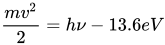
where h is the Planck constant and ν is the frequency of the photon.
This formula defines the photoelectric effect.
Not every photon which encounters an atom or ion will photoionize it. The probability of photoionization is related to the photoionization cross-section, which depends on the energy of the photon and the target being considered. For photon energies below the ionization threshold, the photoionization cross-section is near zero. But with the development of pulsed lasers it has become possible to create extremely intense, coherent light where multi-photon ionization may occur. At even higher intensities (around 1015 - 1016 W/cm2 of infrared or visible light), non-perturbative phenomena such as barrier suppression ionization[7] and rescattering ionization[8] are observed.
Multi-photon ionization
[edit]Several photons of energy below the ionization threshold may actually combine their energies to ionize an atom. This probability decreases rapidly with the number of photons required, but the development of very intense, pulsed lasers still makes it possible. In the perturbative regime (below about 1014 W/cm2 at optical frequencies), the probability of absorbing N photons depends on the laser-light intensity I as IN .[9]
Above threshold ionization (ATI) [10] is an extension of multi-photon ionization where even more photons are absorbed than actually would be necessary to ionize the atom. The excess energy gives the released electron higher kinetic energy than the usual case of just-above threshold ionization. More precisely, the system will have multiple peaks in its photoelectron spectrum which are separated by the photon energies, this indicates that the emitted electron has more kinetic energy than in the normal (lowest possible number of photons) ionization case. The electrons released from the target will have approximately an integer number of photon-energies more kinetic energy. In intensity regions between 1014 W/cm2 and 1018 W/cm2, each of MPI, ATI, and barrier suppression ionization can occur simultaneously, each contributing to the overall ionization of the atoms involved.[11]
Photo-Dember
[edit]In semiconductor physics the Photo-Dember effect (named after its discoverer H. Dember) consists in the formation of a charge dipole in the vicinity of a semiconductor surface after ultra-fast photo-generation of charge carriers. The dipole forms owing to the difference of mobilities (or diffusion constants) for holes and electrons which combined with the break of symmetry provided by the surface lead to an effective charge separation in the direction perpendicular to the surface.[12]
Grotthuss–Draper law
[edit]The Grotthuss–Draper law (also called the principle of photochemical activation) states that only that light which is absorbed by a system can bring about a photochemical change. Materials such as dyes and phosphors must be able to absorb "light" at optical frequencies. This law provides a basis for fluorescence and phosphorescence. The law was first proposed in 1817 by Theodor Grotthuss and in 1842, independently, by John William Draper.[5]
This is considered to be one of the two basic laws of photochemistry. The second law is the Stark–Einstein law, which says that primary chemical or physical reactions occur with each photon absorbed.[5]
Stark–Einstein law
[edit]The Stark–Einstein law is named after German-born physicists Johannes Stark and Albert Einstein, who independently formulated the law between 1908 and 1913. It is also known as the photochemical equivalence law or photoequivalence law. In essence it says that every photon that is absorbed will cause a (primary) chemical or physical reaction.[13]
The photon is a quantum of radiation, or one unit of radiation. Therefore, this is a single unit of EM radiation that is equal to the Planck constant (h) times the frequency of light. This quantity is symbolized by γ, hν, or ħω.
The photochemical equivalence law is also restated as follows: for every mole of a substance that reacts, an equivalent mole of quanta of light are absorbed. The formula is:[13]

where NA is the Avogadro constant.
The photochemical equivalence law applies to the part of a light-induced reaction that is referred to as the primary process (i.e. absorption or fluorescence).[13]
In most photochemical reactions the primary process is usually followed by so-called secondary photochemical processes that are normal interactions between reactants not requiring absorption of light. As a result, such reactions do not appear to obey the one quantum–one molecule reactant relationship.[13]
The law is further restricted to conventional photochemical processes using light sources with moderate intensities; high-intensity light sources such as those used in flash photolysis and in laser experiments are known to cause so-called biphotonic processes; i.e., the absorption by a molecule of a substance of two photons of light.[13]
Absorption
[edit]In physics, absorption of electromagnetic radiation is the way by which the energy of a photon is taken up by matter, typically the electrons of an atom. Thus, the electromagnetic energy is transformed to other forms of energy, for example, to heat. The absorption of light during wave propagation is often called attenuation. Usually, the absorption of waves does not depend on their intensity (linear absorption), although in certain conditions (usually, in optics), the medium changes its transparency dependently on the intensity of waves going through, and the Saturable absorption (or nonlinear absorption) occurs.
Photosensitization
[edit]Photosensitization is a process of transferring the energy of absorbed light. After absorption, the energy is transferred to the (chosen) reactants. This is part of the work of photochemistry in general. In particular this process is commonly employed where reactions require light sources of certain wavelengths that are not readily available.[14]
For example, mercury absorbs radiation at 1849 and 2537 angstroms, and the source is often high-intensity mercury lamps. It is a commonly used sensitizer. When mercury vapor is mixed with ethylene, and the compound is irradiated with a mercury lamp, this results in the photodecomposition of ethylene to acetylene. This occurs on absorption of light to yield excited state mercury atoms, which are able to transfer this energy to the ethylene molecules, and are in turn deactivated to their initial energy state.[14]
Cadmium; some of the noble gases, for example xenon; zinc; benzophenone; and a large number of organic dyes, are also used as sensitizers.[14]
Photosensitisers are a key component of photodynamic therapy used to treat cancers.
Sensitizer
[edit]A sensitizer in chemiluminescence is a chemical compound, capable of light emission after it has received energy from a molecule, which became excited previously in the chemical reaction. A good example is this:
When an alkaline solution of sodium hypochlorite and a concentrated solution of hydrogen peroxide are mixed, a reaction occurs:
- ClO−(aq) + H2O2(aq) → O2*(g) + H+(aq) + Cl−(aq) + OH−(aq)
O2*is excited oxygen – meaning, one or more electrons in the O2 molecule have been promoted to higher-energy molecular orbitals. Hence, oxygen produced by this chemical reaction somehow 'absorbed' the energy released by the reaction and became excited. This energy state is unstable, therefore it will return to the ground state by lowering its energy. It can do that in more than one way:
- it can react further, without any light emission
- it can lose energy without emission, for example, giving off heat to the surroundings or transferring energy to another molecule
- it can emit light
The intensity, duration and color of emitted light depend on quantum and kinetical factors. However, excited molecules are frequently less capable of light emission in terms of brightness and duration when compared to sensitizers. This is because sensitizers can store energy (that is, be excited) for longer periods of time than other excited molecules. The energy is stored through means of quantum vibration, so sensitizers are usually compounds which either include systems of aromatic rings or many conjugated double and triple bonds in their structure. Hence, if an excited molecule transfers its energy to a sensitizer thus exciting it, longer and easier to quantify light emission is often observed.
The color (that is, the wavelength), brightness and duration of emission depend upon the sensitizer used. Usually, for a certain chemical reaction, many different sensitizers can be used.
List of some common sensitizers
[edit]Fluorescence spectroscopy
[edit]Fluorescence spectroscopy aka fluorometry or spectrofluorometry, is a type of electromagnetic spectroscopy which analyzes fluorescence from a sample. It involves using a beam of light, usually ultraviolet light, that excites the electrons in molecules of certain compounds and causes them to emit light of a lower energy, typically, but not necessarily, visible light. A complementary technique is absorption spectroscopy.[15][16]
Devices that measure fluorescence are called fluorometers or fluorimeters.
Absorption spectroscopy
[edit]Absorption spectroscopy refers to spectroscopic techniques that measure the absorption of radiation, as a function of frequency or wavelength, due to its interaction with a sample. The sample absorbs energy, i.e., photons, from the radiating field. The intensity of the absorption varies as a function of frequency, and this variation is the absorption spectrum. Absorption spectroscopy is performed across the electromagnetic spectrum.[15][16]
See also
[edit]References
[edit]- ^ Gerischer, Heinz (1985). "Semiconductor electrodes and their interaction with light". In Schiavello, Mario (ed.). Photoelectrochemistry, Photocatalysis and Photoreactors Fundamentals and Developments. Springer. p. 39. ISBN 978-90-277-1946-1.
- ^ Madden, R. P.; Codling, K. (1965). "Two electron states in Helium". Astrophysical Journal. 141: 364. Bibcode:1965ApJ...141..364M. doi:10.1086/148132.
- ^ Mammana, A.; et al. (2011). "A Chiroptical Photoswitchable DNA Complex" (PDF). Journal of Physical Chemistry B. 115 (40): 11581–11587. doi:10.1021/jp205893y. PMID 21879715. S2CID 33375716.
- ^ Vachon, J.; et al. (2014). "An ultrafast surface-bound photo-active molecular motor". Photochemical and Photobiological Sciences. 13 (2): 241–246. Bibcode:2014PhPhS..13..241V. doi:10.1039/C3PP50208B. PMID 24096390. S2CID 23165784.
- ^ a b c d "Radiation". Encyclopædia Britannica Online. Retrieved 9 November 2009.
- ^ Carroll, B. W.; Ostlie, D. A. (2007). An Introduction to Modern Astrophysics. Addison-Wesley. p. 121. ISBN 978-0-321-44284-0.
- ^ Delone, N. B.; Krainov, V. P. (1998). "Tunneling and barrier-suppression ionization of atoms and ions in a laser radiation field". Physics-Uspekhi. 41 (5): 469–485. Bibcode:1998PhyU...41..469D. doi:10.1070/PU1998v041n05ABEH000393. S2CID 250763981.
- ^ Dichiara, A.; et al. (2005). "Cross-shell multielectron ionization of xenon by an ultrastrong laser field". Proceedings of the Quantum Electronics and Laser Science Conference. Vol. 3. Optical Society of America. pp. 1974–1976. doi:10.1109/QELS.2005.1549346. ISBN 1-55752-796-2.
- ^ Deng, Z.; Eberly, J. H. (1985). "Multiphoton absorption above ionization threshold by atoms in strong laser fields". Journal of the Optical Society of America B. 2 (3): 491. Bibcode:1985JOSAB...2..486D. doi:10.1364/JOSAB.2.000486.
- ^ Agostini, P.; et al. (1979). "Free-Free Transitions Following Six-Photon Ionization of Xenon Atoms". Physical Review Letters. 42 (17): 1127–1130. Bibcode:1979PhRvL..42.1127A. doi:10.1103/PhysRevLett.42.1127.
- ^ Nandor, M.; et al. (1999). "Detailed comparison of above-threshold-ionization spectra from accurate numerical integrations and high-resolution measurements". Physical Review A. 60 (3): 1771–1774. Bibcode:1999PhRvA..60.1771N. doi:10.1103/PhysRevA.60.R1771.
- ^ Dekorsy, T.; et al. (1996). "THz electromagnetic emission by coherent infrared-active phonons" (PDF). Physical Review B. 53 (7): 4005–4014. Bibcode:1996PhRvB..53.4005D. doi:10.1103/PhysRevB.53.4005. PMID 9983955.
- ^ a b c d e "Photochemical equivalence law". Encyclopædia Britannica Online. Retrieved 7 November 2009.
- ^ a b c "Photosensitization". Encyclopædia Britannica Online. Retrieved 10 November 2009.
- ^ a b Hollas, J. M. (2004). Modern Spectroscopy (4th ed.). John Wiley & Sons. ISBN 978-0-470-84416-8.
- ^ a b Harris, D. C.; Bertolucci, M. D. (1978). Symmetry and Spectroscopy: An introduction to vibrational and electronic spectroscopy (Reprint ed.). Dover Publications. ISBN 978-0-486-66144-5.
Photoelectrochemical process
View on GrokipediaFundamentals
Definition and Principles
Photoelectrochemical (PEC) processes are light-driven electrochemical reactions that occur at the interface between a semiconductor and an electrolyte, where photons absorbed by the semiconductor generate electron-hole pairs to drive redox reactions, which may or may not require an external electrical bias depending on the configuration.[2] These processes combine elements of photovoltaics, in which light induces charge separation in a semiconductor, and electrochemistry, where the separated charges participate in interfacial redox events such as water splitting or pollutant degradation.[7] The efficiency of PEC systems depends on the semiconductor's ability to absorb solar photons effectively while providing sufficient driving force for the desired reactions. Fundamental to PEC operation is the role of the semiconductor band gap, which determines the wavelengths of light that can be absorbed and the potential generated for electrochemical work. The band gap energy corresponds to the minimum photon energy required for excitation across the valence and conduction bands, expressed asHistorical Development
The discovery of the photovoltaic effect, foundational to photoelectrochemical processes, occurred in 1839 when French physicist Edmond Becquerel observed the generation of a photovoltage at a metal-electrolyte interface during experiments with electrodes immersed in an electrolytic solution.[10] This early observation laid the groundwork for understanding light-induced charge separation at interfaces, though practical applications remained elusive for over a century.[11] Significant progress in semiconductor-based photoelectrochemistry emerged in the 1950s through the work of Walter H. Brattain and Charles G. B. Garrett at Bell Laboratories, who investigated the interface between germanium electrodes and aqueous electrolytes.[12] Their experiments demonstrated light-dependent changes in electrode potential and current, establishing the semiconductor-electrolyte junction as a key site for photoelectrochemical reactions and bridging solid-state physics with electrochemistry.[13] The 1970s marked a pivotal era for photoelectrochemical research, spurred by the global oil crises of 1973 and 1979, which intensified efforts to harness solar energy for alternative fuels.[14] This context propelled the seminal 1972 experiment by Akira Fujishima and Kenichi Honda, who reported the photoelectrochemical splitting of water into hydrogen and oxygen using a titanium dioxide (TiO₂) semiconductor photoanode under ultraviolet illumination, achieving bias-free decomposition in a simple cell configuration.[15] Their work, often termed the Honda-Fujishima effect, demonstrated the potential of semiconductors for direct solar-to-chemical energy conversion and ignited widespread interest in photoelectrochemical water splitting.[16] Building on these foundations, Michael Grätzel advanced the field in 1991 by developing dye-sensitized solar cells that incorporated photoelectrochemical principles, using a mesoporous TiO₂ film sensitized with ruthenium-based dyes to achieve over 7% power conversion efficiency under standard sunlight conditions. This innovation extended PEC concepts to efficient photovoltaic devices, emphasizing low-cost materials and electrolyte-based charge transfer. In the 2010s, tandem photoelectrochemical-photovoltaic (PEC-PV) systems emerged as a major milestone, with configurations integrating wide-bandgap PEC absorbers and narrow-bandgap PV cells to surpass 10% solar-to-hydrogen (STH) efficiency for unassisted water splitting, using configurations such as silicon heterojunction PV cells.[17][18] By 2025, advancements in perovskite-silicon tandems and other configurations have pushed unassisted STH efficiencies beyond 10%, reaching records like 10.36% for scalable systems.[19] These developments evolved PEC processes from fundamental photovoltage observations to integrated, scalable systems for sustainable hydrogen production, addressing global energy challenges.[18]Photoelectrochemical Cells
Components and Configuration
A photoelectrochemical (PEC) cell fundamentally comprises a photoelectrode, a counter electrode, an electrolyte, and often a membrane or separator to facilitate controlled operation. The photoelectrode, typically a semiconductor material, serves as the site for light absorption and initial charge generation, while the counter electrode, often a metal like platinum or another semiconductor, completes the circuit by enabling the complementary electrochemical reaction. The electrolyte, which can be aqueous or non-aqueous, contains redox couples or ions to mediate charge transfer between electrodes and maintain ionic conductivity.[20][21] In configurations designed for water splitting, a membrane or separator is commonly incorporated to prevent the mixing of evolved gases, such as hydrogen and oxygen, ensuring safe and efficient product separation.[20] PEC cells are assembled in various configurations depending on the application, with laboratory testing often employing a three-electrode setup that includes a working electrode (the photoelectrode), a reference electrode (e.g., saturated calomel electrode), and a counter electrode connected via a potentiostat for precise potential control and measurement. This arrangement allows isolated evaluation of the photoelectrode's performance without interference from other cell components. For practical, bias-free operation, two-electrode tandem configurations pair a photoanode and photocathode directly, mimicking full solar-to-chemical conversion without external wiring for applied bias, as seen in integrated devices for hydrogen production. Wiring for optional external bias is included in setups requiring additional voltage to overcome kinetic barriers.[21][20] Operationally, PEC cells are illuminated using a solar simulator calibrated to standard conditions, such as AM 1.5 global spectrum at 100 mW/cm², to replicate sunlight exposure on the photoelectrode. Flow systems are integrated to circulate the electrolyte, manage reactant supply, and collect gaseous products like hydrogen, often routing outputs through separate compartments to handle volumes and prevent back-diffusion. Safety considerations are paramount in hydrogen evolution setups, where separators and venting mechanisms mitigate explosion risks from gas accumulation.[20][21] A typical schematic of a PEC cell depicts the photoelectrode and counter electrode immersed in the electrolyte, separated by a membrane if present, with an external circuit connecting them; band bending at the semiconductor-electrolyte interface is illustrated to show the spatial arrangement for charge flow under illumination.[20]Types of PEC Cells
Photoelectrochemical (PEC) cells are broadly classified into several architectures based on their operational principles, electrode configurations, and intended functions, ranging from direct solar fuel production to electricity generation and specialized applications. These types differ primarily in how they handle charge generation, separation, and utilization, with photoelectrolytic cells focusing on bias-free chemical synthesis, photovoltaic-electrochemical (PV-EC) tandems integrating separate components for enhanced performance, and regenerative cells emphasizing reversible redox processes without net chemical change. Other variants address niche roles like gradient-driven transport or detection. Photoelectrolytic cells (PECs), also known as photoelectrosynthetic cells, operate without external bias by leveraging the band edges of semiconductor photoelectrodes to straddle the redox potentials of water, enabling unassisted splitting into hydrogen and oxygen. In this configuration, illumination generates electron-hole pairs in the semiconductor, driving oxidation at the photoanode and reduction at the cathode, with examples including TiO₂-based systems that achieve solar-to-hydrogen (STH) efficiencies around 3% under lab conditions.[22] These cells integrate light absorption, charge separation, and catalysis in a single device, promoting autonomous operation for sustainable fuel production. However, challenges such as poor charge transport and stability limit their practical efficiencies. Photovoltaic-electrochemical (PV-EC) tandem cells decouple light harvesting from catalysis by pairing a photovoltaic component, such as a perovskite solar cell, with an electrochemical cell containing catalysts for reactions like water splitting. The PV module generates the necessary voltage to bias the EC part, allowing higher overall efficiencies; for instance, a BiVO₄ photoanode coupled with a perovskite PV has demonstrated an STH efficiency of 6.2%.[23] This design benefits from the maturity of PV technology for scalable voltage supply but requires precise integration to minimize losses at interfaces, resulting in increased complexity and costs compared to monolithic PECs. Regenerative PEC cells function without net chemical reactions, converting light to electrical energy via reversible redox couples, such as the iodide/triiodide (I⁻/I₃⁻) system in dye-sensitized configurations. Here, photoexcitation in the semiconductor drives the redox cycle, with electrons flowing externally to produce current, akin to dye-sensitized solar cells achieving efficiencies over 14% when integrated into flow batteries for energy storage. These cells excel in electricity generation but do not produce fuels, making them suitable for applications prioritizing power output over synthesis. Other PEC variants include concentration cells that exploit light-induced ion or charge gradients for energy conversion or storage. In these systems, illumination creates asymmetric concentration profiles across a membrane or nanofluidic channel, driving ion transport against gradients via photo-generated potentials, as demonstrated in spiropyran-based devices that enable repetitive charging under visible light.[24] Additionally, PECs adapted for sensing utilize photocurrent modulation by target analytes binding to the semiconductor surface, offering high sensitivity for detecting biomolecules or pollutants with limits down to nanomolar levels in biosensor formats.| Type | Pros | Cons |
|---|---|---|
| Photoelectrolytic (PECs) | Simple, bias-free design; integrated solar-to-fuel conversion | Low STH efficiency (~3%); stability issues in electrolytes |
| PV-EC Tandem | Higher efficiency (up to >20% STH as of 2025); leverages mature PV tech for scalability | Complex assembly; higher costs due to multi-component integration |
| Regenerative | Reversible operation; high electricity conversion (>14%); suitable for storage | No net fuel production; limited to power generation |
| Concentration & Sensing | Enables gradient-driven processes or ultrasensitive detection; versatile for niche uses | Lower energy densities; application-specific, less focus on large-scale energy |