Hubbry Logo
PiculetPiculetMain
Open search
Piculet
Community hub
Piculet
logo
8 pages, 0 posts
0 subscribers
Be the first to start a discussion here.
Piculet
Piculet
from Wikipedia
Not found
Revisions and contributorsEdit on WikipediaRead on Wikipedia
from Grokipedia
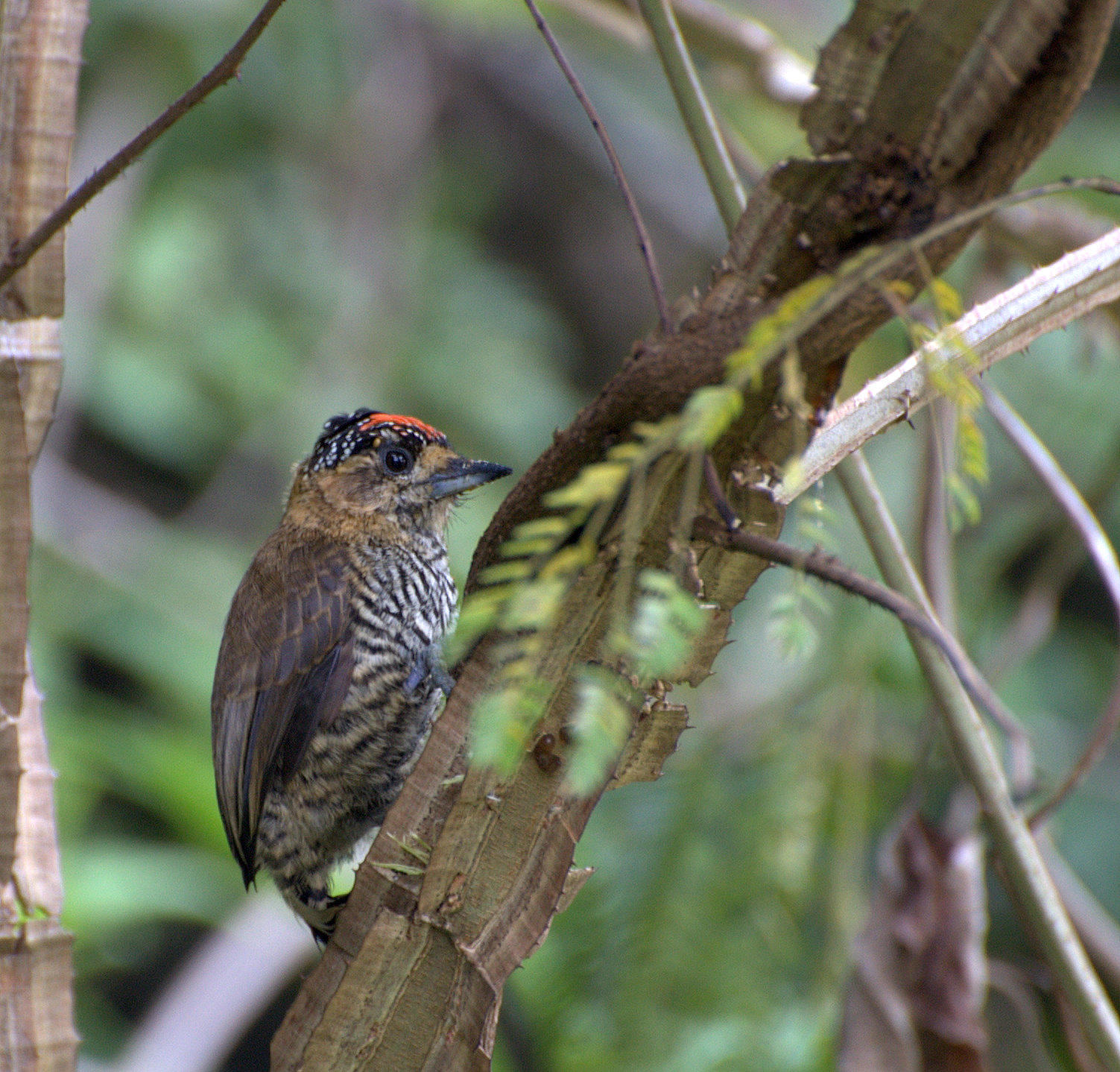
Piculets are a distinctive subfamily of small woodpeckers, Picumninae, within the family Picidae, encompassing 30 across three genera: Sasia, Verreauxia, and . These tiny, short-tailed birds, typically measuring 9–11 cm in length and weighing 8–14 g, possess straight, pointed bills adapted for probing rather than heavy excavation, and they exhibit a distribution primarily concentrated in the Neotropics of Central and , with isolated in and . Piculets inhabit diverse woodland environments, including humid and dry forests, scrublands, gallery forests, and woodland edges, often at elevations from up to 2,100 m. Their is generally cryptic and barred or spotted in shades of , , white, and buff, providing among foliage and branches; males often feature or orange crowns, while females have or ones. Unlike larger woodpeckers, piculets have soft, rounded tail feathers unsuitable for propping against trunks and instead move nuthatch-like, clinging to slender twigs and vines while . Their diet consists mainly of small , , larvae, and eggs, supplemented occasionally by or , which they extract by from leaves, probing crevices, or lightly hammering into decaying wood. Piculets are typically solitary or found in pairs, producing high-pitched, whinnying calls rather than loud drumming, and they excavate small nest cavities in soft, dead wood or branches, often low to the ground. While most are widespread, habitat destruction poses threats to several, including the near-threatened speckle-chested piculet (Picumnus steindachneri).

Taxonomy and Systematics

Classification and Genera

Piculets are classified within the order , family Picidae, and subfamily Picumninae, distinguishing them from the larger true woodpeckers of the subfamily Picinae and the wrynecks of the subfamily Jynginae. This placement reflects their shared morphological and genetic traits with woodpeckers, such as zygodactyl feet and specialized bill structures adapted for , while emphasizing their smaller size and distinct behaviors. The subfamily Picumninae comprises approximately 29 species distributed across three genera: Picumnus, Sasia, and Verreauxia. The genus Picumnus is the most diverse, containing approximately 26–27 species primarily found in the Neotropics, with one species extending to ; these include small, inconspicuous birds like the speckled piculet (Picumnus innominatus). In contrast, Sasia includes two species restricted to Southeast Asian forests, such as the rufous piculet (Sasia abnormis), characterized by their olive-brown and localized distributions. The monotypic genus Verreauxia consists of a single African species, the African piculet (Verreauxia africana), which was previously classified under Sasia but elevated based on morphological and genetic distinctions. Recent taxonomic revisions within Picumninae have been driven by molecular phylogenetic analyses, including mitochondrial and nuclear . Notably, the Antillean piculet (Nesoctites micromegas), traditionally grouped with piculets, has been proposed for elevation to its own , Nesoctitinae (Benz et al. 2006), supported by evidence showing it as evolutionarily distinct and sister to the core woodpecker lineages (Picinae) rather than a true piculet; however, this placement is not universally accepted and some sources retain it within Picumninae. This change highlights the paraphyletic nature of earlier Picumninae classifications and underscores the role of genetic data in refining avian taxonomy. More recently, a 2022 molecular study proposed a new , Sasinae, for the genera Sasia and Verreauxia, separating them from Picumnus due to their distinct phylogenetic position.

Etymology and Naming

The term "piculet" derives from the Latin picus, meaning "," combined with a suffix to emphasize the birds' small size, translating as "little ." It entered English usage around 1840–1850 as a borrowing that reflects this form, and is linked to the French "piculete" or "picumne," a term coined by Dutch zoologist Coenraad Temminck in 1825 for these s. The primary genus Picumnus, established by Temminck in 1825 and encompassing most piculet species, originates from Latin picus (woodpecker) augmented by the diminutive suffix -umnus, again denoting a "little woodpecker." This naming convention draws from ancient Roman associations, including the mythological figure , a linked to and sometimes depicted as a . The Asian genus Sasia, introduced by British naturalist in 1837, likely stems from a local Nepalese name "Sasya" applied to the white-browed piculet (Sasia ochracea), or possibly honors the Italian naturalist M. Sassi; alternative derivations suggest Greek roots driis (tree) and allomai (to leap), implying a tree-leaping bird. The monotypic African genus Verreauxia, created in 1861 by French ornithologist for the African piculet (Verreauxia africana), commemorates the French naturalist brothers Jules Pierre Verreaux (1807–1873) and Jean Baptiste Édouard Verreaux (1810–1868), prominent collectors and dealers in specimens. Common names for piculets frequently highlight plumage characteristics, such as the "speckled piculet" (Picumnus innominatus), where "speckled" describes the bird's spotted markings, and the specific innominatus is Latin for "unnamed," alluding to its initial obscurity in ornithological records.

Evolutionary History

Origins and

The piculet lineages within the subfamily Picumninae originated during the , approximately 8 million years ago (MYA), as part of the broader of the (Picidae) in tropical regions. This timing aligns with molecular analyses calibrated using biogeographic events, reflecting the expansion of forested habitats and climatic changes that facilitated diversification within the order. Molecular phylogenetic reconstructions, based on sequences, indicate divergences among piculet genera around 7.9 MYA (split between African and Indo-Malayan Sasia; split between New World and Old World Picumnus), though of Picumninae could not be recovered with confidence in early studies. These divergences are part of a broader trichotomy involving the sister subfamily Picinae, dated to approximately 15.5 MYA, indicating an early origin for the major clades. Earlier analyses suggest the initial separation of piculet lineages from Picinae may extend to 20–25 MYA, underscoring the deep evolutionary history of these small woodpeckers within the family. Fossil evidence for piculets remains limited, with no direct specimens of Picumninae identified to date; however, the evolutionary origins of the group are inferred from early piciform remains dating back to the Eocene epoch (approximately 55–34 MYA), which document the ancient diversification of woodpecker-like birds in both the Old and New Worlds. Subsequent , particularly within the speciose Picumnus (encompassing 27 ), occurred in during the Pliocene and Pleistocene epochs (5.3 MYA to 11,700 years ago), driven by climatic oscillations, , and the isolation of tropical forests that promoted and partitioning.

Biogeographic Patterns

Piculets exhibit a distribution, with the Picumninae comprising approximately 30 across three genera adapted to forested habitats in the . The genus Picumnus dominates in the Neotropics, with 26 primarily in Central and , while a single , Picumnus innominatus, occurs in ; Sasia is restricted to n forests from to , encompassing two ; and Verreauxia, a monotypic genus, inhabits West and Central African forests. Recent taxonomic proposals (Sangster et al. 2022) suggest restricting Picumninae to Picumnus and elevating Sasia and Verreauxia to a new , Sasiinae, due to doubts about Picumninae . Phylogenetic analyses indicate an origin for piculets, with overland migration from facilitating colonization of Asian and African regions during the . For the Neotropical radiation of Picumnus, hypotheses include trans-Atlantic dispersal across the widening or vicariance driven by the uplift of the northern and expansion of grasslands, which fragmented tropical forest connectivity around 7.9 million years . These events, tied to climatic cooling and formation, isolated lineages and promoted intercontinental disjunctions. In the , Pleistocene climatic oscillations created forest refugia that drove within , with stable refugial populations in Amazonia supporting isolated evolutionary lineages, contributing to the high observed today. Endemism patterns highlight insular diversification, as seen in the Antillean piculet (Nesoctites micromegas), which represents a distinct lineage formerly classified within and is now placed in its own genus in the subfamily Picinae, reflecting historical isolation on islands.

Physical Characteristics

Size and Morphology

Piculets, members of the subfamily Picumninae, are among the smallest woodpeckers, with most species measuring 8–12 cm in length and weighing 8–15 g, though some like the Antillean piculet (Nesoctites micromegas) reach 11–16 cm and 30 g. This diminutive size distinguishes them from larger woodpeckers in the subfamily , contributing to their agile, nuthatch-like climbing behavior on slender branches. Key morphological traits include a short, straight bill that is notably shorter and less chisel-like than in typical woodpeckers, adapted for probing rather than heavy excavation. They possess zygodactyl feet, with two toes forward and two backward, facilitating secure perching and movement along vertical surfaces. Their tongues are long and sticky, similar to those of other woodpeckers, enabling extraction of from crevices, though scaled to their small body size. Unlike typical woodpeckers, piculets lack stiffened tail feathers for prop support, relying instead on their short, soft tails and flexible bodies for balance. Skeletal adaptations support their lightweight build and style, including a flexible neck enhanced by specialized musculature such as the M. scalenus and Mm. levatores costarum, allowing extended head movements. The ribs show modifications for stability during pounding, with the first thoracic rib broadened and the second floating rib enlarged at vertebral attachments. is minimal, primarily manifested in males possessing red crowns or patches, while females typically have dark crowns, often with spotting or markings.

Plumage and Coloration

Piculets exhibit plumage that is generally subdued and cryptic, aiding their arboreal . The upperparts are typically dull green, gray-brown, or olive, often featuring fine barring or scaling for blending with bark and foliage. Underparts are usually white or buff, marked with dark streaks, spots, or a scaled appearance created by feathers with pale edges and darker centers. For instance, the Scaled Piculet (Picumnus squamulatus) displays prominent scaling on both upperparts and underparts, with sandy brown upperparts and dirty white underparts accented by blackish tips on feathers. Sexual dimorphism is evident primarily in head coloration, where males often possess a red or yellow or forecrown patch contrasting against a black cap, while females show a black with white or yellowish spotting. Juveniles are duller overall, with reduced streaking or spotting on the underparts and a mottled buff or gray lacking the vivid male markings. Plumage patterns vary by genus, contributing to camouflage in forested environments. Species in the genus Picumnus tend toward bolder barring or scaling on the body, enhancing disruption against tree trunks. In contrast, the genus Sasia features finer streaking, with olive-green upperparts tinged rufous or ochre and subtle buff underparts, allowing seamless integration into dense understory foliage. These adaptations provide effective visual concealment during foraging on branches. Most piculets undergo an annual complete molt following a Complex Basic Strategy, replacing body feathers, primaries, and tail feathers progressively. In some , such as the Mottled Piculet (Picumnus nebulosus), molting occurs primarily from to March, with retained juvenile feathers in younger birds leading to temporarily brighter or more uniform coloration during breeding seasons.

Distribution and Habitat

Geographic Range

Piculets of the subfamily Picumninae display a distribution, primarily confined to tropical regions of the , , and , encompassing four genera: Picumnus, Sasia, Verreauxia, and Nesoctites. This distribution reflects their adaptation to warm, forested environments, with approximately 31 species in total across these continents. The genus Picumnus dominates the Neotropical range, extending from southern southward through and into as far as northern . Within this expanse, species diversity peaks in the , where over 20 Picumnus species occur, many forming closely related superspecies groups indicative of recent regional diversification. One outlier, Picumnus innominatus, extends the genus into Asia. The monotypic genus Nesoctites is endemic to the island of . In , the genus Sasia accounts for the piculet presence, with species ranging from northeastern and southern through to the Greater Sundas and , including habitats in countries such as , , , and . The African representation is limited to the monotypic genus Verreauxia, with Verreauxia africana distributed across West and Central African forests from and eastward to the , including nations like Côte d'Ivoire, , , and . Notably, piculets are absent from temperate zones worldwide, , and nearly all of beyond southern , underscoring their strict tropical affinity. is prominent in certain lineages, such as several Picumnus species restricted to specific Neotropical locales and the genus Nesoctites on , though intercontinental disjunctions highlight historical biogeographic barriers.

Habitat Preferences

Piculets primarily inhabit tropical lowland forests, woodlands, and secondary growth areas, favoring open understories over dense vegetation to facilitate their foraging and movement. These birds seek environments rich in decaying wood, which provides essential resources for nesting and feeding; for instance, several species in the genus Picumnus preferentially occupy bamboo thickets and riparian zones where such substrates abound. In the Andean region, piculets extend their range to elevations up to 2,000 m, particularly in foothill forests along the eastern slopes. Habitat preferences vary across genera, reflecting their biogeographic distributions. The genus Picumnus, comprising the majority of piculet species, thrives in humid Amazonian and other Neotropical forests, including both primary and degraded woodlands with scattered trees. In contrast, species of the genus Sasia in Southeast Asia favor dipterocarp-dominated evergreen forests, dense second growth, and scrublands, often near watercourses and with abundant bamboo understory. The African piculet (Verreauxia africana) is restricted to humid Guinean savanna-forest mosaics, gallery forests, and ecotones between primary and secondary growth in West and Central Africa. The Antillean piculet (Nesoctites micromegas) inhabits a variety of dry and humid forests, mangroves, and wooded areas on Hispaniola, often in open habitats. Many piculets exhibit adaptability to modified landscapes, such as edges, plantations, and mangroves, allowing persistence in human-altered areas with retained woody . However, they show high sensitivity to full , as it eliminates the decaying wood and structural complexity critical to their survival.

Behavior and Ecology

Foraging and Diet

Piculets are primarily insectivorous birds, with their diet consisting mainly of , , beetles, weevils, and their larvae, which they extract from bark, , and decaying wood. Species such as the Speckled Piculet (P. innominatus) also consume spiders and insect eggs, while the Mottled Piculet (P. nebulosus) shows a strong preference for and insect larvae. The Rufous-breasted Piculet (P. rufiventris) focuses on and their larvae found in internodes. Foraging methods in piculets emphasize and probing over extensive excavation, allowing these small birds to exploit narrow crevices in thin branches (typically 1–4 cm in diameter). They use their short, slightly curved bill to tap and peck small holes in substrates like live and dead wood, then deploy a long, extensible tongue to retrieve hidden prey, often hanging upside down or moving agilely along twigs and vines. This technique is evident in species like the Ochraceous Piculet (P. limae), which pecks on slender branches to access larvae. Unlike larger woodpeckers, piculets rarely create large cavities, relying instead on their zygodactyl feet for stability on delicate perches at heights of 1–8 m. Piculets are diurnal foragers, active from dawn to dusk, and typically hunt in pairs or small family groups, though they may join mixed-species flocks outside the breeding season. For instance, the Rufous-breasted Piculet has been observed in pairs 78% of the time, sometimes associating with flocks that flush insects. They target vegetation, forest edges, and scrub, pursuing flushed prey by hovering or short flights when necessary. In their , piculets contribute to within canopies and understories, particularly by preying on wood-boring larvae and colonial that could otherwise damage vegetation. This role is supported by their specialized foraging on decaying wood and epiphytes, helping maintain balance in tropical and subtropical habitats.

Reproduction and Breeding

Piculets exhibit monogamous systems, with pairs forming for the breeding season and cooperating in all aspects of . Breeding seasons vary by region; in Neotropical , it typically occurs during wet periods, such as to in northern regions, though it shifts to through in southern populations like those in . In Asian Sasia , breeding takes place from to , while in African Verreauxia africana, laying spans to , with similar cavity excavation in dead wood. Pairs excavate small nesting cavities in soft, dead wood, often in branches or trunks 1–5 m above ground, with entrance diameters around 2–2.5 cm. Cavities are unlined or sparsely lined with wood chips and measure about 10–11 cm deep and 5–6 cm wide. Clutch sizes range from 2 to 4 glossy white eggs, which are short-oval in shape and measure approximately 16.3 × 13.0 , weighing about 1.38 g on average. Incubation, lasting 13–17 days, is shared by both parents, with on-bout durations of 30–50 minutes per sex and near-constant attentiveness during this period. Nestlings hatch altricial, blind, and featherless, developing pin feathers and opening eyes around day 13. The nestling period spans 20–27 days, after which young but remain dependent on parents for feeding. Parental care shows minimal , with both sexes brooding early nestlings, delivering food at intervals of 4–13 minutes (primarily ant larvae and small ), and removing fecal sacs—females handling about 71% in like the Ochre-collared Piculet. Pairs often roost together in the nest cavity before egg-laying, during incubation, and post-fledging with offspring. includes vocal trills to attract mates and defend territories.

Conservation Status

The genus Picumnus comprises approximately 27 of piculets, most of which are assessed as Least Concern on the due to their relatively wide distributions and presumed stable populations in intact forest habitats. However, a small number face higher risks, including the Speckle-chested Piculet (Picumnus steindachneri) and Varzea Piculet (Picumnus varzeae), both classified as Near Threatened owing to their restricted ranges and ongoing habitat degradation. The Mottled Piculet (Picumnus nebulosus) and Grayish Piculet (Picumnus granadensis) are both rated Least Concern as of the 2025 IUCN Red List update, with suspected declines driven by forest cover loss in their Andean and Central American ranges, respectively. No in the genus is currently categorized as Endangered globally. Population trends for most piculets remain unquantified, particularly for understudied species, but available data indicate stability in core Neotropical ranges with sufficient forest cover, while declines occur in fragmented landscapes. For instance, the Olivaceous Piculet (Picumnus olivaceus) is estimated to number 500,000–4,999,999 mature individuals and is considered fairly common, suggesting a stable trend. The global population across the genus likely exceeds 1 million individuals, based on estimates for common species like the Ochraceous Piculet (approximately individuals), though comprehensive monitoring is lacking for many. The primary threats to piculets stem from habitat loss and fragmentation due to for agricultural expansion and cattle ranching, which disproportionately affect species reliant on lowland and montane forests. For example, the Varzea Piculet (Picumnus varzeae) in Brazilian Amazonia has experienced severe declines from clearance of varzea forests, though its status improved to Near Threatened in 2022 after targeted surveys. Secondary threats include the use of pesticides in agricultural areas, which reduce availability of prey central to piculet diets. Climate change may exacerbate these pressures by altering forest dynamics and prey distribution in tropical regions. Significant data gaps persist in population monitoring, especially for remote tropical populations in and , where field studies are limited and trends for many rely on indirect indicators like cover change. Asian piculet species in related genera (e.g., Sasia) face similar threats but are not part of Picumnus, highlighting the need for genus-specific assessments in the Neotropics.

Conservation Measures

Conservation efforts for piculets focus on habitat protection and restoration, given their reliance on forested environments across the Neotropics and Asia. Key protected areas include in , which safeguards several Picumnus species such as the bar-breasted piculet (Picumnus aurifrons) and rufous-breasted piculet (Picumnus rufiventris). In , in Malaysia encompasses over 92% of the range of the rufous piculet (Sasia abnormis) and supports its persistence in lowland forests. These sites, designated as Important Bird and Biodiversity Areas (IBAs) by , provide essential refuges from pressures. BirdLife International leads monitoring initiatives through species factsheets and IBA programs, recommending actions such as site protection, artificial nesting provisions, and translocation for woodpeckers including piculets. projects in Brazil's Amazon region, such as those restoring degraded lands through native , indirectly benefit piculet habitats by enhancing forest connectivity. In , restoration efforts in support forests critical for Asian piculets like Sasia species. Research priorities include genetic studies to assess subspecies structure and phylogeographic patterns, as seen in analyses of the ochraceous piculet (Picumnus limae) and white-browed piculet (Sasia ochracea). Citizen science platforms like eBird facilitate population tracking by aggregating observer data on piculet sightings, aiding in trend monitoring across their ranges. Successes include stable populations of species like the speckled piculet ( innominatus) in conserved and restored secondary forests, where avian communities recover post-restoration. Piculets are not currently listed under appendices, though enhanced trade regulations could address potential future risks from habitat loss.

References

Add your contribution
Related Hubs
User Avatar
No comments yet.