


Community hub
Recent from talks
Contribute something
Nothing was collected or created yet.
Pieris rapae
View on Wikipedia
| Small white | |
|---|---|

| |
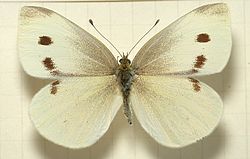
| Female | |

| |
| Male | |
Scientific classification 
| |
| Kingdom: | Animalia |
| Phylum: | Arthropoda |
| Class: | Insecta |
| Order: | Lepidoptera |
| Family: | Pieridae |
| Genus: | Pieris |
| Species: | P. rapae
|
| Binomial name | |
| Pieris rapae (Linnaeus, 1758)
| |
| Synonyms | |
|
Papilio rapae Linnaeus, 1758 | |

Pieris rapae is a small-to-medium-sized butterfly species of the whites-and-yellows family Pieridae. It is known in Europe as the small white, in North America and the United Kingdom as the cabbage white or cabbage butterfly,[note 1] on several continents as the small cabbage white, and in New Zealand as the white butterfly.[2] The butterfly is recognizable by its white color with small black dots on its wings, and it can be distinguished from P. brassicae by the latter's larger size and black band at the tip of the forewings.
The caterpillar of this species, often referred to as the "imported cabbageworm", is a pest to crucifer crops such as cabbage, kale, bok choy and broccoli. Pieris rapae is widespread in Europe and Asia; it is believed to have originated in the Eastern Mediterranean region of Europe and to have spread across Eurasia thanks to the diversification of brassicaceous crops and the development of human trade routes. Over the past two centuries, it spread to North Africa (about 1800), North America (1860s), Hawaii (1897), New Zealand (1930), and Australia (1937), as a result of accidental introductions.[3]
Description
[edit]
.jpg)
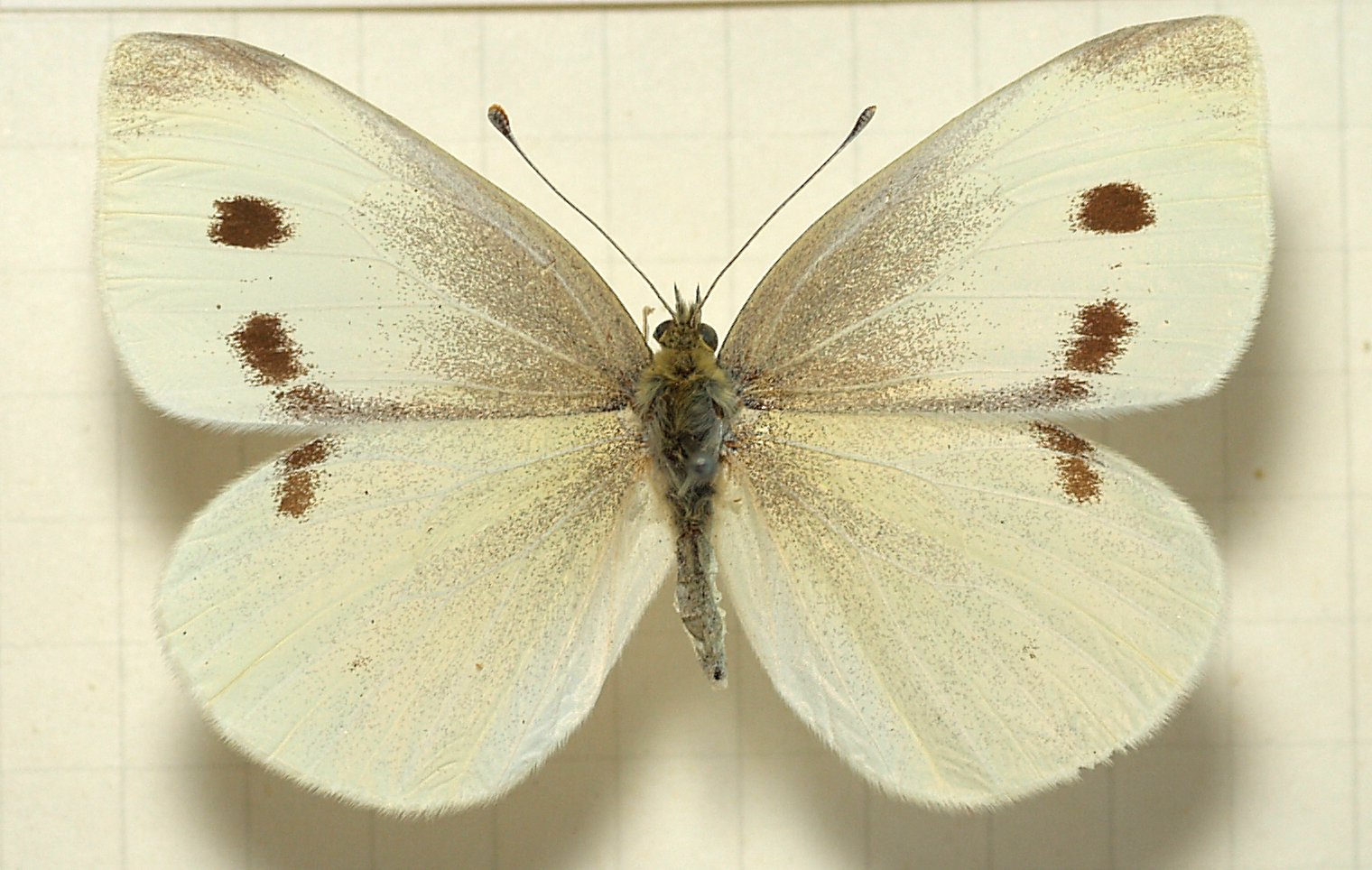
In appearance it looks like a smaller version of the large white (Pieris brassicae). The upperside is creamy white with black tips on the forewings. Females also have two black spots in the center of the forewings. Its underwings are yellowish with black speckles. It is sometimes mistaken for a moth due to its plain appearance. The wingspan of adults is roughly 32–47 mm (1.3–1.9 in).[4]
Pieris rapae has a wingbeat frequency averaging 12.8 flaps per second.[5]
Distribution and habitat
[edit]

The species has a natural range across Europe, Asia, and North Africa.[6] It was accidentally introduced to Quebec, Canada, around 1860 and spread rapidly throughout North America.[7] The species has spread to all North American life zones from Lower Austral/Lower Sonoran to Canada.[8] Estimates show that a single female of this species might be the progenitor in a few generations of millions.[9][10] It is absent or scarce in desert and semidesert regions (except for irrigated areas). It is not found north of Canadian life zone, nor on Channel Islands off the coast of southern California. By 1898, the small white had spread to Hawaii; by 1929, it had reached New Zealand[11] and the area around Melbourne, Australia, and found its way to Perth as early as 1943. It does not seem to have made it to South America.
In Britain, it has two flight periods, April–May and July–August, but is continuously brooded in North America, being one of the first butterflies to emerge from the chrysalis in the spring and flying until hard freeze in the fall.
The species can be found in any open area with diverse plant association. It can be seen usually in towns, but also in natural habitats, mostly in valley bottoms. Although an affinity towards open areas is shown, the small white is found to have entered even small forest clearings in recent years.[12]
The nominate subspecies P. r. rapae is found in Europe, while Asian populations are placed in the subspecies P. r. crucivora. Other subspecies include atomaria, eumorpha, leucosoma, mauretanica, napi, novangliae, and orientalis.
Life cycle
[edit]
The small white will readily lay eggs on both cultivated and wild members of the cabbage family, such as charlock (Sinapis arvensis) and hedge mustard (Sisymbrium officinale). P. rapae is known to lay eggs singularly on the host plant. The egg is characterized by a yellowish color and 12 longitudinal ridges.[13] The egg production peaks about a week after adulthood in lab and the female can live up to 3 weeks. Females tend to lay fewer eggs on plants in clumps than on isolated plants.[8][14] It has been suggested that isothiocyanate compounds in the family Brassicaceae may have been evolved to reduce herbivory by caterpillars of the small white.[15] However, this suggestion is not generally accepted because the small white has later been shown to be immune to the isothiocyanate forming reaction due to a specific biochemical adaptation. In contrast, the small white and relatives seem to have evolved as a consequence of this biochemical adaptation to the isothiocyanate-forming glucosinolates.

Traditionally known in the United States as the imported cabbage worm, now more commonly the cabbage white, the caterpillars are bluish-green, with tiny black spots,[16] a black ring around the spiracles, and a lateral row of yellow dashes, and a yellow middorsal line.[7] Caterpillars rest on the undersides of the leaves, making them less visible to predators. Although the larval instars have not been fully studied, different instars are easily differentiated simply by comparing sizes, especially the head alone. During the first and second instar the head is entirely black; third instar has the clypeus yellow but the rest of the head black. In the fourth and fifth instar, there is a dark greenish-yellow dot behind each eye but with rest of the head black. However, the color of the caterpillar head does not necessarily indicate specific instar, as the time of color change is not fixed.[13] In the larval stage, the small white can be a pest on cultivated cabbages, kale, radish, broccoli, and horseradish. The larva is considered a serious pest for commercial growth of cabbage and other Brassicaceae.[17]

The pupa of P. rapae is very similar to that of P. napi. It is brown to mottled-gray or yellowish, matching the background color. It has a large head cone, with a vertical abdomen and flared subdorsal ridge.[8] The two (pupa of P. rapae and P. napi) can be easily distinguished by comparing the proboscis sheath. In P. rapae, the proboscis sheath extends far beyond the antennal sheath while in P. napi, only a very short distance.[13]
Like its close relative the large white, the small white is a strong flyer and the British population is increased by continental immigrants in most years. Adults are diurnal and fly throughout the day, except for early morning and evening. Although there is occasional activity during the later part of the night, it ceases as dawn breaks.[18] Adult P. rapae can move many kilometers in individual flights. Adults have been observed to fly as much as 12 km in one flight.[12] On average, a female flies about 0.7 km per day and moves 0.45 km from where she starts.[8] Males patrol all day around host plants to mate with females.
Behavior and ecology
[edit]Larva feeding and role as pests
[edit]The P. rapae larva is voracious. Once it hatches from the egg, it eats its own eggshell and then moves to eat the leaves of the host plant. It bores into the interior of the cabbage, feeding on the new sprouts. The larvae adjust their feeding rate to maintain a constant rate of nitrogen uptake. They will feed faster in low nitrogen environment and utilize the nitrogen more efficiently (at the cost of efficiency in other nutrients) than larvae hatched on nitrogen high host plant. However, no significant difference in growth rate was observed between larvae in the two environments.[8] Considered a serious pest, the caterpillar is known to be responsible for annual damage worth hundreds of thousands of dollars.[10]
The larvae are shown to disperse their damage on the plant.[19] Larvae are shown to feed mostly during the day. They move around the plant mostly spending their time feeding. A feeding bout is immediately followed by a change in position, either to a new leaf or to another part of the same leaf.[19] This dispersal of damage is seen as an adaptive behavior to hide the visual cues from predators that rely on vision. Even though P. rapae larvae are cryptic, they remain in the sun for the majority of the day, rather than hiding on the underside of the leaf. The condition of the host plant influences the larval growth significantly.
Larval duration, pupal weights, adult weights, and larval growth rates were significantly altered by both plant nutrient availability and plant species. Larvae preferred Brassicaceae plants over other host plants. Larvae that have previously fed on crucifers will refuse nasturtium leaves to the point of starving to death.[20] Within the family Brassicaceae, larvae show no significant difference in feeding behavior; larvae placed on kale show no difference from larvae placed on Brussels sprouts.[21]
Survival rates do not differ depending on nutrition availability of host plant. Elevated plant nutrient levels decrease larval duration and increase larval growth rate.[20] The elevated nutrition level also decreased the fourth instar's consumption rate and increased its food utilization efficiencies. Larvae on cultivated host plant was observed to have higher growth efficiency than those fed in foliage of wild species. In short, larvae fed on high nutrition foliage show shorter duration of development, less consumption rate, higher growth rate and food processing efficiency.[20]
Adult feeding
[edit]
Adult P. rapae use both visual and olfactory cues to identify flowers in their foraging flight.[22] The cabbage butterfly prefers purple, blue, and yellow flowers over other floral colors.[22] Some flowers, like Brassica rapa, have a UV guide which aids the butterfly in search for nectar where the petals reflect near UV light, whereas the center of the flower absorbs UV light, creating a visible dark center in the flower when seen in UV condition.[22] This UV guide plays a significant role in P. rapae foraging.
The adult flies around feeding from nectars of the plant. The adult looks for certain colors among green vegetation (purple, blue, and yellow preferred to white, red, and green) and extends the proboscis before landing. It probes for nectar after landing. The butterfly identifies the flower through vision and odor. Chemical compounds such as Phenylacetaldehyde or 2-Phenylethanol were shown to provoke reflex proboscis extension.[23] The search for nectar is also limited by the memory constraint. An adult butterfly shows a flower constancy in foraging, visiting flower species that it has already experienced. The ability to find nectar from the flower increases over time, showing a certain learning curve. Furthermore, the ability to find nectar from the first flower species decreased if the adult butterfly started to feed on nectar from other plant species.[24]
Courtship and reproduction
[edit]
The male, when it spots a female, zigzags up, down, below, and in front of her, flying until she lands. The male flutters, catches her closed forewings with his legs, and spreads his wings. This causes her to lean over. He usually flies a short distance with her dangling beneath him. An unreceptive female may fly vertically or spread her wings and raise the abdomen to reject the male.[25] Most host plants of P. rapae contain mustard oils and females use these oils to locate the plants. Females then lay the eggs singly on host leaves.[8] In the northern hemisphere, adults appear as early as March and they continue to brood well into October. Spring adults have smaller black spots on its wings and are generally smaller than summer adults.[25]
Males seem to benefit from the sodium uptake through mud-puddling behaviour with an increase in reproductive success.
Host selection
[edit]All known host plants contain natural chemicals called glucosinolates, that are cues for egg laying. Host plants are: herb Cruciferae – Arabis glabra, Armoracia lapthifolia, Armoracia aquatica, Barbarea vulgaris, Barbarea orthoceras, Barbarea verna, Brassica oleracea, Brassica rapa, Brassica caulorapa, Brassica napus, Brassica juncea, Brassica hirta, Brassica nigra, Brassica tula, Cardaria draba, Capsella bursa-pastoris (females oviposit but larvae refuse it), Dentaria diphylla, Descurainia Sophia, Eruca sativa, Erysimum perenne, Lobularia maritima, Lunaria annua (retards larval growth), Matthiola incana, Nasturtium officinale, Raphanus sativus, Raphanus raphanistrum, Rorippa curvisiliqua, Rorippa islandica, Sisymbrium irio, Sisymbrium altissimum, Sisymbrium officinale (and var. leicocarpum), Streptanthus tortuosus, Thlaspi arvense (larvae grow slowly or refuse it); Capparidaceae: Cleome serrulata, Capparis sandwichiana; Tropaeolaceae: Tropaeolum majus; Resedaceae: Reseda odorata.[8]
There are three phases to host selection by the P. rapae adult female butterfly: searching, landing, and contact evaluation.[26] A gravid female adult will first locate suitable habitats, and then identify patches of vegetation that contain potential host plants. The cabbage butterflies seem to limit their search to open areas and avoid cool, shaded woodlands even when host plants are available in these areas.[26] Furthermore, gravid females will not oviposit during overcast or rainy weather. In laboratory conditions, high light intensity is required to promote oviposition. The females fly in a linear path independent of wind direction or position of the sun.[26]
Host plant searching behavior
[edit]Pre-mating females do not display host plant searching behavior. The behavior starts soon after mating.[27] Flight behavior of an ovipositing female of P. rapae follows the Markov process.[28] Females foraging for nectar will readily abandon a linear path; they will show tight turns concentrating on flower patches. Females searching for host plant, however, will follow a linear route. As a result of directionality, the number of eggs laid per plant declines with increases in host plant density.[14][28] The average move length declined as host plant density increases, but the decline is not enough to concentrate eggs on a dense host plant.[27] Although females avoid laying eggs on plants or leaves with other eggs or larvae in a lab condition; this discrimination is not shown in field conditions.
Adult females may search for a suitable Brassicaceae over a range of 500 m to several kilometers.[27]
Small differences in flight patterns have been observed in Canadian and Australian P. rapae, indicating that there may be slight variation among different geographic populations.
Plant preference
[edit]
Landing appears to be mediated primarily by visual cues, of which color is the most important. P. rapae in a lab environment showed no significant preference for the shape or size of the oviposition substrate.[26] Gravid females responded most positively to green and blue/green colors for oviposition. The preference was shown for surfaces with maximal reflectance of 550 nm.[26] In natural conditions, oviposition was preferred on larger plants, but this was not reflected in laboratory conditions. Younger plants often had yellow/green color while older plants display a darker and stronger green. Female butterflies preferred the older plants due to the attraction to the darker green color. However, larvae perform better on younger plants.
Behavior on plant
[edit]Once a gravid female lands on a plant, tactile and contact chemical stimuli are major factors affecting acceptance or rejection of the site for egg deposition. Once a female lands on a host plant, it will go through a "drumming reaction" or a rapid movement of the forelegs across the surface of a leaf. This behavior is believed to provide physical and chemical information about the suitability of a plant.[29] P. rapae is shown to prefer smooth hard surfaces similar to a surface of an index card over rougher softer textures like blotting paper or felt. P. rapae use their chemoreceptors on their tarsi to search for chemical cues from the host plant.[30] An adult female will be sensitive to number of glucosinolates, gluconasturtiin being the most effective glucosinolate stimulants for these sensilla.
Egg-laying behavior
[edit]A gravid female adult will lay disproportionate number of eggs on peripheral or isolated plants. A single larva is less likely to exhaust the whole plant, therefore laying eggs singly prevents the likelihood of larval starvation from resource exhaustion.[30] This behavior may have evolved to exploit the original vegetation in the eastern Mediterranean where brassica plants originated.[21]
Age of butterflies appears to have no effect on their ability to select the source of highest concentration of oviposition stimulant.
Additionally, it has been shown that the weather has a large impact on the eggs of P. rapae.[31] The main issues with the weather are that strong winds can blow eggs from the leaves and strong rains can drown the caterpillars.[31]
Larval growth
[edit]Larvae feeding and growth is highly dependent on their body temperature. While the larvae survives from as low as 10 °C, the growth of larvae changes with changing temperature. From 10 °C to 35 °C, growth increases, but declines rapidly at temperatures higher than 35 °C. Past 40 °C, larvae start showing substantial mortality. The diurnal variation of temperature can be extensive with daily range of more than 20 °C on some sunny days and clear nights.[32] Larvae are able to respond well to a wide range of temperature condition, which allows them to inhabit various locations in the world. In natural conditions, larvae shows fastest growth at temperatures close to 35 °C. however, in constant temperature conditions in laboratory, larvae shows mortality at 35 °C.[32] In this lab condition, larvae grows between 10 °C to 30.5 °C while showing maximal developmental rate at 30.5 °C.[32] The difference between lab and natural condition is due to routine temperature changes on the scale of minutes to hours under field conditions.
Predation
[edit]Studies in Britain showed that birds are a major predator in British town and city environments (such as in gardens) while arthropods had larger influence in rural areas. Bird predators include the house sparrow (Passer domesticus), goldfinch (Carduelis carduelis) and skylark (Alauda arvensis).[33] Caterpillars are cryptic, coloured as green as the host plant leaves and they rest on the undersides of the leaves, thus making them less visible to predators. Unlike the large white, they are not distasteful to predators like birds. Like many other "white" butterflies, they overwinter as a pupa. Bird predation is usually evident only in late-instar larvae or on overwintering pupae.[33]
Parasitism
[edit]P. rapae caterpillars are commonly parasitized by a variety of insects. The four main parasitoids are braconid wasps Cotesia rubecula and Cotesia glomerata, and flies Phryxe vulgaris, and Epicampocera succinata. Cotesia rubecula and Cotesia glomerata, previously in the genus Apanteles, were introduced in North America from Asia as biocontrols.[31] C. rubecula lays its eggs in the 1st and 2nd instar caterpillars. The larva then grows within the caterpillar and continues to feed on the caterpillar until it is almost fully grown, and at that point the caterpillar is killed.[31] It is important to note that only one larva develops per host and the rate of C. rubecula is largely independent of P. rapae population size.[31] C. glomerata is similar to C. rubecula in that both parasitize the host in either the 1st or 2nd instar. The main difference is that C. glomerata always kill the host in the 5th instar and multiple larvae can be raised within one host.[31]
P. rapae pupae are frequently parasitized by Pteromalus puparum.[33]
Gallery
[edit]-
Emerging from egg and first feedings.
-
Second instar larvae eating. Speeded up 50 times to illustrate feeding behavior. This species first and second instar larvae's nearly transparent body shows internal digestion.
-
This species second instar larvae sheds skin in under 20 minutes.
-
Larvae eating remainder of a leaf. Six hours speeded up one hundred times.
-
Segments of the last two hours of the larvae shedding its 4th instar skin, after starting a few hours earlier.
-
Fifth instar white cabbage larvae walking on broccoli stem and on glass, showing it laying down silk it then walks on.
-
Parasitized larvae showing wasp larvae exiting its body, spinning cocoons. Playback at double speed. Adult wasps at normal speed.
-
Larvae shedding skin, becoming a chrysalis. Recorded over fifteen hours. Closeups at two times speed. Other clips at ten times speed.
-
Emerging from chrysalis into an adult.
-
Butterflies flying. Later clips in slow motion.
-
Male butterflies mud-puddling to concentrate salts for female reproduction.
-
Butterflies depositing eggs under leaves. Each repeated in slow motion.
Notes
[edit]- ^ In Europe, "cabbage white" and "cabbage butterfly" refer instead to Pieris brassicae, also known as "large white"
References
[edit]- ^ "NatureServe Explorer 2.0 Pieris rapae Cabbage White". explorer.natureserve.org. Retrieved 3 October 2020.
- ^ RR Scott & RM Emberson (compilers) (1999). Handbook of New Zealand Insect Names. Entomological Society of New Zealand. ISBN 978-0-9597663-5-6. Archived from the original on 2010-05-25. Retrieved 2010-05-07.
- ^ Ryan, S.F.; et al. (2019). "Global invasion history of the agricultural pest butterfly Pieris rapae revealed with genomics and citizen science". PNAS. 116 (40): 20015–20024. Bibcode:2019PNAS..11620015R. doi:10.1073/pnas.1907492116. PMC 6778179. PMID 31506352.
- ^ "Butterflies of Canada – Cabbage White". 11 June 2014.
- ^ Ha, Ngoc San; Truong, Quang Tri; Goo, Nam Seo; Park, Hoon Cheol (Oct 2013). "Relationship between wingbeat frequency and resonant frequency of the wing in insects". Bioinspiration & Biomimetics. 8 (4) 046008. Bibcode:2013BiBi....8d6008S. doi:10.1088/1748-3182/8/4/046008. PMID 24166827. S2CID 11346861.
- ^ Scudder, Samuel H. (1887). "The introduction and spread of Pieris rapae in North America, 1860–1886". Memoirs of the Boston Society of Natural History. 4 (3): 53–69. doi:10.5962/bhl.title.38374. ISBN 978-0-665-14771-5.
{{cite journal}}: ISBN / Date incompatibility (help) - ^ a b Howe, William H. (1975). The Butterflies of North America. Garden City, N.Y.: Doubleday. ISBN 978-0-385-04926-9.
- ^ a b c d e f g Scott, James A. (1986). The butterflies of North America: a natural history and field guide. Stanford, Calif.: Stanford University Press. ISBN 978-0-8047-1205-7.
- ^ Gilbert, N. (June 1984). "Control of Fecundity in Pieris rapae: I. The Problem". Journal of Animal Ecology. 53 (2): 581–588. Bibcode:1984JAnEc..53..581G. doi:10.2307/4536. JSTOR 4536.
- ^ a b Holland, W. J. (1931). The Butterfly book. Garden City, New York: Doubleday, INC.
- ^ Gibbs, G. W. (1980). New Zealand butterflies identification and natural history. Auckland, New Zealand: Collins.
- ^ a b Klots, Alexander B. (1951). A Field guide to the Butterflies of North America, East of the Great Plains. Cambridge: The Riverside Press.
- ^ a b c Richards, O. W. (November 1940). "The Biology of the Small White Butterfly (Pieris rapae), with Special Reference to the Factors Controlling its Abundance". Journal of Animal Ecology. 9 (2): 243–288. Bibcode:1940JAnEc...9..243R. doi:10.2307/1459. JSTOR 1459.
- ^ a b Hasenbank, Marc; Hartley, Stephen (2014-10-07). "Weaker resource diffusion effect at coarser spatial scales observed for egg distribution of cabbage white butterflies". Oecologia. 177 (2): 423–430. doi:10.1007/s00442-014-3103-7. ISSN 0029-8549. PMID 25288057. S2CID 18306617.
- ^ Agrawal, AA & NS Kurashige (2003). "A Role for Isothiocyanates in Plant Resistance Against the Specialist Herbivore Pieris rapae". Journal of Chemical Ecology. 29 (6): 1403–1415. doi:10.1023/A:1024265420375. PMID 12918924. S2CID 7947436.
- ^ ""Tiny black pints on the caterpillar"". Butterfly Identification. 2019-04-09. Retrieved 2021-05-04.
- ^ Richard, J.; Heitzman, Joan E. (1996). Butterflies and moths of Missouri. Jefferson City, MO: Missouri Dept. of Conservation. ISBN 978-1-887247-06-1.
- ^ Fullard, James H.; Napoleone, Nadia (2001). "Diel flight periodicity and the evolution of auditory defences in the Macrolepidoptera". Animal Behaviour. 62 (2): 349–368. doi:10.1006/anbe.2001.1753. S2CID 53182157.
- ^ a b Maurico, Rodney; M. Deane Bowers (1990). "Do caterpillars disperse their damage?: larval foraging behavior of two specialist herbivores, Euphrydryas phaeton (Nymphalidae) and Pieris rapae (Pieridae)". Ecological Entomology. 15 (2): 153–161. Bibcode:1990EcoEn..15..153M. doi:10.1111/j.1365-2311.1990.tb00796.x. S2CID 84852010.
- ^ a b c Hwang, Shaw-Yhi; Liu, Cheng-Hsiang; Shen, Tse-Chi (1 July 2008). "Effects of plant nutrient availability and host plant species on the performance of two Pieris butterflies (Lepidoptera: Pieridae)". Biochemical Systematics and Ecology. 36 (7): 505–513. doi:10.1016/j.bse.2008.03.001.
- ^ a b Davis, C. R.; N. Gilbert (1985). "A comparative study of egg-laying behaviour and larval development of Pieris rapae L. and P. brassicae L. on the same host plants". Oecologia. 67 (2): 278–281. Bibcode:1985Oecol..67..278D. doi:10.1007/bf00384299. PMID 28311324. S2CID 32329879.
- ^ a b c Omura, Hisashi; Keiichi Honda; Nanao Hayashi (6 April 1999). "Chemical and chromatic bases for preferential visiting by the cabbage butterfly, Pieris rapae, to rape flowers". Journal of Chemical Ecology. 25 (8): 1895–1905. doi:10.1023/a:1020990018111. S2CID 42519089.
- ^ Honda, Keiichi; Omura, H.; Hayashi, N. (13 August 1998). "Identification of Floral Volatiles from Lingustrum japonicum that Stimulate Flower Visiting by Cabbage Butterfly, Pieris rapae". Journal of Chemical Ecology. 24 (12): 2167–2180. doi:10.1023/a:1020750029362. S2CID 21394740.
- ^ Lewis, Alcinda C. (16 May 1986). "Memory Constraints and Flower Choice in Pieris rapae". Science. 232 (4752): 863–865. Bibcode:1986Sci...232..863L. doi:10.1126/science.232.4752.863. PMID 17755969. S2CID 20010229.
- ^ a b New, T.R. (1997). Butterfly conservation (2nd ed.). South Melbourne: Oxford University Press. ISBN 978-0-19-554124-3.
- ^ a b c d e Renwick, J. A. A.; Celia D. Radke (1988). "Sensory cues in host selection for oviposition by the cabbage butterfly, Pieris rapae". Journal of Insect Physiology. 34 (3): 251–257. Bibcode:1988JInsP..34..251R. doi:10.1016/0022-1910(88)90055-8.
- ^ a b c Ikeura, Hiromi; Kobayashi, Fumiyuki; Hayata, Yasuyoshi (1 December 2010). "How do Pieris rapae search for Brassicaceae host plants?". Biochemical Systematics and Ecology. 38 (6): 1199–1203. Bibcode:2010BioSE..38.1199I. doi:10.1016/j.bse.2010.12.007.
- ^ a b Root, Richard B.; Peter M. Kareiva (February 1984). "The search for resources by cabbage butterflies (Pieris rapae): ecological consequences and adaptive significance of Markovian movements in a patchy environment". Ecology. 65 (1): 147–165. Bibcode:1984Ecol...65..147R. doi:10.2307/1939467. JSTOR 1939467.
- ^ Renwick, J. A. A.; Celia D. Radke (1983). "Chemical recognition of host plants for oviposition by the Cabbage butterfly, Pieris rapae (Lepidoptera: Pieridae)". Environmental Entomology. 12 (2): 446–450. doi:10.1093/ee/12.2.446.
- ^ a b Miles, Carol I.; Campo, Marta L. del; Renwick, J. Alan A. (3 December 2004). "Behavioral and chemosensory responses to a host recognition cue by larvae of Pieris rapae". Journal of Comparative Physiology A. 191 (2): 147–155. doi:10.1007/s00359-004-0580-x. PMID 15711970. S2CID 12774590.
- ^ a b c d e f Dempster, J.P. (1967). "The Control of Pieris rapae with DDT. I. The Natural Mortality of the Young Stages of Pieris". Journal of Applied Ecology. 4 (2): 485–500. Bibcode:1967JApEc...4..485D. doi:10.2307/2401350. JSTOR 2401350.
- ^ a b c Kingsolver, Joel G. (October 2000). "Feeding, growth, and the thermal environment of Cabbage White caterpillars, Pieris rapae L.". Physiological and Biochemical Zoology. 73 (5): 621–628. doi:10.1086/317758. PMID 11073798. S2CID 1052766.
- ^ a b c Ashby, J; Pottinger (1974). "R". New Zealand Journal of Agricultural Research. 17 (2): 229–239. doi:10.1080/00288233.1974.10421002.
Further reading
[edit]- Asher, Jim et al.: The Millennium Atlas of Britain and Ireland. Oxford University Press.
- Evans, W. H. (1932). The Identification of Indian Butterflies (2nd ed.). Mumbai, India: Bombay Natural History Society.
External links
[edit]

- Pieris project A worldwide citizen science project undertaking research on Pieris rapae
- Pieris rapae on the UF / IFAS Featured Creatures website
- Cabbage white, Butterflies of Canada
| National | |
|---|---|
| Other | |

Pieris rapae
View on GrokipediaTaxonomy and Classification
Pieris rapae belongs to the order Lepidoptera and family Pieridae, with the species first described by Carl Linnaeus in 1758 as Papilio rapae.[5] It is classified under:- Kingdom: Animalia
- Phylum: Arthropoda
- Class: Insecta
- Order: Lepidoptera
- Family: Pieridae
- Genus: Pieris
- Species: rapae
Distribution and Habitat
Originally from the Palearctic region—including Europe, North Africa, and temperate Asia—P. rapae was accidentally introduced to Quebec, Canada, in the 1860s via imported cabbage plants and rapidly spread across North America, reaching as far as southern Canada and northern Mexico.[1][2] It has also established in Australia and New Zealand, thriving in temperate climates with open habitats such as meadows, fields, gardens, roadsides, and urban areas.[1][6] Adults prefer sunny, weedy areas near host plants, while larvae are host-specific to Brassicaceae, including wild mustards and cultivated crops.[2][3]Life Cycle and Ecology
The life cycle of P. rapae is holometabolous, with four stages: egg, larva, pupa, and adult. Females lay 300–400 pale yellow eggs singly on the undersides of host leaves, which hatch in 4–8 days into velvety green larvae that feed voraciously for about 15 days across five instars.[1] Pupation occurs in a chrysalis (19–20 mm long), lasting 11 days to several weeks, with overwintering in colder regions.[1] Adults emerge with a wingspan of 45–65 mm, live 3–6 weeks, and fly diurnally from early spring to late fall, producing 2–8 generations annually depending on latitude and climate.[1][2] Ecologically, adults pollinate flowers by feeding on nectar, but the species is often invasive, with larvae causing economic damage by defoliating crops; natural enemies include parasitoid wasps and birds.[1][4] In some regions, it exhibits migratory behavior, aiding dispersal.[7]Description
Adults
The adult Pieris rapae, commonly known as the small white or cabbage white butterfly, has a wingspan ranging from 32 to 47 mm.[8][2] The wings are predominantly creamy white on the upperside, with the forewings featuring distinctive black tips that extend along the outer margins and veins.[9] The hindwings are similarly white, while the undersides of both wings display a pale yellowish tint, particularly on the hindwings, which aids in camouflage when at rest.[9][1] Sexual dimorphism is evident in the wing markings and body coloration. Males typically exhibit a single black spot near the center of each forewing, whereas females have two such spots, along with a slightly more pronounced black shading that can appear as a faint band-like extension from the wing tips inward.[1][9] The body is robust and covered in dense hair; this hair is white in females but darker, often grayish or yellowish, in males.[1][9] During flight, adults beat their wings at a frequency of up to 12.8 flaps per second, enabling agile, fluttering movement characteristic of pierid butterflies.[10] For identification, P. rapae can be distinguished from the similar Pieris napi (green-veined white) by the absence of greenish-gray scaling along the wing veins on the hindwing underside; in P. rapae, this area remains creamy white without such markings, and the forewing tips show fainter black shading compared to the more prominent veining in P. napi.[11]Immature stages
The eggs of Pieris rapae are barrel-shaped, measuring approximately 0.5 mm in width and 1.0 mm in length, with longitudinal and transverse ridges on the surface.[9] They are laid singly, typically upright on the underside of host plant leaves, and initially appear pale white before turning yellowish as development progresses.[9] This color change aids in blending with the plant foliage for camouflage during the embryonic stage.[12] The larvae, known as imported cabbageworms, undergo five instars, starting as small, pale individuals about 3 mm long and reaching up to 30 mm in mature form.[9] They exhibit a velvety green body covered in fine white and black hairs, accented by a faint yellow dorsal stripe and lateral rows of yellow spots, which provide camouflage against brassica foliage.[13] Across instars, the larvae grow progressively larger with head capsules widening from 0.4 mm in the first to 2.2 mm in the fifth, while maintaining their green coloration for crypsis; they possess five pairs of prolegs for locomotion.[9] Larvae produce copious greenish-brown frass pellets, which accumulate beneath feeding sites.[14] The pupae are angular chrysalids, 18–20 mm long, featuring sharp dorsal projections for structural support and attachment via a silken girdle and cremaster.[9] Coloration varies for camouflage, appearing green when pupating on vegetation to match plant surfaces, or brown, gray, and speckled when on other substrates like stems or fences, enabling background mimicry.[9] In overwintering forms, pupae adopt darker, more cryptic hues to endure diapause through colder months.[13] Upon completion, the pupa splits to allow adult emergence.[9]Taxonomy
Nomenclature
The binomial name of this species is Pieris rapae (Linnaeus, 1758), originally described by Carl Linnaeus as Papilio rapae in his Systema Naturae.[5] The genus name Pieris derives from the Latin Pieris, which originates from the Ancient Greek Πιερίς (Pierís), referring to a Muse worshiped in the region of Pieria, and has been associated with white coloration in butterflies due to mythological connections to the Pierides.[15] The specific epithet rapae comes from the Latin rapa, meaning turnip, alluding to the host plant Brassica rapa.[7] Franz von Paula Schrank transferred the species to the genus Pieris in 1801, establishing the current combination.[5] In 1947, Hugh Newman Verity proposed Artogeia as a subgenus of Pieris for the napi-group, including P. rapae, which some later elevated to full genus status based on morphological distinctions.[16] However, a 1986 analysis by Robbins and Henson argued for retaining Pieris rapae due to nomenclatural priority, cladistic evidence from wing venation and genitalia, and stability in taxonomy, a position now widely accepted.[16][17] Notable synonyms include Artogeia rapae (Linnaeus, 1758), Pontia rapae Fabricius, 1793, Papilio rapae Linnaeus, 1758, Ascia rapae Linnaeus, and Mancipium rapae Linnaeus.[5][18] Common names for the adult butterfly vary regionally: it is known as the small white in Europe, the cabbage white in North America and other areas, and simply the white butterfly in places like New Zealand.[7][19] The larval stage is commonly called the imported cabbageworm, reflecting its status as an introduced agricultural pest.[19] Subspecies naming follows the species convention, such as P. rapae crucivora Boisduval, 1852, for Asian populations.[18]Subspecies
Pieris rapae is classified into several subspecies, distinguished primarily by geographic distribution and subtle morphological variations in wing patterns and coloration. Recognized subspecies include the nominate P. r. rapae, P. r. crucivora, P. r. mauretanica, P. r. debilis, and P. r. lusitanica.[20] The nominate subspecies, P. r. rapae, is native to Europe and extends into western parts of Eurasia, featuring white wings with black apical markings on the forewings and typically one or two discal black spots, with females showing two spots and males one.[21] This subspecies serves as the type for the species described by Linnaeus in 1758. In eastern Asia, the subspecies P. r. crucivora occupies regions from western China through Korea, Japan, Taiwan, and into the Russian Far East, often in agricultural and open habitats. Morphological differences include variations in wing scale structure, particularly sexual dichroism where females possess UV-reflecting scales that alter wing appearance under ultraviolet light, facilitating mate recognition—a trait less pronounced or absent in P. r. rapae. Additionally, P. r. crucivora tends to exhibit larger black spots on the forewings compared to the nominate form, contributing to regional identification.[22][23] The subspecies P. r. mauretanica is restricted to North Africa, including Morocco and surrounding areas, with wing markings similar to P. r. rapae but adapted to arid environments through slight reductions in spot size and paler overall coloration for camouflage.[24] Other subspecies include P. r. debilis in Central Asia and P. r. lusitanica in the Iberian Peninsula, showing minor variations in coloration and spot size. Genetic and morphological variations across these subspecies, such as differences in spot size and UV reflectance, reflect adaptations to local climates and host plants, though intergradation occurs in overlap zones. Recent genomic studies, including post-2020 analyses building on ddRADseq data, have confirmed the distinct lineages of P. r. rapae and P. r. crucivora, with divergence dated to approximately 1,200 years before present, linked to human-mediated dispersal via trade routes. These investigations also validate the invasive origins of non-native populations, tracing them primarily to European (P. r. rapae) introductions.[25][26]Distribution and habitat
Native range
Pieris rapae is native to the Palearctic ecozone, specifically Europe, North Africa, and temperate Asia.[1] Genetic and historical evidence indicates that the species originated in the eastern Mediterranean or Levant region approximately 20,000 years before present, with subsequent divergence into European and Asian populations around 1,200 years before present, facilitated by the diversification of Brassica crops and ancient trade routes like the Silk Road.[27] Within these native regions, it occupies elevations ranging from sea level to montane habitats up to approximately 2,500 meters, as observed in various European and Asian localities.[28] The preferred habitats of P. rapae in its native range include open, sunny areas such as meadows, fields, gardens, and woodland edges, where larval host plants from the Brassicaceae family, like wild mustards and cabbages, are prevalent.[1] These environments provide the necessary resources for oviposition and larval development, with the butterfly showing a strong association with cruciferous vegetation across its distribution.[4] Climatically, P. rapae is adapted to temperate zones with mild winters, typically between 23.5° N and 60° N latitude, where it remains active from spring through autumn.[1] The species avoids extreme arid deserts and severe cold beyond its overwintering tolerances, with pupae capable of surviving temperatures as low as -20°C but preferring regions without prolonged harsh winters.[29] This climatic preference aligns with its historical spread along temperate corridors in Europe and Asia.[30]Introduced ranges
Pieris rapae was first introduced to North America in the 1860s, arriving accidentally via ships from Europe to Quebec, Canada, from where it rapidly spread across the continent within two decades.[1][6] The butterfly reached Hawaii in 1897, likely through similar inadvertent transport on vessels, establishing populations in the islands' temperate regions.[31] In New Zealand, it was detected in 1930, having been transported unintentionally through international trade routes, and quickly became widespread.[31] Australia saw its arrival in 1937, again as an accidental introduction via shipping, leading to establishment across southern temperate areas.[31] The success of these invasions stems primarily from the enemy release hypothesis, where the absence of co-evolved natural enemies in the new environments allowed populations to thrive without significant predation or parasitism pressures.[27] Additionally, the abundance of suitable host plants, especially cultivated Brassica crops like cabbage and kale, provided ample resources for reproduction and larval development, facilitating rapid population growth.[25] Genetic studies indicate that while invasions often involved bottlenecks leading to reduced diversity, the species' adaptability and human-mediated dispersal overcame these limitations.[25] Today, P. rapae is widespread across temperate zones in its introduced ranges, from southern Canada to northern Mexico in North America, and throughout much of Australia and New Zealand. The nominate subspecies P. r. rapae predominates in North American populations, originating from European introductions.[27] In urban and agricultural settings, adult densities can exceed 150,000 individuals per hectare during peak late-summer periods, underscoring its prolific establishment.[32]Life cycle
Developmental stages
Pieris rapae undergoes complete metamorphosis, consisting of egg, larval, pupal, and adult stages, with development times varying primarily with temperature. The egg stage lasts 4–7 days, with hatching accelerated at warmer temperatures and optimal development occurring between 20–25°C.[33][13] The larval stage spans 10–20 days and comprises five instars, during which the caterpillar experiences rapid growth, increasing in mass up to approximately 3000-fold. Growth rates are highest at temperatures around 25–30°C, with the entire larval period completing in approximately 10.5 days under laboratory conditions at 25°C.[34][35] The pupal stage in non-diapausing individuals lasts 8–15 days, though pupae entering diapause can overwinter for up to 9 months, with emergence triggered by increasing spring temperatures. Diapause mechanisms, which allow survival through cold periods, are further detailed in the section on voltinism and diapause. Adult butterflies have a lifespan of 3 to 6 weeks, during which they mate and lay eggs. The total generation time from egg to adult emergence ranges from 30–50 days under favorable conditions. Development rates across all stages are temperature-dependent, often modeled using degree-days, with approximately 280–300 degree-days (base temperature ~10°C) required for completion of one generation.[1][36][37]Voltinism and diapause
Pieris rapae displays a multivoltine life history, producing multiple generations within a single year, with the precise number influenced by environmental conditions such as temperature and photoperiod. In temperate regions, including parts of Canada and the northern United States, the species typically completes 2 to 3 generations annually.[9] Further south in warmer temperate areas like California, this increases to 3 to 5 generations, while in subtropical and southernmost portions of its range, up to 6 to 8 generations can occur.[9] This variation allows the butterfly to capitalize on favorable growing seasons while adapting to regional climates. To survive unfavorable winter conditions, P. rapae enters facultative diapause primarily at the pupal stage, induced by shortening day lengths in late summer or autumn. Photoperiods of less than approximately 12 hours trigger this response, with a critical day length around 12 hours and 10 minutes associated with 50% diapause incidence in laboratory conditions at 20°C.[38] The mechanism involves physiological arrest through hormonal regulation, including suppression of juvenile hormone titers, which halts metamorphic processes and promotes dormancy.[39] Diapausing pupae overwinter in sheltered locations, exhibiting reduced metabolic activity to conserve energy reserves. Overwintering survival for diapausing pupae varies with climate severity but typically ranges from 70% to 90% in mild temperate conditions, with lower rates in colder exposures due to freeze risks.[40] Diapause termination occurs in spring, prompted by cumulative chilling followed by rising temperatures that reactivate development, often requiring a period of low temperatures (around 4–10°C) to fulfill the chilling requirement before post-diapause quiescence ends.[41] Recent studies (2023–2025) highlight how climate warming affects this process: acute exposure to higher temperatures elevates metabolic rates in early diapause, depleting reserves, while prolonged warming later in diapause reduces rates but impairs cold tolerance and overall survival.[42] These adjustments underscore potential vulnerabilities to shifting seasonal patterns.Behavior and ecology
Foraging behavior
Adult Pieris rapae butterflies are nectar feeders that preferentially visit flowers with purple, blue, and yellow colors, including those in the Asteraceae family, to obtain carbohydrates and amino acids essential for flight and reproduction.[43][44] They locate these resources primarily through visual cues during active flight foraging patterns, often scanning open areas on sunny days for contrasting floral signals against green vegetation.[43][45] In contrast, P. rapae larvae are specialized herbivores restricted to plants in the Brassicaceae family, such as Brassica oleracea, where they consume foliage to support rapid development.[1] Consumption rates increase dramatically in later instars, allowing larvae to process substantial leaf biomass daily while detoxifying plant defenses like glucosinolates through a gut enzyme known as the nitrile specifier protein (NSP), which redirects hydrolysis products away from toxic isothiocyanates toward less harmful nitriles.[46] Larvae detect suitable host plants using chemosensory receptors on their mouthparts and body, enabling precise foraging on chemically suitable tissues.[47] Foraging efficiency in P. rapae is enhanced by specialized sensory mechanisms and physiological adaptations, with adults relying on color vision for efficient nectar location and larvae employing chemosensory detection for host selection.[43] Larval performance is particularly notable, exhibiting a high relative growth rate (RGR) exceeding 1.15 day⁻¹ on Brassicaceae hosts, which facilitates rapid biomass accumulation and outpaces many other insect-herbivore systems.[35] This high RGR, combined with NSP-mediated detoxification, allows larvae to achieve efficient nutrient extraction despite host plant defenses.[46] Foraging impacts differ between native and introduced ranges, where in native Eurasian habitats P. rapae larvae typically exploit dispersed wild Brassicaceae with moderate population densities, whereas in introduced North American and other regions, access to abundant cultivated hosts leads to elevated larval consumption and higher overall foraging pressure on local vegetation.[32][48]Reproductive behavior
Males of Pieris rapae initiate courtship by releasing aphrodisiac pheromones from specialized scales on their wings, particularly during interactions with potential mates, which helps attract and stimulate females.[49] Courtship typically involves aerial pursuits where the male chases the female in flight, performing rapid maneuvers to display vigor and wing patterns; this phase can last several minutes before landing and copulation, with the entire mating event enduring 10–30 minutes.[50][51] Female mate choice in P. rapae is influenced by male wing markings, particularly ultraviolet-reflective patterns that signal genetic quality, and the male's demonstrated vigor during pursuits, leading to selective acceptance of copulation attempts.[52] Multiple matings by females are uncommon due to the transfer of a spermatophore during copulation, which provides nutrients but also reduces female receptivity for several days post-mating.[53] Host selection for oviposition relies on a combination of visual and chemical cues, with females preferring Brassicaceae plants that provide high contrast against the background, such as green leaves, and detecting glucosinolates—secondary metabolites unique to this family—as key attractants.[54][55] Females show a strong preference for young leaves, which offer optimal nutrition and lower defense levels for emerging larvae.[54] During oviposition, females lay individual eggs singly on the undersides of host leaves to protect them from predators and environmental stress, with each female capable of depositing 200–400 eggs over her lifetime.[56][57] Conspecific eggs release an oviposition-deterring pheromone that discourages additional egg-laying on the same plant, promoting dispersal and reducing larval competition.[58] Searching behavior involves patrolling flights over potential habitat, where females scan for suitable hosts from afar before landing to assess them closely by drumming their tarsi on leaf surfaces to taste chemical cues.[59][60] This hierarchical process ensures efficient host discrimination and egg placement.Migration
_Pieris rapae displays migratory behavior primarily in its native European range, characterized by annual southward movements during autumn to evade harsh winter conditions. These migrations involve adults flying in directed paths, often crossing geographical barriers such as the Pyrenees Mountains, with individuals covering distances of up to 40 km in a single day under favorable conditions. While individual flights are relatively short, cumulative multi-generational dispersal can result in broader range shifts spanning hundreds of kilometers, aided by active flight rather than strong reliance on wind currents.[61] The onset of these migrations is influenced by several environmental and biological triggers, including high population densities in summer breeding areas that prompt dispersal, advancing cold weather fronts signaling winter's approach, and shortening photoperiods that cue seasonal changes in behavior. Migrating adults maintain consistent flight speeds of approximately 8 km/h, translating to daily displacements of 20–30 km assuming several hours of active flight. Primarily the second and third broods engage in these autumn southward flights, consisting of newly emerged adults of normal wing size (around 24 mm). The northward return in spring is achieved not by the same individuals but through their offspring, which exhibit varied ages and larger wing sizes (up to 26 mm), continuing the cycle.[61] These migratory patterns contribute to significant ecological implications, particularly enhancing gene flow between populations and facilitating the species' invasive spread in introduced ranges such as North America, Australia, and New Zealand. By enabling repeated introductions and admixture events tied to human trade routes, migrations have supported rapid range expansions over the past 160 years despite genetic bottlenecks, promoting adaptation to new environments. Recent studies from 2024–2025 indicate phenological shifts due to climate warming, with flight periods in regions like Transylvania extending by over 35 days from 1973 to 2023—spring emergence advancing by about 15 days and autumn activity prolonging by up to 23 days—potentially allowing extended migratory opportunities into milder winters and altering seasonal dynamics.[30][62]Ecological interactions
Predation and parasitism
Pieris rapae faces significant predation pressure from a variety of generalist predators across its life stages, including birds such as sparrows and other passerines, which consume eggs, larvae, and pupae, contributing to mortality rates of up to 50% in field studies.[63] Arthropod predators, including spiders, ants, wasps, and ground beetles, also inflict high mortality, with rates averaging 53% on eggs and early-instar larvae through direct consumption.[64] These predators employ attack mechanisms such as visual foraging for exposed eggs and larvae or web entrapment for mobile stages, often targeting crucifer foliage where P. rapae develops.[35] Larvae of P. rapae exhibit behavioral and physiological defenses against predation, including camouflage through their green, velvety coloration that blends with host plant leaves, reducing detection by visually hunting predators.[9] Additionally, larvae sequester glucosinolates—mustard oil precursors—from their Brassicaceae host plants, rendering them chemically defended and distasteful to generalist predators like birds and spiders, thereby lowering consumption rates in tritrophic interactions.[65] Parasitoids, particularly Hymenoptera, represent a primary source of mortality for P. rapae, with the gregarious braconid wasp Cotesia glomerata targeting young larvae by ovipositing multiple eggs internally, leading to host mummification and parasitism rates of 20-81% in field studies.[35] The pteromalid wasp Pteromalus puparum specializes on pupae, injecting venom to suppress host immunity before laying eggs.[66] These parasitoids locate hosts via herbivore-induced plant volatiles, exemplifying tritrophic interactions where plant signals mediate enemy recruitment.[67] Hyperparasitism further complicates these dynamics, as wasps like Lysibia nana (Ichneumonidae) attack C. glomerata cocoons, with hyperparasitism rates of 20-55% on C. glomerata pupae and influencing overall population control.[68] Stage-specific vulnerabilities vary markedly: eggs experience low parasitoid attack but high predation (up to 80%), while larvae face elevated risks from both predation and parasitism (50-90% combined mortality), and pupae are more susceptible to specialized parasitoids like P. puparum than to generalist predators.[64]Pest status and management
Pieris rapae is a significant agricultural pest, primarily due to larval feeding on cruciferous crops such as cabbage (Brassica oleracea) and broccoli (B. oleracea var. italica), where it causes extensive defoliation and reduces marketable yield. Larvae skeletonize leaves, leading to up to 85% leaf area damage in unmanaged fields, and can result in significant reductions in marketable cabbage heads without intervention.[35] Globally, the species is a major cabbage pest, driving economic impacts through reduced harvests in Europe, North America, Asia, and Australia.[35] Effective management relies on integrated pest management (IPM) protocols that combine monitoring with multiple tactics to minimize environmental harm and resistance risks. Cultural practices include crop rotation to disrupt life cycles and row covers to exclude adult butterflies from oviposition sites. Physical methods, such as yellow sticky traps, target migrating adults to reduce egg-laying on crops. Chemical controls focus on targeted applications against early-instar larvae, with Bacillus thuringiensis (Bt) var. kurstaki being highly effective at rates of 0.5–2 lb/acre, preserving beneficial insects when timed properly. Spinosad formulations like Entrust SC (3–6 fl oz/acre) provide similar efficacy with a pre-harvest interval of 1 day. Unlike the diamondback moth (Plutella xylostella), P. rapae populations have not evolved widespread resistance to Bt toxins, allowing sustained use in rotation with other modes of action to prevent future issues.[3] Biological controls enhance IPM by leveraging natural enemies, including augmentative releases of the parasitoid Cotesia rubecula, which reduces larval survival by parasitizing early instars and limits pupal densities in field trials across paired sites. Egg parasitoids like Trichogramma spp. wasps, when released alongside Bt, significantly lower larval counts and boost marketable cabbage proportions compared to single treatments. Entomopathogens, such as Steinernema carpocapsae nematodes combined with Beauveria bassiana fungi, demonstrate synergistic mortality against 4th-instar larvae and pupae and are compatible with low-dose insecticides. IPM emphasizes weekly scouting (e.g., examining 25 plants per field) and action thresholds, such as treating when >10% of plants are infested at heading stage, to optimize interventions. Climate change intensifies outbreaks by elevating nocturnal temperatures, which boost developmental rates and voltinism while reducing fitness costs from diapause, potentially increasing generational overlaps and pest pressure in temperate regions.[4]References
- https://en.wiktionary.org/wiki/Pieris