


Community hub
Recent from talks
Contribute something
Nothing was collected or created yet.
Pinawa
View on WikipediaPinawa is a local government district and small community of 1,331 residents (2016 census) located in southeastern Manitoba, Canada. It is 110 kilometres north-east of Winnipeg. The town is situated on the Canadian Shield within the western boundary of Whiteshell Provincial Park, which lies near the Manitoba-Ontario provincial boundary. Administratively, the town includes the surrounding area, and is officially the Local Government District of Pinawa. Except for a small eastern border with the unorganized area of the Eastman Region, it is surrounded by the Rural Municipalities of Lac du Bonnet to the north and Whitemouth to the south, but is independent of either one. The community lies on the north bank of the Winnipeg River in the southeastern part of the Local Government District.
Key Information


History
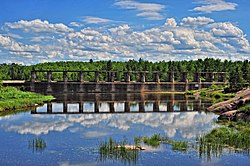
[edit]The community of Pinawa was established in 1901 to support the operation of an early hydroelectric generating station but was abandoned in 1951 when the site was shut down.
Pinawa was re-established about 10 km from the original Hydro town in 1963 when Atomic Energy of Canada Limited built the Whiteshell Laboratories nuclear research facility in the area. Pinawa was chosen as the site for the research station due to the seismic stability of the area. Pinawa was developed as a planned community which preserved many of the natural features of the site and designated all riverfront property as public reserve.
Whiteshell Laboratories was somewhat similar to the Chalk River Nuclear Laboratories in Chalk River, Ontario. AECL began decommissioning the Whiteshell Laboratories in 1998. The economy of Pinawa is diversifying and now includes small recreation and resort businesses and a number of environmental science firms.
Geography
[edit]Pinawa is located beside the Winnipeg River, which offers access to boating, kayaking, canoeing, and other water recreational activities. Other attractions include an 18-hole golf course, beach, outdoor pool, tennis courts, a curling rink, a hockey arena and many kilometres of cross-country ski trails.
The Trans-Canada Trail runs through the town of Pinawa along the Riverside. Pinawa also hosts the Eastern Manitoba Concert Association or EMCA's concerts, held in the community centre's gymnasium in the secondary school building once a month between October and April.
Pinawa is also home to an abundance of wildlife, including deer, bears, and other species. The people of Pinawa are very familiar with white-tailed deer, although their views on them may differ. Five deer in the backyard is a common sight there, and the town is known as the Deer Capital of Manitoba.
Climate
[edit]Pinawa has a humid continental climate (Köppen climate classification Dfb) with warm summers and severely cold winters. Precipitation is moderate, but is somewhat higher in summer than at other times of the year.
| Climate data for Pinawa | |||||||||||||
|---|---|---|---|---|---|---|---|---|---|---|---|---|---|
| Month | Jan | Feb | Mar | Apr | May | Jun | Jul | Aug | Sep | Oct | Nov | Dec | Year |
| Record high °C (°F) | 8 (46) |
12 (54) |
20 (68) |
32.5 (90.5) |
34.5 (94.1) |
37.5 (99.5) |
35 (95) |
35.5 (95.9) |
36 (97) |
27.2 (81.0) |
23.3 (73.9) |
10 (50) |
37.5 (99.5) |
| Mean daily maximum °C (°F) | −12.6 (9.3) |
−7.8 (18.0) |
−0.4 (31.3) |
9.7 (49.5) |
18.1 (64.6) |
22.2 (72.0) |
24.8 (76.6) |
23.7 (74.7) |
17.3 (63.1) |
9.8 (49.6) |
−1.3 (29.7) |
−9.8 (14.4) |
7.8 (46.0) |
| Daily mean °C (°F) | −18.1 (−0.6) |
−13.7 (7.3) |
−6.2 (20.8) |
3.4 (38.1) |
11.4 (52.5) |
16.2 (61.2) |
18.9 (66.0) |
17.7 (63.9) |
11.8 (53.2) |
5.1 (41.2) |
−4.9 (23.2) |
−14.5 (5.9) |
2.3 (36.1) |
| Mean daily minimum °C (°F) | −23.5 (−10.3) |
−19.5 (−3.1) |
−12 (10) |
−2.9 (26.8) |
4.7 (40.5) |
10.1 (50.2) |
12.9 (55.2) |
11.6 (52.9) |
6.3 (43.3) |
0.4 (32.7) |
−8.5 (16.7) |
−19 (−2) |
−3.3 (26.1) |
| Record low °C (°F) | −43.9 (−47.0) |
−47.8 (−54.0) |
−39.4 (−38.9) |
−28.9 (−20.0) |
−13.9 (7.0) |
−3.9 (25.0) |
−0.6 (30.9) |
−1.5 (29.3) |
−6.7 (19.9) |
−15.5 (4.1) |
−34.5 (−30.1) |
−40 (−40) |
−47.8 (−54.0) |
| Average precipitation mm (inches) | 21.7 (0.85) |
16.9 (0.67) |
27.3 (1.07) |
31.9 (1.26) |
59.5 (2.34) |
94.5 (3.72) |
78.3 (3.08) |
71.5 (2.81) |
64.1 (2.52) |
45.5 (1.79) |
30.6 (1.20) |
23.7 (0.93) |
565.3 (22.26) |
| Source: Environment Canada[2] | |||||||||||||
Demographics
[edit]In the 2021 Census of Population conducted by Statistics Canada, Pinawa had a population of 1,558 living in 708 of its 797 total private dwellings, a change of 3.6% from its 2016 population of 1,504. With a land area of 126.51 km2 (48.85 sq mi), it had a population density of 12.3/km2 (31.9/sq mi) in 2021.[3]
Infrastructure
[edit]Pinawa has a full service hospital with 24 hour emergency service, doctors' offices, and an ambulance station. There is a small shopping centre with a post office, credit union, grocery store, bakery, hairdresser, and the offices. The town also has a motel, a conference centre, and an art gallery.
Education
[edit]Pinawa has two schools: F.W. Gilbert Elementary School for students in Kindergarten up to grade six, with about 85 students, and Pinawa Secondary School for grades 7–12, with about 110 students. The schools of Pinawa comprise their own school district, the School District of Whiteshell.
Pinawa Secondary School is located near the elementary school, and is well known in the Whiteshell area for its outstanding Pinawa Panther sports teams and a unique outdoor education program that takes full advantage of the surrounding wilderness. Students are involved in basketball, soccer, volleyball, badminton, and travel club as well as academic sports like Reach For The Top and community service activities such as the LIVE volunteer group.
Pinawa was also selected as host for one day of the Kraft Celebration Tour during the summer of 2010, which saw Dan O'Toole and Jay Onrait host TSN's SportsCentre in the town on August 23. The town also received a cheque for $25,000 from Kraft Canada which went towards renovating their local rink, the Orville Acres Arena.
Notable people
[edit]- Robin Black, MMA commentator, musician
- Andrew Davidson, writer
See also
[edit]References
[edit]- ^ "Census Profile, 2016 Census". Statistics Canada. 2017-04-14. Retrieved 2017-05-06.
- ^ "Canadian Climate Normals 1971–2000". Environment Canada. Retrieved 26 August 2012.
- ^ "Population and dwelling counts: Canada, provinces and territories, and census subdivisions (municipalities), Manitoba". Statistics Canada. February 9, 2022. Retrieved February 20, 2022.
External links
[edit]Places adjacent to Pinawa | |
|---|---|


.svg)
Pinawa
View on GrokipediaHistory
Early settlement and hydroelectric era
The region around Pinawa, situated along the Winnipeg River in southeastern Manitoba, has been occupied by Indigenous peoples for at least 8,000 years, as evidenced by archaeological excavations revealing tools and settlements along the riverbanks. This area served as traditional territory for the Anishinaabe (Ojibwe) peoples, who utilized the river for travel, fishing, and ceremonial purposes, including the creation of petroforms—sacred rock arrangements still present in the nearby Whiteshell Provincial Park. European explorers and fur traders began navigating the Winnipeg River in the late 18th and early 19th centuries, noting the Pinawa Channel as a key portage route to avoid rapids, but permanent non-Indigenous settlement remained minimal until industrial development in the early 20th century.[10] The catalyst for early settlement was the harnessing of the Winnipeg River's hydroelectric potential to support Winnipeg's rapid urbanization and electrification. In 1901, the Winnipeg Electric Railway Company conducted surveys of the Pinawa Channel, identifying it as an ideal site due to its 14-meter head and stable water flow.[11] Construction of the Pinawa Generating Station commenced in 1903 under the Winnipeg Electric Railway Company (later reorganized as the Winnipeg General Power Company), requiring innovative engineering in remote, roadless terrain with materials transported by horse teams and temporary rail lines.[10] The project, costing approximately $3 million, employed up to 1,500 workers at its peak and was completed in spring 1906, marking Manitoba's first major hydroelectric venture.[11][12] On June 9, 1906, the station delivered its inaugural low-cost power to Winnipeg, initially at 8 megawatts capacity (expanded to 22 megawatts by 1912), operating year-round despite harsh winters—a pioneering achievement for cold-climate hydroelectricity.[13] To support operations, a company townsite, known as Old Pinawa, was built adjacent to the station, housing 50 to 60 staff members—including managers, technicians, and laborers—along with their families, predominantly of Scandinavian and English descent.[14] The community featured essential amenities like homes, a school, and recreational facilities, fostering a tight-knit enclave amid the wilderness.[10] The hydroelectric era shaped Pinawa's identity for over four decades, powering regional growth until the station's decommissioning on October 25, 1951, as more efficient downstream facilities like the Seven Sisters Generating Station came online.[11] By 1953, demolition of equipment and structures began, with wooden homes relocated to nearby areas and brick buildings left to decay, leading to the town's abandonment.[10] The site was later preserved as Pinawa Dam Provincial Heritage Park in 1985, commemorating its role in Manitoba's energy history with plaques from engineering bodies.[15]Nuclear research development and transition
The Whiteshell Nuclear Research Establishment (WNRE), later known as Whiteshell Laboratories, was established in 1963 by Atomic Energy of Canada Limited (AECL) in Pinawa, Manitoba, as Canada's second major nuclear research facility and the first in western Canada.[16][5] Its primary purpose was to advance nuclear science and engineering, with an initial focus on developing organically cooled reactor technologies to support Canada's CANDU (CANada Deuterium Uranium) program.[16][17] The site spanned 4,375 hectares and quickly became a hub for experimental research, peaking at over 1,000 staff in the early 1970s.[18][19][20] A cornerstone of the facility was the Whiteshell Reactor #1 (WR-1), constructed between 1962 and 1965 and achieving criticality on November 1, 1965.[16] This 60 MWth organic-cooled, heavy water-moderated reactor was the world's largest of its kind and served as a test bed for CANDU component materials, nuclear fuel cycles, and coolant systems under high-temperature conditions.[21][18] Over its operational life until shutdown on May 17, 1985, WR-1 contributed significantly to enhancing reactor safety and efficiency, influencing global nuclear standards through data on organic coolant performance and structural integrity.[16][22] Additional projects included the SLOWPOKE Demonstration Reactor (SDR), which operated briefly from 1989 to 1990 for low-power research, and the Underground Research Laboratory (URL), excavated between 1984 and 1988 to study deep geological repositories for nuclear waste disposal.[18][16] These efforts advanced waste management techniques and supported international collaborations on long-term nuclear safety.[16] The transition from active research to decommissioning began in the late 1980s amid shifting national priorities and budget constraints. WR-1 was defueled and placed in storage-with-surveillance after 1985, while broader operations wound down, with remaining work transferred to AECL's Chalk River Laboratories by 1998.[21][18] Formal decommissioning commenced in 2003 under Canadian Nuclear Laboratories (CNL), which assumed management from AECL, following approval of a comprehensive framework by the Canadian Nuclear Safety Commission (CNSC).[23][18] The URL's research mission concluded in 2010, marking the end of experimental activities.[16] As of 2025, decommissioning remains ongoing, with CNL proposing in situ decommissioning for WR-1 to entomb the reactor structure safely and cost-effectively, pending CNSC approval; the site's license extends to December 31, 2027.[23][18] Environmental monitoring continues to ensure site safety, while community and Indigenous consultations explore potential future uses, such as clean energy innovation.[23][21]Geography and environment
Location and physical features
Pinawa is a local government district in southeastern Manitoba, Canada, situated approximately 110 kilometres northeast of Winnipeg along Provincial Trunk Highway 11. The community occupies the north bank of the Winnipeg River at the entrance to the Pinawa Channel, a narrow waterway that connects to the broader river system. This positioning places Pinawa within the western extent of the Canadian Shield, a vast Precambrian geological formation characterized by ancient, eroded rock exposures. The district's boundaries also align with the western edge of Whiteshell Provincial Park, near the Manitoba-Ontario border, integrating it into a larger protected landscape of natural features.[24][25][26] The physical geography of Pinawa reflects the rugged terrain of the Canadian Shield, with low, rolling hills composed primarily of granitic and gneissic bedrock overlaid by thin soils. Boreal forests dominate the landscape, featuring coniferous species such as jack pine, black spruce, and balsam fir, interspersed with deciduous elements like trembling aspen and birch. Wetlands and small streams are common, supporting diverse flora including wild rice in adjacent waters. The Winnipeg River itself serves as a key hydrological feature, with its calm upper reaches near Pinawa contrasting the more turbulent sections downstream, and influencing local microclimates through seasonal flooding and water levels.[27][28] Encompassing a land area of 126.51 square kilometres, the district's density of natural features underscores its role as a transitional zone between urban accessibility and wilderness. Proximity to Whiteshell Provincial Park amplifies these attributes, with over 200 lakes, rushing rivers, and exposed shield rock formations extending into the surrounding region. Sandy beaches along the river and nearby lakes provide recreational access, while the overall topography—marked by glacial deposits from the last Ice Age—contributes to a mosaic of forests, rocky outcrops, and aquatic habitats that define the area's environmental character.[29][27]Climate
Pinawa, located in southeastern Manitoba, Canada, experiences a humid continental climate classified as Köppen Dfb, featuring cold, snowy winters and warm, humid summers with significant seasonal temperature variations.[30] The annual mean temperature is approximately 2.5°C, with extremes ranging from severe winter lows below -30°C to summer highs occasionally exceeding 30°C. Winters are prolonged and frigid, typically from November to March, while summers last from June to August, offering comfortable daytime warmth but cooler nights. Precipitation is moderate and fairly evenly distributed throughout the year, totaling around 581 mm annually, with about 170 cm of snowfall contributing to the winter accumulation.[30] The table below summarizes monthly climate normals based on data from 1991 to 2020, including mean, maximum, and minimum temperatures, as well as total precipitation (rain and snow combined). These values highlight the stark contrast between seasons: January's mean temperature of -18.2°C and 22.1 mm of mostly snow contrasts with July's 19.7°C mean and 83.4 mm of rain.[30]| Month | Mean Temp (°C) | Max Temp (°C) | Min Temp (°C) | Precipitation (mm) |
|---|---|---|---|---|
| January | -18.2 | -13.5 | -22.9 | 22.1 |
| February | -14.5 | -9.3 | -19.7 | 17.8 |
| March | -6.8 | -0.9 | -12.7 | 25.6 |
| April | 4.1 | 10.2 | -2.0 | 31.9 |
| May | 11.5 | 18.1 | 4.9 | 62.3 |
| June | 16.9 | 23.2 | 10.6 | 98.7 |
| July | 19.7 | 25.9 | 13.5 | 83.4 |
| August | 18.4 | 24.6 | 12.2 | 74.6 |
| September | 12.7 | 18.4 | 7.0 | 61.2 |
| October | 5.3 | 9.8 | 0.8 | 47.5 |
| November | -4.7 | -1.0 | -8.4 | 31.9 |
| December | -14.3 | -9.7 | -18.9 | 23.6 |
Government and demographics
Local government structure
Pinawa operates as a Local Government District (LGD) under the provisions of The Local Government Districts Act of Manitoba, which establishes LGDs as a form of local governance for designated unincorporated areas to provide municipal services and administration.[32] The LGD of Pinawa was formally established on January 4, 1962, by order in council to support the development of the Atomic Energy of Canada Limited (AECL) research site and surrounding community infrastructure.[2] The governing body is a council comprising a mayor, who serves as the head of council, and four councillors, all elected at large by residents for staggered four-year terms in accordance with The Local Authorities Election Act.[33] Elections occur concurrently with those for other Manitoba municipalities, with the most recent cycle in October 2022 determining the current council until 2026.[33] The mayor presides over meetings, represents the district externally, and votes on council matters, while councillors contribute to policy-making, budgeting, and oversight of services such as land use planning, utilities, and public works. Council holds regular public meetings, typically on the second and fourth Tuesdays of each month at 7:00 p.m. in the municipal office at 36 Burrows Road, allowing resident input on agendas including bylaws, development approvals, and community initiatives.[34] Administrative operations are led by a Chief Administrative Officer (CAO), who manages day-to-day affairs, implements council decisions, and ensures compliance with provincial regulations.[33] The LGD's powers include zoning, taxation, and service provision similar to rural municipalities, but with costs borne by local ratepayers rather than provincial funding.[32] Public consultation is integral, particularly for development plans and bylaw amendments, fostering community involvement in governance.[35]Population and composition
As of the 2021 Canadian Census, the population of Pinawa's designated population centre was 1,512, reflecting a 4.9% increase from 1,442 in 2016.[9] The local government district encompassing the community reported a slightly lower total of 1,510 residents in the same census, with estimates projecting modest growth to approximately 1,581 by 2024.[36][37] This small, stable population aligns with Pinawa's role as a specialized research community, with a density of 707 people per square kilometre in the core area.[9] Pinawa exhibits a notably aging demographic profile, characteristic of rural Canadian communities with historical ties to specialized industries. The median age stood at 60.8 years in 2021, significantly higher than the national average of 41.1.[9] Broad age groups showed 12.6% of residents under 15 years (190 individuals), 45.6% aged 15 to 64 (690 individuals), and 41.7% aged 65 and over (630 individuals).[38] This distribution underscores a high proportion of seniors, with over 40% in the 65+ category, contributing to a dependency ratio that emphasizes retirement and post-research careers among former nuclear facility workers. Ethnically and culturally, Pinawa's residents are predominantly of European descent, reflecting broader patterns in southeastern Manitoba. The most frequently reported ethnic or cultural origin in the 2021 census was English, cited by 490 individuals or 32.4% of the local government district's population.[39] Other common origins include Canadian (reported by 12.6% in private households) and various British Isles and continental European backgrounds, though detailed rankings beyond the top group are limited in available data.[9] Visible minorities constitute a small share, consistent with the area's low overall diversity; the total visible minority population in private households was minimal, with no dominant non-European group exceeding a few percent.[9] Indigenous identity is also limited, comprising under 5% based on provincial rural trends, though specific census figures for Pinawa indicate no significant concentration.[40] In terms of immigration and citizenship, 88.1% of residents (1,330 individuals) were Canadian-born non-immigrants, while 11.9% (180 individuals) were immigrants, primarily from Europe and the Americas.[36] No non-permanent residents were recorded, and recent immigration (2016–2021) was negligible at 0%. Nearly all residents hold Canadian citizenship, with generational status showing 71.5% third-generation or more, 15.9% second-generation, and 12.3% first-generation.[36] Language use is overwhelmingly English-dominant, aligning with the community's historical development. In 2021, 85.3% of residents reported English as their mother tongue (1,290 individuals), followed by 3.0% French (45 individuals) and 8.3% other languages (125 individuals), including minor non-official tongues.[38] At home, English was spoken by 94.5% either solely or with other languages, with French at 1.5% and non-official languages at 4.0%.[38] This monolingual English profile supports Pinawa's integration within Manitoba's Anglophone majority.Economy and infrastructure
Economic activities
Pinawa's economy is primarily driven by professional, scientific, and technical services, which employed 85 individuals in 2021, reflecting the ongoing influence of nuclear research and decommissioning activities at the Whiteshell Laboratories operated by Canadian Nuclear Laboratories (CNL).[1] The site, located in Pinawa, supports decommissioning projects and potential future small modular reactor demonstrations, contributing to local employment in utilities (50 workers) and public administration (45 workers).[18][20] Health care and social assistance form another key sector, with 75 employed residents in 2021, underscoring the community's focus on services for its aging population.[1] Educational services (40 workers) and construction (40 workers) also play significant roles, supporting community infrastructure and lifelong learning initiatives.[1] Tourism and recreation are emerging drivers, bolstered by Pinawa's natural environment and four-season amenities, with 30 residents employed in arts, entertainment, and recreation in 2021.[1] The Pinawa Community Development Corporation (PCDC) promotes eco-tourism and active transportation, including projects like multi-day tourism offerings funded by federal grants of $118,685 to Pinawa Unplugged Ltd. in 2025.[41][42] These efforts aim to diversify the economy beyond legacy research, emphasizing sustainability and business investment through entrepreneurship support.[43] Retail trade (35 workers) and other services (20 workers) provide essential local commerce, while smaller sectors like manufacturing (10 workers) and finance (15 workers) contribute to a balanced, small-scale economy with a total labour force of 550 in 2021.[1] The Pinawa Chamber of Commerce fosters growth by advocating for business sustainability and employment opportunities.[44]Transportation and utilities
Pinawa's transportation infrastructure primarily relies on road access, with Provincial Road 211 serving as the main route connecting the community to Highway 11 and Lac du Bonnet, approximately 100 kilometers northeast of Winnipeg. This highway facilitates personal vehicle travel, which is the dominant mode for both local and regional commuting, taking about one hour to reach Winnipeg under normal conditions. Public transit options are limited; there is no direct bus service to major cities, though residents can use taxis or charter services to connect to regional buses at nearby stops like Prawda, followed by routes to Winnipeg via operators such as Rider Express. Locally, Two Rivers Transit provides accessible demand-response services from the Sunova Mall, catering primarily to seniors and those with mobility needs for appointments and errands within the area.[45][46][47] Active transportation is emphasized in Pinawa to support its eco-tourism identity, with extensive pedestrian and cycling paths integrated into the community's design, including trails along the Pinawa Channel for walking and birdwatching. Cross-country skiing and snowshoeing routes, such as those maintained by the Eastman SnoPals, enhance winter mobility and recreational access during the snowy season, when road conditions on PR 211 can become slick due to limited sanding. There is no local airport, and air travel requires private shuttles or the Handi-Van service from nearby Lac du Bonnet for trips to Winnipeg James Armstrong Richardson International Airport.[47][48][49][50] Utilities in Pinawa are managed through a combination of provincial and local providers, ensuring reliable services for the small population. Electricity is supplied by Manitoba Hydro, which also maintains street lighting and handles outage reporting through its online portal. Water and sewer services are operated by the Local Government District of Pinawa using a remote meter reading system, with quarterly billing issued in January, April, July, and October based on By-law 839-18; rates are regulated by the Public Utilities Board and include a 1.25% monthly penalty for late payments. Bills can be paid via cash, cheque, debit at the municipal office, online through Credit Union or Bank of Montreal, or e-transfer to [email protected], with pre-authorized plans available to avoid penalties.[51][52][53] High-speed internet access is available through two providers: BellMTS and Xplornet, with residents advised to check coverage directly due to the rural setting. Telephone services are provided by BellMTS, supporting both landline and related communications. Garbage and recycling collection is handled municipally, with designated yard waste and landfill sites accessible via local roads, while television services are offered through Shaw Direct's bulk satellite program administered by the LGD, at a rate of $47.08 per month plus GST for 2023-2025, including free equipment installation for eligible households.[51][54][55]Education and community life
Education system
The education system in Pinawa is managed by the School District of Whiteshell, a public school district established in 1962 that serves the local community with a student-centered approach emphasizing outdoor learning and balanced school days.[56][57] The district operates two schools in Pinawa, providing continuous education from Junior Kindergarten through Grade 12 under Manitoba's provincial curriculum framework.[56][58] F.W. Gilbert Elementary School, located at 33 Massey Avenue, enrolls students from Junior Kindergarten to Grade 6 and features play-based learning in its early years program to build foundational skills for later academics.[56] As of September 29, 2024, the school had 120 students, with enrollment distributed across nursery (13), kindergarten (14), and grades 1 through 6 (ranging from 9 to 25 per grade).[59] The curriculum includes core subjects like English, mathematics, science, and social studies, supplemented by opportunities for outdoor education activities that leverage Pinawa's natural environment.[60][58] Pinawa Secondary School, situated at 20 Vanier Avenue, serves Grades 7 to 12 with an emphasis on high school-level mathematics and science courses tailored to prepare students for post-secondary pathways.[56] Enrollment stood at 102 students as of September 29, 2024, with numbers per grade from 11 in Grade 9 to 26 in Grade 8.[59] The school offers the English program alongside French Communication and Culture from Grades 4 to 12, and includes specialized initiatives such as the International Student Program, which welcomed five students from Germany, Belgium, and Australia in a recent semester.[61][62] Extracurriculars, including athletics like varsity volleyball and community philanthropy projects through Youth in Philanthropy, support holistic student development.[63][64] The district's total enrollment was 222 in 2024, reflecting a small but stable system focused on individualized programming.[59]Community facilities and culture
Pinawa's community facilities serve as central hubs for recreation, education, and social interaction, reflecting the town's emphasis on active and engaged living. The Pinawa Community Centre, located at 20 Vanier Avenue within Pinawa Secondary School, features a stage-equipped multi-purpose room, kitchen, and ample parking, accommodating a range of events from weddings and conferences to sporting activities.[65] It hosts theatrical productions by the local Pinawa Players group and performances from the Eastern Manitoba Concert Association, underscoring its role in fostering community gatherings.[65] Adjacent to the centre, the Pinawa Public Library offers an extensive collection of books, magazines, audiobooks, and videos, along with interlibrary loans, free Wi-Fi, and two public access computers, making it a vital resource for lifelong learning.[66] The library also organizes book readings, storytime sessions for children, and evenings focused on special interest topics, enhancing its function as a cultural and informational anchor.[66] Recreational amenities further enrich community life, with the outdoor Pinawa Public Pool at 5 Willis Drive operating from late June to August and providing programs such as swimming lessons, aquafit classes, lap swims, and youth sessions.[67] In 2025, it introduced free community swims for residents holding a Community Swim Card, alongside seasonal passes that include parking access.[67] Complementing the pool is the adjacent Pinawa Beach, equipped with a play structure, picnic shelter, volleyball court, and floating platform, where water quality is regularly monitored by the Province of Manitoba; swimming occurs at visitors' own risk without lifeguards.[67] Year-round recreation programs, coordinated through the local recreation department, include yoga and exercise classes limited to small groups, with opportunities for volunteers to support community clubs and events.[68] Pinawa's cultural landscape thrives on local artistic talent and organized events, positioning the town as a creative enclave in southeastern Manitoba. The Pinawa Art Gallery, situated in Suite 20 of the W.B. Lewis Business Centre at 24 Aberdeen Avenue, displays works by regional artists in mediums ranging from painting, pottery, and sculpture to photography, jewelry, and fiber arts.[69] Open Monday, Thursday, Friday, and Saturday from 10 a.m. to 3 p.m., it participates in the annual Boreal Shores Art Tour in August, connecting Pinawa's artist community—spanning novices to established creators—with visitors from Whiteshell Provincial Park to Grand Marais.[69] The gallery also hosts workshops and serves artisan coffee, promoting cultural exchange and supporting initiatives like Pinawa Art211.[70] Community cultural events emphasize music and performance, including the annual Community Christmas Concert featuring the Eastman Community Band, Pinawa Secondary School ensembles, and local choirs, alongside the May "Spring Tune-Up" concert by the 15-piece Pinawa Stage Band—known for swing and jazz—and the Pinawa Community Choir.[71] Public art installations, such as murals at F.W. Gilbert Elementary School and Sunova Mall depicting Pinawa's history and future, and carved wooden pieces by local woodcrafters along trails and near the municipal office, add visual vibrancy to everyday spaces.[71] These elements, combined with the town's home to musicians, visual artists, and artisans, cultivate a vibrant cultural identity tied to its natural surroundings and innovative heritage.[71]Notable people
- Robin Black (born 1969), martial arts commentator, musician, and former MMA fighter, grew up in Pinawa.[72]
- Andrew Davidson (born 1969), author known for the novel ''The Gargoyle'', was born in Pinawa.[73]