


Community hub
Recent from talks
Contribute something
Nothing was collected or created yet.
Pinxton
View on Wikipedia
Pinxton is a village and civil parish in Derbyshire on the western boundary of Nottinghamshire, England, just south of the Pinxton Interchange at Junction 28 of the M1 motorway where the A38 road meets the M1. Pinxton is part of the Bolsover District and at the 2021 Census had a population of 5,652.
Key Information


History
[edit]Etymology
[edit]In Anglo-Saxon times, Pinxton was a small agricultural community, thought to have been recorded in the Domesday Book of 1086 as "Esnotrewic." It is also thought that it was known as "Snodeswic," given by Wulfric Spott to Burton Abbey.

In Norman times, it was under the control of William Peveril, for whom it was held by Drogo fitz Pons. It is thought that he renamed the manor "Ponceston" and it gradually changed to Penekeston and then to Pinxton.[1]
Coal
[edit]Since 1800 BC, coal had been extracted in the area. In 1794 the Cromford Canal encouraged this trade. By the beginning of the next century there were a number of deep coal mines. Trade increased with the growth of the Industrial Revolution. There were also four lime kilns and a china works producing quality ware. Pinxton's prosperity increased further as the terminus of the Mansfield and Pinxton Railway, opened in 1819.
From the profits of his colliery at Pinxton, D'Ewes Coke (1747-1811) of Brookhill Hall, a clergyman colliery master, founded a local school and an educational charity. The collieries and coking ovens have been replaced by an industrial estate, and the old colliery village has all but disappeared.
John King
[edit]John King is the inventor of a mining safety device, a detaching hook, which successfully completed trials in 1873 at Pinxton No.1 colliery. The detaching hook prevents a cage raising miners from a shaft from being raised up and over the headstock pulley when raised from a mine shaft. A mining museum in Pinxton honoring John King and commemorating the invention of the detaching hook was closed in 2014 and its contents distributed to other museums and heritage centres.[2] In Pinxton today, there remains the John King mining wheel which was used in the days when mining was available. Now the John King wheel is a historical model for the public to see. John King is also named after an infant school in Pinxton. The horse gin, or whim from Pinxton Green Colliery has been re-erected at Nottingham Industrial Museum.[3] Pinxton signal box, which once controlled access to Bentinck Colliery has been relocated to Barrow Hill Engine Shed.
World War II
[edit]On 12 August 1940, a stick of bombs was dropped on Pinxton. One council house was hit, killing one person.[4]
Church
[edit]
The church of St Helen dates from medieval times, possibly having been built on the site of a previous small castle. Much of it was rebuilt in 1790 reusing the original materials, and only the west tower and west end of the old church remains. By 1890, it was so dilapidated that most of the services were held in the mission room. In the following century it was repaired, and a new porch and north aisle were added in 1939.
Transport
[edit]The M1 reached junction 28 on Monday 3 July 1967, just after noon. It was to have opened at 10am, making the M1 136 miles.[5][6]
The Pinxton to Barlborough section, to the north, was built by John Laing Construction Ltd, and opened on Wednesday 25 October 1967; it had cost £12.5m, and was two months late. Construction had started in August 1965, and there had been mining subsidence.[7]
The A38 section from Alfreton to the M1 opened as the A615 on 27 August 1969. It was built by Robert McGregor & Sons, and was built as a concrete road. It was Derbyshire's largest road project, and took 29 acres of land in Pinxton. Construction started in October 1967, and opened four months early.[8][9] It crossed the former A613 at Alfreton.
Trainspotting
[edit]"Pinxton Level Crossing" is a major tourist attraction for trainspotters who come from all over the country to take photographs of some of the unique locomotives that pass over the crossing.[10]
Education
[edit]There are four schools in Pinxton; John King Infant Academy situated on Church St W, Longwood Infant Academy on Wharf Rd, Kirkstead Junior Academy on Kirkstead Rd, and Pinxton Nursery School on Kirkstead Rd.[11]
Pinxton Wharf
[edit]
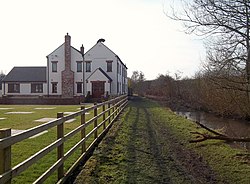
Pinxton Wharf is a site that consists of a stretch of Pinxton Canal and a fishing pond located on the southern edge of Pinxton. Pinxton Canal was a branch of the Cromford Canal.[12]
Pinxton FC
[edit]Pinxton Football Club is a football club based at The Welfare Ground, Pinxton. They compete in the Central Midlands League South Division. The manager is Kenny Shinfield.[13][14]
Notable people
[edit]
- D'Ewes Coke (1747–1811), rector of Pinxton and South Normanton, a colliery owner and philanthropist.
- John Hancock (1857–1940), politician, Trade Unionist and MP for Mid Derbyshire, 1909-1918 & Belper, 1918–1923.
- Roger Sacheverell Coke (1912–1972), composer and pianist.
Sport
[edit]- Ralph Hoten (1896–1978), footballer, played 310 games including 197 for Northampton Town
- Cyril Stocks (1905–1989), footballer who played 241 games for Nottingham Forest.
- Ivan Hollett (1940–2022), footballer, played 362 games including 157 for Chesterfield
- Aden Flint (born 1989), footballer, born in Pinxton; he has played over 575 games including 209 for Bristol City. In 2025 he plays for Walsall. He has won the EFL Championship Player of the Month in Feb. 2016, and Sept. 2017.[15][16][17]
See also
[edit]References
[edit]- ^ "A History of Pinxton". pinxton parish council. Retrieved 13 July 2023.
- ^ "Blue Plaque for Pinxton : Inventor of the mining safety device commemorated". miningheritage.co.uk. Retrieved 12 December 2021.
- ^ Interpretative Board, Gin Yard, Nottingham Industrial Museum
- ^ "Bombings in Derbyshire". tuptonhistorysociety.co.uk. Retrieved 29 December 2024.
- ^ Nottingham Guardian Journal Tuesday 27 June 1967, page 8
- ^ Derby Evening Telegraph Monday 3 July 1967
- ^ Derby Evening Telegraph Tuesday 17 October 1967, page 5
- ^ Nottingham Evening Post Friday 18 July 1969, page 12
- ^ Derby Evening Telegraph Wednesday 27 August 1969, page 10
- ^ "Pinxton Level Crossing - The ABC Railway Guide". abcrailwayguide.uk. Retrieved 14 July 2023.
- ^ "Home | Pinxton Village Academies". www.pvacademies.co.uk. Retrieved 14 July 2023.
- ^ "Pinxton Wharf - Derbyshire County Council". www.derbyshire.gov.uk. Retrieved 13 July 2023.
- ^ "Pinxton FC | Abacus Lighting Central Midlands Football League". fulltime.thefa.com. Retrieved 14 July 2023.
- ^ "Kenny Shinfield - Pinxton Football Club Pinxton FC First Team". www.pitchero.com. Retrieved 14 July 2023.
- ^ "Player of the Month: Aden Flint - Bristol City". www.efl.com. Retrieved 14 July 2023.
- ^ "Football (Sky Sports)". SkySports. Retrieved 14 July 2023.
- ^ James, Stuart (19 December 2017). "From asphalt to Zlatan: Aden Flint's long road to facing Manchester United". The Guardian. ISSN 0261-3077. Retrieved 14 July 2023.
External links
[edit]
| International | |
|---|---|
| National | |

Pinxton
View on GrokipediaGeography
Location and administration
Pinxton is a village and civil parish in the Bolsover District of Derbyshire, England, situated on the western boundary of Nottinghamshire. It is positioned approximately 15 miles (24 km) north of Nottingham and 7 miles (11 km) south of Mansfield, placing it within easy reach of these larger towns.[8][9] The parish lies just south of the Pinxton Interchange, where the A38 road meets the M1 motorway at Junction 28, facilitating strong connections to the national road network. Pinxton's boundaries adjoin South Normanton to the west and northwest within Derbyshire, and Kirkby-in-Ashfield and Selston to the east and north across the Nottinghamshire border.[7][10][11] Administratively, Pinxton is part of the East Midlands region and operates as a civil parish with its own local governance through the Pinxton Parish Council, which handles community matters such as village maintenance and events. At the district level, it falls under the jurisdiction of Bolsover District Council, responsible for broader services including planning and waste management. For policing, the area is covered by the South Normanton and Pinxton Safer Neighbourhood Team of Derbyshire Constabulary, integrated into the Amber Valley policing division.[7][12][13][14]Physical features
Pinxton's topography consists of flat to gently undulating terrain characteristic of the Derbyshire coalfields, shaped by underlying Carboniferous geology and historical extraction activities. Elevations in the area range from 79 meters to 163 meters above sea level, with an average of 122 meters, reflecting a landscape that rises modestly from the surrounding lowlands. The village lies in close proximity to the Erewash Valley, contributing to its position within a broader riverine and canal-influenced setting. The area is subject to flood risks associated with the Erewash Valley, with ongoing management by local authorities.[15][16][17][18] Environmental features include several former colliery sites that have been reclaimed and transformed into green spaces, such as Hill Top Park and a country park proposed in 2009 south of Mansfield Road, as part of local regeneration efforts. The Pinxton Branch, an arm of the Cromford Canal system, extends approximately three miles from Ironville to Pinxton Wharf, historically serving coal mines but now largely infilled and integrated into the landscape following 1980s flood relief works; its final half-mile retains water and supports adjacent habitats. Local water bodies, including Pinxton Wharf Ponds, provide additional ecological and recreational elements within this reclaimed industrial terrain.[19][20][21] The built environment blends Victorian terraced housing erected during the mining era with more recent residential developments and lingering industrial remnants. Rows of terraced homes, typical of coalfield villages, reflect the 19th-century expansion tied to coal extraction, while modern affordable housing projects address contemporary needs. Sites like the Kirkstead Road Industrial Estate occupy former pit heads, preserving elements of Pinxton's industrial heritage amid ongoing economic adaptation. Historical mining has left a visible imprint on the landscape through subsidence and spoil heaps, now mitigated in reclamation projects.[19][22][23] Ecological aspects feature habitats that support local wildlife, including woodlands and wetland areas designated as Local Wildlife Sites, with 126 such sites in the Erewash Valley region, 39% in favorable condition. These are managed by Derbyshire County Council through initiatives like the East Derbyshire Greenway Strategy, which enhances countryside access via footpaths and promotes habitat connectivity without encompassing major protected designations. Pinxton forms part of the wider East Midlands landscape character, where fragmented habitats are bolstered by green infrastructure to aid biodiversity recovery.[17][24][25]History
Etymology and early settlement
The origins of Pinxton trace back to the Anglo-Saxon era, with the settlement recorded in the Domesday Book of 1086 as Esnotrewic, a modest community in the hundred of Scarsdale, Derbyshire, comprising 7 households (6 villagers and 1 smallholder), 1 lord's plough team, 3 men's plough teams, and woodland measuring 1 league by 4 furlongs; its value had declined from £2 in 1066 to £1 by 1086 under tenant-in-chief William Peverel.[26] It is also identified in earlier records as Snodeswic, a grant by Wulfric Spott to Burton Abbey as an appendage to Morton.[27] Following the Norman Conquest, the manor fell under William Peverel's control and was held by Drogo fitz Pons, who reportedly renamed it Ponceston after his own surname; over time, phonetic shifts transformed it to Penekeston and eventually the modern Pinxton.[28] Archaeological evidence points to prehistoric activity in Derbyshire's Erewash Valley. In the medieval period, Pinxton developed as a rural village focused on agriculture, with arable land supporting mixed farming and limited small-scale trade via nearby routes; the manor changed hands among lords, including the Peverels and later families like the Heriz, reflecting feudal land tenure post-Conquest. Pre-industrial life centered on a farming economy, with tenants cultivating crops and livestock on the manor's holdings; coal deposits were first noted in local records during the 13th century, though extraction remained incidental and non-commercial until the 18th century.[29]Coal mining and industrial growth
Coal mining in the Pinxton area dates back to Roman times, with evidence of coal use in Derbyshire from that period, though systematic extraction remained limited until the 18th century.[30] Commercial mining began in 1788 when Reverend D'Ewes Coke sank the first shaft at Pinxton Colliery after inheriting mineral rights in the area.[3] The opening of the Cromford Canal in 1794, including a branch to Pinxton Wharf, facilitated efficient coal transport to markets via the Erewash Canal and River Trent, boosting local production.[31] Alongside mining, Pinxton was home to the Pinxton Porcelain Works, established in 1796 on land rented from the Coke family at Brookhill Hall. Founded in partnership with porcelain artist William Billingsley, the factory produced high-quality bone china tableware and decorative items until its closure in 1813, using the nearby canal for importing raw materials and distributing goods. Its wares are noted for elegant painting and gilding and remain collectible.[5][6] The Mansfield and Pinxton Railway, constructed in 1819 as one of Britain's early plateways, connected Pinxton to Mansfield and the canal system, initially using horse-drawn wagons to haul coal over eight miles.[32] D'Ewes Coke (1747–1811), the colliery's principal owner, reinvested profits into community welfare, funding a local school and establishing an educational charity that allocated £5 annually for books from colliery earnings; he also constructed housing for miners.[33] Mining peaked during the Victorian era, with Pinxton Colliery expanding to multiple shafts (numbered 1 through 6) to access seams like the Top Hard and Deep Soft, supporting household and manufacturing coal output that drove regional trade.[3][34] The influx of miners spurred significant population growth, transforming Pinxton from a small agricultural settlement of around 500 residents in 1801 into a thriving industrial village exceeding 5,000 by 1901, fueled by coal demand during the Industrial Revolution.[35] This boom prompted infrastructure developments, including wharves at Pinxton for canal loading and additional worker accommodations to house the expanding labor force.[36] By the mid-20th century, declining demand and exhaustion of viable seams led to progressive pit closures: several early shafts at Pinxton Colliery shut in 1860 and 1910, with main operations ending in 1950, followed by the interconnected Brookhill Colliery in 1968 as the last in the immediate area.[3][37]Local innovations and events
In the 19th century, Pinxton gained prominence in mining safety through the invention of local collier John King (1814–1886), who patented a detaching hook for mine cages on 18 October 1867 to prevent overwinding accidents that could cause cages to crash into headgear.[38] The device, which automatically detached the cage if it ascended too far, underwent successful trials in 1873 at Sleights (Pinxton) No. 1 Colliery, marking a significant advancement in underground transport safety and earning widespread adoption across British collieries.[29] To commemorate King's contribution, the John King Workshop Museum opened in 1986 at his former workshop on Victoria Road in Pinxton, housing artifacts, models of the detaching hook, and exhibits on local mining history; it operated intermittently, including Sunday afternoons, before closing in 2014, with its collections redistributed to other heritage sites.[39] In recognition of his legacy, the John King Infant School (now John King Infant Academy) was established in Pinxton in the early 20th century, serving as a community educational hub named in his honor. Local enterprise drove key infrastructural developments tied to the coal trade, including the Pinxton Branch of the Cromford Canal, constructed in the late 18th century to link Pinxton's collieries directly to the Erewash Canal system for efficient coal export to the River Trent.[40] Complementing this, the Mansfield and Pinxton Railway opened in 1819 as one of Britain's earliest commercial railways, transporting coal from Mansfield pits to the canal wharf at Pinxton; it was acquired by the Midland Railway in 1847 and extended to Nottingham in 1848, enhancing regional connectivity. Social advancements in Pinxton's mining community included the formation of the Pinxton Miners' Welfare Institute in 1925, funded through the national Miners' Welfare Fund established under the Mining Industry Act 1920 to improve workers' recreational and health facilities amid post-World War I industry reforms.[41] This venue, known locally as "The Welly," served as a social center for miners and families, hosting events and supporting pigeon racing federations.[42] Throughout the 20th century, Pinxton colliers participated in broader coalfield labor movements, including the 1912 national miners' strike over wages and the 1921 lockout, which highlighted demands for better conditions in Derbyshire's pits.[43] The 1984–1985 miners' strike further impacted the area, with local solidarity actions underscoring ongoing tensions in the Nottinghamshire-Derbyshire coalfield.[44]World War II
During World War II, Pinxton experienced limited but notable direct impacts from aerial warfare, primarily as part of broader Luftwaffe operations targeting industrial and infrastructural sites in the Midlands. On 12 August 1940, a stick of bombs was dropped on the village during a raid that was likely aimed at nearby airfields and facilities as part of the early Battle of Britain phase. One bomb struck a council house, resulting in the death of a local woman and causing property damage to surrounding structures. The incident was one of the first wartime bombings in the immediate area, prompting local inspections of the debris the following day.[45][46] On the home front, Pinxton's coal mines played a vital role in supporting the national war effort, as the village's collieries, including Brookhill and Langton, contributed to the increased production of coal essential for fueling industry, power generation, and military transport across Britain. Output from these pits helped meet the heightened demand, with miners facing extended shifts and restrictions on enlistment to prioritize domestic fuel supplies. Air raid precautions were implemented rigorously, including the construction of underground connections between collieries for emergency evacuations and compulsory fire-watching duties at surface facilities. In July 1941, the local council began building a public air raid shelter on land owned by the Heath family, providing communal protection amid sporadic alerts in the region. These measures underscored Pinxton's integration into broader civil defense efforts, with mine personnel also participating in local ARP teams to mitigate risks from potential strikes on industrial targets.[45][46] Post-war recovery in Pinxton was relatively minor, focused on repairing the limited bomb damage to residential properties like the affected council house, which underwent basic reconstruction to restore habitability. The local economy transitioned gradually to peacetime operations, with coal mining remaining the dominant industry but shifting from wartime urgency to standard production levels ahead of nationalization in 1947; this continuity helped stabilize employment without major disruptions.[45]Demographics
Population trends
Pinxton's population exhibited slow growth in the early modern period, remaining under 500 residents prior to 1800, with the 1801 census recording 463 inhabitants.[47] This modest expansion reflected its status as a primarily agricultural settlement, with limited urbanization until the onset of industrial activities. By the mid-19th century, the figure had risen gradually to 943 in 1851, still constrained by the absence of major economic drivers.[47] The late 19th century marked a significant acceleration, fueled by the coal mining boom and associated industrial migration, as deep mines proliferated in the Erewash Valley. Population surged from 2,317 in 1881 to 2,994 by 1901, surpassing 3,000 for the first time and more than tripling the mid-century total.[47] This influx of workers supported the expansion of collieries like Pinxton Colliery, established in the late 18th century but reaching peak operations during this era.[48] In the 20th century, growth peaked at 5,348 in 1921 before stabilizing and slightly declining following the decline of mining after the 1950s pit closures.[47] The 1951 census showed 5,126 residents, dropping to 4,440 by 1971, as the local economy shifted away from heavy industry.[47] The opening of the M1 motorway at Junction 28 in 1967 enhanced connectivity to nearby Nottingham and Derby.[49] Recent censuses indicate a modest recovery, with the population reaching 5,699 in 2011 and 5,652 in 2021, reflecting a slight decrease of about 0.8% over the decade.[50] Ongoing housing developments including 11 affordable units approved in 2023 may support future growth.[51]| Year | Population |
|---|---|
| 1801 | 463 |
| 1851 | 943 |
| 1881 | 2,317 |
| 1901 | 2,994 |
| 1921 | 5,348 |
| 1951 | 5,126 |
| 1971 | 4,440 |
| 2011 | 5,699 |
| 2021 | 5,652 |