Hubbry Logo
PollokPollokMain
Open search
Pollok
Community hub
Pollok
logo
8 pages, 0 posts
0 subscribers
Be the first to start a discussion here.
Pollok
Pollok
from Wikipedia

Pollok (Scottish Gaelic: Pollag, lit.'a pool', Scots: Powk) is a large housing estate on the south-western side of the city of Glasgow, Scotland. The estate was built either side of World War II to house families from the overcrowded inner city. Housing 30,000 at its peak, its population has since declined due to the replacement of substandard housing with lower-density accommodation. As of 2021, the population was recorded at 81,951 people.[1]

Key Information

The main features of the area are the nearby Pollok Country Park, where the Burrell Collection is now housed, the ruins of Crookston Castle (within the north part of residential Pollok) which Mary, Queen of Scots once visited, and the Silverburn Centre, one of Glasgow's major indoor retail complexes.

Location

[edit]

The country park and the White Cart Water which flows through it form the northern and eastern boundary of the district, with Corkerhill and Cardonald the closest northern suburbs. Recent developments in the late 20th and early 21st century have created an adjoining neighbourhood to the west of Pollok at Crookston, Glasgow, stretching from Rosshall to Roughmussel and including conversions of the original buildings of Leverndale Hospital, alongside its newer facilities. Haugh Hill Woodland[2] partially provides a natural barrier between Pollok and Crookston.

The Levern Water, a tributary of the White Cart, flows through Pollok from the south-west where the Househillwood and Priesthill residential areas are situated, with the Brock Burn bordering them and meeting the Levern Water in the centre of Pollok. In some contexts these neighbourhoods are referred to as separate localities, and otherwise are considered parts of 'Greater Pollok' (a ward of Glasgow City Council), along with Nitshill, South Nitshill, Parkhouse and Darnley further south which share the same G53 postcode;[3] Househillwood is next to the district's central amenities and bus terminus.

History

[edit]
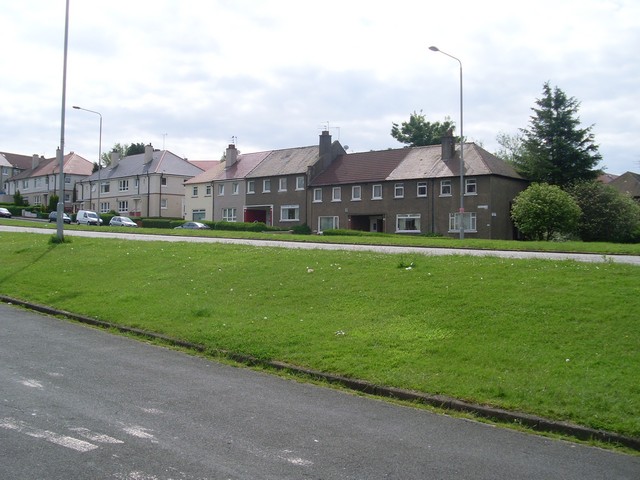
View over the Lyoncross Road area from Crookston Castle, 2005

Previously farmland[4][5][6][7] which was purchased by the city from the Stirling-Maxwell family in 1935,[8] Pollok was built by the old Glasgow Corporation and was the first of the 'big four' peripheral housing schemes constructed to improve Glasgow's slum housing conditions in the inner city.

1930s houses on Braidcraft Road, Old Pollok

The building of Old Pollok, as the first sector retrospectively became known, commenced in the 1930s[9] but was interrupted by World War II. The urgent need for housing after the war along with budgetary constraints meant that the original plan to build a 'garden suburb' was abandoned in favour of higher density, lower quality housing.[8][10][11][3][12] Unusually, one of the 'new' churches in Pollok (St James') was transplanted from Pollokshields, 2+12 miles (4 kilometres) away.[13][14][15]

Pollok suffered the same social problems that also emerged from the other large housing schemes (Castlemilk, Drumchapel and Easterhouse). The slum clearance programme disrupted the networks of the old communities and the extended family. There were few shops (a central shopping centre was not added for three decades),[16] no pubs, cinemas or leisure facilities. Even schools, something which eventually were well provisioned, were not built until some years after the main wave of housing, with pupils being transported to facilitates elsewhere at considerable cost and disruption.[17] People lived far away from their places of work and there were very few employment opportunities locally.

Renovated tenements (and one block awaiting work) in central Pollok, 2013

The post-war tenement buildings were of poor quality and suffered from damp, condensation and lack of soundproofing. Glasgow Corporation (later Glasgow District Council) could not maintain the buildings in the face of budgetary cuts imposed by central Government. Local manufacturing jobs were outsourced to overseas countries and unemployment rates grew to unprecedented levels. Those who were able to left the area, the remaining population enduring poverty, lack of opportunities, ill-health and lower life expectancy.

In recent years there has been a sustained effort to improve the area. Most of the post-war tenement housing has been demolished or refurbished, and new private housing has also been built among the individual houses, which lasted more successfully than the multi-floor blocks.[16][3][18]

To the east of the residential area, Pollok House is a Georgian building constructed in 1752 with many fine paintings, and Pollok Country Park was chosen to house the "Burrell Collection" in a modern contemporary and clean air green space.[16] It is the largest park in Glasgow.[19]

Education

[edit]
St Paul's High School (2017)

Pollok has one secondary school: St Paul's High School, recognised as one of the 'schools of ambition' in Scotland. It was built on the site of another former school, Craigbank Secondary, which had lain empty for some years,[20][3] and replaced the area's previous Catholic school, St Robert Bellarmine Secondary which was sited where the southern sector of Silverburn now stands.[21][22] However, St Paul's associated primary schools are in neighbourhoods to the south of Pollok proper,[23] whereas the Pollok-based primaries are part of the 'learning community' of Lourdes Secondary School in Cardonald.[24]

The nondenominational Rosshall Academy (completed in 2002) serves a large catchment area including much of Pollok, but replaced Penilee Secondary and Crookston Castle Secondary so was built on a site between its predecessors which falls outwith Pollok across the White Cart. In 2009 the area lost a local primary school, Bonnyholm Primary, which was merged with other schools to create Crookston Castle Primary School. It was officially opened in August 2007 on the grounds of the former Crookston Castle Secondary, close to the castle.

The former Cardonald College, now a campus of the merged Glasgow Clyde College, is near to Pollok between Cardonald and Mosspark.

Shopping

[edit]
Entrance to Silverburn Centre

Pollok is home to the Silverburn Centre which opened in October 2007, replacing the old Pollok Shopping Centre dating from the late 1970s[16] which itself was previously tenement housing built in the late 1940s which survived barely 30 years before being torn down.[10][3] The largest of its kind in Scotland, Silverburn has brought hundreds of jobs to the area. Key stores include a 24-hour Tesco Extra adjoining the centre. This was the largest store in Scotland when it opened in July 2006. Other anchor stores are M&S, Debenhams (now closed) and Next. Altogether, the centre houses 95 shopping units and 14 restaurants and cafés. A cinema complex with further restaurants was later added as an extension in 2015.

Other amenities

[edit]
Pollok civic realm (2013)

Next to the Silverburn Centre is the Pollok civic realm, renovated in 2009[25] containing an extended Health Centre and the Pollok Library[26] and Swimming Pool.[27][28] There is another sports centre, Nethercraigs, at the north-east of Pollok near Corkerhill.[29]

Transport

[edit]

Pollok is about 7 miles (11 km) from Glasgow International Airport, and 24 miles (39 km) from Glasgow Prestwick Airport. The area is accessible from Junctions 2 and 3 of the M77 motorway, and the main bus terminus is Silverburn bus station.[30][31]

Pollok is served by five nearby railway stations which run to central Glasgow, although none in the district itself; these are Nitshill, Kennishead and Priesthill & Darnley to the south on the Glasgow South Western Line, and Mosspark and Crookston to the north on the Paisley Canal line.

References

[edit]
[edit]
Revisions and contributorsEdit on WikipediaRead on Wikipedia
from Grokipedia

Pollok is a residential in the south-western sector of , , encompassing a of 12,053 as of recent estimates.
The area is defined by its inclusion of , 's largest spanning approximately 360 hectares of woodlands, gardens, and lands originally established as the Maxwell estate nearly two centuries ago.
At the heart of the park lies Pollok House, a Georgian mansion constructed in 1752 and extended in the late 19th century, which served as the seat until donated to the city in 1966 and now managed by the National Trust for .
Developed primarily through mid-20th-century housing schemes on the former estate lands, Pollok features a demographic profile with a high proportion of White Scottish (around 88%), elevated child populations compared to averages, and significant green spaces that contribute to local biodiversity and urban retreat value.
While the benefits from its proximity to amenities like the Silverburn shopping centre and strong home ownership rates, it also contends with pockets of socioeconomic deprivation amid ongoing regeneration efforts.

Geography

Location and Boundaries

Pollok is situated in the south-western sector of , , approximately 3 miles (4.8 km) southwest of the . The neighborhood forms part of the Greater Pollok electoral ward (Ward 3) of , established in and covering an area that includes Pollok alongside adjacent locales such as Arden, Burnbrae, Crookston, Darnley, Priesthill, and Nitshill. Greater Pollok, encompassing Pollok, lies at the southern edge of Glasgow's urban extent, proximate to the boundary and influenced by historical from the Stirling Maxwell Estate. The district's approximate boundaries align with and infrastructural features: the White demarcates the southern limit, while the M77 motorway and define much of the eastern ; to the west, it adjoins Hillington and Cardonald areas, and northward it transitions into Corkerhill and Dumbreck locales. These delineations reflect post-war housing development patterns rather than formal administrative lines, with some overlap or noted in documents, such as cross-boundary issues with Pollok Park excluded from the ward.

Physical Features and Environment

Pollok occupies an undulating in southwest , shaped by glacial drumlins that rise to approximately 60 above ordnance datum, interspersed with lower corridors along watercourses. The is around 26 , reflecting a gently rolling formed by post-glacial deposits and underlying lavas of the Clyde Plateau. This provides a mix of open parklands and elevated wooded areas, contrasting with the surrounding urban development. The White Cart Water, a meandering tributary of the River Clyde, bisects the area eastward through a clay-rich floodplain, influencing local hydrology and supporting scenic riverine features such as weirs and cascades established in the 18th century. This river corridor enhances biodiversity and flood dynamics within a catchment prone to riverine inundation. Environmental elements include extensive semi-natural broadleaved woodlands like and managed stands in Pollokhead Wood, dominated by , , sycamore, lime, and species, alongside veteran trees and champion specimens. Priority habitats comprise mixed woodlands, neutral grasslands, boundary features, rivers, , and standing open waters, fostering diverse and amid the urban fringe.

History

Origins and the Pollok Estate

The lands of Pollok, situated in southern , derive their name from the Gaelic term pollag, denoting a small pool or stream, indicative of the area's historical watery terrain formed by the White Cart Water. Archaeological evidence suggests human activity in the vicinity from prehistoric Celtic settlements through the early medieval period, with earthworks and mottes potentially dating to the mid-13th century or earlier, reflecting defensive structures amid the baronial landscape. Nether Pollok, the core of the future estate, was granted around 1270 by Sir Aymer Maxwell, lord of the broader Maxwell estates, to his younger son Sir John Maxwell (c. 1243–after 1306), establishing the distinct Maxwell of Pollok lineage. This branch of the Maxwell family, tracing descent from Saxon origins via Maccus, son of Unwin, maintained continuous possession of the lands, developing them into a major barony within Renfrewshire and Lanarkshire. By the 15th century, associated fortifications like Crookston Castle, constructed circa 1400 by a Maxwell of Pollok, underscored the family's regional influence and defensive needs during feudal conflicts. Pollok House, the estate's central residence, was built between and for John Maxwell, 2nd , supplanting earlier medieval dwellings and exemplifying Georgian with possible design input from builders or . The estate at its encompassed roughly 13,000 acres, supporting agricultural tenancies, , and later landscape improvements under owners like John Stirling-Maxwell (), who emphasized conservation and convened the meeting that founded the . This preserved the estate's rural character amid 's industrial expansion until mid-20th-century transfers for urban development.

Post-War Housing Development

The post-war phase of Pollok's housing development accelerated after 1944 as part of Glasgow Corporation's response to severe slum overcrowding and wartime displacement, completing the peripheral scheme by 1951. This expansion built upon the pre-war initiation in 1934, when land was acquired from Sir John Stirling Maxwell, but shifted toward higher-density tenemental layouts due to the urgent need to rehouse tens of thousands from inner-city tenements. Over 9,000 houses were constructed, accommodating nearly 50,000 residents at a density of 12 houses per acre. Construction incorporated modern amenities absent in prior slum dwellings, including indoor toilets, balconies, separate front and back doors, electric heating, hot water immersers, and communal laundry facilities, alongside planned green spaces and shared amenities. Three- and four-story flats predominated in the post-1944 builds, contrasting with the garden-equipped bungalows of "Old Pollok," as wartime exigencies prioritized volume over aesthetic or spacious design. Labor drew from local workers supplemented by German and Italian prisoners of war, enabling rapid erection amid material shortages. As the inaugural of Glasgow's "Big Four" peripheral estates—alongside Castlemilk, Easterhouse, and Drumchapel—Pollok initially elicited enthusiasm for its escape from dilapidated conditions, yet early lacks in shops, schools, and transport fostered isolation. Subsequent decades revealed structural issues like dampness, with a 1985 survey indicating high rates of substandard dwellings, exacerbating socioeconomic challenges despite the scheme's foundational intent to modernize urban living.

Late 20th and 21st Century Changes

In the 1980s and early 1990s, Pollok grappled with socioeconomic challenges common to Glasgow's peripheral estates, including high unemployment, poverty, and rising gang activity amid the city's deindustrialization. The opening of the Pollok Shopping Centre in 1979 provided a local retail focal point, but it struggled with maintenance issues and competition from city-centre developments by the late 1980s. These pressures were compounded by infrastructure projects like the M77 motorway extension, which faced vehement local opposition over its route through green spaces and established communities. The extension's construction sparked the Pollok Free State protest in 1994, where residents established a camp in Pollok Country Park to blockade works and highlight environmental and social costs; the action drew broad community support, including schoolchildren striking in solidarity. Despite halting work temporarily, the motorway proceeded to completion in the mid-1990s, enhancing regional connectivity to Ayrshire but at the expense of approximately 100 acres of woodland and farmland. This period underscored tensions between urban expansion and local preservation, with critics arguing the project prioritized economic links over community input, though it later facilitated commuter access. ![Entrance to new Silverburn Centre in Pollok - geograph.org.uk -597238.jpg][float-right] Entering the 21st century, Pollok underwent substantial urban regeneration, particularly through the phased redevelopment of the aging Pollok Shopping Centre into the larger Silverburn Shopping Centre. Initial phases began in the early 2000s, with the new facility opening on June 2, 2008, after demolishing much of the original structure; it expanded to over 75 acres, incorporating 80,000 m² of retail space anchored by major stores like Tesco and providing 4,500 parking spaces. Subsequent phases, including Phase 3 around 2019, cleared remaining dilapidated sections to enable further mixed-use growth, transforming the site into a regional draw that boosted local footfall and employment. Housing transformations paralleled retail upgrades, as Glasgow's 2003 stock transfer to community-owned associations enabled targeted demolitions of substandard post-war multi-storey and deck-access blocks in Pollok and adjacent areas. This shifted toward lower-density family homes and improved amenities, reducing the area's peak population of around 30,000 while addressing dampness, maintenance failures, and social isolation reported in earlier decades. Regeneration initiatives, supported by council partnerships, also enhanced public realms, such as upgraded pathways and green spaces, though persistent deprivation metrics indicate ongoing challenges despite these physical improvements.

Pollok Country Park

Establishment and Key Attractions

originated from the historic Pollok Estate, held by the Maxwell since the , which encompassed extensive parklands, woodlands, and gardens developed over centuries. In 1966, Maxwell Macdonald, of Iain Maxwell, donated approximately 1,400 acres of the estate, including and its grounds, to (now ) for use, ensuring its preservation as a amid post-war urban expansion. The park opened to the shortly thereafter, functioning initially as a municipal park before formal designation as a Country Park in 1981 under the Countryside (Scotland) Act 1967, making it largest such area at 834 hectares. Key attractions within the park include Pollok House, a Category A-listed Georgian mansion constructed between 1747 and 1752 for the Stirling-Maxwell family, featuring an interior with Spanish art masterpieces, a library of over 1,000 rare books, and period furnishings; it served as the family residence until the 1966 donation. The Burrell Collection, housed in a purpose-built museum opened in 1983 and reopened after refurbishment on March 29, 2022, displays over 8,000 objects amassed by shipping magnate Sir William Burrell, including notable Chinese porcelain, medieval tapestries, and Impressionist works, drawing over 500,000 visitors annually pre-refurbishment. Additional draws encompass the park's Highland cattle herd, introduced in the 20th century for grassland management, and over 15 kilometers of walking trails through ancient oak woodlands and gardens, including the formal walled garden and rhododendron collections planted from the 19th century onward. Note that Pollok House closed on November 20, 2023, for a two-year conservation project involving structural repairs and upgrades, with partial reopening anticipated by late 2025.

Natural and Cultural Features

Pollok Country Park encompasses extensive woodlands much of its acres, featuring mature trees such as and notable heritage specimens like "," providing for diverse including birds, , and parasitic such as toothwort associated with hazel in nutrient-rich soils. The park includes neutral grasslands on circumneutral soils, supporting populations as evidenced by dedicated planting 500 wildflowers and attracting of attendees for enhancement. Over six miles of woodland trails wind through these areas, bordered by traditional hedges, walls, and fences that define the landscape. Culturally, the park hosts , a Georgian mansion constructed between 1747 and as the of the Stirling-Maxwell , surrounded by formal and a woodland containing 26 champion , including five national champions registered by the Register of the . The estate's designed landscape, recognized on Historic Environment Scotland's Inventory of Gardens and Designed Landscapes, dates to the 13th century under Maxwell family ownership for over 27 generations and includes features like the Polloktoun Bridge and historic parklands suited for walks. Additional cultural elements comprise two allotment sites dating to around 1895 and the Burrell Collection museum, housed in a structure opened in 2022 within the park grounds, showcasing art amid the historic setting. The park's heritage trail highlights these rural historical aspects, emphasizing its role as a conserved designed landscape of outstanding merit.

Conservation and Recent Projects

Pollok Country Park's conservation initiatives emphasize enhancement and habitat restoration amid urban pressures. The Friends of Pollok Park, a group, have undertaken projects including the installation of nesting boxes and bat roosting boxes in collaboration with the Govan , supporting local populations in the park's woodlands and grasslands. In 2019, a -led nursery was established with Glasgow City Council support to counteract the 97% national loss of wildflower habitats, fostering pollinator-friendly meadows and engaging residents in seed propagation and planting efforts. These activities align with broader pollinator conservation, as evidenced by a 2021 NatureScot-funded initiative creating green corridors in southern Glasgow, including park enhancements for insect habitats. Heritage conservation has focused on restoring key estate structures. Pollok House, an 18th-century mansion housing fine art collections, closed to visitors on November 20, 2023, for a two-year refurbishment project led by Glasgow City Council, addressing structural decay and updating visitor facilities while preserving its Regency interiors and gardens. This follows the 2022 reopening of the nearby Burrell Collection after its own multimillion-pound overhaul. The A-listed Pollok Stables and Sawmill, to the , underwent conservation in 2024, including specialist removal from historic surfaces by Quill in partnership with Reigart Contracts to reveal original materials without . In August 2025, Morrison secured a £9 million Government-funded for full refurbishment, converting the semi-derelict complex into a Living Heritage Centre interpreting the estate's evolution from horse-powered operations to early industrial water power via the White Cart Water. The park's status as a designated Conservation Area, appraised by Glasgow City Council, mandates these interventions to protect its designed landscapes, veteran trees, and archaeological features from development threats.

Housing and Urban Planning

Peripheral Housing Scheme Design

Pollok's peripheral scheme, developed by starting in the late , represented the inaugural effort among the city's four major peripheral designed to alleviate inner-city . The scheme incorporated a variety of typologies, predominantly three-storey blocks and low-rise terraced houses featuring gardens, three-bedroom layouts, separate kitchens, and indoor toilets—amenities that contrasted sharply with the prevalent single-end tenements in central . of key elements, such as the three-storey tenements on , commenced in to rapidly accommodate displaced families. The design philosophy emphasized community formation over mere shelter provision, integrating open green spaces, local shops, schools, and recreational areas to foster social cohesion and improve living standards for over 30,000 residents by 1951 across more than 9,000 dwellings. However, budgetary constraints led to deviations from initial plans, resulting in higher-density configurations with flat-roofed structures that were often cramped, prone to dampness, and of reduced build quality compared to envisioned standards. Like the other peripheral schemes—Castlemilk, Drumchapel, and Easterhouse—Pollok's architecture exhibited structural uniformity, relying on a limited repertoire of housing types to enable efficient mass construction amid acute housing shortages. This approach prioritized scalability and cost-effectiveness, drawing on standardized tenement designs adapted for suburban peripheries, though long-term maintenance issues from flat roofs and material choices later highlighted design limitations in Scotland's climate. By the scheme's expansion in the 1950s and 1960s, it had established Pollok as a self-contained neighborhood, albeit one where architectural pragmatism sometimes undermined durability and resident satisfaction.

Architectural and Planning Outcomes

The housing in Pollok primarily consisted of low-rise tenements and terraced houses, constructed by starting in the late to address , with two-storey appearing as early as at sites like Brockburn . This architectural approach emphasized functionality over high-density towers seen in other peripheral schemes, incorporating front and basic amenities to foster a sense of , though designs were often monotonous and of lower in areas like Dormanside and Priesthill. By the 1970s, these structures faced deterioration, prompting widespread replacement with modern cottage-style homes, which improved energy efficiency and aesthetic variety but highlighted the original builds' limited durability under Scotland's climate. Planning outcomes reflected to create self-contained communities with integrated spaces, shops, and schools adjacent to the historic Pollok Estate, differentiating Pollok as the first of Glasgow's "Big Four" peripheral and avoiding the isolation of more remote developments. However, the peripheral exacerbated dependencies, with early inadequacies in contributing to social fragmentation and , as rehousing prioritized over job proximity, leading to persistent deprivation indices higher than city averages. Empirical assessments note that while physical standards exceeded inner-city slums—reducing rates through better ventilation and —the schemes concentrated low-income households without sufficient commercial or industrial anchors, resulting in failed cohesion by the . Recent evaluations under the Greater Pollok Development Framework underscore mixed legacies: successful preservation of near mitigated some urban , but legacy tenements required for sustainable upgrades, with 86% support for visions emphasizing high-quality, affordable designs over replication of errors. Causal factors include underinvestment in and over-reliance on state tenancy without market incentives, though Pollok's lower-rise profile yielded fewer structural failures than high-rise counterparts elsewhere in .

Demographics and Socioeconomics

Population and Composition

The Greater Pollok ward, encompassing the Pollok district, had a population of 32,890 according to the 2022 census. This represents a 0.83% annual growth rate from the 2011 census figure of approximately 30,050. The ward spans 11.73 km² with a population density of 2,805 persons per km². Demographic composition indicates a higher-than-average proportion of children for , with 7,457 individuals aged under 18, comprising about 22.7% of the total . The Pollok specifically features a lower share of ethnic minorities relative to the citywide , where non-White British groups constitute around 25-30%. Religious affiliation per the shows Roman Catholics as the largest group at 7,418 (22.5%), followed by adherents at 4,735 (14.4%) and at 4,039 (12.3%). Other Christians numbered 1,037 (3.2%), reflecting a diverse but predominantly Christian and Muslim profile alongside a substantial unaffiliated segment typical of urban Scotland.

Economic Indicators and Challenges

Greater Pollok exhibits elevated levels of multiple deprivation relative to national benchmarks, with approximately 20% of its population residing in data zones ranked within Scotland's lowest quintile under the Scottish Index of Multiple Deprivation (SIMD) framework, which aggregates indicators across income, employment, health, education, access to services, crime, and housing domains. This positioning reflects persistent structural economic pressures, including low household incomes that correlate with reduced life expectancy—particularly among men—below the Scottish average, compounded by concentrations of elderly residents and suboptimal health metrics. Employment deprivation remains a core challenge, mirroring broader trends where affected 5.1% of aged 16 and over in the year ending 2023, exceeding Scotland's rate and indicative of job in a post-industrial dominated by service-sector and low-wage roles following the decline of Clydeside and . Economic inactivity rates in reached 26% among working-age adults in 2023, with Pollok's peripheral housing origins amplifying vulnerability through intergenerational welfare reliance and skill mismatches, as deindustrialization eroded traditional blue-collar opportunities without commensurate retraining or investment. Poverty metrics underscore these dynamics, with child poverty in Pollok lower than the Glasgow average (around 33% citywide) but still substantial in absolute terms, driven by income deprivation affecting family stability and educational outcomes. Local development frameworks prioritize inclusive growth to address these, emphasizing higher-quality job creation amid critiques of over-reliance on benefits, which sustain but do not resolve underlying causal factors like educational attainment gaps and labor market disconnection.

Education

Primary and Secondary Schools

Pollok is served by multiple primary schools, primarily under , catering to local children aged 3 to 12. Key institutions include at 30 Kempsthorn Road, G53 5SR, a Roman Catholic denominational school established to serve the Pollok and Crookston areas. , located at Langton , G53 5LW, also operates as a Catholic primary, emphasizing community engagement such as after-school storytelling clubs for Greater Pollok children. Non-denominational options include at 271 Househillmuir Road, G53 6NL, and at 14-16 Dove Street, G53 7BP, both providing standard curriculum with nursery provisions. Secondary education in Pollok centers on St Paul's High School, a co-educational Roman Catholic comprehensive school at 36 Damshot Road, G53 5HW, serving pupils aged 11 to 18 from the local catchment. Founded as the primary secondary institution for the area, it reports to Glasgow City Council under head teacher Lisa Pierotti as of 2025. Attainment data for S4 pupils in the Pollok profile exceeds the Glasgow average by 14 percentage points, with 38% fewer 16- to 19-year-olds classified as not in employment, education, or training compared to city-wide figures. Overall school attendance aligns with broader Glasgow trends, at approximately 92% for primaries and 88% for secondaries in 2022/23.

Further Education and Community Programs

Pollok Community Education Centre, located at 134 Langton , serves as the primary hub for in the area, offering courses in a variety of practical and academic tailored to . These programs, coordinated through Council's services, include options for development in , , and vocational , accessible to adults seeking flexible learning opportunities beyond . Glasgow Clyde College extends further education reach into Pollok via community-based adult learning initiatives delivered at venues such as Pollok Community Centre. A notable example is the college's Community Newsletter course, held at the centre, which culminated in students producing and launching the 'Pollok Paper' newsletter on 30 November 2023, fostering skills in writing, editing, and community journalism. Such partnerships emphasize accessible, non-traditional further education, often free or low-cost, to support lifelong learning in underserved areas. Community programs complement formal with and development activities. Organizations like SWAMP Glasgow, a trust in Greater Pollok, run free arts-based initiatives to engage , promoting social cohesion through creative workshops and as of 2023. Additionally, centres such as Leithland Centre provide programs including fitness instruction and classes, which double as skill-building for personal and roles. These efforts, often supported by , prioritize empirical outcomes like improved and social integration, drawing on needs assessments rather than top-down mandates.

Amenities and Recreation

Shopping and Commercial Facilities

The primary shopping and commercial hub in Pollok is Silverburn Shopping Centre, which opened on 1 July 2007, replacing the earlier Pollok Shopping Centre established in 1979. The centre encompasses approximately one million square feet of retail and leisure space, accommodating over 100 stores and leisure outlets. Major anchors include Next, Marks & Spencer, and TK Maxx, alongside fashion retailers such as H&M, New Look, and a flagship Zara store that debuted in March 2025 within the former Debenhams unit spanning 47,000 square feet. Silverburn supports extensive with over 4,500 spaces and has demonstrated , achieving record in amid expansions adding new retail and across more than square feet. Recent international additions include Spanish chains and , enhancing its offerings. The centre was recognized as the UK's best destination venue at the Revo Ace Awards. Supplementary commercial facilities in Pollok include smaller retail units and a fitted café opportunity within the adjacent Pollok Civic Realm, catering to local needs alongside convenience stores and bakeries scattered throughout the housing estate. These amenities primarily serve residents, with Silverburn functioning as the dominant regional draw due to the area's peripheral residential character.

Leisure and Community Centers

Glasgow Club Pollok, situated at 27 Cowglen Road (G53 6EW), serves as the area's principal leisure facility, featuring a modern gymnasium, swimming pool with flumes and wave machines, and daily fitness classes including aquafit, body conditioning, and chair yoga. Managed by Glasgow Life, the centre emphasizes hands-on training and community health improvement through structured programs. Pollok , located at 134 Langton (G53 5DP), functions as a multi-purpose venue for social and commercial , accommodating meetings, classes, , and classes for groups like Moo for children. It operates under Life's oversight, with facilities including a café and floor, available for hire from 9:00 a.m. to 9:00 p.m. weekdays and supporting initiatives such as guided walks and harvest festivals. These centres integrate with the Pollok Civic , a public encompassing the club, Pollok , and (Pollok Kist), fostering combined access to recreational, educational, and advisory services like citizens' . Smaller hubs, such as the SWAMP community at 27 Brockburn , complement these by providing affordable food and drink alongside services.

Transportation and Infrastructure

Road Network and Public Transit

Pollok's road network connects residential areas to the wider Glasgow system primarily through the M77 motorway, accessed via Junction 3, which links to the south of Pollok, Nitshill, and Darnley using the A726 road. The M77 runs adjacent to Pollok's western edge, with the section between Junctions 1 and 2 constructed in a cutting to lessen its impact on nearby Pollok Country Park. Local distributor roads, including Braidcraft Road and Brockburn Road, facilitate internal traffic and access to amenities like Silverburn Shopping Centre. Public rail services are provided by from Mosspark railway station, located within Pollok and serving the Paisley Line, with hourly trains to Central Station taking 11 minutes and costing £2–£5. Nearby stations such as Kennishead offer additional connections, approximately a 20-minute walk from central Pollok areas. Bus services, subsidized by (SPT), are operated by First Glasgow and McGill's Bus Service, providing frequent to . Key routes include First Bus X8, a circular service from Buchanan Bus Station through Silverburn to Pollok, and McGill's 153 from Hope Street in to Silverburn in Pollok. Silverburn acts as the primary interchange for and express buses in the area. No stations serve Pollok directly, requiring transfers via bus or train to city centre stops.

Major Developments and Impacts

The extension of the M77 motorway through Pollok, completed in stages between 1981 and 2005 with final sections opening in 1997, represented a pivotal linking Glasgow's urban core to and enhancing regional freight and commuter access. This development alleviated congestion on older routes like the A77, facilitating faster times—reducing the Glasgow to Prestwick journey from approximately 90 minutes to under an hour for many users—and supported economic activity by improving for industries in south-west . However, the route's path severed approximately 7 miles of woodland in Pollok Country Park, leading to the felling of thousands of mature trees and fragmentation of habitats, which ecological assessments linked to localized biodiversity declines, including impacts on bird and mammal populations reliant on the area. In parallel, the Pollok Roundabout upgrade project, initiated in the early 2020s, replaced the existing five-arm junction at Road and Road with a signalized incorporating advanced systems to handle peak-hour volumes exceeding 50,000 vehicles daily. This intervention has reduced average delay times by up to 30% at the site, based on pre- and post-implementation modeling, while integrating pedestrian crossings and cycle to promote multimodal use amid 's broader shift toward sustainable mobility. Impacts include enhanced , with projected annual collision reductions of 20-25 incidents, though construction disruptions temporarily increased local from idling traffic. Recent bus infrastructure enhancements, funded through the Scottish Government's Bus Infrastructure Fund, have introduced AI-optimized traffic signals along Pollokshaws Road—a primary corridor serving over 10,000 daily passengers—and segregated busways adjacent to Pollok Park, trialed from September 2025 onward. These measures aim to cut journey times by 10-15% on routes to the city center, addressing chronic delays from mixed traffic, and have already shown preliminary reliability gains in pilot data, potentially boosting public transit ridership in an area where bus usage constitutes 40% of local trips. Environmentally, the emphasis on priority lanes supports decarbonization goals by shifting commuters from private vehicles, though fiscal constraints have scaled back some planned extensions, limiting broader congestion relief. Overall, these developments have incrementally improved Pollok's connectivity, with traffic flow metrics indicating a 5-8% net efficiency gain since 2020, tempered by ongoing debates over balancing road capacity with active travel priorities.

Controversies

M77 Motorway Extension Protests

The proposed extension of the M77 motorway through in the early aimed to connect the existing route to the M8, facilitating from central southward while traversing and spaces in Pollok. Local opposition arose due to environmental impacts, including the destruction of over 100 mature trees and disruption to recreational areas, as well as socioeconomic concerns that the route disproportionately affected working-class neighborhoods while sparing wealthier suburbs. inquiries in 1991 and 1994 rejected objectors' arguments, with Scottish Office approval granted despite widespread petitions and demonstrations organized by groups like Friends of Pollok . In response, residents established the Pollok Free State, an autonomous protest camp in the park's western wing during the summer of 1994, featuring treehouses, barricades, and communal living to physically obstruct construction by contractors George Wimpey. Key figure Colin , a local resident dubbed the "Birdman of Pollok," occupied treetops for extended periods starting in 1991, drawing media attention and symbolizing non-violent direct action against tree felling. The camp, sustained by volunteers and local support, hosted cultural events, educational workshops, and confrontations with security, including instances where school students halted work by blockading sites in 1995. Tactics echoed broader UK anti-roads movements, emphasizing ecological preservation and community autonomy over infrastructural priorities. Tensions escalated with a major police operation on February 14, 1995, involving over 200 officers and 150 security personnel who sealed access roads and evicted occupants, marking one of the largest clearances in Scotland's environmental protest history. Despite legal challenges and ongoing sabotage attempts, construction proceeded under the Conservative government, with the extension opening in 1997 at a cost exceeding £100 million. The campaign failed to halt the project but amplified national discourse on motorway expansions, influencing subsequent activism such as anti-nuclear efforts at Faslane and contributing to policy shifts toward urban green space protections. Archival materials from the era, including photographs and manifestos, preserve the Free State's emphasis on grassroots resistance against perceived top-down development.

Social and Environmental Debates

Pollok has been subject to ongoing social debates regarding deprivation, crime, and community regeneration efforts. Surveys conducted as part of the Greater Pollok Local Development Framework highlighted resident concerns over persistent poverty, crime, and drug abuse, with respondents emphasizing the need to address these issues prior to further urban expansion. The area's crime rate stands at approximately 88 incidents per 1,000 residents, exceeding the city average and contributing to discussions on safety and social cohesion in post-war housing estates. Regeneration initiatives, such as the Greater Pollok Social Inclusion Partnership established in the late 1990s, sought to incorporate community input into local planning, though analyses have critiqued the early consultation processes for limited genuine participation and top-down decision-making. Environmental debates in Pollok center on urban heat vulnerability and the balance between development and green infrastructure. The neighborhood has been identified as high-risk for extreme heat events within Glasgow, prompting community-led research into expanding urban greening to enhance resilience, shade provision, and cooling effects in areas with comparatively low tree canopy coverage. Local development frameworks incorporate measures to mitigate pollution from traffic and construction, aiming to reduce environmental impacts on residents through strategic planning that prioritizes air quality and habitat preservation. These efforts intersect with social concerns, as enhanced green spaces are viewed as tools to alleviate health disparities linked to the broader "Glasgow effect," where deprived urban environments exacerbate premature mortality rates beyond what socioeconomic factors alone predict. Digital modeling of Pollok Country Park, for instance, projects a 34% reduction in carbon emissions through optimized green management, fueling arguments for integrating such technologies into wider environmental policy.

References

Add your contribution
Related Hubs
User Avatar
No comments yet.