


Community hub
Recent from talks
Contribute something
Nothing was collected or created yet.
Poly Prep
View on Wikipedia | This article needs additional citations for verification. (December 2017) |
Poly Prep Country Day School (commonly known as Poly Prep) is an independent, co-educational day school with two campuses in Brooklyn, New York, United States. The Middle School (5th to 8th grades) and Upper School (9th to 12th grades) are located in the Dyker Heights section of Brooklyn, while the Lower School (nursery to 4th grade) is located in Brooklyn's Park Slope neighborhood. Initially founded as part of the Brooklyn Collegiate and Polytechnic Institute (predecessor of the NYU Tandon School of Engineering), Poly Prep now offers classes from nursery school through 12th grade.
Key Information


History
[edit]Poly Prep was established 171 years ago in 1854 as the Brooklyn Collegiate and Polytechnic Institute in Downtown Brooklyn. It was one of the first private boys' schools in the city of Brooklyn. The initial aim of the school was to offer an academic program similar to that of boarding schools of the time while striving to maintain a strong community feel among students and faculty alike.
After 45 years, the future of the Brooklyn Collegiate and Polytechnic Institute was re-evaluated in 1889, when the preparatory school and the collegiate division were finally separated. In 1891, the construction of a new building next door to the school's original building provided a home for the college, which became known as the Polytechnic Institute of Brooklyn. Both divisions still exist, although the collegiate division, after many changes of name, was eventually acquired by New York University (NYU) in 2008 and, as of 2014, is now known as the New York University Tandon School of Engineering.[1]
After its initial separation from the collegiate division, the Polytechnic Preparatory Institute remained an all-boys collegiate preparatory program at 99 Livingston Street and, by the mid-1890s, had already become one of the largest prep schools in the country, with over 600 students.
Going co-educational
[edit]During the tenure of headmaster William M. Williams, the school began the transition to co-education in 1977 when it first admitted girls, graduating its first co-ed class in 1979.
Major primary school expansion
[edit] |
In the 2006–2007 school year, a modern expansion was added onto the Park Slope building. In April 2009, Poly Prep's Lower School won the Lucy B. Moses Award from the New York Landmarks Conservancy as an outstanding example of historic preservation and renovation.
Child abuse claims
[edit]The school was the subject of a federal lawsuit filed in the United States District Court for the Eastern District of New York in Brooklyn in 2009 centering on the sexual assault of students by Philip Foglietta, the head football coach from 1966 to 1991.
The allegations surfaced during Foglietta's first year at the school, during the tenure of Headmaster J. Folwell Scull, who was the head of Poly Prep from 1949 to 1970. They persisted during the tenure of William M. Williams, who was the headmaster from 1970 to 2000. Despite ongoing accusations of rape and molestation, no action was taken for 25 years, until Foglietta's contract was not renewed in 1991. However, even then, the school announced that Foglietta had decided to retire and made no mention of the abuse.
Alumni continued to press the matter, and eventually Williams's successor, David Harman, wrote to alumni in 2002 that the school had "recently [emphasis added] received credible allegations" of abuse—36 years after the first report of molestation.[2]
Two years later 12 victims filed suit in state court, but the suit was dismissed due to New York State's statute of limitations. However, U.S. District Court Judge Frederic Block subsequently ruled that portions of the suit could proceed in federal court. The suit was settled for $10 million in December 2012. On February 21, 2014, the school issued what the Wall Street Journal called "a sweeping apology" for the abuse and the school's failure over the decades to respond appropriately when victims revealed their abuse.[3] Headmaster Harman and the chairman of the board of trustees, Scott Smith, subsequently resigned. A permanent memorial to the victims of the abuse was placed in a prominent location of the campus.
Institution
[edit]Divisions
[edit]Poly Prep consists of three divisions, beginning with the Lower School located at 50 Prospect Park West in Brooklyn.[4] Lower School education commences with the nursery school program, which consists of early childhood learning up until the pre-kindergarten level, and continues on through fourth grade. The middle school program begins at grade 5, at which point Poly students enroll at Poly Prep's Middle and Upper School campus located at 9216 Seventh Avenue in Brooklyn,[4] where they continue their education through 8th grade and then into high school.
Athletics
[edit]
Interscholastic Leagues
[edit]Poly Prep is part of the Ivy Preparatory School League, a division of the greater New York State Association of Independent Schools (NYSAIS), which comprises all the private schools in the state. The school has a number of award-winning programs, most notably football, basketball, and baseball. Hockey was introduced in 2010.[citation needed]
Athletic teams
[edit] |
| Fall teams | Winter teams | Spring teams |
|---|---|---|
| Boys' soccer | Girls' basketball | Softball |
| Girls' soccer | Boys' basketball | Baseball |
| Cross country | Girls' swimming | Girls' lacrosse |
| Girls' tennis | Boys' swimming | Boys' lacrosse |
| Girls' volleyball | Boys' squash | Golf |
| Football | Girls' squash | Ultimate frisbee |
| Wrestling | Outdoor track and field | |
| Hockey | Boys' tennis | |
| Indoor track and field | Crew |
Headmasters of the Country Day School
[edit]In the 108 years since the opening of the Dyker Heights campus in 1917, Poly has had six headmasters (currently known as Head of School): Joseph Dana Allen (1917–1949), J. Folwell Scull (1949–1970), William M. Williams (1970–2000), David Harman (2000–2016), Audrius Barzdukas (2016–2023), John Rankin - interim (2023-2025), and Noni Thomas López (2025 - TBD)
Notable alumni and attendees
[edit]- Louis Aronne, obesity medicine specialist at Weill Cornell Medicine[5]
- Jake Bongiovi (born 2002), son of rock star, Bon Jovi[6]
- Robert Briskman (born 1932), co-founder of SIRIUS Satellite Radio[6]
- Michael Brown (1949–2015), founder/member of bands The Left Banke and Stories, composer of "Walk Away Renée" and "Pretty Ballerina." Known as Michael Lookofsky during Poly years. (Did not graduate with class of 1967)
- Rob Brown, actor[6]
- William G. Carroll, member of the New York State Assembly[7]
- Bruce Cutler (born 1948), criminal defense attorney[8]
- Ken Dashow (born 1958), radio personality[citation needed]
- Calvert DeForest (1921-2007), actor, comedian best known for work on the David Letterman Show as Larry "Bud" Melman[citation needed]
- Kenneth Duberstein (born 1944), White House Chief of Staff to President Ronald Reagan; political consultant[6]
- Brian Flores, Defensive Coordinator of the NFL's Minnesota Vikings[9]
- Dan Fogler (born 1976), actor; Tony Award for 25th Annual Putnam County Spelling Bee[6]
- Michael Furst (1856–1934), lawyer
- Joel Gertner (born 1975), professional wrestling personality
- Jahkeen Gilmore (born 1983), former NFL wide receiver for the Carolina Panthers[10]
- Louisa Gummer (born 1991), model
- Briton Hadden (1898-1929), co-founder of Time magazine[11]
- Harold Hellenbrand, university professor, administrator, and author [12]
- P. J. Hill (born 1987), former NFL running back[13]
- R. M. Koster (born 1934), novelist
- Rich Kotite (born 1942), former NFL player and coach[6]
- Arthur Levitt (born 1931), Chairman of the United States Securities and Exchange Commission, 1993-2001; Chairman of the American Stock Exchange, 1978-1989[6]
- Howard Levy (born 1951), musician and Grammy Award winner (with Bela Fleck and The Flecktones)[6]
- Seth Low (1851–1916), Mayor of Brooklyn and New York City; President of Columbia University[6]
- Charles E. Marsters (1883-1962), lacrosse player[6]
- William C. McCreery (1896–1988), American lawyer and member of the New York State Assembly
- Joseph McElroy (born 1930) novelist[6]
- Joakim Noah (born 1985), professional basketball player who played in the NBA for the Chicago Bulls and New York Knicks[14]
- Eric Olsen (born 1988), professional football player who played in the NFL for the New Orleans Saints[6]
- Park Cannon (born 1991), member of the Georgia House of Representatives from the 58th District
- Richard Perry (1942–2024), record producer[6]
- Stewart Rahr, founder and owner of Kinray, the largest privately held pharmaceutical distributor in the world[6]
- Max Rose (born 1986), US Congressman from New York's 11th congressional district, and US Army Bronze Star recipient.
- Jabari Brisport — activist and former public school teacher[15]
- Alfred P. Sloan (1875–1966), General Motors Corporation President, 1923-1937; CEO, 1923-1946; Chairman, 1937-1956[16]
- Bonnie Somerville (born 1974) actress[6]
- Stephen E. Smith (1927–1990), brother-in-law and campaign manager for President John F. Kennedy.
- Joe Tacopina (born 1966), criminal defense lawyer and owner//president/chairman of Italian soccer club Venezia F.C.[17]
- Armin Tehrany, New York City based orthopaedic surgeon and film producer[18]
- Bob Telson (born 1949), composer (The Gospel at Colonus)[6]
- Overton Tremper (1906–1996), professional baseball player for the Brooklyn Dodgers[19]
- Henry van Dyke Jr. (1852–1933), author, educator and clergyman[20]
- Isaiah Wilson (born 1999), NFL offensive lineman
- Angela Yee (born 1976), radio host on Sirius XM's Shade 45[citation needed]
Notable faculty
[edit]- William Cary Duncan (1874–1945), American playwright who taught English and public speaking at Poly Prep (then known as Brooklyn Polytechnic Preparatory School) from 1897 through 1917.[21]
References
[edit]- ^ "Rich History - About the School of Engineering". NYU Tandon School of Engineering. Archived from the original on July 11, 2015. Retrieved March 7, 2018.
- ^ Lewis, John (November 17, 2016). "See No Evil, Hear No Evil, Speak No Evil". Esquire.
- ^ Hollander, Sophia (February 21, 2014). "Brooklyn's Poly Prep Apologizes in Sexual Abuse Case Acknowledges Abuse by Former Football Coach and Missteps in School's Handling of Allegations". The Wall Street Journal. Retrieved February 22, 2014.
Poly Prep Country Day School issued a sweeping apology in a schoolwide email on Friday, acknowledging decades of sexual abuse by the former football coach and missteps in the school's subsequent handling of the allegations.
- ^ a b "Poly Prep Country Day School - Directions to Poly Prep's Lower School, Middle School, Upper School". www.polyprep.org. Retrieved March 7, 2018.
- ^ "Dr. Louis Aronne '73 Receives Poly's Alumni Distinguished Achievement Award at Special Reunion 2013". May 20, 2013. Retrieved March 7, 2018.
- ^ a b c d e f g h i j k l m n o p "Since 1854, A Track Record of Success". Poly Prep Country Day School. Archived from the original on January 8, 2014. Retrieved January 7, 2014.
- ^ Malcolm, James, ed. (1920). The New York Red Book. Albany, N.Y.: J. B. Lyon Company. pp. 174–175 – via Google Books.
- ^ Hoffman, Jan (April 7, 1993). "AT THE OFFICE WITH: Bruce Cutler; Even Mob Lawyers Get the Blues". The New York Times. Retrieved January 7, 2014.
- ^ "Vikings Hire Brian Flores as Defensive Coordinator". www.vikings.com. Retrieved January 3, 2025.
- ^ Bierman, Fred. "High School Football; Low-Key Leadership Gives Poly Prep a Lift", The New York Times, October 27, 2001. Accessed November 18, 2019. "Poly Prep's other captain is receiver Jahkeen Gilmore, who is not quite as reserved as Combs."
- ^ "Brit Hadden and the Founding of Time", H-Net. Accessed November 18, 2019. "The scion of a wealthy family of some prominence in Brooklyn Heights, New York, Hadden attended Brooklyn Poly Prep, the same prep school his father and grandfather had attended, then moved on to Hotchkiss, one of the wealthiest boarding schools of the time."
- ^ Bauer, B.; Hellenbrand, H.; Stern, K. (November 18, 2011). "A prep school scandal eerily similar to Penn State". Washington Post. Retrieved March 28, 2012.
- ^ "Poly Prep grad P.J. Hill prepares for the NFL Draft", New York Daily News, April 21, 2009.
- ^ Kussoy, Howie. "You can’t understand Joakim Noah until you know where he came from", New York Post, October 28, 2016 .Accessed November 18, 2019. "In the summer of 2001, Cox, the upper school head at Poly Prep Country Day, was scheduled to meet with a student interested in transferring to the Brooklyn school. Yannick entered first, followed by his son, whose one-on-one interview doubled as a lengthy, casual chat."
- ^ Conn, Megan (February 23, 2021). "Jabari Brisport Eyes Leadership Role on Families in New York Senate". The Imprint. Retrieved February 24, 2023.
- ^ "Who was Alfred P. Sloan Jr.?". Alfred P. Sloan Foundation. Retrieved January 7, 2014.
- ^ Eligon, John. "A Case That Will Test a Lawyer’s Bond With the Police", The New York Times, January 11, 2009. Accessed November 18, 2019. "Joseph Tacopina, a former prosecutor from Brooklyn, was the legal voice in the courtroom; the Patrolmen’s Benevolent Association was the ever-present voice of unconditional support for its officers.... He attended Poly Prep High School in Brooklyn and went on to Skidmore College."
- ^ "DDr. Tehrany welcomes Poly's Pre-Med Students to shadow his work through the Poly Prep Internship Program". February 27, 2017. Retrieved September 10, 2020.
- ^ Scott, Lee (June 19, 1927). "Bobby's Batting Average Took A Decided Boost and His Work In Field Was Very Encouraging". The Standard Union. p. 16. Retrieved March 23, 2024.
- ^ "Brooklyn Newspaper" (PDF).
- ^ "WILLIAM C. DUNCAN, WRITER OF MUSICALS". The New York Times. November 22, 1945. p. 33.
External links
[edit]
| International | |
|---|---|
| National | |
Poly Prep
View on GrokipediaHistory
Founding and early development (1854–1900s)
Poly Prep Country Day School traces its origins to 1854, when it was established as the Brooklyn Collegiate and Polytechnic Institute, the first independent school for boys in the City of Brooklyn. Located at 99 Livingston Street in Brooklyn Heights, the institution offered a rigorous college-preparatory curriculum alongside technical education, reflecting the era's emphasis on classical studies and emerging scientific disciplines. Founded amid Brooklyn's rapid urbanization and industrial growth, it aimed to prepare young men for higher education and professional careers, drawing initial enrollment from local families seeking alternatives to public schooling.[3][14] During its early decades, the school expanded steadily, emphasizing a structured program that included Latin, Greek, mathematics, and practical sciences tied to the affiliated polytechnic institute's engineering focus. By the mid-1890s, enrollment exceeded 600 students, attracting pupils from across New York City due to its reputation for academic discipline and preparation for elite colleges such as Harvard and Yale. The institution operated as an integrated entity with both preparatory and collegiate divisions, fostering a culture of intellectual rigor and character development suited to the sons of Brooklyn's burgeoning merchant and professional class.[3] A pivotal development occurred in 1891, when the collegiate division separated from the preparatory program to form the independent Polytechnic Institute of Brooklyn in a newly constructed adjacent building, allowing each to specialize—the former in advanced engineering and the latter in secondary education. The preparatory school was subsequently renamed the Polytechnic Preparatory Institute, maintaining its all-boys enrollment and focus on foundational academics while benefiting from the separation's administrative clarity. This restructuring enabled targeted growth in facilities and curriculum, setting the stage for further evolution into the 20th century.[3][15] In the early 1900s, the school began addressing space constraints and the need for extracurricular facilities by acquiring land in 1905 between Ocean Parkway and Gravesend Avenue for athletic fields, accessible via the Culver Line Elevated railway. This move underscored an emerging commitment to physical education and holistic student development, complementing its academic core amid Brooklyn's continued expansion. Enrollment and programmatic stability during this period solidified its status as a leading preparatory institution.[3]Growth as an all-boys institution (1900s–1960s)
In 1905, under Headmaster Dr. Francis Lane, the school acquired land between Ocean Parkway and Gravesend Avenue for athletic fields, supporting expanded physical education and leadership development programs.[3] By 1916, seeking greater space amid Brooklyn's urbanization, trustees purchased a 25-acre parcel in Dyker Heights, previously the Dyker Meadow Golf Course, and incorporated the institution as Polytechnic Preparatory Country Day School on July 1.[3] [16] This marked its full separation from the affiliated Polytechnic Institute of Brooklyn, establishing it as an independent all-boys country day school emphasizing rigorous academics alongside character formation.[16] Construction proceeded amid ongoing classes when 350 students relocated to the Dyker Heights campus on September 18, 1917, initiating a phase of infrastructural and programmatic expansion suited to a suburban setting.[3] [16] Dr. Joseph Dana Allen assumed leadership as headmaster from 1917 to 1948, the longest tenure in the school's history, during which the institution solidified its reputation for preparing boys for elite colleges through a balanced curriculum of sciences, humanities, and athletics.[17] The campus's scale enabled additions like playing fields and laboratories, fostering enrollment stability and institutional maturation as an all-boys enclave amid New York's elite preparatory schools.[3] Under J. Folwell Scull, headmaster from 1949 to 1970, the school continued its all-boys focus, prioritizing scholarship and moral development, as evidenced by the enduring Joseph Dana Allen Award for academic excellence and character.[17] [18] Facility enhancements culminated in the 1969 completion of the Joseph Dana Allen Library, central to the Dyker Heights campus and enhancing resources for middle and upper school students.[19] [18] Throughout the period, Poly Prep maintained its commitment to boys-only education, avoiding coeducational trends until the following decade, while cultivating a tradition of alumni leadership in business, engineering, and public service.[3]Transition to co-education and physical expansions (1970s–1990s)
Under the leadership of Headmaster William M. Williams, Poly Prep initiated discussions on transitioning from an all-boys institution to co-education in 1973, prompted by the broader women's rights movement and the passage of Title IX in 1972, which prohibited sex-based discrimination in federally funded education programs.[20] A Curriculum Committee report evaluated the potential benefits and challenges, with the Board of Trustees and school heads concluding in May 1973 that while not an immediate priority, the shift warranted ongoing consideration.[20] Faculty deliberations in December 1974 revealed divided opinions, with half favoring co-education and half calling for further study, while surveys indicated majority support among alumni (392 of 636), faculty (27 of 49), and parents (124 of 246).[20] The decision to admit female students was finalized in 1975, with an announcement distributed via a flier titled "An Historic Announcement."[20] The first junior girls enrolled in September 1977, marking the practical start of co-education at the upper school level.[20] [3] This phased approach allowed for gradual integration, culminating in the graduation of Poly Prep's inaugural co-educational class in 1979, which included female students such as Beth Bonina.[3] [20] Physical expansions during this era focused on accommodating growth in enrollment and program diversification. In the mid-1970s, the school pursued enhancements to support younger grades, aligning with strategic goals to extend offerings from nursery through higher levels, though specific building projects remained limited until later in the period.[3] The most significant development occurred in 1995, when Poly Prep acquired the historic Woodward Park School site—known locally as "The Mansion"—on Prospect Park West in Park Slope, establishing a dedicated second campus for the Lower School serving nursery through grade 4.[3] This acquisition, formalized in 1995 and operationalized by 1997, dramatically expanded the school's footprint and capacity, enabling separation of lower and upper divisions across Brooklyn campuses.[3]Modern institutional changes and leadership shifts (2000s–present)
David Harman served as Head of School from 2000 to 2016, succeeding William M. Williams and overseeing continued growth in enrollment and facilities following the co-educational transition. Under Harman's leadership, the school maintained its focus on academic rigor while navigating early 2000s challenges, including the implementation of standardized testing alignments and extracurricular expansions. Institutional stability characterized this period, with minimal structural overhauls reported, though preparatory steps for enhanced administrative roles laid groundwork for later reforms.[21] Audrius Barzdukas assumed the role of Head of School in 2016 as the 10th leader since the school's founding, bringing prior experience from international institutions.[22] Barzdukas introduced the modern dean system around 2017, shifting from grade-level deans to a broader structure incorporating academic advising and college counseling to address student support needs amid growing enrollment.[21] This era saw policy evolutions, including relaxed dress codes from formal requirements to more flexible guidelines, expanded bus services to outer boroughs and Manhattan to boost socioeconomic diversity, and heightened emphasis on inclusion initiatives, such as diversity programming and a 2022 DEIB climate survey that faced parental backlash and subsequent retraction due to concerns over its scope and implications.[21][23] The dean system experienced significant turnover, with multiple departures leaving only one original member by 2024.[21] Barzdukas departed in June 2023 after seven years, transitioning to an advisory role amid a nationwide search for a successor.[24] John Rankin, a longtime faculty member since 1985 and former Academic Dean, served as the first interim Head of School from 2023 to 2025, ensuring continuity during the transition.[24][25] In January 2024, the Board of Trustees announced Dr. Noni Thomas López as the 12th Head of School, effective July 1, 2025; she is the first woman and person of color in the role, with prior experience as Head at the Gordon School in Rhode Island.[26][27] López's appointment reflects ongoing commitments to transformative education and inclusivity, though specific policy shifts under her tenure remain nascent as of late 2025.[28] Recent years have also seen retirements of veteran staff, including several with over 30 years of service, signaling generational turnover in faculty leadership.[29]Academic Programs
School divisions and enrollment structure
Poly Prep Country Day School structures its enrollment into three distinct divisions: the Lower School, Middle School, and Upper School, spanning from Nursery (age 3) through grade 12.[30] The Lower School accommodates students from Nursery through fourth grade at its Park Slope campus, a landmark building situated near Prospect Park, emphasizing foundational skills in a nurturing environment.[31] The Middle School serves fifth through eighth grades, bridging elementary and secondary education with a focus on academic transition and extracurricular engagement.[32] The Upper School covers ninth through twelfth grades at the Dyker Heights campus, preparing students for college through rigorous coursework and advisory support.[33] Both the Middle and Upper Schools operate from the school's 25-acre Dyker Heights facility.[34] The overall enrollment totals 1,162 students for the 2024–2025 academic year, reflecting a co-educational day school model with no boarding options.[34] Primary admission occurs in Nursery, with approximately 30 new students enrolled annually in this entry point; additional entries are available in Pre-Kindergarten, Kindergarten, and ninth grade, while grades 10 through 12 are non-entry years with admissions limited to attrition.[30] The student-teacher ratio stands at 8:1, supporting individualized instruction across divisions.[35] This divisional structure allows for age-appropriate programming while maintaining institutional cohesion under unified leadership.[1]Curriculum standards and pedagogical approach
Poly Prep Country Day School maintains a college-preparatory curriculum across its Lower, Middle, and Upper School divisions, independent of public education standards such as Common Core, with a focus on fostering critical thinking, problem-solving, and interdisciplinary connections tailored to developmental stages.[36][2] The pedagogical approach prioritizes nurturing students' innate curiosity through collaborative teacher planning and engaging, hands-on lessons that integrate core academics with arts, physical education, and world languages, aiming to develop resilient, empathetic thinkers capable of real-world application.[37][38] In the Lower School (Nursery through Grade 4), instruction emphasizes a whole-child philosophy derived from diversity of experiences to generate intellectual and moral excellence, with core subjects in literacy, mathematics (recently incorporating Singapore Math elements), science, and social studies supplemented by specialties like art, dance, music, Spanish, technology, and physical education.[37][38][39] Teaching methods encourage inquisitiveness and empathy via problem-solving challenges, without formal grades in early years to support discovery-based learning.[37] In the Middle School (Grades 5–8), the curriculum builds intellectual, emotional, and physical growth through core disciplines including computer science, English, history, mathematics, science, and world languages or classics, alongside electives in performing arts, visual arts, health, and physical education.[40] Pedagogically, it promotes risk-taking, ethical leadership, and connections between classroom content and global events, with no grades assigned in Grade 5 to prioritize executive function skills and broad exploration; faculty support habits of mind for purposeful analysis, reading, writing, and quantification.[40][41][42] The Upper School (Grades 9–12) requires 22 academic credits for graduation—1.0 for full-year courses and 0.5 for semesters—encompassing departments such as English, history, interdisciplinary studies, mathematics, science, world languages, and computer science, with personalized advising for electives and independent studies.[43][36] Since the 2022–23 academic year, the school has discontinued College Board Advanced Placement courses in favor of in-house advanced curricula aligned with faculty expertise and institutional priorities, culminating in a mandatory Senior Plan capstone involving independent research, writing, and public presentation.[44][36] This approach integrates diverse perspectives and social justice themes to challenge assumptions and prepare students as innovators, though it reflects the school's self-described commitment to anti-racism without external validation of pedagogical efficacy.[36]Academic performance metrics and college outcomes
Poly Prep upper school students demonstrate competitive academic performance on standardized tests amid the test-optional policies adopted by many colleges. For the Class of 2024, the average SAT composite superscore for recorded submissions was 1364, while the ACT composite superscore averaged 31.[34] Earlier classes reported slightly higher averages, such as 1381 SAT and 32 ACT for submitters from the Class of 2020.[45] The school's reported unweighted GPA for grades 9-11 averages 3.54 for the Class of 2025, with the highest at 4.18 and nine students above 4.0 out of 140.[34] Poly Prep phased out Advanced Placement courses after the 2021-22 school year, replacing them with an internal advanced curriculum that does not culminate in external exams.[46] All graduates proceed to four-year colleges.[34] For the Classes of 2021-2025, graduates matriculated to 126 institutions, with common destinations including Tulane University (24 total), Lehigh University (21), New York University (20), Syracuse University (20), and University of Wisconsin-Madison (20).[47] Selective university placements over these classes include Cornell University (14), University of Pennsylvania (14), Brown University (9), Columbia University (8), Dartmouth College (8), and Yale University (8), alongside smaller numbers to Harvard (3), Stanford (2), and MIT (2).[47] A substantial portion of seniors pursue binding early options, with 81% of the Class of 2025 applying via Early Decision I or Restricted Early Action, yielding admission rates exceeding 50% in those rounds and 79% of seniors securing at least one offer by mid-year.[48] The Class of 2025, comprising 139 students, dispersed to 64 colleges, while the Class of 2024 (138 students) attended 75.[49][50]Facilities and Campuses
Dyker Heights campus and historical sites
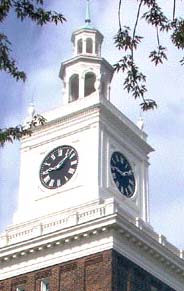
The Dyker Heights campus, located at 1 Poly Prep Drive in Brooklyn, New York, serves as the primary site for the school's middle and upper school divisions, encompassing grades 5 through 12.[51] Spanning 25 acres in the Dyker Heights neighborhood, the verdant, college-like grounds feature athletic fields, academic buildings, and views of the Verrazzano-Narrows Bridge, providing an expansive environment distinct from the urban density of earlier school locations.[52] The campus has operated continuously since its establishment in 1917, marking a significant relocation from the original Brooklyn Heights site to accommodate growth in enrollment and facilities for an all-boys institution at the time.[34] This move reflected the school's adaptation to suburban expansion in Brooklyn, with initial construction focused on core academic and dormitory structures to support boarding students.[3] Key historical elements on the campus include the main academic building and its prominent clock tower, visible from 92nd Street and Seventh Avenue, which anchor the site's early 20th-century architecture.[53] The chapel, constructed around 1922 beneath the clock tower, served early religious and communal functions, while the back fields—documented in 1919 photographs—originally supported outdoor activities amid undeveloped surroundings that later urbanized.[54] These structures embody the campus's evolution from a semi-rural outpost to a modern educational hub, with student-led historical accounts tracing infrastructural changes, such as field expansions and building additions, tied to enrollment surges post-World War I.[55] No designated landmarks beyond the campus core are formally tied to Poly Prep in Dyker Heights, though the site's longevity underscores its role in preserving institutional continuity amid Brooklyn's demographic shifts.[3]Infrastructure expansions and modern amenities
Poly Prep Country Day School has undertaken significant infrastructure expansions on its 25-acre Dyker Heights campus, including the construction of the Poly Arts Center, which broke ground in October 2022 and added 10,000 square feet of space for rehearsal, exhibition, and teaching in music, dance, drama, and visual arts.[56] This facility links the north and south campuses, incorporating new dance studios with mirrored walls and acoustic sound systems, as well as practice rooms adjacent to the existing theater.[57] The center welcomed students for classes in February 2024, enhancing the school's performing arts programming.[58] In athletics, the Novogratz Center for Athletics opened in 2016 as the first new building on the Dyker Heights campus in nearly two decades, spanning 27,900 square feet with flexible multipurpose spaces for training and events.[59] The school maintains two fitness centers, including the High Performance Lab equipped for strength and conditioning, alongside redeveloped outdoor fields through the Take the Field partnership, featuring NCAA-regulation surfaces for soccer, lacrosse, football, track, and baseball/softball on an 11-acre site.[60][61] Additional amenities include six tennis courts, world-class squash courts, three heated swimming pools, and two indoor gyms, supporting interscholastic and recreational activities.[62] Recent acquisitions support further growth, such as the purchase of 53 Prospect Park West in Park Slope in January 2024, expanding infrastructure beyond the main campus.[63] Ongoing renovations, managed by firms like Titan Construction Management since 2016, continue to modernize facilities, including a new glass-clad stair tower and landscaped playground at the Lower School.[64][65] These developments align with the school's master plan to accommodate its enrollment and programmatic needs while preserving historical elements.[66]Athletics and Extracurriculars
Interscholastic leagues and team offerings
Poly Prep Country Day School's upper school interscholastic teams compete primarily in the Ivy Preparatory School League, a conference comprising independent preparatory schools in the New York City area, with opportunities to advance to New York State Association of Independent Schools (NYSAIS) championships.[67][68] The program emphasizes competitive play at varsity, junior varsity, and freshman levels across multiple sports, fostering skill development and team discipline.[69] Teams are organized by season, offering opportunities for both boys and girls in a range of traditional and specialized sports: Fall Sports:- Boys: Cross country, football, soccer
- Girls: Cross country, soccer, tennis, volleyball[70]
- Boys: Basketball, squash, swimming, indoor track and field, wrestling
- Girls: Basketball, squash, swimming, indoor track and field[69][71]
- Boys: Baseball, golf, lacrosse, tennis, outdoor track and field
- Girls: Lacrosse, softball, outdoor track and field[69][70]
Athletic achievements and traditions
Poly Prep's athletic programs compete in the Ivy Preparatory School League, of which the school is a founding member, and have amassed over 275 league championships alongside more than 70 New York State Association of Independent Schools (NYSAIS) titles.[69] Since 2017, 31 student-athletes have earned All-American recognition across various sports.[69] Football holds a prominent place in the school's traditions, with the varsity team capturing the 2022 Metropolitan Independent Football League championship after defeating Rye Country Day School in the Ivy Prep League finals, finishing the season 9-3.[74] The program sustains longstanding rivalries, including annual games against Collegiate School, characterized by consistently elite competition that has seen the teams alternate as New York City's top performers in recent years.[75] Another historic matchup is with St. Paul's School, regarded as the second-oldest interscholastic football rivalry in the United States.[76] In basketball, the boys' varsity team completed an undefeated season en route to the Ivy Prep League title and the New York State Federation Class B championship.[77] The girls' varsity squad has also claimed Ivy Prep honors, contributing to the sport's status as a cornerstone of school athletics.[78] Baseball under coach Harlow Parker, hired in 1947 and later promoted to director of athletics, secured 19 Ivy League Prep School championships.[79] More recently, the varsity baseball team won the 2023 NYSAIS title.[6] Softball achieved an undefeated Ivy Prep League campaign in the same period.[78] Wrestling programs have produced undefeated Ivy Prep seasons and the 2023 NYSAIS championship.[6][78] Track and field successes include NYSAIS indoor titles for both boys' and girls' teams in 2024, with the boys also taking the 2023 outdoor crown.[80][6] Girls' volleyball earned state championship status in 2023 by defeating Avenues at Fieldston.[81] The girls' tennis team holds 10 Ivy Prep League titles.[82] These accomplishments underscore a culture emphasizing competitive excellence and character development through sports.[83]Scandals and reforms in athletic programs
In the late 1960s through 1991, Poly Prep's football program was marred by serial sexual abuse perpetrated by head coach Philip Foglietta, who targeted numerous male student-athletes, primarily in locker rooms, showers, and off-campus settings.[8] Foglietta, who also served as athletic director and physical education teacher, abused boys as young as 10, with allegations surfacing in lawsuits claiming the school administration received complaints as early as 1966 but failed to act, prioritizing the program's reputation over student safety.[8] [84] A 2009 federal lawsuit by multiple alumni accused Poly Prep of a decades-long cover-up, estimating dozens to hundreds of victims; it settled confidentially in December 2012 after discovery revealed internal knowledge of the abuse.[8] [85] Additional abuse claims extended to other athletic staff, including tennis coach William Martire, sued in 2019 under New York's Child Victims Act for allegedly assaulting a student in the 1980s during team activities.[86] Non-sexual misconduct scandals included a 2017 incident where lacrosse coaches were dismissed after over a dozen varsity players were caught consuming alcohol during a team trip to Disney World, highlighting supervisory lapses.[87] In November 2021, varsity football head coach Kevin Fountaine was fired for fostering a "toxic culture" that made players uncomfortable, as determined by an internal investigation prompted by complaints about his leadership style.[88] Following the Foglietta revelations and settlements, Poly Prep implemented reforms to athletic oversight, including a 2014 public apology from then-headmaster David Levin acknowledging the "horrible misconduct" and expressing regret for institutional failures.[89] Under headmaster Audrius Barzdukas, appointed in 2016, the school introduced mandatory harm-prevention curricula and staff trainings focused on recognizing and reporting abuse, aimed at rebuilding trust in athletic programs.[8] These measures, alongside ongoing lawsuits under extended statutes of limitations, reflect efforts to address cultural issues, though critics argue early cover-ups eroded program integrity for generations.[90]Leadership and Administration
Historical heads of school
Poly Prep Country Day School traces its leadership to its origins as Adelphi Academy in 1854, evolving into the Polytechnic Preparatory Country Day School in 1916 under the guidance of early headmasters who emphasized a balanced curriculum of academics, arts, and athletics. Dr. Francis Lane, serving in the early 1900s, played a pivotal role in advocating for the country day model, securing land for athletic fields in 1905 and overseeing the school's incorporation on July 1, 1916, on a 25-acre former golf course site, with classes commencing in 1917.[3] Subsequent leadership included Folwell Scull, who headed the school from 1949 to 1970, followed by William M. Williams, who served from 1970 to 2000 and oversaw the transition to coeducation in the mid-1970s, with the first coed graduating class in 1979.[91][3] Williams enforced a formal dress code and focused on building a diverse student body reflective of broader society.[92] David B. Harman succeeded Williams, leading from approximately 2000 to 2016 over 16 years, during which the school navigated growth amid emerging scrutiny over past athletic program issues.[93] Audrius Barzdukas then served as head of school for seven years, from around 2016 to the end of the 2022-2023 school year, introducing structural changes such as a revamped dean system for student support modeled after Harvard-Westlake School and expansions to the bus system to enhance socioeconomic diversity.[94][21] Following Barzdukas's departure, John Rankin, a long-time faculty member since 1985, acted as interim head of school for the 2023-2024 and 2024-2025 academic years, prioritizing community cohesion during the transition to the subsequent permanent head.[25][21] These leaders collectively advanced Poly Prep's development from a boys' preparatory institution to a coeducational day school serving nursery through grade 12 across two Brooklyn campuses.| Head of School | Tenure | Key Developments |
|---|---|---|
| Dr. Francis Lane | Early 1900s–1916 | Incorporation as country day school; campus establishment.[3] |
| Folwell Scull | 1949–1970 | Pre-coeducation stability.[91] |
| William M. Williams | 1970–2000 | Coeducation transition (1977); first coed class (1979).[91][3] |
| David B. Harman | ca. 2000–2016 | Institutional growth amid accountability challenges.[93] |
| Audrius Barzdukas | ca. 2016–2023 | Dean system overhaul; diversity initiatives.[94][21] |
| John Rankin (interim) | 2023–2025 | Transitional leadership.[25] |
Current governance and recent appointments
Poly Prep Country Day School is governed by a Board of Trustees, which oversees strategic direction, financial stewardship, and policy implementation, while day-to-day operations are managed by the Head of School in collaboration with division heads for the Lower, Middle, and Upper Schools.[28] The board's officers include Chair Laurie T. Rosenblatt (parent of graduates from classes of 2023 and 2026), Vice Chair Jennifer Powers (parent of 2026 and 2028), Treasurer Kareem Raymond (parent of 2031 and 2033), and Secretary John D. (specific surname not detailed in public listings).[28] Dr. Noni Thomas López serves as the current Head of School, the 12th in the institution's history and the first woman and first person of color in the role; she assumed the position on July 1, 2025, following an announcement by the board on January 24, 2024, after a search process initiated amid prior leadership transitions.[28][95][27] Prior to Poly Prep, López led the Gordon School in Rhode Island, where she announced her departure at the end of the 2024-2025 academic year to take this role.[96] Recent appointments include Olivia Baumgartner as Chief Advancement Officer, effective July 2, 2025, bringing 15 years of experience in educational philanthropy from roles including at Harbor Day School, where she significantly increased fundraising.[97] Monique Lopez was appointed Chief Financial and Operations Officer, starting July 1, 2025, with nearly 20 years in nonprofit finance.[98] These hires align with the new Head of School's arrival and follow the board's prior chairmanship under Andrew Foote, who held the position through at least early 2024 before the transition to Rosenblatt.[27][99]Notable Individuals
Prominent alumni achievements
Joakim Noah (class of 2003) played basketball at Poly Prep during his junior year, averaging 24 points, 12 rebounds, and 5 blocks per game, contributing to two league titles.[68] He later starred at the University of Florida, winning the 2006 NCAA championship and earning All-American honors before being drafted ninth overall by the Chicago Bulls in 2007.[100] In the NBA, Noah became a two-time All-Star (2013, 2014), won the Defensive Player of the Year award in 2014, and helped the Bulls reach the Eastern Conference Finals in 2015.[101] Dan Fogler (class of 1994) is an actor and comedian who won the Tony Award for Best Featured Actor in a Musical in 2005 for his role in The 25th Annual Putnam County Spelling Bee.[102] His film credits include voicing Kuzco in The Emperor's New Groove (2000 video game) and roles in Fantastic Beasts films, while television appearances feature The Walking Dead and The Goldbergs.[103] Liz Feldman (class of 1995) is a television writer and producer known for creating the Netflix series Dead to Me (2019–2022), which received multiple Emmy nominations including Outstanding Comedy Series, and No Good Deed (2024).[102] She has also written for shows like 2 Broke Girls and One Big Happy, earning recognition for her work in comedy and drama.[104] Angela Yee (class of 1993) rose to prominence as co-host of The Breakfast Club radio show from 2010 to 2022, interviewing high-profile figures in hip-hop and culture, and later launched Way Up with Angela Yee on iHeartRadio and syndication in 2023.[102] She authored Read This First (2022), a wellness guide, and expanded into television with her own SiriusXM channel. Bruce Cutler graduated from Poly Prep, where he captained the football team and wrestled.[105] As a defense attorney, he represented John Gotti in three trials during the 1980s and 1990s, gaining notoriety for aggressive courtroom tactics, and later defended clients in high-profile cases including the Gambino crime family associates.[106] Cutler served as a Brooklyn Assistant District Attorney before entering private practice.[107] Bonnie Somerville, an actress and singer who attended Poly Prep, appeared in recurring roles on NYPD Blue, Friends, and Code Black, and starred in films like The Omen (2006) remake.[108] She began performing in high school plays at the school and pursued musical theater training afterward.[1]Influential faculty contributions
William Cary Duncan, who taught English and public speaking at Poly Prep (then Brooklyn Polytechnic Preparatory School) from 1897 to 1917, integrated dramatic arts into language instruction, drawing from his career as a playwright to emphasize oratory and performance skills among students.[109] José Oliveras, a World Languages teacher, has advanced interdisciplinary education by founding Teatro Círculo and directing productions that blend Spanish literature with theater, earning multiple Association of Independent Theaters (ATI) awards, including Best Classical Production, Best Director, and Best Actor for works such as El burlador de Sevilla in 2019 and portrayals of historical figures like Rafael Trujillo in 2015.[7][110][111] His efforts extend to co-coordinating international exchange programs, such as the Argentina trip focused on cultural immersion through tango and language, fostering global competencies in students.[112] Michal Hershkovitz, Assistant Head of School for Academics, has driven curriculum reforms to prioritize robust intellectual discourse and resilience in learning, implementing updates that encourage open exchange of ideas amid evolving educational challenges like AI integration since 2022.[113][114] Faculty under her guidance have pursued professional development in adaptive teaching strategies, contributing to Poly Prep's emphasis on lifelong learning and ethical technology use in classrooms.[115] Juliet Moretti, Director of Student Support, contributed to educational innovation by securing a National AI Innovation Fellowship from Google in 2025, applying insights to enhance support services and faculty training on AI tools for personalized student outcomes.[114]Controversies
Philip Foglietta abuse allegations and timeline
Philip Foglietta served as head football coach, physical education teacher, and coach for baseball and basketball at Poly Prep Country Day School from 1966 to 1991.[8] [116] During this period, he faced allegations of sexually abusing numerous male students, primarily football players, through acts including groping, molestation, and rape occurring in locations such as school showers, the gymnasium, squash courts, his apartment, and off-campus sites.[8] [9] Plaintiffs estimated the number of victims at dozens to hundreds, with abuse spanning the entirety of his tenure.[8] [117] 1966–1991: Alleged Abuse PeriodFoglietta was hired in 1966, and allegations claim the abuse began that year, with an early report from a scholarship student of molestation that school administrators allegedly ignored.[116] The misconduct reportedly continued openly for 25 years, enabled by Foglietta's revered status for building a successful football program, during which complaints from parents and students were dismissed or not investigated by headmasters and staff to avoid disrupting team achievements.[8] [117] Foglietta retired in 1991 amid honors from the school, which later claimed in legal defenses to have first become aware of rumors that year, a assertion contradicted by court findings and victim testimonies citing earlier ignored warnings.[8] [116] 1998: Foglietta's Death
Foglietta died in 1998, precluding criminal charges, though no formal police investigation had occurred during his lifetime despite persistent rumors.[116] Early 2000s–2009: Initial Legal Actions
Public allegations emerged in the early 2000s, leading to a 2004 lawsuit dismissed on New York's statute of limitations; a 2005 suit by victim John Paggioli met the same fate.[8] [117] On October 27, 2009, seven former students filed a federal racketeering (RICO) lawsuit in Brooklyn, expanded to 12 plaintiffs including James Zimmerman and Philip Culhane, accusing Foglietta of abusing "dozens, if not hundreds" over four decades and the school of systematic cover-up by successive headmasters who prioritized athletic success and tuition revenue.[117] [8] [9] 2012: Settlement
The 2009 suit settled confidentially in December 2012 without admission of liability by Poly Prep, though the agreement included a three-year gag order on details; the school had faced sanctions for mishandling an internal investigation, including lost notes.[8] [9] Subsequent reporting highlighted ongoing victim trauma and institutional failures, with no criminal accountability due to expired statutes and Foglietta's death.[8]