



Community hub
Recent from talks
Contribute something
Nothing was collected or created yet.
Pound (force)
View on Wikipedia| Pound-force | |
|---|---|
| Unit system | English Engineering units, British Gravitational System |
| Symbol | lbf |
| Conversions | |
| 1 lbf in ... | ... is equal to ... |
| SI units | 4.448222 N |
| CGS units | 444,822.2 dyn |
| Absolute English System | 32.17405 pdl |

The pound of force or pound-force (symbol: lbf,[1] sometimes lbf,[2]) is a unit of force used in some systems of measurement, including English Engineering units[a] and the foot–pound–second system.[3]
Pound-force should not be confused with pound-mass (lb), often simply called "pound", which is a unit of mass; nor should these be confused with foot-pound (ft⋅lbf), a unit of energy, or pound-foot (lbf⋅ft), a unit of torque.
Definitions
[edit]The pound-force is equal to the gravitational force exerted on a mass of one avoirdupois pound on the surface of Earth. Since the 18th century, the unit has been used in low-precision measurements, for which small changes in Earth's gravity (which varies from equator to pole by up to half a percent) can safely be neglected.[4]
The 20th century, however, brought the need for a more precise definition, requiring a standardized value for acceleration due to gravity.
Product of avoirdupois pound and standard gravity
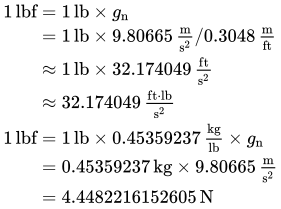
[edit]The pound-force is the product of one avoirdupois pound (exactly 0.45359237 kg) and the standard acceleration due to gravity, approximately 32.174049 ft/s2 (9.80665 m/s2).[5][6][7]
The standard values of acceleration of the standard gravitational field (gn) and the international avoirdupois pound (lb) result in a pound-force equal to 32.174049 ft⋅lb/s2 (4.4482216152605 N).[b]
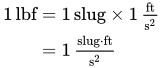
This definition can be rephrased in terms of the slug. A slug has a mass of 32.174049 lb. A pound-force is the amount of force required to accelerate a slug at a rate of 1 ft/s2, so:
Conversion to other units
[edit]| newton | dyne | kilogram-force, kilopond |
pound-force | poundal | |
|---|---|---|---|---|---|
| 1 N | ≡ 1 kg⋅m/s2 | = 105 dyn | ≈ 0.10197 kgf | ≈ 0.22481 lbF | ≈ 7.2330 pdl |
| 1 dyn | = 10−5 N | ≡ 1 g⋅cm/s2 | ≈ 1.0197×10⁻⁶ kgf | ≈ 2.2481×10⁻⁶ lbF | ≈ 7.2330×10⁻⁵ pdl |
| 1 kgf | = 9.80665 N | = 980665 dyn | ≡ gn × 1 kg | ≈ 2.2046 lbF | ≈ 70.932 pdl |
| 1 lbF | ≈ 4.448222 N | ≈ 444822 dyn | ≈ 0.45359 kgf | ≡ gn × 1 lb | ≈ 32.174 pdl |
| 1 pdl | ≈ 0.138255 N | ≈ 13825 dyn | ≈ 0.014098 kgf | ≈ 0.031081 lbF | ≡ 1 lb⋅ft/s2 |
| The value of gn (9.80665 m/s2) as used in the official definition of the kilogram-force is used here for all gravitational units. | |||||
Foot–pound–second (FPS) systems of units
[edit]In some contexts, the term "pound" is used almost exclusively to refer to the unit of force and not the unit of mass. In those applications, the preferred unit of mass is the slug, i.e. lbf⋅s2/ft. In other contexts, the unit "pound" refers to a unit of mass. The international standard symbol for the pound as a unit of mass is lb.[8]
| Base | Force | Weight | Mass | |||||
|---|---|---|---|---|---|---|---|---|
| 2nd law of motion | m = F/a | F = W ⋅ a/g | F = m ⋅ a | |||||
| System | BG | GM | EE | M | AE | CGS | MTS | SI |
| Acceleration (a) | ft/s2 | m/s2 | ft/s2 | m/s2 | ft/s2 | Gal | m/s2 | m/s2 |
| Mass (m) | slug | hyl | pound-mass | kilogram | pound | gram | tonne | kilogram |
| Force (F), weight (W) |
pound | kilopond | pound-force | kilopond | poundal | dyne | sthène | newton |
| Pressure (p) | pound per square inch | technical atmosphere | pound-force per square inch | standard atmosphere | poundal per square foot | barye | pieze | pascal |
In the "engineering" systems (middle column), the weight of the mass unit (pound-mass) on Earth's surface is approximately equal to the force unit (pound-force). This is convenient because one pound mass exerts one pound force due to gravity. Note, however, unlike the other systems the force unit is not equal to the mass unit multiplied by the acceleration unit[11]—the use of Newton's second law, F = m ⋅ a, requires another factor, gc, usually taken to be 32.174049 (lb⋅ft)/(lbf⋅s2). "Absolute" systems are coherent systems of units: by using the slug as the unit of mass, the "gravitational" FPS system (left column) avoids the need for such a constant. The SI is an "absolute" metric system with kilogram and meter as base units.
Pound of thrust
[edit]The term pound of thrust is an alternative name for pound-force in specific contexts. It is frequently seen in US sources on jet engines and rocketry, some of which continue to use the FPS notation. For example, the thrust produced by each of the Space Shuttle's two Solid Rocket Boosters was 3,300,000 pounds-force (14.7 MN), together 6,600,000 pounds-force (29.4 MN).[12][13]
See also
[edit]- Foot-pound (energy)
- Ton-force
- Kip (unit)
- Mass in general relativity
- Mass in special relativity
- Mass versus weight for the difference between the two physical properties
- Newton
- Poundal
- Pounds per square inch, a unit of pressure
Notes and references
[edit]- ^ Despite its name, this system is based on United States customary units and is only used in the US.
- ^ The international avoirdupois pound is defined to be exactly 0.45359237 kg.
- ^ IEEE Standard Letter Symbols for Units of Measurement (SI Units, Customary Inch-Pound Units, and Certain Other Units), IEEE Std 260.1™-2004 (Revision of IEEE Std 260.1-1993)
- ^ Fletcher, Leroy S.; Shoup, Terry E. (1978), Introduction to Engineering, Prentice-Hall, ISBN 978-0135018583, LCCN 77024142, archived from the original on 2019-12-06, retrieved 2017-08-03.: 257
- ^ "Mass and Weight". engineeringtoolbox.com. Archived from the original on 2010-08-18. Retrieved 2010-08-03.
- ^ Acceleration due to gravity varies over the surface of the Earth, generally increasing from about 32.1 ft/s2 (9.78 m/s2) at the equator to about 32.3 ft/s2 (9.83 m/s2) at the poles.
- ^ BS 350 : Part 1: 1974 Conversion factors and tables, Part 1. Basis of tables. Conversion factors. British Standards Institution. 1974. p. 43.
- ^ In 1901 the third CGPM Archived 2012-02-07 at the Wayback Machine declared (second resolution) that:
The value adopted in the International Service of Weights and Measures for the standard acceleration due to Earth's gravity is 980.665 cm/s2, value already stated in the laws of some countries.
This value was the conventional reference for calculating the kilogram-force, a unit of force whose use has been deprecated since the introduction of SI.
- ^ Barry N. Taylor, Guide for the Use of the International System of Units (SI), 1995, NIST Special Publication 811, Appendix B note 24
- ^ IEEE Std 260.1™-2004, IEEE Standard Letter Symbols for Units of Measurement (SI Units, Customary Inch-Pound Units, and Certain Other Units)
- ^ Comings, E. W. (1940). "English Engineering Units and Their Dimensions". Industrial & Engineering Chemistry. 32 (7): 984–987. doi:10.1021/ie50367a028.
- ^ Klinkenberg, Adrian (1969). "The American Engineering System of Units and Its Dimensional Constant gc". Industrial & Engineering Chemistry. 61 (4): 53–59. doi:10.1021/ie50712a010.
- ^ The acceleration unit is the distance unit divided by the time unit squared.
- ^ "Space Launchers - Space Shuttle". www.braeunig.us. Archived from the original on 6 April 2018. Retrieved 16 February 2018.
Thrust: combined thrust 29.36 MN SL (maximum thrust at launch reducing by 1/3 after 50 s)
- ^ Richard Martin (12 January 2001). "From Russia, With 1 Million Pounds of Thrust". wired.com. Archived from the original on 25 September 2019. Retrieved 25 November 2019.
General sources
[edit]- Obert, Edward F. (1948). Thermodynamics. New York: D. J. Leggett Book Company. Chapter I "Survey of Dimensions and Units", pp. 1-24.
Pound (force)
View on GrokipediaDefinition and Fundamentals
Core Definition
The pound-force (symbol: lbf) is a unit of force in the imperial and United States customary systems, defined as the amount of force exerted by standard gravity on a mass of one avoirdupois pound.[1] It represents the force required to accelerate one avoirdupois pound-mass at the rate of standard gravitational acceleration, denoted as ft/s². Symbolically, this is expressed as , where is the mass of one pound-mass and is the standard acceleration due to gravity.[2] The avoirdupois pound-mass is exactly 0.45359237 kilograms, as established by the 1959 International Yard and Pound Agreement between the United States, the United Kingdom, Canada, Australia, New Zealand, and South Africa, which aligned customary units with metric equivalents for precision in international trade and science.[5] Using the standard value of m/s² (exact), the pound-force equates precisely to newtons.[6] This exact numerical value in SI units facilitates conversions in engineering and physics applications while preserving the unit's foundational role in customary systems.[2] It is essential to distinguish the pound-force from the pound-mass (often denoted lbm or simply lb when context indicates mass), as the former measures force—a vector quantity derived from mass and acceleration—while the latter measures mass alone.[1] This separation avoids confusion in technical contexts, such as structural engineering or aviation, where specifying lbf ensures clarity that gravitational force, not inertial mass, is intended.[5]Relation to Mass and Acceleration
The pound-force relates to mass and acceleration via Newton's second law of motion, which states that the net force on an object is equal to its mass times its acceleration , expressed as In this context, one pound-force (lbf) is defined as the force required to accelerate a mass of one avoirdupois pound-mass (lbm) at the standard acceleration due to gravity, denoted . This ensures that the unit of force is tied directly to the gravitational interaction, providing a consistent basis for measurements in engineering and physics applications where weight is a primary consideration. The avoirdupois pound-mass serves as the mass standard and is defined exactly as 0.45359237 kilograms, established through the 1959 International Yard and Pound Agreement between the United States, United Kingdom, Canada, Australia, New Zealand, and South Africa.[7] The standard acceleration due to gravity is defined exactly as 9.80665 m/s², a value adopted by the 3rd General Conference on Weights and Measures (CGPM) in 1901 and reaffirmed in subsequent international standards.[8] Equivalently, in foot-pound-second units, ft/s², derived precisely from the meter-to-foot conversion factor of 0.3048 m/ft. To illustrate, consider an object with a mass of 1 lbm subjected to the standard gravitational field: the resulting downward force is exactly 1 lbf, as . This example highlights how the pound-force encapsulates the product of mass and gravitational acceleration, avoiding ambiguity in systems where local gravity variations might otherwise affect force measurements.Historical Development
Origins in British Engineering Units
The pound-force traces its conceptual roots to the medieval English unit of the pound, which functioned primarily as a measure of weight—the gravitational force acting on a standard mass derived from the ancient Roman libra (a balance weight of approximately 327 grams). In medieval England, various regional standards emerged, such as the Tower pound (equivalent to 5,400 Troy grains or about 350 grams), used for official and mercantile purposes until its replacement by the Troy pound in 1527 under Henry VIII. These early pounds were defined by physical prototypes and implicitly tied force to the pull of gravity on the associated mass, without a formal distinction between mass and the resulting weight, reflecting the practical needs of trade and taxation in a pre-scientific era.[9][10] The 19th-century Industrial Revolution amplified the need for a dedicated force unit in British engineering, as the design and analysis of steam engines and machinery required precise calculations of mechanical work, pressure, and power. Pioneering engineers like James Watt, who improved the steam engine in the 1770s, quantified performance using the "pound-weight"—the force exerted by gravity on a one-pound mass—as seen in his 1782 definition of horsepower, equivalent to lifting a 550-pound weight one foot in one second (or 33,000 foot-pounds per minute). This terminology, common in early technical descriptions of engines and pumps, allowed for empirical assessments of machinery efficiency, such as the pounds of water lifted per bushel of coal consumed, bridging everyday weights with emerging mechanical principles.[11][12] As engineering practices matured, the term evolved to "pound-force" to explicitly denote this gravitational unit and avoid ambiguity with the pound-mass, particularly in contexts demanding clear separation of inertial mass from applied force. This shift was spurred by tensions between absolute (coherent) and gravitational unit systems in the foot-pound-second (FPS) framework; the poundal, introduced as an absolute force unit (the force accelerating one pound-mass at one foot per second squared), exposed early confusions but proved impractical for engineering due to its small magnitude (about 1/32 of a pound-force). Consequently, the pound-force solidified as the gravitational standard in British engineering traditions, aligning with observable weights while supporting calculations in steam power, structural design, and ballistics.[3][13]Standardization Efforts
The formal standardization of the pound-force in British engineering gained momentum in the early 20th century through the work of committees focused on unit consistency. In 1901, the Engineering Standards Committee, formed by leading British engineering institutions, began efforts to unify measurement practices, including the adoption of standard gravity g_n = 32.2 ft/s² to distinguish the pound-force from the pound-mass in mechanical and electrical engineering calculations. This marked the first systematic formalization of the pound-force as a distinct unit for practical applications. A pivotal advancement came with the 1959 International Yard and Pound Agreement, negotiated between the United States, United Kingdom, Canada, Australia, New Zealand, and South Africa. The agreement fixed the avoirdupois pound at exactly 0.45359237 kg, enabling the precise definition of the pound-force as the product of this mass and standard gravity (9.80665 m/s²), equivalent to 4.4482216152605 N. This international accord eliminated minor variations in national definitions of the pound, ensuring uniformity in force measurements.[14] Following the 1959 agreement, national metrology institutes such as the National Institute of Standards and Technology (NIST) in the United States and the National Physical Laboratory (NPL) in the United Kingdom played essential roles in maintaining and refining these standards. These bodies conducted calibrations, intercomparisons, and updates to align customary units with the International System of Units (SI), including refinements that enhanced compatibility through improved realization techniques for force standards. Their collaborative efforts, such as joint force scale comparisons, ensured ongoing accuracy and traceability.[15] The standardization of the pound-force significantly impacted global trade by resolving discrepancies in unit interpretations that had previously complicated cross-border transactions. In sectors like aviation and manufacturing, where force specifications for components such as engines and structural elements are critical, the unified definitions reduced errors in design, production, and certification, promoting interoperability and efficiency in international supply chains.[7]Conversions and Equivalents
To SI and Metric Units
The pound-force (lbf) converts exactly to the SI unit of force, the newton (N), via the factor 1 lbf = 4.4482216152605 N, as defined under the 1959 International Yard and Pound Agreement that aligned customary units with metric standards.[2] This exact equivalence stems from the pound-force being the force exerted by standard gravity on one avoirdupois pound mass, where standard gravity is precisely 9.80665 m/s². For the metric gravitational unit, the kilogram-force (kgf), the conversion is 1 lbf = 0.45359237 kgf exactly. The exact equivalence follows from the mass ratio, as 1 lbf is the weight of 0.45359237 kg under standard gravity, while 1 kgf is the weight of 1 kg under the same acceleration, and 1 kgf = 9.80665 N exactly.[2] In practical applications, such as structural load analysis, 100 lbf converts to 444.822 N, facilitating integration of imperial specifications into SI-dominant international standards.[2] Mixed-unit engineering, like in automotive testing where torque might be specified in ft·lbf alongside metric power outputs, requires these conversions to maintain accuracy. Dimensional analysis ensures force equivalence across units in broader physical equations; for work, where energy E = F × d, 1 ft·lbf converts to 1.3558179483314004 J exactly, preserving consistency when substituting lbf for N in computations like potential energy mgh.[5] This approach avoids errors in interdisciplinary fields such as thermodynamics, where imperial-derived units interface with SI energy metrics.To Other Imperial Force Units
The pound-force (lbf) relates to other imperial force units through defined gravitational and absolute systems, where the lbf is a gravitational unit equivalent to the weight of one avoirdupois pound-mass under standard gravity. In the absolute foot-pound-second (FPS) system, the corresponding unit is the poundal (lpd or pdl), defined as the force required to accelerate one pound-mass by one foot per second squared. Thus, 1 lbf equals exactly 32.17404856 lpd, derived from the standard acceleration due to gravity of 32.17404856 ft/s².[16] Similarly, the ounce-force (ozf) is the gravitational force on one avoirdupois ounce-mass, with 1 lbf equaling 16 ozf, as one pound-mass comprises 16 ounce-masses. This direct proportionality simplifies scaling within imperial mass-based definitions.[16] In engineering contexts, the lbf is preferred over the absolute poundal in gravitational systems like the English Engineering units because it allows numerical equivalence between a body's mass in pounds and its weight in pound-force under standard Earth gravity, avoiding the need to incorporate the gravitational constant explicitly in routine calculations such as those for structural loads or fluid pressures.[17] For completeness with older CGS-derived units still encountered in legacy engineering references, the following table provides key conversions from lbf:| Unit | Conversion from 1 lbf |
|---|---|
| Poundal (lpd) | 32.17404856 lpd |
| Ounce-force (ozf) | 16 ozf |
| Dyne (dyn) | 444,822.16152605 dyn |