Hubbry Logo
Powderpost beetlePowderpost beetleMain
Open search
Powderpost beetle
Community hub
Powderpost beetle
logo
8 pages, 0 posts
0 subscribers
Be the first to start a discussion here.
Powderpost beetle
Powderpost beetle
from Wikipedia

Powderpost beetle
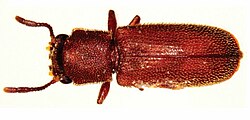
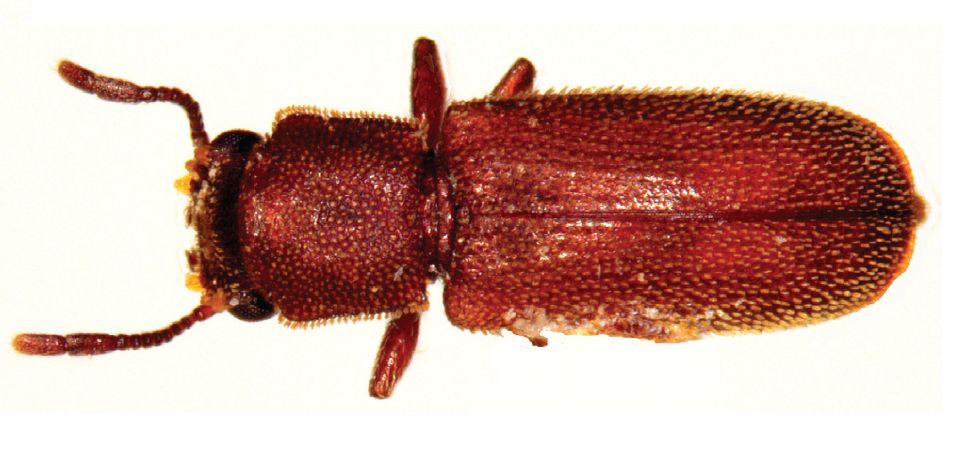
Dorsal view of Lyctoxylon dentatum
Scientific classification Edit this classification
Kingdom: Animalia
Phylum: Arthropoda
Class: Insecta
Order: Coleoptera
Suborder: Polyphaga
Family: Bostrichidae
Subfamily: Lyctinae
Billberg, 1820
Tribes and genera
A typical C-shaped larva of a beetle in the superfamily Bostrichoidea
A typical straight larva of a beetle in the family Cerambycidae, unrelated to the Bostrichoidea

Powderpost beetles are a group of seventy species of woodboring beetles classified in the insect subfamily Lyctinae.[1] These beetles, along with spider beetles, death watch beetles, common furniture beetles, skin beetles, and others, make up the superfamily Bostrichoidea. While most woodborers have a large prothorax, powderpost beetles do not, making their heads more visible. In addition to this, their antennae have two-jointed clubs. They are considered pests and attack deciduous trees, over time reducing the wood to a powdery dust. The damage caused by longhorn beetles (family Cerambycidae) is often confused with that of powderpost beetles, but the two groups are unrelated. The larvae of the Cerambycidae are white, straight and generally flat-headed, whereas those of the Bostrichidae are white and C-shaped.

Name

[edit]

The term "powderpost" comes from the fact that the larvae of these beetles feed on wood and, given enough time, can reduce it to a mass of fine powder. Because of this behavior, they are considered pests. These beetles can survive in colder climates.

Life cycle

[edit]

Powderpost beetle larvae spend months or years inside wood while developing, feeding mainly on the starch content. Their presence is only apparent when they emerge as adults, leaving behind pinhole-sized openings, often called "shot holes".[2] They may also leave piles of powdery frass below. Shot holes normally range in diameter from 132 inch (0.79 mm) to 18 inch (3.2 mm), depending on the species of beetle. If wood conditions are right, female beetles may lay their eggs and re-infest the wood, continuing the cycle for generations.

Target materials

[edit]

Powderpost beetles feed on deciduous trees, including certain hardwoods or softwoods depending on the species. Some hardwoods are naturally immune if they have low starch content or if their pore diameters are too small for the female beetle's ovipositor to lay her eggs in.

Wood preservatives can be used to prevent beetle infestation. Common treatments may use borate, and frequently structural fumigation.

Items that can be infested by powderpost beetles include wooden tools or tool handles, frames, furniture, gun stocks, books, toys, bamboo, flooring, and structural timbers.

References

[edit]
[edit]
Revisions and contributorsEdit on WikipediaRead on Wikipedia
from Grokipedia
Powderpost beetles are small (1/16- to 1/4-inch-long), wood-boring belonging to the families Lyctidae (true powderpost beetles), Anobiidae (deathwatch and furniture beetles), and (false powderpost beetles) that infest and damage dry, seasoned wood by reducing it to a fine, - or talc-like powder () through the tunneling activity of their larvae. These beetles are among the most destructive pests of wooden materials second only to , targeting structural components, furniture, , and other products while leaving small, round exit holes (1/32 to 1/8 inch in diameter) as evidence of infestation. They are widespread globally, including across the and . Adults of powderpost beetles are typically reddish-brown to black, measuring 1/16 to 1/4 inch in length, with distinct morphological features: lyctids are narrow and elongated with visible heads and antennae ending in a two-segmented club; anobiids are convex and oval-shaped; and bostrichids have a hooded pronotum that covers the head. The life cycle involves complete , beginning when females lay 15 to 50 eggs in the pores or cracks of unfinished wood during late winter to summer; the larvae (white, legless grubs) then bore meandering tunnels, feeding on wood for periods ranging from 3 months to 5 years depending on , temperature, and wood moisture (typically below 20% for lyctids and bostrichids, but up to 30% for anobiids). Pupation occurs within the wood, and adults emerge to mate and reinfest nearby materials, with full cycles lasting 6 months to 4 years. These beetles primarily infest hardwoods such as , , , , and —especially sapwood with at least 3% content—though anobiids can also attack softwoods like if moisture levels are suitable; infestations often enter homes via , infested , or imported wood products and are widespread across the and . Damage manifests as structural weakening from interconnected tunnels filled with , potentially compromising furniture, paneling, joists, and subflooring if left unchecked, though the process is gradual and activity peaks in warmer months. Management focuses on prevention through kiln-drying (130–140°F for 8+ hours), finishing wood surfaces with or paint, and treatments like applications, heat (140–150°F for 2–4 hours), freezing (0°F for 72 hours to weeks), or professional for severe cases.

Overview and Classification

Definition and Etymology

Powderpost beetles refer to a group of small wood-boring , typically ranging from 1/8 to 3/4 inch in , belonging to several families whose larvae feed on fibers, reducing the to a fine, flour-like powder known as . This is a key indicator of their activity, as the larvae tunnel through the wood, consuming the starch-rich portions and leaving behind the powdery residue. The term encompasses species that infest seasoned hardwoods and softwoods, posing significant risks to structural timber, furniture, and other wooden artifacts. The common name "powderpost" originates from the distinctive fine, talcum-powder-like consistency of the produced during larval feeding, which contrasts with the coarser, pellet-shaped droppings left by other wood-damaging organisms such as . This nomenclature highlights the beetles' unique mode of wood degradation, where the interior of the wood is pulverized into dust over time. Early scientific descriptions of relevant species emerged within the Linnaean taxonomic framework, which classified Coleoptera (beetles) as an order in 1758, facilitating the identification of wood-boring taxa. This taxonomic foundation supported ongoing studies of their pest status in the following centuries.

Taxonomic Groups

Powderpost beetles belong to the order Coleoptera and are primarily grouped within the superfamily Bostrichoidea, encompassing species from the families and (formerly Anobiidae). The "true" powderpost beetles are classified in the subfamily Lyctinae of the family Bostrichidae (formerly treated as the separate family Lyctidae), which includes approximately 70 species worldwide specialized in wood-boring behavior. In contrast, the deathwatch beetles fall under the subfamily Anobiinae of the family (formerly Anobiidae), while the false powderpost beetles are represented by the subfamily Bostrichinae within Bostrichidae. Key species exemplify the diversity within these groups. In Lyctinae, Lyctus brunneus (Stephens, 1830), known as the brown powderpost beetle, is the most widespread and commonly encountered species, particularly in temperate regions where it infests hardwoods. Another notable Lyctine is Lyctus planicollis LeConte, 1857, the western powderpost beetle, prevalent in North American hardwoods. For Anobiinae, Anobium punctatum (De Geer, 1774), often called the furniture beetle, is a prominent example responsible for significant structural damage in damp wood. The taxonomic groups differ in their ecological niches and infestation patterns. Lyctids in Lyctinae primarily target starch-rich hardwoods, such as and , producing fine, flour-like from their tunneling. Anobiids in Anobiinae favor softwoods like in moist environments and develop more slowly, often taking 1–3 years per generation, with pellet-like as a distinguishing feature. Bostrichids in Bostrichinae exhibit broader host specificity, attacking a variety of hardwoods, softwoods, and even , while generating coarser, gritty containing wood particles. These beetles trace their origins to ancient wood-boring lineages within Coleoptera, with the family showing remarkable morphological stasis since its earliest fossil occurrences in Cretaceous amber approximately 100 million years ago.

Physical Description

Adult Morphology

Adult powderpost beetles exhibit an elongated body form, typically measuring 3 to 9 mm in length, with a shape that ranges from cylindrical to slightly flattened and a coloration spanning reddish-brown to black. These features aid in distinguishing them from other wood-boring insects, as their compact, robust build reflects adaptations for navigating and emerging from wooden substrates. The head is prognathous and visible from above in lyctids, while it is deflexed and often concealed beneath the pronotum in anobiids and bostrichids. Antennae are composed of 9 to 11 segments, terminating in a two- or three-segmented club that is more pronounced in males. The thorax features a pronotum that varies significantly: in lyctids, the pronotum is not hood-like and leaves the head visible; anobiids display a humped, bell-shaped pronotum; and bostrichids have a large, roughened pronotum with spiny projections that covers the head. The elytra are smooth, fully covering the , and marked by fine punctures arranged in striae. Sexual dimorphism is evident, with males generally smaller and possessing more elongated antennal clubs compared to females, which are larger to support egg production. Variations across taxonomic groups further refine identification: lyctids tend to be more slender overall, anobiids exhibit a distinctly humped pronotum, and bostrichids are characterized by prominent spiny projections on the .

Larval and Other Stages

The eggs of powderpost beetles are tiny, , and in shape, typically laid singly or in small clusters within the pores, cracks, or rough surfaces of unfinished . These eggs serve as the initial stage for , with females selecting sites that provide access for emerging larvae to the wood's nutrient-rich interior. Larvae represent the destructive phase of powderpost beetles, emerging from eggs to bore extensive tunnels into while feeding voraciously. They are generally or yellowish-white, C- or U-shaped, legless or equipped with vestigial legs, measuring 1–6 mm in length, and possess a prominent brown head capsule with robust chewing mouthparts adapted for excavating galleries. This tunneling activity directly causes structural weakening by reducing to fine particles, with larvae targeting and content for nutrition. Morphological variations occur among the major groups. Lyctid larvae (Lyctidae) are slightly flattened and hairy, with three pairs of small spine-like legs behind the head, facilitating movement through the dense pores of hardwoods. Anobiid larvae (Anobiidae) feature a nearly white body with a darkened head capsule and rows of small dorsal spines, giving a hairy appearance that aids in navigation through softer wood grains. Bostrichid larvae () exhibit a C-shaped form where the segments immediately behind the head are wider than the tail end, sometimes with horn-like projections, enabling efficient boring in both hardwoods and softwoods. A key diagnostic trait across all groups is frass production, the fine, pelletized, or meal-like waste from larval feeding, which accumulates in tunnels and sifts out as a telltale sign of . Pupae form the transitional stage, typically exarate in type with free appendages, appearing white to light brown and measuring 3–8 mm in length; they develop within enlarged larval chambers near the wood surface, close to prospective exit holes. This immobile phase precedes adult emergence, during which the pupa remains protected inside the wood, completing without further feeding or damage.

Life Cycle and Biology

Developmental Stages

Powderpost beetles undergo complete , a holometabolous life cycle characteristic of all major taxonomic groups including Lyctidae, Anobiidae, and , consisting of four distinct stages: , , , and . In the stage, female powderpost beetles lay 10 to 50 , typically inserting them into pores, vessels, cracks, or crevices of unfinished or other suitable substrates over a period of about one week following . The eggs are small, white, and oval, hatching into tiny larvae after approximately 7 to 14 days under favorable conditions. The larval stage represents the longest and most destructive phase, during which the creamy white, C-shaped grubs tunnel through while feeding voraciously. Larvae pass through multiple instars, ranging from 3 to 5 in lyctids to up to 20 or more in anobiids, molting as they grow and excavate meandering galleries. Digestion of wood components varies by group: lyctids primarily consume starches and sugars using gut enzymes, while anobiids and bostrichids break down and with the aid of symbiotic fungi or cells harbored in specialized gut structures. During the pupal stage, the mature larva forms a chamber near the wood surface, where it undergoes non-feeding into the form over 1 to 4 weeks, depending on and environmental cues. The pupa is exarate, with legs and wings visible, and remains immobile within the protective tunnel. The stage is brief, lasting from a few weeks to a couple of months, during which the beetle emerges through a small round exit hole, focuses primarily on , and initiates egg-laying without significant feeding in most . Adults are typically nocturnal and may be attracted to light, with females selecting new substrates for oviposition to continue the cycle.

Duration and Influencing Factors

The life cycle duration of powderpost beetles varies significantly among taxonomic groups and is influenced by environmental conditions. For lyctid species, development typically spans 3 to 12 months under optimal conditions, though it can extend to several years in suboptimal environments. Anobiid species generally require 1 to 5 years to complete their cycle, potentially extending up to 10 years in cool, dry settings where larval growth is slowed. Bostrichid species exhibit a relatively rapid cycle, often completing in about one year, particularly in warmer conditions. Temperature plays a critical role in accelerating or inhibiting development across all groups. Optimal temperatures for larval growth and overall progression range from 75°F to 90°F (24°C to 32°C), where metabolic rates increase and stages advance quickly; below 50°F (10°C), larval feeding and development effectively halt, leading to prolonged cycles. In temperate regions, larvae of many species, especially anobiids, enter during winter, resuming activity in spring when temperatures rise above this threshold. Moisture levels and nutritional quality of the host further modulate cycle length. High content exceeding 3% in accelerates larval development in lyctids by providing readily available , shortening the overall duration; conversely, low prolongs and extends the larval stage as stress limits feeding. Anobiids, which can digest more effectively than other groups, are particularly sensitive to between 13% and 30%, where insufficient levels delay maturation and increase vulnerability to incomplete cycles. Species-specific interactions with environmental factors also influence timing. Bostrichids develop faster in tropical climates due to consistently warm temperatures and higher , often achieving shorter cycles compared to temperate populations. In anobiids, fungal symbionts in the gut aid by supplying essential nutrients like sterols and vitamins, enabling sustained larval growth in lower-starch woods and mitigating some nutritional limitations that prolong development in other groups.

Hosts and Infestation

Preferred Materials

Powderpost beetles, encompassing species from the families Lyctidae (true powderpost beetles), Anobiidae, and (false powderpost beetles), exhibit distinct preferences for host materials based on wood type, nutritional content, and surface conditions. Lyctids primarily target the sapwood of hardwoods such as , , , , poplar, cherry, and , which contain high levels of and sugars essential for larval development. These beetles require wood with at least 3% starch content and large pores (greater than 65–70 micrometers in diameter) to facilitate insertion and larval tunneling. They avoid heartwood, which is typically low in , and seldom infest wood older than 3-5 years old due to starch depletion over time. In contrast, anobiids infest both hardwoods and softwoods but show a preference for the sapwood of softwoods like , , and Douglas-fir, particularly in damp conditions with 13-30% content. Unlike lyctids, anobiids are less dependent on and can digest in the wood cell walls, allowing them to exploit a broader range of seasoned timbers. Bostrichids attack both hardwoods and softwoods, with a noted preference for hardwoods, and they readily infest processed materials such as and particleboard. These beetles favor substrates with elevated initial (above 30%) and , though they can develop in drier conditions post-infestation. Common wood products targeted across these families include seasoned , furniture, , paneling, tool handles, antiques, and structural elements like beams and joists, provided the surfaces are bare and unfinished to allow egg-laying. Finished or varnished wood resists oviposition, as females cannot access the substrate effectively. In tropical regions, species such as Dinoderus minutus frequently target and due to their high and porous structure, often infesting these materials prior to export.

Signs of Infestation and Damage

Powderpost beetles are often detected through the presence of small, round exit holes on the surface of infested , typically measuring 1/32 to 1/8 inch in diameter, which are created by emerging adults. These holes may appear clustered and are most evident on unfinished or exposed surfaces; fresh holes with sharp, clean edges and no discoloration indicate an active , while older holes may be weathered or filled with dust. A key indicator of activity is the fine, -like , or insect excrement mixed with wood particles, that sifts from these exit holes or accumulates in small piles below the infested item. This powder resembles or baking in texture and often matches the color of the host wood, appearing white or light-colored in hardwoods; fresh is typically loose and clean, whereas old may yellow or cake over time. Beneath the wood surface, larvae excavate interconnected galleries and meandering tunnels, primarily in the sapwood, which progressively weaken the material's structural without causing visible surface cracking, distinguishing this from that of . These tunnels are often packed with and follow the grain, leading to extensive internal deterioration that can the wood in severe, unchecked cases. Certain species, particularly anobiid powderpost beetles like the , produce faint ticking or tapping sounds during or , audible in quiet conditions and historically associated with as omens of . These auditory cues, resembling a clock's , may emanate from within infested wood, especially in moist environments. Infestations often begin with hidden larval feeding that remains undetected for months to years, depending on species and environmental factors, before adults emerge and produce visible signs; over time, repeated generations can convert sound wood into a fragile, powdery mass, compromising items like furniture or structural beams.

Distribution and Ecology

Geographic Range

Powderpost beetles, encompassing species from the families Lyctidae, Anobiidae, and , exhibit a worldwide, facilitated by in products. These are particularly prevalent in regions with suitable and resources, though their specific ranges vary by family. Lyctids, or true powderpost beetles, are most common in temperate zones, including , , and , where they infest hardwoods like and . Lyctids are widespread throughout the . Anobiids, known as deathwatch or furniture beetles, occur worldwide but thrive in cooler climates, with notable prevalence in , where species like the furniture beetle (Anobium punctatum) have long been pests in historic structures. Bostrichids, or false powderpost beetles, predominate in tropical and subtropical areas such as and , though some species have spread to temperate regions via imports. Historical spread has been driven by human commerce, with many species introduced beyond their native ranges through infested furniture and lumber; for instance, lyctid species like Lyctus brunneus reached the from during colonial trade. Invasive examples include the establishment of Lyctus species in since the early 1900s via imported timber, expanding their impact in the . The subfamily Lyctinae comprises approximately 70 species worldwide, with greater diversity in tropical regions, underscoring the ' role as a center for these pests.

Habitat and Behavioral Ecology

Anobiid powderpost beetles primarily inhabit natural environments consisting of moist, dead wood in forests, such as fallen logs, tree limbs, branches, and bark-free trunk scars on dying trees. Lyctids and bostrichids target drier, seasoned hardwoods in similar natural settings. These sites provide suitable shaded conditions ideal for initial egg-laying and larval development, where the beetles target hardwoods like oak and hickory. In artificial habitats, powderpost beetles thrive in human-made structures containing unfinished or unseasoned wood, including buildings, warehouses, barns, and sheds with stored or wooden items. Infestations commonly occur in poorly ventilated, moist areas like crawl spaces, basements, and garages, where supports larval survival in materials such as flooring, paneling, and furniture. Behaviorally, adult powderpost beetles exhibit phototaxis, being strongly attracted to sources, which facilitates their from wood and dispersal, often leading them to windowsills or illuminated areas. Larvae remain sedentary within the wood, tunneling through galleries without significant movement. typically takes place near sites shortly after adults exit the wood, with females depositing eggs directly on or in cracks of bare wood surfaces. Ecologically, powderpost beetles play a key role as wood decomposers in forest ecosystems, breaking down dead and aiding nutrient recycling to support and plant growth. Their larval feeding reduces woody material to fine , accelerating the natural decay process. Additionally, adults and larvae serve as prey for various predators, including birds, , snakes, bats, and parasitic wasps that target wood-boring insects. Powderpost beetles interact symbiotically with certain wood-inhabiting fungi, particularly in species like anobiid powderpost beetles, where fungi partially predigest cellulose, enabling more efficient larval digestion of wood. In humid environments, they may compete with for access to suitable decaying wood resources, though termites often dominate softer materials.

Human Impact and Management

Economic and Structural Effects

Powderpost beetles pose substantial risks to wooden structures by boring tunnels into the wood as their larvae feed primarily on its content, leading to progressive weakening of load-bearing elements such as beams, joists, and . In severe infestations, particularly those involving anobiid species like the , this degradation can compromise structural integrity, potentially resulting in partial collapses or the need for extensive reinforcements in buildings and other wooden frameworks. For instance, larvae tunnel through softwoods and hardwoods alike, creating networks of galleries that reduce wood and strength over time, often going unnoticed until exit holes and appear. The economic consequences of powderpost beetle infestations are considerable, primarily stemming from the costs associated with repairing or replacing damaged wooden items and structures. , these beetles rank second only to among wood-destroying insects, inflicting substantial losses on industries including furniture , , and the trade, where infested hardwoods like and require costly treatments or outright replacement. Homeowners frequently face claims for infestation-related damages, with individual repair expenses ranging from thousands of dollars for refinishing floors and paneling to tens of thousands for structural interventions in infested homes. Historically, powderpost beetles have plagued wooden and , as seen in 19th-century outbreaks that affected timber supplies and vessel durability; a notable modern parallel is the ongoing infestation in , Nelson's flagship from 1805, where deathwatch beetles have caused extensive deterioration of oak timbers, necessitating multimillion-pound conservation efforts. As of 2025, conservation efforts continue, including genomic studies of the beetles initiated in 2024 to develop more effective controls. In the United States, similar issues arise in imported wood products, such as furniture, crates, and items from tropical regions, which introduce exotic species like bostrichid powderpost beetles, exacerbating economic burdens through quarantines and treatments at ports. Beyond structural and financial harms, powderpost beetles inflict non-structural effects, including aesthetic degradation of heirlooms and antiques, where fine powder and pinhole patterns mar the appearance of cherished wooden artifacts. The , in particular, contributes a psychological dimension through its characteristic ticking sounds—produced by adults banging their heads against wood to attract mates—which have long been mythologized in as omens of , evoking unease in quiet, infested spaces like old homes or churches.

Prevention and Control Strategies

Preventing powderpost beetle infestations begins with proper wood handling and treatment during and storage. Kiln-drying to a moisture content below 20% effectively kills existing beetles and their eggs, as the high temperatures (typically 125–140°F for several hours) destroy all life stages, while reducing moisture prevents reinfestation by making the wood less suitable for larval development. Applying borate-based preservatives, such as tetrahydrate (e.g., Bora-Care or Tim-bor), to unfinished wood surfaces via spraying, brushing, or soaking penetrates the material and provides long-term protection against larvae by disrupting their digestion. Sealing wood surfaces with , , or after treatment blocks female beetles from laying eggs, as these coatings prevent access to the wood's content. For active infestations, chemical controls target adults and larvae at different stages. Surface applications of insecticides like or , applied to bare wood after removing finishes, kill emerging adults and provide residual protection for several months, though multiple applications over 2–3 years may be needed to cover the full life cycle. or solutions can be injected into exit holes to reach tunneling larvae, offering a targeted treatment that diffuses through and inhibits feeding without broad environmental impact. Non-chemical methods are preferred for small items or environmentally sensitive areas. in an oven or chamber to achieve a core temperature of at least 133°F (56°C) for 30 minutes or more, up to 150°F (66°C) for several hours depending on wood thickness and severity, kills all stages by denaturing proteins in eggs, larvae, and adults, with temperatures monitored to ensure efficacy. Freezing infested objects at 0°F (-18°C) or below for at least 72 hours, up to 7 days depending on item size, followed by gradual thawing to avoid , eliminates beetles in furniture or antiques, though wrapping in plastic is essential. For larger structures or items, with gas (e.g., aluminum ) under professional supervision penetrates wood and eradicates infestations, but it requires sealed enclosures and offers no residual protection. Integrated pest management (IPM) combines these approaches with regular inspections to detect or exit holes early, reducing reliance on chemicals. Homeowners should consult certified professionals for assessments and treatments, especially for structural wood, and replace heavily infested pieces if feasible, as this is often the most cost-effective option. Emerging biological controls, such as entomopathogenic nematodes, show promise in laboratory studies for targeting larvae but lack widespread field validation. Regulatory measures under USDA guidelines mandate treatments like (133°F for 30 minutes) or for imported wood packaging to prevent introduction of powderpost beetles, with quarantines imposed on infested materials to limit spread.

References

Add your contribution
Related Hubs
User Avatar
No comments yet.