


Community hub
Recent from talks
Contribute something
Nothing was collected or created yet.
Priestia
View on Wikipedia
| Priestia | |
|---|---|

| |
| Priestia megaterium | |
Scientific classification 
| |
| Domain: | Bacteria |
| Kingdom: | Bacillati |
| Phylum: | Bacillota |
| Class: | Bacilli |
| Order: | Bacillales |
| Family: | Bacillaceae |
| Genus: | Priestia Gupta et al. 2020[1] |
| Type species | |
| Priestia megaterium (de Bary 1884) Gupta et al. 2020
| |
| Species | |
|
See text | |
| Synonyms | |
| |
Priestia is a genus of mostly Gram-positive (P. flexa stains Gram-variable and P. koreensis stains Gram-negative), rod-shaped bacteria in the family Bacillaceae from the order Bacillales.[2][3] The type species of this genus is Priestia megaterium.[1]
Members of Priestia are previously species belonging to Bacillus, a genus that has been recognized as displaying extensive polyphyly within its members due to the vague criteria[4] used to assign species to this clade. Multiple studies have been conducted using comparative phylogenetic analyses as a means to clarify the evolutionary relationships between Bacillus species, resulting in the transfer of species into numerous novel genera such as Alkalihalobacillus, Brevibacillus, Solibacillus, Alicyclobacillus, Virgibacillus and Evansella.[5][6][7][8][9][2] In addition, the genus Bacillus has been restricted to only include species closely related to Bacillus subtilis and Bacillus cereus.[5][2]
Priestia is named after the British microbiologist Fergus G. Priest (professor, Heriot-Watt University, Edinburgh; 1948–2019) for his many contributions to the systematics and uses of the members of the genus Bacillus.[2]
Biochemical characteristics and molecular signatures
[edit]Source:[2]
Members of this genus are aerobic and found in diverse locations, such as soil, faeces, upper atmosphere, inner tissues of cotton plants, sea sediment, and the rhizosphere of willow roots. All members can produce endospores and most are motile. Priestia species can grow in temperatures ranging from 5 to 48 °C, with optimal growth in the range of 28–37 °C, so it can be qualified as a mesophile and psychrotrophic organism. P. aryabhattai is industrially important as it is resistant to arsenic and UV radiation, allowing for an affordable alternative to conventional, expensive, metal remediation technologies.
Two conserved signature indels (CSIs) have been identified through genomic analysis as exclusive for this genus in the proteins oligoribonuclease NrnB or cAMP/cGMP phosphodiesterase and DHH superfamily protein, and can be used to reliably differentiate this genus from other Bacillaceae genera and bacteria in molecular terms.[2]
Phylogeny
[edit]Priestia, as of May 2021, contains 10 species with validly published names.[1][10] This genus was identified as a monophyletic clade and phylogenetically unrelated to other Bacillus species in studies examining the taxonomic relationships within Bacillus.[2] This branching pattern is also observed in the Genome Taxonomy Database.[11]
Two invalidly published species, "Bacillus pseudoflexus" and "Bacillus zanthoxyli", are also found to group with other members of Priestia in phylogenetic trees, as well as share the same molecular markers in the form of CSIs.[2] Their transfer was not officially proposed, though, due to the lack of culture strain information. Further revision of this genus is required, as additional genomes and novel species are discovered and assigned.
| 16S rRNA based LTP_10_2024[12][13][14] | 120 marker proteins based GTDB 09-RS220[15][16][17] | ||||||||||||||||||||||||||||||||||||||||||||||||||||||||||||||||||||||||||||||||||||||||||||||||||||||||||||||||||||||||||||||
|---|---|---|---|---|---|---|---|---|---|---|---|---|---|---|---|---|---|---|---|---|---|---|---|---|---|---|---|---|---|---|---|---|---|---|---|---|---|---|---|---|---|---|---|---|---|---|---|---|---|---|---|---|---|---|---|---|---|---|---|---|---|---|---|---|---|---|---|---|---|---|---|---|---|---|---|---|---|---|---|---|---|---|---|---|---|---|---|---|---|---|---|---|---|---|---|---|---|---|---|---|---|---|---|---|---|---|---|---|---|---|---|---|---|---|---|---|---|---|---|---|---|---|---|---|---|---|---|
|
|
Unassigned species:
- "P. veravalensis" Wagh, Ram & Dastager 2021
See also
[edit]References
[edit]- ^ a b c A.C. Parte; et al. "Priestia". List of Prokaryotic names with Standing in Nomenclature (LPSN). Retrieved 28 February 2025.
- ^ a b c d e f g h Gupta, Radhey S.; Patel, Sudip; Saini, Navneet; Chen, Shu (1 November 2020). "Robust demarcation of 17 distinct Bacillus species clades, proposed as novel Bacillaceae genera, by phylogenomics and comparative genomic analyses: description of Robertmurraya kyonggiensis sp. nov. and proposal for an emended genus Bacillus limiting it only to the members of the subtilis and cereus clades of species". International Journal of Systematic and Evolutionary Microbiology. 70 (11): 5753–5798. doi:10.1099/ijsem.0.004475. ISSN 1466-5026. PMID 33112222.
- ^ Brenner, Don J.; Krieg, Noel R.; Staley, James T.; Garrity, George M.; Boone, David R.; De Vos, Paul; Goodfellow, Michael; Rainey, Fred A.; Schleifer, Karl-Heinz, eds. (2005). Bergey's Manual® of Systematic Bacteriology. doi:10.1007/0-387-28022-7. ISBN 978-0-387-24144-9.
- ^ Ash, Carol; Farrow, J.A.E.; Wallbanks, Sally; Collins, M.D. (28 June 2008). "Phylogenetic heterogeneity of the genus Bacillus revealed by comparative analysis of small-subunit-ribosomal RNA sequences". Letters in Applied Microbiology. 13 (4): 202–206. doi:10.1111/j.1472-765x.1991.tb00608.x. ISSN 0266-8254. S2CID 82988953.
- ^ a b Patel, Sudip; Gupta, Radhey S. (1 January 2020). "A phylogenomic and comparative genomic framework for resolving the polyphyly of the genus Bacillus: Proposal for six new genera of Bacillus species, Peribacillus gen. nov., Cytobacillus gen. nov., Mesobacillus gen. nov., Neobacillus gen. nov., Metabacillus gen. nov. and Alkalihalobacillus gen. nov". International Journal of Systematic and Evolutionary Microbiology. 70 (1): 406–438. doi:10.1099/ijsem.0.003775. ISSN 1466-5026. PMID 31617837.
- ^ SHIDA, O.; TAKAGI, H.; KADOWAKI, K.; KOMAGATA, K. (1 October 1996). "Proposal for Two New Genera, Brevibacillus gen. nov. and Aneurinibacillus gen. nov". International Journal of Systematic Bacteriology. 46 (4): 939–946. doi:10.1099/00207713-46-4-939. ISSN 0020-7713. PMID 8863420.
- ^ Wisotzkey, J. D.; Jurtshuk, P.; Fox, G. E.; Deinhard, G.; Poralla, K. (1 April 1992). "Comparative Sequence Analyses on the 16S rRNA (rDNA) of Bacillus acidocaldarius, Bacillus acidoterrestris, and Bacillus cycloheptanicus and Proposal for Creation of a New Genus, Alicyclobacillus gen. nov". International Journal of Systematic Bacteriology. 42 (2): 263–269. doi:10.1099/00207713-42-2-263. ISSN 0020-7713. PMID 1374624.
- ^ Mual, Poonam; Singh, Nitin Kumar; Verma, Ashish; Schumann, Peter; Krishnamurthi, Srinivasan; Dastager, Syed; Mayilraj, Shanmugam (1 May 2016). "Reclassification of Bacillus isronensis Shivaji et al. 2009 as Solibacillus isronensis comb. nov. and emended description of genus Solibacillus Krishnamurthi et al. 2009". International Journal of Systematic and Evolutionary Microbiology. 66 (5): 2113–2120. doi:10.1099/ijsem.0.000982. ISSN 1466-5026. PMID 26907585.
- ^ Heyndrickx, M.; Lebbe, L.; Kersters, K.; Hoste, B.; De Wachter, R.; De Vos, P.; Forsyth, G.; Logan, N. A. (1 July 1999). "Proposal of Virgibacillus proomii sp. nov. and emended description of Virgibacillus pantothenticus (Proom and Knight 1950) Heyndrickx et al. 1998". International Journal of Systematic and Evolutionary Microbiology. 49 (3): 1083–1090. doi:10.1099/00207713-49-3-1083. ISSN 1466-5026. PMID 10425765.
- ^ C.L. Schoch; et al. "Priestia". National Center for Biotechnology Information (NCBI) taxonomy database. Retrieved 28 February 2025.
- ^ "GTDB – Tree". gtdb.ecogenomic.org. Retrieved 28 May 2021.
- ^ "The LTP". Retrieved 10 December 2024.
- ^ "LTP_all tree in newick format". Retrieved 10 December 2024.
- ^ "LTP_10_2024 Release Notes" (PDF). Retrieved 10 December 2024.
- ^ "GTDB release 09-RS220". Genome Taxonomy Database. Retrieved 10 May 2024.
- ^ "bac120_r220.sp_labels". Genome Taxonomy Database. Retrieved 10 May 2024.
- ^ "Taxon History". Genome Taxonomy Database. Retrieved 10 May 2024.

Priestia
View on GrokipediaTaxonomy
Classification
The genus Priestia belongs to the domain Bacteria, phylum Bacillota, class Bacilli, order Caryophanales, family Sutcliffiellaceae, as per recent taxonomic revisions based on phylogenomic analyses of type strains.[2] Originally placed within the family Bacillaceae upon its establishment in 2020, Priestia was reassigned to the newly proposed Sutcliffiellaceae following a comprehensive reevaluation of the order Caryophanales using 1080 high-quality genome sequences, which highlighted distinct phylogenetic clusters among Bacillaceae genera.[3][2] Priestia was proposed as a novel genus by Gupta et al. in 2020 to accommodate a monophyletic clade of species previously classified under Bacillus, distinguished through phylogenomic and comparative genomic analyses that identified unique molecular markers separating it from the core Bacillus lineage.[3] These analyses included whole-genome comparisons and 16S rRNA gene sequence similarities, revealing average nucleotide identity values below 95% and digital DNA-DNA hybridization below 70% with Bacillus species, supporting the generic separation.[3] The type species is Priestia megaterium (formerly Bacillus megaterium), selected for its representative position within the clade and historical significance as a well-studied soil bacterium.[3] As of 2024, the genus Priestia comprises 10 validly published species, reflecting its establishment with the reclassification of several former Bacillus species such as P. aryabhattai, P. flexa, and P. koreensis based on shared genomic signatures.[4] No additional species have been validly added since 2021, though ongoing genomic studies continue to refine boundaries within the Sutcliffiellaceae.[2]Etymology and History
The genus name Priestia is a New Latin feminine noun derived from the surname of Prof. Fergus G. Priest (1948–2019), a British microbiologist at Heriot-Watt University, Edinburgh, honoring his extensive contributions to the taxonomy and systematics of Bacillus species.[4] Prior to 2020, species now assigned to Priestia were classified within the polyphyletic genus Bacillus, which encompassed diverse bacterial groups lacking clear phylogenetic boundaries. This classification stemmed from early 19th- and 20th-century descriptions based primarily on morphological traits, such as spore formation and Gram-positive staining, rather than genomic evidence. For instance, the type species Priestia megaterium was originally described as Bacillus megaterium by Anton de Bary in 1884 from soil samples, highlighting its large cell size (hence "megaterium").[3] In 2020, Radhey S. Gupta and colleagues proposed Priestia as a novel genus in the family Bacillaceae, based on phylogenomic analyses of over 300 genomes and comparative studies identifying 17 distinct clades within Bacillus. These analyses, using methods like multi-locus sequence alignments and whole-genome phylogenies, demonstrated that the Priestia clade formed a robust, monophyletic group separate from core Bacillus lineages (e.g., the Subtilis and Cereus clades), supported by unique conserved signature indels in proteins. This reclassification addressed the polyphyly of Bacillus by elevating well-demarcated clades to genus level, with the proposal published in the International Journal of Systematic and Evolutionary Microbiology (DOI: 10.1099/ijsem.0.004475). As a result, 10 species were transferred to Priestia, including B. megaterium, B. aryabhattai, B. endophytica, and B. qingshengii, establishing P. megaterium as the type species.[3][4]Description
Morphology
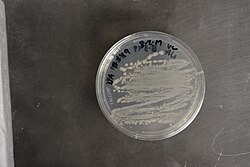
Priestia species are rod-shaped bacilli, typically measuring 0.5–1.2 μm in width and 1.2–4.0 μm in length.[7][8] Members of the genus are mostly Gram-positive, though exceptions exist, such as P. flexa, which is Gram-variable, while P. koreensis is Gram-positive.[9][10] Priestia bacteria are endospore-producing, with spores that are central or subterminal and ellipsoidal in shape.[11][8] The genus is mostly motile, with motility achieved via peritrichous flagella.[8][12] On agar media, colonies of Priestia are circular, convex, and range from creamy white to beige in color, attaining diameters of 2–5 mm after 24–48 hours of incubation.[13][11]Physiology and Growth Characteristics
Priestia species are primarily aerobic, though some exhibit facultative anaerobic growth under certain conditions.[14] These bacteria are chemoorganotrophic, deriving energy from the oxidation of organic compounds and utilizing a variety of carbohydrates such as glucose and starch, as well as amino acids, as carbon and nitrogen sources.[15] Growth is supported in nutrient-rich media like nutrient broth or minimal salts media supplemented with glucose.[16] The genus is mesophilic, with optimal growth temperatures ranging from 28 to 37°C, enabling robust proliferation under moderate environmental conditions typical of soil and plant-associated habitats.[15] Priestia species can tolerate a broad temperature spectrum, growing from as low as 5°C to 48°C, and certain strains demonstrate psychrotrophic traits, allowing survival and slow growth in cooler environments.[17] pH tolerance is similarly versatile, with optimal growth at neutral to slightly alkaline levels of 6.5–7.5 and viable growth spanning pH 5.0 to 9.0, reflecting adaptations to diverse terrestrial niches.[15] Biochemical assays indicate that Priestia species are generally catalase-positive, facilitating the decomposition of hydrogen peroxide and contributing to oxidative stress resistance. Oxidase activity is variable across strains, with some testing negative, which aids in distinguishing species within the genus during identification.[18] These physiological traits underscore the genus's resilience and potential for biotechnological exploitation in varied settings.Phylogeny and Molecular Signatures
Phylogenetic Position
Priestia constitutes a monophyletic clade within the family Sutcliffiellaceae (previously classified in Bacillaceae), distinctly separated from Bacillus sensu stricto, as demonstrated by phylogenetic reconstructions using 16S rRNA gene sequences. This distinction is robustly supported by whole-genome phylogenomic analyses, including trees based on 650 core Bacillaceae proteins and 87 conserved proteins specific to the order Bacillales, where Priestia branches independently with high bootstrap support (100% SH-like values).[3][2] Within the order Bacillales, Priestia occupies a position as a sister group to other Bacillaceae genera, such as the emended Bacillus (limited to the subtilis and cereus clades) and Peribacillus, reflecting deep evolutionary divergence within the family. Genomic data for Priestia species reveal consistent features that align with their phylogenetic placement, including chromosome sizes ranging from 4.0 to 5.7 Mb and G+C contents of 35–38 mol%, as observed in type strains like Priestia megaterium ATCC 14581 (5.7 Mb, 37.9 mol%). The original clade encompassed seven species; as of 2025, the genus includes ten species, maintaining the monophyletic nature supported by the original molecular markers.[4] These phylogenetic inferences are additionally bolstered by conserved signature indels unique to the clade.Conserved Signature Indels
The genus Priestia is defined by two conserved signature indels (CSIs) identified in the protein oligoribonuclease NrnB, a member of the DHH superfamily, which are exclusive to all sequenced members of this taxon.[3] These include a 1 amino acid insertion at positions 87–124 and a 4 amino acid insertion at positions 203–251, flanked by conserved residues that confirm their specificity.[3] These CSIs are absent in Bacillus species and other genera within the family Bacillaceae, providing diagnostic molecular markers that distinguish Priestia.[3] These molecular signatures were discovered through comparative analyses of protein sequences from over 300 genomes representing Bacillus and related Bacillaceae species, enabling the robust demarcation of 17 distinct clades.[3] As synapomorphies—shared derived characters—the CSIs corroborate the monophyly of the Priestia clade, which encompasses seven species including the type species P. megaterium, and support its elevation to genus status independent of the emended genus Bacillus.[3] This approach complements phylogenomic trees based on concatenated core proteins, offering lineage-specific synapomorphies that enhance taxonomic reliability beyond sequence similarity.[3] The presence of these CSIs in conserved regions of oligoribonuclease NrnB, an enzyme involved in RNA degradation, underscores their potential as tools for rapid identification of Priestia in genomic and metagenomic studies.[3] While their exact functional contributions remain to be elucidated, such indels in essential proteins often correlate with adaptive traits unique to the lineage.[3]Species
Type Species
Priestia megaterium serves as the type species for the genus Priestia, which was established through a comprehensive phylogenomic reclassification of Bacillus species clades in 2020. Originally described as Bacillus megaterium by Anton de Bary in 1884, the species was named for its notably large cell size, distinguishing it from other bacilli at the time. This reclassification into the novel genus Priestia was based on robust genomic analyses identifying distinct monophyletic clades within Bacillaceae, with P. megaterium anchoring the genus due to its representative phylogenetic position and conserved molecular signatures.[3] Morphologically, P. megaterium consists of large, rod-shaped cells measuring 1.2–1.5 μm in width and 3–5 μm in length, which are Gram-positive, aerobic, and capable of forming endospores. These spores contribute to the bacterium's resilience, allowing survival in harsh conditions. The species is ubiquitous across diverse environments, including soil, marine and freshwater sediments, air, and plant rhizospheres, reflecting its broad ecological adaptability.[19] As a foundational species, P. megaterium holds significant value as a model organism in microbiological research, particularly for investigating sporulation mechanisms and enzyme production pathways. Its genome has been extensively sequenced, with the strain QM B1551 featuring a 5.1 Mb chromosome harboring approximately 5,300 genes, complemented by seven plasmids totaling 417 kb. This genomic framework has facilitated studies on gene regulation and protein expression, underscoring its role in advancing bacterial genetics.[19][20]Other Recognized Species
In addition to the type species Priestia megaterium, the genus Priestia encompasses nine other validly recognized species, all reclassified from the genus Bacillus in 2020 based on shared conserved signature indels and phylogenomic analyses that delineate a distinct clade within the Bacillaceae family. These species are primarily aerobic, endospore-forming rods, but they differ in Gram-stain reactions, motility, habitat preferences, and specialized tolerances.[3]- Priestia abyssalis, originally described as Bacillus abyssalis, is a moderately halophilic species isolated from seawater, characterized by its ability to grow in up to 10% NaCl and form ellipsoidal endospores; it exhibits optimal growth at 30–37 °C and pH 7–8.
- Priestia aryabhattai, formerly Bacillus aryabhattai, was isolated from air samples collected at high altitudes (up to 41 km), demonstrating remarkable resistance to arsenic (tolerating up to 10 mM As(V)) and UV radiation (surviving doses >500 J/m²), with motile cells bearing peritrichous flagella and optimal growth at 28–30 °C.
- Priestia endophytica, reclassified from Bacillus endophyticus, is an endophytic species recovered from plant roots, notable for its non-motile nature, production of indole-3-acetic acid, and tolerance to salt (up to 5% NaCl), thriving at 25–30 °C and pH 6–8.
- Priestia filamentosa, previously Bacillus filamentosa, features elongated, filamentous cells that can branch under certain conditions, isolated from forest soil; it is Gram-positive, motile, and grows optimally at 30 °C with a pH range of 6–9.
- Priestia flexa, derived from Bacillus flexus, displays flexible, rod-shaped morphology with Gram-variable staining and peritrichous flagella for motility; commonly found in marine and soil environments, it tolerates up to 7% NaCl and grows at 25–40 °C.[12]
- Priestia iocasae, formerly Bacillus iocasae, is a halotolerant marine species isolated from coastal sediment, capable of growth in 0–12% NaCl, with ellipsoidal endospores and optimal conditions at 30 °C and pH 7–10; it is non-motile and oxidase-negative.
- Priestia koreensis, reclassified from Bacillus koreensis, uniquely stains Gram-negative despite its firmicute phylogeny, isolated from soil; it is motile, forms subterminal spores, and grows at 10–45 °C with a preference for neutral pH.
- Priestia paraflexa, originally Bacillus paraflexus, is a spore-forming rod from compost, exhibiting high salt tolerance (up to 7% NaCl) and broad temperature range (15–42 °C), with motile cells and growth at pH 5–11.
- Priestia qingshengii, formerly Bacillus qingshengii, was isolated from soil contaminated with crude oil, showing hydrocarbon degradation potential, Gram-positive staining, motility via peritrichous flagella, and optimal growth at 30–37 °C and pH 7.
- Priestia taiwanensis, formerly Bacillus taiwanensis, is a Gram-positive, aerobic, rod-shaped, endospore-forming bacterium isolated from soil in Taiwan; it is mesophilic with optimal growth at 30 °C and pH 7.0.[21]