


Community hub
Recent from talks
Contribute something
Nothing was collected or created yet.
Prosenjit Chatterjee
View on Wikipedia
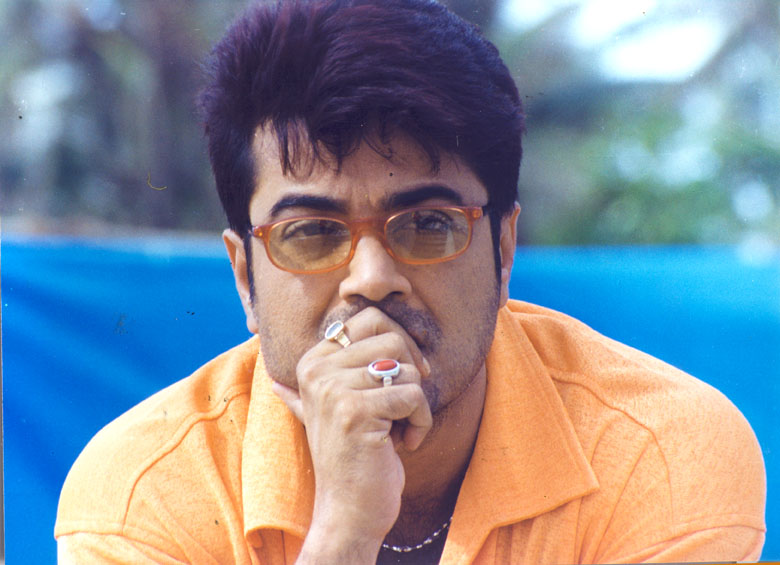
Prosenjit Chatterjee (pronounced [prosenˈdʒit tʃæt̪ːarˈdʒi]; born 30 September 1962) is an Indian actor, director, producer, screenwriter, playback singer and television personality who works primarily in Bengali cinema. Referred to in the media as the "Jyeshthoputro" (Bengali for "The Eldest Son") and "Mr. Industry", through his career spanning over four decades, Prosenjit is widely regarded as one of the most successful and influential actors in the history of Indian cinema. In his cinematic career, he has made over 250 films in Bengali, Hindi and Odia, having numerous accolades, including two National Film Awards, five Filmfare Awards and six BFJA Awards. He was honoured with Mahanayak Samman in 2013, Banga Bibhushan in 2018 and Padma Shri in 2026.
Key Information


The son of actor Biswajeet Chatterjee, Prosenjit started his career at the age of 5 in Hrishikesh Mukherjee's 1968 Bengali film Chotto Jigyasa, which earned him the BFJA Award for Most Outstanding Work of the Year. After playing a few supporting roles, he progressed to lead role in the romantic drama Duti Pata (1983). Despite having widespread recognition for his portrayal of an unemployed man in Tarun Majumdar's Pathbhola (1986), he reached the height of superstardom with the 1987 blockbuster Amar Sangee. Besides starring in top-grossing romantic films including Chhoto Bou (1988), Jyoti (1988), Aamar Tumi (1989), Amar Prem (1989), Apan Amar Apan (1990), Mandira (1990), Mon Mane Na (1992), Biyer Phool (1996) and Mayar Badhon (1997), he had further box-office hits in action films such as Ora Charjon (1988), Asha O Bhalobasha (1989), Badnam (1990), Sangharsha (1995), Bhai Amar Bhai (1997) and Ranokhetro (1998). He made his directorial debut with Purushottam (1992), which inaugurated the Best Asian Film Award at the Bucheon International Fantastic Film Festival, South Korea.[1] His next Sasurbari Zindabad (2000) became the first Bengali film to have CinemaScope technology, while his portrayal of a volatile police officer in Pratibad (2001) was selected by Forbes India as one of the 25 greatest acting performances of Indian cinema. During this period, Prosenjit gained critical acclaim for his performances as an alcoholic in Devdas (2002), a medical practitioner in Chokher Bali (2003), a disabled person in Dosar (2006), a surveillance specialist in Ami, Yasin Ar Amar Madhubala (2007), a film director in Khela (2008), a film screener in Swapner Din (2008), a thespian poet in Shob Charitro Kalponik (2009), showcasing his versatility as an actor who excelled in both commercially and critically acclaimed films. Notably Dosar earned him National Award in the Special Mention category.
In 2010, Prosenjit transitioned to parallel cinema through Srijit Mukherji's Autograph, for which he was nominated at MIAAC Film Festival, under the Best Actor category. His another author-backed performance came in Moner Manush (2010), the biopic of Lalon, a noted spiritual leader, poet and folk singer of the 19th century Bengal. He got wider appeal for his roles of a troubled father in the sports drama Cholo Paltai (2011), a retired police officer in the psychological thriller Baishe Srabon (2011), a doctor in the political thriller Shanghai (2012), a football coach in the sports drama Lorai (2015), a gangster in the crime drama Zulfiqar (2016), a scientist in the action thriller One (2017), a serial killing specialist in Dawshom Awbotaar (2023), and a businessman in the thriller Ajogyo (2024), and went to earn further recognition in the psychological drama Jaatishwar (2014), erotic thriller Khawto (2015), the romantic drama Praktan (2016), the drama Shankhachil (2016), the National Award-winning dramas Mayurakshi (2017) and Jyeshthoputro (2019), the historical courtroom film Gumnaami (2019), the drama Nirontor (2019), the dark-comedy Kacher Manush (2022), the romantic thriller Kaberi Antardhan (2023), the drama Shesh Pata (2023), the historical actioner Devi Chowdhurani (2025), with expansion to action-adventures in Mishawr Rawhoshyo (2013), Yeti Obhijaan (2017), Kakababur Protyaborton (2021) and Vijaynagar'er Hirey (2026), each ranking among the highest-grossing Bengali films.
Personal life
[edit]Prosenjit lives in Kolkata with his wife, actress Arpita Pal, and their son Trishanjit.[2]
He was previously married to Debashree Roy and Aparna Guha Thakurta.[3][4][5][6] Prosenjit and Aparna have a daughter together, Prerona Chatterjee.[7][8] In 2015, Prosenjit bought the Bengal Celebrity League cricket team Purulia Panthers.[9][10][11]
Acting career
[edit]Beginning as a child artist (1968–1969)
[edit]When Hrishikesh Mukherjee was working on the script of Chotto Jigyasa (1968), collaborating with Biswajeet Chatterjee for the third time, he was apparently impressed by Prosenjit and cast him in the central character of the film.[12] In the film, he played a child who initially struggles to cope with his mother's absence, becoming withdrawn and isolated.[13] Prosenjit won the Most Outstanding Work of the Year Award at the 28th BFJA Awards, for his performance in the film at age six.[14][15]
.jpg)
Chotto Jigyasa's success led Prosenjit to appear as a child artist in two of his father's films: the first was the Hindi film Rahgir,[16] directed by Tarun Majumdar,[17] and the second was the action thriller Rakta Tilak (1974), which marked his father's directorial debut.[18] In the meanwhile, he continued his education, taking a break from acting.[19]
Theatre acting and early years in films (1979–1986)
[edit]In 1979, after completing the graduation, he joined Nandikar, one of Bengal's earliest theatre groups, where he used to act for a fee of ₹250.[20] His time with the theatre company shaped Prosenjit's craft and ignited his interest in direction,[21][16] where Rudraprasad Sengupta had served as his mentor.[22][21] By this time, his performance was observed by Uttam Kumar, who approached him to star in his home-production Dui Prithibi (1980).[23] In the film, he played the younger version of Kumar's character, and also served as the assistant under director Pijush Basu's supervision.[24] During this time, he made brief appearances in some films including a few uncredited roles, such as Pankhiraj (1980) and Kalankini Kankabati (1981).[23]
In 1981, Prosenjit played a supporting role in Manu Sen's multistarrer comedy Subarna Golak, pairing with Debashree Roy for the first time,[25] and became a popular face for playing a negative role in Sukhen Das' action film Pratishodh, starring Uttam Kumar and Soumitra Chatterjee.[26] Contemporarily working in Star Theatre as a professional on stage on thursdays, saturdays and sundays for ₹500 a month, he got his first lead role in Duti Pata (1983),[27] which emerged as a commercial success and went on to be the second highest-grossing Bengali film of 1983.[28] Thematically and stylistically inspired by the Archie comics, the film introduced the genre of teen-age romance with a rich-versus-poor clash as a backdrop to Bengali cinema.[29] Though the film ran for over 22-23 weeks, Prosenjit had to go on playing character roles for the next few years.[27] During this period, he played very different roles in films "made by the great masters"; In Tapan Sinha's Atanka (1986),[30][31] he played the role of a book seller, and also got much recognition for his portrayal of an unemployed youth in Tarun Majumder's Western film Pathbhola (1986), co-starring Utpal Dutt, Sandhya Roy, Tapas Paul and Abhishek Chatterjee.[32][33] The same year, he played his first dual role in Prem Bandhan, which became a moderate success, and had in the second lead in the family drama Bouma, directed by Sujit Guha.[34]
Breakthrough and rise to prominence (1987–1989)
[edit]In 1987, Prosenjit played negative roles in Arpan and Mouno Mukhor,[35] and played the lead role alongside Debashree Roy in Samrat O Shundori.[36] The same year, his first breakthrough role came with Sujit Guha's blockbuster musical romance Amar Sangi,[37][38] alongside Vijayta Pandit.[39] Its success turned him into an overnight sensation,[40] eventually taking top spot at the box office that year and emerging as his biggest up to that point of time.[41] The music by Bappi Lahiri also played a significant role as the song "Chirodini Tumi Je Amar" sung by Kishore Kumar became a chartbuster, which is still considered as the "love anthem" in Bengal.[42][43][44] The same year, he made a guest appearance in the film Dolon Chapa, also directed by Guha.[45]
Prosenjit's next releases were Protipokkho (1988) and Channachara (1988), each being moderately successful. That year, actor Samit Bhanja cast him in his directorial debut Ora Charjon, a revisionist Western film.[46] He portrayed a man driven to rebellion after his family is killed due to feudal oppression. Although his intense and emotionally resonant performance was praised, despite the film's grim tone, the film did not performed well at the box office, as per its high production values.[47]
Superstardom (1990–2001)
[edit]He made his debut in Hindi cinema with David Dhawan directed Aandhiyan (1990).[48][49] Apart from appearing in a series of masala films, he started doing middle-of-the-road cinema with Chokher Bali which starred Aishwarya Rai Bachchan in her debut Bengali film and which met with critical and commercial success upon release.[50] He again came back in doing commercial films and in 2006,[51] he again collaborated with Rituparno Ghosh for Dosar and received the Best Actor Award and National Film Award - Special Jury Award / Special Mention (Feature Film) for his performance in the film.[52][53]
In 2009, Prosenjit did once again collaborate with Ghosh for Shob Charitro Kalponik, which starred Bipasha Basu in her Bengali debut, won the National Film Award for Best Feature Film in Bengali. In 2010, Prosenjit got another breakthrough by portraying the lead character of Arun Chatterjee in debutant Srijit Mukherji's Autograph,[54][55] for which he was nominated at MIAAC (Mahindra Indo-American Arts Council) film festival, under the Best Actor category. He portrayed the role of Lalon, a noted spiritual leader, poet and folk singer of Bengal in the 19th century in Goutam Ghose directorial Moner Manush and Anthony Firingee in the National Film Awards winning film, Jaatishwar. He went to earn further recognition and wider appeal for his roles in the romantic thriller Khawto, the drama Praktan, the thriller Traffic, the drama Shankhachil, the crime film Zulfiqar,[56] the National Film Award winning dramas Mayurakshi and Jyeshthoputro, the historical courtroom film Gumnaami, the drama Nirontor, the dark-comedy Kacher Manush, the thriller Kaberi Antardhan and have committed to star in the Hindi films 3 Dev, alongside Kay Kay Menon, Raima Sen, Karan Singh Grover and Tabeer alongside Neeraj Kabi.[57]
Chatterjee produced the Ghosh scripted the television series Gaaner Oparey, which launched the careers of brothers Arjun Chakraborty and Gaurav Chakraborty and Mimi Chakraborty as well.[58] In 2016, he debuted on the non-fiction category of television with a 97-episode mini-series, titled Mahanayak. Produced by Shree Venkatesh Films and directed by Birsa Dasgupta, the show starred Paoli Dam, Tanushree Chakraborty and Priyanka Sarkar in other pivotal roles and was based on the life of a superstar of the 60s era — a life fraught with career highs and personal turbulences.[59][60][61][62]
He made his debut as a protagonist with Bimal Roy's Duti Pata (1983), a teenage romance along the lines of Bobby. Amar Sangi (1987) opposite Vijayeta Pandit, Apon Amaar Apon (1990) directed by Tarun Majumdar and Buddhadeb Dasgupta's Ami, Yasin Ar Amar Madhubala (2007) are three important films of his career. The song "Chirodini Tumi Je Amar" from Amar Sangi became a cult hit. Satabdi Roy has acted with him in more than 50 films. He has done 35 films with Rachana Banerjee, 50 with Rituparna Sengupta, around 16 with Indrani Haldar and four with his wife Arpita Pal. Prosenjit debuted in Bollywood in 1990 with the David Dhawan directed Aandhiyan where he played the role of Mumtaz's son. After working in commercial films, Chatterjee started debuted in Parallel Cinema with Rituparno Ghosh's Chokher Bali (film) and since then have appeared in numerous art films, including Dosar, Jaatishwar, Shankhachil, Shob Charitro Kalponik. Chatterjee returned to Hindi cinema by playing the role of lead protagonist in Mehul Kumar directed Meet Mere Man Ke (1991) alongside Ayesha Jhulka, Feroz Khan and Salma Agha. His other Bollywood films are Sone Ki Zanjeer, Veerta, Shanghai and more recently Traffic which received critical acclaim upon release.[63] One of the most important works of Prosenjit is as Arun Chatterjee in Srijit Mukherji's Autograph. His first ever produced film Bapi Bari Jaa[64][65] was released on 7 December 2012.
Awards and honours
[edit]Filmography
[edit]Television
[edit]| Year | Title | Channel |
|---|---|---|
| 2010–2011 | Gaaner Oparey | Star Jalsha |
| 2011–2012 | Kanakanjali | Zee Bangla |
| 2014 | Tumi Je Aamar[66][67] | |
| 2016 | Mahanayak Uttam Kumar | Star Jalsha |
| 2018–2019 | Shubho Drishti | Colors Bangla |
| 2019 | Aloukik Na Loukik | Star Jalsha |
| 2023–2024 | Alor Kole | Zee Bangla |
| 2024–2025 | Amar Sangee | |
| 2024–2025 | Mittir Bari | |
| 2025 | Kabhi Neem Neem Kabhi Shahad Shahad[68] | StarPlus |
| 2025–2026 | Sriman Bhogoban Das | Zee Bangla Sonar |
Reality Shows
1.Banglar Shera Paribar
2. Ke Hobe Banglar Kotipoti
Notes
[edit]References
[edit]- ^ "The man who would be prince". The Telegraph. 25 October 2014. Archived from the original on 30 January 2026. Retrieved 30 January 2026.
- ^ "prosenjit chatterjee". Calcuttaweb. Archived from the original on 23 September 2015. Retrieved 7 April 2014.
- ^ আনন্দবাজার – আনন্দ plus – কমেলশ্বেরর মহাভারত ভীষ্ম প্রসেনিজৎ (in Bengali). Anandabazar. Retrieved 7 April 2014.
- ^ আনন্দবাজার – আনন্দ plus – বিপরীতমুখী (in Bengali). Anandabazar. Retrieved 7 April 2014.
- ^ আনন্দবাজার – আনন্দ plus – বারো বছর বাদে (in Bengali). Anandabazar. Retrieved 7 April 2014.
- ^ "Prosenjit as Bhupen Hazarika in biopic by Kalpana Lajmi –". The Times of India. Retrieved 14 April 2014.
- ^ "Prosenjit The Fighter | Published by The Telegraph". Archived from the original on 23 October 2015.
- ^ "Is Actor Prosenjit Chatterjee's Daughter Prerona Chatterjee Interested in Acting dgtl". www.anandabazar.com (in Bengali). Retrieved 5 March 2021.
- ^ "Bengal Celebrity League to start December 26". Business Standard. Retrieved 23 December 2015.
- ^ "Tollywood all set to kick off Bengal Celebrity League". The Economic Times. Retrieved 24 November 2015.
- ^ "Tolly stars launch BCL logo, team jerseys". The Economic Times. Archived from the original on 19 October 2015. Retrieved 12 October 2015.
- ^ "Prosenjit shares a throwback picture from the sets of 'Chhotto Jigyasha'". The Times of India. 15 November 2018. ISSN 0971-8257. Archived from the original on 1 July 2025. Retrieved 1 July 2025.
- ^ "Prosenjit Chatterjee's throwback picture will surely win your hearts". The Times of India. 11 March 2019. ISSN 0971-8257. Archived from the original on 26 January 2026. Retrieved 26 January 2026.
- ^ "With father Biswajit in 'Chotto Jigyasa' - Prosenjit Chatterjee: Rare childhood pictures of the Bengali superstar you shouldn't miss". The Times of India. 29 October 2018. Archived from the original on 27 January 2026. Retrieved 21 October 2020.
- ^ Sen, Zinia (22 March 2018). "Did you know Prosenjit Chatterjee started out as a child artiste in Chhotto Jigyasha?". The Times of India. ISSN 0971-8257. Archived from the original on 27 January 2026. Retrieved 27 January 2026.
- ^ a b "Unveiling the Versatile Persona of Prosenjit Chatterjee: Actor, Producer, and UNICEF Advocate". Elgin. Archived from the original on 27 January 2026. Retrieved 27 January 2026.
- ^ Roy Chowdhury, Arpita (4 July 2022). "Prosenjit Chatterjee on Tarun Majumdar : তাঁর ছবিতে হাতেখড়ি শিশুশিল্পী হিসেবে, 'তনুজেঠু' তাঁর শিক্ষাগুরু, স্মৃতি-অর্ঘ্য প্রসেনজিতের". News18. Archived from the original on 30 January 2026. Retrieved 30 January 2026.
- ^ "Prosenjit Chatterjee: Interesting facts about the Tollywood superstar". The Times of India. 29 August 2018. ISSN 0971-8257. Archived from the original on 27 January 2026. Retrieved 27 January 2026.
- ^ "54 fun facts about Prosenjit Chatterjee as he turns 54". Hindustan Times. Retrieved 13 May 2019.
- ^ "My Fundays". The Telegraph. Archived from the original on 2 April 2015. Retrieved 16 February 2011.
- ^ a b "Audience interest in Bengali stage is returning: Prosenjit | Indiablooms - First Portal on Digital News Management". India Blooms. 28 July 2015. Archived from the original on 27 January 2026. Retrieved 27 January 2026.
- ^ Sen, Zinia (7 June 2018). "I am hoping something will be done in Kolkata to restore old theatres: Prosenjit". The Times of India. ISSN 0971-8257. Retrieved 27 January 2026.
- ^ a b Jha, Subhash K. (3 September 2025). "Prosenjit Chatterjee on his idol Uttam Kumar on his 99th birth anniversary". Bollywood Hungama. Archived from the original on 27 January 2026. Retrieved 27 January 2026.
- ^ "'উত্তমজেঠুর মতো কেউ আগামী ১৩৭ বছরেও আসবে না'". Sangbad Pratidin (in Bengali). 11 July 2018. Archived from the original on 29 January 2026. Retrieved 28 January 2026.
- ^ Mitra, Arnab (28 September 2019). "Mahalaya 2019: Why Birendra Krishna Bhadra is still relevant to Bengalis". The Indian Express. Archived from the original on 29 January 2026. Retrieved 29 January 2026.
- ^ Ganguly, Ruman (15 April 2017). "I have been through hell to be No. 1: Prosenjit Chatterjee". The Times of India. ISSN 0971-8257. Archived from the original on 29 January 2026. Retrieved 29 January 2026.
- ^ a b Ghosh, Devarsi (15 April 2023). "Superstar Prosenjit Chatterjee on his 15 best roles". Scroll.in. Archived from the original on 30 January 2026. Retrieved 30 January 2026.
- ^ "On Prosenjit Chatterjee's birthday, take a look at some of his films". India Today. 30 September 2020. Archived from the original on 29 January 2026. Retrieved 30 January 2026.
- ^ "These pictures prove Prosenjit Chatterjee is the ultimate style icon". The Times of India. 23 April 2019. Archived from the original on 30 January 2026. Retrieved 31 January 2026.
- ^ Prosenjit Chatterjee [@@prosenjitbumba] (23 March 2016). "What a memorable frame ..Tapan Sinha directing me & Satabdi for Atanka ..exceptional teacher." (Tweet) – via Twitter.
- ^ "For him, the challenge lies in change". The Telegraph. 9 January 2006. Archived from the original on 30 January 2026. Retrieved 30 January 2026.
- ^ "হাতে ধরে তৈরি করেছেন 'তনু জেঠু', আমি যা, যতটুকু, সব ওঁর জন্য". Anandabazar Patrika. 4 July 2022. Archived from the original on 30 January 2026. Retrieved 30 January 2026.
- ^ Kumar, Anuj (10 September 2015). "Renaissance man". The Hindu. ISSN 0971-751X. Archived from the original on 30 January 2026. Retrieved 30 January 2026.
- ^ Paul, Papri (13 October 2016). "Here's what Prosenjit Chatterjee said about Hyderabad". The Times of India. ISSN 0971-8257. Archived from the original on 29 January 2026. Retrieved 29 January 2026.
- ^ Mukherjee, Madhureeta (2 July 2023). "Prosenjit Chatterjee: Working across mediums doesn't take away from my stardom, it elevates it". The Times of India. ISSN 0971-8257. Archived from the original on 5 February 2026. Retrieved 5 February 2026.
- ^ Agarwal, Bhavna (9 May 2023). "Prosenjit Chatterjee says 'started with Rs 500, did many side roles, had nobody by my side' | Exclusive". India Today. Archived from the original on 5 February 2026. Retrieved 5 February 2026.
- ^ "Prosenjit Chatterjee reveals his inspiration from Bollywood". The Times of India. 27 February 2018. ISSN 0971-8257. Archived from the original on 5 February 2026. Retrieved 5 February 2026.
The 1987 cult classic 'Amar Sangi', which not only gave the timeless romantic track 'Chirodini tumi je amar', but also introduced an ageless superstar, Prosenjit Chatterjee
- ^ Sengupta, Supratik (19 March 2023). "Praise by audience matters more than awards: Prosenjit Chatterjee". The Times of India. ISSN 0971-8257. Archived from the original on 5 February 2026. Retrieved 5 February 2026.
- ^ "'Ismart Jodi' to welcome Prosenjit Chatterjee, Rituparna Sengupta and Vijayta Pandit". The Times of India. 24 June 2022. ISSN 0971-8257. Archived from the original on 5 February 2026. Retrieved 5 February 2026.
- ^ "'অমর সঙ্গী' আজও আমার সিগনেচার: প্রসেনজিৎ". RadioBanglaNet. 26 January 2025. Archived from the original on 5 February 2026. Retrieved 5 February 2026.
- ^ Chakraborty, Anurupa (24 July 2024). "Amar Sangi-Prosenjit Chatterjee: ৩৮ বছর পরও ম্যাজিক বর্তমান". The Indian Express (in Bengali). Archived from the original on 5 February 2026. Retrieved 5 February 2026.
- ^ "'Chirodini Tumi Je Aamar' to 'E Amar Gurudakshina': Bappi Lahiri's Bengali hits etched in our hearts". The Times of India. 16 February 2022. ISSN 0971-8257. Archived from the original on 5 February 2026. Retrieved 5 February 2026.
- ^ Chowdhury, Soumita (16 February 2022). "Prosenjit Chatterjee Remembers Bappi Lahiri: 'চিরদিনই তুমি যে আমার যুগে যুগে আমি তোমারই'...ভাল থেকো বাপ্পি দা: প্রসেনজিৎ". Aaj Tak (in Bengali). Archived from the original on 5 February 2026. Retrieved 5 February 2026.
- ^ দে, সুস্মিতা (5 November 2024). "ফের মঞ্চ কাঁপালেন প্রসেনজিৎ, অভিনেতার কণ্ঠে 'অমরসঙ্গী'র গানের ভিডিয়ো ভাইরাল". Ei Samay (in Bengali). Archived from the original on 5 February 2026. Retrieved 5 February 2026.
- ^ "Prosenjit Chatterjee questions the definition of commercial cinema". The Times of India. 6 June 2024. ISSN 0971-8257. Archived from the original on 9 February 2026. Retrieved 9 February 2026.
- ^ "Prosenjit Chatterjee opens up on having 22 film releases in one year: 'Used to do three shifts a day, slept on roof of my car'". The Indian Express. 6 June 2023. Retrieved 10 February 2026.
- ^ "Prosenjit Chatterjee: "I'm a worker, not a superstar"". The Statesman. 27 November 2024. Retrieved 10 February 2026.
- ^ "Prosenjit Chatterjee opens up about turning down Maine Pyar Kiya: 'Most important thing is that Salman Khan was born'". The Indian Express. 6 June 2023. Archived from the original on 5 February 2026. Retrieved 5 February 2026.
- ^ Bakshi, Dibyajyoti (19 October 2009). "Direction is my next career choice: Prosenjit Chatterjee". Hindustan Times. Archived from the original on 30 January 2026. Retrieved 30 January 2026.
- ^ "'Chokher Bali' is a hit | Chokher Bali (2003) | Latest Movie News". Bollywood Hungama. 11 October 2003. Archived from the original on 3 February 2015. Retrieved 8 July 2012.
- ^ Bhattacharya, Spandan (3 April 2017). "The action heroes of Bengali cinema: industrial, technological and aesthetic determinants of popular film culture, 1980s – 1990s". South Asian History and Culture. 8 (2): 205–230. doi:10.1080/19472498.2017.1304093. ISSN 1947-2498.
- ^ "Prosenjit Chatterjee: Still evergreen". Deccan Chronicle. Retrieved 11 October 2016.
- ^ "The real-life incident behind 'Jyeshthoputro's story". The Times of India. 18 April 2019. ISSN 0971-8257. Archived from the original on 26 January 2026. Retrieved 26 January 2026.
- ^ Ghosal, Sutanuka (7 September 2013). "Tollywood sees a revival with new genre of directors and multiplexes". The Economic Times. ISSN 0013-0389. Archived from the original on 30 January 2026. Retrieved 30 January 2026.
- ^ Kanji, Subhasmita (15 January 2026). "'জ্যেষ্ঠ পুত্র বল, ইন্ডাস্ট্রি বল, আমি হাত জোড় করে বলছি...', কী বললেন প্রসেনজিৎ চট্টোপাধ্যায়?". Aajkaal (in Bengali). Archived from the original on 27 January 2026. Retrieved 27 January 2026.
- ^ Ghosh, Sankhayan (13 May 2016). "Thirty-five years and going strong". The Hindu. ISSN 0971-751X. Archived from the original on 29 January 2026. Retrieved 29 January 2026.
- ^ "Prosenjit, Raima to star in bolly flick 3 Dev". The Times of India. Retrieved 24 September 2014.
- ^ "Rituparno and Prosenjit kiss and makeup". The Times of India.
- ^ "My character in Mahanayak bears traces of Uttam: Prosenjit". Business Standard. Retrieved 19 June 2016.
- ^ "First look of 'Mahanayak'". Daily News and Analysis. Retrieved 15 January 2016.
- ^ "From Hosting KBC Bangla To Playing Mahanayak: Times When Prosenjit Chatterjee Mesmerised TV Audience With His Charisma". Times Of India.
- ^ "Prosenjit Chatterjee: Once a CHOCOLATE BOY, now an ACTING PHENOMENON". Times Of India.
- ^ "Divya will be seen as the wife of a superstar-played by Prosenjit Chatterjee inTraffic". Retrieved 25 March 2014.
- ^ "The Telegraph – Calcutta (Kolkata) – Entertainment – Producer Prosenjit celebrates his television outing. more applause for Goutam Ghose's Moner Manush". Telegraphs. Archived from the original on 9 January 2011. Retrieved 25 March 2014.
- ^ "Kolkata applauds Bapi Bari Jaa's first look". The Times of India. Retrieved 25 March 2014.
- ^ "Tumi Je Amar: Zee Bangla Show- Watch Tumi Je Amar TV Serial Episodes and Videos Online at zeebangla.com". zee bangla. Archived from the original on 7 April 2014. Retrieved 8 April 2014.
- ^ "Bengali Wedding Reality Show Tumi Je Amar on Zee Bangla with Prasenjit Chatterjee Starts Today". sholoanabangaliana. Archived from the original on 17 April 2014. Retrieved 8 April 2014.
- ^ Sehgal, Chirag (23 April 2025). "Bengali Superstar Prosenjit Chatterjee Turns Producer, Backs Abrar Qazi's THIS Show". News18. Retrieved 8 June 2025.
External links
[edit]
| International | |
|---|---|
| National | |
| Other | |
