



Community hub
Protoplanet
View on Wikipedia
A protoplanet or planetary embryo is an astronomical body originated within a protoplanetary disk that has undergone internal melting to produce a differentiated interior.[1]
Protoplanets are thought to form out of kilometre-sized planetesimals that gravitationally perturb each other's orbits and collide, gradually coalescing into larger bodies[2] through a process known as "runaway growth".[3] Once accumulated enough mass, protoplanets will begin to assume a spherical shape due to hydrostatic equilibrium and become dwarf planets, those of which that subsequently succeed in dominating their own orbit will become planets proper.
An alternative formation pathway of protoplanets is a process called disk fragmentation. Formation by this process, also called gravitational (disk) instability, is favoured for giant planets on wide orbits.[4]
The planetesimal hypothesis
[edit]A planetesimal is an object formed from dust, rock, and other materials, measuring from meters to hundreds of kilometers in size. According to the Chamberlin–Moulton planetesimal hypothesis and the theories of Viktor Safronov, a protoplanetary disk of materials such as gas and dust would orbit a star early in the formation of a planetary system. The action of gravity on such materials form larger and larger chunks until some reach the size of planetesimals.[5][6]
It is thought that the collisions of planetesimals created a few hundred larger planetary embryos. Over the course of hundreds of millions of years, they collided with one another. The exact sequence whereby planetary embryos collided to assemble the planets is not known, but it is thought that initial collisions would have replaced the first "generation" of embryos with a second generation consisting of fewer but larger embryos. These in their turn would have collided to create a third generation of fewer but even larger embryos. Eventually, only a handful of embryos were left, which collided to complete the assembly of the planets proper.[7]
Early protoplanets had more radioactive elements,[8] the quantity of which has been reduced over time due to radioactive decay. Heating due to radioactivity, impact, and gravitational pressure melted parts of protoplanets as they grew toward being planets. In melted zones their heavier elements sank to the center, whereas lighter elements rose to the surface. Such a process is known as planetary differentiation. The composition of some meteorites show that differentiation took place in some asteroids.
Evidence in the Solar System
[edit]In the case of the Solar System, it is thought that the collisions of planetesimals created a few hundred planetary embryos. Such embryos were similar to Ceres and Pluto with masses of about 1022 to 1023 kg and were a few thousand km in diameter.[citation needed]
According to the giant impact hypothesis, the Moon formed from a colossal impact of a hypothetical protoplanet called Theia with Earth, early in the Solar System's history.[9][10][11]
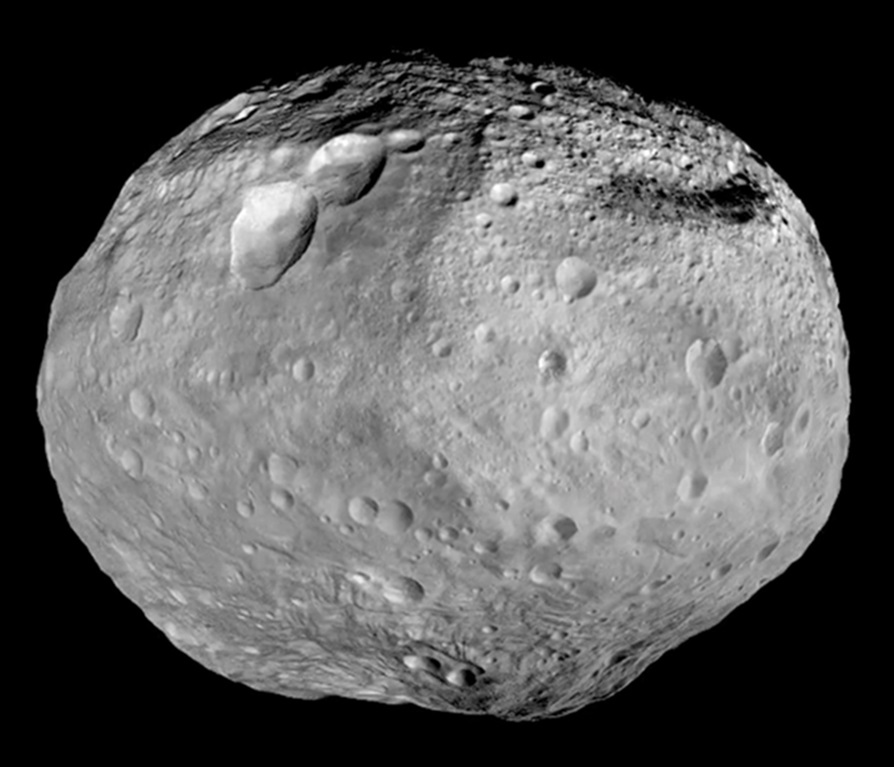
In the inner Solar System, the three protoplanets to survive more-or-less intact are the asteroids Ceres, Pallas, and Vesta. Psyche is likely the survivor of a violent hit-and-run with another object that stripped off the outer, rocky layers of a protoplanet.[12] The asteroid Metis may also have a similar origin history to that of Psyche.[13] The asteroid Lutetia also has characteristics that resemble a protoplanet.[14][15] Kuiper-belt dwarf planets have also been referred to as protoplanets.[16] Because iron meteorites have been found on Earth, it is deemed likely that there once were other metal-cored protoplanets in the asteroid belt that since have been disrupted and that are the source of these meteorites.[citation needed]
Extrasolar protoplanets
[edit]The first directly imaged exoplanet candidates were confirmed in 2005. Several of them are very young, DH Tauri b, GQ Lupi b, 2M1207b and show signs of accretion. However, all these candidates either lack in confirmation of a planetary mass or in confirmation that they formed within the protoplanetary disk of the host object.
In January 2012 astronomers made the first direct observation of a candidate protoplanet forming in a disk of gas and dust around a distant star, LkCa 15.[17] Subsequent observations, however, refuted the existence of this candidate.[18]
In February 2013 astronomers made the first direct observation of a candidate protoplanet, that is still a candidate, forming in a disk of gas and dust around a distant star, HD 100546.[19][20] Subsequent observations suggest that several protoplanets may be present in the gas disk.[21]
Another protoplanet, AB Aur b, may be in the earliest observed stage of formation for a gas giant. It is located in the gas disk of the star AB Aurigae. AB Aur b is among the largest exoplanets identified, and has a distant orbit, three times as far as Neptune is from the Earth's sun. Observations of AB Aur b may challenge conventional thinking about how planets are formed. It was viewed by the Subaru Telescope and the Hubble Space Telescope.[22]
Rings, gaps, spirals, dust concentrations and shadows in protoplanetary disks could be caused by protoplanets. These structures are not completely understood and are therefore not seen as a proof for the presence of a protoplanet.[23] One new emerging way to study the effect of protoplanets on the disk are molecular line observations of protoplanetary disks in the form of gas velocity maps.[23] HD 97048 b is the first protoplanet detected by disk kinematics in the form of a kink in the gas velocity map.[24]
| Star | Exoplanet | Mass (MJ) |
Period (yr) |
Separation (AU) |
Distance to Earth (Parsec) |
Year of Discovery | Detection technique |
|---|---|---|---|---|---|---|---|
| PDS 70 | PDS 70 b | 6+6 −4 |
119 | 20 ± 2 | 112[25] | 2018[26] | Direct Imaging |
| PDS 70 c | 9+9 −6 |
227 | 34 +6 −3 |
112 | 2019[26] | Direct imaging | |
| HD 97048 | HD 97048 b | 2.5 ± 0.5 | 956 | 130 | 184[25] | 2019[27] | Disk Kinematics |
| HD 169142 | HD 169142 b | 3 ± 2 | 167 | 37.2± 1.5 | 114 | 2019[28]/2023[29] | Direct Imaging |
| TYC 5709-354-1 | WISPIT 2b | 5.3 ± 1.0 | 54 | 133 | 2025[30][31] | Direct Imaging | |
| WISPIT 2c | 8–12 | 15 | 133 | 2025[31]/2026[32] | Direct Imaging |
Unconfirmed protoplanets
[edit]The confident detection of protoplanets is difficult. Protoplanets usually exist in gas-rich protoplanetary disks. Over-densities within these disks can mimic protoplanets. A number of unconfirmed protoplanet candidates are known and some detections were later questioned.
| Star/host | Exoplanet | Mass (MJ) |
Period (yr) |
Separation (AU) |
Distance to Earth (Parsec) |
Year of Discovery | Status | Detection technique |
|---|---|---|---|---|---|---|---|---|
| DH Tauri | DH Tauri b | 8–50 | 330 | 135 | 2005[33] | unconfirmed planetary mass and formation in disk | Direct Imaging | |
| GQ Lupi | GQ Lupi b | 1–36 | 103 | 152 | 2005[34] | unconfirmed planetary mass and formation in disk | Direct Imaging | |
| 2M1207 | 2M1207b | 5–6 | 49.8 | 65 | 2005[35] | unconfirmed formation in disk | Direct Imaging | |
| LkCa 15 | LkCa 15 b | 12.7 | 2012[17] | refuted in 2019[18] | Direct Imaging | |||
| LkCa 15 c | 18.6 | 2015[36] | Direct Imaging | |||||
| LkCa 15 d | 24.7 | 2015[36] | Direct Imaging | |||||
| HD 100546 | HD 100546 b | 4–13[37] | 249 | 53 ± 2 | 108[25] | 2015[38] | disputed in 2017[39] | Direct Imaging |
| Gomez's Hamburger | GoHam b | 0.8–11.4 | 350 ± 50 | 250 | 2015[40] | unconfirmed candidate | Direct Imaging | |
| AB Aurigae | AB Aur b | 9–20 | 94 ± 49 | 156[25] | 2022[41] | disputed in 2023[42] and 2024[43] | Direct Imaging | |
| IM Lupi | 2–3 | 110 | 2022[44] | unconfirmed candidate | Disk Kinematics | |||
| HD 163296 | multiple?[45] | 2022[46] | unconfirmed candidates | Disk Kinematics | ||||
| Elias 2-24 | 2–5 | 52 | 2023[47] | unconfirmed candidate | Direct Imaging + Disk Kinematics | |||
| 2MJ1612 | 2MJ1612b | 4 | 23.45 ± 0.29 | 132 | 2025[48] | unconfirmed candidate | Direct Imaging (ASDI) |
See also
[edit]References
[edit]- ^ Crespi, Samuele; Dobbs-Dixon, Ian; Georgakarakos, Nikolaos; Haghighipour, Nader; Maindl, Thomas I; Schäfer, Christoph M; Winter, Philip Matthias (2021-10-13). "Protoplanet collisions: Statistical properties of ejecta". Monthly Notices of the Royal Astronomical Society. 508 (4). Oxford University Press, Royal Astronomical Society: 6013–6022. doi:10.1093/mnras/stab2951. Retrieved 2025-08-10.
- ^ Kokubo, Eiichiro; Ida, Shigeru (2002-12-10). "Formation of Protoplanet Systems and Diversity of Planetary Systems". The Astrophysical Journal. 581 (1). IOP Publishing, American Astronomical Society: 666–680. Bibcode:2002ApJ...581..666K. doi:10.1086/344105. Retrieved 2025-08-10.
- ^ Raymond, Sean N. (2023-07-28). Encyclopedia of Astrobiology. Berlin, Heidelberg: Springer Nature. p. 2703. doi:10.1007/978-3-662-65093-6_1397. ISBN 978-3-662-65092-9. Retrieved 2025-08-10.
- ^ Teague, Richard; Jankovic, Marija R.; Haworth, Thomas J.; Qi, Chunhua; Ilee, John D. (2020-06-01). "A three-dimensional view of Gomez's hamburger". Monthly Notices of the Royal Astronomical Society. 495 (1): 451–459. arXiv:2003.02061. Bibcode:2020MNRAS.495..451T. doi:10.1093/mnras/staa1167. ISSN 0035-8711.
- ^ Cessna, Abby (26 July 2009). "Planetesimals". Universe Today. Retrieved 5 April 2022.
- ^ Ahrens, T J (1 May 1993). "Impact Erosion of Terrestrial Planetary Atmospheres". Annual Review of Earth and Planetary Sciences. 21 (1): 525–555. Bibcode:1993AREPS..21..525A. doi:10.1146/annurev.ea.21.050193.002521. hdl:2060/19920021677. ISSN 0084-6597. Retrieved 5 April 2022.
- ^ McBride, Neil; Iain Gilmour; Philip A. Bland; Elaine A. Moore; Mike Widdowson; Ian Wright (2004). An Introduction to the Solar System. Cambridge: Cambridge University Press. p. 56. ISBN 9780521837354.
- ^ Cessna, Abby (2009). "Protoplanets". Universe Today.
- ^ Nace, Trevor (2016-01-30). "New Evidence For 4.5 Billion Year Old Impact Formed Our Moon". Forbes. Retrieved 2016-01-30.
- ^ Young, E. D.; Kohl, I. E.; Warren, P. H.; Rubie, D. C.; Jacobson, S. A.; Morbidelli, A. (28 January 2016). "Oxygen isotopic evidence for vigorous mixing during the Moon-forming giant impact". Science. 351 (6272): 493–496. arXiv:1603.04536. Bibcode:2016Sci...351..493Y. doi:10.1126/science.aad0525. PMID 26823426. S2CID 6548599.
- ^ Wolpert, Stuart (January 28, 2016). "Moon was produced by a head-on collision between Earth and a forming planet". UCLA newsroom. UCLA.
- ^ "NASA Selects Investigations for Future Key Planetary Mission". 30 September 2015.
- ^ Kelley, Michael S; Michael J. Gaffey (2000). "9 Metis and 113 Amalthea: A Genetic Asteroid Pair". Icarus. 144 (1): 27–38. Bibcode:2000Icar..144...27K. doi:10.1006/icar.1999.6266.
- ^ "BIG PIC: 2 Pallas, the Asteroid with Protoplanetary Attitude". Discovery Space. Discovery Communications. 2009-10-08. Retrieved 2009-10-08.
- ^ Klotz, Irene (2011-10-27). "ASTEROID FAILS TO MAKE IT BIG: A newly studied asteroid is actually a planetary building block that stopped growing". Discovery News. Discovery Communications. Retrieved 2011-10-27.
- ^ Alan Boyle (2009-10-08). "Protoplanet frozen in time". MSNBC. Archived from the original on 2009-10-10. Retrieved 2009-09-12.
- ^ a b Kraus, Adam L.; Ireland, Michael J. (2012-01-01). "LkCa 15: A Young Exoplanet Caught at Formation?". The Astrophysical Journal. 745 (1): 5. arXiv:1110.3808. Bibcode:2012ApJ...745....5K. doi:10.1088/0004-637X/745/1/5. ISSN 0004-637X.
- ^ a b Currie, Thayne; Marois, Christian; Cieza, Lucas; Mulders, Gijs D.; Lawson, Kellen; Caceres, Claudio; Rodriguez-Ruiz, Dary; Wisniewski, John; Guyon, Olivier; Brandt, Timothy D.; Kasdin, N. Jeremy; Groff, Tyler D.; Lozi, Julien; Chilcote, Jeffrey; Hodapp, Klaus (2019-05-01). "No Clear, Direct Evidence for Multiple Protoplanets Orbiting LkCa 15: LkCa 15 bcd are Likely Inner Disk Signals". The Astrophysical Journal. 877 (1): L3. arXiv:1905.04322. Bibcode:2019ApJ...877L...3C. doi:10.3847/2041-8213/ab1b42. ISSN 0004-637X.
- ^ "The Birth of a Giant Planet?". European Southern Observatory. 28 February 2013. Retrieved 2 March 2013.
- ^ Quanz, Sascha P.; Amara, Adam; Meyer, Michael P.; Kenworthy, Matthew P.; et al. (2013). "A young protoplanet candidate embedded in the circumstellar disk of HD 100546". Astrophysical Journal. 766 (1). L1. arXiv:1302.7122. Bibcode:2013ApJ...766L...1Q. doi:10.1088/2041-8205/766/1/l1. S2CID 56140977.
- ^ Garufi, A.; Quanz, S. P.; Schmid, H. M.; Mulders, G. D.; Avenhaus, H.; Boccaletti, A.; Ginski, C.; Langlois, M.; Stolker, T.; Augereau, J.-C.; Benisty, M.; Lopez, B.; Dominik, C.; Gratton, R.; Henning, T.; Janson, M.; Ménard, F.; Meyer, M. R.; Pinte, C.; Sissa, E.; Vigan, A.; Zurlo, A.; Bazzon, A.; Buenzli, E.; Bonnefoy, M.; Brandner, W.; Chauvin, G.; Cheetham, A.; Cudel, M.; Desidera, S.; Feldt, M.; Galicher, R.; Kasper, M.; Lagrange, A.-M.; Lannier, J.; Maire, A. L.; Mesa, D.; Mouillet, D.; Peretti, S.; Perrot, C.; Salter, G.; Wildi, F. (April 2016). "The SPHERE view of the planet-forming disk around HD 100546". Astronomy & Astrophysics. 588: A8. arXiv:1601.04983. Bibcode:2016A&A...588A...8G. doi:10.1051/0004-6361/201527940. ISSN 0004-6361. Retrieved 5 April 2022.
- ^ "Gigantic Jupiter-like alien planet observed still 'in the womb'". CBC News. April 5, 2022. Retrieved 5 April 2022.
- ^ a b Pinte, Christophe; Teague, Richard; Flaherty, Kevin; Hall, Cassandra; Facchini, Stefano; Casassus, Simon (2022-03-01). "Kinematic Structures in Planet-Forming Disks". Protostars and Planets VII. 534: 645. arXiv:2203.09528. Bibcode:2023ASPC..534..645P.
- ^ Pinte, C.; van der Plas, G.; Ménard, F.; Price, D. J.; Christiaens, V.; Hill, T.; Mentiplay, D.; Ginski, C.; Choquet, E.; Boehler, Y.; Duchêne, G.; Perez, S.; Casassus, S. (2019-08-01). "Kinematic detection of a planet carving a gap in a protoplanetary disk". Nature Astronomy. 3 (12): 1109–1114. arXiv:1907.02538. Bibcode:2019NatAs...3.1109P. doi:10.1038/s41550-019-0852-6. ISSN 2397-3366. S2CID 195820690.
- ^ a b c d Gaia Collaboration (2020-11-01). "VizieR Online Data Catalog: Gaia EDR3 (Gaia Collaboration, 2020)". VizieR Online Data Catalog: I/350. Bibcode:2020yCat.1350....0G. doi:10.26093/cds/vizier.1350.
- ^ a b "PDS 70 | NASA Exoplanet Archive". exoplanetarchive.ipac.caltech.edu. Retrieved 2023-03-01.
- ^ "HD 97048 | NASA Exoplanet Archive". exoplanetarchive.ipac.caltech.edu. Retrieved 2023-03-01.
- ^ Gratton, R.; Ligi, R.; Sissa, E.; Desidera, S.; Mesa, D.; Bonnefoy, M.; Chauvin, G.; Cheetham, A.; Feldt, M.; Lagrange, A. M.; Langlois, M.; Meyer, M.; Vigan, A.; Boccaletti, A.; Janson, M. (March 2019). "Blobs, spiral arms, and a possible planet around HD 169142". Astronomy & Astrophysics. 623: A140. arXiv:1901.06555. Bibcode:2019A&A...623A.140G. doi:10.1051/0004-6361/201834760. ISSN 0004-6361.
- ^ Hammond, Iain; Christiaens, Valentin; Price, Daniel J.; Toci, Claudia; Pinte, Christophe; Juillard, Sandrine; Garg, Himanshi (2023-02-01). "Confirmation and Keplerian motion of the gap-carving protoplanet HD 169142 b". Monthly Notices of the Royal Astronomical Society. 522 (1): L51–L55. arXiv:2302.11302. Bibcode:2023MNRAS.522L..51H. doi:10.1093/mnrasl/slad027.
- ^ van Capelleveen, Richelle F.; Ginski, Christian; Kenworthy, Matthew A.; Byrne, Jake; Lawlor, Chloe; McLachlan, Dan; Mamajek, Eric E.; Stolker, Tomas; Benisty, Myriam; Bohn, Alexander J.; Close, Laird M.; Dominik, Carsten; Haffert, Sebastiaan; Landman, Rico; Ma, Jie (2025-08-26). "WIde Separation Planets In Time (WISPIT): A Gap-clearing Planet in a Multi-ringed Disk around the Young Solar-type Star WISPIT 2". The Astrophysical Journal Letters. 990 (1): L8. doi:10.3847/2041-8213/adf721. ISSN 2041-8205.
- ^ a b Close, Laird M.; van Capelleveen, Richelle F.; Weible, Gabriel; Wagner, Kevin; Haffert, Sebastiaan Y.; Males, Jared R.; Ilyin, Ilya; Kenworthy, Matthew A.; Li, Jialin; Long, Joseph D.; Ertel, Steve; Ginski, Christian; Weinberger, Alycia J.; Follette, Kate; Liberman, Joshua (2025-08-26). "Wide Separation Planets in Time (WISPIT): Discovery of a Gap Hα Protoplanet WISPIT 2b with MagAO-X". The Astrophysical Journal Letters. 990 (1): L9. doi:10.3847/2041-8213/adf7a5. ISSN 2041-8205.
- ^ Lawlor, Chloe; Capelleveen, Richelle F. van; Bourdarot, Guillaume; Ginski, Christian; Kenworthy, Matthew A.; Stolker, Tomas; Close, Laird; Bohn, Alexander J.; Eisenhauer, Frank (2026-03-23). "Direct spectroscopic confirmation of the young embedded proto-planet WISPIT 2c". arXiv:2603.22085 [astro-ph.EP]. (accessed 24 March 2026)
- ^ Itoh, Yoichi; Hayashi, Masahiko; Tamura, Motohide; Tsuji, Takashi; Oasa, Yumiko; Fukagawa, Misato; Hayashi, Saeko S.; Naoi, Takahiro; Ishii, Miki; Mayama, Satoshi; Morino, Jun-ichi; Yamashita, Takuya; Pyo, Tae-Soo; Nishikawa, Takayuki; Usuda, Tomonori (2005-02-20). "A Young Brown Dwarf Companion to DH Tauri". The Astrophysical Journal. 620 (2): 984–993. arXiv:astro-ph/0411177. Bibcode:2005ApJ...620..984I. doi:10.1086/427086. ISSN 0004-637X.
- ^ Neuhäuser, R.; Guenther, E. W.; Wuchterl, G.; Mugrauer, M.; Bedalov, A.; Hauschildt, P. H. (May 2005). "Evidence for a co-moving sub-stellar companion of GQ Lup". Astronomy & Astrophysics. 435 (1): L13–L16. arXiv:astro-ph/0503691. Bibcode:2005A&A...435L..13N. doi:10.1051/0004-6361:200500104. ISSN 0004-6361.
- ^ Chauvin, G.; Lagrange, A.-M.; Dumas, C.; Zuckerman, B.; Mouillet, D.; Song, I.; Beuzit, J.-L.; Lowrance, P. (August 2005). "Giant planet companion to 2MASSW J1207334-393254". Astronomy & Astrophysics. 438 (2): L25–L28. arXiv:astro-ph/0504659. Bibcode:2005A&A...438L..25C. doi:10.1051/0004-6361:200500116. ISSN 0004-6361.
- ^ a b Sallum, S.; Follette, K. B.; Eisner, J. A.; Close, L. M.; Hinz, P.; Kratter, K.; Males, J.; Skemer, A.; Macintosh, B.; Tuthill, P.; Bailey, V.; Defrère, D.; Morzinski, K.; Rodigas, T.; Spalding, E. (2015-11-01). "Accreting protoplanets in the LkCa 15 transition disk". Nature. 527 (7578): 342–344. arXiv:1511.07456. Bibcode:2015Natur.527..342S. doi:10.1038/nature15761. ISSN 0028-0836. PMID 26581290. S2CID 916170.
- ^ Quanz, Sascha P.; Amara, Adam; Meyer, Michael R.; Girard, Julien H.; Kenworthy, Matthew A.; Kasper, Markus (2015-07-01). "Confirmation and Characterization of the Protoplanet HD 100546 b—Direct Evidence for Gas Giant Planet Formation at 50 AU". The Astrophysical Journal. 807 (1): 64. arXiv:1412.5173. Bibcode:2015ApJ...807...64Q. doi:10.1088/0004-637X/807/1/64. hdl:1887/48578. ISSN 0004-637X. S2CID 119119314.
- ^ "HD 100546 | NASA Exoplanet Archive". exoplanetarchive.ipac.caltech.edu. Retrieved 2023-03-01.
- ^ Rameau, Julien; Follette, Katherine B.; Pueyo, Laurent; Marois, Christian; Macintosh, Bruce; Millar-Blanchaer, Maxwell; Wang, Jason J.; Vega, David; Doyon, René; Lafrenière, David; Nielsen, Eric L.; Bailey, Vanessa; Chilcote, Jeffrey K.; Close, Laird M.; Esposito, Thomas M. (2017-06-01). "An Optical/Near-infrared Investigation of HD 100546 b with the Gemini Planet Imager and MagAO". The Astronomical Journal. 153 (6): 244. arXiv:1704.06317. Bibcode:2017AJ....153..244R. doi:10.3847/1538-3881/aa6cae. ISSN 0004-6256. S2CID 19100982.
- ^ Berné, O.; Fuente, A.; Pantin, E.; Bujarrabal, V.; Baruteau, C.; Pilleri, P.; Habart, E.; Ménard, F.; Cernicharo, J.; Tielens, A. G. G. M.; Joblin, C. (2015-06-01). "Very Large Telescope observations of Gomez's Hamburger: Insights into a young protoplanet candidate". Astronomy and Astrophysics. 578: L8. arXiv:1504.02735. Bibcode:2015A&A...578L...8B. doi:10.1051/0004-6361/201526041. ISSN 0004-6361.
- ^ "AB Aur | NASA Exoplanet Archive". exoplanetarchive.ipac.caltech.edu. Retrieved 2023-03-01.
- ^ Zhou, Yifan; Bowler, Brendan P.; Yang, Haifeng; Sanghi, Aniket; Herczeg, Gregory J.; Kraus, Adam L.; Bae, Jaehan; Long, Feng; Follette, Katherine B.; Ward-Duong, Kimberley; Zhu, Zhaohuan; Biddle, Lauren I.; Close, Laird M.; Yushu Jiang, Lillian; Wu, Ya-Lin (30 Aug 2023). "UV-Optical Emission of AB Aur b is Consistent with Scattered Stellar Light". Astrophysical Journal. 166 (6): 11. arXiv:2308.16223. Bibcode:2023AJ....166..220Z. doi:10.3847/1538-3881/acf9ec.
- ^ Biddle, Lauren I.; Bowler, Brendan P.; Zhou, Yifan; Franson, Kyle; Zhang, Zhoujian (2024-04-01). "Deep Paβ Imaging of the Candidate Accreting Protoplanet AB Aur b". The Astronomical Journal. 167 (4): 172. arXiv:2402.12601. Bibcode:2024AJ....167..172B. doi:10.3847/1538-3881/ad2a52. ISSN 0004-6256.
- ^ Verrios, Harrison J.; Price, Daniel J.; Pinte, Christophe; Hilder, Thomas; Calcino, Josh (2022-07-01). "Kinematic Evidence for an Embedded Planet in the IM Lupi Disk". The Astrophysical Journal. 934 (1): L11. arXiv:2207.02869. Bibcode:2022ApJ...934L..11V. doi:10.3847/2041-8213/ac7f44. ISSN 0004-637X.
- ^ Kanagawa, Kazuhiro D.; Ono, Tomohiro; Momose, Munetake (2023-12-01). "Kinematic signatures of a low-mass planet with a moderately inclined orbit in a protoplanetary disk". Publications of the Astronomical Society of Japan. 75 (6): 1105–1123. arXiv:2308.12144. Bibcode:2023PASJ...75.1105K. doi:10.1093/pasj/psad059. ISSN 0004-6264.
- ^ Calcino, Josh; Hilder, Thomas; Price, Daniel J.; Pinte, Christophe; Bollati, Francesco; Lodato, Giuseppe; Norfolk, Brodie J. (2022-04-01). "Mapping the Planetary Wake in HD 163296 with Kinematics". The Astrophysical Journal. 929 (2): L25. arXiv:2111.07416. Bibcode:2022ApJ...929L..25C. doi:10.3847/2041-8213/ac64a7. ISSN 0004-637X. S2CID 244117638.
- ^ Pinte, C.; Hammond, I.; Price, D. J.; Christiaens, V.; Andrews, S. M.; Chauvin, G.; Pérez, L. M.; Jorquera, S.; Garg, H.; Norfolk, B. J.; Calcino, J.; Bonnefoy, M. (2023-11-01). "Kinematic and thermal signatures of the directly imaged protoplanet candidate around Elias 2-24". Monthly Notices of the Royal Astronomical Society. 526 (1): L41–L46. arXiv:2301.08759. Bibcode:2023MNRAS.526L..41P. doi:10.1093/mnrasl/slad010. ISSN 0035-8711.
- ^ Li, Jialin; et al. (2025). "Discovery of H$α$ Emission from a Protoplanet Candidate Around the Young Star 2MASS J16120668-3010270 with MagAO-X". arXiv:2508.11155 [astro-ph.EP].
External links
[edit]- Thread on the definition of a protoplanet (Minor Planet Mailing List : July 15, 2011)


