Hubbry Logo
Iron meteoriteIron meteoriteMain
Open search
Iron meteorite
Community hub
Iron meteorite
logo
8 pages, 0 posts
0 subscribers
Be the first to start a discussion here.
Iron meteorite
Iron meteorite
from Wikipedia
Iron meteorite
— Type —
Tamentit Iron Meteorite, found in 1864 in the Sahara,[1] weighing about 500 kg (1,100 lb). On display at Vulcania park in France.
Compositional typeIron
Parent body>50
Composition>95% iron, nickel, and cobalt; 5–25% nickel
TKWc. 500 short tons (450 t)
Widmanstätten pattern as seen on an etched and polished slice of an olivine-free portion of the Seymchan meteorite.[a] Scale unknown.

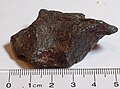
Iron meteorites, also called siderites or ferrous meteorites, are a type of meteorite that consist overwhelmingly of an iron–nickel alloy known as meteoric iron that usually consists of two mineral phases: kamacite and taenite. Most iron meteorites originate from cores of planetesimals,[3] with the exception of the IIE iron meteorite group.[4]

The iron found in iron meteorites was one of the earliest sources of usable iron available to humans, due to the malleability and ductility of the meteoric iron,[5] before the development of smelting that signaled the beginning of the Iron Age.

Occurrence

[edit]

Although they are fairly rare compared to the stony meteorites, comprising only about 5.7% of witnessed falls, iron meteorites have historically been heavily over-represented in meteorite collections.[6] This is due to several factors:

  • They are easily recognized as unusual, as opposed to stony meteorites. Modern-day searches for meteorites in deserts and Antarctica yield a much more representative sample of meteorites overall.
  • They are much more resistant to weathering.
  • They are much more likely to survive atmospheric entry, and are more resistant to the resulting ablation. Hence, they are more likely to be found as large pieces.
  • They can be found even when buried by use of surface metal-detecting equipment, due to their metallic composition.

Because they are also denser than stony meteorites, iron meteorites also account for almost 90% of the mass of all known meteorites, about 500 tons.[7] All the largest known meteorites are of this type, including the largest—the Hoba meteorite.

Origin

[edit]

Iron meteorites have been linked to M-type asteroids because both have similar spectral characteristics in the visible and near-infrared. Iron meteorites are thought to be the fragments of the cores of larger ancient asteroids that have been shattered by impacts.[8] The heat released from the radioactive decay of the short-lived nuclides 26Al and 60Fe is considered as a plausible cause for the melting and differentiation of their parent bodies in the early Solar System.[9][10] Melting produced from the heat of impacts is another cause of melting and differentiation.[11] The IIE iron meteorites may be a notable exception, in that they probably originate from the crust of S-type asteroid 6 Hebe.

Chemical and isotope analysis indicates that at least about 50 distinct parent bodies were involved. This implies that there were once at least this many large, differentiated, asteroids in the asteroid belt – many more than today.

Composition

[edit]

The overwhelming bulk of these meteorites consists of the FeNi-alloys kamacite and taenite. Minor minerals, when occurring, often form rounded nodules of troilite or graphite, surrounded by schreibersite and cohenite. Schreibersite and troilite also occur as plate shaped inclusions, which show up on cut surfaces as cm-long and mm-thick lamellae. The troilite plates are called Reichenbach lamellae.[12]

The chemical composition is dominated by the elements Fe, Ni and Co, which make up more than 95%. Ni is always present; the concentration is nearly always higher than 5% and may be as high as about 25%.[13] A significant percentage of nickel can be used in the field to distinguish meteoritic irons from human-made iron products, which usually contain lower amounts of Ni, but it is not enough to prove meteoritic origin.

Use

[edit]

Iron meteorites were historically used for their meteoric iron, which was forged into cultural objects, tools or weapons. With the advent of smelting and the beginning of the Iron Age the importance of iron meteorites as a resource decreased, at least in those cultures that developed those techniques. In Ancient Egypt and other civilizations before the Iron Age, iron was as valuable as gold, since both came from meteorites, for example Tutankhamun's meteoric iron dagger.[14] The Inuit used the Cape York meteorite for a much longer time. Iron meteorites themselves were sometimes used unaltered as collectibles or even religious symbols (e.g. Clackamas worshiping the Willamette meteorite).[15] Today iron meteorites are prized collectibles for academic institutions and individuals. Some are also tourist attractions as in the case of the Hoba meteorite.

Classification

[edit]

Two classifications are in use: the classic structural classification and the newer chemical classification.[16]

Structural classification

[edit]

The older structural classification is based on the presence or absence of the Widmanstätten pattern, which can be assessed from the appearance of polished cross-sections that have been etched with acid. This is connected with the relative abundance of nickel to iron. The categories are:

Chemical classification

[edit]

A newer chemical classification scheme based on the proportions of the trace elements Ga, Ge and Ir separates the iron meteorites into classes corresponding to distinct asteroid parent bodies.[19] This classification is based on diagrams that plot nickel content against different trace elements (e.g. Ga, Ge and Ir). The different iron meteorite groups appear as data point clusters.[3][20]

There were originally four of these groups designated by the Roman numerals I, II, III, IV. When more chemical data became available these were split, e.g. Group IV was split into IVA and IVB meteorites. Even later some groups got joined again when intermediate meteorites were discovered, e.g. IIIA and IIIB were combined into the IIIAB meteorites.[21]

In 2006 iron meteorites were classified into 13 groups (one for uncategorized irons):[3]

  • IAB
    • IA: Medium and coarse octahedrites, 6.4–8.7% Ni, 55–100 ppm Ga, 190–520 ppm Ge, 0.6–5.5 ppm Ir, Ge-Ni correlation negative.
    • IB: Ataxites and medium octahedrites, 8.7–25% Ni, 11–55 ppm Ga, 25–190 ppm Ge, 0.3–2 ppm Ir, Ge-Ni correlation negative.
  • IC: 6.1–6.8% Ni. The Ni concentrations are positively correlated with As (4–9 μg/g), Au (0.6–1.0 μg/g) and P (0.17–0.40%) and negatively correlated with Ga (54–42 μg/g), Ir (9–0.07 μg/g) and W (2.4–0.8 μg/g).
  • IIAB
    • IIA: Hexahedrites, 5.3–5.7% Ni, 57–62 ppm Ga, 170–185 ppm Ge, 2–60 ppm Ir.
    • IIB: Coarsest octahedrites, 5.7–6.4% Ni, 446–59 pm Ga, 107–183 ppm Ge, 0.01–0.5 ppm Ir, Ge-Ni correlation negative.
  • IIC: Plessitic octahedrites, 9.3–11.5% Ni, 37–39 ppm Ga, 88–114 ppm Ge, 4–11 ppm Ir, Ge-Ni correlation positive
  • IID: Fine to medium octahedrites, 9.8–11.3%Ni, 70–83 ppm Ga, 82–98 ppm Ge, 3.5–18 ppm Ir, Ge-Ni correlation positive
  • IIE: octahedrites of various coarseness, 7.5–9.7% Ni, 21–28 ppm Ga, 60–75 ppm Ge, 1–8 ppm Ir, Ge-Ni correlation absent
  • IIIAB: Medium octahedrites, 7.1–10.5% Ni, 16–23 ppm Ga, 27–47 ppm Ge, 0.01–19 ppm Ir
  • IIICD: Ataxites to fine octahedrites, 10–23% Ni, 1.5–27 ppm Ga, 1.4–70 ppm Ge, 0.02–0.55 ppm Ir
  • IIIE: Coarse octahedrites, 8.2–9.0% Ni, 17–19 ppm Ga, 3–37 ppm Ge, 0.05–6 ppm Ir, Ge-Ni correlation absent
  • IIIF: Medium to coarse octahedrites, 6.8–7.8% Ni,6.3–7.2 ppm Ga, 0.7–1.1 ppm Ge, 1.3–7.9 ppm Ir, Ge–Ni correlation absent
  • IVA: Fine octahedrites, 7.4–9.4% Ni, 1.6–2.4 ppm Ga, 0.09–0.14 ppm Ge, 0.4–4 ppm Ir, Ge-Ni correlation positive
  • IVB: Ataxites, 16–26% Ni, 0.17–0.27 ppm Ga, 0,03–0,07 ppm Ge, 13–38 ppm Ir, Ge–Ni correlation positive
  • Ungrouped meteorites. This is actually quite a large collection (about 15% of the total) of over 100 meteorites that do not fit into any of the larger classes above, and come from about 50 distinct parent bodies.

Additional groups and grouplets are discussed in the scientific literature:

Magmatic and nonmagmatic (primitive) irons

[edit]

The iron meteorites were previously divided into two classes: magmatic irons and non magmatic or primitive irons. Now this definition is deprecated.

Iron class Groups
Nonmagmatic or primitive iron meteorites IAB, IIE
Magmatic iron meteorites IC, IIAB, IIC, IID, IIF, IIG, IIIAB, IIIE, IIIF, IVA, IVB

Stony–iron meteorites

[edit]

There are also specific categories for mixed-composition meteorites, in which iron and 'stony' materials are combined.

[edit]

See also

[edit]

Notes

[edit]

References

[edit]
[edit]
Revisions and contributorsEdit on WikipediaRead on Wikipedia
from Grokipedia
An iron meteorite is a type of meteorite consisting predominantly of a metallic iron-nickel alloy called kamacite, often exhibiting a distinctive crystalline structure known as the when etched with acid. These meteorites originate from the differentiated cores of ancient asteroids that underwent melting and separation of metal from materials early in the Solar System's history, with fragments ejected by collisions and eventually falling to . Composed typically of 70-95% iron, 5-30% , 0.2-2% , and trace amounts of elements like , , and , iron meteorites are notably dense and nonporous compared to stony meteorites, making them among the heaviest known extraterrestrial materials. Iron meteorites represent about 5% of all observed meteorite falls but account for a significant portion of the total mass recovered due to their durability during atmospheric entry. They are classified into at least 14 chemical groups (such as IAB, IIAB, and IIIAB) based on nickel content, trace element abundances, and structural features like bandwidth of kamacite plates, which reflect cooling rates from 10-100°C per million years in their parent bodies. These groups indicate origins from multiple asteroid cores, providing insights into planetary differentiation processes over 4.5 billion years ago. Notable examples include the Willamette meteorite, a 15.5-ton specimen discovered in Oregon in 1902 and classified as a IIIAB iron, now housed at the American Museum of Natural History. Another famous find is the Canyon Diablo meteorite from Arizona's Meteor Crater, an IAB-MG iron with fragments totaling over 30 tons, illustrating the impact capabilities of such objects. Iron meteorites have also been identified extraterrestorially, such as the "Heat Shield Rock" found by NASA's Opportunity rover on Mars in 2005, confirming their prevalence across the Solar System.

Characteristics

Physical Properties

Iron meteorites exhibit a high , typically ranging from 7.3 to 8.0 g/cm³, attributable to their predominant iron-nickel composition. This density is significantly greater than that of most terrestrial rocks, which average around 2.7 g/cm³. Due to their substantial metallic iron content, iron meteorites display strong , resulting in powerful attraction to magnets and enabling their detection using standard metal detectors. On the Mohs hardness scale, these meteorites measure 4 to 5, indicating moderate resistance to scratching while possessing notable malleability that permits without fracturing. Their thermal conductivity surpasses that of typical terrestrial rocks, with values increasing from approximately 15 W/m·K at 100 K to 27 W/m·K at 300 K, facilitating rapid heat dissipation after . A representative example is the , which has a measured of 7.67 g/cm³ and tensile strength in monocrystalline samples ranging from 162 to 483 MPa, comparable to that of mild (400–550 MPa).

Appearance and Identification

Iron meteorites exhibit a distinctive external appearance characterized by a thin, black, glassy fusion crust that forms during due to intense frictional heating and melting. This crust often features regmaglypt indentations, which are shallow, thumbprint-like depressions resulting from the and reshaping of the meteoroid's surface as it plummets through the atmosphere. The fusion crust typically measures less than 1 millimeter thick and gives the exterior a smooth, vitreous texture that contrasts with the underlying metallic interior. Internally, iron meteorites reveal a striking structure when cut, polished, and etched, displaying the Widmanstätten pattern of interlocking crystals composed primarily of kamacite (low-nickel iron alloy) and taenite (high-nickel iron alloy). These patterns, which formed through extremely slow cooling over millions of years in the cores of differentiated asteroids, appear as oriented bands or plates with octahedral or hexagonal geometries. Polished surfaces prior to etching show a bright metallic luster, with the specific pattern orientation and bandwidth varying based on the meteorite's nickel content, which typically ranges from 5% to 30%. Identification of iron meteorites relies on several diagnostic tests that highlight their unique visual and physical traits. Acid etching with nital—a solution of in —dissolves the kamacite and at different rates, vividly revealing the and confirming extraterrestrial origin. A streak test, performed by rubbing a sample on unglazed , produces a faint gray or no mark, distinguishing iron meteorites from stony varieties that leave no streak and from terrestrial iron oxides like , which yield a red streak. Common misidentifications occur with industrial iron or , but iron meteorites can be differentiated by their lack of gas vesicles, uniform slag-like impurities such as , or artificial alloys lacking the natural -iron composition and crystalline structure. Unlike man-made iron, which typically contains less than 5% and no Widmanstätten patterns, meteoritic iron exhibits 5-30% and the diagnostic etched microstructure.

Origin and Formation

Parent Bodies

Iron meteorites are primarily remnants of the metallic cores of differentiated asteroids that formed during the early Solar System, approximately 4.5 billion years ago, when planetesimals underwent core-mantle separation due to heating from and impacts. These parent bodies were small, with estimated diameters ranging from 100 to 200 kilometers, and were largely destroyed by collisional fragmentation in the main shortly after their formation. The metallic cores, composed mainly of and , survived as fragments that later became the iron meteorites collected on . Spectroscopic observations provide key evidence linking iron meteorites to M-type asteroids, which exhibit reflectance spectra in the visible and near-infrared wavelengths that closely match those of iron-nickel meteorites. Asteroid 16 Psyche, a prominent M-type body with a diameter of about 226 kilometers, is often cited as a potential exposed core remnant analogous to the parent bodies of iron meteorites, though recent analyses suggest it contains a significant rocky component mixed with metal; for example, 2024 James Webb Space Telescope observations detected hydroxyl molecules, indicating surface hydration and supporting a mixed metal-silicate composition. This spectral similarity supports the idea that many M-type asteroids represent partially eroded or exposed cores from the same population of differentiated planetesimals that produced the meteorites. Cosmic ray exposure ages of iron meteorites, determined from the accumulation of cosmogenic nuclides such as those from the ^{40}K-^{41}K and methods, typically range from 10 to 100 million years, indicating the time elapsed since their ejection from these disrupted parent bodies through impacts. This relatively short exposure period reflects the recent collisional history in the , where fragments were liberated and began their journey toward Earth. Although most iron meteorites derive from asteroidal sources, rare hypotheses propose origins from larger planetary cores, such as fragments of Mercury's iron-rich interior or Mars, though these remain unconfirmed due to lacking direct compositional or isotopic matches. In contrast, some metallic components in mesosiderites—stony-iron meteorites—link to the howardite-eucrite-diogenite (HED) group, suggesting a shared parent body with asteroid , serving as partial analogs for iron meteorite origins through core-mantle mixing events.

Formation Processes

Iron meteorites primarily originate from the metallic cores of differentiated planetesimals in the early solar system, where heating led to the separation of molten iron-nickel alloys from mantles. This differentiation process was driven by heat from accretionary impacts and the decay of short-lived radionuclides, such as ^{26}Al, which raised temperatures to 1325–1615°C, allowing iron-sulfur alloys to melt and sink to form cores approximately 4.56 billion years ago, within 1–1.5 million years after calcium-aluminum-rich inclusions (CAIs). The resulting cores solidified through fractional , producing the compositional diversity observed in magmatic iron meteorite groups like IIAB, IIIAB, and IVA. Following solidification, these cores underwent slow cooling at rates of 1–10°C per million years, enabling the exsolution of low-nickel kamacite (α-Fe,Ni) from high-nickel (γ-Fe,Ni) and the development of the characteristic . This diffusion-controlled process occurred below ~700°C, with kamacite lamellae nucleating and growing perpendicular to taenite grain boundaries, influenced by and contents; for example, meteorites like those in the IIIAB group cooled at ~2–5°C/Ma. The pattern's orientation and bandwidth reflect the thermal gradient and burial depth within the parent body core. Post-formation impacts on these parent bodies induced shock metamorphism, deforming the metallic structure without fully remelting it. Pressures of 1.5–13 GPa generated —twin lamellae in kamacite—through mechanical twinning, as simulated in experiments on body-centered cubic iron at temperatures up to 670 ; higher temperatures above 1100 prevent twinning due to enhanced recovery. These shocks also caused localized in phosphorus-rich regions, forming eutectic structures, while avoiding significant heating that would erase the features. Non-magmatic iron meteorites, such as those in the IIE and IAB groups, formed differently through impact-induced melting of metal segregated within undifferentiated chondritic , rather than global differentiation. Collisional heating partially melted iron-nickel grains in these primitive bodies, mixing them with silicates and leading to rapid cooling without extensive ; for instance, IIE irons derive from impact melting of H-chondrite-like material on a single parent . Impact activity in the has shaped iron meteorites over billions of years, inducing shock features like Neumann lines in groups such as IIE through collisions, with final disruptions of parent bodies and ejection of fragments into space occurring relatively recently, as indicated by exposure ages of 10-100 million years.

Occurrence

Meteorite Falls and Finds

Iron meteorites represent approximately 5% of all observed falls, yet their durability and high metallic content make them disproportionately common among recovered specimens, accounting for a significant portion of the total mass of known meteorites—nearly 90% in some collections—due to their resistance to and ease of detection. This contrast arises because iron meteorites, composed primarily of iron-nickel alloys, endure and surface exposure far better than stony varieties, allowing long-term survival on Earth's surface. As of 2025, the Meteoritical Society's database catalogs over 1,400 iron meteorite finds, reflecting ongoing discoveries in favorable terrains. Notable falls highlight the dramatic nature of iron meteorite arrivals. The Sikhote-Alin event in , occurring in the Sikhote-Alin Mountains of eastern , produced one of the largest documented showers, with an estimated entry mass of 70-100 tons and over 23 tons recovered from thousands of fragments scattered across an area of several square kilometers. Eyewitness accounts described a brilliant daytime fireball and thunderous explosions that created numerous small craters, up to 25 meters in diameter. Similarly, the , recovered from in 1894 by explorer with assistance from local guides, includes the massive Ahnighito fragment weighing 31 tons, one of the largest known iron meteorites. Recovery methods for iron meteorites leverage their magnetic and metallic properties, particularly in arid or icy environments where preservation is optimal. In deserts like , hunters often use visual searches across deflated terrains combined with metal detectors to locate iron-rich specimens exposed by wind erosion, as demonstrated in expeditions yielding hundreds of pieces since the 1990s. In , systematic searches employ snowmobiles towing arrays of metal-detecting panels, similar to landmine detection systems, to scan vast ice fields for buried iron meteorites that may be hidden just centimeters below the surface. For falls, eyewitness reports and rapid field expeditions guide initial recoveries, as seen in , where Soviet scientists collected samples shortly after the event. The resistance to enables ancient iron meteorites to persist for millennia, facilitating their use in pre-modern societies. The , for instance, was known to communities for over 1,000 years before European contact, with fragments shaped into tools and harpoon heads using local stone hammers, providing a rare source of iron in the . This longevity underscores why iron meteorites dominate historical finds, even if rare in recent falls, and their physical properties—such as high and —aid modern detection efforts.

Global Distribution

Iron meteorites, despite comprising only about 5% of observed falls, account for approximately 84% of the total of all recovered meteorites due to their high and tendency to form large specimens. This is disproportionately concentrated in a limited number of global sites, primarily cold and hot deserts where preservation conditions favor recovery. The primary hotspots for iron meteorite discoveries are and the Desert in Northwest . In , dry conditions and ice sheet dynamics concentrate meteorites in stranding zones, enabling the recovery of well-preserved specimens, though irons represent just 0.7% of Antarctic finds compared to 5.5% in global falls, possibly due to faster ice burial of denser irons. The , particularly regions in , , and , has yielded over 14,000 meteorites since the , with irons comprising a few percent of these but including many ungrouped and rare types recovered by nomadic herders across vast arid expanses. These two regions together account for the majority of recent iron recoveries, with contributing around 50% of all global meteorite finds overall, though irons are less dominant there. Recovery patterns are heavily influenced by geographic and human biases. Human drives higher reporting in accessible areas, but systematic expeditions mitigate this in remote deserts; conversely, cold and dry environments like and the preserve large irons (>100 kg) better due to low rates, yielding about 70% of such massive specimens globally. Iron meteorites' and rust resistance further bias collections toward arid zones, where is minimal, allowing survival for tens of thousands of years. Finds have surged since 2000, driven by organized searches such as the U.S. Search for Meteorites (ANSMET) program, which has recovered over 24,000 meteorites total since 1976, including several irons annually from targeted sites in the —recent seasons yielding 200+ specimens overall, with irons among them despite their underrepresentation. Similar efforts in hot deserts have boosted iron discoveries, reflecting improved logistics rather than increased influx. Oceanic falls, comprising roughly 71% of Earth's surface, result in most meteorites being lost , skewing terrestrial collections. Latitudinal distribution shows no inherent solar system bias, but Earth's oblate shape and atmospheric effects lead to higher flux near the , with polar regions receiving about 65% of the equatorial rate. Overall, iron meteorite mass is focused in fewer than 10 key sites worldwide, including , the Northwest African , and secondary areas like and .

Composition

Metallic Components

Iron meteorites are predominantly composed of iron-nickel alloys, with kamacite and as the dominant metallic phases that constitute the bulk chemistry. Kamacite, characterized by a body-centered cubic , contains 4-7 wt% , while exhibits a face-centered cubic with 25-65 wt% . These phases form the metallic matrix, comprising over 95% of the meteorite's in most cases. The overall nickel content in iron meteorites varies from 5 to 30 wt%, with an average of approximately 8 wt%, reflecting the heterogeneous distribution between kamacite and taenite. Low-nickel irons, containing less than 5 wt% nickel, are derived from distinct parent body sources and often classified as hexahedrites. Trace elements are present in minor amounts, including 0.1-1 wt% , which partitions preferentially into kamacite, and 0.01-0.5 wt% , which influences phase stability. Siderophile elements such as (typically 10-200 ppm) and (50-500 ppm) serve as diagnostic tracers for chemical grouping due to their siderophilic affinities. The structural development of these alloys arises from the eutectoid decomposition in the iron-nickel , where high-temperature (γ phase) decomposes into kamacite (α phase) and residual at around 700°C, establishing the foundational composition. Ataxites represent a notable example, with bulk contents exceeding 20 wt%, resulting in a -dominated matrix that prevents the formation of distinct kamacite lamellae. Minor non-metallic inclusions, such as , occur sporadically within this metallic framework but do not alter the dominant alloy proportions.

Non-Metallic Inclusions

Non-metallic inclusions in iron meteorites consist of minor phases such as phosphides, sulfides, silicates, and carbon-bearing minerals embedded within the dominant metallic matrix, providing insights into the parent body's differentiation and cooling history. These inclusions typically constitute less than a few percent of the meteorite's volume and form through processes like fractional , immiscibility, or incomplete separation during . Schreibersite, with the (Fe,Ni)3P, appears as rhabdite or skeletal crystals that can grow up to 1 cm in length, particularly in high- groups like IIG irons. These crystals precipitate during the fractional of the molten metallic core, as the of in the iron-nickel decreases with falling temperature, leading to the formation of large grains in the later stages of solidification. Troilite, the mineral FeS, occurs as rounded nodules or blebs ranging from 1 to 10 mm in diameter, frequently intergrown with daubreelite (FeCr2S4) and (FeCr2O4). These sulfide inclusions reflect sulfur segregation from the metallic melt during core cooling, where immiscibility causes sulfur to concentrate into discrete phases, often along grain boundaries or as isolated pods. Silicate inclusions are uncommon in most iron meteorites but occur in primitive groups such as IAB and IIICD, where they comprise (MgSiO3) and ((Mg,Fe)2SiO4) phases making up to 1% of the volume. These inclusions represent remnants of unmelted mantle material that failed to fully separate from during partial differentiation of the parent body, preserving chondritic-like textures and compositions indicative of limited thermal processing. Graphite, a form of elemental carbon, is present in high-carbon iron meteorites like the Cape York specimen, where it manifests as elongated spindles or nodules formed under highly reduced conditions during core crystallization. In such environments, carbon in the metal is low, promoting its exsolution as rather than carbides, with spindle morphologies arising from oriented precipitation along crystallographic directions in the host . These non-metallic inclusions play a crucial analytical role, particularly through oxygen compositions in the silicate phases, which reveal genetic links to specific bodies and help distinguish between endogenic formation and impact-induced mixing events. For instance, δ17O and Δ17O values from silicates in groups like IIE and IAB align with those of H-chondrites or winonaites, supporting models of shared asteroidal origins.

Classification

Structural Types

Iron meteorites are structurally classified based on their internal microstructure, which develops during slow cooling in their parent bodies and is primarily revealed through acid etching to display the or its absence. This divides them into three main types—octahedrites, hexahedrites, and ataxites—reflecting variations in content and resulting crystalline architecture. Octahedrites represent the most common structural type, accounting for approximately 90% of all iron meteorites. They feature a distinctive formed by broad, interlocking lamellae of low- kamacite (body-centered cubic iron- alloy) and high- (face-centered cubic iron- alloy), oriented along octahedral planes. These meteorites typically contain 6–13% by weight and are subdivided according to the average width of the kamacite bands, which correlates with cooling rates: coarse octahedrites have bands wider than 3.3 mm, medium octahedrites have bands between 0.3 and 3.3 mm, and fine octahedrites have bands narrower than 0.3 mm. A representative example is the Canyon Diablo meteorite from , classified as a coarse with kamacite bandwidths around 2–3 mm. Hexahedrites are characterized by a uniform microstructure composed almost entirely of kamacite, with nickel contents of 4-6 wt%. Unlike octahedrites, they lack a due to insufficient for nucleation, resulting in large, single-domain kamacite crystals. These meteorites often exhibit lines—parallel bands of deformation twins formed by shock events during or parent body impacts. The meteorite from serves as a classic example of a hexahedrite, with its low-nickel composition and prominent lines. Ataxites display no ordered , owing to their high contents exceeding 18 wt%, which suppresses kamacite lamellae formation. Instead, their microstructure consists primarily of plessite—a fine-scale, interlaminated mixture of kamacite and —along with swathing borders and occasional plates, indicative of relatively rapid cooling compared to other types. This structure arises when the high stabilizes , preventing the development of coarse octahedral textures. An empirical parameter known as Bandwidth II, defined as the product of the kamacite bandwidth (in mm) and (10 minus the bulk content in wt%), provides a standardized measure for estimating cooling rates in octahedrites and helps reconstruct the thermal evolution of their asteroidal parent bodies.

Chemical Groups

Iron meteorites are genetically classified into chemical groups primarily based on the abundances of trace elements such as (Ni), (Ga), (Ge), and (Ir), which reflect their formation processes and parent body origins. These groupings distinguish magmatic irons, derived from the fractional of molten metallic cores in differentiated asteroids, from non-magmatic or primitive irons, which formed through impact-induced and mixing in chondritic precursors. Platinum-group elements (PGEs), including , further refine these classifications by revealing crystallization gradients and volatile depletions. Magmatic iron meteorites, comprising the majority of classified specimens, exhibit systematic trends in trace element abundances consistent with core crystallization sequences. The IIAB group, with around 150 members (as of November 2025), is characterized by low Ni contents (typically 4–10 wt%) and elevated Ge concentrations, indicating early crystallization stages in a parent core. In contrast, the IIIAB group, the largest with around 360 members (as of November 2025), shows higher Ni (8–25 wt%) and lower Ga levels, reflecting later solidification and a close genetic link to main-group pallasites. Other magmatic groups, such as IVA and IVB, display distinct signatures: IVA irons are depleted in volatile siderophiles like Ge relative to Ga, while IVB irons exhibit extreme depletions in volatiles alongside high PGE abundances, including steep iridium gradients from core to rim due to rapid cooling. Non-magmatic irons, representing primitive achondritic materials, show greater variability in siderophile elements due to incomplete differentiation and impact processes on chondritic parent bodies. The IAB/IIICD complex, encompassing around 260 irons (as of November 2025), features high variability in PGEs and other siderophiles, with formation linked to and metal segregation in winonaite-like precursors rather than full core crystallization. This complex includes subgroups like IAB-MG (main group) with silicate inclusions and IIICD irons showing enriched elements. The IIE group, with about 17 members (as of November 2025), is distinguished by its association with H-chondrite-like silicates and moderate spreads. Isotopic signatures, particularly oxygen isotopes in associated silicate inclusions, provide key evidence for parent body affiliations. For instance, silicates in IIE irons plot within the field of H-group ordinary chondrites on the oxygen three-isotope diagram, supporting a shared origin on a common . Similarly, IAB complex silicates align with winonaite isotopic compositions, reinforcing their primitive, non-magmatic heritage. Recent advancements in have led to reclassifications within the IAB complex, identifying distinct subgroups like IAB-sLL based on highly siderophile element (HSE) patterns and isotopic anomalies. For example, isotopic studies confirmed that the IIG subgroup shares a non-carbonaceous parent body with IIAB irons, distinguishing it from earlier undifferentiated classifications through precise Fe, Ni, Cr, and O isotope measurements. These updates highlight over 50 potential parent bodies for iron meteorites, with IIIAB irons predominantly exhibiting structures.

Significance and Uses

Historical Applications

Iron meteorites have been valued by humans for their rarity and metallic properties since , serving as a crucial source of workable iron in regions where terrestrial was not yet developed. Indigenous peoples often cold-hammered the metal into tools, leveraging its natural malleability without the need for high-temperature . These early applications highlight the meteorites' role in bridging the gap between the and Iron Ages in isolated cultures. In the Arctic, the Inuit of northwest Greenland extensively utilized fragments of the Cape York iron meteorite, including the approximately 31-ton Ahnighito mass discovered in 1894, to craft harpoons, knives, arrowheads, and other essential tools through cold-working techniques. This meteorite, part of a larger strewnfield estimated at over 30 tons, provided a vital metal resource in an environment scarce in native iron, with evidence of use dating back centuries before European contact. Similarly, prehistoric Native Americans in the American Southwest recognized and employed Canyon Diablo meteorites—scattered around the Barringer Crater in —for tools and ceremonial purposes, viewing the site with reverence as a place of supernatural origin. Cultural artifacts from ancient civilizations further demonstrate the prestige of meteoritic iron. In , nine small beads from burials at Gerzeh, securely dated to circa 3200 BCE, represent the earliest known iron artifacts and were fashioned by hammering meteoritic iron into shape, showcasing advanced cold-working skills predating widespread iron smelting by millennia. These beads, with their high content confirming extraterrestrial origin, were likely sourced from a -rich iron meteorite and strung into necklaces for elite burials. Although specific medieval European swords forged from the meteorite lack direct archaeological confirmation, historical accounts suggest sporadic use of meteoritic iron in high-status blades across , valued for its perceived otherworldly strength. By the , iron meteorites transitioned from practical tools to objects of scientific curiosity and display. The 15.5-ton , found in in 1902 and sacred to Native American tribes, was acquired by the in 1906 for $20,600 and immediately placed on public exhibition, drawing millions of visitors and symbolizing early 20th-century interest in . Industrial experiments during this era, such as attempts to smelt large meteorite fragments for production, largely failed due to high and impurity levels that rendered the output brittle and incompatible with conventional . Today, modern replicas of ancient meteorite tools, crafted using non-destructive techniques, aid by illustrating prehistoric craftsmanship without depleting rare specimens. Ethical considerations surrounding iron meteorite artifacts have intensified in recent decades, particularly regarding to indigenous communities. As of , ongoing debates under the Native American Graves Protection and Repatriation Act (NAGPRA)—updated by a 2023 rule emphasizing tribal consultation—focus on items like the , revered as Tomanowos (the "Sky Person") by the Confederated Tribes of the Grand Ronde Community of , which remains on at the following a 2000 agreement but continues to spark calls for full return or shared stewardship. These discussions underscore the cultural and spiritual significance of meteorites to , balancing scientific preservation with ancestral rights.

Scientific Importance

Iron meteorites serve as critical samples of the metallic cores of differentiated planetesimals, providing direct evidence for the processes of and core formation in the early solar system. Their compositions, dominated by iron-nickel alloys, mirror the expected makeup of Earth's core, offering analogues for understanding core-mantle differentiation and the generation of planetary through processes. Paleomagnetic studies of iron meteorites have revealed remnants of ancient , with strengths up to several microteslas, indicating that these parent bodies sustained active s powered by core crystallization and convection for millions of years. Cooling rates derived from metallographic textures in iron meteorites, typically ranging from 1 to 100 per million years, provide constraints on the thermal evolution and sizes of their parent bodies, suggesting metallic cores with radii of approximately 100 km. These rates reflect conductive cooling after core solidification, helping to establish a for solar system formation where planetesimals differentiated within the first few million years. Trace element abundances, such as , , and , in these meteorites exhibit patterns that trace nucleosynthetic contributions from supernovae to the solar nebula, with isotopic anomalies in elements like indicating heterogeneous distribution of presolar material during accretion. Recent advancements include NASA's Psyche mission, launched on October 13, 2023, and scheduled to arrive at the metal-rich asteroid 16 Psyche in 2029, which is hypothesized to be a remnant core similar to those sampled by iron meteorites, enabling in-situ analysis of core composition and structure. Studies in the 2020s on non-magmatic iron meteorites, such as those in the IAB and IIICD groups, have addressed gaps in impact models by demonstrating how collisions could mix metal and silicates without full melting, refining scenarios for the disruption and reassembly of differentiated bodies. In 2025, NASA's Perseverance rover identified a high-iron, high-nickel rock on Mars, potentially an iron meteorite, expanding evidence of their Solar System distribution. Additionally, a February 2025 study analyzed iron meteorites to challenge models of Earth's core formation through isotopic variations, suggesting more complex early planetary processes.

References

Add your contribution
Related Hubs
User Avatar
No comments yet.