Hubbry Logo
Prudence IslandPrudence IslandMain
Open search
Prudence Island
Community hub
Prudence Island
logo
8 pages, 0 posts
0 subscribers
Be the first to start a discussion here.
Prudence Island
Prudence Island
from Wikipedia

41°37′01″N 71°18′59″W / 41.6170°N 71.3164°W / 41.6170; -71.3164

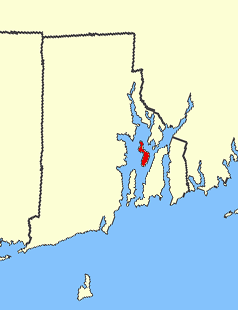
Prudence Island, shown in red, in the inner part of Narragansett Bay; the islands to the south are Conanicut and Aquidneck (formerly called Rhode Island)
Prudence Island Light in the early 20th century
A more recent view of the Prudence Island Light, with the Mt. Hope Bridge in the background
The Prudence Island Schoolhouse, built in 1896 on the corner of Broadway and Mt. Pleasant Ave.

Prudence Island is the third-largest island in Narragansett Bay in the state of Rhode Island and part of the town of Portsmouth, Rhode Island, United States. It is located near the geographic center of the bay. It is defined by the United States Census Bureau as Block Group 3, Census Tract 401.03 of Newport County, Rhode Island. As of the 2010 census, the population was 278 people living on a land area of 14.43 km2 (5.57 sq mi).[1]

History

[edit]

The Narragansett name for the island was Chibachuweset (or Chibachuwese), and the Narragansetts originally offered to gift it to John Oldham if he would settle there and set up a trading post. Oldham failed to meet the condition, so they gave the island to Roger Williams and John Winthrop in 1637, with each man retaining a one-half interest. Williams took the northern side of the island, and Winthrop took the southern side.

Williams and Winthrop hoped to farm pigs on the island. Williams named it "Prudence" and shortly afterwards purchased and named nearby Patience Island and Hope Island. He sold his half interest in Prudence Island while in England on behalf of the colony, and Winthrop willed his land to his son Stephen.[2][3]

In colonial times, the island was used mainly for farming. During the American Revolution, the British forces under Captain James Wallace raided Prudence Island for livestock and engaged in a skirmish with American forces, losing approximately a dozen soldiers. In the 20th century, farming began to decline and the island began to attract summer residents. In World War II, the Navy established an ammunition depot on the southernmost 400 acres (1.6 km2) of the island. In 1972, the Navy turned the base over to the State of Rhode Island, leaving bunkers, roads, and a large deep-water pier.

Several buildings and businesses that once stood on the island were destroyed by the 1938 New England hurricane and Hurricane Carol.[4] As of 2018, the only business in operation on the island is a general store that doubles as the post office.[4] The former naval base is now home to the Narragansett Bay National Estuarine Research Reserve, while Farnham Farm is a national historic site. The island is served by ferry service to Bristol, Rhode Island. Parts of the 2012 film Moonrise Kingdom were filmed on the island and nearby Jamestown.[5]

Prudence Island is the location of Rhode Island's last one-room schoolhouse. It is operated by the Prudence Island School Foundation in cooperation with the Portsmouth school district and educates island children from kindergarten through fourth grade.[6][7] The school has served the community on the island since 1896, with a six-year hiatus from 1982 to 1989.[8] In 2019, three students were enrolled.[9]

Summer colonies on Prudence Island

[edit]

There are several different summer colonies on the island. These are in order from the south:

  • Prudence Park: on the west side of the island at the western end of Broadway. Development began in 1872 with the building of the Stone Wharf on the west side of the island which became a stop on the Fall River Line steamers running from Providence and Fall River to New York City. Most of the summer homes in this area of the island are fine examples of Victorian and Beaux-Arts architecture, in a similar style to those at Oak Bluffs on Martha's Vineyard. The Stone Wharf was severely damaged and many houses were lost in the hurricane of 1938.[10]
  • Bristol Colony: on the east side of the island at the eastern end of Broadway.[10]
  • Sandy Point: on the eastern side of the island, along Narragansett Avenue. Site of Prudence Island Light and the Town Dock, and a former landing point for the ferry.
  • Homestead: plat of summer homes along the east coast of the island, north of Pier Road, to the north of the former Homestead Casino, which was lost in the hurricane of 1938, now the site of the island's post office, general store, and ferry landing.
  • Warnerville: directly north of the Homestead Plat, on Warner Avenue off Narragansett Avenue.
  • Boystown Fly-in-Ranch: a small private airport on the northern part of the island.[11]
[edit]

The Snow Island Trilogy tells the story of a fictionalized version of Prudence Island across two generations. The 2012 film Moonrise Kingdom was filmed in part on Prudence.

References

[edit]
Revisions and contributorsEdit on WikipediaRead on Wikipedia
from Grokipedia
Prudence Island is the third-largest island in , , spanning approximately 5.57 square miles and situated at the geographic center of the bay. It forms part of the town of and measures roughly 7 miles long by 1 mile wide at its broadest point, with a year-round of about 180 residents (as of 2025) that increases to over 1,500 during the summer months. Originally inhabited seasonally by Narragansett Native Americans for hunting and fishing, the island—known to them as Chibachuwesa, meaning "a place apart"—was purchased in 1637 by and for agricultural use and named after the virtue of prudence. Settlement began in the mid-17th century with tenant farms producing crops, livestock, and timber, leading to over 20 farms by 1730 and a population of 228 by the 1774 census. During the Revolutionary War, British raids from 1776 to 1778 devastated the island, burning nearly all structures and prompting widespread abandonment that persisted until the late 19th century. In the late 1800s, declined, and Prudence Island transitioned into a summer resort destination, with over 300 cottages and seasonal inns by the mid-20th century, supported by services from . During , the U.S. Navy established a munitions depot on 625 acres, which operated until the 1970s and was later transferred to state control in 1980. Today, nearly 70% of the island is preserved, including areas within the National Estuarine Research Reserve, emphasizing conservation, low-impact , and wildlife habitats for like , wading birds, and harbor seals. Notable landmarks include the Prudence Island Light, a stone tower relocated in 1852 to the northern tip to guide vessels through the East Passage and remaining an active aid to navigation (with ownership transferred to the Prudence Conservancy in 2024); and the last remaining one-room schoolhouse in , constructed in 1896 and which historically served up to a dozen K–12 students but had no enrolled students as of 2025. The island also features Sandy Point Beach for swimming and picnicking, hiking trails in the , and historical sites tied to its maritime and military past, accessible only by and fostering a close-knit, self-sufficient community.

Geography

Location and Physical Features

Prudence Island is the third-largest island in , measuring approximately 7 miles in length and 1 mile at its widest point, with a total land area of 5.57 square miles (14.43 km²). It is situated in the central portion of the bay at coordinates 41°36′28″N 71°21′41″W, forming part of the town of in , and designated by the U.S. Census Bureau as Block Group 3 within 401.03. The island's topography is characterized by low relief, with elevations averaging around 20 feet (6 meters) above and reaching a maximum of approximately 180 feet (55 meters) at its highest point. Much of the interior consists of wooded areas, including forests and that cover a significant portion of the landscape, historically shaped by natural disturbances and human activity. Freshwater ponds, such as Sisson Pond and Nag Pond, dot the terrain, providing small inland water bodies amid the forested uplands. The shoreline of Prudence Island spans about 20 miles and features a diverse mix of habitats, including mostly cobble beaches with some sandy stretches, rocky intertidal zones, and fringing salt marshes that extend along low-lying coastal edges. Positioned roughly 1 mile west of across the East Passage and 2 miles east of the mainland near , the island offers views of the Mt. Hope Bridge to the north, connecting the eastern shore of the bay to the mainland.

Climate and Ecology

Prudence Island's climate is characterized by a temperate maritime regime, strongly moderated by its position within , which tempers extremes in and elevates levels throughout the year. Average high temperatures in summer months range from 70°F to 80°F, while winter lows typically fall between 20°F and 40°F, with an overall annual mean around 52°F. Annual averages approximately 45 inches, distributed relatively evenly but with occasional intense storms influenced by the bay's proximity. The island forms a core component of the National Estuarine Research Reserve, designated in 1980 to protect and study its estuarine habitats, encompassing about 2,353 acres of land and adjacent waters on Prudence Island within the reserve's total 4,332 acres. This designation underscores the island's role in preserving dynamic coastal ecosystems amid ongoing environmental research. Ecologically, Prudence Island hosts expansive salt marshes along its northern and western shores, which serve as critical nurseries for fish and foraging grounds for wildlife, alongside upland forests featuring unique pitch pine barrens adapted to sandy soils. These habitats support a variety of species, including migratory wading birds such as great blue herons, snowy egrets, and glossy ibises that utilize the marshes seasonally, as well as resident that browse in the forested areas. The island's ecosystems face significant threats from sea-level rise, which has accelerated in , leading to increased inundation of low-lying salt marshes and potential shifts in vegetation zones. As of 2025, continued sea-level rise and events like precautionary shellfishing closures due to risks highlight ongoing challenges to the island's estuarine habitats. Historical storms have exacerbated these vulnerabilities; the caused widespread and uprooted vegetation across , including structural damage and tree blowdowns on Prudence Island that altered local forest composition. Similarly, in 1954 generated storm surges up to 14 feet in the bay, flooding marshes and contributing to long-term erosion and habitat stress on the island. These events highlight the fragility of Prudence Island's estuarine environment to intensifying climate-driven disturbances.

History

Pre-Colonial and Colonial Eras

Prior to European contact, Prudence Island, known to the as Chibachuweset, served primarily as a site for seasonal camps used for fishing, shellfishing, and tool-making, with evidence of habitation dating back to the Middle Archaic period around 6,000 years . Artifacts such as stone tools indicate intermittent use by and possibly groups, but no permanent settlements were established due to the island's isolation in . The claimed ownership and offered the island to early English explorers, including John Oldham in 1634, as a potential neutral territory for settlement. In 1637, the island was sold by Narragansett sachems to , founder of Providence, and John Winthrop Jr., governor of the , for 20 fathoms of and two coats, marking the beginning of English colonial control. Williams acquired the northern half, while Winthrop took the southern portion, dividing the 3,000-acre island with a boundary wall that ran east-west. Initial settlement focused on stock farming, with livestock such as sheep and pigs grazed on the open pastures, supplemented by crops including corn, , and ; Joshua Windsor became the first recorded resident around this time, establishing a near Potters Cove. During the 17th and 18th centuries, the island developed into a network of small family farms and nascent communities, attracting more English settlers by the , particularly to the southern end for planting. By 1730, over 20 farms dotted the landscape, supporting a "golden age of farming" from 1735 to 1775, when produce and livestock were exported to nearby ports like Newport and Providence. The colonial recorded 33 families and a permanent of 228 on the island, though seasonal laborers swelled numbers to 2,500–3,000 during peak agricultural periods. Disruptions from in 1675–1676 temporarily halted growth, but recovery followed with the island's annexation to the town of in 1647. Early infrastructure supported this agrarian economy, including the establishment of regular ferry service in to connect the island to the mainland, necessitating basic wharves at key landings like Potters Cove. By the mid-18th century, three mills—two wind-powered and one water-powered—operated for grinding grain, with remnants of millstones and a small grist mill still evident on northern farms; a blacksmith's "pin factory" also emerged to produce agricultural tools. These facilities underscored the island's self-sufficiency, though its remote location limited expansion until the late colonial period.

Revolutionary War and 19th Century

During the , Prudence Island experienced repeated British raids and occupations as part of the broader conflict in , beginning in 1775. On August 24, 1775, James Wallace of HMS Rose landed approximately 100 British sailors and on the island, plundering farms for , corn, and hay, marking one of the earliest incursions. These raids intensified in early 1776, with Wallace leading a force of about 250 men on January 12 to burn homes and seize supplies, only to face resistance from a small contingent of under Samuel Pearce, including 11 enslaved fighting for the Patriot cause. The next day, January 13, British forces returned for further foraging but were ambushed by reinforced militia from and , resulting in several British casualties and a retreat after three hours of fighting. The conflicts escalated through 1777 and 1778, with skirmishes such as the December 4, 1777, engagement where Rhode Island Militia killed three British marines, and a January 13, 1778, clash involving around 80 Kentish Guards and 50 men from Warren against foraging parties. British forces systematically devastated the island between 1776 and 1778, burning nearly all buildings, including a and six houses, felling trees for firewood, and driving off , which led to the complete abandonment of settlements by residents fearing further violence. These "Battles of Prudence Island" demonstrated the resilience of the Rhode Island Militia in defending local resources, though they ultimately forced the island's evacuation and contributed to British control of the bay until the 1778 . In the aftermath of the , Prudence Island saw gradual repopulation in the , as many pre-war inhabitants did not return and a wealthy acquired large tracts of , constructing three new farmhouses to revive tenant farming. By the mid-19th century, approximately 12 farms operated across the island, ranging from 100 to 800 acres each, focusing on crops like corn and oats alongside such as sheep, cows, and pigs, restoring a semblance of the pre-war agricultural . Sheep became a principal source of income, with stock farming sustaining small communities amid the island's recovering landscape. The 19th-century economy on Prudence Island remained agrarian but diversified modestly with small-scale fishing, particularly processing operations like those of Herreshoff, Wilson & Almy, which utilized the island's coastal access. However, competition from Midwestern agriculture led to a decline in farming profitability by the mid-to-late 1800s, reducing the number of active farms and shifting toward grass seed production and turf cultivation, which eroded soils. By the 1880s, as farming waned, the island began transitioning with the establishment of summer retreats; in 1875, developers created Prudence Park on the west side as a Victorian-era resort community, attracting seasonal visitors via regular service and marking the onset of recreational development.

20th Century and Modern Era

In the early , Prudence Island remained largely rural, serving as a summer retreat and farming community, but brought significant change with the establishment of a U.S. Navy ammunition depot on its southern end in 1941. The facility, known as the Naval Magazine, was constructed in April 1942 and included over 100 concrete bunkers designed for secure munitions storage, spanning approximately 625 acres. This military presence dominated the island's landscape and economy until the Navy decommissioned the site in 1972, leaving behind abandoned bunkers and buildings that posed environmental challenges, including potential soil and contamination from stored materials. The land was transferred to state control in 1972. In the , a proposed U.S. government animal research facility on Baker Farm was abandoned due to local opposition, and the land was preserved in 1959. The island faced devastating natural disasters during this period, beginning with the Great New England Hurricane of 1938, which generated a 17-foot and winds up to 100 mph in , destroying the Prudence Island Lighthouse's keeper's house and four other buildings while claiming five lives at the site. , a Category 3 storm that struck in 1954 with sustained winds of 80-100 mph and gusts up to 135 mph statewide, further ravaged the area, unroofing homes, uprooting trees, and demolishing much of the remaining infrastructure across islands. These events wiped out most pre-existing structures on Prudence Island, though the general store and endured both storms and continues to operate as the island's sole year-round business into the 2020s. Following the Navy's departure, the state of acquired the former depot lands in 1972, marking a shift toward conservation and public use. By 1980, the southern portion was designated as part of the National Estuarine Research Reserve under the ; the reserve, which includes Prudence Island and adjacent sites, encompasses over 4,000 acres focused on ecological research, education, and habitat protection. In the 1980s, the reserve developed extensive hiking trails, including loops through forests and along shorelines, promoting low-impact recreation while integrating the repurposed naval structures for research facilities. In the , Island's year-round population has remained stable at around 150 residents, swelling to about 1,500 in summer, supported by access and limited development. has grown since 2000, driven by the research reserve's programs attracting educators, scientists, and eco-tourists for , , and guided hikes, though conservation easements restrict large-scale commercialization. As of 2025, climate adaptation efforts include the Heritage Unit's plan to combat and pests through prescribed burns, invasive removal, and infrastructure upgrades like installations to mitigate sea-level rise and altered precipitation patterns affecting forests and wetlands.

Demographics and Community

Population and Demographics

As of the 2020 U.S. Census, Prudence Island had a year-round of 292 residents. This figure reflects a small, stable community, with estimates indicating approximately 230 permanent residents as of 2025. During the summer months, the swells significantly to over 1,000, driven by seasonal visitors and second-home owners returning to their properties. The island's low of approximately 52 people per is largely attributable to extensive conservation efforts, with about 85% of its 5.6 s protected from development through easements and . Demographically, Prudence Island's residents are predominantly white, comprising over 95% of the population based on 02872 data. The median age is notably high at around 58.5 years, indicating an older community compared to the state average of 40.5. Homeownership rates are exceptionally high, approaching 100% among occupied units, far exceeding Rhode Island's statewide rate of 62.1%. household income stands at $132,969, well above the state median of $81,370, reflecting the affluent, retiree-heavy profile of the island's inhabitants. Historically, the island's population has shown gradual growth followed by periods of decline. In , colonial records documented 228 inhabitants across 33 families. The population expanded modestly through the 19th and early 20th centuries amid agricultural and residential settlement but began declining after major hurricanes in and , which devastated infrastructure, homes, and the local economy, prompting some residents to leave. By the mid-20th century, shifts toward seasonal use and conservation priorities further stabilized numbers at low levels.

Education and Daily Life

The Prudence Island Schoolhouse, constructed in 1896 by Captain Halsey Chase, operates as Rhode Island's sole remaining one-room schoolhouse and provides elementary education for grades K-8 to the island's year-round residents. Students in higher grades commute via ferry to Portsmouth High School on the mainland for secondary education. Enrollment remains low due to the small resident population, with the school facing periodic threats of closure but supported by the nonprofit Prudence Island School Foundation, which maintains the facility for community use even during enrollment dips, such as zero students in the 2024-2025 school year. Daily life on Prudence Island centers on and ferry-dependent , as residents arrange deliveries of groceries, appliances, and other essentials through the Prudence & Bay Islands Transport service, which handles mail and freight from . The all-volunteer Prudence Island , established in 1942, ensures year-round emergency response from its single station, serving approximately 200 permanent homes despite the department's limited resources. Community events, including the annual meeting of the Prudence Improvement Association in June, bring residents together for discussions on island affairs and fundraisers, reinforcing communal ties. The island's year-round community forms a close-knit social fabric, where neighbors share resources like homegrown and participate in longstanding traditions such as the Day family's annual , a multi-generational event involving over 150 participants who gather for steamed , corn, and potatoes prepared over a beach fire. However, geographic isolation poses ongoing challenges, including limited access to amenities and an aging demographic that exacerbates service gaps during winter months when ferry schedules tighten. Health care access is constrained by the island's remoteness, with no on-site facilities and the nearest full-service , Newport Hospital, located approximately 10 miles away across in Newport. The Prudence Island , housed within Prudence Variety general store at 837 Narragansett Avenue, functions as a vital social gathering point, opening around arrivals to facilitate pickup and casual interactions—a role it has fulfilled since the late amid the island's evolving settlement patterns.

Land Use and Access

Conservation and Land Management

Approximately 80 percent of Prudence Island's land area is protected under conservation easements or public ownership, preserving its natural habitats from development. The National Estuarine Research Reserve (NBNERR), established in 1980 and managed by the Rhode Island Department of Environmental Management (DEM), encompasses about 63 percent of the island, including roughly 2,300 acres of upland and coastal habitats across Prudence and adjacent islands. The Prudence Conservancy, a nonprofit founded in 1987, holds or has facilitated protection of over 800 acres through direct ownership, easements, and partnerships, including a 2020s acquisition of the 103-acre Eugene Chase Farm preserved in perpetuity. Conservation efforts emphasize preservation through strict development restrictions, such as prohibiting subdivision and commercial use on conserved parcels to maintain ecological integrity. The Conservancy maintains over 13 miles of trails on its holdings, providing access while limiting impacts through designated paths and signage. Management practices include active control of , such as removing non-native plants to promote native regeneration in forests and wetlands. NBNERR conducts ongoing research on estuarine health, including long-term monitoring of , nutrient levels, and responses to stressors. This includes studies on ecology amid sea-level rise, given Rhode Island's status as an Atlantic "hotspot" with accelerated rates exceeding global averages. Recent initiatives in the feature grants supporting resilience, such as a 2025 $1.2 million state subaward for the Mill Creek restoration project on Prudence Island to enhance coastal adaptation and . Volunteer-led trail maintenance by groups like the "Trail Gang" continues to sustain access and habitat protection as of 2025.

Transportation and Infrastructure

Access to Prudence Island is exclusively by water, with no bridges or roads connecting it to the mainland. The primary transportation method is the year-round ferry service operated by Prudence & Bay Islands Transport, departing from Church Street Wharf in . The crossing takes approximately 30 minutes and accommodates passengers, bicycles, and vehicles with advance reservations required; schedules vary seasonally, offering more frequent departures from June to . Private boats provide an alternative for residents and visitors, often docking at personal or public facilities around the island. On the island, a network of primarily unpaved facilitates local travel, with many in poor condition that can cause significant wear on vehicles. A main runs northeast from the landing toward the island's northern sections, supplemented by narrower trails and paths suitable for off-road utility vehicles or low-speed vehicles, which are permitted on roadways between 6 a.m. and 6 p.m. All motor vehicles must pass inspections to be landed on the island, and there is no public transportation system. Bicycles and walking are common for non-motorized exploration. Utilities on Prudence Island are limited and community-managed. Electricity is provided through the regional grid, primarily by Rhode Island Energy, with some residents supplementing via individual solar panels due to the island's remote location. Water supply relies on the nonprofit Prudence Island Water District, which draws from wells and treats for about 328 customers, though it has faced ongoing challenges including a since 2018 due to and vulnerabilities to droughts and . In April 2025, the district secured a $3.8 million low-interest from the Rhode Island Clean Water Finance Agency for a new plant, with groundbreaking occurring in September 2025 to address the advisory and enhance resilience against climate threats. Cell phone coverage is robust, with major carriers like Verizon and providing near-100% / access across the island. Infrastructure faces several challenges, including weather-dependent ferry operations that can lead to cancellations during storms, restricting access and complicating emergency evacuations which depend on the ferry or private vessels. Docks experience erosion from coastal flooding and storms, prompting federal funding for repairs, such as a $1 million grant in 2018 for the Bristol ferry terminal. These issues are exacerbated by climate change, affecting both transportation reliability and utility resilience.

Notable Features and Culture

Landmarks and Historic Sites

Prudence Island features several notable landmarks and historic sites that reflect its maritime and agricultural heritage. Among the most prominent is the Prudence Island Light, originally constructed in 1823 on Goat Island in Newport Harbor and relocated to Sandy Point on the eastern tip of Prudence Island in 1851 due to erosion threats to its original site. The octagonal granite tower, standing 28 feet tall, was automated in 1939, replacing its original fixed white light with a more efficient system, and it continues to serve as an active aid to navigation, offering panoramic views of . In June 2024, ownership was transferred from the U.S. Coast Guard to the Prudence Conservancy, ensuring its preservation as a historic structure accessible via trails. The Farm, located at 113 Mount Pleasant Avenue, represents one of the island's enduring 18th-century agricultural legacies and was listed on the in 2006. Spanning approximately 18.5 acres of cleared land, the site includes a circa-1850 homestead, barns, and outbuildings from the Farnham family's operations, which ran a dairy farm and grew corn, fruits, and from the 1860s until the 1950s. Now managed by the Conservancy, it functions as a community center with gardens, orchards, and trails, preserving the farm's role in the island's colonial-era farming traditions. Remnants of World War II-era naval infrastructure dot the southern end of the island, where a major munitions depot operated from 1942 until 1972, featuring over 30 concrete storage bunkers designed for secure ammunition handling and ship loading. These bunkers, along with associated roads and a deep-water , were transferred to the State of in 1972 and now form part of the National Estuarine Research Reserve, popular for and amid the overgrown landscape. The Prudence Island Schoolhouse, a one-room structure built in 1896 by Captain Halsey Chase on donated land, stands as Rhode Island's last functional example of such architecture and served as the island's for over a century. Its simple wooden exterior, with a and later additions like a 1954 kitchen and bathrooms, evokes the island's rural educational past, and is currently managed by the Prudence Island School Foundation as a community resource and , with no enrolled students as of 2025. The Prudence Island General Store, the island's sole commercial establishment and , has operated continuously since the late , providing essential goods to residents and visitors arriving by . Known as Prudence Variety, it remains a vital community hub in the absence of other businesses. Natural landmarks include scenic coves such as Potter's Cove on the northern end, a protected anchorage with a small and bottom depths of 10-11 feet, ideal for boating and , and Coggeshall Cove to the west, offering similar tranquil waters reminiscent of nearby Beavertail State Park's rocky shorelines. These coves, part of the island's 475 acres of conserved landscapes, support diverse estuarine habitats and are accessible via hiking trails.

Summer Colonies and Recreation

Prudence Island's transition to a summer destination began in the late , when the island shifted from agricultural use to attracting seasonal residents seeking respite from urban life. The Prudence Land Company established Prudence Park in 1874 on 380 acres along the western shore, developing it as a resort community complete with a beach pavilion and the Prudence Park , which hosted social events until its destruction by fire in 1936. By , Prudence Park featured 30 seasonal homes, marking the start of organized summer colonies on the island. Further developments included the Homestead Plat on the eastern side, where the Homestead opened in 1911 and a followed in 1912, serving as a hub for summer visitors arriving by or . Other small communities, such as Colony and Sandy Point, emerged along the shores, contributing to a patchwork of seasonal settlements. Today, the island hosts approximately 475 cottages, the majority seasonal, with summer populations reaching up to nearly 2,000 residents as of 2024—outnumbering the approximately 292 year-round inhabitants (2020 Census) by a ratio of about 7 to 1. These homes, many dating to the early , face strict building restrictions due to the island's ordinances and extensive conservation protections, which cover over 80% of the land and limit new development to preserve natural habitats. The Prudence Park Club, formed in the early 1900s, and the subsequent Prudence Improvement Association (established 1919) have played key roles in maintaining these communities, organizing maintenance and social activities while adhering to environmental guidelines. Recreation on Prudence Island centers on its natural landscapes, with 13.5 miles of blazed and biking trails winding through forests, wetlands, and coastal areas managed by the National Estuarine Research Reserve. is a prominent activity, particularly in the northern salt marshes that attract wading birds such as , egrets, and ibises. from shorelines and in the surrounding bays provide additional leisure options, though the island lacks commercial beaches or facilities. Seasonal events enhance the island's recreational appeal, including sailing regattas that circumnavigate , such as the annual Fall Race Around organized by the Twenty Hundred Club, drawing boats from for competitive races in September. Community gatherings, like those hosted by the Prudence Improvement Association, feature chowder cook-offs and games, fostering social connections among summer residents. Prudence Island served as a primary filming location for Wes Anderson's 2012 film , where various homes, landscapes, and coastal areas stood in for the fictional "Miles Barbour" community on the invented New island. The island inspired the setting for Katherine Towler's Snow Island Trilogy, a series of novels comprising Snow Island (2002), Evening Ferry (2006), and Island Light (2009), which depict life across two generations on a fictionalized version of Prudence from the 1940s to the 1990s. In recent media, Prudence Island has appeared in 2020s productions addressing Narragansett Bay's ecology, including the April 2025 episode of PBS Weekly titled "Island Water," which examined the island's groundwater challenges amid . These portrayals often highlight Prudence Island as an emblem of secluded coastal existence, emphasizing its isolation and natural serenity in both cinematic and literary works.

References

Add your contribution
Related Hubs
User Avatar
No comments yet.