

Q-exponential distribution
View on Wikipedia| q-exponential distribution | |||
|---|---|---|---|
|
Probability density function  | |||
| Parameters |
shape (real) rate (real) | ||
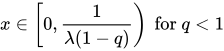
| Support |
| ||
| CDF | |||
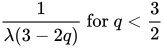
| Mean |
Otherwise undefined | ||
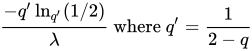
| Median | |||
| Mode | 0 | ||
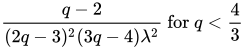
| Variance | |||
| Skewness | |||
| Excess kurtosis | |||





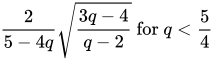

The q-exponential distribution is a probability distribution arising from the maximization of the Tsallis entropy under appropriate constraints, including constraining the domain to be positive. It is one example of a Tsallis distribution. The q-exponential is a generalization of the exponential distribution in the same way that Tsallis entropy is a generalization of standard Boltzmann–Gibbs entropy or Shannon entropy.[1] The exponential distribution is recovered as

Originally proposed by the statisticians George Box and David Cox in 1964,[2] and known as the reverse Box–Cox transformation for a particular case of power transform in statistics.

Characterization
[edit]Probability density function
[edit]The q-exponential distribution has the probability density function
where
![{\displaystyle e_{q}(x)=[1+(1-q)x]^{1/(1-q)}}](https://wikimedia.org/api/rest_v1/media/math/render/svg/5e7212d1a9980d9e5f5903426e902ca335ed8ee2)
is the q-exponential if q ≠ 1. When q = 1, eq(x) is just exp(x).
Derivation
[edit]In a similar procedure to how the exponential distribution can be derived (using the standard Boltzmann–Gibbs entropy or Shannon entropy and constraining the domain of the variable to be positive), the q-exponential distribution can be derived from a maximization of the Tsallis Entropy subject to the appropriate constraints.
Relationship to other distributions
[edit]The q-exponential is a special case of the generalized Pareto distribution where

The q-exponential is the generalization of the Lomax distribution (Pareto Type II), as it extends this distribution to the cases of finite support. The Lomax parameters are:

As the Lomax distribution is a shifted version of the Pareto distribution, the q-exponential is a shifted reparameterized generalization of the Pareto. When q > 1, the q-exponential is equivalent to the Pareto shifted to have support starting at zero. Specifically, if
![{\displaystyle X\sim \operatorname {{\mathit {q}}-Exp} (q,\lambda ){\text{ and }}Y\sim \left[\operatorname {Pareto} \left(x_{m}={\frac {1}{\lambda (q-1)}},\alpha ={\frac {2-q}{q-1}}\right)-x_{m}\right],}](https://wikimedia.org/api/rest_v1/media/math/render/svg/632d8ecbba4a7776ac0b5b68461a72f560cfb7a8)
then

Generating random deviates
[edit]Random deviates can be drawn using inverse transform sampling. Given a variable U that is uniformly distributed on the interval (0,1), then

where is the q-logarithm and


Applications
[edit]Being a power transform, it is a usual technique in statistics for stabilizing the variance, making the data more normal distribution-like and improving the validity of measures of association such as the Pearson correlation between variables. It has been found to be an accurate model for train delays.[3] It is also found in atomic physics and quantum optics, for example processes of molecular condensate creation via transition through the Feshbach resonance.[4]
See also
[edit]Notes
[edit]- ^ Tsallis, C. Nonadditive entropy and nonextensive statistical mechanics-an overview after 20 years. Braz. J. Phys. 2009, 39, 337–356
- ^ Box, George E. P.; Cox, D. R. (1964). "An analysis of transformations". Journal of the Royal Statistical Society, Series B. 26 (2): 211–252. doi:10.1111/j.2517-6161.1964.tb00553.x. JSTOR 2984418. MR 0192611.
- ^ Keith Briggs and Christian Beck (2007). "Modelling train delays with q-exponential functions". Physica A. 378 (2): 498–504. arXiv:physics/0611097. Bibcode:2007PhyA..378..498B. doi:10.1016/j.physa.2006.11.084. S2CID 107475.
- ^ C. Sun; N. A. Sinitsyn (2016). "Landau-Zener extension of the Tavis-Cummings model: Structure of the solution". Phys. Rev. A. 94 (3) 033808. arXiv:1606.08430. Bibcode:2016PhRvA..94c3808S. doi:10.1103/PhysRevA.94.033808. S2CID 119317114.
Further reading
[edit]- Juniper, J. (2007) "The Tsallis Distribution and Generalised Entropy: Prospects for Future Research into Decision-Making under Uncertainty" Archived 2011-07-06 at the Wayback Machine, Centre of Full Employment and Equity, The University of Newcastle, Australia

