Hubbry Logo
RPG-29RPG-29Main
Open search
RPG-29
Community hub
RPG-29
logo
8 pages, 0 posts
0 subscribers
Be the first to start a discussion here.
RPG-29
RPG-29
from Wikipedia

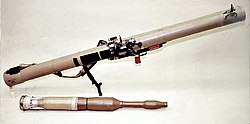
The RPG-29 "Vampir" is a Soviet reusable rocket-propelled grenade (RPG) launcher. Adopted by the Soviet Army in 1989, it was the last RPG to be adopted by the Soviet military before the fall of the Soviet Union in 1991.

Key Information

The RPG-29 has since been supplemented by other rocket-propelled systems, such as the RPG-30 and RPG-32.

Description

[edit]

The RPG-29 is a shoulder-fired, unguided, tube-style, breech-loading anti-tank rocket system with an effective range of 500 m (1,600 ft).[5] The light weapon is designed to be carried and used by one soldier. Atop the launch tube is a 2.7× 1P38 optical sight.

When launched, the missile deploys eight fins as the rocket leaves the launcher, stabilizing the rocket during flight, up to an effective range of 500 m (1,600 ft).[6]

TBG-29V thermobaric round.
OG-29 HE/FRAG round.
PG-29V HEAT round.

Three warheads are available for the weapon:

  • The TBG-29V thermobaric anti-personnel round.
  • The OG-29 high-explosive/fragmentation (HE/FRAG) round for anti-personnel purposes. This is an Iranian round produced by Shahed Weaponry with a time fuze and over 2,000 premade fragments.[7]
  • The PG-29V anti-tank/bunker round has a tandem-charge high-explosive anti-tank (HEAT) warhead to defeat explosive reactive armor (ERA). This warhead is standardized with that of the PG-7VR round fired by the RPG-7V rocket launcher.[8] With a tandem-charge, an initial small charge detonates any reactive armor. If explosive reactive armor (ERA) or cage armor is absent, this charge strikes the main armor. Behind the primary charge, a much larger secondary shaped charge bursts at the rear of the initial warhead and projects a thin, high-speed-jet of metal into the armour compromised by the first charge. PG-29V can kill hard targets, including tanks with ERA.[citation needed]

The RPG-29 is unusual among Russian anti-tank rocket launchers in that it lacks an initial propellant charge to place the projectile at a safe distance from the operator before the rocket ignites. Instead, the rocket engine starts as soon as a trigger is pulled, and burns out before the projectile leaves the barrel.

On the bottom of the tube is a shoulder brace for proper positioning along with a pistol grip trigger mechanism. A side rail on its left side accepts a 1PN51-2 night sight.[9]

History

[edit]
Size comparison. Closest to furthest. RPG-29, RPG-27, RPG-26, RPG-18

The RPG-29 was developed during the late 1980s, following the development of the RPG-26, and entered service with the Soviet Army in 1989. It has recently seen intermittent use by irregular forces in the Middle East theater, including in combat against Allied forces during the Iraq War, and the 2006 Lebanon War, when it was used against Israeli forces.

2003 Iraq War

[edit]

The RPG-29 is believed to have been used in skirmishes against American and British forces during the initial 2003 invasion of Iraq.[10] An RPG-29 round was reported in August 2006 to have penetrated the lower glacis (equipped with ERA) of a Challenger 2 tank during an engagement in al-Amarah, Iraq, maiming one and wounding several other crew members, but only lightly damaging the tank, which drove home under its own power.[11]

On August 25, 2007 a PG-29V hit a passing M1 Abrams in the hull rear wounding 3 crew members.[citation needed] On September 5, 2007, a PG-29V hit the side turret of an M1 Abrams in Baghdad, killing 2 of the crew and wounding 1, and the tank was seriously damaged.[citation needed]

In May 2008, The New York Times disclosed that another M1 Abrams tank had also been damaged by an RPG-29 in Iraq, while fighting Shia militias at Sadr City.[10] The US Army ranks the RPG-29 threat to armor so high that they refused to allow the newly formed Iraqi army to buy it, fearing that it would fall into insurgent hands.[12]

2006 Lebanon War

[edit]

During the conflict, the Israeli newspaper Haaretz stated that the RPG-29 was a major source of Israel Defense Forces (IDF) casualties in the 2006 Lebanon War.[13] Shortly before the end of the conflict the Russian Kommersant magazine acknowledged through anonymous sources the possibility of a weapons transfer between Syria and Hezbollah during the Syrian withdrawal from Lebanon.[14]

Syrian Civil War

[edit]

During the Syrian Civil War, Syrian Opposition Forces, Syrian Armed Forces and Islamic State (ISIL) used RPG-29s.[15]

Mexican Drug War

[edit]

The cartels are known to have smuggled RPG-29s with some seized by Mexican forces.[16]

2014 Gaza War

[edit]

During the 2014 Gaza War, Hamas had RPG-29s in their inventory.[17]

Iraqi Civil War

[edit]

During the Iraqi Civil War, ISIL has used RPG-29s in Iraq, probably ones taken in Syria. And anti-ISIL Shia militias in Iraq have also used RPG-29s, the Iranian produced "Ghadir", which was supplied by Iran.

Operators

[edit]
Operators
  Current
  Former

State operators

[edit]

Non-state organizations

[edit]

Former operators

[edit]

See also

[edit]
  • M47 Dragon – (United States)
  • PF-98 – (China)
  • LRAC F1 – (France)
  • M79 Osa – (Socialist Federal Republic of Yugoslavia)
  • Rocket-propelled grenade (includes a description of tactics and history)

References

[edit]

Bibliography

[edit]
[edit]
Revisions and contributorsEdit on WikipediaRead on Wikipedia
from Grokipedia

The RPG-29 "Vampir" is a Soviet-developed, reusable, shoulder-launched, unguided anti-tank rocket-propelled grenade launcher adopted by the Soviet Army in 1989 as the final design in the RPG series.
Firing 105 mm PG-29V rockets equipped with tandem high-explosive anti-tank (HEAT) warheads, it employs a precursor charge to trigger explosive reactive armor (ERA) followed by a main charge penetrating over 600 mm of rolled homogeneous armor equivalent behind ERA, with an effective range of 500 meters.
The breech-loading system allows a single operator to reload via a two-part tube assembly weighing 12.1 kg unloaded, supported by iron sights or optional 2.7x optics, and variants include thermobaric TBG-29V rounds for anti-personnel and bunker roles.
Notable for its combat debut in the 2003 Iraq War, where Iraqi forces used it to disable M1 Abrams tanks by penetrating weak points such as the turret ring, and later by Hezbollah against Israeli armor in 2006, the RPG-29 underscores the enduring threat of man-portable systems to heavily armored vehicles despite advanced defenses.
In service with Russian forces and exported to nations including Algeria, Brazil, Cuba, Iran, Mexico, Pakistan, Syria, Ukraine, and Vietnam, as well as non-state groups like Hezbollah, its simplicity, low cost, and proliferation highlight ongoing challenges in countering infantry anti-armor capabilities.

Development and Design

Origins in Soviet Era

The RPG-29 was developed by the Soviet State Research and Production Enterprise Bazalt in the late as the latest iteration in the of man-portable anti-tank systems, succeeding disposable designs like the RPG-26. This effort addressed the limitations of earlier Soviet RPGs, such as the muzzle-loaded , by introducing a reusable, shoulder-fired launcher optimized for use against evolving armored threats. The design emphasized countermeasures to advanced Western tank protections, incorporating a tandem warhead configuration capable of defeating explosive reactive armor layers, alongside a breech-loading mechanism that enabled quicker reloading in combat compared to prior models. Bazalt's focus on these features positioned the RPG-29 as a response to the proliferation of composite and reactive armor systems on vehicles during the . Adopted by the in 1989 under the operational name "Vampir," the was intended to supplant older RPG variants by offering sustained fire potential through its reloadable nature, with assigning it the reporting name RPG-29 Vampir. It represented the final major RPG adoption before the Soviet Union's dissolution in 1991, with initial production limited primarily to Soviet forces.

Key Design Features

The RPG-29 is a shoulder-launched, unguided, tube-style, breech-loading anti-tank rocket launcher equipped with a mechanical optical sight, providing an effective firing range of 500 meters. Unlike the muzzle-loading RPG-7, its breech-loading design facilitates quicker reloading under combat conditions, enhancing operational efficiency for infantry operators. The launcher comprises two concentric steel tubes joined centrally, with the inner tube serving as the firing chamber and the outer providing protective shrouding, supporting single-soldier portability despite its robust build. Weighing 12.1 kilograms unloaded, the system incorporates ergonomic elements such as an integrated and a foldable bipod for stability during aiming, allowing effective employment from prone or standing positions. The rocket propulsion mechanism features no initial booster charge within the tube; instead, the sustainer motor ignites post-exit from the muzzle at approximately 280 meters per second, minimizing backblast hazards and enabling safer firing from confined spaces compared to earlier RPG variants. This design innovation, developed in the late Soviet era, prioritizes reduced operator exposure to launch gases while maintaining compatibility with advanced technologies.

Technical Specifications

The RPG-29 launcher has an overall length of 1,850 mm when assembled and ready to fire, reducing to 1,000 mm when disassembled for transport. It weighs 12.1 kg unloaded including the optical sight, increasing to 18.8 kg when loaded with a PG-29V round. The system fires 105 mm diameter projectiles with a of 280 m/s, achieving an of 500 meters against stationary targets. The PG-29V anti-armor round features a tandem designed to defeat reactive armor, with a penetration capability of up to 750 mm of rolled homogeneous armor (RHA) equivalent behind ERA. The maximum is 2 rounds per minute, limited by the breech-loading mechanism and need to reload after each shot. Operation requires a clear , with the danger zone extending approximately 20 meters behind the launcher, rendering the weapon unsuitable for use in confined or enclosed spaces due to risk of injury from exhaust gases and .

Ammunition and Variants

PG-29V Tandem HEAT Warhead

The PG-29V is the primary anti-tank munition for the RPG-29, utilizing a tandem high- anti-tank () warhead optimized to defeat armored vehicles equipped with reactive armor () and underlying composite or rolled homogeneous armor (RHA). This configuration addresses the limitations of single-charge HEAT rounds, which ERA can neutralize by explosively disrupting the incoming penetrator jet. The warhead's design leverages the Munroe effect, where a precisely shaped charge directs energy to form a focused metal jet upon . In operation, the setup features a precursor charge—a smaller forward element—that impacts first, detonating to trigger the 's reactive tiles and expend their capability. A timed delay, typically on the order of microseconds, ensures the main charge follows without interference from the disrupted debris. The main charge incorporates a conical liner, which collapses under the force to produce a jet traveling at approximately 8-10 km/s, enabling deep penetration into the base armor. This mechanism has been tested to achieve penetration of over 650 mm RHA behind , sufficient to defeat upgraded tanks with Kontakt-1 and comparable early-model Western main battle tanks lacking advanced spaced or armor. The PG-29V weighs 6.7 kg, with a 105 mm , and achieves a of 280 m/s via initial booster propulsion followed by stabilization fins for unguided flight. Effective range extends to 500 meters, with flight time to this distance under 2 seconds due to the sustained profile. These specifications prioritize portability and rapid engagement while maximizing anti-armor lethality against ERA-protected targets.

Thermobaric and Other Rounds

The RPG-29 accommodates the TBG-29V thermobaric round, which employs a fuel-air explosive warhead to generate intense overpressure and heat, making it suitable for neutralizing infantry concentrations in buildings, bunkers, or other enclosed structures. This ammunition disperses a aerosolized fuel cloud that ignites, producing a blast wave with high destructive potential in confined spaces, covering up to 300 cubic meters in enclosed areas. The round features a 105 mm caliber warhead, weighs 6.7 kg, and maintains the launcher's muzzle velocity of 280 m/s with an effective range of 500 meters. Its lethal radius extends approximately 10 meters, prioritizing blast and fragmentation effects over armor penetration. Complementing the thermobaric option, the OG-29 high-explosive fragmentation round targets exposed personnel and light cover, utilizing a that scatters pre-formed fragments for anti-personnel . Variants such as the OG-29 AB incorporate airburst capability with time fuzes, dispersing over 2,000 fragments to enhance area denial. Produced primarily by Iranian manufacturers for compatibility with the RPG-29, this round shares the 105 mm caliber and unguided trajectory, supporting the launcher's breech-loading mechanism for rapid reloads. Standard production lacks guided variants, limiting all rounds—including thermobaric and fragmentation types—to unguided flight paths stabilized by fins, which ensures interchangeability but shifts emphasis from anti-armor primacy to versatile infantry support in non-armored engagements. This compatibility enhances the RPG-29's reusability across urban and scenarios without requiring launcher modifications.

Upgrades and Modern Adaptations

In 2021, announced development of the RPG-V2, an upgraded reusable intended to enhance anti-armor capabilities against modern threats. New series for the RPG-V2 were described as 30% more efficient than prior munitions, specifically designed to defeat tanks equipped with active protection systems (APS) by improving warhead performance and penetration reliability. These rounds were projected for operational readiness within two years, reflecting ongoing Russian efforts to adapt shoulder-fired systems to counter evolving defenses like radar-guided interceptors. The RPG-29 itself has undergone no verified structural modifications or major variant production in Russian service beyond its original 1989 design, retaining its tandem () configuration. Integration with contemporary sighting systems, such as or networked optics, has not been documented for the RPG-29 in official sources, though its disposable tube and simple permit compatibility with ancillary spotters. No significant foreign-developed adaptations or licensed variants of the RPG-29 have been confirmed, with production limited to Soviet-era stockpiles and limited post-1991 exports. Despite its age, the RPG-29's baseline lethality against composite and reactive armors persists in empirical field tests, supporting tactical adaptations like drone-assisted targeting in peer conflicts. Russian forces have employed unmanned aerial vehicles for real-time target designation, allowing RPG-29 teams to engage beyond unaided visual range without altering the launcher's core mechanics. This low-cost integration leverages the weapon's 500-meter while mitigating exposure in drone-contested environments.

Operational History

Soviet Adoption and Early Testing

The RPG-29 Vampir was officially adopted by the in 1989 as a shoulder-fired anti-tank weapon system, marking the final such launcher integrated into service prior to the in 1991. Developed by the Tula-based Bazalt design bureau during the late , it addressed vulnerabilities exposed by the proliferation of explosive reactive armor () on Western main battle tanks, such as the and , through its PG-29V tandem high-explosive anti-tank () warhead. This configuration featured a precursor charge to detonate tiles, followed by a primary penetrating up to 750 mm of rolled homogeneous armor equivalent behind them, establishing a baseline capability against layered defenses in pre-combat evaluations. Field trials conducted by Soviet evaluators in the late confirmed the system's superiority over earlier disposable launchers like the Netto, which lacked effective countermeasures to ; static and dynamic tests against simulated armored vehicles demonstrated consistent defeat of composite armor arrays, validating its role in motorized anti-tank squads. Integration emphasized operational doctrine, prioritizing ambushes against massed armored thrusts along the European fulcrum, with the launcher's disposable fiberglass tube and reusable fire control unit enabling rapid redeployment by two-man teams in forward positions. Pre-1991 exports remained restricted to allies, including and , limiting broader proliferation data during initial rollout. Early reliability assessments from Soviet exercises highlighted the RPG-29's mechanical robustness, with the solid-fuel motor achieving stable trajectories out to 500 meters and minimal misfires in adverse weather, though specific quantitative hit probabilities under 200 meters were not publicly detailed beyond general claims of enhanced accuracy over the due to improved optical sights and . These evaluations underscored its baseline performance as a doctrinal staple for countering anticipated offensives, informing subsequent adaptations without reliance on live combat validation at the time.

2003 Iraq War

During the following the , RPG-29 launchers proliferated to non-state actors through channels originating from post-Soviet stockpiles, enabling insurgents to acquire advanced anti-tank capabilities previously limited to state militaries. These weapons were smuggled into amid the chaos of regime collapse and regional networks. Insurgents employed RPG-29s in ambushes targeting coalition armored vehicles, achieving penetrations against tanks via side and rear shots where armor thickness is reduced. The PG-29V tandem HEAT warhead proved capable of defeating explosive reactive armor (ERA) tiles fitted on early Abrams variants, triggering the ERA with its precursor charge before the main charge penetrated the underlying composite armor. Documented strikes resulted in mobility kills by damaging engines or tracks, with and blast effects injuring or killing crew members inside the turret. A notable incident occurred on September 5, 2007, in , when an RPG-29 PG-29V round struck the side turret of an , penetrating the armor, killing two crew members (commander and gunner), wounding a third, and rendering the vehicle combat-ineffective. Earlier, in late 2003, a "mystery projectile"—later attributed to an RPG-29—drilled a pencil-sized hole through an M1A1 Abrams hull after piercing skirting, damaging internal components though the crew survived. Overall, at least two confirmed RPG-29 penetrations against Abrams occurred during the conflict, highlighting vulnerabilities in non-frontal engagements despite official U.S. analyses often minimizing such losses relative to total fleet size.

2006 Lebanon War

During the , forces utilized the RPG-29, armed with PG-29V tandem () rounds, in ambushes against Israeli Defense Forces (IDF) armored columns advancing into . The weapon's dual-charge design allowed the precursor warhead to trigger explosive reactive armor (ERA), enabling the main charge to penetrate the underlying composite armor on Mk 3 and Mk 4 main battle tanks, resulting in verified breaches on multiple occasions. Israeli military assessments post-conflict confirmed that such penetrations caused injuries and fatalities, contributing significantly to IDF ground losses from anti-tank fire. Hezbollah operators fired the RPG-29 from concealed positions in villages and rugged terrain, often at effective ranges under 300 meters where the system's unguided nature could still achieve hits on slow-moving or halted targets. This tactic exploited the tank's frontal and side armor vulnerabilities, with reports indicating successful strikes during engagements near towns like Ayta al-Sha'b and Maroun al-Ras. The RPG-29's portability enabled small teams to relocate quickly after firing, complicating IDF countermeasures and forcing armored units to adopt more dispersed formations and screening. Official Israeli sources, including debriefs from the Northern Command, attributed the RPG-29's impact to its prior absence from threat assessments, which had underestimated the proliferation of advanced Soviet-era tandem-warhead launchers via Syrian supply channels to . While exact kill counts remain classified, the weapon's role in disabling or destroying several vehicles underscored tactical adaptations needed against shoulder-launched threats, prompting upgrades to tank defenses in subsequent years. This episode illustrated the disproportionate battlefield leverage of low-cost, man-portable systems—priced under $3,000 per unit—against multimillion-dollar armored platforms, amplifying 's deterrence despite numerical inferiority. The was employed by multiple factions during the , which erupted in March 2011, including the Syrian Arab Army (SAA) and opposition groups such as the (FSA). Pre-war Syrian stockpiles, acquired from between 1990 and 1999, provided the initial supply, with captured launchers and PG-29V tandem HEAT rounds enabling rebels to target SAA main battle tanks and infantry fighting vehicles (IFVs) in close-quarters engagements. Thermobaric TBG-29V variants were favored for urban operations due to their fuel-air explosive effects, generating overpressure in confined spaces to assault fortified rebel positions and cause casualties among entrenched fighters. Rebel applications emphasized anti-armor roles, with documented successes against unupgraded s lacking comprehensive explosive reactive armor (ERA). In a January 25, 2013, clash in near , FSA fighters struck a stationary SAA with an RPG-29, triggering an that ejected the turret and fully destroyed the vehicle, as captured in combat footage. Similar strikes inflicted mobility kills or catastrophic damage on s and IFVs during early urban battles in and suburbs, where the weapon's 500-meter and 750 mm rolled homogeneous armor (RHA) penetration allowed ambushes from building rooftops or alleys. SAA forces reciprocated by using RPG-29s against captured rebel technicals and improvised armored vehicles, though footage of government applications remains scarcer than rebel successes. Captured RPG-29 systems proliferated among factions, with opposition groups redistributing them via battlefield seizures from SAA depots, sustaining rebel offensives through 2014. Islamist elements, including those aligned with the , integrated the launcher into their arsenals for assaults on SAA and Kurdish positions, targeting T-72s in and campaigns. Thermobaric rounds enhanced urban lethality, with their 10-meter blast radius suitable for clearing multi-room structures, though specific casualty figures from are limited; estimates from visual confirmations indicate dozens of strikes on fortified sites between 2012 and 2016. As SAA T-72s received field upgrades like Kontakt-1 and by mid-decade, RPG-29 penetration reliability declined against these variants, shifting reliance toward massed ATGMs or drones for later anti-tank efforts.

Other Uses Including Mexican Drug War and 2014 Gaza Conflict

Mexican drug cartels have acquired RPG-29 launchers, enabling their adaptation for anti-armor ambushes against police and military vehicles during the ongoing Drug War. These weapons, capable of defeating modern armored plating, have been highlighted in tactical assessments as a escalation in cartel capabilities for confronting government forces equipped with armored personnel carriers and light tanks, though documented uses remain rare and primarily inferred from seizures rather than widespread battlefield reports. The RPG-29's tandem warhead provides significant penetration potential against such targets in ambush scenarios typical of cartel operations in rural and urban fringes. In the 2014 Gaza Conflict, operatives deployed the RPG-29 against Israeli Mark IV tanks, exploiting its short of approximately 500 meters for urban ambushes where side armor exposure was more feasible. While the weapon demonstrated potential against less-protected aspects of armored vehicles, Israeli Trophy active protection systems intercepted multiple RPG-29 projectiles, preventing confirmed penetrations of main battle tanks. No tanks were destroyed by RPG-29 fire during the operation, underscoring limitations in achieving decisive hits amid countermeasures. Across these engagements, the RPG-29's low —requiring manual reloading after each shot, with practical cycles exceeding 10 seconds—constrained its utility in dynamic, sustained , favoring one-off tactics over prolonged exchanges.

Russo-Ukrainian War (2014–Present)

In the initial phase of the conflict from 2014, Russian-backed separatists in the self-proclaimed and People's Republics integrated the RPG-29 into their anti-armor inventory, leveraging Soviet-era stockpiles supplemented by external supplies to counter Ukrainian mechanized advances. The weapon's portability and tandem warhead enabled ambushes on BMP-series infantry fighting vehicles and tanks during urban and rural engagements, though specific kill confirmations are sparse amid the prevalence of more common systems. The OSCE Special Monitoring Mission documented an RPG-29 (105 mm) positioned at a separatist checkpoint in Vesela Hora, region, on July 24, 2017, underscoring its deployment in non-government-controlled areas near the border. Separatist forces reportedly fired it against Ukrainian armored columns in battles around in early , where its 500-meter effective range supported defensive operations amid duels and assaults. Following the escalation of Russia's full-scale invasion on February 24, 2022, and Donbas militia units employed the RPG-29 in combined-arms assaults on Ukrainian positions, particularly targeting BMP-1/2 variants and older tanks in the and directions during the initial thrusts toward and subsequent attritional fighting. footage from Ukrainian sources captured teams firing RPG-29 rounds at Russian convoys in northern in late February 2022, indicating bidirectional use amid mutual scavenging of legacy Soviet equipment. Unverified reports from Russian military channels claim RPG-29 strikes on Western-donated tanks in strikes in mid-2023, citing the PG-29V warhead's ability to defeat reactive armor, though independent OSINT analyses like those from Oryx lack visual corroboration of penetrations amid drone and artillery dominance. The system's backblast radius—approximately 20-30 meters—poses hazards in trench networks and urban ruins, contributing to operator casualties in confined 2023-2025 frontline advances near and Pokrovsk. Russia's pre-war stockpiles, estimated in the thousands by defense analysts, sustain its role despite shifts toward loitering munitions and Kornet ATGMs, as the RPG-29 offers immediate, low-cost firepower for dismounted against soft-skinned and lightly protected targets in peer-like . Ukrainian countermeasures, including active protection trials on donated vehicles, have reduced but not eliminated vulnerabilities to such man-portable systems by 2025.

Combat Performance and Effectiveness

Verified Penetrations and Tank Kills

In May 2006, during British operations in , , an RPG-29 fired by insurgents penetrated the frontal lower hull armor of a tank commanded by Captain Tomos Stringer, severing part of the driver's leg and injuring two other crew members, though the tank remained operational after evacuation. The incident marked the first confirmed penetration of armor by a man-portable anti-tank , highlighting the RPG-29's warhead capability against advanced composite and reactive protections. During the , forces employed RPG-29 launchers against Israeli tanks, with the weapon's tandem () round successfully penetrating the tanks' armor on multiple occasions due to its precursor charge detonating explosive reactive armor () ahead of the main charge. This contributed to the destruction of at least five and Mark 4 variants, as verified through battlefield wreckage analysis and IDF after-action reviews, where the RPG-29's 105 mm PG-29V warhead defeated and packages. The design's sequential —first a small charge to trigger , followed by a larger penetrating 600–750 mm of rolled homogeneous armor (RHA) equivalent at engagement ranges below 500 meters—enabled these outcomes against tanks optimized for defense. These verified penetrations demonstrate the RPG-29's tactical utility in asymmetric engagements, where a single launcher costing under $3,000 can neutralize tanks valued at tens of millions, as evidenced by the and cases where crew survivability mitigated total losses but confirmed armor breaches.

Limitations Against Modern Defenses

The RPG-29's unguided, ballistic trajectory renders it susceptible to evasion by maneuvering armored vehicles, as operators cannot adjust mid-flight for target movement. Effective engagement ranges are limited to 300 meters against moving targets and 500 meters against stationary ones, placing crews at a severe disadvantage against modern main battle tanks equipped with sights and guns capable of first-shot engagements beyond 2,000 meters. Firing the RPG-29 generates a substantial backblast extending approximately 20-30 meters rearward, which can injure nearby personnel and betray the launcher's position through visible exhaust and , compelling operators to seek isolated firing points that may limit tactical flexibility. The reusable launcher requires manual reloading of single-use grenades, a process estimated at 20-30 seconds under combat stress, during which the two-person crew remains vulnerable to return fire without cover. Although the PG-29V grenade's tandem shaped-charge warhead defeats many explosive reactive armor tiles and penetrates up to 750 mm of rolled homogeneous armor equivalent, it demonstrates reduced reliability against the frontal composite and packages of late-model Western tanks, such as the M1A2 Abrams, where layered ceramics, , and air-spaced designs disrupt the penetrator jet. Documented battlefield outcomes indicate that successful disablements typically involve side or rear impacts on thinner armor sections rather than direct frontal hits, underscoring dependence on flanking ambushes over symmetric engagements. The weapon's accuracy deteriorates markedly beyond 200 meters due to inherent ballistic dispersion and environmental factors, with empirical firing data suggesting hit probabilities below 50% on maneuvering targets at extended ranges, necessitating close-quarters surprise attacks that expose crews to detection by thermal sights or supporting infantry.

Countermeasures and Evolving Threats

Active protection systems (APS) have emerged as a primary countermeasure against RPG-29 launches, detecting and intercepting incoming projectiles via radar and explosive countermeasures. Israel's Trophy APS, deployed on Merkava tanks following the 2006 Lebanon War, has demonstrated effectiveness in neutralizing RPG-29 tandem-warhead rounds in operational environments, including urban settings with short-range threats. The system achieves interception by detonating the RPG's warhead mid-flight, preventing impact, with battlefield data indicating successful defeats of RPG-29 and similar munitions without detonating the primary charge. Passive defenses such as , retrofitted on Western vehicles like the and during post-2003 operations, aim to disrupt the RPG-29's precursor charge through spaced bars that trigger premature detonation. However, the tandem design of the RPG-29 often allows the main charge to penetrate after the precursor neutralizes the slats, limiting efficacy against this specific threat compared to single-stage rounds. Upgrades incorporating composite spaced arrays have been applied to mitigate such vulnerabilities, though empirical tests show variable success dependent on impact angle and fuzing. Tactical adaptations further reduce RPG-29 ambush risks by emphasizing convoy spacing to disperse potential hits and employing unmanned aerial vehicles (UAVs) for real-time overwatch to identify concealed launchers before firing. In conflicts like the , drone has enabled preemptive suppression of anti-tank teams, minimizing close-range exposure where the RPG-29's 500-meter poses the greatest danger. These measures reflect evolving doctrinal shifts toward networked , reducing reliance on armor alone against proliferated shoulder-fired threats.

Operators and Proliferation

State Operators

The RPG-29 entered service with the Soviet Army in 1989 as a primary anti-tank weapon for motorized rifle units, designed to defeat modern armored vehicles equipped with explosive reactive armor. Following the dissolution of the Soviet Union in 1991, production ceased, but large stockpiles remained in inventories of successor states and allied nations. Russia maintains the RPG-29 in active service within its ground forces, with documented use by Russian troops in the Russo-Ukrainian War confirming the ongoing serviceability of stored munitions despite decades of age. Ukraine inherited substantial Soviet-era stockpiles of the upon independence in 1991, integrating it into its for anti-armor roles prior to the 2014 conflict escalation. operates the RPG-29 as part of its armored equipment, having received units during the era from Soviet suppliers. acquired RPG-29 systems through post-Soviet exports, employing them in its conventional forces for defensive operations against armored threats. Exports extended to and , where the launcher supplements lighter anti-tank capabilities in motorized units, with deliveries occurring in the from Russian state firms. These state operators emphasize the RPG-29's role in providing disposable, man-portable firepower to dismounted troops, though reliance has diminished with the proliferation of guided missiles in modern arsenals.

Non-State Actors and Insurgents

acquired launchers from in the early 2000s, following 's purchases from between 1990 and 1999. These systems enabled the group to employ advanced tandem-warhead munitions against armored targets, contributing to asymmetric engagements where inferior forces challenged technologically superior militaries. Iraqi insurgents, including Shiite militias, utilized RPG-29s during the post-2003 , often penetrating Western main battle tanks like the in urban ambushes. The also deployed RPG-29s in , likely capturing stocks from Syrian depots amid the civil war's chaos. networks through and facilitated proliferation to these groups, bypassing state controls and amplifying capabilities. Thermobaric variants like the TBG-29V proved valuable for insurgents in urban denial operations, generating effects ideal for confined spaces and bunkers. On black markets, complete RPG-29 units traded for $2,000 to $5,000, reflecting demand among non-state for reliable anti-armor despite logistical risks. This accessibility underscored proliferation's dual nature: empowering guerrilla tactics while heightening threats to civilian areas through indiscriminate urban applications.

Export Controls and Illicit Spread

The RPG-29 falls under Russian export controls for conventional arms, governed by Federal Service for Military-Technical Cooperation regulations that align with multilateral frameworks like the Arrangement's Munitions List category for rocket launchers and . Official Soviet-era exports prior to 1991 were negligible due to the weapon's recent adoption in 1989 and focus on domestic stockpiling for forces. Post-Soviet Russian production and sales remained restricted, primarily to allied states such as between 1990 and 1999, with volumes undisclosed but sufficient to equip military units. Illicit diffusion accelerated through state-to-proxy diversions and cross-border smuggling, bypassing end-user assurances. Syria transferred Russian-supplied RPG-29s to in the early 2000s, enabling the group's deployment of the system against Israeli armored vehicles during the , where it inflicted verified penetrations on tanks. Similarly, U.S. military assessments in 2007 documented Iranian smuggling networks introducing RPG-29s into for use by Shiite militants against coalition forces, including armor-piercing variants integrated with improvised explosive devices. These pathways exploited weak verification in Russian approvals and regional instability, with reports noting failures in enforcing controls on transfers to Iran-linked entities. The Arrangement's voluntary nature—lacking binding enforcement or diversion prevention mandates—has permitted such persistence, as participating states like report transfers transparently but face no penalties for downstream leaks. Consequently, lax oversight has shifted the weapon's utility from state deterrence to non-state escalation, amplifying threats in asymmetric conflicts without commensurate regulatory adaptation.

References

Add your contribution
Related Hubs
User Avatar
No comments yet.