Hubbry Logo
RPO-A ShmelRPO-A ShmelMain
Open search
RPO-A Shmel
Community hub
RPO-A Shmel
logo
8 pages, 0 posts
0 subscribers
Be the first to start a discussion here.
RPO-A Shmel
RPO-A Shmel
from Wikipedia

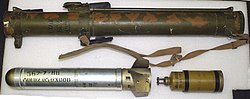
The RPO-A Shmel[5][6] (Russian: реактивный пехотный огнемёт РПО-А «Шмель», lit.'rocket-propelled infantry flamethrower "Bumblebee"') is a man-portable, single-use, rocket-assisted thermobaric weapon.[7][8] While its name directly translates to flamethrower (and it is classified as such in Russian military documents), the RPO-A Shmel is more accurately described as a thermobaric weapon.[9] The Shmel is designed, produced and exported by the Russian Federation and previously by the Soviet Union. It entered service with the Soviet Armed Forces at the end of the 1980s as the successor for the RPO Rys.

Key Information

Description

[edit]

The RPO-A is a single-shot, self-contained tube shaped launcher that operates much like the RPG-18 anti-tank launcher, a sealed tube, carried in a man-pack in pairs. The same person can remove the tube, place it in firing position, and launch the weapon without assistance. After launch, the tube is discarded. All models are externally similar.[8]

Designed to defeat concealed enemy firing positions, disable lightly armored vehicles and destroy enemy manpower. The aiming range with a diopter sight is 600 meters, with an OPO optical sight – 450 m, OPO-1 – up to 850 m.

Ammunition

[edit]

Each weapon contains a single rocket, of which there are three varieties. The basic rocket is the RPO-A, which has a thermobaric warhead and is designed for attacking soft targets under moderate cover. The RPO-Z is a incendiary warhead (from зажигательный, zazhigatel'nyy, 'incendiary') designed to spread fire and ignite targets. The RPO-D is a smoke warhead (from дымовой, dymovoy, 'related to smoke').

Variants

[edit]

RPO PDM-A Shmel-M

An updated development is the improved RPO-M "Shmel-M" that was shown for the first time at Eurosatory 2006. This version is similar to the original weapon, but has a calibre of 90 mm, a weight of 8.8 kg (19 lb), and an overall length of 940 mm. The system has better ergonomics, an improved rocket, and better ballistics and terminal effects. It consists of a disposable launching tube attached to a reusable fire control unit that includes the pistol grip, electronic trigger and safety, and a folding base with an optical sight and additional rail for an infrared/night vision sight. Effective range is 300 m, maximum sighting range is 800 m, and maximum range is 1,700 m. The thermobaric warhead's blast effect is equivalent to 5.5 kg (12 lb) of TNT, comparable to a 155 mm artillery shell. The "Shmel-M" is also known as RPO PDM-A (from Повышенной Дальности и Мощности, Povyshennoy Dal'nosti i Moshchnosti, 'enhanced range and power') and is produced for the local and export markets. A version with a mechanical sight was adopted on 24 December 2003.[10][11][12][13][14]

The MRO-A is a smaller development of the RPO-series with caliber reduced to 72.5 mm, similar to the RShG-2. It is self-contained, disposable, single-shot recoilless launcher with an overall length of 900 mm, weight of 4.7 kg (10 lb), and has a folding forward grip. The sights are RPO-based, with a fixed front and folding ladder-type diopter rear, giving an effective range of 90 m and maximum range of 450 m. The MRO-series includes different versions, again based on RPO versions: MRO-A thermobaric; MRO-D white phosphorus smoke; and MRO-Z incendiary. It was adopted by the Russian army around 2002 and issued to chemical troops to supplement the larger RPO-A.[15][3][16][17]

MGK Bur[18] (Russian: малогабаритный гранатомётный Комплекс «Бур», romanizedMalogabaritnyy Granatomotnyy Kompleks "Bur" — Compact Grenade-launching System "Auger") is a 62 mm version of the RPO-M consisting of two major components: the disposable launch tube and reusable fire control unit. Described as "the most compact grenade launcher in the world," the weapon has an overall length of 742 mm and weighs 5 kg (11 lb). Loaded tubes weigh 3.5 kg (7.7 lb) and can fire thermobaric (blast yield similar to 6 kg (13 lb) of TNT, or a 122 mm artillery rocket) or fragmentation warheads. The fire control unit is the same one used on the RPO-M, weighing 1.5 kg (3.3 lb) and enabling ranges of 25–650 m with the baseline day sight; night and thermal systems are also available. Maximum range is 950 meters, with a firing mechanism service life of at least 500 rounds. It can be fired in confined spaces with a volume of at least 30 cubic meters. As of October 2014, it has been accepted into service and serial production has been started.[19][20][21][22][23][24]

Service history

[edit]

RPO weapons have seen use by the Soviet Army in Afghanistan and by both the Russian invasion forces and Chechen resistance forces in the First and Second Chechen Wars. In September 1997, a large number of RPO were included in an arms airdrop to pro-Nguesso forces during the Second Republic of Congo Civil War.[25] On September 3, 2004, Russian forces used RPO-A Shmel as part of the effort to end the Beslan school siege.[26] On 9 August 2014, during the war in Donbas, the Ukrainian border checkpoint of Milove was attacked using RPO thermobaric weapons. The main building was hit by five incendiary rockets.[27] It was used by Indian Army in September 2016 for surgical strike against insurgents in Pakistan-administered Kashmir successfully.[citation needed] It was also used on 8 February 2017 in Ukraine, killing Donetsk People's Republic commander Mikhail "Givi" Tolstykh.[28] The munition has seen wide use by the Russian Federation in its 2022 invasion of Ukraine.

On October 2, 2023, an attack by presumed PKK members was foiled in the Turkish capital city of Ankara.[29] One attacker was armed with an M4 Carbine and an RPO launcher.

On December 2, 2023, Izz ad-Din al-Qassam Brigades, the military wing of Hamas, announced their first deployment of the weapon during the Gaza war to target a specialized Israeli force taking cover in a house in Jabalia, Northern Gaza.[30]

Operators

[edit]
Operators
  Current
  Former

Current operators

[edit]

Former operators

[edit]

See also

[edit]

References

[edit]
[edit]
Revisions and contributorsEdit on WikipediaRead on Wikipedia
from Grokipedia
The RPO-A Shmel (Russian: РПО-А Шмель, meaning "Bumblebee") is a man-portable, disposable, single-shot rocket launcher that fires 93 mm thermobaric rockets, classified by its manufacturer as a flamethrower despite its rocket-assisted propulsion and primary role in delivering fuel-air explosive warheads for anti-personnel and anti-fortification effects. Developed by Russia's KBP Instrument Design Bureau in Tula during the late 1980s, it weighs approximately 12 kg, measures 920 mm in length, and has an effective range of up to 150 meters, enabling infantry to engage targets in urban or enclosed environments where the thermobaric blast wave maximizes overpressure and fragmentation damage. Introduced into Soviet and subsequently Russian service for and assault units, the Shmel has been employed in conflicts including the Chechen Wars and more recent operations, valued for its ability to clear bunkers, cave complexes, and buildings without the need for line-of-sight precision typical of tank rounds. Variants such as the RPO-M (with incendiary and smoke options) and the upgraded RPO-A Shmel-M extend its tactical flexibility, incorporating reusable firing mechanisms and increased range beyond 300 meters in some models, while maintaining the core thermobaric destructive potential that distinguishes it from conventional grenade launchers. Its deployment underscores the emphasis on portable, high-impact area-denial weapons in post-Soviet , particularly against entrenched defenders where blast effects can incapacitate without structural penetration.

Development

Origins in Soviet Era


Development of the RPO-A Shmel commenced in 1984 at the KBP Instrument Design Bureau in Tula, Soviet Union, as part of efforts to replace outdated liquid-fueled flamethrowers with a safer, disposable rocket-based system for infantry use. This initiative addressed the operational limitations of prior systems, such as bulkiness, refueling hazards, and vulnerability to enemy fire, by introducing a man-portable launcher firing thermobaric or incendiary rockets effective against personnel and light fortifications.
The Shmel succeeded the earlier RPO "Rys" rocket , incorporating improvements in range, versatility, and operator safety through its single-use design. Adopted by the in 1988, it entered service in three primary variants: RPO-A with a thermobaric for blast and overpressure effects, RPO-Z with an incendiary , and RPO-D with a smoke-producing for obscuration. Primarily allocated to troops, the system was also utilized by units, reflecting Soviet emphasis on versatile, short-range incendiary capabilities in contested environments.

Design Evolution and Production

The RPO-A Shmel's development was initiated in 1984 by the in Tula, , as a man-portable successor to the earlier , addressing limitations in range and effectiveness against entrenched targets. The design focused on a disposable, system using a launch tube pre-loaded with a 93mm , incorporating recoilless operation via back-blast venting to enable shoulder-fired use by . This evolution prioritized simplicity, portability, and multi-role capability, with the thermobaric warhead providing enhanced blast and incendiary effects over prior liquid-fuel systems. Adoption occurred in 1988 by the , with initial variants including the RPO-A for thermobaric attacks, RPO-Z for incendiary payloads, and RPO-D for smoke screening, reflecting iterative refinements during trials to cover diverse tactical needs. Production began in the late 1980s at KBP facilities in Tula, emphasizing high-volume of the sealed, ready-to-fire units for chemical troops and special operations. Following the Soviet Union's dissolution, production transitioned seamlessly to the Russian Federation, where KBP continued manufacturing the RPO-A series for domestic use and export, maintaining the original design with minimal modifications to ensure compatibility and reliability in field conditions. The system's enduring production underscores its proven utility, though exact output figures remain classified.

Technical Characteristics

Launcher Mechanism and Operation

The RPO-A Shmel launcher consists of a disposable tube, pre-loaded at the factory with a 93 mm rocket projectile. The tube measures 920 mm in length and weighs approximately 11-12 kg when loaded, designed for shoulder-fired, recoilless operation similar to disposable anti-tank launchers like the RPG-18. It features a rifle-style trigger mechanism with a manual safety and integrated sighting system, including a folding diopter rear sight with multiple apertures and a fixed front sight for aiming up to an effective range of 200 meters. In operation, the operator shoulders the sealed tube after ensuring a clear , as the propelling charge expels rearward 3-5 meters following launch. Upon disengaging the and pulling the trigger, the firing mechanism ignites a propelling charge that accelerates the fin-stabilized forward at a of 125 m/s, with the charge gases venting rearward to counter . The arms after a minimum range of 20 meters to prevent premature , achieving a maximum range of 1,000 meters though practical use is limited to shorter distances due to sighting constraints. Post-firing, the single-use tube is discarded, with a reported of up to 4 rounds per minute achievable by employing multiple launchers carried by the operator or team.

Ammunition and Warhead Details

The RPO-A Shmel employs 93 mm disposable , each pre-loaded into a launch tube that serves as the ammunition carrier, with the complete round weighing approximately 2.5–3 kg including the and . The solid-fuel rocket motor provides for an effective firing range of up to 200 meters, though maximum kinematic range extends to 1,000 meters under ideal conditions. The primary RPO-A features a thermobaric containing about 2.1–2.2 kg of fuel-air (FAE) mixture, typically a semi-liquid paste incorporating , aluminum powder, and isopropyl nitrate as oxidizers to enhance combustion with atmospheric oxygen. Upon impact and detonation, the disperses an cloud of flammable particles that ignites, generating a high-temperature with a flame cloud diameter of 6–7 meters, a lethal radius of at least 3 meters, and sustained effects lasting around 0.4 seconds; this yields destructive power equivalent to a 107–152 mm high- shell against enclosed or soft targets. Variant ammunition includes the incendiary rocket, which substitutes a pyrogel-based filler in the to produce intense flames reaching 1,500–1,800 °C for sustained burning and area denial against personnel and in cover. The fragmentation adds a pre-formed sleeve around the core charge to enhance anti-personnel lethality with shrapnel dispersion combined with blast effects, while some sources reference an RPO-D smoke round for obscuration, though production emphasis remains on blast and incendiary types. All are designed for short-range, man-portable delivery against bunkers, buildings, and positions, prioritizing volume over penetration.

Variants and Modernizations

RPO-M Shmel-M

The RPO-M Shmel-M, also designated RPO PDM-A, represents a modernized iteration of the RPO-A Shmel man-portable thermobaric , developed by the Tula-based in the mid-2000s as a replacement for the original model. This variant was publicly unveiled at the 2006 exhibition and subsequently adopted by the while being offered for export. Key enhancements include a reduced overall weight, improved , enhanced ballistic performance, and greater terminal effects compared to the RPO-A, enabling more effective engagement of fortified positions, light vehicles, and personnel in confined spaces. Technical specifications of the Shmel-M emphasize portability and extended reach, with a caliber of 90 , total length of 940 , and unloaded weight of 8.8 kg, making it lighter and more maneuverable than its predecessor. The system achieves a of 180 m/s, supporting a maximum firing range of 1700 m, an of 800 m for sighted fire, and capability up to 300 m against targets 3.5 m high. It incorporates an optical sight for improved accuracy and a detachable firing handle, facilitating operations in urban or enclosed environments where backblast risks are minimized due to the rocket-assisted propulsion. The Shmel-M maintains the single-use, disposable design of the RPO-A series, delivering thermobaric warheads optimized for high-explosive and incendiary effects against bunkers, buildings, and clustered . These upgrades address limitations in the original system's range and weight, enhancing capabilities in modern conflicts, as evidenced by its integration into Russian for assault operations. Production continues under oversight, with the variant prioritizing reliability in adverse conditions over the RPO-A's baseline performance.

Specialized Rounds and Disposable Models

The RPO-A Shmel employs three primary specialized , each pre-loaded into the launch tube for single-use firing. The RPO-A round incorporates a thermobaric optimized for destroying personnel and light fortifications in enclosed spaces, generating a high-pressure and sustained heat exceeding 1,000°C through -air explosive detonation. The RPO-Z variant uses an incendiary filled with pyrogel, a gelled that ignites on impact and burns at temperatures between 1,500°C and 1,800°C, intended for igniting flammable materials, structures, or enemy positions. The RPO-D (or RPO-S in some designations) round delivers a for obscuration and signaling, dispersing a dense cloud to screen movements or mark targets. All share a 93 mm , with rockets achieving muzzle velocities of approximately 125 m/s and effective ranges up to 400 meters, though optimal engagement occurs within 200-250 meters due to unguided flight stability. Disposable models emphasize portability and simplicity for use, discarding the entire launcher post-firing to minimize logistical burden. The baseline RPO-A configuration is fully disposable, comprising a sealed tube weighing 12 kg loaded, with integrated sights and a folding grip, adopted by Soviet forces in for rapid deployment in urban or environments. A lighter disposable iteration, the (72.5 mm caliber), reduces weight to 4.7 kg and length to 900 mm while retaining thermobaric capability similar to the RPO-A but with reduced blast radius suited for close-quarters suppression. The MRO series extends disposability to its variants—MRO-D for smoke and others for incendiary effects—using simple and tubes, entering service post-2000s for emphasizing concealability over reusability. These models prioritize one-shot efficacy over reloadable systems, with backblast hazards requiring 6-10 meters of open space for safe operation.

Combat Employment

Early Use in Afghanistan

The RPO-A Shmel entered service with Soviet forces in the 1980s, coinciding with the latter stages of the (1979–1989). Its initial combat deployments targeted cave complexes and entrenched positions in 's mountainous regions, where conventional small arms and grenades often proved inadequate against fighters sheltered in natural fortifications. The thermobaric warhead's fuel-air explosive mechanism generated intense heat and a sustained , capable of penetrating and pressurizing enclosed spaces to lethal effect, thereby clearing out hidden combatants without requiring direct line-of-sight exposure for the operator. Mujahideen fighters dubbed the weapon "Shaitan-Tuba" (Devil's Pipe), a testament to its psychological and destructive impact on their defensive networks of tunnels and bunkers. This nickname arose from observed instances where a single RPO-A rocket could devastate reinforced hideouts, equivalent in blast power to a 152 mm shell despite the launcher's compact, man-portable design weighing approximately 8.8 kg loaded. Soviet employed it during assault operations in areas like the and other high-altitude strongholds, integrating it with motorized rifle units to suppress resistance prior to advances. Early field reports highlighted the Shmel's reliability in harsh Afghan conditions, including dust and elevation, though operators required training to manage backblast hazards in close-quarters engagements. Its adoption marked a shift toward shoulder-fired incendiary systems for urban and , filling a gap left by bulkier flamethrowers like the , and influencing subsequent Soviet tactics against dispersed, fortified adversaries.

Applications in Chechen and Georgian Conflicts

The RPO-A Shmel was employed by Russian forces during the (1994–1996), particularly in the Battle of from December 1994 to March 1995, where it served as a preferred for assaulting fortified urban positions held by Chechen separatists. Its thermobaric warhead proved effective for clearing snipers, RPG teams, and strongpoints in multi-story buildings, enabling room-by-room advances by penetrating walls and firing slits to deliver a sustained blast and incendiary effect equivalent to a 122 mm artillery shell. Russian infantry integrated the launcher into close-quarters tactics, valuing its psychological impact alongside physical destruction, though its single-use design limited sustained . In the Second Chechen War (1999–2009), the weapon saw expanded use by Russian federal forces in operations around and other urban centers like Shali, targeting rebel bunkers and entrenched positions amid intensified house-to-house fighting. Deployments in late 1999, including reported fuel-air explosive applications on , highlighted its role in suppressing fortified defenses, with the warhead's blast covering up to 80 cubic meters inside structures and producing a flame stream 4 meters wide by 40 meters long. Chechen militants also captured and utilized RPO-A units against Russian advances, as evidenced in clashes in during 2000, demonstrating the weapon's proliferation among non-state actors in the conflict. During the 2008 , the RPO-A remained part of the standard equipment for , including airborne and units engaged in urban and defensive assaults in and adjacent areas; however, specific documented instances of its tactical application are limited in open sources, with its employment likely aligned to general support against Georgian fortifications rather than as a standout system. The weapon's utility in confined spaces would have complemented operations in , though post-conflict analyses emphasize broader and armor over man-portable thermobarics.

Role in Syrian Civil War

The RPO-A Shmel saw deployment by Russian military units supporting Syrian government forces starting in late 2015, primarily as part of chemical, biological, radiological, and nuclear (CBRN) defense detachments equipped for urban assault roles. These units, including flamethrower squads, integrated the Shmel alongside heavier systems like the TOS-1A Solntsepyok multiple rocket launcher to neutralize fortified positions and underground rebel networks in densely built environments. In the Aleppo offensive, thermobaric RPO-A launchers were reported in active use by December 2016, targeting insurgent-held buildings and tunnels amid the battle for control of the city, where their portable design allowed to engage at ranges up to 450 meters without exposing operators to . Syrian Arab Army (SAA) and National Defense Forces (NDF) also employed the weapon in operations such as those in Jabal al-Nuba, leveraging its 93 mm thermobaric warhead to produce blasts effective against enclosed spaces, akin to scaled-down multiple effects but with greater precision in close-quarters fighting. Rebel groups, including those affiliated with Hay'at Tahrir al-Sham, captured Shmel units from government stocks during engagements like the October 2015 seizure in Sukayk village, enabling limited reverse use against SAA positions in subsequent and clashes through 2022. This proliferation highlighted the weapon's tactical value in asymmetric , though its thermobaric yields raised concerns over indiscriminate effects in civilian areas, as noted in analyses of joint Syrian-Russian operations.

Deployment in Russo-Ukrainian War

The RPO-A Shmel has been employed by Russian forces during the 2022 invasion of to target fortified and camouflaged positions, exploiting its thermobaric warhead's capacity to generate intense blast waves and heat in enclosed spaces. Photographs and videos documented the weapon's presence with Russian units in as early as March 2022, indicating its integration into operations for suppressing entrenched defenders. In April 2024, squads from the Russian "West" grouping of forces, specifically the , conducted assaults in the Kupyansk sector using the RPO-A Shmel to destroy Ukrainian strongholds. These units advanced covertly before launching thermobaric rockets, which neutralized personnel, light fortifications, and lightly armored vehicles through high-temperature explosions and effects. The single-use, man-portable design facilitated rapid engagement at ranges up to 600 meters, supporting advances in contested urban and defensive environments. Captured examples have appeared in Ukrainian hands, with some systems adapted for unmanned surface vehicles in naval operations, though primary deployment remains with for support. Non-state actors, including the , have also fired RPO-A Shmel rockets in the conflict, such as against encircled Russian troops at the Volchansk Aggregate Plant in October 2024.

Operators and Exports

Primary State Users

The remain the primary operator of the RPO-A Shmel, having inherited the system from the where it entered service in the late 1980s for use against fortified positions and urban structures. Russian forces continue to deploy it in infantry support roles, with documented employment in conflicts such as the Second Chechen War (1999–2009) and the starting in 2014, where its thermobaric warhead provides overpressure effects equivalent to a 152 mm round in confined spaces. maintains the RPO-A Shmel in its military inventory as a legacy Soviet-era system, integrated into and units for anti-fortification tasks, though procurement of the successor PDM-A Priz began around 2019 to replace aging stockpiles. operates a licensed variant designated PF-97, a direct adaptation of the RPO-A Shmel produced since the early for the , emphasizing similar disposable, shoulder-fired thermobaric capabilities against bunkers and light armor. This version features minor modifications for compatibility with Chinese production lines but retains core operational parameters, including a 93 mm caliber and of up to 600 meters.

Licensed Production and Proliferation

The RPO-A Shmel has undergone licensed production in , where it is manufactured as the PF-97, a direct copy incorporating similar thermobaric and incendiary capabilities. This variant maintains the original's 93 mm and disposable design, adapted for integration into Chinese infantry units. No other countries are documented as having obtained formal licenses for production. Proliferation of the RPO-A beyond authorized state exports has been limited but notable in conflict zones, often through battlefield captures or illicit transfers. In the , the militia received several units in September 1997, highlighting early instances of diversion to non-state groups. Similar patterns emerged in Central African conflicts, where Democratic Forces for the Liberation of Rwanda (FDLR) elements acquired systems, contributing to their use against fortified positions. These cases underscore the weapon's appeal to irregular forces due to its effectiveness in urban and cave environments, despite international concerns over thermobaric munitions' indiscriminate effects.

Tactical Analysis

Effectiveness Against Fortifications and Personnel

The RPO-A Shmel's thermobaric , weighing approximately 2.1–2.2 kg, disperses a fuel-air that ignites to produce a prolonged lasting up to one second, with peak temperatures exceeding 1,900°C and overpressures that reflect off internal surfaces to amplify damage in enclosed environments. This mechanism enables the munition to penetrate unsealed openings in fortifications, such as bunkers or building cavities, where the blast propagates and sustains high pressure, rendering it particularly suited for defeating hardened urban strongpoints. Destructive equivalence to a 122 mm round has been noted for its performance against structures, surpassing conventional explosives in confined spaces due to the reflected wave dynamics. The weapon's 6–7 meter flame cloud diameter and minimum 3-meter deliver effects comparable to a 107 mm high-explosive shell, incinerating contents and compromising structural integrity through combined pressure and incendiary action. Effective engagement ranges extend from 20 meters minimum to 1,000 meters maximum, allowing to target fortified positions at tactically relevant distances without requiring line-of-sight precision beyond 600 meters. Against personnel, the Shmel induces catastrophic injuries via overpressures up to 73 kg/cm², primarily manifesting as primary blast trauma including alveolar rupture leading to "blast lung" with delayed , arterial gas embolisms, and . Gastrointestinal effects include gas pocket ruptures causing perforation or bruising, while thermal components produce flash burns and oxygen depletion exacerbating suffocation in unventilated areas; overpressures of 1,380 kPa are uniformly fatal even in open exposure. Secondary risks encompass auditory damage from tympanic membrane rupture to disruption, and cardiovascular or complications from emboli, with survival dependent on distance and enclosure.

Comparative Advantages Over Conventional Weapons

The RPO-A Shmel's thermobaric warhead generates a prolonged and that exceeds the effects of conventional high-explosive munitions, particularly in confined spaces where the fuel-air mixture disperses, ignites, and consumes available oxygen to amplify thermal and pressure damage. This mechanism produces temperatures reaching several thousand degrees and a vacuum-like aftereffect from oxygen depletion, resulting in higher against personnel sheltered in bunkers, buildings, or caves compared to standard fragmentation or blast from high-explosive rounds, which rely on shorter-duration shocks and shrapnel ineffective against cover. In urban combat scenarios, the Shmel functions as man-portable "pocket ," delivering an yield equivalent to approximately 5.5 kg of TNT—far surpassing the 0.3–0.5 kg TNT equivalence of typical grenade launchers or RPG anti-personnel warheads—enabling it to neutralize fortified positions or multiple combatants behind light barriers without requiring direct line-of-sight penetration like shaped-charge rounds. Unlike optimized for armor defeat, such as RPG HEAT projectiles, the Shmel prioritizes volume-filling detonation that propagates through doorways, vents, and structural breaches, enhancing tactical flexibility for assault teams clearing multi-room structures. Operational data from conflicts indicates the Shmel's disposable, single-operator design reduces logistical burden over reusable systems like the Carl Gustaf , while its 200–300 meter allows suppression of entrenched enemies in environments where support is restricted, though its open-air performance diminishes relative to conventional munitions due to fuel dispersion limits. Russian military assessments emphasize its role in minimizing exposure during advances, as the warhead's incendiary secondary effects deny reoccupation of targeted areas more effectively than non-thermobaric alternatives. The RPO-A Shmel's thermobaric generates a prolonged characterized by , oxygen depletion, and extreme heat, resulting in effects more severe than conventional high explosives of equivalent yield, such as rupture of alveoli leading to blast lung, arterial gas embolisms, and cardiovascular damage from air emboli. These injuries often manifest delayed symptoms, including or up to 48 hours post-detonation, and are exacerbated in confined or urban environments where reflected shock waves amplify damage to air-filled tissues like lungs, , and . Medical analyses highlight a higher incidence of primary blast trauma compared to traditional munitions, with potential from unburned fuel components posing additional risks akin to chemical exposure. Critics, including humanitarian organizations, argue that the weapon's wide-area effects—encompassing thermal burns, suffocation from oxygen consumption, and structural —render it particularly hazardous for personnel in enclosed spaces or near civilians, earning it the moniker "Devil's Tube" during Soviet use against Afghan cave complexes due to its devastating indoor lethality. In urban combat scenarios, such as those in or , the Shmel's deployment has raised concerns over disproportionate , as the blast's vacuum-like aftereffect and fragmentation can cause unnecessary suffering beyond direct , though empirical data on specific casualty attribution remains limited. Under , thermobaric weapons like the RPO-A Shmel are not explicitly prohibited by , remaining permissible against military objectives provided they adhere to customary principles of distinction, proportionality, and precautions against harm. However, their inherent characteristics—prolonged pressure waves and secondary effects like toxic gases—have prompted debates over inherent indiscriminacy, particularly in populated areas, where International Committee of the Red Cross analyses recommend avoidance to mitigate risks of excessive incidental casualties. The in the Tagayeva v. Russia case referenced Shmel use in without classifying it as incendiary, but underscored IHL obligations to minimize broad-area harm, with violations potentially constituting war crimes under the if proportionality is disregarded.

References

Add your contribution
Related Hubs
User Avatar
No comments yet.