


Community hub
Recent from talks
Contribute something
Nothing was collected or created yet.
Rạch Giá
View on Wikipedia | This article needs additional citations for verification. (March 2013) |
 | You can help expand this article with text translated from the corresponding article in Vietnamese. (June 2023) Click [show] for important translation instructions.
|
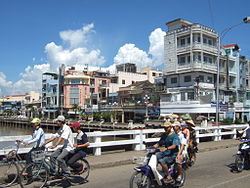
Rạch Giá (ⓘ) was a provincial city and the formal capital of Kiên Giang province, Vietnam. It is located on the Eastern coast of the Gulf of Thailand, 250 kilometres (160 mi) southwest of Ho Chi Minh City. East of city, it borders Tân Hiệp and Châu Thành town, the Gulf of Thailand is to the West and surrounds some parts of the city, south of the city is Châu Thành and An Biên town, and to the North it borders Hòn Đất and Tân Hiệp.
Key Information


On 1 July 2025, Rạch Giá ceased to exist as a municipal city following the elimination of district level units in Vietnam.[3]
Administrative units
[edit]Rạch Giá was upgraded from a town to a city by Government Decree No. 97/2005/NĐ-CP on July 26, 2005.[1] The city has 12 administrative units:
- Vĩnh Thanh Vân Ward
- Vĩnh Thanh Ward
- Vĩnh Lạc Ward
- Vĩnh Lợi Ward
- Vĩnh Quang Ward
- An Hòa Ward
- An Bình Ward
- Rạch Sỏi Ward
- Vĩnh Thông Ward
- Vĩnh Hiệp Ward
- Phi Thông Commune
Rạch Giá is the first city where the Vietnamese government applied a "lấn biển"[4] project to build out to the ocean to expand territory. The "lấn biển" project expanded the city to become one of the biggest new cities in southwest Vietnam. This project added 2 more new wards in Rạch Giá. Besides that, several future construction projects such as industrial center Rach Vuot and urban city Vĩnh Hiệp which will be started after finishing Lạc Hồng Bridge will expand Rạch Giá to the east.[citation needed]
Cultures and tourism
[edit]Ceremony of Nguyễn Trung Trực is held annually in lunar August.[citation needed]
Historic
[edit]National historical sites:
- Nguyễn Trung Trực Temple
- Tam Bảo Temple
- Vĩnh Hoà temple
- Huỳnh Mẫn Đạt grave
- Phật Lớn pagoda
- Láng Cát pagoda
- Kiên Giang museum
- Quan Đế pagoda
Other historical sites:
- Sắc Tứ Tam Bảo Temple
- Tam quan gate. This is the historical main gate and the symbol of Rạch Giá City.
- Nguyễn Hiền Điều temple
- Suông council
- Bắc Đế temple
- Thiên Hậu temple
- Thiên Hậu Palace
Climate
[edit]Rạch Giá has a tropical savanna climate (Köppen Aw), not quite wet enough to be classified as a tropical monsoon climate (Am) though wetter than most climates of its type. There is a very pronounced dry season from December to March, but rainfall is consistently heavy for the remaining eight months of the year.
| Climate data for Rạch Giá | |||||||||||||
|---|---|---|---|---|---|---|---|---|---|---|---|---|---|
| Month | Jan | Feb | Mar | Apr | May | Jun | Jul | Aug | Sep | Oct | Nov | Dec | Year |
| Record high °C (°F) | 35.6 (96.1) |
35.4 (95.7) |
37.8 (100.0) |
37.9 (100.2) |
37.7 (99.9) |
34.7 (94.5) |
34.0 (93.2) |
34.0 (93.2) |
34.4 (93.9) |
33.9 (93.0) |
34.0 (93.2) |
34.8 (94.6) |
37.9 (100.2) |
| Mean daily maximum °C (°F) | 30.4 (86.7) |
31.6 (88.9) |
32.9 (91.2) |
33.5 (92.3) |
32.1 (89.8) |
30.7 (87.3) |
30.1 (86.2) |
29.9 (85.8) |
30.1 (86.2) |
30.7 (87.3) |
30.6 (87.1) |
30.0 (86.0) |
31.0 (87.8) |
| Daily mean °C (°F) | 25.8 (78.4) |
26.5 (79.7) |
27.7 (81.9) |
28.9 (84.0) |
28.8 (83.8) |
28.3 (82.9) |
27.9 (82.2) |
27.7 (81.9) |
27.7 (81.9) |
27.6 (81.7) |
27.2 (81.0) |
26.1 (79.0) |
27.5 (81.5) |
| Mean daily minimum °C (°F) | 22.4 (72.3) |
22.8 (73.0) |
24.0 (75.2) |
25.5 (77.9) |
26.1 (79.0) |
26.0 (78.8) |
25.7 (78.3) |
25.5 (77.9) |
25.5 (77.9) |
25.2 (77.4) |
24.7 (76.5) |
23.1 (73.6) |
24.7 (76.5) |
| Record low °C (°F) | 14.8 (58.6) |
16.9 (62.4) |
17.1 (62.8) |
21.5 (70.7) |
22.0 (71.6) |
21.7 (71.1) |
21.9 (71.4) |
21.9 (71.4) |
22.2 (72.0) |
21.3 (70.3) |
19.0 (66.2) |
16.3 (61.3) |
14.8 (58.6) |
| Average rainfall mm (inches) | 13.4 (0.53) |
10.9 (0.43) |
34.9 (1.37) |
89.9 (3.54) |
251.8 (9.91) |
277.7 (10.93) |
315.8 (12.43) |
335.9 (13.22) |
301.1 (11.85) |
295.6 (11.64) |
177.4 (6.98) |
46.6 (1.83) |
2,151.1 (84.69) |
| Average rainy days | 2.2 | 1.5 | 3.4 | 7.5 | 16.8 | 19.5 | 20.3 | 21.2 | 20.0 | 21.1 | 15.8 | 6.1 | 155.6 |
| Average relative humidity (%) | 78.8 | 77.9 | 76.5 | 78.2 | 82.5 | 84.1 | 85.0 | 85.6 | 85.0 | 84.1 | 81.6 | 79.4 | 81.5 |
| Mean monthly sunshine hours | 244.2 | 236.6 | 256.6 | 249.9 | 207.1 | 173.8 | 176.4 | 166.3 | 161.0 | 176.1 | 203.3 | 223.5 | 2,469.8 |
| Source: Vietnam Institute for Building Science and Technology[5] | |||||||||||||
Transportation
[edit]
Rạch Giá has 2 main stations: Rạch Sỏi station (main routes to neighbor towns or provinces on highway 61 and 63) and Rạch Giá station (main routes to Ho Chi Minh City and Hà Tiên). Those are the main stations to transport passengers to other towns in the province, or to other provinces in Vietnam.[citation needed]
The bus transportation system was developed pretty early. Passengers can take the bus from Rạch Giá to 4 other towns: Châu Thành (route Rạch Giá – Tắc Cậu), Giồng Riềng (route Rạch Giá – Giồng Riềng), Tân Hiệp (route Rạch Giá – Kinh B), Hòn Đất (route Rạch Giá – Tám Ngàn).
Currently, Rạch Giá Airport is the biggest airport in Rạch Giá. Rạch Giá airport has flight routes to Ho Chi Minh City with Vietnam Airlines.
Rạch Giá has 2 big ship stations: Rạch Giá ship station or Phú Quốc ship station (routes to Phú Quốc island and other big islands such as Phú Quốc, Hon Tre, Hòn Sơn and Thổ Chu) and Rạch Mẽo station (route to rural towns of Cà Mau Peninsula). High speed ship is the economic choice for passengers to Phú Quốc island or Kiên Hải islands.
References
[edit]- ^ a b (in Vietnamese) "Nghị định của Chính phủ về việc thành lập thành phố Rạch Giá thuộc tỉnh Kiên Giang; điều chỉnh địa giới hành chính, thành lập xã thuộc các huyện Gò Quao, An Minh, Châu Thành, Kiên Hải và Giồng Riềng, tỉnh Kiên Giang". Ministry of Justice's Portal (Vietnam). Retrieved December 26, 2012.
- ^ "The 2009 Vietnam Population and Housing census: Completed results". General Statistics Office of Vietnam. Retrieved December 26, 2012.
- ^ "From July 1, 87 cities across Vietnam will no longer exist". Vietnamnet. Retrieved 13 October 2025.
- ^ "Đô thị lấn biển Rạch Giá vươn mình bên bờ biển Tây". Văn phòng Ủy ban nhân dân tỉnh Kiên Giang.
- ^ "Vietnam Institute for Building Science and Technology" (PDF).
External links
[edit]
Former districts of the Mekong Delta | ||
|---|---|---|
| Cần Thơ city |  | |
| An Giang province | ||
| Bạc Liêu province | ||
| Bến Tre province | ||
| Cà Mau province | ||
| Đồng Tháp province | ||
| Hậu Giang province |
| |
| Kiên Giang province | ||
| Long An province | ||
| Sóc Trăng province | ||
| Tiền Giang province |
| |
| Trà Vinh province | ||
| Vĩnh Long province | ||
※ denotes provincial seat. | ||
| 2,000,000 and more |
|
|---|---|
| 1,000,000–1,999,999 | |
| 500,000–999,999 | |
| 200,000–499,999 | |
| International | |
|---|---|
| National | |
| Geographic | |
| Other | |

Rạch Giá
View on GrokipediaGeography
Location and environment
Rạch Giá is situated at coordinates 10°1′0″N 105°5′0″E, approximately 250 kilometers southwest of Ho Chi Minh City.[12] As the capital of An Giang Province in southern Vietnam, the city occupies an area of about 105 km², incorporating coastal plains, extensive river networks, and reclaimed land from the pioneering "lấn biển" (sea reclamation) project initiated in 1997. This project expanded the urban territory by 420 hectares across five zones, with 360 hectares directly reclaimed from the sea to accommodate new developments in wards such as Vĩnh Bảo, Vĩnh Lạc, and An Hòa.[13][14] The city's administrative boundaries adjoin Tân Hiệp and Châu Thành districts to the east, An Biên and Hòn Đất districts to the south and north, and the Gulf of Thailand along its western flank.[15] This positioning places Rạch Giá at the interface of terrestrial and marine environments, with the Gulf's waters shaping its western coastal edges. Topographically, the area consists of predominantly flat, low-lying swampy land typical of the Mekong Delta, crisscrossed by a dense web of waterways and canals that facilitate drainage and connectivity. These features, combined with scattered coconut groves, reflect the region's alluvial plain formation, where sediment deposition from upstream rivers creates fertile, waterlogged soils.[16] Environmentally, Rạch Giá lies on the eastern shore of the Gulf of Thailand, benefiting from the nutrient-rich alluvial soils deposited by the Mekong River system, which underpin local agriculture and aquaculture activities. The proximity to the delta's riverine network influences tidal dynamics and sediment flow, contributing to a landscape of mangroves, estuaries, and productive wetlands along the Cai Lon River estuary.[17][18]Climate
Rạch Giá experiences a tropical savanna climate classified as Aw under the Köppen-Geiger system, characterized by a distinct dry season and a prolonged wet season influenced by the monsoon patterns of southern Vietnam.[19] The annual average temperature is approximately 27.5°C, with the dry season from December to March featuring highs reaching up to 32°C and comfortable daytime warmth, while the wet season from April to November sees lows around 24°C, particularly during the cooler evenings of June to January.[20] These temperatures reflect the region's proximity to the equator and the moderating effects of coastal breezes, maintaining relatively stable conditions year-round without extreme heatwaves or frosts.[20] Precipitation in Rạch Giá averages 2,151.1 mm annually, with the dry season receiving minimal rainfall—often less than 50 mm per month—allowing for clearer skies and lower humidity during this period. In contrast, the monsoon-driven wet season brings heavy downpours, peaking in September and October when monthly totals can exceed 400 mm, contributing to the majority of the yearly accumulation. Average humidity levels hover around 80% throughout the year, creating persistently muggy conditions that intensify during the rainy months.[20] The climate exposes Rạch Giá to frequent typhoons originating from the South China Sea and seasonal flooding from Mekong River overflows, particularly during the wet season when upstream rains swell the delta's waterways.[21] These events have led to significant urban inundation and disruptions in the coastal areas.[22] Climate change exacerbates these vulnerabilities, with rising sea levels—projected to inundate up to 40% of the Mekong Delta under scenarios of 1-meter rise—threatening Rạch Giá's low-lying coastal zones through increased salinity intrusion and erosion.[23] Recent data through 2025 indicates heightened storm intensity, driven by warmer ocean temperatures that fuel stronger typhoons with greater moisture content, resulting in more severe flooding events compared to historical norms.[24]History
Origins and colonial era
The region encompassing modern Rạch Giá was originally part of Cambodian territory in the Mekong Delta, known in Khmer as Kramuon Sa (or Kramuon-Srok), a flat, swampy area with early Khmer settlements influenced by the Funan and later Khmer kingdoms. In 1715, amid Khmer-Siamese conflicts and Vietnamese southward expansion (Nam tiến), the area was placed under the protection of the Nguyễn lords of Huế, marking the beginning of Vietnamese administrative influence over former Khmer lands. Khmer communities continued to inhabit the region, maintaining agricultural practices and cultural traditions centered on rice cultivation and Theravada Buddhism.[25] During the late 18th century civil wars, the area gained strategic importance when Prince Nguyễn Ánh (later Emperor Gia Long) sought refuge there in 1783 after his fleet was destroyed by Tây Sơn forces, retreating to nearby Phú Quốc Island before regrouping. By 1786, Nguyễn Ánh established Rạch Giá as a fortified outpost to secure the southwestern frontier and facilitate naval operations against the Tây Sơn dynasty, leveraging the Rach Gia Canal—a pre-existing waterway linking the Mekong to the Gulf of Thailand—for logistics and defense. Following his victory and the founding of the Nguyễn dynasty in 1802, Rạch Giá solidified as a key port under centralized rule, attracting migrants including Vietnamese settlers, Chinese immigrants led by figures like Mạc Cửu who developed nearby Hà Tiên, and residual Khmer populations, fostering a multiethnic economy based on trade in rice, fish, and salt.[26][27] French forces incorporated Rạch Giá into the colony of Cochinchina in 1867 following the conquest of southern Vietnam, administering it as a provincial center within the protectorate. The town evolved into a vital market hub, with the French enhancing infrastructure such as roads, canals, and port facilities to support export-oriented agriculture and maritime trade to the Gulf of Thailand and beyond; by the early 1900s, it handled significant volumes of rice and seafood shipments.[28] Rạch Giá also became a focal point for anti-colonial resistance, exemplified by the activities of Nguyễn Trung Trực, who in 1861 burned the French ship Espérance on the Nhật Tảo Canal near Tân An and in 1868 led attacks on French outposts in the province before his capture and execution that year.20th century and independence
During World War II, Rạch Giá fell under Japanese occupation as part of French Indochina following the Japanese coup against Vichy French authorities in March 1945, marking a brief period of direct imperial control in the region. The occupation ended abruptly with Japan's surrender in August 1945, creating a power vacuum that enabled the Viet Minh to assert influence. In Rạch Giá, this transition manifested through the August Revolution, where local revolutionary forces seized government buildings and established committees, contributing to the nationwide proclamation of Vietnamese independence on September 2, 1945.[29] In the Vietnam War era, Rạch Giá's position as a key port in the Mekong Delta made it strategically vital for logistics and supply routes supporting South Vietnamese and allied forces, while also serving as a hotspot for anti-colonial and Viet Cong activities amid ongoing guerrilla warfare. The city's historical ties to resistance were reinforced through 20th-century commemorations of 19th-century hero Nguyễn Trung Trực, including annual festivals and temple rituals at his dedicated shrine in Rạch Giá, which symbolized enduring patriotism and drew community participation to honor anti-imperial struggles.[30] Following the fall of Saigon in 1975, Rạch Giá was integrated into the unified Socialist Republic of Vietnam and reorganized administratively; in February 1976, it was designated as a town (thị xã) and provincial seat of the re-established Kiên Giang Province under the Provisional Revolutionary Government of the Republic of South Vietnam.[31] The ensuing decades saw recovery from wartime destruction, with the town upgraded to full city status on July 26, 2005, via Government Decree No. 97/2005/NĐ-CP, which expanded its administrative boundaries to include 12 wards and enhance its role as a regional hub.[32] The late 1970s and 1980s brought challenges from regional instability, including a notable influx of Cambodian refugees fleeing Khmer Rouge atrocities and cross-border raids into Kiên Giang Province, which strained local resources near Rạch Giá and prompted Vietnamese military responses along the frontier.[33] By the 1990s and 2000s, as Vietnam's Đổi Mới reforms took hold, Rạch Giá pursued urban expansion through key infrastructure initiatives, such as water supply network upgrades and extensions funded by international aid, which addressed wartime damage and supported population growth while improving livability.[34] As Kiên Giang's capital through the early 21st century, Rạch Giá benefited from steady economic expansion driven by its port and trade position, fostering urbanization and development until national administrative reforms culminated in 2025. On July 1, 2025, amid Vietnam's sweeping provincial mergers, Kiên Giang and An Giang were consolidated into a new An Giang Province, with Rạch Giá designated as its administrative headquarters, marking a shift in its municipal framework while preserving its central role.[14]Government and administration
Current status
Following the nationwide administrative reforms implemented on July 1, 2025, Rạch Giá serves as the headquarters of the newly formed An Giang Province, resulting from the merger of the former Kiên Giang and An Giang provinces.[14][35] This consolidation is part of Vietnam's broader 2024–2025 initiative to streamline governance by reducing the number of provincial-level units from 63 to 34, aiming to enhance administrative efficiency, resource allocation, and regional development.[1] The reforms have elevated Rạch Giá from its previous status as a district-level city to the urban core of the enlarged province, directly under provincial-level administration, with its former district-level structures dissolved to support a more centralized two-tier system.[36] As the political and administrative center, Rạch Giá holds significant importance as an economic and cultural hub in the Mekong Delta region, facilitating integrated planning for agriculture, trade, and tourism across the merged territory.[37] It acts as a population center for the former Kiên Giang area, which had approximately 1.8 million residents prior to the merger, underscoring its role in coordinating services for a larger, more diverse provincial population.[38] The recent reforms have introduced impacts on local services and urban planning in Rạch Giá, including streamlined public administration, consolidated service delivery, and enhanced infrastructure projects to accommodate the province's expanded scope.[39] These changes promote efficiency in areas such as healthcare, education, and transportation, positioning Rạch Giá as a key node for regional connectivity and sustainable growth within the Mekong Delta.[40]Administrative divisions
Following the administrative reforms implemented on July 1, 2025, as part of Vietnam's provincial merger reducing units from 63 to 34, the former Rạch Giá City was restructured and integrated into the newly formed An Giang Province, with its district-level status abolished.[1] The area now comprises two urban wards (phường), reflecting a consolidation of previous divisions to streamline governance and enhance provincial integration, while maintaining a total area of approximately 141 km².[41] This realignment merged nine former wards and incorporated rural elements from adjacent areas, eliminating separate commune structures within the original city boundaries.[42] Phường Rạch Giá, the central urban ward, was formed by consolidating the former wards of Vĩnh Quang, Vĩnh Thanh, Vĩnh Thanh Vân, Vĩnh Lạc, An Hòa, Vĩnh Hiệp, An Bình, Rạch Sỏi, and Vĩnh Lợi, covering 45.53 km² with a population of 250,661 as of 2025—making it the most populous ward in Vietnam.[41][43] This ward serves as the primary hub for commercial activity, high-density residential areas, and administrative functions, including the former city center, with Vĩnh Thanh Vân area contributing significantly to its urban density and economic vibrancy.[44] Phường Vĩnh Thông, encompassing the peripheral and semi-rural zones, resulted from the merger of the former Phước Tiến Ward (previously known as Vĩnh Thông in some contexts), Phi Thông Commune, and Mỹ Lâm Commune from Hòn Đất District, spanning 95.89 km² with a population of 55,185.[41] It functions as the outskirts supporting agriculture, aquaculture, and fishing industries, providing essential resources to the urban core while undergoing gradual urbanization.[45]Demographics
Population trends
Rạch Giá's population has exhibited steady growth over recent decades, primarily driven by natural increase and internal migration. The 2009 Vietnam Population and Housing Census recorded 226,316 residents, marking a notable urban center in the Mekong Delta region. By the 2019 census, this had risen modestly to 227,527, reflecting an average annual growth rate of approximately 0.05% over the decade, consistent with broader trends in provincial urban areas where migration supplements limited natural expansion. As of 2020, estimates placed the population at 228,416, with the overall urban density averaging about 2,158 people per km² across the then 105.86 km² area.[46] In July 2025, following the merger of Kiên Giang and An Giang provinces into a new An Giang province with Rạch Giá as the provincial capital, the administrative structure was reorganized. The former city was consolidated into Phường Rạch Giá, a directly administered ward encompassing the merger of nine previous wards, with a natural area of 45.53 km² and a population of 250,661 as of 2025. This results in a significantly higher density of approximately 5,505 people per km². The reorganization and economic opportunities have contributed to accelerated growth, with an annual rate of around 1.0% in the immediate post-merger period. Projections indicate continued expansion to around 280,000 by 2030, driven by urbanization, trade, and fisheries development.[47][48]| Year | Population | Annual Growth Rate (approx.) | Source |
|---|---|---|---|
| 2009 | 226,316 | - | General Statistics Office of Vietnam (via citypopulation.de) |
| 2019 | 227,527 | 0.05% | General Statistics Office of Vietnam (via citypopulation.de) |
| 2020 | 228,416 | 0.4% | Worldometers estimate[46] |
| 2025 | 250,661 | 1.0% | Post-merger official data[47] |