Hubbry Logo
Jake LaMottaJake LaMottaMain
Open search
Jake LaMotta
Community hub
Jake LaMotta
logo
8 pages, 0 posts
0 subscribers
Be the first to start a discussion here.
Jake LaMotta
Jake LaMotta
from Wikipedia

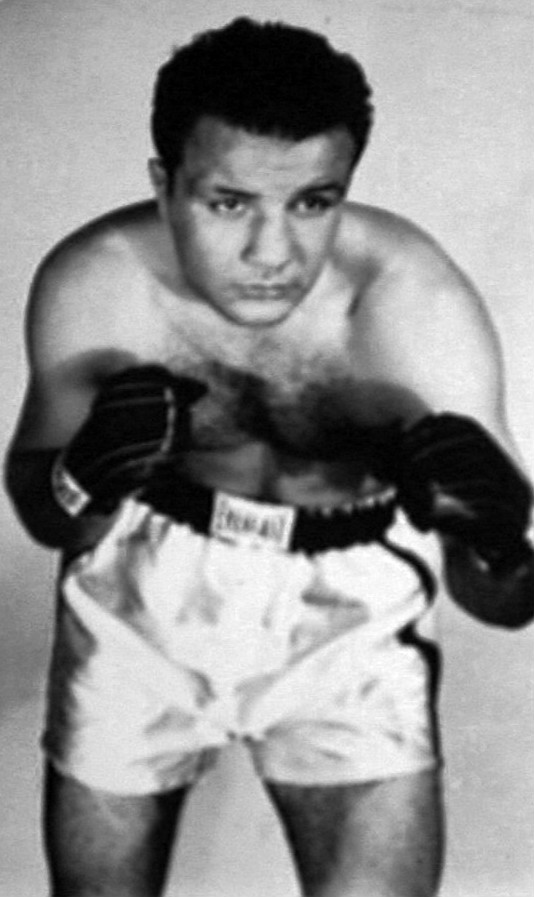
Giacobbe "Jake" LaMotta (July 10, 1922 – September 19, 2017) was an American professional boxer who was world middleweight champion between 1949 and 1951. Nicknamed "the Bronx Bull" or "Raging Bull" for his technique of constant stalking, brawling and inside fighting, he developed a reputation for being a "bully"; he was what is often referred to today as a swarmer and a slugger.[citation needed]

Key Information

Due to his hard style of fighting, LaMotta often took as much as he dished out in an era of great middleweights. With a thick skull and jaw muscles, LaMotta was able to absorb incredible amounts of punishment over the course of his career, and is thought to have one of the greatest chins in boxing history. LaMotta's six-fight rivalry with Sugar Ray Robinson was one of the most notable in the sport. Although each fight was close and LaMotta dropped Robinson to the canvas multiple times, LaMotta won only one of the bouts. LaMotta, who lived a turbulent life in and out of the ring, was managed by his brother Joey. He was ranked 52nd on Ring Magazine's list of the "80 Best Fighters of the Last 80 Years",[3] and also ranked amongst its list of the 10 greatest middleweights of all time.[4] LaMotta was inducted into the International Boxing Hall of Fame in the inaugural class of 1990.[5]

LaMotta's autobiography was adapted into the 1980 Martin Scorsese film Raging Bull. It went on to be nominated for eight Academy Awards, with Robert De Niro winning Best Actor for his portrayal of LaMotta.

Early life

[edit]

LaMotta was born on the Lower East Side of New York City on July 10, 1922, to Italian parents, Elizabeth (Merluzzo) and Giuseppe "Joseph" LaMotta.[6][7][8] Many sources had reported his year of birth as 1921,[9] but his daughter Christi claimed it was in fact 1922.[9] His mother was born in the United States to Italian immigrants, while his father was an immigrant from Messina, Sicily, who came with family including Jake's older brother Joseph. The family lived briefly in Philadelphia before returning to New York City and settling in the Bronx.[6]

Jake's father forced the boy to fight other boys in order to entertain neighborhood adults, who threw pocket change into the ring. LaMotta's father collected the money and used it to help pay the rent.[10] One of LaMotta's cousins on his father's side was Richard LaMotta, who became an entrepreneur and creator of the Chipwich ice cream treat.[11]

LaMotta learned to box while in a reformatory in upstate New York, where he'd been sent for attempted robbery.[6] Afterward he fought undefeated in amateur bouts, turning professional at age 19 in 1941. During World War II, he was rejected for military service due to a childhood mastoid operation on one of his ears which affected his hearing.[6][12]

Boxing career

[edit]

As a middleweight in his first fifteen bouts, LaMotta went 14–0–1 (3 KOs). On September 24, 1941, he almost defeated Jimmy Reeves by a knockout in Reeves' hometown of Cleveland, Ohio, but the referee counted to nine before he was interrupted by the boxing bell, signaling the end of the match, and by a split decision, LaMotta controversially lost to Reeves, despite the latter being knocked down. Chaos erupted after the decision was announced. Fights broke out around the ring and the crowd continued to riot for 20 minutes. The arena's organist unsuccessfully tried to calm down the crowd by playing the "Star Spangled Banner". However, while the crowd continued to riot, the violence outside the ring led to many arrests.

One month later, LaMotta and Reeves fought again in the same arena. LaMotta lost a much less controversial decision. A third match between the two took place on March 19, 1943, in Detroit, Michigan. The first five rounds were close, though Reeves was struggling in the fourth. In the sixth round, LaMotta floored Reeves, who was only down for a second. Once the fight resumed, LaMotta landed a left on Reeves' chin, sending him down face-first. Reeves was blinking his eyes and shaking his head as the referee counted him out.

LaMotta vs. Robinson I–V

[edit]

LaMotta fought Sugar Ray Robinson in Robinson's middleweight debut at Madison Square Garden, New York City, October 2, 1942.[13] LaMotta knocked Robinson down in the first round of the fight. Robinson got up and took control over much of the fight, winning via a unanimous 10-round decision.[13]

A 10-round rematch took place February 5, 1943, at Olympia Stadium in Detroit, Michigan.[13] In the eighth round, LaMotta landed a right to Robinson's head and a left to his body, sending him through the ropes. Robinson was saved by the bell at the count of nine. LaMotta, who was already leading on the scorecards before knocking Robinson out of the ring, pummeled and outpointed him for the rest of the fight. Robinson had trouble keeping LaMotta at bay.[14] LaMotta won via unanimous decision, giving Robinson the first defeat of his career.

The victory was short-lived, as the two met on February 26, 1943, in what was another 10-round fight, once again at Olympia Stadium in Robinson's former home of Detroit.[13] Robinson was knocked down for a nine-count in Round 7. Robinson later stated, "He really hurt me with a left in the seventh round. I was a little dazed and decided to stay on the deck." Robinson won the close fight by unanimous decision, using a dazzling left jab and jarring uppercuts.[15] LaMotta said the fight was given to Robinson because he would be inducted into the army the next day.[16]

A fourth fight, the duo's final 10 rounder, took place nearly two years after the third, on February 23, 1945, at Madison Square Garden, New York.[17] Robinson won again by a unanimous decision.

LaMotta and Robinson had their fifth bout at Comiskey Park, Chicago, Illinois on September 26, 1945. Robinson won by a very controversial split decision, contested over 12 rounds.[18] The decision was severely booed by the 14,755 people in attendance. LaMotta later said in his autobiography that the decision was widely criticized by several newspapers and boxing publishers. Robinson said afterward, "This was the toughest fight I've ever had with LaMotta."[19]

LaMotta vs. Fox

[edit]

On November 14, 1947, LaMotta was knocked out in the fourth round by Billy Fox. Suspecting the fight was fixed, the New York State Athletic Commission withheld purses for the fight and suspended LaMotta. The fight with Fox would come back to haunt him later in life, during a case with the Federal Bureau of Investigation.

In his testimony and in his later book, LaMotta admitted to throwing the fight to gain favor with the Mafia. All involved agreed the fix was obvious and their staging inept.

As LaMotta wrote,

The first round, a couple of belts to his head, and I see a glassy look coming over his eyes. Jesus Christ, a couple of jabs and he's going to fall down? I began to panic a little. I was supposed to be throwing a fight to this guy, and it looked like I was going to end up holding him on his feet... By [the fourth round], if there was anybody in the Garden who didn't know what was happening, he must have been dead drunk.[20]

The thrown fight and a payment of $20,000 to the Mafia got LaMotta his title bout against World Middleweight Champion Marcel Cerdan.[21]

LaMotta vs. Cerdan

[edit]

LaMotta won the World Middleweight title on June 16, 1949, in Detroit, Michigan, defeating Frenchman Marcel Cerdan.[22] LaMotta won the first round (in which he knocked Cerdan down), Cerdan the second, and the third was even. At that point it became clear something was wrong. Cerdan dislocated his arm in the first round, apparently damaged in the knockdown, and gave up before the start of the 10th round. LaMotta damaged his left hand in the fifth round, but still landed 104 punches in the ninth round, whereas Cerdan hardly threw a punch.[23] The official score had LaMotta as winner by a knockout in 10 rounds because the bell had already rung to begin that round when Cerdan announced he was quitting. A rematch was arranged, but while Cerdan was flying back to the United States to fight the rematch, his Air France Lockheed Constellation crashed in the Azores, killing everyone on board.[24]

World Middleweight Champion

[edit]

LaMotta made his first title defense against Tiberio Mitri on July 7, 1950, at Madison Square Garden, New York. LaMotta retained his title via unanimous decision. LaMotta's next defense came on September 13, 1950, against Laurent Dauthuille. Dauthuille had previously beaten LaMotta by decision before LaMotta became world champion. By the fifteenth round, Dauthuille was ahead on all scorecards (72–68, 74–66, 71–69) and seemed to be about to repeat a victory against LaMotta. LaMotta hit Dauthuille with a barrage of punches that sent him down against the ropes toward the end of the round. Dauthuille was counted out with 13 seconds left in the fight.[25] This fight was named Fight of the Year for 1950 by The Ring magazine.

Saint Valentine's Day Massacre of boxing

[edit]

The sixth and final fight between LaMotta and Robinson took place at Chicago Stadium. This fight was scheduled for 15 rounds and was for the middleweight title.[13] Held on February 14, 1951, Saint Valentine's Day, the fight became known as boxing's version of the Saint Valentine's Day Massacre. In the last few rounds, LaMotta began to take a horrible beating and was soon unable to defend himself from Robinson's powerful blows. But LaMotta refused to go down. Robinson won by a technical knockout in the 13th round, when the fight was stopped.[26]

Light heavyweight

[edit]

LaMotta moved up to light heavyweight after losing his world middleweight title. He had poor results at first. He lost his debut against Bob Murphy, lost a split decision to Norman Hayes, and drew with Gene Hairston in his first three bouts. In his next three fights, LaMotta had rematches with Hayes, Hairston, and Murphy, and defeated all of them by unanimous decisions.

On December 31, 1952, LaMotta had his next fight against Danny Nardico. He knocked LaMotta down for the only time in his career (not counting his thrown 1947 fight) by a right hand in the seventh round. LaMotta got up and was beaten against a corner by Nardico until the bell rang. LaMotta's corner stopped the bout before the eighth round began.[27]

Following that fight, LaMotta took time off; when he returned, in early 1954,[28] he knocked out his first two opponents, Johnny Pretzie (TKO 4) and Al McCoy (KO 1), but a controversial split decision loss to Billy Kilgore on April 14, 1954, convinced him to retire.[29]

Post-boxing

[edit]

After retiring from the ring, LaMotta owned and managed a bar at 1120 Collins Ave in Miami Beach. He also became a stage actor and comedian. In 1958 he was arrested and charged with introducing men to an underage girl at a club he owned in Miami. He was convicted and served six months on a chain gang, although he maintained his innocence.[citation needed]

In 1960 LaMotta was called to testify before a U.S. Senate sub-committee that was looking into underworld influence on boxing. He testified that he had thrown his bout with Billy Fox so that the mob would arrange a title bout for him.[20]

LaMotta appeared in more than 15 films, including The Hustler (1961) with Paul Newman and Jackie Gleason, in which he had a role as a bartender.[30] He appeared in several episodes of the NBC police comedy Car 54 Where Are You? (1961–63). A lifelong baseball fan, he organized the Jake LaMotta All-Star Team in the Bronx. The LaMotta team played in Sterling Oval which was located between 165th and 164th Streets between Clay and Teller Avenue.[citation needed]

In 1965, LaMotta appeared as "Big Jule" in the New York City Center production of Guys and Dolls for 15 performances alongside Alan King and Jerry Orbach.[31]

In his old age, LaMotta lived mostly in a northern suburb of Miami, FL, alternating to Bisbee, Arizona during the rainy Florida summer season,[32] where he knew comedian Doug Stanhope.[33]

Fighting style

[edit]

LaMotta is recognized as having had one of the best chins in boxing. He rolled with punches, minimizing their force and damage when they landed, but he was also able to absorb many blows.[10] In the Saint Valentine's Day Massacre, his sixth bout with Robinson, LaMotta suffered numerous severe blows to the head. Commentators could be heard saying "No man can take this kind of punishment!" But LaMotta did not go down. The fight was stopped by the referee in the 13th round, declaring it a TKO victory for Robinson.

LaMotta was one of the first boxers to adopt the "bully" style of fighting, in that he always stayed close and in punching range of his opponent, by stalking him around the ring, and sacrificed taking punches himself in order to land his own shots. Due to his aggressive, unrelenting style he was known as "The Bronx Bull".[34] He boasted "No son-of-a-bitch ever knocked me off my feet", but that claim was ended in December 1952 at the hands of Danny Nardico when Nardico caught him with a hard right in the seventh round. LaMotta fell into the ropes and went down. After regaining his footing, he was unable to come out for the next round.[35][36]

Raging Bull: My Story

[edit]

Raging Bull: My Story is a 1970 second edition of LaMotta's memoir. The autobiographical details include his life as a young teenage criminal; his reformation in prison; his extensive career as an amateur and professional boxer; his struggles with organized crime who kept a boxing title out of reach; and his jealous obsession with his wife, Vikki. The book details his life, from childhood until the end of his fame.

The first edition is:

  • La Motta, Jake with Carter, Joseph and Savage, Peter (1970). Raging Bull: My Story. Englewood Cliffs, N.J.: Prentice-Hall [1970]. ISBN 0-13-752527-3.

Raging Bull

[edit]

Hollywood executives approached LaMotta with the idea of a movie about his life, based on his 1970 memoir Raging Bull: My Story. The film, Raging Bull, released in 1980, was a box-office bomb, but eventually received overwhelming critical acclaim for both director Martin Scorsese and actor Robert De Niro, who gained about 60 pounds during the shooting of the film to play the older LaMotta in later scenes.

To accurately portray the younger LaMotta, De Niro trained with LaMotta until LaMotta felt he was ready to box professionally. De Niro lived in Paris for three months, eating at the finest restaurants in order to gain sufficient weight to portray LaMotta after retirement.[20] De Niro won the Academy Award for Best Actor for his performance.

Later life

[edit]
LaMotta in the 1980s, with former wife Vikki LaMotta, right, actress Cathy Moriarty, left

LaMotta had a troubled personal life, including an early spell in a reformatory, and was married seven times. He admitted to having raped a woman, having beaten his wives and coming close to beating a man to death during a robbery.[37]

In February 1998, LaMotta's elder son, Jake LaMotta Jr., died of liver cancer.[10] In September 1998, his younger son, Joseph LaMotta, died aged 49 in the crash of Swissair Flight 111.[10][38]

His nephew John LaMotta fought in the heavyweight-novice class of the 2001 Golden Gloves championship tournament.[39] John later became an actor, and one of his roles was as "Duke", who ran the bar of that name featured in the television comedy series Frasier. Another nephew, William Lustig, is a well-known director and producer of horror films and the president of Blue Underground, Inc.[40]

LaMotta had four daughters, including Christi by his second wife Vikki LaMotta and Stephanie by his fourth wife Dimitria. He married his seventh wife, his longtime fiancée Denise Baker, on January 4, 2013.[41] LaMotta remained active on the speaking and autograph circuit, and published several books about his career, his life, and his fights with Robinson.

LaMotta appeared in a 50-minute New York City stage production, Lady and the Champ, in July 2012. The production focused on LaMotta's boxing career, and was criticized by The New York Times as poorly executed and a "bizarre debacle".[42]

LaMotta is the subject of a documentary directed and produced by Greg Olliver. The film features an appearance by Mike Tyson among other notable athletes, actors and Jake's family and friends. Also in production was a sequel to Raging Bull, although MGM filed suit to halt the project, saying that LaMotta did not have the right to make a sequel. The lawsuit was settled on July 31, 2012, when LaMotta agreed to change the title of the film to The Bronx Bull.[43]

LaMotta: The Bronx Bull stars actor William Forsythe as LaMotta, while Paul Sorvino plays his father. It also features Joe Mantegna, Tom Sizemore, Penelope Ann Miller, Natasha Henstridge, Joey Diaz and Ray Wise.[44]

Death

[edit]

LaMotta died on September 19, 2017, from complications of pneumonia in a nursing home in Florida, at the age of 95.[45][6][9]

Professional boxing record

[edit]
106 fights 83 wins 19 losses
By knockout 30 4
By decision 53 15
Draws 4
No. Result Record Opponent Type Round, time Date Age Location Notes
106 Loss 83–19–4 Billy Kilgore SD 10 April 14, 1954 31 years, 278 days Auditorium, Miami Beach, Florida, U.S.
105 Win 83–18–4 Al McCoy KO 1 (10), 1:10 April 3, 1954 31 years, 267 days Armory, Charlotte, North Carolina, U.S.
104 Win 82–18–4 Johnny Pretzie TKO 4 (10), 1:42 Mar 11, 1954 31 years, 244 days Legion Arena, West Palm Beach, Florida, U.S.
103 Loss 81–18–4 Danny Nardico RTD 7 (10) Dec 31, 1952 30 years, 174 days Coliseum, Coral Gables, Florida, U.S.
102 Win 81–17–4 Bob Murphy UD 10 Jun 11, 1952 29 years, 337 days Olympia Stadium, Detroit, Michigan, U.S.
101 Win 80–17–4 Gene Hairston UD 10 May 21, 1952 29 years, 316 days Olympia Stadium, Detroit, Michigan, U.S.
100 Win 79–17–4 Norman Hayes UD 10 April 9, 1952 29 years, 274 days Olympia Stadium, Detroit, Michigan, U.S.
99 Draw 78–17–4 Gene Hairston PTS 10 Mar 5, 1952 29 years, 239 days Olympia Stadium, Detroit, Michigan, U.S.
98 Loss 78–17–3 Norman Hayes SD 10 Jan 28, 1952 29 years, 202 days Boston Garden, Boston, Massachusetts, U.S.
97 Loss 78–16–3 Irish Bob Murphy RTD 7 (10) Jun 27, 1951 28 years, 352 days Yankee Stadium, Bronx, New York, U.S.
96 Loss 78–15–3 Sugar Ray Robinson TKO 13 (15), 2:04 Feb 14, 1951 28 years, 219 days Chicago Stadium, Chicago, Illinois, U.S. Lost NYSAC, NBA, and The Ring middleweight titles
95 Win 78–14–3 Laurent Dauthuille KO 15 (15), 2:47 Sep 13, 1950 28 years, 65 days Olympia Stadium, Detroit, Michigan, U.S. Retained NYSAC, NBA, and The Ring middleweight titles
94 Win 77–14–3 Tiberio Mitri UD 15 Jul 12, 1950 28 years, 2 days Madison Square Garden, New York, U.S. Retained NYSAC, NBA, and The Ring middleweight titles
93 Win 76–14–3 Joe Taylor UD 10 May 4, 1950 27 years, 298 days State Fair Coliseum, Syracuse, New York, U.S.
92 Win 75–14–3 Chuck Hunter TKO 6 (10), 0:59 Mar 28, 1950 27 years, 261 days Arena, Cleveland, Ohio, U.S.
91 Win 74–14–3 Dick Wagner TKO 9 (10), 2:40 Feb 3, 1950 27 years, 208 days Olympia Stadium, Detroit, Michigan, U.S.
90 Loss 73–14–3 Robert Villemain UD 10 Dec 9, 1949 27 years, 152 days Madison Square Garden, New York, U.S.
89 Win 73–13–3 Marcel Cerdan RTD 9 (15) Jun 16, 1949 26 years, 341 days Briggs Stadium, Detroit, Michigan, U.S. Won NYSAC, NBA and The Ring middleweight titles
88 Win 72–13–3 Joey DeJohn TKO 8 (10), 2:41 May 18, 1949 26 years, 312 days State Fair Coliseum, Syracuse, New York, U.S.
87 Win 71–13–3 O'Neill Bell TKO 4 (10), 1:40 April 18, 1949 26 years, 282 days Olympia Stadium, Detroit, Michigan, U.S.
86 Win 70–13–3 Robert Villemain SD 12 Mar 25, 1949 26 years, 258 days Madison Square Garden, New York, U.S.
85 Loss 69–13–3 Laurent Dauthuille UD 10 Feb 21, 1949 26 years, 226 days Forum, Montreal, Quebec, Canada.
84 Win 69–12–3 Tommy Yarosz UD 10 Dec 3, 1948 26 years, 146 days Madison Square Garden, New York, U.S.
83 Win 68–12–3 Vern Lester SD 10 Oct 18, 1948 26 years, 100 days Eastern Parkway Arena, Brooklyn, New York, U.S.
82 Win 67–12–3 Johnny Colan TKO 10 (10), 1:32 Oct 1, 1948 26 years, 83 days St. Nicholas Rink, New York, U.S.
81 Win 66–12–3 Burl Charity TKO 5 (10) Sep 7, 1948 26 years, 59 days Park Arena, Bronx, New York, U.S.
80 Win 65–12–3 Ken Stribling TKO 5 (10), 2:46 Jun 1, 1948 25 years, 327 days Griffith Stadium, District of Columbia, U.S.
79 Loss 64–12–3 Billy Fox TKO 4 (10) Nov 14, 1947 25 years, 127 days Madison Square Garden, New York, U.S.
78 Loss 64–11–3 Cecil Hudson SD 10 Sep 3, 1947 25 years, 55 days Comiskey Park, Chicago, Illinois, U.S.
77 Win 64–10–3 Tony Janiro UD 10 Jun 6, 1947 24 years, 331 days Madison Square Garden, New York, U.S.
76 Win 63–10–3 Tommy Bell UD 10 Mar 14, 1947 24 years, 247 days Madison Square Garden, New York, U.S.
75 Win 62–10–3 Anton Raadik UD 10 Dec 6, 1946 24 years, 149 days Chicago Stadium, Chicago, Illinois, U.S.
74 Win 61–10–3 O'Neill Bell KO 2 (10), 2:32 Oct 25, 1946 24 years, 107 days Olympia Stadium, Detroit, Michigan, U.S.
73 Win 60–10–3 Bob Satterfield KO 7 (10), 1:50 Sep 12, 1946 24 years, 64 days Wrigley Field, Chicago, Illinois, U.S.
72 Win 59–10–3 Holman Williams UD 10 Aug 7, 1946 24 years, 28 days University of Detroit Stadium, Detroit, Michigan, U.S.
71 Draw 58–10–3 Jimmy Edgar PTS 10 Jun 13, 1946 23 years, 338 days University of Detroit Stadium, Detroit, Michigan, U.S.
70 Win 58–10–2 Joe Reddick UD 10 May 24, 1946 23 years, 318 days Arena, Boston, Massachusetts, U.S.
69 Win 57–10–2 Marcus Lockman UD 10 Mar 29, 1946 23 years, 262 days Boston Garden, Boston, Massachusetts, U.S.
68 Win 56–10–2 Tommy Bell UD 10 Jan 11, 1946 23 years, 185 days Madison Square Garden, New York, U.S.
67 Win 55–10–2 Charley Parham TKO 6 (10), 0:59 Dec 7, 1945 23 years, 150 days Chicago Stadium, Chicago, Illinois, U.S.
66 Win 54–10–2 Walter Woods KO 8 (10), 1:33 Nov 23, 1945 23 years, 136 days Boston Garden, Boston, Massachusetts, U.S.
65 Win 53–10–2 Coolidge Miller KO 3 (10), 2:51 Nov 13, 1945 23 years, 126 days Park Arena, Bronx, New York, U.S.
64 Loss 52–10–2 Sugar Ray Robinson SD 12 Sep 26, 1945 23 years, 78 days Comiskey Park, Chicago, Illinois, U.S.
63 Win 52–9–2 George Kochan TKO 9 (10), 0:54 Sep 7, 1945 23 years, 59 days Madison Square Garden, New York, U.S.
62 Win 51–9–2 José Basora TKO 9 (10) Aug 10, 1945 23 years, 31 days Madison Square Garden, New York, U.S.
61 Win 50–9–2 Tommy Bell UD 10 Jul 6, 1945 22 years, 361 days Madison Square Garden, New York, U.S.
60 Win 49–9–2 Bert Lytell SD 10 April 27, 1945 22 years, 291 days Boston Garden, Boston, Massachusetts, U.S.
59 Win 48–9–2 Vic Dellicurti UD 10 April 20, 1945 22 years, 284 days St. Nicholas Rink, New York, U.S.
58 Win 47–9–2 George Costner KO 6 (10) Mar 26, 1945 22 years, 259 days Chicago Stadium, Chicago, Illinois, U.S.
57 Win 46–9–2 Lou Schwartz KO 1 (10), 2:30 Mar 19, 1945 22 years, 252 days U.S.O. Auditorium, Norfolk, Virginia, U.S.
56 Loss 45–9–2 Sugar Ray Robinson UD 10 Feb 23, 1945 22 years, 228 days Madison Square Garden, New York, U.S.
55 Win 45–8–2 George Kochan TKO 9 (10) Nov 3, 1944 22 years, 116 days Olympia Stadium, Detroit, Michigan, U.S.
54 Win 44–8–2 George Kochan UD 10 Sep 29, 1944 22 years, 81 days Olympia Stadium, Detroit, Michigan, U.S.
53 Loss 43–8–2 Lloyd Marshall UD 10 April 21, 1944 21 years, 286 days Arena, Cleveland, Ohio, U.S.
52 Win 43–7–2 Lou Woods SD 10 Mar 31, 1944 21 years, 265 days Chicago Stadium, Chicago, Illinois, U.S.
51 Win 42–7–2 Coley Welch UD 10 Mar 17, 1944 21 years, 251 days Boston Garden, Boston, Massachusetts, U.S.
50 Win 41–7–2 Ossie Harris SD 10 Feb 25, 1944 21 years, 230 days Olympia Stadium, Detroit, Michigan, U.S.
49 Win 40–7–2 Ossie Harris SD 10 Jan 28, 1944 21 years, 202 days Olympia Stadium, Detroit, Michigan, U.S.
48 Win 39–7–2 Fritzie Zivic UD 10 Jan 14, 1944 21 years, 188 days Olympia Stadium, Detroit, Michigan, U.S.
47 Win 38–7–2 Fritzie Zivic SD 10 Nov 12, 1943 21 years, 125 days Madison Square Garden, New York, U.S.
46 Win 37–7–2 Johnny Walker TKO 2 (10), 0:53 Oct 11, 1943 21 years, 93 days Convention Hall, Philadelphia, Pennsylvania, U.S.
45 Win 36–7–2 José Basora UD 10 Sep 17, 1943 21 years, 69 days Olympia Stadium, Detroit, Michigan, U.S.
44 Loss 35–7–2 Fritzie Zivic SD 15 Jul 12, 1943 21 years, 2 days Forbes Field, Pittsburgh, Pennsylvania, U.S.
43 Win 35–6–2 Fritzie Zivic SD 10 Jun 10, 1943 20 years, 335 days Forbes Field, Pittsburgh, Pennsylvania, U.S.
42 Win 34–6–2 Tony Ferrara KO 6 (10) May 12, 1943 20 years, 306 days Music Hall Arena, Cincinnati, Ohio, U.S.
41 Win 33–6–2 Ossie Harris UD 10 Mar 30, 1943 20 years, 263 days Duquesne Gardens, Pittsburgh, Pennsylvania, U.S.
40 Win 32–6–2 Jimmy Reeves KO 6 (10) Mar 19, 1943 20 years, 252 days Olympia Stadium, Detroit, Michigan, U.S.
39 Loss 31–6–2 Sugar Ray Robinson UD 10 Feb 26, 1943 20 years, 231 days Olympia Stadium, Detroit, Michigan, U.S.
38 Win 31–5–2 Sugar Ray Robinson UD 10 Feb 5, 1943 20 years, 210 days Olympia Stadium, Detroit, Michigan, U.S.
37 Win 30–5–2 Charley Hayes TKO 6 (10) Jan 22, 1943 20 years, 196 days Olympia Stadium, Detroit, Michigan, U.S.
36 Win 29–5–2 California Jackie Wilson PTS 10 Jan 15, 1943 20 years, 189 days Madison Square Garden, New York, U.S.
35 Win 28–5–2 Jimmy Edgar SD 10 Jan 1, 1943 20 years, 175 days Olympia Stadium, Detroit, Michigan, U.S.
34 Win 27–5–2 Henryk Chmielewski UD 10 Nov 6, 1942 20 years, 119 days Mechanics Building, Boston, Massachusetts, U.S.
33 Win 26–5–2 Bill McDowell TKO 5 (8), 0:44 Oct 20, 1942 20 years, 102 days Broadway Arena, Brooklyn, New York, U.S.
32 Loss 25–5–2 Sugar Ray Robinson UD 10 Oct 2, 1942 20 years, 84 days Madison Square Garden, New York, U.S.
31 Win 25–4–2 Vic Dellicurti PTS 10 Sep 8, 1942 20 years, 60 days New York Coliseum, Bronx, New York, U.S.
30 Win 24–4–2 Jimmy Edgar PTS 10 Aug 28, 1942 20 years, 49 days Madison Square Garden, New York, U.S.
29 Win 23–4–2 Lorenzo Strickland PTS 8 Jul 28, 1942 20 years, 18 days New York Coliseum, Bronx, New York, U.S.
28 Loss 22–4–2 José Basora PTS 10 Jun 16, 1942 19 years, 341 days New York Coliseum, Bronx, New York, U.S.
27 Win 22–3–2 Vic Dellicurti PTS 10 Jun 2, 1942 19 years, 327 days New York Coliseum, Bronx, New York, U.S.
26 Draw 21–3–2 José Basora PTS 10 May 12, 1942 19 years, 306 days New York Coliseum, Bronx, New York, U.S.
25 Win 21–3-1 Buddy O'Dell PTS 10 April 21, 1942 19 years, 285 days New York Coliseum, Bronx, New York, U.S.
24 Win 20–3–1 Lou Schwartz KO 9 (10) April 7, 1942 19 years, 271 days New York Coliseum, Bronx, New York, U.S.
23 Win 19–3–1 Lorenzo Strickland PTS 10 Mar 18, 1942 19 years, 251 days New York Coliseum, Bronx, New York, U.S.
22 Win 18–3–1 Frankie Jamison PTS 8 Mar 3, 1942 19 years, 236 days New York Coliseum, Bronx, New York, U.S.
21 Win 17–3–1 Frankie Jamison PTS 8 Jan 27, 1942 19 years, 201 days New York Coliseum, Bronx, New York, U.S.
20 Loss 16–3–1 Nate Bolden MD 10 Dec 22, 1941 19 years, 165 days Marigold Gardens, Chicago, Illinois, U.S.
19 Win 16–2–1 Jimmy Casa PTS 6 Nov 14, 1941 19 years, 127 days Madison Square Garden, New York, U.S.
18 Loss 15–2–1 Jimmy Reeves UD 10 Oct 20, 1941 19 years, 102 days Arena, Cleveland, Ohio, U.S.
17 Win 15–1–1 Lorenzo Strickland PTS 8 Oct 7, 1941 19 years, 89 days Westchester County Center, White Plains, New York, U.S.
16 Loss 14–1–1 Jimmy Reeves SD 10 Sep 24, 1941 19 years, 76 days Arena, Cleveland, Ohio, U.S.
15 Win 14–0–1 Cliff Koerkle PTS 6 Aug 11, 1941 19 years, 32 days New York Coliseum, Bronx, New York, U.S.
14 Draw 13–0–1 Joe Shikula PTS 6 Aug 5, 1941 19 years, 26 days Queensboro Arena, Long Island City, Queens, New York, U.S.
13 Win 13–0 Joe Baynes PTS 6 Jul 15, 1941 19 years, 5 days Queensboro Arena, Long Island City, Queens, New York, U.S.
12 Win 12–0 Johnny Morris KO 3 (6) Jun 23, 1941 18 years, 348 days Starlight Park, Bronx, New York, U.S.
11 Win 11–0 Lorenzo Strickland PTS 6 Jun 16, 1941 18 years, 341 days Starlight Park, Bronx, New York, U.S.
10 Win 10–0 Lorenzo Strickland PTS 4 Jun 9, 1941 18 years, 334 days Queensboro Arena, Woodhaven, Queens, New York, U.S.
9 Win 9–0 Johnny Morris PTS 4 May 27, 1941 18 years, 321 days New York Coliseum, Bronx, New York, U.S.
8 Win 8–0 Johnny Cihlar PTS 4 May 20, 1941 18 years, 314 days Broadway Arena, Brooklyn, New York, U.S.
7 Win 7–0 Monroe Crewe PTS 4 April 26, 1941 18 years, 290 days Ridgewood Grove, Brooklyn, New York, U.S.
6 Win 6–0 Lorne McCarthy PTS 4 April 22, 1941 18 years, 286 days Westchester County Center, White Plains, New York, U.S.
5 Win 5–0 Stanley Goicz PTS 4 April 15, 1941 18 years, 279 days Westchester County Center, White Plains, New York, U.S.
4 Win 4–0 Joe Fredericks TKO 1 (4), 1:36 April 8, 1941 18 years, 272 days Westchester County Center, White Plains, New York, U.S.
3 Win 3–0 Johnny Morris TKO 4 (4) April 1, 1941 18 years, 265 days Westchester County Center, White Plains, New York, U.S.
2 Win 2–0 Tony Gillo PTS 6 Mar 14, 1941 18 years, 247 days Pyramid Mosque, Bridgeport, Connecticut, U.S.
1 Win 1–0 Charley Mackley PTS 4 Mar 3, 1941 18 years, 236 days St. Nicholas Rink, New York, U.S.

Titles in boxing

[edit]

Major world titles

[edit]

The Ring magazine titles

[edit]

Undisputed titles

[edit]

See also

[edit]

References

[edit]
[edit]
Revisions and contributorsEdit on WikipediaRead on Wikipedia
from Grokipedia
Giacobbe "Jake" LaMotta (July 10, 1922 – September 19, 2017) was an American professional who held the world championship from 1949 to 1951. LaMotta, born in , began his professional career in 1941 and amassed a record of 83 wins, 19 losses, and 4 draws over 106 bouts, including 30 knockouts, before retiring in 1954. Nicknamed the "" or "" for his ferocious, pressure-oriented style and exceptional durability, he is most noted for a six-bout rivalry with spanning 1942 to 1951, in which LaMotta achieved one upset victory. He captured the title via retirement against in 1949 and made successful defenses before losing it to Robinson in their final encounter. LaMotta's career included admissions of corruption, such as intentionally losing a 1947 fight to Billy Fox to position for a title opportunity, leading to his involvement in congressional hearings on in . Post-retirement, he pursued and acting, with his tumultuous life inspiring Martin Scorsese's 1980 biopic .

Early Life

Birth and Family Background

Giacobbe "Jake" LaMotta was born on July 10, 1922, in the borough of to Italian immigrant parents. His father, Giuseppe (also known as Joseph) LaMotta, originated from and had immigrated to the , settling in New York where he worked in low-paying labor jobs amid the economic hardships of the era. LaMotta's mother, Elizabeth LaMotta, managed the household in a working-class environment marked by poverty and urban density. As the eldest of five children, LaMotta grew up in a large family strained by financial difficulties, with his parents relying on meager incomes in the immigrant enclaves of New York. His father, facing unemployment and desperation during the Great Depression's early years, reportedly encouraged young LaMotta to engage in street fights against other children for small sums of money—sometimes as little as a few cents or a piece of fruit—to contribute to the family's support. This early exposure to physical confrontations in the rough neighborhoods of and shaped his formative years, instilling a survivalist toughness amid a backdrop of familial instability and limited opportunities for Italian-American immigrants. While some records list his birth year as 1921, the preponderance of biographical accounts confirm 1922 as the accurate date.

Juvenile Delinquency and Reform School

LaMotta's childhood in was marked by poverty and familial abuse, with his father routinely compelling him to engage in street fights against other children for purposes, fostering an environment of from an early age. This upbringing contributed to his involvement in petty crime and brawling, culminating in an estimated 1,000 street fights during his youth. By age 15, LaMotta faced multiple arrests for offenses including , breaking and entering, , and , reflecting a pattern of escalating typical of his rough neighborhood. A failed attempt to rob a jewelry store led to his commitment to a New York reform school, where he served time as a juvenile offender before his release in his late teens. During his incarceration, LaMotta began formal training in , which provided structure amid the institution's disciplinary regimen and marked a pivotal shift from unstructured toward organized athletic pursuit. Upon discharge, he transitioned to , setting the stage for his professional career debut in 1941 at age 19.

Introduction to Boxing

LaMotta's initial exposure to physical combat occurred in his childhood in , where his father compelled him to engage in street fights against neighborhood children for small sums of money paid by onlookers, beginning around age seven. These encounters, driven by family and his father's encouragement to monetize his aggression, honed LaMotta's resilience but lacked formal structure. Following that led to his commitment to a for attempted in his early teens, LaMotta encountered organized within the institution, where he began learning proper techniques under supervised conditions. This environment provided his first systematic introduction to the sport, transforming unstructured brawling into disciplined ring work; fellow inmate , later a champion, was among those present during this period. Upon release from reform school around age 16 or 17, LaMotta transitioned to amateur boxing, compiling an undefeated record in local bouts that showcased his durability and aggressive style. This phase, spanning the late 1930s, marked his formal entry into competitive pugilism, setting the foundation for his professional debut on March 13, 1941, against Al McCoy in Washington, D.C. His early amateur success stemmed from the raw toughness forged in street and reformatory experiences, enabling him to absorb punishment while pressing opponents relentlessly.

Boxing Career

Amateur Beginnings and Professional Debut

LaMotta entered the boxing ranks shortly after his release from the Hawthorne-Cedar Knolls School reformatory in the late , channeling his street-fighting experience into structured bouts. Reports describe him as undefeated during this phase, though detailed records of opponents or fight counts remain undocumented in primary boxing archives, suggesting a brief and informal progression rather than extensive competitive seasoning. He turned professional at age 18 on March 3, 1941, defeating Charley Mack by unanimous points decision over four rounds at the Valley Arena in . This debut showcased his aggressive, pressure-oriented style, earning him a reputation for durability even in preliminary matchups. LaMotta's initial professional stretch saw him compete primarily as a , securing victories in his first 15 bouts, including several stoppages that highlighted his capacity to absorb punishment while advancing relentlessly. By mid-1943, prior to his high-profile clashes with , his ledger stood at 25 wins, 4 losses, and 2 draws, with losses typically by decision against seasoned opponents. This foundation underscored his transition to contention, built on raw toughness rather than technical finesse.

Rise Through the Ranks and Early Fights

LaMotta made his professional debut on March 3, 1941, defeating Charley Mackley by four-round points decision at St. Nicholas Arena in . Over his first 15 bouts, primarily as a , he achieved 14 wins (including three by ), one draw, and no losses initially, building momentum through consistent victories against regional opponents. By early 1942, LaMotta transitioned toward competition, facing tougher foes and experiencing his first defeats, including losses to and Nate Bolden, which tested his durability but honed his swarming, inside-fighting approach. His record stood at roughly 17-2-2 by mid-1942, with wins over repeat challengers like Lorenzo Strickland and Frankie Jamison demonstrating his ability to adapt and overpower aggressors in close-range exchanges. In 1943, LaMotta accelerated his ascent by defeating four undefeated middleweights within six weeks, showcasing relentless pressure and a chin that absorbed punishment while delivering volume punches. These victories, including stoppages and decisions against ranked contenders, propelled him into national prominence, positioning him as a viable threat in despite occasional setbacks to elite technicians. By the end of the year, his aggressive style had earned him bouts against top-tier talent, underscoring a trajectory from club fighter to contender through sheer volume of high-stakes engagements—over 20 fights in his first three years.

Rivalry with Sugar Ray Robinson

The rivalry between Jake LaMotta and Sugar Ray Robinson spanned six professional bouts from 1942 to 1951, marked by intense physical exchanges and contrasting fighting approaches, with Robinson securing victories in five contests and LaMotta claiming one upset win. Robinson, renowned for his exceptional speed, combination punching, and ring generalship, frequently outmaneuvered LaMotta's forward-pressing, mauling style, which relied on high-volume aggression, body work, and exceptional durability to close distance and trade in the trenches. These matchups tested LaMotta's legendary ability to withstand punishment—often described as an iron chin—against Robinson's precision and power, resulting in some of boxing's most grueling welterweight and middleweight clashes. Their initial encounter occurred on October 2, 1942, at Madison Square Garden in New York City, marking Robinson's debut at middleweight; despite LaMotta flooring him in the first round, Robinson rallied to win a unanimous decision over ten rounds through superior boxing and counterpunching. LaMotta reversed the outcome in the February 5, 1943, rematch at Olympia Stadium in Detroit, Michigan, capturing a unanimous ten-round decision—Robinson's first professional loss—after a knockdown in the eighth round that saw Robinson draped over the ropes, underscoring LaMotta's edge in raw exchanges at closer range. Robinson reasserted control in the third fight on February 26, 1943, in Detroit, prevailing in a ten-round decision that evened the series and highlighted his adaptability to LaMotta's pressure. The duo met twice more during World War II's aftermath in 1945: Robinson won a in their fourth bout on February 24 in New York, followed by a controversial in the fifth on September 26 at in , where many observers believed LaMotta deserved the nod due to his volume of punches landed amid the close, foul-marred action. The series concluded on February 14, 1951, at , as Robinson dethroned LaMotta for the world middleweight title via technical knockout in the thirteenth round of a scheduled fifteen-rounder, in an onslaught remembered as the "St. Valentine's Day Massacre" for the one-sided brutality in the later stages, during which LaMotta absorbed over 70 unanswered punches before the referee intervened to halt the punishment. LaMotta later testified that, despite his documented associations with figures who influenced other aspects of his career—including admissions of fixing three non-Robinson fights in the 1940s—he fought Robinson honorably in all encounters, driven by personal animosity and a refusal to yield.
FightDateLocationResultNotes
1October 2, 1942New York CityRobinson UD 10Robinson knocked down in Rd 1; his middleweight debut.
2February 5, 1943Detroit, MILaMotta UD 10Robinson's first loss; knockdown in Rd 8.
3February 26, 1943Detroit, MIRobinson UD 10Series tiebreaker.
4February 24, 1945New York CityRobinson UD 10Increasing brutality evident.
5September 26, 1945Chicago, ILRobinson SD 10Controversial; fouls and close rounds.
6February 14, 1951Chicago, ILRobinson TKO 13 (15)Title fight; "St. Valentine's Day Massacre."

Path to the Middleweight Title

LaMotta's pursuit of the crown intensified after five defeats to between 1942 and 1945, bouts that enhanced his reputation for durability despite the losses, as he absorbed over 100 rounds of punishment from the faster, more skilled turned contender. His lone professional victory over Robinson had come via on February 5, 1943, at New York's , marking Robinson's first career defeat and establishing LaMotta as a legitimate threat in the division. A pivotal and controversial setback occurred on November 14, 1947, when LaMotta faced welterweight contender Billy Fox at in a non-title bout. LaMotta, who entered with a record of 61-11-3, was stopped via technical knockout at 2:26 of the fourth round after appearing listless, failing to mount offense, and collapsing under light pressure that buckled his knees repeatedly—uncharacteristic for a fighter renowned for his chin and aggression. In 1960 testimony before a U.S. subcommittee investigating organized crime's influence in , LaMotta confessed under oath that he had deliberately thrown the fight on orders from mob associates, including local figures tied to gambler Frank "Blinky" Palermo, in exchange for a promised shot at the title; he described receiving threats and a $20,000 payoff, actions that suspended him temporarily but did not derail his ranking climb. The fix, later corroborated in LaMotta's own accounts, highlighted systemic corruption in 1940s but ultimately propelled him toward contention, as wins in subsequent bouts against mid-level opponents restored his momentum. By mid-1949, with a rebounding record approaching 70 wins amid ongoing divisional disarray following champion Marcel Cerdan's 1948 capture of the belt from , LaMotta secured his title opportunity. On June 16, 1949, before 18,839 spectators at Detroit's Briggs Stadium, the 26-year-old LaMotta (weighing 158 pounds) challenged the 32-year-old Cerdan (159 pounds) for the vacant or recognized world championship, sanctioned by the and others. Cerdan, hampered by a pre-existing left from a motorcycle accident that limited his left hook, dislocated the joint early in the fight while attempting to counter LaMotta's pressure; unable to throw effectively or defend, Cerdan's corner retired him at the end of the ninth round (some reports cite after the tenth due to delayed inspection), handing LaMotta a technical victory by corner stoppage and the title after he landed body shots and rights amid Cerdan's visible agony. LaMotta, who suffered a swollen right hand from punching Cerdan's elbow, later reflected that the win validated his relentless style, though critics noted Cerdan's impairment diminished the triumph's purity; a rematch was planned but aborted after Cerdan's death in a plane crash en route to training on October 27, 1949. This outcome elevated LaMotta to 82-15-3, cementing his status as champion despite the asterisk of circumstance and prior scandals.

Championship Reign and Defenses

LaMotta captured the world championship on June 16, 1949, defeating reigning champion by technical knockout after the ninth round at Briggs Stadium in , . Cerdan, fighting with a pre-existing shoulder injury that worsened early in the bout, was unable to continue as his corner threw in the towel following a dominant ninth round in which LaMotta landed over 100 punches. Cerdan's death in a plane crash on October 27, 1949, prevented a scheduled rematch, leaving LaMotta as the undisputed titleholder. LaMotta's first title defense came on July 12, 1950, against undefeated Italian contender Tiberio Mitri at in , where he retained the belt via over 15 rounds. Mitri, a southpaw known for his resilience, pressed LaMotta throughout but could not overcome the champion's relentless pressure and body work, with judges scoring the fight decisively in LaMotta's favor despite a competitive middle stretch. His second and final successful defense occurred on September 13, 1950, against Laurent Dauthuille at Olympia Stadium in , ending with a dramatic 15th-round victory. Trailing significantly on all three judges' scorecards entering the final round (by margins of 4 to 8 points), an exhausted LaMotta mounted a furious rally, dropping the French challenger with a series of unanswered hooks and causing Harry Kessler to halt the bout at 2:47. This rematch—Dauthuille had previously defeated LaMotta by decision in a non-title fight on , 1949—earned The Ring magazine's Fight of the Year honors for its intensity and LaMotta's improbable comeback. LaMotta's reign lasted until February 14, 1951, spanning approximately 19 months with two defenses against top European challengers.

Final Major Fights and Retirement

Following his title loss to on June 16, 1951, LaMotta faced Bob Murphy on June 20, 1951, at in , where he was unable to continue after the seventh round, marking a loss. He then lost a ten-round decision to Norman Hayes on January 12, 1952, at . LaMotta drew with Gene Hairston over ten rounds on March 7, 1952, in Detroit's Olympia Stadium. LaMotta avenged his earlier defeats in 1952, defeating Hayes by decision on April 11 in , Hairston by decision on May 21 in the same venue, and Murphy by decision on June 6, 1952, also in . These rematches demonstrated resilience amid declining prominence after the championship era. On , 1952, against Danny Nardico at the Coliseum in , LaMotta suffered the only knockdown of his career (excluding the fixed 1947 bout with Billy Fox), resulting in a technical knockout when his corner stopped the fight between the seventh and eighth rounds. LaMotta remained inactive throughout 1953 before attempting a comeback in 1954. He won decisions over Johnny Pretzie on March 12 in West Palm Beach and Al McCoy on April 7 in Charlotte. His final fight occurred on April 14, 1954, against Billy Kilgore at Miami Beach Auditorium, ending in a decision loss. LaMotta retired from later that year at age 31, concluding a career spanning 1941 to 1954 with a record of 83 wins (30 by ), 19 losses, and 4 draws across 106 bouts. The cumulative physical toll from his durable, high-volume fighting style likely contributed to the decision, as he had absorbed significant without prior s.

Fighting Style

Core Techniques and Physical Attributes

LaMotta stood at 5 feet 8 inches (173 cm) tall with a reach of 67 inches (170 cm), competing primarily in the division at weights around 160 pounds, though he scaled up to 175 pounds at times. His compact, muscular build contributed to his power generation in close quarters, enabling him to deliver forceful punches despite a relatively short reach that disadvantaged him against taller opponents. LaMotta's most renowned physical attribute was his extraordinary durability, particularly his "iron chin," which allowed him to absorb severe punishment without being knocked down, a trait demonstrated across 83 professional wins, including grueling bouts against elite middleweights. He reportedly strengthened his muscles by extensively, enhancing his capacity to withstand head shots that felled lesser fighters. This resilience was not mere toughness but a physiological edge, as evidenced by his never being stopped in 106 fights, even when opponents like unleashed combinations that would have ended most careers. In terms of core techniques, LaMotta employed a swarming pressure style, relentlessly advancing on opponents to close distance and initiate infighting where his hooking power excelled. His devastating left , thrown with compact from his stocky frame, targeted the body and head in clinch range, often following defensive rolls or slips to counter incoming fire. He incorporated subtle defensive maneuvers, such as rolling with punches to mitigate impact while maintaining forward momentum, rather than retreating, which allowed him to sacrifice facial exposure for offensive opportunities. This blend of aggression and calculated risk—staying in the pocket to draw foes into brawls—defined his approach, prioritizing volume punching and over or footwork.

Tactical Approach and Ring Psychology

LaMotta employed a swarmer or pressure fighting style characterized by relentless forward movement to close distances and engage opponents in close-range exchanges, minimizing the effectiveness of out-boxers' reach and footwork. This approach relied on high-volume flurries, particularly to the body, to sap opponents' stamina and create openings for heavier hooks and uppercuts inside. Against technically superior fighters like , LaMotta's tactic involved bulling past jabs and counters to force infighting, as demonstrated in their October 20, 1942, encounter where he secured a victory by outworking Robinson over 10 rounds through persistent pressure despite the latter's superior speed. Defensively, LaMotta prioritized durability over evasion, absorbing punishment on his famously resilient —which withstood over 100 professional bouts without a knockdown—while rolling with blows to mitigate impact and maintain forward momentum. His flat-footed, high-workrate advances often drew opponents into brawls, leveraging raw strength and conditioning from street-fighting roots rather than refined footwork or head movement. In ring psychology, LaMotta's unyielding aggression and refusal to yield under fire instilled , compelling adversaries to expend energy in prolonged exchanges where his prevailed. This mental fortitude, rooted in a willingness to endure severe beatings—such as the 1951 "St. Massacre" loss to Robinson where he absorbed over 70 unanswered punches yet remained standing—psychologically drained foes by demonstrating invincibility. LaMotta's approach transformed potential defeats into wars of attrition, as opponents confronted the futility of attempts against a fighter whose and rage-fueled resolve turned the ring into a test of wills.

Personal Life

Marriages and Relationships

LaMotta was married seven times. His first marriage, to Ida Geller, involved instances of , including an episode in which he knocked her unconscious and briefly believed her to be dead. His second marriage was to Beverly Thailer, known as , whom he wed in 1947 when he was 24 and she was following their meeting at a community pool the prior year; the union lasted until their 1957 divorce after 10 years marked by his declining career and escalating tensions. Vikki and LaMotta had three children together: sons Jack (born circa 1947) and Joe (born 1949), and daughter Christi. LaMotta's fourth marriage was to Dimitria Minakakis Makris in 1970, with whom he had a daughter, . His fifth marriage occurred in the late 1970s to Deborah Broffman. LaMotta's seventh and final marriage was to actress and writer Denise Baker on January 4, 2013, in ; the couple had met in 1992, and she remained with him until his death in 2017. Despite the multiple unions, LaMotta maintained an amicable post-divorce relationship with Vikki, as evidenced by their joint commentary appearances on events.

Criminal Associations and Admissions

LaMotta maintained associations with figures who exerted significant control over during the mid-20th century, including and Frank "Blinky" Palermo, who influenced matchmaking and title opportunities. These connections were necessitated by the mob's dominance in the sport, where fighters often required approval from syndicate members to secure high-profile bouts. LaMotta later expressed resentment toward these figures, testifying that he was compelled to engage with them despite personal aversion, as refusing cooperation barred contenders from championship contention. In 1960, LaMotta provided testimony to the U.S. Senate's Kefauver Committee, which investigated organized crime's infiltration of , admitting that he had fixed his November 14, 1947, bout against Billy Fox by intentionally losing in the fourth round after receiving a $20,000 payment arranged through mob intermediaries. He disclosed that this arrangement was part of a broader deal to earn a title shot against , revealing how syndicate members like Carbo leveraged such fixes to manipulate rankings and generate revenue. LaMotta clarified during the hearings that he had effectively paid the mob $20,000 upfront rather than profiting from the fix, underscoring the coercive dynamics at play. These admissions highlighted systemic in the sport, where mobsters treated boxers as assets in schemes, though LaMotta's cooperation with the stemmed from a desire for redemption rather than initial . His contributed to exposing how criminal elements dictated outcomes, prompting regulatory scrutiny but limited immediate reforms in governance.

Domestic Incidents and Personal Struggles

LaMotta's domestic life was characterized by repeated acts of physical violence toward his wives, which he openly admitted in his 1970 autobiography : My Story. These incidents included severe beatings, often triggered by and uncontrolled rage, with his second wife, (married 1945–1957), bearing the brunt of such abuse; he described episodes where he struck her repeatedly, once leaving her hospitalized. LaMotta attributed this behavior partly to his volatile temperament, shaped by a childhood under an abusive father, but offered no excuses in later accounts, acknowledging the harm inflicted. Beyond spousal abuse, LaMotta confessed to other predatory acts in the same , including statutory rapes and additional assaults on women, reflecting a pattern of misogynistic that extended his ring brutality into private life. These admissions, while self-reported, align with contemporary reports from associates and family, underscoring a lack of impulse control that alienated loved ones and contributed to his seven failed marriages. No criminal convictions directly resulted from these domestic episodes, though his admissions post-retirement lent credibility to claims otherwise dismissed as during his active career. Post-boxing, LaMotta grappled with , which exacerbated his relational and financial instability after retiring in 1954; by his own recounting, heavy drinking fueled depressive episodes and further eroded personal stability into the . This addiction, compounded by the physical toll of his fighting style—sustained head trauma likely contributing to mood dysregulation—manifested in erratic behavior, including public outbursts, though he eventually achieved sobriety through in the 1970s. His struggles highlight the causal links between untreated , , and the long-term neurological effects of repetitive combat sports impacts, patterns observed in many former boxers without external narrative impositions.

Post-Boxing Activities

Entertainment Ventures and Public Performances

Following his retirement from in 1954, LaMotta entered the entertainment field by operating nightclubs and bars, primarily in , where he hosted events and began experimenting with performances. These early routines, often delivered in the venues he managed, incorporated material from his boxing career and personal anecdotes, though they were described by observers as uneven and performed in less reputable establishments. By the late 1970s, LaMotta had developed a more structured stand-up act, performing at clubs including in and hotels in . His material emphasized self-deprecating humor drawn from his fighting days, multiple marriages, and Italian-American background, frequently improvised for audience engagement; notable bits included jokes about ex-wives leaving "rice marks on his face" from wedding ceremonies. He opened for established comedian and sustained these public appearances through personal bookings and club gigs into his later decades. LaMotta also acted in over 15 films across several decades, debuting in 1961 as a bartender in The Hustler, alongside Paul Newman and Jackie Gleason. Later roles encompassed Nickel Sam in the action thriller Firepower (1979), a gangster in New Jack City (1991), and himself in Resurrecting the Champ (2007), reflecting a shift toward character parts leveraging his tough-guy persona from boxing. These ventures supplemented his income from comedy and bar ownership, establishing him as a recognizable figure in low- to mid-budget productions.

Autobiography and Reflections

LaMotta co-authored the autobiography Raging Bull: My Story in 1970 with Peter Savage, an actor and fight manager, and Joseph Carter, a , providing a raw account of his life without evasion of personal failings. The book details his youth in as Giacobbe LaMotta, born July 10, 1922, marked by poverty, street fights starting at age eight for money under his father's encouragement, and including stints by age 15. It covers his debut in 1941, accumulation of 83 fights by retirement in 1954 with a record of 57 wins (30 by knockout), one draw, and 25 losses, including five defeats to across six bouts from 1942 to 1951, and his world title win on June 16, 1949, against . The narrative emphasizes LaMotta's self-described persona, admitting to explosive jealousy, routine wife-beating across three marriages—first to in 1946, marked by physical assaults and a 1957 statutory rape conviction for sex with a 15-year-old—and associations with mob figures like Tommy Como for fight fixes, including taking a dive in a bout against Billy Fox to secure a title shot. LaMotta reflects in the book on the causal links between his unchanneled aggression from and adult volatility, noting physical self-destruction through extreme weight cuts totaling over 400 pounds across his career, yet claiming minimal ring injuries compared to emotional wounds: "In my whole career, I've never really gotten hurt. The only ones that really hurt me were the ones I loved." In later reflections, LaMotta endorsed the autobiography's unflattering self-portrait, stating in a 2013 interview on his Robinson fights and the 1980 film adaptation that it captured his life's turbulence truthfully, though he quipped about the movie, "I kind of look bad in it." By 1986, he discussed a follow-up book, Raging Bull II, with input from his then-wife and ex-wife Vikki, revisiting career highs like his 1951 title defense streak and personal regrets amid post-retirement stand-up comedy and nightclub ownership. In a 2017 interview days before his death, the 95-year-old LaMotta reiterated pride in his durability—surviving "the streets, the ring, and everything else"—while acknowledging boxing's evolution from raw brawling to technical skill, without expressing remorse for past violence but attributing it to era-specific machismo and survival instincts.

Media Portrayals

Raging Bull Film Adaptation

Raging Bull is a 1980 American biographical sports drama film directed by , adapted from the 1970 autobiography Raging Bull: My Story co-authored by Jake LaMotta, Joseph Carter, and Peter Savage. The screenplay was credited to and , with LaMotta receiving a story by credit; the project originated when discovered the book and persuaded Scorsese to direct after initial reluctance. Produced by and , the black-and-white film employs innovative slow-motion by Michael Chapman to depict LaMotta's brutal fights and inner turmoil. De Niro stars as LaMotta, undergoing rigorous training under the boxer's guidance and gaining approximately 60 pounds through a regimen of and to portray his post-retirement decline. plays his second wife Vickie, while portrays his brother and manager Joey, capturing the volatile relationships marked by jealousy, , and alleged mob influence in LaMotta's career. The narrative spans the and , focusing on LaMotta's middleweight championship win in 1949, his six bouts against —including the infamous 1951 "St. Valentine's Day Massacre" loss—and his descent into and self-sabotage. LaMotta consulted on set, sparring with De Niro to ensure authentic ring action, though production tensions arose over the autobiography's tone. Released on December 19, 1980, the film earned widespread critical praise for its unflinching portrayal of masculinity, redemption, and self-destruction, grossing over $23 million against a $18 million budget despite limited initial distribution. It received eight Academy Award nominations, including Best Picture, Best Director for Scorsese, and Best Supporting Actress for Moriarty, ultimately winning for De Niro—his second Oscar—and Best Film Editing for . LaMotta's response to the finished film was emotionally charged; upon first viewing, he wept, later stating it forced him to confront the harm he inflicted on others, marking a rare moment of for the former . He also noted, "I kind of look bad in it," acknowledging the depiction's emphasis on his flaws over triumphs. Despite this, LaMotta embraced the adaptation's cultural impact, which elevated his legacy beyond boxing rings to cinematic history.

Discrepancies Between Autobiography, Film, and Reality

The film Raging Bull (1980), adapted from LaMotta's 1970 autobiography Raging Bull: My Story, takes significant dramatic liberties with characters and events, often prioritizing cinematic tension over strict fidelity to the source material or documented facts. While the autobiography provides LaMotta's firsthand, often unvarnished admissions of misconduct—including fight-fixing, domestic violence, and mob associations—the film composites figures and alters timelines for narrative cohesion, resulting in a portrayal that LaMotta himself initially criticized as excessively negative and cruel. For instance, the real Joey LaMotta's involvement in his brother's career was primarily advisory on boxing matters, not the deeply intertwined managerial and personal role depicted in the film, where Joey (played by Joe Pesci) functions as a composite character drawing about 80% from LaMotta's friend Pete Petrella and only 20% from Joey himself. A key alteration concerns the paranoia-fueled beating of Joey over a suspected with LaMotta's second wife, Vicki. In the film, this confrontation escalates to severe physical violence, with Jake () pummeling his brother in a rain-soaked , symbolizing irreparable familial rupture; however, both Joey and Vicki consistently denied any occurred, attributing Jake's suspicions to his chronic rather than evidence-based , and the real incident lacked the film's dramatized intensity and hospitalization aftermath. The autobiography similarly frames such episodes through LaMotta's self-reflective lens but omits Pete Savage, a childhood friend and co-author who resisted influence and supported Vicki, effectively merging his functions into Joey for the film's streamlined antagonist-protagonist dynamic. The depiction of LaMotta's fixed bout against Billy Fox on November 14, 1947, at aligns broadly with reality and the autobiography's admission—made under oath during 1960 congressional hearings on boxing corruption—but diverges in emphasis. The film portrays mobsters coercing the dive to secure a title shot, heightening external pressure; the book, however, stresses LaMotta's autonomous decision amid career desperation, without the same degree of gangster intimidation, underscoring his personal agency in ethical compromise. Additional omissions in the film include the autobiography's account of LaMotta assaulting bookie Harry Gordon into a (from which Gordon recovered, a fact LaMotta learned 11 years later) and the supportive role of Father Joseph, a at Coxsackie who aided young LaMotta's rehabilitation—elements absent to focus on the protagonist's unrelenting self-destruction. These changes reflect Scorsese's thematic intent to explore self-inflicted isolation and redemption, diverging from the autobiography's rawer, less mythologized confessions, which LaMotta co-authored with figures like Savage to candidly reckon with his flaws without cinematic redemption arcs. While the film's rivalry with Sugar Ray Robinson accurately nods to their six real fights (LaMotta's sole victory on February 5, 1943, snapping Robinson's 40-bout streak), it compresses and stylizes sequences for visual impact, prioritizing psychological opera over chronological precision. LaMotta, despite consulting on the production and sparring with De Niro, expressed dissatisfaction with the unflattering emphasis on his cruelty, though he later acknowledged its role in revitalizing his post-boxing fame.

Later Years and Death

Health Decline and Final Activities

LaMotta exhibited remarkable resilience against the neurological sequelae typically associated with prolonged boxing exposure, such as or , which afflicted contemporaries like . Neurologists and observers attribute this to genetic predispositions conferring resistance to repetitive head trauma, combined with LaMotta's technique of rolling with punches to mitigate impact force. Into his mid-80s, LaMotta remained publicly active, granting interviews that, while revealing age-related frailties like slurred speech, demonstrated sustained mental acuity and engagement with his legacy. He continued personal interactions, such as affectionate encounters with fellow boxers, underscoring his enduring vitality. By 2017, at age 95, natural necessitated admission near , where he contracted leading to fatal complications on September 19. His fiancée described him as a "fighter to the end," reflecting minimal prior debility beyond advanced age. One of his final documented activities was an interview revisiting his career highlights, conducted shortly before his passing.

Death and Immediate Aftermath

Jake LaMotta died on September 19, 2017, at the age of 95, from complications of while residing in a in , near . His longtime fiancée, Denise Baker, confirmed the cause and location of death to multiple outlets. News of LaMotta's passing spread rapidly, prompting tributes from figures connected to his life and career. , who portrayed LaMotta in the 1980 film , issued a concise statement: ", Champ." , the film's director, also paid respects, reflecting on LaMotta's enduring impact as depicted in the biopic. A private funeral service was arranged in shortly after his death, with a public memorial planned for New York to honor his Bronx origins and boxing legacy. Boxing personalities and media outlets highlighted LaMotta's resilience in the ring, though immediate coverage also noted his controversial personal history without altering the focus on his passing.

Legacy and Assessment

Boxing Achievements and Records

LaMotta's record stood at 83 wins, 19 losses, and 4 draws over 106 bouts from his debut on March 3, 1941, to his final fight on April 20, 1954, with 30 of his victories coming by . His career knockouts percentage was approximately 36%. LaMotta captured the world championship on June 16, 1949, defeating reigning champion via tenth-round technical knockout in , , after Cerdan suffered a shoulder injury that prevented him from continuing. He defended the title twice in 1950: first on July 12 against Tiberio Mitri by unanimous decision in , and then on September 13 against Laurent Dauthuille by fifteenth-round knockout in , where LaMotta rallied from a late knockdown to secure the stoppage. His reign ended on February 14, 1951, when stopped him in the thirteenth round via technical knockout in , in a bout known as the St. Valentine's Day Massacre due to the severe punishment inflicted on LaMotta. A hallmark of LaMotta's career was his rivalry with Sugar Ray Robinson, against whom he fought six times between 1942 and 1951, compiling a 1–5 record but earning respect for his resilience. LaMotta's sole victory came in their second encounter on October 19, 1942, by unanimous decision in Detroit, marking the only defeat Robinson suffered in their series and highlighting LaMotta's aggressive, pressure-fighting style. Robinson won the other five bouts, including their final middleweight title clash. LaMotta was never knocked out in his career, with his only knockdown occurring in a non-title loss to Danny Nardico on December 7, 1953, from which he rose to continue fighting. This durability underscored his reputation as "The Raging Bull," emphasizing his ability to absorb punishment while maintaining forward pressure.

Enduring Reputation and Historical Context

Jake LaMotta's enduring reputation in is defined by his unparalleled durability and capacity to withstand severe punishment, earning him recognition as one of the toughest fighters in the sport's history. His career record stood at 83 wins, 19 losses, and 4 draws, with 30 knockouts, but it was his granite-like chin and aggressive swarming style that distinguished him among middleweights. LaMotta's most iconic contribution to lore stems from his six bouts against from 1942 to 1951, where he became the only opponent to defeat Robinson during the latter's undisputed prime, securing a victory on February 5, 1943. Despite suffering defeats in the remaining encounters, including the infamous "St. Valentine's Day Massacre" stoppage on February 14, 1951, after 13 rounds of absorbing over 50 unanswered punches while nearly blinded, LaMotta's refusal to yield exemplified the raw resilience that solidified his archetype of the indomitable brawler. Within the historical context of and boxing, an era marred by organized crime's extensive control over matchmaking and promotions, LaMotta's path to the world middleweight title on June 16, 1949, against was tainted by controversy. Pressured by mob associates, he intentionally underperformed in his November 14, 1947, fight against Billy Fox, resulting in an uncharacteristically quick fourth-round stoppage loss that drew immediate suspicion and led to his suspension by the . This episode, which LaMotta later detailed in testimony before the U.S. Senate's Kefauver Committee in 1960, highlighted systemic corruption in the sport but paradoxically facilitated his title opportunity as a compensatory measure. Despite relinquishing the championship to Robinson in their February 1951 rematch, LaMotta's career illuminated the gritty underbelly of boxing's golden age, where personal fortitude often clashed with external manipulations. LaMotta's legacy persists as a benchmark for pugilistic toughness, with contemporaries and historians crediting him for elevating the division's standards through his relentless pressure fighting and ability to extend wars against superior technicians like Robinson. Inducted into the in 1990, he is frequently cited in rankings of elite s, underscoring how his physical and mental endurance transcended scandals to embody the unyielding spirit of the ring.

References

Add your contribution
Related Hubs
User Avatar
No comments yet.