



Community hub
Recent from talks
Contribute something
Nothing was collected or created yet.
Reaction rate constant
View on WikipediaIn chemical kinetics, a reaction rate constant or reaction rate coefficient () is a proportionality constant which quantifies the rate and direction of a chemical reaction by relating it with the concentration of reactants.[1]

For a reaction between reactants A and B to form a product C,
where
- A and B are reactants
- C is a product
- a, b, and c are stoichiometric coefficients,
the reaction rate is often found to have the form:
![{\displaystyle r=k[\mathrm {A} ]^{m}[\mathrm {B} ]^{n}}](https://wikimedia.org/api/rest_v1/media/math/render/svg/c3928f20e19b56d269b6df4ea167049a48d69351)
Here is the reaction rate constant that depends on temperature, and [A] and [B] are the molar concentrations of substances A and B in moles per unit volume of solution, assuming the reaction is taking place throughout the volume of the solution. (For a reaction taking place at a boundary, one would use moles of A or B per unit area instead.)
The exponents m and n are called partial orders of reaction and are not generally equal to the stoichiometric coefficients a and b. Instead they depend on the reaction mechanism and can be determined experimentally.
Sum of m and n, that is, (m + n) is called the overall order of reaction.
Elementary steps
[edit]For an elementary step, there is a relationship between stoichiometry and rate law, as determined by the law of mass action. Almost all elementary steps are either unimolecular or bimolecular. For a unimolecular step
the reaction rate is described by , where is a unimolecular rate constant. Since a reaction requires a change in molecular geometry, unimolecular rate constants cannot be larger than the frequency of a molecular vibration. Thus, in general, a unimolecular rate constant has an upper limit of k1 ≤ ~1013 s−1.
![{\displaystyle r=k_{1}[\mathrm {A} ]}](https://wikimedia.org/api/rest_v1/media/math/render/svg/36c04dc68b92c2111b760cf00cf863635937f5e4)

For a bimolecular step
the reaction rate is described by , where is a bimolecular rate constant. Bimolecular rate constants have an upper limit that is determined by how frequently molecules can collide, and the fastest such processes are limited by diffusion. Thus, in general, a bimolecular rate constant has an upper limit of k2 ≤ ~1010 M−1s−1.
![{\displaystyle r=k_{2}[\mathrm {A} ][\mathrm {B} ]}](https://wikimedia.org/api/rest_v1/media/math/render/svg/06af30eb3663e68c2237c0433e9eb3bda2584800)

For a termolecular step
the reaction rate is described by , where is a termolecular rate constant.
![{\displaystyle r=k_{3}[\mathrm {A} ][\mathrm {B} ][\mathrm {C} ]}](https://wikimedia.org/api/rest_v1/media/math/render/svg/35adbf96c51c02f1ee4c87659d9c357695489d6c)

There are few examples of elementary steps that are termolecular or higher order, due to the low probability of three or more molecules colliding in their reactive conformations and in the right orientation relative to each other to reach a particular transition state.[2] There are, however, some termolecular examples in the gas phase. Most involve the recombination of two atoms or small radicals or molecules in the presence of an inert third body which carries off excess energy, such as O + O
2 + N
2 → O
3 + N
2. One well-established example is the termolecular step 2 I + H
2 → 2 HI in the hydrogen-iodine reaction.[3][4][5] In cases where a termolecular step might plausibly be proposed, one of the reactants is generally present in high concentration (e.g., as a solvent or diluent gas).[6]
Relationship to other parameters
[edit]For a first-order reaction (including a unimolecular one-step process), there is a direct relationship between the unimolecular rate constant and the half-life of the reaction: . Transition state theory gives a relationship between the rate constant and the Gibbs free energy of activation , a quantity that can be regarded as the free energy change needed to reach the transition state. In particular, this energy barrier incorporates both enthalpic () and entropic () changes that need to be achieved for the reaction to take place:[7][8] The result from transition state theory is , where h is the Planck constant and R the molar gas constant. As useful rules of thumb, a first-order reaction with a rate constant of 10−4 s−1 will have a half-life (t1/2) of approximately 2 hours. For a one-step process taking place at room temperature, the corresponding Gibbs free energy of activation (ΔG‡) is approximately 23 kcal/mol.





Dependence on temperature
[edit]The Arrhenius equation is an elementary treatment that gives the quantitative basis of the relationship between the activation energy and the reaction rate at which a reaction proceeds. The rate constant as a function of thermodynamic temperature is then given by:

The reaction rate is given by:
![{\displaystyle r=Ae^{-E_{\mathrm {a} }/RT}[\mathrm {A} ]^{m}[\mathrm {B} ]^{n},}](https://wikimedia.org/api/rest_v1/media/math/render/svg/1f0b5f3b0c4ce9db7716ea5d5917f106bcaabf90)
where Ea is the activation energy, and R is the gas constant, and m and n are experimentally determined partial orders in [A] and [B], respectively. Since at temperature T the molecules have energies according to a Boltzmann distribution, one can expect the proportion of collisions with energy greater than Ea to vary with e−Ea⁄RT. The constant of proportionality A is the pre-exponential factor, or frequency factor (not to be confused here with the reactant A) takes into consideration the frequency at which reactant molecules are colliding and the likelihood that a collision leads to a successful reaction. Here, A has the same dimensions as an (m + n)-order rate constant (see Units below).
Another popular model that is derived using more sophisticated statistical mechanical considerations is the Eyring equation from transition state theory:

where ΔG‡ is the free energy of activation, a parameter that incorporates both the enthalpy and entropy change needed to reach the transition state. The temperature dependence of ΔG‡ is used to compute these parameters, the enthalpy of activation ΔH‡ and the entropy of activation ΔS‡, based on the defining formula ΔG‡ = ΔH‡ − TΔS‡. In effect, the free energy of activation takes into account both the activation energy and the likelihood of successful collision, while the factor kBT/h gives the frequency of molecular collision.
The factor (c⊖)1-M ensures the dimensional correctness of the rate constant when the transition state in question is bimolecular or higher. Here, c⊖ is the standard concentration, generally chosen based on the unit of concentration used (usually c⊖ = 1 mol L−1 = 1 M), and M is the molecularity of the transition state. Lastly, κ, usually set to unity, is known as the transmission coefficient, a parameter which essentially serves as a "fudge factor" for transition state theory.
The biggest difference between the two theories is that Arrhenius theory attempts to model the reaction (single- or multi-step) as a whole, while transition state theory models the individual elementary steps involved. Thus, they are not directly comparable, unless the reaction in question involves only a single elementary step.
Finally, in the past, collision theory, in which reactants are viewed as hard spheres with a particular cross-section, provided yet another common way to rationalize and model the temperature dependence of the rate constant, although this approach has gradually fallen into disuse. The equation for the rate constant is similar in functional form to both the Arrhenius and Eyring equations:

where P is the steric (or probability) factor and Z is the collision frequency, and ΔE is energy input required to overcome the activation barrier. Of note, , making the temperature dependence of k different from both the Arrhenius and Eyring models.

Comparison of models
[edit]All three theories model the temperature dependence of k using an equation of the form

for some constant C, where α = 0, 1⁄2, and 1 give Arrhenius theory, collision theory, and transition state theory, respectively, although the imprecise notion of ΔE, the energy needed to overcome the activation barrier, has a slightly different meaning in each theory. In practice, experimental data does not generally allow a determination to be made as to which is "correct" in terms of best fit. Hence, all three are conceptual frameworks that make numerous assumptions, both realistic and unrealistic, in their derivations. As a result, they are capable of providing different insights into a system.[9]
Units
[edit]The units of the rate constant depend on the overall order of reaction.[10]
If concentration is measured in units of mol·L−1 (sometimes abbreviated as M), then
- For order (m + n), the rate constant has units of mol1−(m+n)·L(m+n)−1·s−1 (or M1−(m+n)·s−1)
- For order zero, the rate constant has units of mol·L−1·s−1 (or M·s−1)
- For order one, the rate constant has units of s−1
- For order two, the rate constant has units of L·mol−1·s−1 (or M−1·s−1)
- For order three, the rate constant has units of L2·mol−2·s−1 (or M−2·s−1)
- For order four, the rate constant has units of L3·mol−3·s−1 (or M−3·s−1)
Plasma and gases
[edit]Calculation of rate constants of the processes of generation and relaxation of electronically and vibrationally excited particles are of significant importance. It is used, for example, in the computer simulation of processes in plasma chemistry or microelectronics. First-principle based models should be used for such calculation. It can be done with the help of computer simulation software.
Rate constant calculations
[edit]Rate constant can be calculated for elementary reactions by molecular dynamics simulations. One possible approach is to calculate the mean residence time of the molecule in the reactant state. Although this is feasible for small systems with short residence times, this approach is not widely applicable as reactions are often rare events on molecular scale. One simple approach to overcome this problem is Divided Saddle Theory.[11] Such other methods as the Bennett Chandler procedure,[12][13] and Milestoning[14] have also been developed for rate constant calculations.
Divided saddle theory
[edit]The theory is based on the assumption that the reaction can be described by a reaction coordinate, and that we can apply Boltzmann distribution at least in the reactant state. A new, especially reactive segment of the reactant, called the saddle domain, is introduced, and the rate constant is factored:
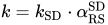
where αSD
RS is the conversion factor between the reactant state and saddle domain, while kSD is the rate constant from the saddle domain. The first can be simply calculated from the free energy surface, the latter is easily accessible from short molecular dynamics simulations [11]
See also
[edit]References
[edit]- ^ "Chemical Kinetics Notes". www.chem.arizona.edu. Archived from the original on 31 March 2012. Retrieved 5 May 2018.
- ^ Lowry, Thomas H. (1987). Mechanism and theory in organic chemistry. Richardson, Kathleen Schueller (3rd ed.). New York: Harper & Row. ISBN 978-0060440848. OCLC 14214254.
- ^ Moore, John W.; Pearson, Ralph G. (1981). Kinetics and Mechanism (3rd ed.). John Wiley. pp. 226–7. ISBN 978-0-471-03558-9.
- ^ The reactions of nitric oxide with the diatomic molecules Cl
2, Br
2 or O
2 (e.g., 2 NO + Cl
2 → 2 NOCl, etc.) have also been suggested as examples of termolecular elementary processes. However, other authors favor a two-step process, each of which is bimolecular: (NO + Cl
2 ⇄ NOCl
2, NOCl
2 + NO → 2 NOCl). See: Compton, R.G.; Bamford, C. H.; Tipper, C.F.H., eds. (2014) [1972]. "5. Reactions of the Oxides of Nitrogen §5.5 Reactions with Chlorine". Reactions of Non-metallic Inorganic Compounds. Comprehensive Chemical Kinetics. Vol. 6. Elsevier. p. 174. ISBN 978-0-08-086801-1. - ^ Sullivan, John H. (1967-01-01). "Mechanism of the Bimolecular Hydrogen—Iodine Reaction". The Journal of Chemical Physics. 46 (1): 73–78. Bibcode:1967JChPh..46...73S. doi:10.1063/1.1840433. ISSN 0021-9606.
- ^ Kotz, John C. (2009). Chemistry & chemical reactivity. Treichel, Paul., Townsend, John R. (7th ed.). Belmont, Calif.: Thomson Brooks/ Cole. p. 703. ISBN 9780495387039. OCLC 220756597.
- ^ Laidler, Keith J. (1987). Chemical Kinetics (3rd ed.). Harper & Row. p. 113. ISBN 0-06-043862-2.
- ^ Steinfeld, Jeffrey I.; Francisco, Joseph S.; Hase, William L. (1999). Chemical Kinetics and Dynamics (2nd ed.). Prentice Hall. p. 301. ISBN 0-13-737123-3.
- ^ Carpenter, Barry K. (1984). Determination of organic reaction mechanisms. New York: Wiley. ISBN 978-0471893691. OCLC 9894996.
- ^ Blauch, David. "Differential Rate Laws". Chemical Kinetics.
- ^ a b Daru, János; Stirling, András (2014). "Divided Saddle Theory: A New Idea for Rate Constant Calculation" (PDF). J. Chem. Theory Comput. 10 (3): 1121–1127. doi:10.1021/ct400970y. PMID 26580187.
- ^ Chandler, David (1978). "Statistical mechanics of isomerization dynamics in liquids and the transition state approximation". J. Chem. Phys. 68 (6): 2959–2970. Bibcode:1978JChPh..68.2959C. doi:10.1063/1.436049.
- ^ Bennett, C. H. (1977). Christofferson, R. (ed.). Algorithms for Chemical Computations, ACS Symposium Series No. 46. Washington, D.C.: American Chemical Society. ISBN 978-0-8412-0371-6.
- ^ West, Anthony M.A.; Elber, Ron; Shalloway, David (2007). "Extending molecular dynamics time scales with milestoning: Example of complex kinetics in a solvated peptide". The Journal of Chemical Physics. 126 (14): 145104. Bibcode:2007JChPh.126n5104W. doi:10.1063/1.2716389. PMID 17444753.
Reaction rate constant
View on GrokipediaFundamentals
Definition and Rate Laws
The reaction rate constant, denoted as , serves as the proportionality factor in the rate law of a chemical reaction, relating the reaction rate to the concentrations of the reactants raised to their respective orders.[7] The general form of the rate law is expressed as where , , etc., represent the reaction orders with respect to each reactant, and for elementary reactions, these orders equal the stoichiometric coefficients in the balanced equation.[8] This formulation arises from the law of mass action, which assumes that the rate is proportional to the product of reactant concentrations, each to the power of its stoichiometric coefficient in single-step processes.[9] The rate constant fundamentally quantifies the frequency of effective molecular interactions that result in product formation, encapsulating the probability of successful collisions between reactant molecules.[10] In collision theory, incorporates both the overall collision frequency factor—dependent on factors like molecular size and temperature—and the fraction of those collisions that possess sufficient energy and proper orientation to overcome the activation barrier.[10] Thus, provides a measure of how efficiently a reaction proceeds under given conditions, independent of reactant concentrations. In reversible reactions, distinct forward rate constants () and reverse rate constants () are defined to describe the opposing processes, with the equilibrium constant given by .[9] For example, in a simple unimolecular elementary reaction such as , the rate law simplifies to where the first-order dependence reflects the single-molecule decomposition process.[10] The value of is temperature-dependent, generally increasing with rising temperature to accelerate the reaction rate.[10]Elementary Reactions
Elementary reactions represent the fundamental building blocks of chemical reaction mechanisms, defined as single-step processes that occur without intermediates and involve a single transition state.[11] In these reactions, the rate law is directly determined by the molecularity, which is the number of reactant species participating in the step—typically one, two, or rarely three molecules.[11] Unimolecular reactions involve a single molecule decomposing or rearranging, such as the isomerization of cyclopropane to propene, with a rate law of the form rate = k [A].[11] Bimolecular reactions, the most common type, entail two species colliding, yielding rate = k [A][B] for distinct reactants or rate = 2k [A]^2 for identical ones, as seen in the reaction between nitric oxide and ozone: \ce{NO + O3 -> NO2 + O2}.[11] The rate constant k for an elementary step is mathematically expressed as k = rate / ∏ [reactant concentrations]^{stoichiometric coefficients}, ensuring the rate law matches the reaction's stoichiometry. Termolecular reactions, involving three species, follow rate = k [A][B][C] but are exceedingly rare due to the low probability of three particles colliding simultaneously with sufficient energy and proper orientation, as exemplified by the reaction 2NO + O₂ → 2NO₂ (rate = k [NO]^2 [O₂]).[11] Such events are improbable under typical conditions, as the collision frequency for three bodies is orders of magnitude lower than for two.[11] In bimolecular elementary reactions, such as A + B → products, the rate constant k encapsulates the collision frequency factor between A and B molecules and the orientation factor, which accounts for the fraction of collisions where the reactants are properly aligned to overcome the energy barrier. This perspective originates from collision theory, where the effective rate depends on both the number of encounters per unit time and the steric requirements for reaction.[12] Thus, k serves as a quantitative measure of the reaction's intrinsic speed for that specific elementary step, distinct from composite reactions that require mechanistic analysis.Theoretical Relationships
Activation Energy and Enthalpy
The activation energy, denoted as , represents the minimum energy barrier that reactant molecules must overcome to form the transition state, enabling the reaction to proceed. This energetic threshold arises from the need for reactants to achieve a specific configuration and sufficient kinetic energy during collisions, as described in collision theory and transition state theory. Without surmounting , collisions between molecules are ineffective, resulting in no net reaction progress.[13][14] The rate constant for a reaction is directly influenced by this energy barrier, exhibiting an exponential dependence such that , where is the gas constant and is the absolute temperature. This relationship highlights how higher temperatures provide more molecules with energy exceeding , thereby accelerating the reaction rate. In empirical observations, reactions with lower values proceed more readily at ambient conditions, underscoring the barrier's role in controlling kinetic behavior.[15] In advanced theoretical frameworks, such as transition state theory, the activation energy connects to thermodynamic quantities like the enthalpy of activation , which quantifies the enthalpic change to reach the transition state. For bimolecular reactions, this manifests approximately as , linking macroscopic kinetic parameters to microscopic enthalpy differences. This approximation accounts for the work associated with forming the activated complex in typical conditions.[16] Catalysts enhance reaction rates by providing an alternative pathway with a reduced activation energy , allowing more frequent successful collisions without being consumed in the process. Importantly, this lowering of the barrier affects both forward and reverse reactions equally, preserving the equilibrium constant and thus the position of chemical equilibrium. For instance, enzymes in biological systems exemplify this by dramatically increasing for specific reactions while maintaining thermodynamic balance.[17][18]Pre-exponential Factor
In the Arrhenius equation, , the pre-exponential factor (also known as the frequency factor) quantifies the rate of molecular collisions that possess the correct orientation for reaction, serving as the baseline rate before accounting for the energy barrier.[10] This factor arises from collision theory, where approximates the product of the collision frequency between reactant molecules and the probability that such collisions lead to a reactive encounter.[19] Specifically, , with depending on temperature and molecular sizes, while adjusts for non-ideal collision outcomes.[16] The primary factors influencing stem from molecular geometry and environmental conditions. The steric factor , which is typically much less than 1 (often ranging from to 0.1 for complex molecules), reflects the fraction of collisions with the precise orientation required for bond breaking and formation, reducing below the maximum collision rate.[19] In solution-phase kinetics, solvents further modulate by increasing viscosity, which lowers the diffusion-controlled collision frequency, and through solvation effects that alter reactant mobility or stabilize transition states, often resulting in values an order of magnitude smaller than in the gas phase.[20] These influences highlight 's role in capturing probabilistic aspects of reactivity beyond energetic thresholds. Empirically, is obtained from Arrhenius plots, where the natural logarithm of the rate constant is graphed against the inverse temperature ; the resulting linear fit has a y-intercept of and a slope of .[10] For gas-phase bimolecular reactions, typical values span to L mol s, reflecting variations in collision cross-sections and steric hindrances across different molecular systems.[16]Temperature Dependence
Arrhenius Equation
The Arrhenius equation provides the foundational empirical model for the temperature dependence of the reaction rate constant in chemical kinetics. Developed by Swedish chemist Svante Arrhenius in 1889, it emerged from his analysis of reaction rates in the acid-catalyzed inversion of cane sugar, where he observed that rates increase exponentially with temperature. Arrhenius built upon Jacobus Henricus van't Hoff's earlier investigations into the temperature effects on chemical equilibria, extending those principles to kinetic processes by interpreting the temperature sensitivity in terms of an energy barrier that molecules must overcome.[21][12] The equation is expressed as where is the rate constant, is the pre-exponential factor representing the frequency of successful collisions, is the activation energy (the minimum energy required for the reaction), is the universal gas constant, and is the absolute temperature in Kelvin. This exponential form arises from the Boltzmann distribution of molecular energies in a system at thermal equilibrium. The probability that a molecule has energy exceeding is proportional to the integral of the Boltzmann factor from to infinity, which approximates to for high activation barriers relative to thermal energy. Thus, the rate constant reflects the fraction of molecules energetic enough to surmount the barrier, multiplied by an attempt frequency captured in .[22] For experimental determination of parameters, the Arrhenius equation is rearranged into its linearized form: A plot of versus produces a straight line, with the slope equal to and the y-intercept equal to . This graphical method allows extraction of activation energies from measured rate constants at different temperatures, typically yielding reliable values for many reactions.[23] The model assumes a constant activation energy and temperature-independent pre-exponential factor, holding well over moderate temperature ranges (e.g., room temperature to a few hundred Kelvin) for simple reactions. At extreme temperatures, such as very low cryogenic conditions or high thermal environments, deviations arise due to changes in molecular partitioning or non-ideal behaviors, necessitating more sophisticated theoretical frameworks.[24]Transition State Theory
Transition state theory (TST) provides a fundamental statistical mechanical framework for deriving reaction rate constants from the molecular properties of reactants and the transition state. The core concept is that a bimolecular reaction proceeds through the formation of an activated complex, a transient high-energy species at the saddle point of the potential energy surface (PES), which maps the potential energy as a function of nuclear coordinates. This saddle point is a first-order stationary point on the PES, characterized by a single imaginary vibrational frequency along the reaction coordinate, distinguishing it from minima (reactants or products) that have all real frequencies. The activated complex exists in a shallow potential well perpendicular to the reaction path but is unstable along the path to products. The theory was developed independently in 1935 by Henry Eyring at Princeton University and by Meredith Gwynne Evans and Michael Polanyi in Manchester. Eyring's formulation emphasized the statistical mechanics of the activated complex, while Evans and Polanyi focused on potential energy surfaces derived from valence bond theory. This approach shifted reaction kinetics from empirical models to a microscopic understanding based on quantum and statistical principles. Within TST, the rate constant for a reaction is given by the Eyring equation: where is the transmission coefficient (approximated as 1 in classical TST), is Boltzmann's constant, is the absolute temperature, is Planck's constant, is the gas constant, is the standard molar activation entropy, and is the standard molar activation enthalpy. This equation expresses the rate constant in terms of thermodynamic activation parameters, with the exponential terms capturing the entropic and enthalpic contributions to the free energy barrier . The derivation begins with the postulate of a quasi-equilibrium between the reactants and the activated complex, justified when the lifetime of the complex is short compared to the reaction timescale and the activation energy exceeds several . The equilibrium constant for activated complex formation is computed using partition functions: , where denotes molecular partition functions (with the transition state partition function treating the reaction coordinate as a translation rather than vibration), is the zero-point energy difference, and standard-state corrections apply for concentrations. The forward rate is then the equilibrium concentration of the complex times the unimolecular decomposition frequency across the dividing surface at the saddle point, yielding ; the transmission coefficient assumes all complexes crossing the surface react without return. A key limitation of classical TST is its assumption of no recrossing, meaning trajectories reaching the canonical dividing surface at the saddle point proceed irreversibly to products, which overestimates rates for reactions with variational effects or corner-cutting dynamics. This is improved in variational transition state theory (VTST), which locates an optimal dividing surface along the reaction path to minimize the flux and thus recrossing, often yielding rate constants accurate to within 10-20% for gas-phase reactions when combined with accurate PES. The Eyring parameters provide a theoretical underpinning for Arrhenius behavior, where the activation energy approximates and the pre-exponential factor incorporates .Comparison of Models
The empirical Arrhenius model, introduced by Svante Arrhenius in 1889, provides a foundational description of temperature dependence through the equation , where is the pre-exponential factor and is the activation energy.[25] This model excels in simplicity and is widely used for fitting experimental data across a range of temperatures, but it lacks a theoretical basis for the pre-exponential factor and does not incorporate entropic contributions. Transition state theory (TST), developed by Henry Eyring in 1935, advances beyond the empirical approach by grounding rate constants in statistical mechanics and the concept of a transition state, incorporating both enthalpic and entropic effects via the Eyring equation (detailed in the Transition State Theory section).[25] TST offers greater predictive power for computational simulations and mechanistic insights, particularly for complex reactions, though it assumes equilibrium at the transition state, which may not hold under non-equilibrium conditions. The Polanyi-Semenov relation, formulated in the 1930s by Michael Polanyi and Nikolai Semenov, specifically addresses gas-phase atom-transfer reactions by linking activation energy to the reaction enthalpy through a linear form , where (typically 0.25–0.5 for exothermic processes) reflects bond energy differences.[26] This model is particularly useful for estimating rates in radical or combustion reactions without full quantum calculations, but it is limited to series of related exothermic gas-phase processes and overlooks steric or solvent effects.[27] Historically, reaction rate modeling evolved from Arrhenius's empirical law, which fit observed exponential temperature dependence, to collision theory in the early 20th century, and then to TST in the 1930s, which integrated quantum mechanics for a more unified framework.[25] Modern extensions incorporate quantum effects, leading to variational and quantum TST formulations that refine predictions for barrier crossing.[28]| Model | Basis | Strengths | Limitations | Applications |
|---|---|---|---|---|
| Arrhenius | Empirical, exponential fit | Simple; excellent for data fitting over moderate temperatures | No theoretical explanation for or entropy; ignores quantum effects | Experimental rate constant analysis in solution or gas phase |
| TST | Theoretical, statistical mechanics | Includes entropy and thermodynamics; predictive for mechanisms | Assumes transition state equilibrium; less accurate at extremes without corrections | Computational predictions for organic and biochemical reactions |
| Polanyi-Semenov | Semi-empirical, bond energies | Rapid estimation using enthalpy; suited for related reaction series | Limited to gas-phase exothermic processes; parameter varies | Radical reactions in combustion or atmospheric chemistry[26] |