


Community hub
Recent from talks
Contribute something
Nothing was collected or created yet.
Brownian noise
View on Wikipedia

| Colors of noise |
|---|
In science, Brownian noise, also known as Brown noise or red noise, is the type of signal noise produced by Brownian motion, hence its alternative name of random walk noise. The term "Brown noise" does not come from the color, but after Robert Brown, who documented the erratic motion for multiple types of inanimate particles in water. The term "red noise" comes from the "white noise"/"white light" analogy; red noise is strong in longer wavelengths, similar to the red end of the visible spectrum.
Explanation
[edit]The graphic representation of the sound signal mimics a Brownian pattern. Its spectral density is inversely proportional to f 2, meaning it has higher intensity at lower frequencies, even more so than pink noise. It decreases in intensity by 6 dB per octave (20 dB per decade) and, when heard, has a "damped" or "soft" quality compared to white and pink noise. The sound is a low roar resembling a waterfall or heavy rainfall. See also violet noise, which is a 6 dB increase per octave.
Strictly, Brownian motion has a Gaussian probability distribution, but "red noise" could apply to any signal with the 1/f 2 frequency spectrum.
Power spectrum
[edit]
A Brownian motion, also known as a Wiener process, is obtained as the integral of a white noise signal: meaning that Brownian motion is the integral of the white noise , whose power spectral density is flat:[1]
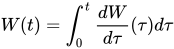

\right|^{2}={\text{const}}.}](https://wikimedia.org/api/rest_v1/media/math/render/svg/8cfb1e60b2ae793d22ac3ef724f690f6d16cc118)
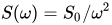
Note that here denotes the Fourier transform, and is a constant. An important property of this transform is that the derivative of any distribution transforms as[2] from which we can conclude that the power spectrum of Brownian noise is


=i\omega {\mathcal {F}}[t\mapsto W(t)](\omega ),}](https://wikimedia.org/api/rest_v1/media/math/render/svg/780f5088f484ece6444214f0efc29b7da942741e)
{\big |}^{2}={\frac {S_{0}}{\omega ^{2}}}.}](https://wikimedia.org/api/rest_v1/media/math/render/svg/fb58022d8c8f4c4566c150add60dea3e70164efc)
An individual Brownian motion trajectory presents a spectrum , where the amplitude is a random variable, even in the limit of an infinitely long trajectory.[3]
Production
[edit]

Brown noise can be produced by integrating white noise.[4][5] That is, whereas (digital) white noise can be produced by randomly choosing each sample independently, Brown noise can be produced by adding a random offset to each sample to obtain the next one. As Brownian noise contains infinite spectral power at low frequencies, the signal tends to drift away infinitely from the origin. A leaky integrator might be used in audio or electromagnetic applications to ensure the signal does not “wander off”, that is, exceed the limits of the system's dynamic range. This turns the Brownian noise into Ornstein–Uhlenbeck noise, which has a flat spectrum at lower frequencies, and only becomes “red” above the chosen cutoff frequency.
Brownian noise can also be computer-generated by first generating a white noise signal, Fourier-transforming it, then dividing the amplitudes of the different frequency components by the frequency (in one dimension), or by the frequency squared (in two dimensions) etc.[6] Matlab programs are available to generate Brownian and other power-law coloured noise in one[7] or any number[8] of dimensions.
Experimental evidence
[edit]Evidence of Brownian noise, or more accurately, of Brownian processes has been found in different fields including chemistry,[9] electromagnetism,[10] fluid-dynamics,[11] economics,[12] and human neuromotor control.[13]
Human neuromotor control
[edit]In human neuromotor control, Brownian processes were recognized as a biomarker of human natural drift in both postural tasks—such as quietly standing or holding an object in your hand—as well as dynamic tasks. The work by Tessari et al. highlighted how these Brownian processes in humans might provide the first behavioral support to the neuroscientific hypothesis that humans encode motion in terms of descending neural velocity commands.[13]
Notes
[edit]References
[edit]- ^ Gardiner, C. W. Handbook of stochastic methods. Berlin: Springer Verlag.
- ^ Barnes, J. A. & Allan, D. W. (1966). "A statistical model of flicker noise". Proceedings of the IEEE. 54 (2): 176–178. doi:10.1109/proc.1966.4630. S2CID 61567385. and references therein
- ^ Krapf, Diego; Marinari, Enzo; Metzler, Ralf; Oshanin, Gleb; Xu, Xinran; Squarcini, Alessio (2018-02-09). "Power spectral density of a single Brownian trajectory: what one can and cannot learn from it". New Journal of Physics. 20 (2): 023029. arXiv:1801.02986. Bibcode:2018NJPh...20b3029K. doi:10.1088/1367-2630/aaa67c.
- ^ "Integral of White noise". 2005. Archived from the original on 2012-02-26. Retrieved 2010-04-30.
- ^ Bourke, Paul (October 1998). "Generating noise with different power spectra laws".
- ^ Das, Abhranil (2022). Camouflage detection & signal discrimination: theory, methods & experiments (corrected) (PhD). The University of Texas at Austin. doi:10.13140/RG.2.2.32016.07683.
- ^ Zhivomirov, Hristo (1 August 2013). "Pink, Red, Blue and Violet Noise Generation with Matlab". MathWorks. Retrieved 9 November 2024.
- ^ Das, Abhranil (23 November 2022). "Colored Noise". MathWorks. Retrieved 9 November 2024.
- ^ Kramers, H.A. (1940). "Brownian motion in a field of force and the diffusion model of chemical reactions". Physica. 7 (4): 284–304. doi:10.1016/S0031-8914(40)90098-2. ISSN 0031-8914.
- ^ Kurşunoǧlu, Behram (1962). "Brownian motion in a magnetic field". Annals of Physics. 17 (2): 259–268. doi:10.1016/0003-4916(62)90027-1. ISSN 0003-4916.
- ^ Hauge, E.H.; Martin-Löf, A. (1973). "Fluctuating hydrodynamics and Brownian motion". Journal of Statistical Physics. 7: 259–281. doi:10.1007/BF01030307.
- ^ Osborne, M.F.M. (1959). "Brownian Motion in the Stock Market". Operations Research. 7 (2): 145–173. doi:10.1287/opre.7.2.145.
- ^ a b Tessari, F.; Hermus, J.; Sugimoto-Dimitrova, R. (2024). "Brownian processes in human motor control support descending neural velocity commands". Scientific Reports. 14: 8341. doi:10.1038/s41598-024-58380-5. PMC 11004188.
Brownian noise
View on GrokipediaDefinition and Fundamentals
Core Definition
Brownian noise, also referred to as brown noise or red noise—a term deriving from the analogy to light spectra, where red noise emphasizes lower frequencies similar to the longer wavelengths at the red end of the visible spectrum, akin to white noise's flat spectrum resembling white light—is a stochastic process in which the signal's amplitude undergoes a random walk, characterized by continuous sample paths that are nowhere differentiable almost surely.[7] This results in a signal that accumulates random deviations over time without any inherent directionality or bounded variance in short intervals. Brownian noise represents the integral of white noise, with each increment adding to the previous state in a cumulative manner. This integration leads to a power spectral density that decays as 1/f², emphasizing low-frequency components over the flat spectrum of white noise. Brownian noise is distinguished from other noise types by its power spectral density. White noise exhibits a flat spectrum across all frequencies, pink noise has a spectrum decaying as 1/f, whereas Brownian noise decays as 1/f², resulting in a greater emphasis on lower frequencies.[2] Unlike deterministic signals, which evolve according to fixed equations and exhibit repeatable patterns, Brownian noise is inherently random and unpredictable, with independent increments that preclude any long-term forecasting or periodic structure.Historical Context
The concept of Brownian noise traces its origins to the observation of erratic particle motion by Scottish botanist Robert Brown in 1827, who noted the irregular jiggling of pollen grains suspended in water under a microscope, a phenomenon that persisted regardless of the particle type or environmental conditions.[8] This discovery, initially puzzling and attributed to various causes like capillary action, remained unexplained until Albert Einstein provided a theoretical framework in 1905, interpreting the motion as the result of incessant bombardment by surrounding fluid molecules, thereby linking it to the kinetic theory of matter and offering indirect evidence for the existence of atoms.[9] Einstein's explanation was experimentally validated by French physicist Jean Perrin starting in 1908, through meticulous measurements of particle displacements that matched the predicted diffusion behavior, confirming the molecular basis of the motion and quantifying atomic properties like Avogadro's number.[10] Perrin's work, detailed in his 1909 publications and later expanded in his 1913 book Les Atomes, resolved longstanding debates about atomic reality and earned him the 1926 Nobel Prize in Physics for demonstrating the discontinuous structure of matter.[11] The evolution from physical observation to formal noise theory began in the 1920s with American mathematician Norbert Wiener, who rigorously defined Brownian motion as a continuous Gaussian stochastic process in his seminal 1923 paper "Differential Space," providing the mathematical foundation for modeling random fluctuations in physical systems. The term "brown noise" derives from this connection to Brownian motion observed by Robert Brown.Mathematical Properties
Power Spectral Density
The power spectral density (PSD) of Brownian noise, which characterizes the random walk-like fluctuations in the position of a particle undergoing Brownian motion, is given by for frequencies , where is a positive constant and denotes the frequency in Hz. This single-sided PSD formulation applies to positive frequencies. The constant is directly related to the variance of the underlying white noise driving the process, ensuring the PSD units are consistent with power (e.g., variance) per unit frequency, such as for displacement noise.[12] This form derives from the fact that Brownian noise represents the time integral of white noise, a stationary process with constant (flat) PSD , where is the noise variance. In the frequency domain, integration corresponds to multiplication by , so the transfer function magnitude squared yields . Thus, the PSD of the integrated process becomes , establishing the scaling after normalizing the constant.[13] This relationship highlights Brownian noise as a non-stationary process with stationary increments, allowing a well-defined PSD via the Wiener-Khinchin theorem applied to its covariance structure.[4] A key property of this PSD is the divergence as , resulting in theoretically infinite total energy unless the signal is band-limited.Statistical Characteristics
Brownian noise is mathematically modeled as a standard Wiener process , a continuous-time stochastic process with zero mean, , and variance that increases linearly with time, .[14] The process features independent increments, where for , the increment is normally distributed as and independent of the history up to time .[14] These increments are Gaussian, which implies that the finite-dimensional distributions of the process are multivariate Gaussian, resulting in Gaussian marginal distributions at each fixed time .[14] The autocorrelation function (or covariance function, since the mean is zero) for the non-stationary Wiener process is , capturing the cumulative dependence from shared initial segments of the path.[15] For the stationary approximation applied to increments, the process over fixed small intervals exhibits white noise characteristics with zero autocorrelation for non-overlapping intervals.[15] Unlike white noise, which is stationary with constant variance, the Wiener process is inherently non-stationary due to its time-dependent variance, leading to unbounded growth in spread over long times and rendering the process non-ergodic.[14][16]Generation Methods
Brownian noise can be produced or approximated through synthetic and natural methods, with a focus on replicating its characteristic 1/f² power spectral density via principles such as integration of white noise or thermal fluctuations.Synthetic Production
Synthetic production of Brownian noise involves algorithmic and hardware-based methods to replicate its characteristic 1/f² power spectral density. The most straightforward algorithmic approach is to compute the cumulative sum of independent white Gaussian noise samples, yielding a discrete-time realization of Brownian motion. Specifically, the sequence is generated via the recurrence X{{grok:render&&&type=render_inline_citation&&&citation_id=0&&&citation_type=wikipedia}} = 0 and for , where are i.i.d. Gaussian random variables with mean zero and variance . This method ensures the increments are Gaussian while the process exhibits the integrated random walk behavior central to Brownian noise.[17][18][19] In digital implementations, this cumulative summation is efficiently realized using built-in functions in scientific computing libraries. For instance, in Python with NumPy, the codenp.cumsum(np.random.randn(N)) produces a sequence of length scaled to unit variance increments, which can be adjusted by multiplying by . Similarly, MATLAB's cumsum(randn(N,1)) achieves the same result. These software methods are computationally inexpensive and allow for high-fidelity generation over arbitrary lengths, provided the sampling rate is sufficiently high to capture the desired frequency range.[20][21]
Analog synthesis mimics the integration of thermal noise using operational amplifier circuits, where white noise from a diode or zener breakdown is passed through an integrator or multiple low-pass stages to approximate the 1/f² roll-off. A practical circuit employs a reverse-biased transistor or avalanche diode for white noise generation, followed by an op-amp integrator with feedback to produce the cumulative effect, ensuring stability through component selection like a 1 kΩ resistor and 1 μF capacitor. Alternatively, frequency-domain filtering applies a 1/f² weighting to the Fourier transform of white noise before inverse transformation; this involves generating complex Gaussian noise, multiplying magnitudes by (with phase preservation), and performing the inverse FFT.[22][23]
Practical considerations include band-limiting to mitigate low-frequency divergence, as the unbounded variance growth () can lead to numerical instability; a high-pass filter at 20 Hz or windowing techniques confines the spectrum to relevant bands. Scaling for target variance involves multiplying the increments by , where is the time step, to match continuous-time properties.