Hubbry Logo
Remote terminal unitRemote terminal unitMain
Open search
Remote terminal unit
Community hub
Remote terminal unit
logo
8 pages, 0 posts
0 subscribers
Be the first to start a discussion here.
Remote terminal unit
from Wikipedia

A remote terminal unit (RTU) is a microprocessor-controlled electronic device that interfaces objects in the physical world to a distributed control system or SCADA (supervisory control and data acquisition) system by transmitting telemetry data to a master system, and by using messages from the master supervisory system to control connected objects.[1] Other terms that may be used for RTU are remote telemetry unit and remote telecontrol unit.

Architecture

[edit]

An RTU monitors the field digital and analog parameters and transmits data to a SCADA Master Station. It runs setup software to connect data input streams to data output streams, define communication protocols, and troubleshoot installation problems in the field.

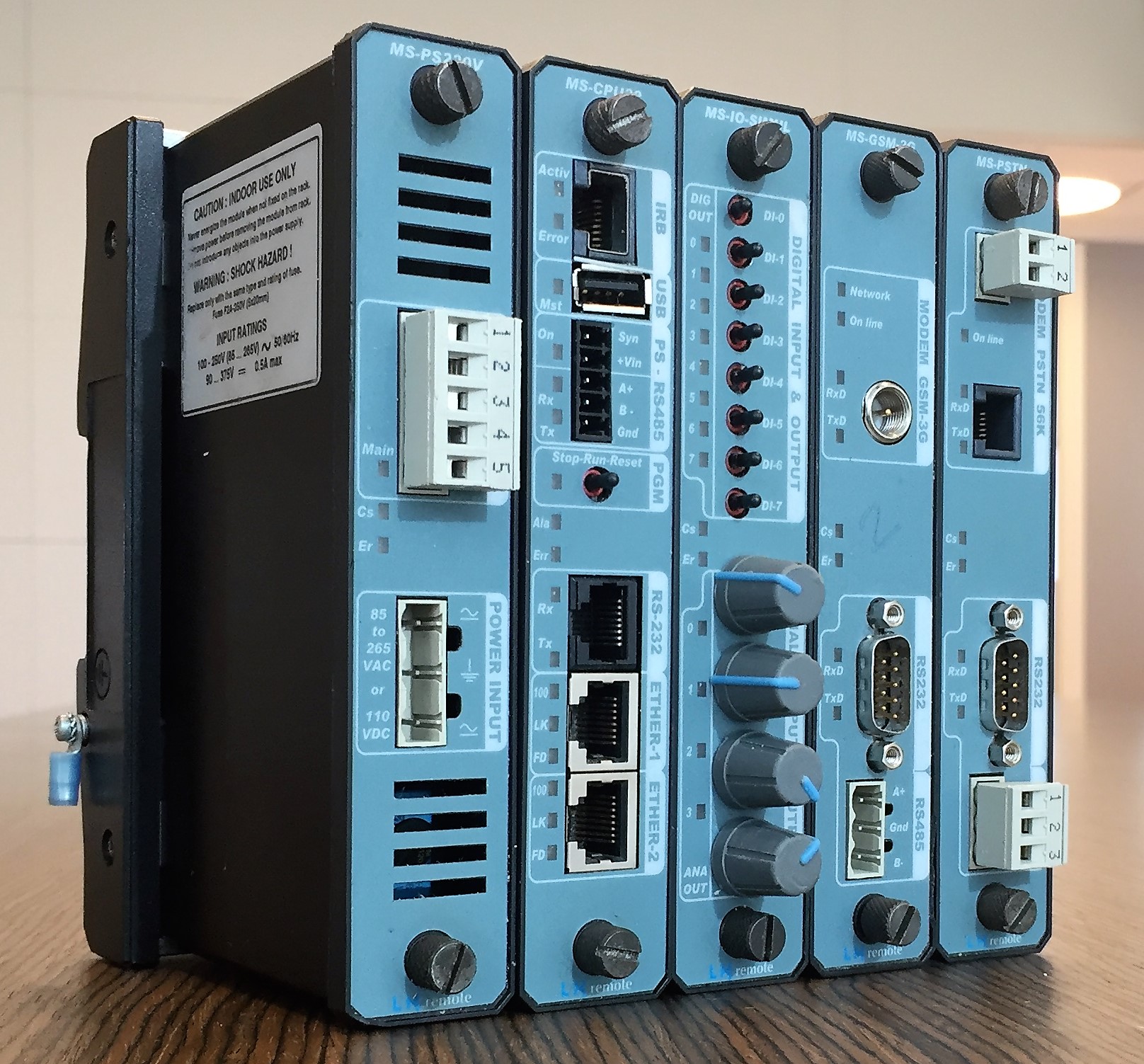
An RTU may consist of one complex circuit card consisting of various sections needed to do a custom-fitted function, or may consist of many circuit cards including a CPU or processing with communications interface(s), and one or more of the following: (AI) analog input, (DI) digital (status) input, (DO/CO) digital (or control relay) output, or (AO) analog output card(s).

An RTU might even be a small process control unit with a small database for PID, Alarming, Filtering, Trending and other functions complemented with some BASIC (programming language) tasks. Modern RTUs typically support the IEC 61131-3 programming standard for programmable logic controllers. Since RTUs may be routinely deployed in pipeline and grid guarding systems, or in other hard-to-reach or extreme environments (for example in the Biosphere 2 project), they are required to operate under harsh conditions, and implement energy-saving measures (such as switching off IO modules when not in use). For example, it communicates via RS485 or wireless communication links in a multi-drop configuration. In this type of configuration it is a remote unit that collects data and performs simple control tasks. It does not have moving parts and uses extremely low power and is often solar powered.

Power supply

[edit]

A form of power supply will be included for operation from the AC mains for various CPU, status wetting voltages and other interface cards. This may consist of AC to DC converters where operated from a station battery system.

RTUs may include a battery and charger circuitry to continue operation in event of AC power failure for critical applications where a station battery is not available.

Digital (status) inputs

[edit]

Most RTUs have a section called input status cards to read ON/OFF information from the field. They do this by checking if a contact (like a switch) is open or closed at the RTU location. This contact could belong to different devices, like:

  • Electrical breakers (open or closed)
  • Valves (open or closed)
  • Alarms (active or not)
  • Machines (in position or not)

Some RTUs can also count events (like how many times a contact opens/closes), but this is optional.

Analog inputs

[edit]

An RTU can monitor analog inputs of different types including 0-1 mA, 4–20 mA current loop, 0–10 V., ±2.5 V, ±5.0 V etc. Many RTU inputs buffer larger quantities via transducers to convert and isolate real-world quantities from sensitive RTU input levels. An RTU can also receive analog data via a communication system from a master or intelligent electronic device (IED) sending data values to it.

The RTU or host system translates and scales this raw data into the appropriate units such as the quantity of water left, temperature degrees, or Megawatts, before presenting the data to the user via the human–machine interface.

Digital (control relay) outputs

[edit]

RTUs may drive high current capacity relays to a digital output (or "DO") board to switch power on and off to devices in the field. The DO board switches voltage to the coil in the relay, which closes the high current contacts, which completes the power circuit to the device.

RTU outputs may also consist of driving a sensitive logic input on an electronic PLC, or other electronic device using a sensitive 5 V input.

Analog outputs

[edit]

While not as commonly used, analog outputs may be included to control devices that require varying quantities, such as graphic recording instruments (strip charts). Summed or processed data quantities may be generated in a master SCADA system and output for display locally or remotely, wherever needed.

Software and logic control

[edit]

Modern RTUs are usually capable of executing simple programs autonomously without involving the host computers of the DCS or SCADA system to simplify deployment and to provide redundancy for safety reasons. An RTU in a modern water management system will typically have code to modify its behavior when physical override switches on the RTU are toggled during maintenance-by-maintenance personnel. This is done for safety reasons; a miscommunication between the system operators and the maintenance personnel could cause system operators to mistakenly enable power to a water pump when it is being replaced, for example.

Maintenance personnel should have any equipment they are working on disconnected from power and locked to prevent damage and/or injury.

Communications

[edit]

An RTU may be interfaced to multiple master stations and IEDs with different communication protocols (usually serial (RS-232, RS-485, RS-422) or Ethernet). An RTU may support standard protocols (Modbus, IEC 60870-5-101/103/104, DNP3, IEC 60870-6-ICCP, IEC 61850 etc.) to interface any third-party software.

Data transfer may be initiated from either end using various techniques to ensure synchronization with minimal data traffic. The master may poll its subordinate unit (Master to RTU or RTU to IED) for changes of data on a periodic basis. Analog value changes will usually be reported only on changes outside a set limit from the last transmitted value. Digital (status) values observe a similar technique and only transmit groups (bytes) when one included point (bit) changes. Another method used is where a subordinate unit initiates an update of data upon a predetermined change in analog or digital data. Complete data transmission must be performed periodically, with either method, to ensure full synchronization and eliminate stale data. Most communication protocols support both methods, programmable by the installer.

Multiple RTUs or IEDs may share a communications line, in a multi-drop scheme, as units are addressed uniquely and only respond to their own polls and commands.

IED communications

[edit]

IED communications transfer data between the RTU and an IED. This can eliminate the need for many hardware status inputs, analog inputs, and relay outputs in the RTU. Communications are accomplished by copper or fibre optics lines.

Master communications

[edit]

Master communications usually occur between an RTU and a larger control system or a data collection system (incorporated into a larger system). Data may be moved using a copper, fibre optic or radio frequency communication system.

Applications

[edit]
  • Remote monitoring of functions and instrumentation for:
    • Oil and gas (offshore platforms, onshore oil wells, pumpstations on pipelines)
    • Networks of pump stations (wastewater collection, or for water supply)
    • Environmental monitoring systems (pollution, air quality, emissions monitoring)
    • Mine sites
    • Air traffic equipment such as navigation aids (DVOR, DME, ILS and GP)
  • Remote monitoring and control of functions and instrumentation for:
    • Hydro-graphic (water supply, reservoirs, sewage systems)
    • Electrical power transmission networks and associated equipment
    • Natural gas networks and associated equipment
    • Outdoor warning sirens
    • The Biosphere II project

See also

[edit]

References

[edit]
[edit]
Revisions and contributorsEdit on WikipediaRead on Wikipedia
from Grokipedia
A remote terminal unit (RTU) is a microprocessor-controlled electronic device that serves as an interface between field sensors, actuators, and other physical equipment in industrial environments and a central supervisory control and data acquisition (SCADA) or distributed control system (DCS), by collecting, processing, and transmitting telemetry data via wired or wireless communication protocols. Designed for rugged operation in remote or harsh conditions—such as extreme temperatures, humidity, or chemical exposure—RTUs feature modular input/output (I/O) modules, onboard processing capabilities, memory for data logging, and often backup power sources like batteries or solar panels to ensure continuous functionality. Unlike programmable logic controllers (PLCs), which are typically used for local, real-time control in factory settings, RTUs emphasize wide-area data transmission and are preconfigured for specific telemetry tasks without on-site programming interfaces. The origins of RTUs trace back to the 1960s, building on early systems that began in the 1950s in power generation facilities, where they replaced manual relay-based monitoring with automated digital telemetry over telephone lines or radio links. By the 1970s and 1980s, advancements in microprocessors enabled more compact and versatile RTUs, integrating and standardized protocols like for interoperability in expanding industrial networks. In contemporary systems, RTUs support modern enhancements such as (IP) connectivity, for local decision-making, and cybersecurity features like and intrusion detection to address vulnerabilities in . RTUs are essential in sectors requiring remote oversight of dispersed assets, including oil and gas for integrity monitoring and control, electric power utilities for substation automation, grid stability, and installations such as solar and farms, and for pump station regulation and quality sensing, and transportation infrastructure for rail signaling and . Their scalability allows integration with thousands of field points, facilitating real-time alarming, historical , and automated responses to maintain operational efficiency and safety across vast geographic areas.

Overview

Definition and Purpose

A Remote Terminal Unit (RTU) is a microprocessor-controlled electronic device that interfaces with physical processes in industrial settings to acquire data from sensors and transmit control signals to actuators, often deployed in remote or harsh environments. RTUs serve as ruggedized intermediaries between field equipment and centralized systems, enabling reliable operation where direct human access is limited or impractical. The primary purposes of an RTU include remote monitoring of field devices to track operational parameters, executing automated control actions based on predefined logic or thresholds, and relaying collected data to supervisory systems such as for centralized oversight and decision-making. By aggregating inputs from multiple sensors and applying local processing, RTUs facilitate efficient and reduce the need for on-site interventions. Key characteristics of RTUs emphasize durability and flexibility, featuring rugged designs capable of withstanding extreme conditions such as operating temperatures from -40°C to 85°C and resistance to vibrations in accordance with industrial standards. They incorporate modular (I/O) configurations to adapt to diverse field requirements and support real-time operation for timely data processing and response. For instance, in oil pipeline deployments, RTUs monitor pressure levels along extended networks to detect anomalies like leaks or fluctuations, enabling automated alerts and adjustments without requiring constant human presence at remote sites. This application highlights the RTU's role in ensuring safety and efficiency in .

Historical Development

The origins of remote terminal units (RTUs) trace back to the mid-20th century, evolving from early systems used in the sector to enable remote monitoring of . In the 1950s, initial supervisory control and (SCADA) systems in power generation plants incorporated basic for data transmission over lines, laying the groundwork for RTUs as interfaces between field devices and central control rooms. Early commercial RTUs were introduced in the , including analog-based units developed by companies such as & Northrup for power grid monitoring, allowing to track voltage, current, and breaker status from distant locations. These early devices marked a shift from manual inspections to automated remote oversight, primarily driven by the need for efficient management of expanding electrical networks. The 1970s brought significant advancements with the adoption of technology, transforming RTUs from simple relay-based systems to more intelligent units capable of local processing and logic execution. Rugged suitable for harsh substation environments became available in the mid-1970s, enabling RTUs to perform tasks like concentration and basic control without relying solely on a central master station. This era's innovations reduced RTU size, improved reliability, and lowered costs, making widespread deployment feasible. By the 1980s, RTUs were increasingly integrated into comprehensive architectures, supporting networked communications and standardized interfaces that enhanced interoperability across utility systems. Standardization efforts in the further propelled RTU evolution, with the development of protocols like the , first specified in by GE Harris Controls (formerly Westronic). addressed the limitations of proprietary protocols by providing a robust, for reliable data exchange in utility environments, facilitating better integration of RTUs in networks. Key drivers of this progression included rapid advancements, which continued to shrink components and cut expenses, alongside energy sector in the that heightened demands for cost-effective remote monitoring to optimize operations amid competitive markets. In the post-2000 period, events such as the , 2003, Northeast blackout—which affected over 50 million people and underscored vulnerabilities in grid reliability—accelerated RTU adoption in initiatives, emphasizing enhanced and automated responses.

Architecture

Power Supply and Environmental Considerations

Remote terminal units (RTUs) typically operate on (DC) power supplies ranging from 24 V to 48 V, often sourced from batteries or solar panels in remote locations, or (AC) supplies of 110 V to 240 V for grid-connected installations. Uninterruptible power supplies (UPS) are integrated using sealed lead-acid batteries to provide backup during outages, ensuring continuous operation in power-unstable environments. Redundancy features, such as inputs and automatic transfer switches, mitigate single-point failures by seamlessly switching between primary and sources without interrupting RTU functionality. These systems often include hot-swappable power modules for maintenance in field conditions. Typical power consumption varies from 5 to 50 , scaling with the number of (I/O) points and active modules, with continuous operation rated up to 60 in modular designs. For remote sites without grid access, solar-powered RTUs employ photovoltaic panels with efficiencies of approximately 20% to 25%, paired with battery storage to deliver reliable power. These variants support up to 3 days of autonomy without sunlight, using panels rated around 43 W to charge 18 Ah batteries. Environmental adaptations ensure RTU reliability in harsh field conditions, with enclosures meeting IP65 or NEMA 4X ratings for dust-tight and water-resistant protection against ingress. Operating temperatures range from -40°C to +70°C, accommodating extreme industrial settings with humidity up to 95% non-condensing. (EMI) and radio-frequency interference (RFI) shielding complies with IEC 61850-3 standards, providing immunity to substation-level disturbances.

Input Interfaces

Remote terminal units (RTUs) acquire data from field sensors primarily through digital and analog input interfaces, enabling the monitoring of binary states and continuous variables in industrial environments. Digital inputs capture binary status signals, such as those from open/closed switches or contacts, typically using opto-isolators to provide electrical isolation between the field device and the RTU's internal circuitry. These opto-isolators support a wide range of voltages, commonly 24-250 V DC or AC, ensuring compatibility with diverse field signaling standards. To mitigate noise from mechanical bounce or electrical transients, digital inputs incorporate debounce filters, which ignore short-duration signal fluctuations and ensure stable readings. Analog inputs, in contrast, process continuous signals from sensors, such as 4-20 mA current loops or 0-10 voltage signals, which are converted to digital values using analog-to-digital converters (ADCs) with 12-16 bit resolution for sufficient precision in applications. The raw ADC output is then scaled to engineering units via formulas like: \text{measured value} = \left( \frac{\text{raw ADC} \times \text{span}}{\text{[full scale](/page/Full_scale)}} \right) + \text{offset} where span represents the desired measurement range and is the ADC's maximum value (e.g., 4095 for 12 bits). Both digital and analog inputs feature up to 1500 V to prevent ground loops and protect against common-mode voltages, alongside surge protection compliant with standards for handling transient overvoltages from lightning or switching. Modern RTUs support up to 100 or more input channels through modular expansions, allowing integration of multiple sensors such as type K thermocouples (operating in the -200°C to 1350°C range) and resistance temperature detectors (RTDs), which provide accurate monitoring in harsh conditions. Local processing of these input data may occur before transmission, as detailed in the Processing and Control Logic section.

Output Interfaces

Remote terminal units (RTUs) employ digital output interfaces primarily for on/off control of field devices, utilizing relay contacts to switch electrical circuits. These relays are typically Form C (single-pole double-throw, SPDT) configurations, capable of handling loads from 5 to 10 A at 250 V AC or DC, enabling direct control of solenoids, lights, or small motors. For higher-power applications, such as operating large pumps or valves, interposing relays are integrated to amplify the RTU's output signal, isolating the RTU from high currents or voltages while ensuring reliable actuation. Additionally, pulse outputs serve metering functions, generating discrete pulses proportional to measured quantities; for instance, in electricity meters to signal energy accumulation (e.g., one pulse per Wh). Analog output interfaces in RTUs provide variable control signals to actuators like valves or variable-frequency drives, commonly using 4-20 mA current loops or 0-10 voltage signals for compatibility with industrial transducers. These outputs are driven by 12-bit digital-to-analog converters (DACs), offering a resolution of approximately 0.024% of , with typical errors below 0.1% to maintain precise positioning. Safety features are integral to RTU output interfaces to prevent hazardous failures, including watchdog timers that monitor system health and default outputs to a predefined safe state—such as de-energizing relays—upon detecting faults like communication loss or processor hangs. Many RTUs comply with Safety Integrity Levels (SIL) 2 or 3 under , ensuring probabilistic failure rates on demand between 10^{-3} and 10^{-2} for high-risk processes in oil, gas, and power sectors. Specific operational capabilities include output latching, where states are held until explicitly reset, facilitating event sequencing such as staged startups to avoid surges. In applications, (PWM) via digital outputs modulates speed by varying the , calculated as \text{[duty cycle](/page/Duty_cycle)} = \left( \frac{\text{desired speed}}{\text{max speed}} \right) \times 100\%, allowing efficient variable-speed operation without dedicated analog hardware.

Processing and Control Logic

The processing and control logic in a remote terminal unit (RTU) relies on robust onboard hardware to enable local decision-making and autonomous operations in industrial environments. Modern RTUs typically employ 32- or 64-bit microprocessors, such as or similar architectures, operating at speeds up to 500 MHz or higher to handle processing and control tasks. These systems are supported by substantial memory resources, including at least 512 MB of RAM for runtime operations and flash storage capacities ranging from 16 MB to several gigabytes for storage, configuration files, and event logging, ensuring reliable performance without constant reliance on external systems. At the software level, RTUs run embedded real-time operating systems (RTOS) designed for deterministic execution, such as or real-time variants of , which provide multitasking capabilities and low-latency responses critical for time-sensitive applications. Control programs are developed using standardized languages compliant with , including for relay-style sequencing and function block diagrams for modular logic, allowing engineers to implement custom algorithms directly on the device. This programming flexibility supports local autonomy, such as adjusting outputs based on inputs without master station intervention. Key logic functions include sequence of events (SOE) recording, which timestamps input changes with 1 ms resolution to capture precise chronologies of incidents like faults or alarms, aiding in root-cause analysis. RTUs also execute control algorithms like proportional-integral-derivative (PID) controllers for maintaining local process variables in closed loops, following the standard formulation: u(t)=Kpe(t)+Ki0te(τ)dτ+Kdde(t)dtu(t) = K_p e(t) + K_i \int_0^t e(\tau) \, d\tau + K_d \frac{de(t)}{dt} where u(t)u(t) is the control output, e(t)e(t) is the (setpoint minus ), and KpK_p, KiK_i, KdK_d are tunable gains. Event buffers accommodate up to 10,000 entries to store SOE data persistently during communication outages, preventing loss of critical historical information. Additionally, RTUs facilitate over-the-air (OTA) firmware updates through secure protocols like encrypted or with authentication, enabling remote enhancements while minimizing downtime and exposure to vulnerabilities. Processed events and control outcomes are briefly forwarded to master stations for higher-level oversight.

Communication Systems

Remote terminal units (RTUs) facilitate local communications with intelligent electronic devices (IEDs) in substations primarily through serial interfaces such as and , often employing the RTU protocol for reliable data exchange over short distances. These serial connections support rates ranging from 9.6 kbps to 115.2 kbps, enabling efficient transmission in noisy industrial environments without requiring extensive cabling. Ethernet interfaces are also commonly integrated for higher-speed local networking, allowing RTUs to connect multiple IEDs via TCP/IP-based protocols like TCP, which enhances scalability in substation automation setups. For master station communications over wide-area networks, RTUs utilize protocols such as and IEC 60870-5-104 to transmit data to central control systems. supports levels 1 through 4, with features like unsolicited reporting that enable RTUs to spontaneously send event data to the master without polling, improving responsiveness in utility monitoring. IEC 60870-5-104 operates over TCP/IP, providing a network-access extension of the serial-based IEC 60870-5-101 standard for efficient telecontrol messaging in IP-enabled infrastructures. Remote links often incorporate or radio technologies to bridge geographically dispersed sites, supporting and similar protocols over media for applications in oil, gas, and power distribution where wired connections are impractical. RTU hardware typically includes multi-port interfaces to handle concurrent local and remote connections, such as combinations of /485 serial ports, Ethernet, and radio modules, ensuring flexible integration with diverse field devices. Bandwidth considerations are critical, with DNP3 frames limited to a maximum size of 256 bytes to optimize transmission over constrained links like serial or low-bandwidth radio. Many modern RTUs incorporate VPN support, such as , to secure data transport across public networks while maintaining protocol compatibility. Accurate time synchronization is essential for RTU operations, achieved through protocols like NTP for network-based timing or IRIG-B for precision in substation environments, delivering accuracy better than 1 ms to correlate events across distributed systems. Hybrid network architectures further enhance reliability by combining high-bandwidth fiber optic connections, capable of 100 Mbps or more via Ethernet, with cellular technologies like (up to 100 Mbps) and (exceeding 1 Gbps in optimal conditions) for and extended coverage in remote deployments.

Operational Applications

Industrial Monitoring and Control

Remote terminal units (RTUs) play a critical role in industrial monitoring and control within and process industries, enabling acquisition from field sensors to optimize . In pipeline integrity monitoring, RTUs support systems to allow rapid response to potential integrity threats and prevent environmental hazards. For factory automation, RTUs enable monitoring of equipment status to ensure seamless and coordinate with upstream processes for uninterrupted production flows. The adoption of RTUs in the oil and gas sector, a key process industry, underscores their widespread use, with the segment representing a significant portion of the global RTU market valued at USD 3.4 billion in 2023. Benefits include reduced downtime via , where RTUs analyze data to forecast equipment failures, such as degradation in lines, thereby minimizing unplanned outages and extending asset life. In plants, RTUs integrate pH s with automated dosing systems; they continuously monitor solution acidity and trigger precise chemical additions to maintain optimal conditions, enhancing and . Despite these advantages, RTUs face challenges in noisy industrial environments, where from machinery can disrupt , necessitating robust shielding and error-checking protocols like those in RTU communications. Integration with () systems for data analytics poses another hurdle, requiring standardized interfaces to aggregate RTU field data with business metrics for holistic insights into production efficiency. These systems often operate under oversight for broader supervisory control.

Utility Sector Deployments

In the power utility sector, remote terminal units (RTUs) play a central role in substation , enabling real-time monitoring and control of critical equipment such as circuit breakers to prevent faults and maintain grid stability. These devices collect status data from breakers and relays, transmitting it to supervisory control and (SCADA) systems for automated responses that help reduce outage durations in distribution networks. Additionally, RTUs facilitate load balancing by integrating with systems, adjusting power distribution dynamically to match supply with demand across transmission lines. In environments, RTUs support programs by providing utilities with real-time consumption data, allowing for automated load shedding during peak periods to avoid blackouts and optimize resource allocation. For water and gas utilities, RTUs are essential for monitoring pump stations and distribution infrastructure, where they track key parameters like flow rates, tank levels, and pressure to ensure operational efficiency and prevent overflows or shortages. In water systems, these units interface with sensors at reservoirs and treatment facilities to measure inflow and storage levels, enabling remote adjustments to pumps and valves for balanced distribution. Similarly, in gas distribution networks, RTUs aid anomaly detection by analyzing data from pipelines and meters within SCADA-integrated setups. Regulatory frameworks drive RTU adoption in utilities, particularly through compliance with (NERC) Protection (CIP) standards, which mandate secure monitoring and control for bulk electric assets to safeguard against cyber and physical threats. These standards require RTUs in high-impact substations to implement electronic access controls and data , ensuring reliable operation of like transmission lines and generation facilities. Utilities have incorporated resilient designs and redundant communication to enhance recovery during extreme events. A practical example is the use of RTUs in pipelines to support for minimizing environmental impact and service disruptions.

Integration in SCADA Systems

Remote terminal units (RTUs) serve as essential remote nodes in Supervisory Control and Data Acquisition (SCADA) systems, functioning to collect field data from sensors and execute control commands issued by the master terminal unit (MTU). In this architecture, RTUs interface directly with physical equipment, such as valves, pumps, and meters, to monitor status and perform actions like opening or closing circuits based on MTU directives. The hierarchical structure typically involves RTUs at the field level, MTUs for centralized supervision and data processing, and human-machine interfaces (HMIs) for operator visualization and interaction. Data flow within SCADA systems relies on RTUs to poll connected (I/O) points at regular intervals, typically ranging from 1 to 60 seconds, to capture analog and digital signals for transmission to the MTU. In addition to scheduled polling, RTUs support event-driven reporting, where significant changes—such as alarms or threshold exceedances—are immediately forwarded to reduce bandwidth usage and enable rapid response. Aggregated I/O data from multiple RTUs is then compiled into SCADA databases at the MTU level, facilitating historical trending, real-time analysis, and system-wide decision-making. SCADA networks are designed for , supporting large numbers of RTUs in deployments across utilities and industrial sites, with from dispersed units enabling comprehensive oversight. Fault-tolerant designs incorporate redundant communication paths and backup processing to maintain operations during failures, ensuring continuous and control even in expansive, multi-site configurations. Since the 2010s, systems have evolved toward distributed architectures, where RTUs play a more autonomous role in edge and integration with cloud-based elements, enhancing responsiveness and reducing central MTU dependency. This shift has facilitated seamless integration of RTUs with modern HMIs, such as AVEVA's for advanced visualization in water and wastewater applications, or Inductive Automation's Ignition for flexible, web-enabled monitoring of remote field data.

Standards and Comparisons

Relevant Protocols and Standards

Remote terminal units (RTUs) rely on standardized communication protocols to ensure interoperability with supervisory control and (SCADA) systems and other field devices in industrial and utility environments. Among the core protocols, the , standardized as , facilitates reliable data exchange with features such as time-stamped event reporting, enabling precise sequencing of measurements and commands in power systems. DNP3, initially released in 1993, supports both serial and TCP/IP transport layers, promoting its widespread use in North American utilities for monitoring and control. Another key protocol is , designed specifically for substation automation, which employs Generic Object Oriented Substation Event () messaging to enable fast, communication of critical status changes and trip signals between intelligent electronic devices (IEDs) and RTUs without reliance on a central master. messages achieve sub-millisecond latency, making them suitable for protective relaying in high-voltage substations. In contrast, operates on a simple master-slave polling model, where the master queries RTU slaves for register-based data, offering ease of implementation for basic remote monitoring in architectures. Standards bodies play a central role in defining RTU protocols and ensuring global consistency. The (IEC) develops international standards for power system communications, including for substation interoperability and for security enhancements to protocols like and IEC 60870. The Institute of Electrical and Electronics Engineers (IEEE) focuses on power-specific standards, such as IEEE 1815 for , to address utility sector needs like event time-stamping and robust error handling. In , the (NERC) enforces utility-specific requirements through standards like CIP-007, which mandates system for bulk electric system cyber assets, including RTUs in . Compliance with these protocols involves rigorous certification processes to verify and adherence. For , the DNP Users Group administers through its Program, ensuring devices meet specifications for features like unsolicited reporting and with legacy implementations. The Utility Communication Architecture International Users Group (UCAIug) supports testing for related standards, including in multi-protocol environments. is a mandated aspect in protocol updates, such as 's retention of serial modes alongside IP transport to support existing RTU deployments without requiring full hardware replacement. Global harmonization efforts further promote RTU protocol adoption across regions. The International Council on Large Electric Systems (CIGRE) coordinates working groups, such as those under Study Committee B5 on protection and automation, to align standards like and for seamless integration in international grids. These initiatives address variances in regional implementations, facilitating cross-border utility operations and reducing .

Differences from PLCs and IEDs

Remote terminal units (RTUs) are primarily designed for remote and supervisory control in distributed systems, emphasizing low-power operation and wide-area communication protocols such as , which facilitate reliable polling over serial or TCP/IP links in environments. In contrast, programmable logic controllers (PLCs) are optimized for high-speed, local process control in industrial settings, utilizing protocols like for real-time I/O handling and deterministic communication within factory floors or plants. This distinction arises from their core architectures: RTUs focus on aggregating and forwarding field with minimal local to conserve in isolated locations, while PLCs execute complex for direct machine actuation. A notable performance difference lies in scan times and environmental resilience. RTUs typically have response times exceeding 100 ms due to event-driven polling and remote communication latency, making them suitable for non-time-critical monitoring rather than rapid local control loops. PLCs, however, achieve scan times of 1-10 ms, enabling precise, millisecond-level responses for tasks. Additionally, RTUs are built for harsh, outdoor deployments with broader tolerances (e.g., -40°C to +70°C) and enclosures rated for NEMA 4X protection against dust, water, and corrosion, whereas PLCs often use NEMA 1 ratings for controlled indoor environments. Compared to intelligent electronic devices (IEDs), RTUs serve a more generalized role in interfacing diverse I/O points with masters, providing modular expansion for analog and digital signals across utilities and . IEDs, by contrast, are specialized for substation protection and metering, incorporating functions like relays defined under ANSI/IEEE C37.2 device numbers for precise fault detection and analysis in power systems. While both support overlapping communication standards (e.g., ), IEDs prioritize embedded analytics for high-accuracy measurements, whereas RTUs emphasize scalable, protocol-agnostic data routing with less focus on protective relaying. In modern applications, hybrid RTU/PLC devices merge these strengths, offering programmable control alongside remote to address evolving needs in distributed . Such integrations are increasingly common, with industry reports indicating a growing adoption in new installations for enhanced flexibility in SCADA-integrated systems.

Security and Modern Enhancements

Cybersecurity Measures

Remote terminal units (RTUs) in industrial control systems face significant cybersecurity threats due to their role in remote and control over . Distributed denial-of-service (DDoS) attacks on communication channels can overwhelm RTU networks, disrupting real-time monitoring and control operations in sectors like utilities. exploits represent another major vulnerability, where attackers target outdated or unpatched RTU software to gain unauthorized access, potentially leading to manipulated control commands similar to historical incidents like in industrial environments. Man-in-the-middle (MITM) attacks on protocols such as are particularly concerning, as they allow interception and alteration of data transmissions between RTUs and central systems without detection. To counter these threats, several protective measures are employed for RTUs. Encryption protocols like TLS 1.3 are recommended for IP-based links to secure data in transit, preventing and ensuring integrity during communication. , as outlined in IEC 62351-8, restricts RTU interactions to authorized users and devices based on predefined roles, minimizing insider threats and unauthorized modifications. For highly critical deployments, air-gapped designs isolate RTUs from external networks, eliminating remote attack vectors by physically separating them from internet-connected systems. Best practices for RTU cybersecurity emphasize proactive and monitoring. Regular patching of and software vulnerabilities is essential to address known exploits, with testing in controlled environments to avoid operational disruptions. using algorithms helps identify deviations from normal traffic patterns, enabling early threat response in dynamic environments. Compliance with frameworks like NIST SP 800-82 provides comprehensive guidance on securing , including RTUs, through risk assessments and layered defenses. The 2015 cyberattack on Ukraine's power grid, which compromised systems including RTUs and caused widespread outages, prompted global regulatory responses, including mandates for RTU firewalls to segment and protect control networks. In 2024, updates to NERC CIP standards introduced requirements for zero-trust models in , verifying every RTU access request regardless of origin to enhance resilience against evolving threats.

Advancements in IoT and Edge Computing

The integration of (IoT) technologies has transformed remote terminal units (RTUs) into wireless, low-power devices capable of operating in expansive networks. Modern RTUs leverage (LPWAN) protocols such as LoRaWAN and NB-IoT to enable connectivity over long distances with minimal , supporting deployments of thousands of nodes in industrial settings like oil and gas monitoring. Edge computing advancements allow RTUs to perform onboard processing with artificial intelligence (AI), shifting from mere data relay to local analytics for applications like . By embedding neural networks, RTUs can analyze sensor in real time to forecast equipment failures, reducing the volume of transmitted to central systems through selective filtering and compression. This local intelligence minimizes bandwidth demands and enhances responsiveness, as seen in industrial RTUs that use AI for without constant cloud reliance. Complementing this, integration provides ultra-reliable low-latency communication (URLLC) with latencies under 10 milliseconds, enabling RTUs in time-critical applications such as factory and real-time grid monitoring. Cloud-hybrid models further extend RTU capabilities by combining edge processing with centralized cloud services, exemplified by AWS IoT Core, which securely aggregates RTU data for advanced while maintaining on-device autonomy. Sustainability features, such as from solar or vibrational sources, are increasingly incorporated into RTU designs to power remote deployments without frequent battery replacements, aligning with eco-friendly IoT trends in . As of 2025, further advancements include enhanced AI-driven threat detection in RTUs and adoption of private networks for secure in . The RTU market reflects these innovations, with projections indicating growth to $9.2 billion by 2030 driven by IoT and edge adoption in industrial .

References

Add your contribution
Related Hubs
User Avatar
No comments yet.