Hubbry Logo
Law reportLaw reportMain
Open search
Law report
Community hub
Law report
logo
8 pages, 0 posts
0 subscribers
Be the first to start a discussion here.
Law report
Law report
from Wikipedia

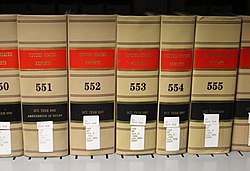
The United States Reports, the official reporter of the Supreme Court of the United States

A law report or reporter is a compilation of judicial opinions from a selection of case law decided by courts.[1] These reports serve as published records of judicial decisions that are cited by lawyers and judges for their use as precedent in subsequent cases.[1]

Historically, the term "reporter" was used to refer to the individuals responsible for compiling, editing, and publishing these opinions.[2] For example, the Reporter of Decisions of the Supreme Court of the United States is the person authorized to publish the Court's cases in the bound volumes of the United States Reports. Today, in American English, "reporter" also refers to the books themselves.[3] In Commonwealth English, these are described by the plural term "law reports", the title that usually appears on the covers of the periodical parts and the individual volumes.

In common law jurisdictions, such as the United States, the doctrine of stare decisis ("to stand by things decided") requires courts to follow precedent by applying legal principles established in prior decisions by higher courts within the same jurisdiction.[4] The system of precedent relies heavily on written opinions issued by appellate and supreme courts, and occasionally by trial courts, as these opinions enable judges and lawyers to reference and compare reasoning in cases involving similar factual circumstances.[5]

Official and unofficial case law reporting

[edit]

Official law reports or reporters are those authorized for publication by statute or other governmental ruling.[6] Governments designate law reports as official to provide an authoritative, consistent, and authentic statement of a jurisdiction's primary law. Official case law publishing may be carried out by a government agency, or by a commercial entity. Unofficial law reports, on the other hand, are not officially sanctioned and are published as a commercial enterprise. In Australia and New Zealand (see below), official reports are called authorised reports—unofficial reports are referred to as unauthorised reports.

For the publishers of unofficial reports to maintain a competitive advantage over the official ones, unofficial reports usually provide helpful research aids (e.g., summaries, indexes), like the editorial enhancements used in the West American Digest System. Some commercial publishers also provide court opinions in searchable online databases that are part of larger fee-based, online legal research systems, such as Westlaw, Lexis-Nexis or Justis.

Unofficially published court opinions are also often published before the official opinions, so lawyers and law journals must cite the unofficial report until the case comes out in the official report. But once a court opinion is officially published, case citation rules usually require a person to cite to the official reports.

Contents

[edit]
The headnote from the leading English case Wilkinson v Downton [1897] 2 QB 57.

A good printed law report in traditional form usually contains the following items:

  • The citation reference.
  • The name of the case (usually the parties' names).
  • Catchwords (for information retrieval purposes).
  • The headnote (a brief summary of the case, the holding, and any significant case law considered).
  • A recital of the facts of the case (unless appearing in the judgment).
  • A note of the arguments of counsel before the judge. (This is often omitted in modern reports.)
  • The judgment (a verbatim transcript of the words used by the judge to explain his or her reasoning).

It is only the last item that is authoritative. The others, although useful for its understanding, are only the law reporter's contribution. Thus, law students are warned that the headnote is not part of the decision rendered, since headnotes occasionally contain misinterpretations of the law, and are not part of the official judgment. (In the United States, however, the headnote, also called the syllabus, is sometimes written by the court itself, and this is noted.)

Open publication on the Internet

[edit]

The development of the Internet created the opportunity for courts to publish their decisions on Web sites. This is a relatively low cost publication method compared to paper and makes court decisions more easily available to the public (particularly important in common law countries where court decisions are major sources of law). Because a court can post a decision on a Web site as soon as it is rendered, the need for a quickly printed case in an unofficial, commercial report becomes less crucial. However, the very ease of internet publication has raised new concerns about the ease with which internet-published decisions can be modified after publication, creating uncertainty about the validity of internet opinions.[7]

Decisions of courts from all over the world can now be found through the WorldLII Web site, and the sites of its member organizations. These projects have been strongly encouraged by the Free Access to Law Movement.

Many law librarians and academics have commented on the changing system of legal information delivery brought about by the rapid growth of the World Wide Web. Professor Bob Berring writes that the "primacy of the old paper sets [print law reports] is fading, and a vortex of conflicting claims and products is spinning into place".[8] In theory, court decisions posted on the Web expand access to the law beyond the specialized law library collections used primarily by lawyers and judges. The general public can more readily find court opinions online, whether posted on Web-accessible databases (such as the Hong Kong Judiciary public access site, above), or through general Web search engines.

Questions remain, however, on the need for a uniform and practical citation format for cases posted on the Web (versus the standard volume and page number used for print law reports).[8] Furthermore, turning away from the traditional "official-commercial" print report model raises questions about the accuracy, authority, and reliability of case law found on the Web.[8] The answer to these questions will be determined, in large part, through changing government information policies, and by the degree of influence exerted by commercial database providers on global legal information markets.

Design and cultural references

[edit]

History and case reporting by country

[edit]

Africa

[edit]

Kenya

[edit]

Kenya's first output of law reports was in the form of volumes under the citation E.A.L.R ('"East African Law Reports'"). They were first published between 1897 and 1905. Seven of these volumes were compiled by the Hon Mr Justice R. W. Hamilton, who was then the Chief Justice of the Protectorate and the reports covered all courts of different jurisdictions.

The 1922–1956 period saw the emergence of some twenty-one volumes of the Kenya Law Reports (under the citation K.L.R). These reports included the decisions of the High Court only and were collated, compiled and edited by different puisne judges and magistrates.

Then came the period covering 1934 to 1956 which saw the birth of the famous Court of Appeal for Eastern Africa Law Reports (E.A.L.R). These reports comprised twenty-three volumes altogether which were also compiled by puisne judges and magistrates, a Registrar of the High Court and a Registrar of the Court of Appeal for Eastern Africa. These volumes reported the decisions of the then Court of Appeal for Eastern Africa and of the Privy Council. They covered only those appeals filed from the territories.

The East Africa Law Reports (cited as E.A.) were introduced in 1957 and were published in nineteen consecutive volumes until 1975. These reports covered decisions of the Court of Appeal for East Africa and the superior courts of the constituent territories, namely, Kenya, Uganda, Tanzania, Aden, Seychelles and Somaliland. They were published under an editorial board consisting of the Chief Justices of the Territories and the presiding judge of the Court of Appeal for Eastern Africa. Following the collapse of the East African Community, under whose auspices the reports were published, the reports went out of publication.

The period before the resumption of the East Africa Law Reports saw sporadic and transitory attempts at law reporting. Firstly, with the authority of the then Attorney-General, six volumes named the New Kenya Law Reports covering the period between and including the years 1976 to 1980 were published by the East African Publishing House. These reports included the decisions of the High Court and Court of Appeal of Kenya and were compiled by the Late Hon Mr Justice S. K. Sachdeva and were edited by Mr Paul H Niekirk and the Hon Mr Justice Richard Kuloba, a judge of the High Court of Kenya. The publication of these reports ceased when the publishing house folded them up ostensibly on account of lack of funds.

Later, two volumes of what were known as the Kenya Appeal Reports were published for the period 1982–1992 by Butterworths, a private entity, under the editorship of The Hon Chief Justice A.R.W. Hancox (hence the pseudonym "Hancox Reports") who had the assistance of an editorial board of seven persons. These reports, as their name suggested, included only the decisions of the Court of Appeal of Kenya selected over that period.

Law reports relating to special topics have also been published. Ten volumes of the Court of Review Law Reports covering the period 1953 to 1962 and including the decisions on customary law by the African Court of Review were published by the Government Printer. There was no editorial board and it is not known who the compilers of these reports were. Their apocryphal origin notwithstanding, they were commonly cited by legal practitioners and scholars.

In 1994, the Kenyan Parliament passed the National Council for Law Reporting Act, 1994 and gave the Council the exclusive mandate of: "publication of the reports to be known as the Kenya Law Reports which shall contain judgments, rulings and opinions of the superior courts of record and also undertake such other publications as in the opinion of the Council are reasonably related to or connected with the preparation and publication of the Kenya Law Reports" (section 3 of the Act).

The Kenya Law Reports are the official law reports of the Republic of Kenya which may be cited in proceedings in all courts of Kenya (section 21 of the Act).

Asia

[edit]

Bangladesh

[edit]

In Bangladesh, the law reports are published according to the provisions of the Law Reports Act, 1875. There are many law reports now in Bangladesh. The most widely known being the Dhaka Law Report which started publication in 1949. Published monthly, the Apex Law Reports (ALR) provides timely treatment of significant developments in law through articles contributed by judges, leading scholars and practitioners. The Law Messenger[9] is an internationally standard law report which started publication in 2016. It is the first law journal in Bangladesh which specifically publishes law decisions of Supreme Court of Bangladesh, India and Pakistan only. Mainstream Law Reports (MLR)[10] is the most-cited law journal and it ranks among the country's most-cited law reviews of any kind. Published monthly, the MLR provides timely treatment of significant developments in law through articles contributed by judges, leading scholars and practitioners. Bangladesh Legal Decisions is published under the authority of the Bangladesh Bar Council. The other law reports include Bangladesh Law Chronicles, Lawyers and Jurists, BCR, ADC, Bangladesh Legal Times and Bangladesh Law Times.

The online law report in Bangladesh is Chancery Law Chronicles, which now publishes verdicts of Supreme Court of Bangladesh.[11]

After the Supreme Court of Bangladesh was established in 1972, its online law report is Supreme Court Online Bulletin[12] and it initially published a law report, containing the judgments, orders and decisions of the Court. Another widely used law report in the country is the Bangladesh Legal Decisions which is published by the official regulator of the enrolled lawyers of the country; the Bangladesh Bar Council. Various others for example, Bangladesh Law Chronicles, Bangladesh Legal Times, Lawyers and Jurists, Counsel Law Reports, Legal Circle Law Reports, Bangladesh Legal Times, BCR, and ADC are also in operation. The decisions of the lower judiciary are not reported in any law report.

Hong Kong

[edit]

Cases of Hong Kong are predominantly published in the authorised Hong Kong Court of Final Appeal Reports (HKCFAR) and Hong Kong Law Reports and Digests (HKLRD), as well as the unauthorised but the oldest Hong Kong Cases (HKC). Some specialist series are available including the Hong Kong Family Law Reports (HKFLR), Hong Kong Public Law Reports (HKPLR) and Conveyancing and Property Reports (CPR). Chinese-language judgments are published in the Hong Kong Chinese Law Reports and Translation (HKCLRT). The Hong Kong Law Reports and Digests were published as the Hong Kong Law Reports (HKLR) until 1997.

India

[edit]

The Supreme Court Reports (SCR) is the official reporter for Supreme Court decisions. In addition, some private reporters have been authorised to publish the Court's decisions.[citation needed]

Pakistan

[edit]

Pakistan inherited a common law system upon independence from Great Britain in 1947, and thus its legal system relies heavily on law reports.

The most comprehensive law book is the Pakistan Law Decisions (PLD), which contains judgments from the Supreme Court of Pakistan, the various provincial High Courts, the Service, Professional and Election Tribunals as well as the superior courts of territories such as Azad Kashmir. PLD is augmented by other books, most notably the Yearly Law Reports (YLR), and the Monthly Law Digest (MLD).

The Supreme Court also has its own law book, the Supreme Court Monthly Review (SCMR), which lists more recent cases that the court has heard.

In addition, there are books dealing with specific areas of law, such as the Civil Law Cases (CLC), which as the name suggests deals with civil cases; the Pakistan Criminal Law Journal (PCrLJ), which reports criminal cases; and the Pakistan Tax Decisions (PTD), on the Income Tax tribunal cases and their appeals.

Europe

[edit]

Ireland

[edit]

Most Irish law reports are contained in The Irish Reports (IR), published by the Incorporated Council of Law Reporting for Ireland. Other reports are contained in the Irish Law Reports Monthly (ILRM) and various online collections of court decisions.

Scotland

[edit]

The Session Cases report cases heard in the Court of Session and Scottish cases heard on appeal in the House of Lords. The Justiciary Cases report from the High Court of Justiciary. Those two series are the most authoritative and are cited in court in preference to other report series, such as the Scots Law Times, which reports sheriff court and lands tribunal cases in addition to the higher courts. The law reports service of Scotland is supplemented by other reports such as the Scottish Civil Case Reports and Green's Weekly Digest.

United Kingdom

[edit]
England and Wales
[edit]
A few volumes of the English Reports at a law library

In England and Wales, beginning with the reports of cases contained in the Year Books (Edward II to Henry VIII) there are various sets of reports of cases decided in the higher English courts down to the present time. Until the nineteenth century, both the quality of early reports, and the extent to which the judge explained the facts of the case and his judgment, are highly variable, and the weight of the precedent may depend on the reputations of both the judge and the reporter. Such reports are now largely of academic interest, having been overtaken by statutes and later developments, but binding precedents can still be found, often most cogently expressed.[13]

In 1865, the nonprofit Incorporated Council of Law Reporting (ICLR) for England and Wales was founded, and it has gradually become the dominant publisher of reports in the UK. It has compiled most of the best available copies of pre-1866 cases into the English Reports. Post-1865 cases are contained in the ICLR's own Law Reports. Even today, the UK government does not publish an official report, but its courts have promulgated rules stating that the ICLR reports must be cited when available.[14] Historical practice, which may still apply where no other report is available, permitted parties to rely on any report "with the name of a barrister annexed to it".[15]

English maritime law
[edit]

While maritime cases often have a contract or tort element and are reported in the standard volumes, the standard source for maritime cases is the Lloyd's Law Reports, which covers matters including maritime matters such as carriage of goods by sea, international trade law, and admiralty law.

Supreme Court of the United Kingdom
[edit]

The UK Supreme Court publishes on its own website the court's judgments after they have been handed down, together with the ICLR summary (or "headnote").[16]

North America

[edit]

Canada

[edit]
Sequentially numbered books on a library shelf.
Canadian Criminal Cases law report.

Each province in Canada has an official reporter series that publishes superior court and appellate court decisions of the respective province. The federal courts, such as the Federal Court, Federal Court of Appeal, and Tax Court, each have their own reporter series. The Supreme Court of Canada has its own Reporter series, the Supreme Court Reports.

There are also general reporters, such as the long-running Dominion Law Reports, that publishes cases of national significance. Other law report series include the Canadian Criminal Cases, the Canadian Criminal Reports, the Ontario Reports and the Rapports Juridiques du Québec.[17][18]: 29 

Neutral citations are also used to identify cases.[17]

United States

[edit]
The Federal Reporter, a part of West's National Reporter System

In each state of the United States, there are published reports of all cases decided by the courts having appellate jurisdiction going back to the date of their organization.[19][20] There are also complete reports of the cases decided in the United States Supreme Court and the inferior federal courts having appellate jurisdiction since their creation under the United States Constitution.[21] The early reporters were unofficial as they were published solely by private entrepreneurs, but in the middle of the 19th century, the U.S. Supreme Court and many state supreme courts began publishing their own official reporters.

In the 1880s, the West Publishing Company started its National Reporter System (NRS), which is a family of regional reporters, each of which collects select state court opinions from a specific group of states.[19][22] The National Reporter System is now the dominant unofficial reporter system in the U.S., and 21 states have discontinued their own official reporters and certified the appropriate West regional reporter as their official reporter.[23] West and its rival, LexisNexis, both publish unofficial reporters of U.S. Supreme Court opinions. West also publishes the West American Digest System to help lawyers find cases in its reporters. West digests and reporters have always featured a "Key Numbering System" with a unique number for every conceivable legal topic.

Map of the U.S., showing areas covered by the Thomson West National Reporter System state law reports.

The U.S. federal government does not publish an official reporter for the federal courts at the circuit and district levels.[24] However, just as the UK government uses the ICLR reporters by default, the U.S. courts use the unofficial West federal reporters for cases after 1880, which are the Federal Reporter (for courts of appeals) and the Federal Supplement (for district courts).[25] For cases from federal circuit and district courts prior to 1880, U.S. courts use Federal Cases.[24] The Federal Reporter, the Federal Supplement, and Federal Cases are all part of the NRS and include headnotes marked with West key numbers.[25] West's NRS also includes several unofficial state-specific reporters for large states like California.[22] The NRS now numbers well over 10,000 volumes;[19] therefore, only the largest law libraries maintain a full hard copy set in their on-site collections.

Some government agencies use (and require attorneys and agents practicing before them to cite to) certain unofficial reporters that specialize in the types of cases likely to be material to matters before the agency. For example, for both patent and trademark practice, the United States Patent and Trademark Office requires citation to the United States Patents Quarterly (USPQ).[26][27]

Today, both Westlaw and LexisNexis also publish a variety of official and unofficial reporters covering the decisions of many federal and state administrative agencies which possess quasi-judicial powers. A recent trend in American states is for bar associations to join a consortium called Casemaker. Casemaker gives members of a state bar access to a computerized legal research system.

Publications
[edit]
  • Eugene Wambaugh, Study of Cases (second edition, Boston, 1894)
  • C. C. Soule, Lawyers' Reference Manual of Law Books and Citations (Boston, 1884)
  • Stephen Elias and Susan Levinkind, Legal Research: How To Find And Understand The Law (Berkeley: Nolo Press, 2004)

Oceania

[edit]

Australia

[edit]
Volumes of the Commonwealth Law Reports

The Commonwealth Law Reports are the authorised reports of decision of the High Court of Australia. The Federal Court Reports are the authorised reports of decisions of the Federal Court of Australia (including the Full Court). Each state and territory has a series of authorised reports, e.g. the Victorian Reports, of decisions of the superior courts of the state or territory.

The Australian Law Reports are the largest series of unauthorised reports although there are several others general reports and reports relating to specific areas of the law, e.g. the Australian Torts Reports publish decisions from any state or federal court relating to tort law. The NSW Law Reports are published by the Council of Law Reporting for New South Wales and cover the Supreme Court of New South Wales. The Victorian Reports[28] are published by Little William Bourke[29] on behalf of the Council of Law Reporting in Victoria and cover the Supreme Court of Victoria.

New Zealand

[edit]

The New Zealand Law Reports (NZLR) are the authorised reports of the New Zealand Council for Law Reporting and have been published continuously since 1883. The reports publish cases of significance from the High Court, Court of Appeal and Supreme Court of New Zealand. The reports, which were initially sorted by volume, are sorted by year. Three volumes per year are now published, with the number of volumes having increased over time from one, to two and now to three. The reports do not focus on any particular area of law, with subject specific reports filling this niche. There are approximately 20 privately published report series focusing on specialist areas of law. Some areas are covered by more than one report series—such as employment, tax and family law.

See also

[edit]

References

[edit]

Source note

[edit]

wikisource-logo.svg This article incorporates text from a publication now in the public domainGilman, D. C.; Peck, H. T.; Colby, F. M., eds. (1905). "yes". New International Encyclopedia (1st ed.). New York: Dodd, Mead.

Revisions and contributorsEdit on WikipediaRead on Wikipedia
from Grokipedia
A law report is a published record of a judicial decision on a point of law, designed to establish in jurisdictions such as the , where it serves as an authoritative source for legal principles under the doctrine of . These reports are selectively compiled from court judgments, with only a small fraction—approximately 2% or about 2,500 cases annually—deemed significant enough for inclusion based on criteria like establishing new legal principles, clarifying existing law, or altering . Unlike raw judgments, law reports include editorial enhancements by qualified legal professionals, such as barristers or solicitors, to ensure accuracy and utility for practitioners, judges, students, and academics. The structure of a typical law report begins with the case title (e.g., Smith v. Jones), identifying the parties involved, followed by details on the , hearing date, and presiding judges. Key components include catchwords or catchlines—brief indexing terms for subject-based retrieval—and a headnote, a concise summary of the facts, legal issues, and the court's (the binding legal reasoning). The full text follows, often preceded by summaries of counsel's arguments in official reports, and may conclude with references to related cases or statutes. This format distinguishes law reports from unreported judgments, which lack such editorial context and are not considered authoritative for citation in higher courts. Law reports play a critical role in legal research and practice by providing binding or persuasive authority depending on the court's hierarchy—for instance, decisions from the UK Supreme Court or Court of Appeal hold greater weight. Official series, such as those published by the Incorporated Council of Law Reporting for England and Wales (established in 1865), are the most authoritative, while secondary reporters like All England Law Reports offer broader coverage. Access to these resources has evolved with digital platforms, but their editorial rigor remains essential for interpreting and applying case law consistently.

Fundamentals

Definition and Scope

A law report is a published document or series that records judicial decisions from courts, capturing the facts of the case, arguments presented, the judgment rendered, and the legal reasoning underlying it. This record serves as an authoritative source of , particularly in jurisdictions where it documents decisions that establish, alter, or clarify legal principles. The scope of law reports is limited to significant decisions, primarily from appellate and superior courts, that possess value as precedents. Unlike unreported cases, which may not be selected for publication due to lacking broader legal impact, or raw trial transcripts that provide unedited procedural records without analytical enhancement, law reports focus on edited accounts of outcome-determinative rulings. This selective coverage ensures that only cases with potential to influence future are disseminated in published form. Key characteristics of law reports include their authoritative selection by legal editors or publishers, professional editing for clarity and consistency, and structured indexing to facilitate and citation. These features distinguish them as reliable tools for practitioners and scholars, emphasizing conceptual and precedential significance over exhaustive documentation of all judicial proceedings. Law reports serve as the official record of judicial decisions in common law systems, preserving the reasoning and outcomes of cases to facilitate the doctrine of stare decisis, which requires courts to follow precedents established by higher courts. This function ensures that past rulings bind future decisions, promoting predictability and stability in the law by allowing judges to reference authoritative interpretations of legal principles. In jurisdictions like and the , law reports thus form the backbone of , distinguishing from civil law traditions where codified statutes predominate over judicial precedents. In legal research, lawyers, judges, and scholars depend on law reports to identify binding authorities, interpret ambiguous statutes, and trace the historical evolution of doctrines. These reports provide detailed accounts of facts, arguments, and judicial opinions, enabling practitioners to apply precedents accurately in advocacy or adjudication. For instance, in the U.S., resources like the Federal Reporter series are essential for analyzing federal appellate decisions, offering context that secondary sources cannot replicate. This reliance underscores law reports' role in maintaining the integrity of adversarial proceedings and scholarly analysis. Law reports contribute significantly to by fostering uniformity in rulings across courts, thereby advancing legal evolution through consistent application of principles. By disseminating key decisions, they encourage alignment in judicial outcomes, reducing discrepancies that could undermine public confidence in the legal system. In law schools, they are integral to the of instruction, where students dissect reported cases to develop analytical skills and understand precedent's practical application. This educational use reinforces the common law's inductive approach, shaping future jurists' contributions to doctrinal development. However, challenges arise from selective reporting practices, which can skew legal development by omitting cases that might refine or challenge established precedents. In , the official Law Reports prioritize "important" decisions, potentially limiting access to nuanced rulings and hindering comprehensive precedent analysis. Similarly, in the U.S., state systems like California's selective publication rules have drawn criticism for creating gaps in reported , leading to inconsistent interpretations and barriers to equitable justice. Such selectivity, while aimed at managing volume, risks distorting the common law's evolutionary path by favoring prominent cases over those addressing emerging issues.

Structure and Contents

Essential Components

Law reports follow a standardized structure to ensure clarity, accessibility, and utility in , with core elements appearing consistently across major jurisdictions. This format facilitates the identification of binding precedents and the analysis of judicial reasoning, enabling lawyers and scholars to efficiently locate and interpret . The essential components typically include the case name, citation, and date, procedural history, facts, issues, arguments, judgment, and , often supplemented by editorial aids like headnotes for quick reference. Case Name: The title of the report begins with the names of the parties involved, such as "Smith v Jones" in civil cases or "R v Brown" in criminal matters, reflecting the adversarial nature of common law proceedings. This naming convention, rooted in English legal tradition, identifies the litigants and signals the case type, with variations for proceedings like judicial reviews (e.g., "R (Smith) v Secretary of State"). Citation: Following the case name is the citation, a unique reference that pinpoints the report's location in print or online volumes, such as " AC 1" for the first case in the Appeals Cases volume of that year. Citations enable precise retrieval and are standardized by publishers to maintain consistency across series. Modern neutral citation systems, independent of commercial reports, use a format like " EWCA Civ 123," where "EWCA Civ" denotes the England and Wales Court of Appeal (Civil Division), followed by the year and sequential number. These neutral citations, introduced in the UK in 2001, promote vendor-neutral access to judgments and are increasingly adopted globally. Court and Date: The court section specifies the issuing tribunal (e.g., or ), often abbreviated in headers for brevity. Adjacent is the date of judgment delivery, which is critical for determining the case's temporal relevance in precedent application, while hearing dates may be noted optionally. Procedural History: This outlines the case's journey through the legal system, including prior proceedings, appeals, and lower court decisions, providing context for the current ruling. For instance, it might summarize an appeal from a decision, highlighting key prior outcomes to trace the litigation path. Facts: A concise of the material events and circumstances giving rise to the dispute follows, focusing on legally relevant details without extraneous information. This section sets the foundation for understanding the issues and , often integrated into the headnote or synopsis for efficiency. Issues: The core legal questions or points in controversy are articulated here, often via catchwords—brief subject headings like ", Breach, "—that index the case for research purposes. These distill the disputes resolved by the , aiding in thematic classification. Arguments: Summaries of the parties' submissions by are presented, capturing the key legal contentions advanced during hearings. Prepared by report editors, this element highlights the adversarial exchanges that inform the judicial decision, though it may be condensed in some formats. Headnotes and Syllabi: Editorial summaries, known as headnotes in and reports or syllabi in U.S. contexts, encapsulate the facts, issues, arguments, holding, and in a structured digest. Numbered for reference (e.g., headnote 1 on liability), they serve as an at-a-glance overview, with topics and key numbers for indexing in systems like . These aids, crafted by professional reporters, enhance navigability without altering the original text. Judgment: The full text of the court's opinion forms the report's core, reproducing the judges' reasoned delivery verbatim or edited for clarity from authorized transcripts. It includes the majority reasoning, with separate sections for concurring opinions (agreeing on outcome but differing in rationale) or dissenting views (opposing the decision), preserving the nuances of multi-judge panels. Ratio Decidendi: The binding legal principle emerging from the decision—the "reason for deciding"—is explicitly or implicitly extracted, often highlighted in the headnote (e.g., "Held: The was void for..."). This element defines the precedent's scope, distinguishing it from obiter dicta (non-binding observations), and is essential for stare decisis in systems.

Supplementary Materials

Supplementary materials in law reports encompass a variety of aids designed to enhance , , and contextual understanding of reported cases without forming the primary record of the judgment itself. These elements, often compiled by editors or publishers, include tools for cross-referencing and updating legal information, ensuring that users can efficiently locate relevant precedents and track developments in the . Indexes and tables serve as essential navigational devices within law report volumes or series. Indexes typically provide alphabetical listings of cases, statutes, and subjects, allowing researchers to identify reports by keyword or theme, such as catchwords summarizing key issues in UK law reports. Tables of cases and statutes cited offer comprehensive lists of all referenced authorities, including parallel citations across different report series, which facilitate verification and broader research; for instance, in US case reporters, these tables link to headnotes organized by the West Topic and Key Number System for topical access. Such features are particularly vital in multi-volume sets, where they appear at the end of annual or periodic compilations to consolidate content across editions. Appendices provide supplementary documents that support the reported cases but are not integral to the judgment text. These may include full texts of referenced statutes, international treaties, or expert affidavits mentioned during proceedings, offering immediate access to foundational materials without requiring separate consultation of legislative sources. In practice, appendices are more common in specialized reports, such as those involving or complex commercial disputes, where they append relevant excerpts to illustrate the case's legal framework. Editorial notes offer critical updates and connections to the evolving body of law. These notes detail the subsequent history of a case, such as whether it has been overruled, affirmed, or distinguished in later decisions, enabling practitioners to assess its ongoing authority. They also include cross-references to related judgments or legislative changes, often compiled in annual supplements or pocket parts within reporter volumes; for example, in regional reporters, editorial enhancements via the Key Number System provide references to subsequent citations for research continuity. Glossaries and annotations further augment usability by clarifying terminology and providing interpretive depth. Glossaries, though less ubiquitous, define specialized legal terms, abbreviations, or archaic language encountered in older reports, aiding non-native or junior practitioners. Annotations consist of brief scholarly commentary or explanations of doctrinal points, as seen in series like American Law Reports, where they summarize jurisdictional variations and cite supporting authorities to contextualize the principal case. These elements are typically found in unofficial or annotated report series, prioritizing analytical insight over exhaustive reproduction.

Classification of Reports

Official Reports

Official law reports are publications authorized or produced by courts, bodies, or designated entities, serving as the primary and most authoritative records of judicial decisions with precedential value. These reports ensure standardized documentation of case outcomes, including judgments, procedural details, and legal reasoning, to support consistent application of the across jurisdictions. Prominent examples include the Law Reports in the , published by the (ICLR), a established by the to produce accurate and reliable reports prepared by qualified barristers and solicitors. In the United States, the (U.S.) constitute the official reporter for decisions, compiled by the Court's Reporter of Decisions and published through the Government Publishing Office. The selection process for inclusion in official reports emphasizes cases with significant legal impact, often under government or judicial oversight. In the UK, the ICLR applies criteria derived from principles established in 1863 by Lindley, prioritizing cases that introduce or materially modify a new or rule, settle or clarify doubtful , or provide peculiarly instructive guidance on established rules. Cases lacking discussion, valueless as precedents, or repetitive of prior reports are excluded to maintain focus on authoritative precedents. For the U.S. , the United States Reports include all opinions issued by the Court, with the Reporter of Decisions responsible for editing, verifying citations, and preparing the volumes without selective exclusion, ensuring comprehensive coverage under statutory mandate (28 U.S.C. § 411). Official reports hold advantages such as enhanced binding status in establishing , with courts requiring their citation in preference to other sources; for instance, courts mandate use of the Law Reports where available per the Practice Direction on Citation of Authorities 1 WLR 780. In the , the United States Reports are the designated official source under citation system, providing unassailable authority for Supreme Court precedents. Access is often subsidized or free in certain jurisdictions, such as through PDFs of U.S. Reports volumes from 1991 onward on the Supreme Court's website. However, a key disadvantage is publication delays, as bound volumes require extensive editing and approval; United States Reports can lag several years behind slip opinions, while Law Reports involve post-judgment checks that extend timelines beyond initial Weekly Law Reports releases. Unlike unofficial reports, which offer quicker dissemination but reduced authoritative weight, official versions prioritize precision over speed.

Unofficial and Specialized Reports

Unofficial law reports, also known as unauthorized or commercial reports, are compilations of judicial decisions published by private entities such as legal publishers rather than government-sanctioned bodies. These reports typically offer faster dissemination of cases and greater accessibility through editorial enhancements like headnotes and summaries, making them valuable supplements to official publications. Prominent examples include West's National Reporter System in the United States, established in 1879 by West Publishing (now ), which systematically organizes cases from federal and state courts across all jurisdictions into regional and topical series for comprehensive coverage. In the , the All England Law Reports, launched in 1936 by Butterworths (now ), provide selected judgments from the , Court of Appeal, and High Court, emphasizing clarity and relevance across general legal areas. Specialized series, such as the Family Law Reports published by since 1980, focus on verbatim accounts of significant cases in family from the Family Division, Court of Appeal, and higher courts, catering to practitioners in niche fields. The selection and editing of cases in unofficial reports are guided by commercial criteria, prioritizing market demand, legal novelty, and practical utility for legal professionals, which often results in broader inclusion of decisions from lower courts or emerging issues not always featured in official series. Editors apply rigorous processes to summarize key points, add catchwords, and ensure accurate indexing, though the choices reflect publisher discretion rather than governmental mandate. These reports offer advantages such as quicker publication—often weeks ahead of official versions—and enhanced tools like cross-references and annotations that aid research efficiency, effectively filling gaps in coverage left by official reports' more selective focus. However, their authority can vary; while many, like the All England Law Reports, are widely cited and respected, they lack the presumptive official status, potentially requiring verification against authorized sources in certain jurisdictions.

Historical Development

Origins in England

The systematic recording of legal decisions in England began in the 13th century with the Year Books, which served as the earliest form of unofficial law reports. These manuscripts, dating from around 1268 to 1535, captured arguments, rulings, and judicial statements from the common law courts in Anglo-Norman French, primarily authored anonymously by law apprentices, clerks, or practitioners. They focused on procedural aspects, pre-trial matters, and extra-curial opinions, functioning as practical aids for litigation and legal education rather than verbatim transcripts. The introduction of the to in 1476 by revolutionized the dissemination of legal knowledge, transitioning from handwritten manuscripts to printed volumes that standardized and broadened access to case reports. This technological shift facilitated the publication of selected cases in the late , reducing reliance on personal notebooks and enabling wider circulation among the , though initial printing of full Year Books occurred later in the . A pivotal advancement came with the nominative reports of the , named after their individual authors and marking the start of printed law reporting. Sir James Dyer, of the Common Pleas from 1559 to 1582, is credited with originating the modern system through his posthumously published reports in 1585, which collected cases from the reigns of to and emphasized judicial reasoning. These works, drawn from his notebooks, represented a shift toward more structured and reliable documentation compared to the Year Books' brevity. In the early 17th century, Sir Edward Coke's Reports further established printed formats as authoritative sources, with the first volume appearing around 1600 and eleven parts published by 1616. Coke, a prominent and , compiled cases involving constitutional and principles, often infusing them with his interpretive views, which influenced subsequent reporting despite criticisms of subjectivity. These reports, reprinted multiple times before 1640, underscored the printing press's role in preserving and propagating legal precedents. The period from 1535 to 1865 saw the proliferation of such private, nominative reports, which were later consolidated in the English Reports compilation—a comprehensive reprint of over 170 series covering key cases from that era. This collection addressed inconsistencies in early printing by standardizing access, while the evolution from reporter-named (nominative) to anonymous, neutral styles reflected growing emphasis on objectivity in legal documentation.

Global Expansion

The English model of law reporting, which emphasized the publication of judicial precedents to guide future decisions, began to disseminate across the in the as colonial administrations established courts modeled on Westminster systems. In response to the growing need for uniformity in legal administration, official series of reports emerged in key colonies, often initiated through the courts themselves. For instance, in , early reports of the at Madras commenced in 1816 under Sir Thomas Strange, covering three volumes of cases, while reports of the Sadar Diwani Adalat at Bombay commenced in 1825 edited by H. T. Colebrook Borradaile, and the Calcutta followed in 1831 with reports by R. G. Bignell. These efforts extended to the Company's courts, such as the Sadar Diwani Adalat in Calcutta, where reports began in 1827 under Sir , focusing on civil cases to promote consistency across diverse jurisdictions. By the mid-19th century, monthly compilations of decisions from Sadar Courts were introduced in 1845 to address the lack of binding precedents in colonial settings, reflecting the adaptation of English practices to imperial governance needs. Similarly, in , law reporting started as early as 1825 in with the publication of cases from the , marking one of the first official series in the to support the fledgling framework. A pivotal transition in the global spread of law reporting occurred with the shift toward professional editing bodies, which aimed to standardize quality and selection amid the proliferation of unofficial publications. In the , this mirrored England's own reforms, where the Incorporated Council of Law Reporting was formed in 1865 to oversee authoritative series, influencing colonial practices by the late 19th century. Post-independence, the adopted and adapted this model rapidly; the first American law reports appeared in 1789 with Ephraim Kirby's collection of cases, establishing a for state-level reporting independent of British oversight yet rooted in traditions. This professionalization helped transition from barrister-compiled notes to structured volumes, ensuring reports served as reliable tools for legal practitioners in expanding jurisdictions. In the , standardization efforts further globalized law reporting through international influences, particularly the American Law Reports (ALR) system introduced in 1919 by the Lawyers Co-operative Publishing Company, which innovated by annotating cases with cross-jurisdictional analyses to aid comparative application. However, challenges persisted in non-English speaking areas, where translating and adapting reports for local legal contexts often led to inconsistencies; for example, in multilingual colonial outposts, the reliance on English-language precedents complicated integration with indigenous customary laws, necessitating bilingual summaries that were not always systematically produced. The broader impact of these developments lay in codifying principles on a global scale, transforming scattered judicial decisions into authoritative sources that unified legal practice across empires and former colonies. , the establishment of High Courts in 1862 under the Indian High Courts Act led to the Indian Law Reports series, which adapted English formats to include cases blending with local statutes, thereby embedding precedent-based in the subcontinent's legal fabric. , early 19th-century reports evolved into official state series by the late 1800s, such as the Queensland Law Reports starting in under the Queensland Law Society, which helped solidify a distinct yet English-derived identity amid federation. These adaptations not only preserved judicial reasoning but also facilitated the export of norms, influencing legal systems in over 50 jurisdictions worldwide by the early 20th century.

Regional Practices

United Kingdom and Europe

In the , the primary official law reports for are the Law Reports, published by the Incorporated of Law Reporting for (ICLR) since 1865, which serve as the most authoritative source for precedential cases from superior courts. In , the Session Cases constitute the official reports, issued by the Scottish of Law Reporting and covering key appellate decisions from the and since 1821. For , the Irish Reports, produced by the Incorporated of Law Reporting for since 1867, provide the official record of significant judgments from the superior courts. The British and Irish Legal Information Institute (BAILII) plays a central role by aggregating and freely disseminating these reports alongside unreported judgments, facilitating broader access to primary legal materials across the jurisdictions. Selection of cases for inclusion in these official reports is guided by criteria established by the and reporting councils, prioritizing decisions that introduce new principles, modify existing rules, establish useful legal propositions, or resolve important questions of , ensuring focus on precedents with lasting impact rather than routine matters. Publication involves editorial processes to include headnotes, summaries of arguments, and full judgments, with the ICLR and equivalent bodies maintaining while aligning with judicial guidance. Prior to in 2020, reporting integrated European Union law through mandatory citation of the Reports of Cases before the Court of Justice (commonly known as the European Court Reports or ECR), which documented binding decisions from the Court of Justice of the that shaped domestic on matters like free movement and competition. Post-, while EU case law retains persuasive , reports now emphasize retained EU as domesticated statutes. In , common law traditions persist in Ireland, where the Irish Law Reports Monthly supplements the official Irish Reports by providing timely coverage of superior court decisions since 1976, emphasizing practical application in a hybrid system influenced by both Irish and former precedents. By contrast, continental European civil law jurisdictions, such as and , exhibit limited systematic case reporting due to the primacy of codified statutes over judicial ; while notable decisions are published in collections like France's Recueil Dalloz or Germany's Entscheidungen des Bundesgerichtshofs, these serve illustrative rather than binding purposes, with reporting practices varying by country and often confined to doctrinal analysis rather than comprehensive archival. Distinct features of UK and select European law reporting include the introduction of neutral citations in 2001, which assign unique identifiers (e.g., EWCA Civ 123) to judgments independently of print reporters, aiding digital referencing and reducing reliance on proprietary series. Additionally, free access to judgments and reports is available through official judiciary websites, such as those of the Courts and Tribunals Judiciary for England and Wales, enabling public and professional consultation without subscription barriers.

North America

In North America, law reporting practices in the and reflect decentralized federal systems with distinct official and unofficial mechanisms for documenting judicial decisions. The United States Supreme Court's official reporter, the (U.S.), has published all decisions since its inception as the government's authorized series in , following the appointment of the first Reporter of Decisions under an . This series, compiled by the Reporter of Decisions, includes full opinions, syllabi, and jurisdictional statements, ensuring comprehensive coverage of the Court's precedential output without selective designation. For lower federal courts, such as the courts of appeals and district courts, publication is more selective: judges designate opinions for official inclusion based on their general precedential value, while unpublished opinions may still be cited persuasively but lack binding authority in most circuits. Unofficial reporters dominate comprehensive federal coverage in the U.S., with the Federal Reporter series, published by West Publishing (now ) since 1880, compiling designated appellate decisions across multiple volumes and series (F., F.2d, F.3d). At the state level, each jurisdiction maintains its own official reporters; for example, the California Reports serve as the official publication for the and Courts of , produced under contract with and including all published opinions with headnotes and tables. Commercial platforms like and have expanded unofficial reporting by digitizing and annotating vast archives of both official and unpublished cases, enabling broader access and headnote systems that enhance research efficiency. A unique feature of U.S. practice is the requirement for parallel citations in briefs and opinions, where both official (e.g., U.S.) and unofficial (e.g., F.3d) reporters are referenced to facilitate verification across sources, as mandated by rules like Federal Rule of Appellate Procedure 32.1 and state equivalents. In Canada, the federal system emphasizes official bilingual publication to reflect the country's dual-language framework under the Official Languages Act. The Supreme Court Reports (S.C.R.), the official reporter for the Supreme Court of Canada, has documented all decisions since 1876, with bilingual (English and French) editions standard since 1970 to ensure accessibility in both official languages for federal cases. Published under the authority of the Supreme Court Act, this series includes full judgments without judicial selection for inclusion, prioritizing completeness for the Court's final appellate role. For broader coverage, unofficial reporters like the Dominion Law Reports (D.L.R.), issued by Canada Law Book since 1912, selectively compile significant cases from federal and provincial courts, offering annotations and digests to aid practitioners. Canadian federal reporting thus mandates parallel English-French texts for Supreme Court output, contrasting with provincial systems that may vary in language and selection, while relying heavily on unofficial series for comprehensive, annotated access beyond official volumes.

Asia

Law reporting in Asia, particularly in common law jurisdictions shaped by British colonial rule, reflects a blend of inherited traditions and post-colonial adaptations to diverse legal needs. These systems emerged from English precedents introduced during imperial expansion, evolving to address local contexts such as federal structures and multilingual societies. In countries like , , and , law reports serve as essential tools for judicial consistency, with unofficial series often filling gaps left by slower official publications. In , law reporting is characterized by a mix of official and unofficial series that prioritize comprehensive coverage of and decisions. The All Reporter (AIR), an unofficial publication launched in 1920 by M/s All Reporter in , provides detailed reports on cases involving central statutes and is widely cited for its accessibility and annotations. Complementing this, Supreme Court Cases (SCC), published privately since 1969, focuses exclusively on judgments and is cited by approximately 60% of advocates in the due to its timely and analytical approach. Official reports include the Reports (SCR), the authorized series for decisions as mandated by judicial practice, and the Indian Law Reports (ILR), established under the Indian Law Reports Act of 1875 for cases, ensuring binding precedents across states. Additionally, judgments appear in official gazettes published by central and state governments, offering primary but unannotated records of statutory notifications and court orders. Pakistan and Bangladesh, having gained independence from British India in 1947 and 1971 respectively, initially relied on shared Indian reporting series before developing distinct national frameworks. In , the Pakistan Law Journal (PLJ), published since 1973 by the Pakistan Law Journal in , reports superior court judgments and has become a key unofficial resource for legal practitioners. This shift marked a departure from pre-partition Indian reports like the ILR, with PLJ and the Pakistan Legal Decisions (PLD), starting in 1950, establishing independent coverage of Federal and High Court cases to reflect 's evolving jurisprudence. Similarly, in , the Law Reports (DLR), originating in 1948 as an East publication, transitioned post-independence to focus on Supreme Court decisions from the Appellate and Divisions, remaining the most cited series under the Reports Act of 1875. supplemented this with unofficial reports like Bangladesh Legal Decisions (BLD) from the Bar Council, diverging from Pakistani series to emphasize local constitutional and civil law developments. Hong Kong's law reporting system, rooted in its colonial history, underwent structural changes following the 1997 handover to while preserving its basis under the "" principle outlined in the . The Hong Kong Law Reports and Digest (HKLRD), the authorized series endorsed by the and published by Sweet & Maxwell since 1997, merged prior publications like the Hong Kong Law Reports (1905–1996) and Hong Kong Law Digest, providing selected judgments from the Court of Final Appeal and lower courts with bilingual (English and Chinese) elements to accommodate the territory's official languages. Post-handover, HKLRD integrated references to Basic Law interpretations by 's Standing Committee, ensuring continuity of precedents alongside emerging Sino-Hong Kong legal synergies without fully adopting mainland civil law reporting practices. Across these jurisdictions, common challenges include multilingual reporting demands and limited access in rural areas, compounded by the need for rapid dissemination that unofficial series address more effectively than official ones. In India, Pakistan, and Bangladesh, where English dominates formal reports but local languages like Hindi, Urdu, and Bengali prevail in daily use, translation barriers hinder equitable access to precedents for non-English speakers, particularly in rural courts. Rural practitioners often face delays in obtaining physical copies, exacerbating disparities in legal application. The growth of unofficial series, such as AIR and PLJ, mitigates this by offering faster publication—sometimes within months versus years for official gazettes—prioritizing speed and affordability to support timely judicial reference in diverse terrains. In Hong Kong, bilingual requirements add complexity but enhance accessibility in an urban setting, though rural New Territories communities still encounter logistical hurdles in report distribution.

Oceania and Africa

In Oceania, law reporting practices in and reflect a strong foundation in British traditions, adapted to incorporate indigenous legal systems. In , the Commonwealth Law Reports (CLR) serve as the official authorized series for decisions of the , commencing in 1903 with the establishment of the court following federation. These reports capture landmark cases shaping federal jurisprudence, while state-level reporting includes series such as the State Reports and Victorian Reports, covering decisions. Access to these materials has been enhanced through the Australasian Legal Information Institute (AustLII), a free online database providing comprehensive, independent access to Australian case law, , and related resources since its inception in 1995. New Zealand's primary official law report series, the New Zealand Law Reports (NZLR), has been published by the New Zealand Council of Law Reporting since 1883, documenting appellate and significant trial court decisions. A distinctive feature of New Zealand's legal reporting is the integration of , the of the indigenous , which influences areas such as property rights, , and ; recent judgments, for instance, have affirmed tikanga as a source of , prompting its explicit consideration in reported cases. This adaptation stems from the (1840), which underpins the bicultural framework of New Zealand law, distinguishing it from purely English-derived models. In Africa, particularly in common law jurisdictions like Kenya, law reporting follows British colonial legacies but faces significant resource limitations, leading to adaptations for customary and indigenous laws. The Kenya Law Reports (KLR), published by the National Council for Law Reporting since 1977, constitute the primary official series, covering judgments from the Supreme Court, Court of Appeal, and High Court. However, the system is hampered by chronic underfunding of the judiciary, which has resulted in budget shortfalls of nearly 50% in recent years, contributing to case backlogs and limited production of comprehensive reports. Due to these constraints, Kenyan courts and practitioners often rely on historical East African Law Reports (1952–1977), a regional series that compiled decisions from courts across Kenya, Tanzania, Uganda, and Zanzibar during the colonial and early post-independence periods. Broader African practices exhibit similar patterns, with British-influenced reporting adapted to recognize indigenous customary laws in areas like family, land, and succession disputes. In Southern Africa, regional compilations such as those accessible via the Southern African Legal Information Institute (SAFLII) aggregate case law from countries including South Africa, Namibia, and Zimbabwe, facilitating cross-jurisdictional reference while incorporating customary norms; for example, South African Law Reports include decisions addressing the interplay between Roman-Dutch law, English common law, and indigenous systems. These developments highlight a shift toward inclusive reporting that balances colonial precedents with local indigenous frameworks, though underfunding remains a persistent challenge in expanding access and coverage across the continent.

Modern Developments

Digitization and Online Access

The digitization of law reports began in the 1970s with the introduction of computerized legal research systems, marking a shift from traditional print formats to electronic databases. Westlaw, launched by West Publishing in 1975, pioneered this transition by providing access to case law through dedicated terminals, evolving from its print origins in the late 19th century. By the 1980s, CD-ROM technology emerged as an intermediate step, allowing offline storage and distribution of case law collections, which became widespread in the 1990s for broader accessibility in law libraries and firms. The 1990s and early 2000s saw the rise of web-based platforms, enabling real-time online access to judgments and reports as courts increasingly produced electronic opinions. Digital law reports offer significant advantages over print versions, including enhanced searchability through keyword and Boolean queries, full-text retrieval of judgments, and seamless integration with case tracking tools that monitor citations and subsequent rulings. , the Access to Court Electronic Records (PACER) system exemplifies this, providing instantaneous public access to over one billion federal court documents, including dockets and case files, via a web interface available 24 hours a day. These features streamline , reduce time spent on manual indexing, and support analytical tools for precedent analysis. Despite these benefits, faces notable challenges, particularly restrictions that limit the reproduction and distribution of proprietary compilations by publishers. In developing jurisdictions, a persists, where limited and high costs hinder access to reports, exacerbating inequalities in legal practice compared to wealthier regions. Standardization efforts, such as the use of XML schemas for structuring judgments, aim to address issues but remain inconsistent across systems, complicating data exchange and preservation. As of 2025, current trends in law report access include AI-assisted searching, which reduces research time from 17-28 hours to 3-5.5 hours by automating precedent identification and summarization while maintaining human oversight. Mobile applications, such as the Westlaw Edge app and Fastcase, further enhance portability, allowing professionals to retrieve full-text reports and annotations on smartphones or tablets for on-the-go use.

Open Access Initiatives

Open access initiatives in law reports seek to provide free, unrestricted online availability of judicial decisions and related legal materials, promoting transparency and equity in the justice system. A pivotal development was the establishment of the Canadian Legal Information Institute (CanLII) in 2000, which has offered comprehensive free access to Canadian court judgments, statutes, and regulations, serving as a model for public-funded legal information dissemination. In the United Kingdom, the British and Irish Legal Information Institute (BAILII), launched in 2000, provides open access to case law from England and Wales, Scotland, Northern Ireland, and Ireland, including over 1.5 million decisions updated daily. These efforts align with the Free Access to Law Movement (FALM), formalized through the 2002 Montreal Declaration, which asserts that public legal information is a public good requiring free online access without barriers to enhance the rule of law globally. Key platforms extending this model include WorldLII, coordinated by AustLII since 2002, which aggregates free legal databases from over 120 countries, encompassing millions of judgments and enabling cross-jurisdictional searches. Similarly, AfricanLII, established in 2014, federates resources across 16 African legal information institutes, offering judgments, legislation, and policy documents to address continent-specific access gaps. These contrast with traditional paywalled services like or , where subscriptions limit access primarily to paying institutions and practitioners, perpetuating inequities in . Drivers for these initiatives stem from the in accessible , as restricted access to law reports hinders work, self-representation, and education, while high subscription costs—often exceeding thousands annually—burden smaller firms and developing regions. The principles echo broader standards, such as the Budapest Open Access Initiative of 2002, adapted to legal scholarship by emphasizing free availability of peer-reviewed legal analyses to foster citation and impact, with studies showing open access legal articles receive up to 18% more citations than paywalled counterparts. By 2025, these initiatives have significantly increased equity, with platforms like and BAILII handling millions of annual searches and supporting judicial transparency amid rising digital demands. However, barriers persist, including resistance from commercial publishers fearing revenue loss from subscription models and legal challenges over in digitized historical reports. In , hybrid models exemplify ongoing tensions, where official resources like the of India's free judgment portal coexist with paywalled databases such as SCC Online, allowing selective for recent cases while older reports remain behind fees, balancing public needs with publisher incentives.

References

Add your contribution
Related Hubs
User Avatar
No comments yet.