Hubbry Logo
Rime iceRime iceMain
Open search
Rime ice
Community hub
Rime ice
logo
8 pages, 0 posts
0 subscribers
Be the first to start a discussion here.
Rime ice
Rime ice
from Wikipedia
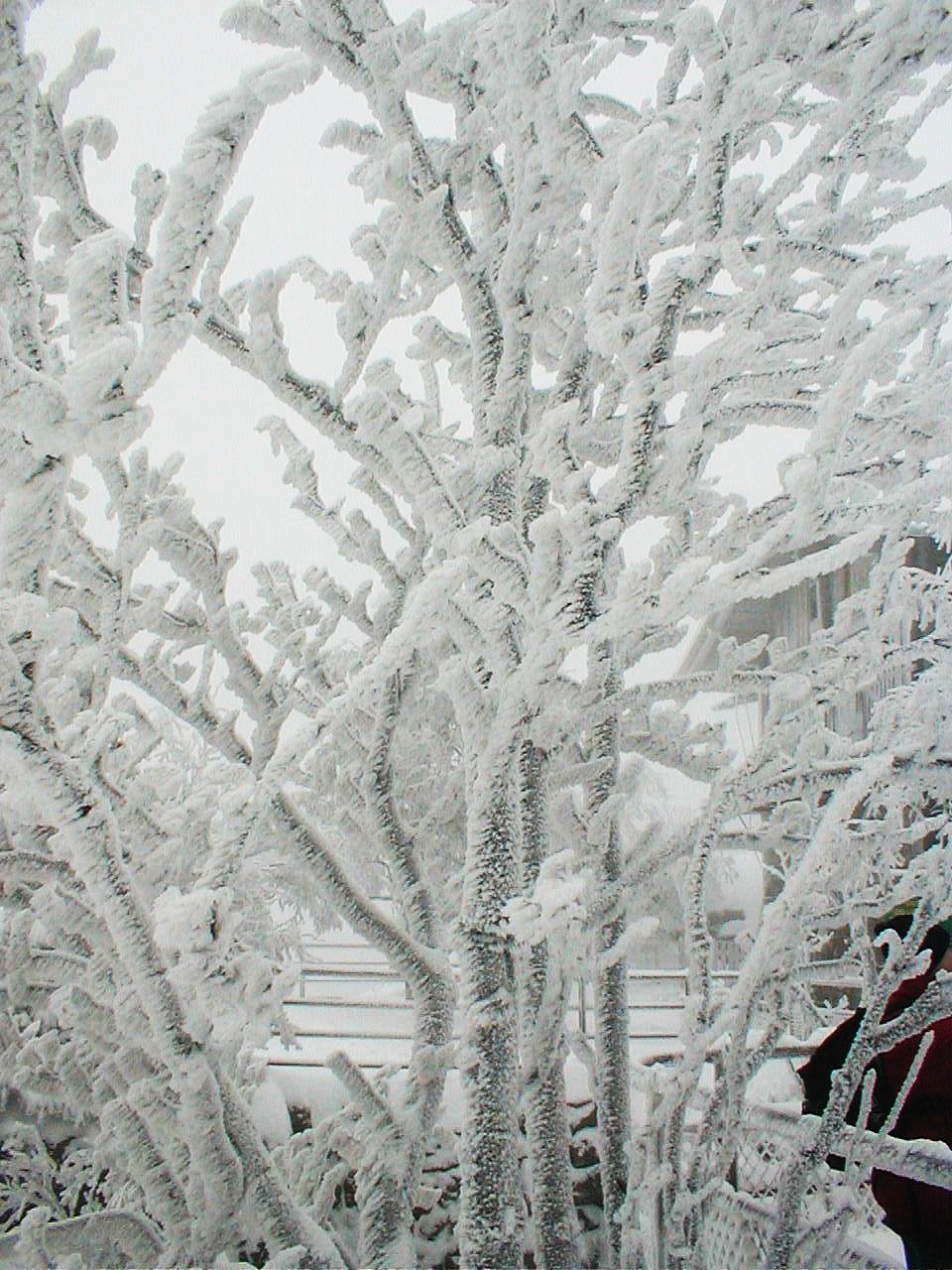
Hard rime on a tree
Wind blown rime ice formed on the summit cross of the Fronalpstock

Rime ice forms when supercooled water droplets freeze onto surfaces.[1] In the atmosphere, there are three basic types of rime ice:

  • Soft rime forms when supercooled water freezes under calm wind conditions. It is milky and crystalline, like sugar, and similar to hoar frost.[2][3]
  • Hard rime forms by rapid freezing of supercooled water under at least moderate wind conditions. The droplets freeze more or less individually, leaving air gaps.[4][3]
  • Clear ice forms by slow freezing of supercooled water. Clear ice is typically transparent and homogeneous. Its amorphous and dense structure makes it adhesive.

Soft and hard rime are less dense than clear ice and less adhesive, thus generally cause less damage. Glaze ice is similar in appearance to clear ice, however it is the result of a completely different process, occurring during freezing rain or drizzle.

Rime ice also forms when ice forms on the surface of an aircraft, particularly on the leading edges and control surfaces when it flies through a cloud made of supercooled water liquid droplets. Rime ice is the least dense, milky ice is intermediately dense and clear ice is the most dense. All forms of ice can spoil lift and may have a catastrophic effect on an airborne aircraft. These hazardous effects are due to the ice's ability to disrupt airflow, increase weight, and add drag. Ice forming on propellers or engine inlets are especially dangerous as it can cause severe vibration and/or damage if ingested.[5]

Hard rime

[edit]
Hard rime on trees in the Black Forest of Germany

Hard rime is a white ice that forms when the water droplets in fog freeze to the outer surfaces of objects. It is often seen on trees atop mountains and ridges in winter, when low-hanging clouds cause freezing fog. This fog freezes to the windward (wind-facing) side of tree branches, buildings, or any other solid objects, usually with high wind velocities and air temperatures between −2 and −10 °C (28 and 14 °F).[6]

Characteristics

[edit]

Hard rime formations are more difficult to remove. They have a comb-like appearance, with the streaks of material parallel to that of the direction of the wind. This is unlike soft rime, which looks feathery or spiky, or clear ice, which looks homogeneous and transparent.

Scientists at meteorologically extreme places, such as Mount Washington in New Hampshire, often have to break huge chunks of hard rime off weather equipment in order to keep anemometers and other measuring instruments operating.

Formation on snow crystals

[edit]
Electron microscope image of rime ice on both ends of a "capped column" snowflake

Under some specific atmospheric conditions, forming and descending snow crystals may encounter and pass via atmospheric supercooled cloud droplets. These droplets, which have a diameter of about 10 μm, can exist in an unfrozen state down to temperatures near −40 °C (−40 °F). Contact between the snow crystal and the supercooled droplets results in the freezing of the liquid droplets onto the surface of the crystals. This process of crystal growth is known as accretion. Crystals that exhibit frozen droplets on their surfaces are referred to as rimed. When this process continues to the point that the shape of the original snow crystal is no longer identifiable the resulting crystal gets referred to as graupel.[7]

The frozen droplets on the surface of rimed crystals are hard to resolve and the topography of a graupel particle is not easy to record with a visible-wavelength microscope because of the limited resolution and depth of field in the instrument. However, observations of snow crystals with a low-temperature scanning electron microscope (LT-SEM) clearly show cloud droplets measuring up to 50 μm on the surface of the crystals. The rime has been observed on all four basic forms of snow crystals, including plates, dendrites, columns and needles. As the riming process continues the mass of frozen, accumulated cloud droplets obscures the identity of the original snow crystal, giving rise to a graupel particle.[7]

Soft rime

[edit]
Soft rime
Soft rime

Soft rime is a white ice deposition that forms when the water droplets in light freezing fog or mist freeze to the outer surfaces of objects during calm or light wind. The fog usually freezes to the windward side of solid objects, particularly those with a likeness to that of tree branches and wires.

Soft rime is similar in appearance to hoar frost; but while rime is formed by vapour first condensing to liquid droplets (of fog, mist or cloud) and then attaching to a surface, hoar frost is formed by direct deposition from water vapour to solid ice. A heavy coating of hoar frost, called white frost, is very similar in appearance to soft rime, but the formation process is different; it happens when there is no fog, but very high levels of air relative humidity (above 90%) and temperatures below −8 °C (18 °F).

Soft rime formations appear as narrow white icy needles and scales. These needles are fragile and can be easily shaken off objects and removed. Factors that favour soft rime include: small drop size, the slow accretion of liquid water, a high degree of supercooling, and fast dissipation of latent heat of fusion. The opposite of these conditions favour ice with higher densities, such as the aforementioned hard rime or clear ice.

See also

[edit]

References

[edit]
[edit]
Revisions and contributorsEdit on WikipediaRead on Wikipedia
from Grokipedia
Rime ice is a white or milky, opaque deposit of granular ice crystals formed by the rapid freezing of small supercooled water droplets upon impact with surfaces at temperatures below 0°C (32°F). These droplets, typically found in fog, clouds, or light precipitation, remain liquid despite the subfreezing air until they collide with cold objects such as tree branches, mountain ridges, or aircraft surfaces, where they instantly solidify and trap air bubbles, resulting in the characteristic opaque appearance. Unlike hoar frost, which forms through the direct deposition of water vapor (sublimation) in calm, clear conditions, rime ice requires the presence of liquid water droplets and often develops in windy or foggy environments. Rime ice exhibits a rough, brittle, and crystalline texture that adheres unevenly to surfaces, commonly building up on the windward side of objects. It is distinguished from denser, transparent glaze ice (also known as clear ice), which forms from larger supercooled droplets that spread and freeze slowly, creating a smooth, heavy coating; rime ice, by contrast, freezes more rapidly at lower temperatures (typically below -7°C or 19°F) and incorporates air, making it lighter and less aerodynamic. There are two primary types: soft rime, which develops in low-wind or calm conditions and has a feathery, fragile structure resembling frost; and hard rime, which forms under stronger winds that drive droplets forcefully against surfaces, producing a denser, more compact, and spiky accumulation that can extend several inches or more. Rime ice is most prevalent in cold, humid regions such as mountainous areas, coastal zones, and high latitudes during winter, where freezing or stratus clouds are common, and it can accumulate rapidly—sometimes at rates of several centimeters per hour in intense conditions. While visually striking and contributing to scenic winter landscapes, such as ice-encrusted forests or "rime mushrooms" on exposed peaks, it poses significant hazards: on vegetation and structures, it adds weight that can cause branches to break; in , it disrupts airflow over wings and engines, increasing and fuel consumption; and in maritime or offshore environments, it endangers ships and oil platforms by altering stability. Mitigation often involves de-icing systems or forecasting to avoid exposure, underscoring its role as both a natural phenomenon and a meteorological .

Definition and Properties

Definition

Rime is a type of deposit formed by the rapid freezing of supercooled liquid water droplets from , clouds, or onto surfaces maintained below 0°C (32°F). This occurs when the droplets, which remain liquid despite subfreezing temperatures, collide with cold objects and solidify almost instantaneously. The process involves accretion, where the supercooled droplets freeze upon impact, resulting in an opaque, granular structure composed of small particles trapped within air bubbles. Unlike precipitation-based forms of such as or , which originate from falling hydrometeors in the atmosphere, rime develops directly on exposed surfaces through this in-place buildup. The term "rime" derives from the word "hrīm," meaning frost or hoarfrost, and has been used to describe such icy deposits for centuries. is broadly classified into soft and hard varieties depending on conditions, though both share the core mechanism of droplet freezing.

Physical Properties

is characteristically opaque and exhibits a or appearance, resulting from the entrapment of air bubbles during the instantaneous freezing of supercooled water droplets upon contact with subfreezing surfaces. This opacity distinguishes it from clearer ice types, as the rapid deposition process incorporates microscopic air pockets that scatter . The texture and internal structure of rime ice depend on its subtype, with soft rime displaying a feathery or crystalline morphology and hard rime forming a more compact, granular composition. Densities vary accordingly, typically ranging from less than 0.6 g/cm³ in soft rime to 0.6–0.9 g/cm³ in hard rime, reflecting the degree of air inclusion and droplet impingement dynamics. Rime ice adheres strongly to underlying surfaces such as , structures, or components, with strength increasing from soft to hard variants due to differences in and . Soft rime shows relatively low , facilitating easier detachment, while hard rime bonds more tenaciously, enhancing its durability against moderate winds but allowing accumulations of up to several kilograms per branch in prolonged events. This bonding contributes to its persistence in exposed environments. The thermal properties of rime ice are influenced by its porous structure, yielding low thermal conductivity that slows and results in prolonged melting times relative to denser ices. Effective thermal conductivity scales with , often falling below 1 W/m·K for lower-density forms, which insulates trapped air and moderates changes within the deposit.

Formation Processes

General Mechanisms

Rime ice accretion begins with the collision of supercooled droplets— remaining unfrozen despite temperatures below °C—present in or clouds, onto subfreezing surfaces such as , , or . These droplets, typically small with median volume diameters around 10 to 40 μm, impact the cold surface due to their and the relative motion between the air and the object; smaller droplets (low MVD, typically <40 μm) promote the opaque, brittle structure of rime ice. Upon contact, the droplets spread slightly before undergoing rapid freezing, a process driven by the release of of fusion. The freezing occurs almost instantaneously, often within milliseconds for small droplets, as the thermal energy from the supercooled state and the surface's low temperature facilitate quick solidification. This rapid phase change releases latent heat Q=mLfQ = m L_f, where mm is the mass of the droplet and LfL_f is the of fusion for , approximately 334 J/g, which must be dissipated to complete the freezing. The heat dissipation into the surrounding cold air and surface allows the droplet to solidify without significant runback, forming an initial layer of that adheres directly to the surface. Subsequent growth of the rime deposit proceeds through the impingement of additional supercooled droplets onto the building layer, with each new impact contributing to layered accretion influenced by the droplet size and impact velocity. At the microscopic level, the rapid freezing traps air bubbles within the , resulting in its characteristic opacity and appearance, as the droplets freeze individually without coalescing fully. Unlike ice formations from water vapor deposition, rime involves no sublimation process, relying solely on the direct freezing of droplets.

Atmospheric Conditions

Rime ice formation requires air temperatures generally between 0°C and -20°C, most commonly -10°C to -20°C, a range in which supercooled water droplets remain stable as liquid despite subfreezing conditions. Exposed surfaces must be at or below 0°C to enable rapid freezing upon droplet contact. These conditions typically involve high relative humidity, often exceeding 100% with respect to , which supports the persistence of supercooled . Such reduces to less than 1 km, as defined by meteorological standards for occurrence. The in these is typically low, around 0.05 to 0.4 g/m³, sufficient for gradual accretion without overwhelming the freezing . Moderate , generally 3 to 10 m/s, facilitate the of supercooled droplets toward surfaces, enhancing deposition rates. These meteorological setups are particularly common in maritime climates or regions with upslope airflow, where persistent layers form over . Rime ice events usually last from several hours to a few days, sustained by continuous without interference from heavier that could alter the droplet dynamics. In this environment, the supercooled droplets freeze rapidly upon impacting surfaces, initiating the accretion process.

Soft Rime

Characteristics

Soft rime is a white, opaque deposit of granular crystals with a feathery, fragile structure resembling hoar frost. It forms a loose, branching accumulation that adheres evenly to surfaces, developing symmetrically on both vertical and horizontal sides without spiky protrusions. The has a low , typically less than 0.6 g/cm³, resulting in lightweight accumulations that impose minimal structural stress compared to denser ice types. Its growth pattern is uniform and non-directional, producing a soft, crystalline texture with numerous air pockets that enhance its brittle and easily dislodged nature. Compared to hard rime, soft rime is less durable, often ephemeral and readily removed by light winds or slight warming, persisting only hours to days in stable conditions.

Formation

Soft rime forms through the accretion of supercooled water droplets onto cold surfaces in environments characterized by calm wind conditions. These conditions, typically involving very light winds, allow the small supercooled droplets present in or low-level clouds to settle slowly and freeze gently upon contact without significant deformation of the accumulating . The trajectory of the droplets in such calm atmospheres is primarily vertical or with minimal horizontal motion, enabling even and branching deposition patterns on surfaces as the droplets freeze instantaneously. This lack of strong prevents of the forming deposits, promoting a uniform buildup rather than directional sculpting. Soft rime develops equally on both vertical and horizontal surfaces, often within stable layers close to the ground where temperatures remain below freezing. Additionally, the same process can occur on falling snowflakes, leading to the creation of rimed particles known as , though the primary manifestation of soft rime is as surface deposits on stationary objects.

Hard Rime

Characteristics

Hard rime exhibits a distinctive opaque or translucent appearance, resulting from the incorporation of numerous air pockets during its formation. It typically develops as spiky, horn-like protrusions on the windward sides of surfaces, aligning with the prevailing and sometimes extending up to 30 cm in length due to the directional buildup of frozen droplets. The has a high , ranging from 0.7 to 0.9 g/cm³, which contributes to substantial weight accumulations of 10–20 kg/ on exposed structures, often imposing significant structural stress and potential damage. Its growth pattern is markedly asymmetric and irregular, producing a rough, granular texture that resembles "stuck-on" aggregates, with internal air pockets enhancing its brittle yet cohesive structure. Compared to softer varieties, hard rime demonstrates greater durability, persisting for days to weeks under stable cold conditions, while resisting dislodgement by light winds but remaining susceptible to ablation from rising temperatures or fronts.

Formation on Objects and Snow Crystals

Hard rime forms on objects through the wind-driven impingement of supercooled liquid droplets onto cold surfaces, typically under moderate to strong winds that propel the droplets with sufficient force to cause deformation and immediate freezing upon contact. In conditions with wind speeds ranging from approximately 10 to 50 km/h, these droplets, often from or , impact the windward sides of structures, , or features, leading to the buildup of dense, opaque layers. The process is most efficient when the median volume diameter of droplets is small (around 10-20 μm), allowing for high collection efficiencies of 50-80%, where a significant portion of impinging droplets adhere and freeze rather than bounce off. The repeated impacts result in irregular, milky-white deposits characterized by granular texture, with the ice growing asymmetrically into protruding horns or feathers on the windward face due to the directional force of the wind. Splashing occurs as droplets deform upon collision, spreading liquid water that rapidly freezes, contributing to the opaque and brittle nature of hard rime; this contrasts with calmer conditions that favor softer, more uniform accretions. Accretion rates can reach several millimeters per hour under optimal windy, subfreezing conditions with sufficient liquid water content in the air. On falling snow crystals within clouds, hard rime develops through a similar impingement process known as riming, where supercooled droplets collide with and freeze onto the crystal's arms and branches, progressively filling in the structure to form , or soft hail. This occurs as snowflakes descend through mixed-phase clouds containing supercooled droplets, with the initial serving as a nucleus for accretion that obscures its original shape over time. The riming enhances the particle's density and fall speed, transforming delicate crystals into rounded, opaque pellets typically 2-5 mm in diameter. The of the impacting droplets plays a crucial role in and deformation, particularly under windy conditions where relative speeds are elevated, promoting better sticking and irregular freezing patterns compared to low-velocity encounters. Higher impact velocities, influenced by wind, cause droplets to flatten and spread before freezing, enhancing the efficiency of to the surface. The terminal velocity of these droplets, which determines impact speed, can be approximated by vt2mgCdρAv_t \approx \sqrt{\frac{2mg}{C_d \rho A}}
Add your contribution
Related Hubs
User Avatar
No comments yet.