Recent from talks
Nothing was collected or created yet.
Rionegro
View on WikipediaThis article needs additional citations for verification. (September 2021) |
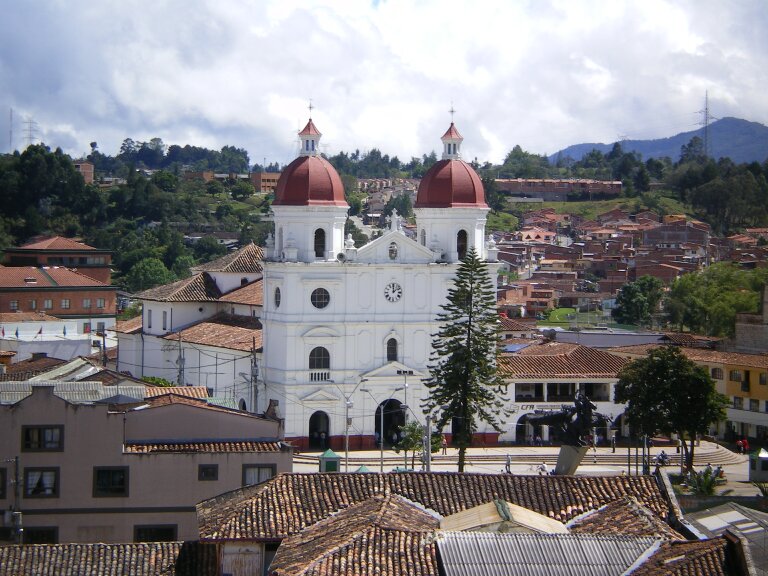
Rionegro (Spanish pronunciation: [rioˈneɣɾo]) is a city and municipality in Antioquia Department, Colombia, located in the subregion of Eastern Antioquia. The official name of the city is Ciudad Santiago de Arma de Rionegro. Rio Negro means "Black River" in Spanish, as the city received its name after a river that looks black because of the shadows cast by trees. The river traverses the city and it is the most prominent geographical feature of the municipality. Rionegro is also sometimes called the Cuna de la democracia (Cradle of democracy) as it was one of the most important cities during the era of the Colombia's struggle for independence and the 1863 constitution was written in the city.
Key Information
History
[edit]The territory was first mentioned in 1541 by the Spanish Lieutenant Álvaro de Mendoza. When the Field Marshal Jorge Robledo took possession of the Valley of Aburrá, he was commissioned by Álvaro de Mendoza. According to Fray Pedro Simón, Robledo was the first Iberian man who discovered the Valley of San Nicolás on 2 September 1541.
Don Juan Daza, a Spaniard of illustrious lineage, took possession of the lands sometime later, and on 8 November 1581, in agreement with the rituals of the laws of Indias, nailed his sword in the ground marking it as an inhabited place and began constructing a farm.
Immigration to Rionegro came from numerous regions of the country, including from the same provincial capital of the time, Santa Fe de Antioquia and the original ranch grew into a village and then a town in the first half of the 17th century. The chapel, Concatedral de San Nicolás el Magno, consecrated to Saint Nicholas was built as early as 1642, another reason why the territory reached a greater degree of independence for religious reasons. Yet, for most part of the 18th century, Rionegro was isolated by the jungle and mountains, and its chapel being only a humble one made of straw and bahareque. In 1783, Rionegro had enough population to become like a municipality, resulting in becoming the City of Santiago de Arma de Rionegro in 1786, with administrative powers under certification of King Carlos III, issued in the Palace of San Idelfonso on 25 September 1786. After this event, its isolation decreased, resulting in the visit of the bishop of Popayán in 1793. After seeing the bad state and rusticity of the chapel, the bishop ordered it to be demolished and a new one was built, its inauguration taking place in 1803. Rionegro became an important town, and a new distribution of lands was made (resulting in the colonization of the south of the region).
Rionegro grew in the 19th century and was an important center during the end of the Spanish rule, and in the early years of Independence. The city then rivaled Santa Fe de Antioquia to compete for the capital of Antioquia, until the city of Medellín grew prominently and far exceeded the growth of these cities.
Geography and climate
[edit]The municipality of Rionegro is located in the central mountain range of the Andes in eastern Antioquia. With a total area of 196 km2, is part of the sub-region of Eastern Antioquia. The city is surrounded in the north by the municipalities of Guarne and San Vicente, in the east by the municipalities of Marinilla and El Carmen de Viboral, in the south by the municipality of La Ceja, and in the west by the municipalities of El Retiro and Medellín.
The city of Rionegro is located at 6°9′18″N 75°22′48″W / 6.15500°N 75.38000°W, at an average elevation of 2,125 metres (6,972 ft) above sea level. The average annual precipitation varies between 1,800 and 2,500 millimetres (71 and 98 in) with an average temperature of 17 °C or 62.6 °F. Much of the land consists of volcanic ashes and soils with a high resistance to erosion.

The altitude of the rest of the territory varies between 2,100 and 2,600 metres (6,890 and 8,530 ft), and the topography is characterised by a number of small hills, some of which may rise to a greater height and slope like Cerro del Capiro, located in limits with the municipality of La Ceja. A sharper mountainous system emerges towards the West of the municipality, which becomes a physical barrier between the Valley of the Aburrá and the Plateau of Rionegro, from where the main affluents of the Negro River are born. The main hills of the mountainous chain that surround the Valley by Rionegro are: Alto Gordo, Alto de Amariles, Alto de Salazar o La Pilastra, Cerro Verde, Alto de Careperro, Alto de Pantanillo, Cerro Corcovado and Cerro del Capiro.
Part of the city is an alluvial plain of the Negro River and its tributaries, which also include the Pantanillo River and the gorges such as Las Palmas and Espíritu Santo y Fizebad. Historically the Negro River divided the valley in two, with the Valley of Llanogrande and the Valley of San Nicholas. Hydroelectric companies operate in the area, and have constructed a Hydroelectric Power station at Guatapé with the Santa Rita Dam. Today the hydroelectric complex of Eastern Antioquia consists of five power stations, two of which are public companies of Medellín city.
| Climate data for Rionegro (José María Córdova International Airport), elevation 2,073 m (6,801 ft), (1981–2010) | |||||||||||||
|---|---|---|---|---|---|---|---|---|---|---|---|---|---|
| Month | Jan | Feb | Mar | Apr | May | Jun | Jul | Aug | Sep | Oct | Nov | Dec | Year |
| Mean daily maximum °C (°F) | 21.8 (71.2) |
22.2 (72.0) |
22.3 (72.1) |
22.2 (72.0) |
22.5 (72.5) |
22.5 (72.5) |
22.5 (72.5) |
22.6 (72.7) |
22.4 (72.3) |
21.8 (71.2) |
21.6 (70.9) |
21.7 (71.1) |
22.2 (72.0) |
| Daily mean °C (°F) | 16.7 (62.1) |
17.1 (62.8) |
17.1 (62.8) |
17.3 (63.1) |
17.4 (63.3) |
17.3 (63.1) |
17.3 (63.1) |
17.3 (63.1) |
17.1 (62.8) |
16.5 (61.7) |
16.5 (61.7) |
16.6 (61.9) |
17.0 (62.6) |
| Mean daily minimum °C (°F) | 12.4 (54.3) |
12.6 (54.7) |
12.7 (54.9) |
13.2 (55.8) |
13.1 (55.6) |
12.4 (54.3) |
11.7 (53.1) |
11.9 (53.4) |
12.3 (54.1) |
12.5 (54.5) |
12.7 (54.9) |
12.6 (54.7) |
12.5 (54.5) |
| Average precipitation mm (inches) | 64.6 (2.54) |
81.4 (3.20) |
134.5 (5.30) |
206.7 (8.14) |
246.7 (9.71) |
178.0 (7.01) |
153.6 (6.05) |
167.7 (6.60) |
204.2 (8.04) |
231.5 (9.11) |
190.3 (7.49) |
104.2 (4.10) |
1,963.5 (77.30) |
| Average precipitation days (≥ 1.0 mm) | 15 | 15 | 19 | 23 | 24 | 21 | 20 | 20 | 24 | 25 | 22 | 17 | 241 |
| Average relative humidity (%) | 80 | 80 | 80 | 82 | 81 | 78 | 76 | 76 | 78 | 82 | 83 | 82 | 80 |
| Mean monthly sunshine hours | 164.3 | 144.0 | 136.4 | 126.0 | 155.0 | 180.0 | 217.0 | 217.0 | 174.0 | 145.7 | 132.0 | 139.5 | 1,930.9 |
| Mean daily sunshine hours | 5.3 | 5.1 | 4.4 | 4.2 | 5.0 | 6.0 | 7.0 | 7.0 | 5.8 | 4.7 | 4.4 | 4.5 | 5.3 |
| Source: Instituto de Hidrologia Meteorologia y Estudios Ambientales[2] | |||||||||||||
| Climate data for Rionegro (Selva La), elevation 2,090 m (6,860 ft), (1981–2010) | |||||||||||||
|---|---|---|---|---|---|---|---|---|---|---|---|---|---|
| Month | Jan | Feb | Mar | Apr | May | Jun | Jul | Aug | Sep | Oct | Nov | Dec | Year |
| Mean daily maximum °C (°F) | 22.3 (72.1) |
22.5 (72.5) |
22.8 (73.0) |
22.6 (72.7) |
22.8 (73.0) |
22.8 (73.0) |
22.9 (73.2) |
23.1 (73.6) |
22.8 (73.0) |
22.4 (72.3) |
22.1 (71.8) |
22.1 (71.8) |
22.6 (72.7) |
| Daily mean °C (°F) | 16.6 (61.9) |
16.8 (62.2) |
17.0 (62.6) |
17.1 (62.8) |
17.1 (62.8) |
17.0 (62.6) |
16.8 (62.2) |
16.9 (62.4) |
16.8 (62.2) |
16.5 (61.7) |
16.6 (61.9) |
16.6 (61.9) |
16.8 (62.2) |
| Mean daily minimum °C (°F) | 12.0 (53.6) |
12.2 (54.0) |
12.5 (54.5) |
13.0 (55.4) |
12.9 (55.2) |
12.0 (53.6) |
11.3 (52.3) |
11.4 (52.5) |
12.0 (53.6) |
12.4 (54.3) |
12.6 (54.7) |
12.3 (54.1) |
12.2 (54.0) |
| Average precipitation mm (inches) | 64.1 (2.52) |
86.8 (3.42) |
131.7 (5.19) |
199.8 (7.87) |
247.6 (9.75) |
187.4 (7.38) |
169.4 (6.67) |
180.2 (7.09) |
212.3 (8.36) |
225.2 (8.87) |
183.8 (7.24) |
98.8 (3.89) |
1,987.1 (78.23) |
| Average precipitation days (≥ 1.0 mm) | 14 | 16 | 19 | 21 | 24 | 20 | 19 | 20 | 23 | 24 | 21 | 16 | 237 |
| Average relative humidity (%) | 80 | 80 | 80 | 81 | 81 | 79 | 78 | 78 | 79 | 81 | 81 | 81 | 80 |
| Mean monthly sunshine hours | 158.1 | 138.3 | 130.2 | 114.0 | 139.5 | 168.0 | 204.6 | 195.3 | 153.0 | 120.9 | 120.0 | 142.6 | 1,784.5 |
| Mean daily sunshine hours | 5.1 | 4.9 | 4.2 | 3.8 | 4.5 | 5.6 | 6.6 | 6.3 | 5.1 | 3.9 | 4.0 | 4.6 | 4.9 |
| Source: Instituto de Hidrologia Meteorologia y Estudios Ambientales[2] | |||||||||||||
Demographics
[edit]According to the figures presented by the National Administrative Department of Statistics (DANE) in the 2005 census, the municipality of Rionegro had a total population of 101,046 inhabitants, the sixth largest populated area in Antioquia.[3]
The municipality had a population density of approximately 466 inhabitants per square kilometer. The ethnicity of the population is almost entirely of Mestizo and White persons (98.9%) with 1.1% Afro Colombian. 48.6% of the population are men and 51.4% women and city had a rate of 5.7% who were illiterate, but most of these were under 5 years of age and not yet eligible or mature enough for an education.[3] Public services in Rionegro are of a relatively high standard with 98.7% of houses supplied with electricity, 95.6% with a water supply and 87.1% with a telephone connection.[3]
In 2020, the population of the city and the municipality was estimated to be 142,995.
Ethnicity
[edit]According to DANE statistics 2005, the ethnic composition of this [3] city is:
Administration
[edit]Rionegro is governed by a democratic system based on the processes of administrative decentralization generated by the proclamation of Political constitution of Colombia in 1991. For the city there is a mayor with executive authority and a Municipal Council with legislative rights. The Mayor of Rionegro is naturally the head of the local government and the municipal administration, representing legal, judicial authority in the municipality. The position of mayor is chosen by popular vote for a period of four years, that at present is a position held by Hernan Ospina with Andres Julian Rendón as elected major for the term 2016–2019. Amongst his main functions are the administration of the resources of the municipality including responsibility of health, housing, education and road infrastructure, to guard the well-being and respond to the interests of his fellow citizens and to represent them before the National Government, besides being impelled to implement local policies to improve quality of life within the municipality.
The Municipal council of Rionegro, is also subject to election, composed by 17 politicians of varying political parties, chosen for a period of four years. The council is the associated executive organization of the municipality with obligation to take responsibility for Rionegro's territorial jurisdiction. Amongst its functions are approving the proposals and projects of the mayor, and with financial obligation to draw up the budget and to take responsibility of collecting rents and taxes. Administratively the Mayorship of Rionegro is divided in two main groups, the chief central administration and the decentralized organizations. These organizations are denominated Secretaries, whose main objective is the benefit of services to the community.
Economy
[edit]From many years ago, Rionegro has become the most important trade center in eastern Antioquia, due to its strategic position in the subregion. The city's dramatic growth has situated it as one of the richest cities in Colombia; its economy is mainly based on industries of all kinds, food industries, fabric industries, paper industries, chemical industries, and trade which brings Rionegro's people one of the highest standards of living in the country. Agriculture also plays an important role in the local economy; the main agricultural activities are floriculture and poultry production.
Transport
[edit]Rionegro has private shuttles that serve all the city's neighborhoods and bus routes throughout the city which connect it to Medellín and the other surrounding municipalities. Taxis are also well used in the urban area. Located within Rionegro city is José María Córdova International Airport, the second most important airport in Colombia, which serves Medellín. Both domestic and international flights arrive and depart from this airport.
Sites of interest
[edit]- Concatedral de San Nicolás el Magno -built in the 1790s and opened in 1804.
- Parque principal La Libertad
- Museo de Arte Religioso
- Calle de la Madera
- Tutucán
- Parque Los Osos Comfama de Rionegro
- Casa de La Convención

- Puente Mejía
- Palacio de la Cultura Ricardo Rendón
- Corregimiento San Antonio de Pereira
- Casa de La Maestranza
- Parque de San Antonio de Pereira
- Iglesia de San Antonio de Pereira
- Antiguo Colegio de Rionegro
- Iglesia de San Francisco
- Iglesia de Jesus Nazareno
- Archivo Historico de Rionegro
- Estatua Ecuestre del General José María Cordova
- Cementerio Principal
Religion
[edit]Sports
[edit]The city is home to Categoría Primera A football club Águilas Doradas since March 2015. They play their home games at the Estadio Alberto Grisales.
Education
[edit]Universidad Católica de Oriente is in Rionegro, as well as a small branch of the University of Antioquia.
Notable people
[edit]- Pablo Escobar, one of the most powerful drug lords of all time, one of the founders of the Medellín Cartel
- Roberto Escobar, older brother of Pablo Escobar and former high-ranking member of Medellín Cartel
- Iván Córdoba, footballer
Sister Cities
[edit]Rionegro's sister cities are:[4]
Biloxi, Mississippi, United States
Gulfport, Mississippi, United States
References
[edit]- ^ Citypopulation.de Population of Rionegro municipality
- ^ a b "Promedios Climatológicos 1981–2010" (in Spanish). Instituto de Hidrologia Meteorologia y Estudios Ambientales. Archived from the original on 15 August 2016. Retrieved 3 June 2024.
- ^ a b c d "Rionegro, Antioquia, Perfiles Departamentos y Municipios, Official Census 2005". Departamento Administrativo Nacional de Estadística. 2005. Archived from the original on July 26, 2008. Retrieved October 11, 2008.
- ^ Bitonel, Marco (July 30, 2025). "Biloxi, Gulfport sign international sister agreement with Rionegro, Colombia". wxxv25.com. WXXV-TV. Retrieved September 24, 2025.
External links
[edit]Rionegro
View on GrokipediaRionegro, officially known as Santiago de Arma de Rionegro, is a municipality and city in the Eastern Antioquia subregion of Colombia's Antioquia Department, serving as the capital of the Eastern Antioquian Province.[1] Founded in 1542, it lies approximately 45 kilometers east of Medellín at an elevation of 2,130 meters above sea level and covers an area of 198 square kilometers.[1][2] With a population of around 135,000 residents, Rionegro is historically dubbed the "Cradle of Liberty" for its pivotal role in early independence events starting in 1810, including being the first Antioquian municipality to proclaim local autonomy, and as the host of the 1863 National Convention that drafted the federal Constitution of the United States of Colombia, establishing a decentralized liberal republic.[1][3][4] The municipality hosts the José María Córdova International Airport, the main gateway for the Medellín metropolitan area, supporting aviation, commerce, and tourism-driven economic growth alongside traditional agriculture in its rural zones.[5]
Geography and Environment
Location and Physical Features
Rionegro is situated in the Oriente Antioqueño subregion of Antioquia Department, Colombia, at geographical coordinates 6°09′18″N 75°22′48″W.[6] The municipality lies approximately 33 kilometers east of Medellín by road, positioning it as a key eastern extension within the department's highland zone. Covering an area of 198 km², Rionegro occupies a strategic location in the inter-Andean valleys, facilitating connectivity across the region's transport corridors.[2] The city's average elevation reaches 2,125 meters above sea level, characteristic of the central cordillera's mid-altitude plateaus.[6] Topographically, Rionegro features undulating terrain formed by Andean foothills, with rolling hills, fertile valleys, and incised river courses that define its physical landscape. The Río Negro river basin influences local hydrology, draining portions of the municipality and supporting the area's geomorphic patterns through erosion and sediment deposition in the Andean foreland.[7] This setting contributes to a varied relief, including elevated plains interspersed with steeper slopes descending toward adjacent lowlands.Climate and Weather Patterns
Rionegro's climate is classified as oceanic (Köppen Cfb), featuring mild temperatures moderated by its elevation of 2,125 meters above sea level, which buffers it from the equatorial heat of Colombia's lower altitudes.[8] [9] This highland position results in consistently temperate conditions, with average annual temperatures ranging from 16°C to 18°C and minimal seasonal fluctuations, contrasting with lowland tropical areas where means often exceed 25°C and humidity drives thermal discomfort.[10] [11] Daily highs typically reach 20–24°C during the day, cooling to 10–14°C at night year-round, with rare extremes below 5°C or above 28°C recorded at local stations like José María Córdova International Airport.[10] [8] Precipitation averages 2,645–2,929 mm annually, distributed across frequent showers rather than intense monsoons, enabling year-round habitability without severe disruptions from heatwaves or freezes.[8] Rainfall exhibits a bimodal pattern, with peaks of 250–350 mm in April–May and October–November, driven by the twice-annual passage of the Intertropical Convergence Zone over the Andes, though drier intervals occur in December–March (under 100 mm monthly) and June–September.[10] [11] These patterns, corroborated by decades of airport meteorological data, underscore the region's stability, where altitude-induced adiabatic cooling maintains productivity in agriculture despite the high rainfall totals.Environmental Challenges
Rionegro's proximity to Medellín has driven peri-urban sprawl, transforming rural landscapes and disrupting traditional communal land relations in expansion zones. This metropolitan growth, part of the Aburrá Valley's urbanization, has led to shifts from agrarian to fragmented peri-urban patterns, with studies indicating accelerated land cover changes that prioritize residential and commercial development over preserved rural structures.[12][13] Deforestation remains a measurable pressure, with the municipality retaining 6.07 thousand hectares of natural forest in 2020, covering 31% of its land area. By 2024, an additional 26 hectares were lost, releasing 10.3 kilotons of CO₂ equivalent, primarily linked to edge effects from urban and infrastructural expansion rather than large-scale clearing.[14] Industrial and urban growth have strained local water resources, including pollution in tributaries like the Negro River from inadequate waste discharge amid rising development. To counter this, a modernization and expansion of the Rionegro wastewater treatment plant advanced in 2022, enhancing capacity to process effluents from expanding residential and industrial zones and mitigate downstream contamination.[15][16] ![Rural area of Rionegro, Colombia][float-right]History
Indigenous and Pre-Colonial Period
The region of present-day Rionegro, situated in the eastern highlands of Antioquia, was inhabited by indigenous groups affiliated with the Nutabe and Tahamí ethnic confederations prior to European contact. These populations formed part of the diverse indigenous mosaic of Antioquia, where the Nutabes occupied central and eastern territories characterized by undulating plateaus and river valleys conducive to dispersed habitation. Archaeological findings, including ceramic artifacts and lithic tools recovered from surface surveys, indicate small-scale communities reliant on slash-and-burn agriculture, cultivating staples such as maize (Zea mays), beans (Phaseolus spp.), and yuca (Manihot esculenta), alongside hunting of local fauna like deer and small game.[17][18] Trade networks linked these groups to broader regional exchanges, utilizing prehispanic footpaths that traversed the Antioquian cordillera for bartering goods including salt, cotton textiles, and basic gold ornaments extracted from alluvial deposits. Subsistence patterns emphasized self-sufficiency, with evidence from burial mounds and rock shelters suggesting semi-sedentary villages rather than fortified centers; population densities remained low, estimated at under 1 inhabitant per square kilometer based on ethnohistoric extrapolations from comparable highland groups. No major ceremonial or urban sites have been documented in the Rionegro vicinity, reflecting adaptation to the area's rugged terrain and limited arable flatlands, in contrast to denser settlements in Antioquia's western lowlands.[19][17]Spanish Colonial Era
Rionegro was established in 1541 as part of the Spanish conquest expeditions in the Antioquia region, with Marshal Jorge Robledo taking formal possession of the territory during explorations aimed at securing control over indigenous lands and resources. The settlement, initially known as Santiago de Arma de Rionegro, functioned primarily as an administrative outpost and base for further incursions into the eastern highlands, facilitating governance under the broader Province of Antioquia centered at Santa Fe de Antioquia.[20] This positioning enabled Spanish authorities to oversee tribute collection and suppress local resistance from sparse indigenous groups, such as those in the Nutibara and Aburrá cultural spheres, whose populations were rapidly diminished by disease, warfare, and exploitation.[21] The encomienda system played a central role in early colonial organization, granting Spanish encomenderos rights to indigenous labor and tribute in exchange for nominal Christian instruction and protection, which in practice drove resource extraction and demographic shifts.[22] In Rionegro and surrounding areas, these grants focused on alluvial gold mining operations, as Antioquia's geology favored placer deposits that required manual labor from reduced indigenous communities, supplemented by imported African slaves and European migrants.[23] This system contributed to the emergence of a mestizo population through coerced unions and voluntary intermixing, with high rates of Spanish immigration from northern Spain reinforcing Basque and Cantabrian lineages in the region's social structure during the 17th century. By the 18th century, Rionegro's role evolved to support the provincial economy through agricultural production that sustained mining camps and trade caravans, with the terrain's rivers aiding transport of gold and provisions toward coastal ports.[24] Encomiendas gradually declined as indigenous numbers fell, shifting reliance to family-based farming and artisan crafts, though gold remained the dominant extractive activity, with output fluctuating due to vein exhaustion and administrative reforms under the Bourbon monarchy.[25] Local elites accumulated wealth via these networks, establishing haciendas that integrated subsistence crops with export-oriented livestock, positioning Rionegro as a nodal point in internal commerce without significant urban development until later periods.[20]Independence Movement and Early Republic
Rionegro played a central role in Antioquia's revolutionary activities following the July 20, 1810, events in Bogotá that ignited broader independence sentiments across New Granada. As Spanish authority waned, local elites in Antioquia, including those from Rionegro, organized juntas to assert provincial sovereignty, contributing to the formation of the United Provinces. By August 11, 1811, Antioquia issued its formal Declaration of Independence, rejecting the Spanish Regency and establishing a provisional government focused on self-rule and defense against royalist forces.[26] This act marked a causal break from colonial hierarchies, enabling early republican experiments in governance amid the 1810–1814 Patria Boba period of factional strife and reconquest attempts. The municipality hosted key assemblies during these years, solidifying its reputation as the "Cuna de la Libertad" through deliberations on constitutional principles and autonomy that influenced Antioquia's alignment with federalist creoles over centralist factions. These gatherings emphasized empirical self-determination, drawing on local agrarian and mining interests to resist both Spanish restoration and Bogotá's dominance, fostering a tradition of decentralized authority. Revolutionary outcomes included fortified local militias and provisional codes that transitioned administrative control from viceregal appointees to elected bodies, though instability persisted until Bolívar's campaigns reconquered the region in 1816.[1] Rionegro's prominence endured into the early republic, culminating in the 1863 National Constituent Assembly convened there from February to May amid liberal victories in the preceding civil wars. On May 8, 1863, delegates promulgated the Constitution of the United States of Colombia, restructuring the nation as a federation of nine sovereign states with extensive local powers, including control over education, justice, and taxation; abolition of perpetual military service; and strict limits on central executive authority.[3] [27] This document, driven by figures advocating causal reforms to curb caudillo rule and church influence, empirically shifted governance toward state-level autonomy, enabling Antioquia's economic expansion but exposing vulnerabilities to inter-state conflicts that undermined national cohesion by the 1880s.19th and 20th Century Growth
Following independence, Rionegro experienced periods of instability due to Colombia's civil conflicts, including the Thousand Days' War (1899–1902), which saw Liberal forces seize nearby Medellín and engage in battles across Antioquia, disrupting local agriculture and trade while causing population displacement and economic stagnation in the region.[28] Recovery began in the early 20th century, driven by Antioquia's shift toward export-oriented agriculture, particularly coffee cultivation, which benefited from Rionegro's high-altitude terrain around 2,200 meters suitable for premium arabica varieties.[29] Smallholder production, fueled by local entrepreneurial initiative rather than large estates, expanded coffee exports from Antioquia, with Rionegro-area farmers forming export companies as early as 1881, contributing to regional prosperity amid national monetary reforms that stabilized trade.[30] Infrastructure improvements, such as the Antioquia Railway completed in 1929 after decades of construction starting in 1874, enhanced connectivity from Medellín eastward, indirectly supporting Rionegro's integration into broader markets by facilitating coffee transport and stimulating ancillary economic activities like processing and commerce.[31] This market-driven expansion, rooted in Antioquia's cultural emphasis on individual enterprise and frontier colonization efforts from the mid-19th century, transitioned the local economy from subsistence mining and cattle to diversified cash crops, laying foundations for sustained growth despite intermittent violence.[23] In the 20th century, Rionegro underwent urbanization tied to Antioquia's industrializing core in Medellín, with population rising from approximately 14,000 in 1905 to over 100,000 by 2000, reflecting migration for agricultural and service opportunities.[32] [33] This growth accelerated post-1950, as coffee revenues funded local improvements and proximity to urban centers drew labor, though it remained anchored in private initiative rather than centralized planning, exemplifying Antioquia's resilient, decentralized development model.[34]Post-2000 Developments
Following the establishment of the Zona Franca de Rionegro in 1993 near the José María Córdova International Airport, the municipality saw sustained industrial attraction and economic expansion into the 21st century, with the zone recognized as one of Antioquia's most productive by 2017, fostering manufacturing and logistics sectors through tax incentives and logistical advantages.[35][36] Municipal administrations prioritized infrastructure enhancements, including significant investments in water supply and sanitation; Empresas Públicas de Medellín allocated 488 billion Colombian pesos over more than a decade ending in 2024 to expand potable water networks, connecting additional households and supporting population growth.[37] Urban renewal efforts, such as the 2017 Integral Neighborhood Improvement project, targeted low-income areas with upgrades to housing, public spaces, and basic services to mitigate socioeconomic disparities.[38] The "Ciudad del Bienestar" framework, formalized in the 2024-2027 Development Plan, emphasized holistic improvements in public amenities, housing quality, and sanitation, aiming to elevate living standards amid metropolitan expansion pressures from Medellín's peri-urban spillover observed between 2000 and 2020.[39][13] In a pro-growth initiative contrasting national fiscal policies, Rionegro's council approved in September 2025 a tax relief program granting up to 80% discounts on overdue interest and 50% on penalties for local taxes like property and industry/commerce levies, valid from October 1 to December 31, 2025, to boost compliance and liquidity for residents and businesses.[40][41]Government and Politics
Municipal Administration
Rionegro's municipal government follows Colombia's standard mayor-council framework, with an alcalde (mayor) elected by popular vote for a non-renewable four-year term to lead executive operations, including policy execution, public service delivery, and administrative coordination under the oversight of Antioquia's departmental authorities.[42][43] The current term runs from January 1, 2024, to December 31, 2027, aligning with national electoral cycles.[44] The concejo municipal, comprising 17 concejales (councilors) also popularly elected for four-year terms, handles legislative duties such as ordinance approval, budget ratification, and fiscal oversight of the executive.[45][43] The executive branch's organizational structure features five central offices, 15 secretarías (secretariats) covering areas like government, finance, health, and planning, and 35 subsecretarías for specialized functions; a restructuring approved in April 2025 and implemented by October 2025 aimed to streamline operations and enhance public service efficiency.[46][47][48] Municipal finances derive from local taxes (e.g., property and industry/commerce levies), fees, and transfers from national and departmental levels; the 2025 budget totals 705,254,471,938 Colombian pesos, approved unanimously by the concejo on December 3, 2024, with projections for 2026 exceeding 950 billion pesos to support infrastructure and service priorities.[49][50] Administratively, the territory divides into four urban comunas—Comuna 1 (Liborio Mejía, encompassing the historic center and adjacent neighborhoods), Comuna 2 (San Antonio), Comuna 3 (Monseñor Alfonso Uribe Jaramillo), and Comuna 4 (El Porvenir)—plus rural zones organized into corregimientos (e.g., Llanogrande, Pontezuela, El Tablazo) and 36 veredas for decentralized service provision and planning.[51][52][53]Political History and Affiliations
Rionegro, as part of Antioquia department, has historically aligned with Colombia's conservative and center-right political traditions, reflecting the region's role as a stronghold for parties emphasizing security, traditional values, and market-oriented policies. Antioquia's conservatism traces to the 19th-century Liberal-Conservative conflicts, where the department consistently supported Conservative Party dominance, contrasting with more liberal coastal and southern areas. This legacy persisted into the late 20th and early 21st centuries, with strong backing for Álvaro Uribe Vélez during his governorship of Antioquia (1995–1997) and presidency (2002–2010), where his Democratic Security policy garnered widespread regional approval for reducing guerrilla influence.[54][55] In contemporary politics, Rionegro and Antioquia have served as a counterbalance to national leftward trends, particularly evident in the 2022 presidential election. While Gustavo Petro of the left-wing Historic Pact coalition won the June 19 runoff with 50.44% nationally against right-wing populist Rodolfo Hernández, Antioquia voters favored Hernández, mirroring the department's opposition to Petro's progressive agenda on issues like environmental regulation and social reforms. This divergence highlights Antioquia's function as a political brake on federal policies perceived as diverging from regional priorities, with local leaders publicly criticizing Petro's administration for punitive measures against opposition strongholds.[56][57] Party affiliations in Rionegro underscore this center-right orientation, with the Democratic Center—Uribe's party—holding significant sway. Andrés Julián Rendón, a Democratic Center affiliate and former Rionegro mayor (2012–2015), won the 2023 Antioquia governorship with endorsement from Uribe, securing victory in regional elections amid high departmental turnout favoring conservative coalitions. However, Rendón's tenure has been marred by a 2025 corruption investigation by Colombia's Supreme Court prosecutor, probing alleged irregularities in public contracts awarded during his Rionegro mayoralty, including appointments tied to family-linked firms; Rendón has denied wrongdoing, framing the probe as politically motivated amid tensions with the Petro government.[58][59][60]Governance Challenges and Reforms
Rionegro has encountered governance challenges centered on corruption risks in public contracting and resource management, mirroring broader issues in Antioquia. Investigations into the construction of police stations (CAIs) in the municipality uncovered irregularities, including overvalued contracts and favoritism toward allied firms, implicating former local officials and prompting ongoing probes by September 2025.[61] These cases highlight vulnerabilities in procurement processes, where 71 intercepted communications allegedly exposed coordinated schemes for illicit gains.[61] Additionally, the former mayor and current Antioquia governor Andrés Julián Rendón, who served as Rionegro's alcalde prior to 2019, faces scrutiny for creating entities like the Empresa de Desarrollo Sostenible del Oriente (EDESO) amid allegations of mismanagement and graft in regional projects.[62] In a related instance, the ex-gerente of a public enterprise was inhabilitated for 12 years and six months in July 2025 for personal misuse of a corporate credit card, underscoring accountability gaps in administrative oversight.[63] To counter these issues, the municipal government launched an administrative reform on October 17, 2025, focused on restructuring operations to expedite citizen services, bolster institutional efficiency, and prioritize transparency in key sectors like security and mobility.[64] This gradual process aims to reduce bureaucratic delays and enhance public management, with commitments to citizen-centered governance articulated by the administration.[65] Complementing structural changes, Rionegro's council approved a tax relief initiative in September 2025, granting up to 80% discounts on interest for overdue local taxes and 50% on sanctions, effective from October 1 to December 31, 2025, to incentivize compliance and increase revenue for service enhancements.[40] Such measures represent targeted efforts to rebuild trust and improve fiscal accountability, though empirical outcomes on service delivery, such as reduced processing times or higher compliance rates, await post-implementation data.Demographics
Population Trends
The population of Rionegro municipality has exhibited consistent growth, driven primarily by net in-migration rather than high natural increase. The 2005 census recorded 101,046 residents, reflecting expansion from earlier decades amid regional urbanization. By the 2018 census, the adjusted population reached 135,465, marking a compound annual growth rate of approximately 1.9% over the intervening period, attributable to inflows from rural Antioquia departments seeking proximity to urban centers.[66][67] DANE projections estimate the 2023 population at 145,704, with a post-2018 annual growth rate averaging 1.5%, sustained by commuter patterns from Medellín and continued rural-to-urban migration within Antioquia. This equates to an addition of roughly 2,000 residents annually, concentrated in peri-urban areas. Recent analyses indicate a slight deceleration to 0.8% annual growth into 2024, potentially reflecting maturing urban infrastructure constraints.[68]| Year | Population | Annual Growth Rate (approx.) | Primary Driver |
|---|---|---|---|
| 2005 | 101,046 | - | Baseline census |
| 2018 | 135,465 | 1.9% (2005-2018) | Rural migration |
| 2023 | 145,704 (proj.) | 1.5% (2018-2023) | Urban pull and commuters |
