Hubbry Logo
Robert BridgesRobert BridgesMain
Open search
Robert Bridges
Community hub
Robert Bridges
logo
8 pages, 0 posts
0 subscribers
Be the first to start a discussion here.
Robert Bridges
Robert Bridges
from Wikipedia

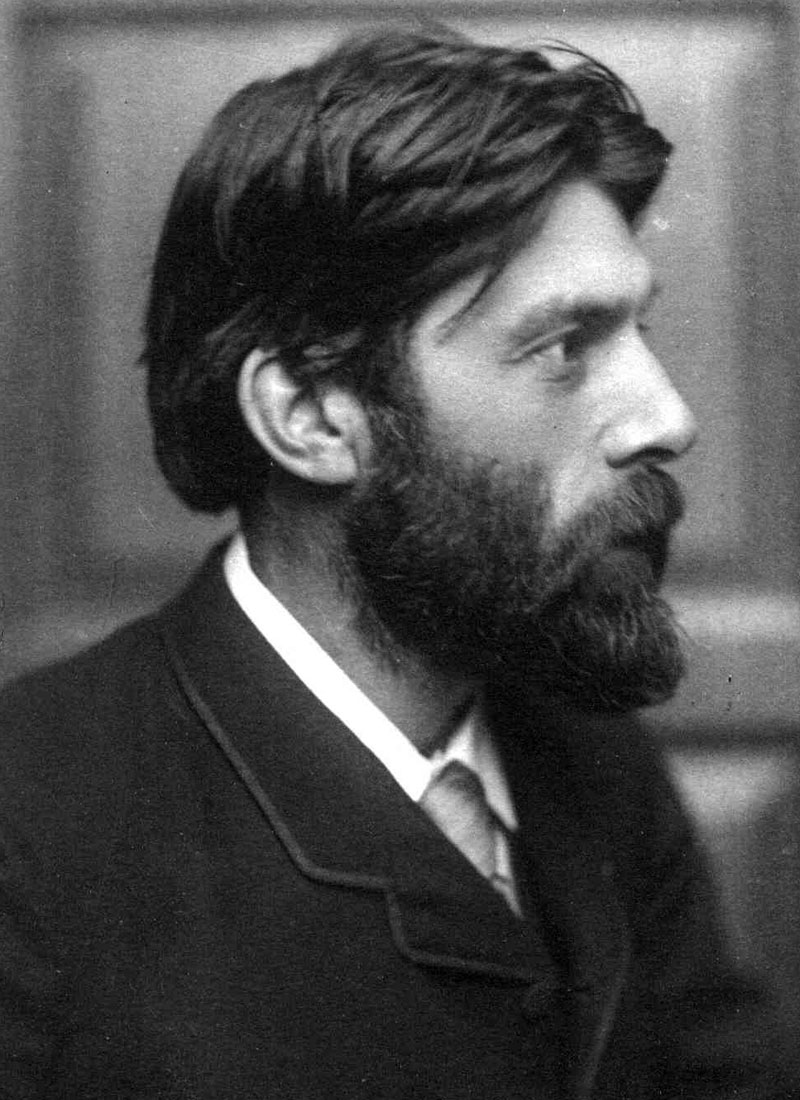
Robert Seymour Bridges OM (23 October 1844 – 21 April 1930) was a British poet who was Poet Laureate from 1913 to 1930. A doctor by training, he achieved literary fame only late in life. His poems reflect a deep Christian faith, and he is the author of many well-known hymns. It was through Bridges's efforts that the poet Gerard Manley Hopkins achieved posthumous fame.

Key Information

Bridges was a grandson of Sir Robert Affleck, 4th Baronet, and a stepson of the vicar John Edward Nassau Molesworth. [1] Bridges studied medicine at St Bartholomew's Hospital, and then practised as a casualty physician at his teaching hospital. He served as a full physician to the Great Northern Central Hospital from 1876 until 1885. [2] He retired as a physician in 1885, due to suffering from a lung disease. [2] During the First World War, Bridges was one of the writers serving in Britain's War Propaganda Bureau at Wellington House.[3]

Personal and professional life

[edit]

Bridges was born at Walmer, Kent, in England, the son of John Thomas Bridges (died 1853) and his wife Harriett Elizabeth, daughter of the Rev. Sir Robert Affleck, 4th Baronet. He was the fourth son and eighth child. After his father's death his mother married again, in 1854, to John Edward Nassau Molesworth, vicar of Rochdale, and the family moved there.[1]

Bridges was educated at Eton College and Corpus Christi College, Oxford.[4] Leaving Oxford in 1867 with a second-class honours degree in Literae humaniores in 1867,[5] he went on to study medicine in London at St Bartholomew's Hospital, intending to practise until the age of forty and then retire to write poetry. He practised as a casualty physician at his teaching hospital (where he made a series of highly critical remarks about the Victorian medical establishment) and subsequently as a full physician to the Great Northern Central Hospital (1876–85)[2](later the Royal Northern Hospital). He was also a physician to the Hospital for Sick Children.

Lung disease forced Bridges to retire from his post as physician in 1885,[2] and from that point on he devoted himself to writing and literary research. However, Bridges's literary work started long before his retirement, his first collection of poems having been published in 1873. In 1884 he married Mary Monica Waterhouse,[1] daughter of the architect Alfred Waterhouse R.A., and spent the rest of his life in rural seclusion, first at the Manor House Yattendon in Berkshire, then (from 1905) on the Boars Hill ridge above Oxford, where he died.[1]

He was elected to the Fellowship of the Royal College of Physicians of London in 1900. He was appointed Poet Laureate in 1913, the only medical graduate to have held the office.

He was the father of poet Elizabeth Daryush and of the cabinet secretary Edward Bridges.

Memorial to Robert Bridges and Edward Bridges, 1st Baron Bridges, in St Nicholas-at-Wade, Kent

Literary work

[edit]

As a poet Bridges stands rather apart from the current of modern English verse, but his work has had great influence in a select circle, by its restraint, purity, precision and delicacy yet strength of expression. It embodies a distinct theory of prosody. Bridges's faith underpinned much of his work.[6]

In the book Milton's Prosody (1889), he took an empirical approach to examining Milton's use of blank verse, and developed the controversial theory that Milton's practice was essentially syllabic. He considered free verse to be too limiting, and explained his position in the essay "Humdrum and Harum-Scarum". His own efforts to "free" verse resulted in the poems he called "Neo-Miltonic Syllabics", which were collected in New Verse (1925). The metre of these poems was based on syllables rather than accents, and he used the principle again in the long philosophical poem The Testament of Beauty (1929), for which he was appointed to the Order of Merit in that year.[7] His best-known poems, however, are to be found in the two earlier volumes of Shorter Poems (1890, 1894). He also wrote verse plays, with limited success, and literary criticism, including a study of the work of John Keats.

"Melancholia"
The sickness of desire, that in dark days
Looks on the imagination of despair,
Forgetteth man, and stinteth God his praise;
Nor but in sleep findeth a cure for care.
Incertainty that once gave scope to dream
Of laughing enterprise and glory untold,
Is now a blackness that no stars redeem,
A wall of terror in a night of cold.

Fool! thou that hast impossibly desired
And now impatiently despairest, see
How nought is changed: Joy's wisdom is attired
Splendid for others' eyes if not for thee:
Not love or beauty or youth from earth is fled:
If they delite thee not, 'tis thou art dead.

Bridges's poetry was privately printed in the first instance, and was slow in making its way beyond a comparatively small circle of his admirers. His best work is to be found in his Shorter Poems (1890), and a complete edition (to date) of his Poetical Works (6 vols.) was published in 1898–1905.

Despite being made poet laureate in 1913, Bridges was never a very well-known poet and only achieved his great popularity shortly before his death with The Testament of Beauty. However, his verse evoked response in many great British composers of the time. Among those to set his poems to music were Hubert Parry, Gustav Holst and later Gerald Finzi.[8]

During the First World War, Bridges joined the group of writers assembled by Charles Masterman as part of Britain's War Propaganda Bureau at Wellington House.[9]

At Oxford, Bridges befriended Gerard Manley Hopkins, who is now considered a superior poet but who owes his present fame to Bridges's efforts in arranging the posthumous publication (1918) of his verse.

Hymnody

[edit]

Bridges made an important contribution to hymnody with the publication in 1899 of his Yattendon Hymnal, which he created specifically for musical reasons. This collection of hymns, although not a financial success, became a bridge between the Victorian hymnody of the last half of the 19th century and the modern hymnody of the early 20th century.

Bridges wrote and also translated historic hymns, and many of these were included in Songs of Syon (1904) and the later English Hymnal (1906). Several of Bridges's hymns and translations are still in use today:

Phonetic alphabet

[edit]
"All the World’s a Stage" set in Bridges's phonetic alphabet.

Robert Bridges developed his own phonetic alphabet for English, with the help of the phonetician David Abercrombie,[10] though the letters were designed by the distinguished typographer Stanley Morison, of the Monotype Corporation.[11] The Oxford University Press printed seven volumes of his Collected Essays, Papers, &tc. in the alphabet. Bridges was also a founding member of the Society for Pure English.[12]

Major works

[edit]

Dates given are of first publication and significant revisions.

Poetry collections

[edit]
  • The Growth of Love (1876; 1889; 1898), a sequence of (24; 79; 69) sonnets
  • Prometheus the Firegiver: A Mask in the Greek Manner (1883)
  • Eros and Psyche: A Narrative Poem in Twelve Measures (1885; 1894), a story from the Latin of Apuleius
  • Shorter Poems, Books I–IV (1890)
  • Shorter Poems, Books I–V (1894)
  • New Poems (1899)
  • Demeter: A Mask (1905), performed in 1904 at the opening of the Somerville College Library
  • Ibant Obscuri: An Experiment in the Classical Hexameter (1916), with reprint of summary of Stone's Prosody, accompanied by 'later observations & modifications'
  • October and Other Poems (1920)
  • The Tapestry: Poems (1925), in neo-Miltonic syllabics
  • New Verse (1926), includes verse of The Tapestry
  • The Testament of Beauty (1929)

Verse drama

[edit]
  • Nero (1885), an historical tragedy; called The First Part of Nero subsequent to the publication of Nero: Part II
  • The Feast of Bacchus (1889); partly translated from the Heauton-Timoroumenos of Terence
  • Achilles in Scyros (1890), a drama in a mixed manner
  • Palicio (1890), a romantic drama in five acts in the Elizabethan manner
  • The Return of Ulysses (1890), a drama in five acts in a mixed manner
  • The Christian Captives (1890), a tragedy in five acts in a mixed manner; on the same subject as Calderón's El Principe Constante
  • The Humours of the Court (1893), a comedy in three acts; founded on Calderón's El secreto á voces and on Lope de Vega's El Perro del hortelano
  • Nero, Part II (1894)

Prose

[edit]
  • Milton's Prosody, With a Chapter on Accentual Verse (1893; 1901; 1921), based on essays published in 1887 and 1889
  • Keats (1895)
  • Hymns from the Yattendon Hymnal (1899)
  • Poems by the late Rev. Dr. Richard Watson Dixon: a selection with portrait and memoir by Robert Bridges (1909)
  • The Poems of Digby Mackworth Dolben: edited with a memoir by Robert Bridges (1911)
  • The Spirit of Man (1916)
  • Poems of Gerard Manley Hopkins (1918), edited with notes by R.B.
  • The Necessity of Poetry (1918)
  • Collected Essays, Papers, Etc. (1927–36)
  • Three Friends: Memoirs of Digby Mackworth Dolben, Richard Watson Dixon, Henry Bradley (1932)

See also

[edit]

References

[edit]
[edit]
Revisions and contributorsEdit on WikipediaRead on Wikipedia
from Grokipedia
Robert Seymour Bridges OM (23 October 1844 – 21 April 1930) was an English poet who served as of the from 1913 until his death. Trained as a physician, Bridges practiced in hospitals until retiring in his early forties to focus on writing. His poetry emphasized classical forms, technical precision in prosody, and philosophical themes, culminating in his late masterpiece The Testament of Beauty (1929), which earned him the . Bridges achieved literary prominence later in life, notably through his role in preserving and publishing the works of his friend , whose innovative he initially edited conservatively before later editions restored the originals. He composed hymns, plays, and masques, and advocated for English via a phonetic alphabet to align with . As , Bridges produced occasional verse, including patriotic pieces during , though his output was modest compared to predecessors. A classicist by inclination, Bridges remained detached from modernist movements, favoring measured neoclassical styles over experimental , which reflected his commitment to linguistic purity and formal discipline. His influence endured through scholarly editions and the Society for Pure English, which he co-founded to safeguard the language against foreign influences and phonetic drift.

Early Life and Education

Family Background and Childhood

Robert Seymour Bridges was born on 23 October 1844 in Walmer, , , the fourth son and eighth of nine children born to John Thomas Bridges (1805–1853), a man of private income educated at , and Harriet Elizabeth Bridges (née Affleck, 1807–1897), daughter of a clergyman who fostered reading among her children. The Bridges family belonged to the prosperous , residing in a house overlooking the anchoring ground of the British fleet, which provided an idyllic setting for his early years marked by the coastal environment of . Bridges's childhood stability ended abruptly with his father's death in 1853 at age 47, leaving the nine-year-old under altered circumstances. His mother subsequently relocated much of the family to , entrusting young Robert to the care of his uncle, the Reverend William Barnes, and aunt in , where he continued his upbringing amid familial support and literary encouragement from his mother's influence. This period of transition, though disruptive, preceded his entry into formal schooling and laid the groundwork for his later interests in and .

Formal Education and Early Influences

Bridges attended from 1854 to 1863, where he commenced writing poetry amid a rigorous classical curriculum that emphasized Latin and Greek texts. During this period, he developed early literary friendships, notably with the precocious poet Digby Mackworth Dolben, whose mystical verse and early death from typhoid in 1867 left a lasting impression, and with Lionel Muirhead, who became a lifelong confidant. These connections, forged in Eton's competitive environment, introduced Bridges to Romantic and devotional poetic sensibilities that subtly shaped his initial compositions, though his output remained private and experimental. Proceeding to , in 1863, Bridges pursued , graduating with a in 1867 after achieving second-class honors in . His studies deepened his affinity for ancient metrics and prosody, fostering a preference for formal structures over Victorian sentimentality, as evidenced by his translations of Virgil's during this time. A pivotal encounter occurred here with , a fellow student whose intellectually rigorous approach to language and faith initiated a correspondence that influenced Bridges' later editorial and metrical innovations, despite Bridges' initial critique of Hopkins' unconventional "." These formative years instilled in Bridges a commitment to precision in verse, drawing from classical exemplars like and , while Eton's communal life and Oxford's intellectual circles honed his resistance to ephemeral trends, prioritizing enduring form over emotional excess.

Medical Career

Professional Training and Practice

Bridges matriculated at , in 1863, earning a second-class degree in (classics) in 1867. Opting for a medical career thereafter, he spent eight months in studying the language essential for contemporary medical literature before entering Medical School in in 1869. His training emphasized a rigorous newly standardized at the institution, aligning with broader reforms in British medical education. In 1873, Bridges sat his final medical examinations at but failed the written component, prompting a six-month sojourn in to study Italian and informally before retaking and passing the exams in , thus qualifying as a physician. He immediately commenced practice as a casualty physician at St Bartholomew's, his , where the demanding role involved triaging over 100 patients per morning clinic and handling an annual caseload exceeding 31,000 cases, which he later described as both exhausting and formative. Expanding his roles, Bridges was appointed physician to the Great Northern Hospital in 1876 and assistant physician at the Hospital for Sick Children (Great Ormond Street) in 1877, while also maintaining a in . These positions exposed him to diverse clinical demands, from emergency care to pediatric medicine, though he innovated in casualty management by advocating systematic patient sifting to prioritize urgent cases amid overcrowding. His professional tenure ended prematurely in 1882 following a severe bout of that damaged his lungs, compelling retirement from active practice at age 37; nonetheless, he was elected a Fellow of the Royal College of Physicians in 1900 in recognition of his contributions.

Transition to Literary Focus

Bridges had long planned to retire from around the age of 40 to pursue writing full-time, a goal he articulated during his professional years. However, in 1881, a severe bout of necessitated prolonged and prompted his early departure from clinical practice three years ahead of schedule. This health crisis, compounded by lingering lung issues, ended his tenure as a physician at institutions including and the Great Northern Hospital, where he had served since qualifying in 1874. Following recovery aided by a recuperative tour of , Bridges relocated to the rural village of Yattendon in , seeking fresher air conducive to both health and creative work. There, unburdened by medical duties, he immersed himself in poetry composition, , and experimentation with prosody, producing works such as the verse drama Prometheus the Firegiver in 1883. This shift marked a deliberate pivot from empirical medical observation to aesthetic and philosophical inquiry, though his physician's precision informed his later advocacy for phonetic spelling reforms to reflect English speech patterns more accurately. The transition solidified Bridges' reputation as a poet of classical restraint, with early post-retirement publications like The Growth of Love (1889) demonstrating refined technique honed amid his divided attentions. Freed from hospital demands, he cultivated correspondences with figures such as , influencing mutual stylistic evolutions while establishing a legacy bridging scientific rigor and artistic formalism.

Personal Relationships

Marriage and Family

In 1884, Bridges married Mary Monica Waterhouse (1863–1949), the eldest daughter of the architect Alfred Waterhouse, on 3 September. The couple, who differed in age by nearly two decades, settled initially in Yattendon, , where Bridges largely withdrew from medical practice to focus on poetry and family life amid rural seclusion. Monica Bridges supported her husband's literary pursuits and became known for promoting italic handwriting in British education, though her role remained secondary to domestic responsibilities. The marriage produced three children: Elizabeth (1887–1977), who later married the poet Robert Daryush and pursued her own verse; Margaret (1889–1926); and Edward Ettingdene Bridges (1892–1969), who rose to prominence as a civil servant, serving as and receiving a peerage as first Bridges. Family life was marked by relocations for health reasons, including a move from Yattendon to Boar's Hill near in 1907 following illnesses affecting Monica and Margaret in 1902. The death of Margaret in 1926 profoundly grieved Bridges and his wife, prompting him to revise an unfinished poem into The Testament of Beauty, published in 1929. Monica outlived Bridges, who died in 1930, by nearly two decades.

Key Friendships and Correspondences

Bridges developed enduring friendships at , where he attended from 1854 to 1863, notably with composer , with whom he maintained a lifelong association rooted in shared intellectual and artistic interests. He also befriended poet Digby Mackworth Dolben during this period, a connection that exposed Bridges to early poetic influences amid their classical education. At , from 1863 to 1867, Bridges formed a pivotal friendship with , whom he met through High Anglican circles including William Sanday. Their correspondence, spanning 1865 to Hopkins's death in 1889, comprised hundreds of letters—enough to fill two wallets—covering , prosody, , and , despite divergences such as Hopkins's Jesuit conversion and experimental , which Bridges initially critiqued as obscure. Bridges preserved Hopkins's unpublished manuscripts, editing and issuing Poems of Gerard Manley Hopkins in 1918, a delayed but landmark publication that introduced the poet's innovative style to the public after nearly three decades of obscurity. In later years, Bridges engaged in correspondences with literary contemporaries that advanced his interests in metrics and language reform. His exchanges with , documented in a 1977 edition, addressed poetic theory and national , reflecting Bridges's advocacy for classical forms amid modernism's rise. Similarly, from 1900 to 1923, he corresponded with philologist Henry Bradley on and , influencing Bridges's efforts. These relationships underscored Bridges's role as a bridge between Victorian traditions and emerging innovations, though he prioritized empirical critique over stylistic novelty in his responses.

Poetic Development and Style

Evolution of Technique and Prosody

Bridges' initial poetic output, commencing with the 1873 collection Poems, adhered to established accentual-syllabic structures prevalent in Victorian poetry, employing iambic rhythms and to convey lyrical themes. These early works reflected his classical training and restraint, prioritizing clarity and formal discipline over metrical deviation. A transitional phase emerged in the late 1870s and 1880s, influenced by his correspondence with , during which Bridges tested innovative rhythms. In "London Snow" (composed circa 1879–1880), he incorporated elements of —a prosody emphasizing natural stresses regardless of syllable count—marking an early departure from rigid iambics toward speech-like cadence. His 1893 treatise Milton's Prosody further catalyzed this evolution, providing an empirical examination of John Milton's in Paradise Lost and later poems, where Bridges posited quantitative metrics—distinguishing long and short syllables by duration rather than accent—as superior for English versification. This analysis rejected prevailing stress-based theories, advocating instead for classical Greek and Latin principles adapted to , and directly informed Bridges' subsequent experiments with loose alexandrines and quantitative feet in pieces like "Wintry Delights." By the early twentieth century, particularly after his appointment as in 1913, Bridges abandoned accentual-syllabic constraints in favor of greater flexibility, culminating in his "Neo-Miltonic syllabics"—lines maintaining fixed syllable counts (often 12 to 16) without enforced rhymes or foot divisions. These appeared prominently in New Verse (1925), comprising twelve poems composed between 1921 and 1925, which prioritized syllabic regularity and musical flow over traditional . This prosodic innovation, indebted to Milton's variable pauses and elisions as detailed in Bridges' , enabled a prosody attuned to English's variable stresses while evoking classical austerity. The pinnacle of this development manifested in The Testament of Beauty (1929), a philosophical poem exceeding 4,000 lines in syllabic verse, where Bridges integrated quantitative principles with naturalistic phrasing to explore themes of and . Selling over 70,000 copies by 1946, the work exemplified his mature technique: a deliberate break from rhyme-bound forms to foster rhythmic independence, yet rooted in empirical observation of speech and classical models, distinguishing it from contemporaneous movements.

Commitment to Classical Forms and Innovation

Bridges maintained a steadfast dedication to the disciplined structures of classical poetry, emphasizing precise meter, rhyme, and prosody as foundational to poetic integrity. His technical mastery of these elements distinguished his work amid the emerging freer forms of late Victorian and Edwardian verse, as evidenced by his advocacy for metrical regularity derived from classical antecedents. In Milton's Prosody (1893), he rigorously analyzed the blank verse of John Milton's Paradise Lost, identifying systematic variations in iambic pentameter while upholding the poem's adherence to underlying rhythmic rules, thereby reinforcing the value of formal constraints in sustaining poetic elevation. This commitment extended to experimental adaptations of ancient quantitative meters—based on syllable length rather than stress—to the accentual patterns of English. In his Poems in Classical Prosody, first collected and published in expanded form around , Bridges composed original English verses mimicking Greek and Latin schemes, such as dactylic hexameters, to demonstrate the feasibility of classical prosody in a modern vernacular. These efforts balanced reverence for tradition with adaptation, prioritizing auditory precision over strict syllabic imitation to align with English phonetics. Bridges' innovations culminated in the invention of Neo-Miltonic , a meter emphasizing consistent counts per line while allowing variable stress placement, which he applied in poems composed between 1921 and 1925. This approach, inspired by Milton's flexible yet controlled rhythms, offered a to accentual-syllabic norms and experimentation, enabling nuanced expression of philosophical themes without abandoning formal discipline. His philosophical epic The Testament of Beauty (1929), written in loose octosyllabic lines approximating Alexandrines, exemplified this synthesis, achieving rhythmic vitality through syllabic patterning that evoked classical while addressing contemporary intellectual concerns. Through such methods, Bridges pioneered syllabic verse as a viable English form, influencing subsequent poets while critiquing the "free verse rebellion" as a dilution of poetic craft.

Religious and Hymnodic Contributions

Christian Faith in Works

Bridges' Anglican faith, shaped by a upbringing and early consideration of ordination in the , infused his poetry with themes of divine order, the sanctity of natural beauty, and rational spirituality reconciled with scientific insight. His works eschew dogmatic fervor in favor of a contemplative reverence for creation as evidence of God's harmonious design, reflecting his medical training's emphasis on empirical observation. This integration appears subtly yet pervasively, portraying beauty not as mere aesthetic pleasure but as a conduit for and ethical elevation. In the lyric "I love all beauteous things," from The Shorter Poems (1894), Bridges declares: "I love all beauteous things, / I seek and adore them; / hath no better praise, / And man in his hasty days / Is honoured for them." Here, adoration of transient natural forms—flowers, clouds, and human artifice—serves as the highest tribute to the divine, equating aesthetic pursuit with religious duty and affirming humanity's role in manifesting 's glory through creation. The poem's serene meter and precise imagery underscore a grounded in sensory experience rather than abstract . Bridges' mature synthesis of and culminates in The Testament of Beauty (1929), a four-book philosophical poem commenced on Day 1924 and completed amid personal loss, including the death of his daughter in 1926. The work posits as the unifying principle bridging instinct, reason, and spirit, offering "religious consolation for the ground of " amid evolutionary flux and human striving. It envisions the soul's alignment with cosmic harmony as a testament to divine benevolence, critiquing mechanistic while endorsing a teleological view of nature's progression toward under God's providence. This rational , distinct from the intense sacramentalism of his Catholic friend —whose poems Bridges edited and published posthumously in 1918—prioritizes intellectual clarity and ethical within Christian orthodoxy.

The Yattendon Hymnal and Hymn Composition

In 1894, Robert Bridges, residing in the village of Yattendon, , initiated the compilation of The Yattendon Hymnal in collaboration with musical scholar Wooldridge, aiming to provide suitable hymns for local village choirs with an emphasis on dignified, unaccompanied singing drawn from historical sources. The hymnal was issued in four parts beginning that year, culminating in a complete edition of 100 hymns in 1899, featuring tunes sourced primarily from , English, French, and German Reformation-era hymns, Restoration composers such as Jeremiah Clark and , and select modern compositions by Wooldridge, while deliberately excluding secular or mixed-origin melodies to prioritize modal purity and textual-musical alignment. Bridges' wife, Mary Monica Bridges (née Waterhouse), assisted by providing accompaniments, reflecting the project's intimate, family-involved genesis tied to their rural Anglican parish needs rather than broad congregational reform. Bridges' principal contributions centered on textual selection, , and , where he modernized archaic for clarity while preserving theological depth, often including notes on origins and modifications to underscore authenticity; he supplied or adapted approximately 44 texts, including original compositions and translations from Latin and German, such as his rendering of "Ah, holy Jesus, how hast Thou offended" from Johann Heermann. The eschewed Victorian sentimentality in favor of austere, metrically precise pairings, influencing subsequent collections like (1906) through its revivalist principles, though its limited print run and focus on elite musical standards curtailed widespread adoption. Beyond the , Bridges composed numerous texts reflecting his Anglican , prioritizing rhythmic fidelity to potential tunes and doctrinal over emotional excess; notable examples include "Rejoice, O land, in God thy might," a post-coronation for in 1902, and translations like "" and "When morning gilds the skies," which achieved broad usage in English hymnals due to their literary polish and avoidance of metrical irregularities. His approach, articulated in contemporaneous essays on hymn-singing principles, advocated for texts that supported modal melodies without concessions, contributing to a niche but enduring elevation of hymnody's artistic standards amid late-19th-century proliferation of populist compilations.

Linguistic and Phonetic Reforms

Development of the Bridges Phonetic Alphabet

Robert Bridges initiated the development of his phonetic alphabet in the early 1910s as part of broader efforts to reform English orthography and counteract what he perceived as the degradation of pronunciation. In 1910, he composed an essay on the state of English pronunciation, which was expanded and published in 1913 as A Tract on the Present State of English Pronunciation by the Clarendon Press. This work argued for phonetic spelling in primary education to standardize sounds and preserve clearer vowel articulations, opposing the prevalent reduction of unstressed vowels to schwa. Bridges founded the Society for Pure English in 1913 to promote such reforms, including simplified spellings by removing mute letters, such as "hav" for "have," "liv" for "live," and "coud" for "could." The adapted existing Roman letter shapes rather than inventing entirely new symbols, drawing on Anglo-Saxon and fonts sourced from the to represent phonemes more accurately. Bridges employed modifications like a script 'g' for the /g/ and an 'ŋ'-like form for the velar nasal /ŋ/, while simplifying words by omitting historically silent final '-e', as in "motiv" for "motive." His system aimed to align closely with a preferred educated , favoring northern English qualities and critiquing urban "vulgarities" like those in speech. By 1913, Bridges demonstrated the alphabet through phonetic res spellings of literary texts, including Shakespeare's "," to illustrate practical application. Bridges continued refining the system into the , reissuing essays with updated orthographic proposals, and in assumed chairmanship of the BBC's Advisory on Spoken English to influence broadcast standards. Despite these efforts, the saw limited adoption, persisting mainly through examples in his publications and advocacy via the Society for Pure English. Bridges' work emphasized retaining etymological cues where possible, distinguishing it from more radical reforms like George Bernard Shaw's .

Advocacy for Spelling Reform

Robert Bridges advocated to align more closely with contemporary , viewing the existing system's irregularities as a barrier to linguistic clarity and . As co-founder of the Society for Pure English in 1907, he promoted standardized as a prerequisite for orthographic changes, arguing that dialects and inconsistent speech must first be rationalized before spelling could be adjusted accordingly. His efforts emphasized prescriptivism, fixing an ideal —drawing from educated southern English speech—prior to reforming letters to match sounds. In his 1913 publication A Tract on the Present State of English Pronunciation, Bridges detailed phonetic inconsistencies and proposed initial simplifications, such as eliminating mute letters in common words: hav for "have," liv for "live," and coud for "could." These changes aimed to remove "useless" silent elements without fully phoneticizing the alphabet, preserving some historical forms while enhancing readability for learners. He extended this through the Society for Pure English tracts, experimenting with typefaces and symbols derived from Anglo-Saxon characters to better represent phonemes. Bridges's advocacy gained traction during his tenure as (1913–1930), when he persuaded to issue reprints of his essays incorporating progressive degrees of reformed spelling, such as tu for "to," wud for "would," fenomenal for "phenomenal," and brawht for "brought." This methodical approach sought gradual implementation to minimize disruption to literary heritage and etymological links, contrasting with more radical proposals by contemporaries like . Despite limited widespread adoption, Bridges's work influenced discussions on phonetic and informed later simplified spelling initiatives.

Major Literary Works

Poetry Collections and Key Poems

Bridges's early poetic output included the The Growth of Love, initially published in 1876 as a cycle of 24 sonnets depicting an oblique account of a romantic attachment, and substantially revised in to encompass 79 sonnets exploring themes of love's progression and philosophical introspection. A further edition in 1898 reduced it to 69 sonnets, reflecting ongoing refinements to its structure and expression. His reputation for solidified with Shorter Poems, issued in two volumes in 1890 and 1894, which gathered concise, nature-infused pieces emphasizing precise imagery and classical restraint, such as "London Snow," evoking winter's quiet transformation of urban scenes, and "The from Her Watch-Tower," contemplating celestial beauty. These collections prioritized metrical purity and emotional subtlety over narrative scope, drawing from personal observations of the English countryside. Subsequent volumes like New Poems (1899) extended this lyric mode with explorations of domestic harmony and ethical reflection, while Later Poems (1912) incorporated experimental prosody aligned with Bridges's phonetic interests. The Testament of Beauty (1929), Bridges's culminating philosophical poem in four books composed in loose Alexandrines, synthesizes his views on , reason, and aesthetic harmony, arguing for beauty as an emergent property of divine order amid natural processes; it sold over 20,000 copies in its first year, underscoring late-career acclaim. Key passages, such as the opening on reason's limits against sensory , exemplify his synthesis of science and .

Verse Dramas and Prose Essays

Bridges composed eight verse dramas between 1885 and 1894, emphasizing classical meters, historical, and mythological themes rendered in English verse adaptations of Greek and Roman styles. His first, Nero, published in 1885, portrays the initial years of the Roman emperor's reign as a tragedy in blank verse, focusing on political intrigue and moral decay. Subsequent works include The Feast of Bacchus (1889), a partial translation and adaptation of classical bacchanalian motifs; Achilles in Scyros (1890), exploring the hero's concealment among women; Palicio (1890), a romantic drama in Elizabethan style; The Return of Ulysses (1890); The Christian Captives (1890), depicting early Christian persecution; The Humours of the Court (1893), a comedic exploration of courtly manners; and The Second Part of the History of Nero (1894), continuing the emperor's narrative from the death of Burrus to Seneca's demise. These dramas, often printed in limited editions by publishers like George Bell & Sons, prioritized poetic innovation over stage viability, with Bridges employing quantitative prosody to evoke ancient rhythms while critiquing modern dramatic conventions. Bridges also produced prose essays on , prosody, and criticism, culminating in the Collected Essays, Papers, &c. (1927–1936), issued in ten volumes by . This compilation includes lectures and papers such as "The Influence of the Audience on Shakespeare's ," "Humdrum & Harum-Scarum: A Lecture on ," "," and "A Critical Introduction to Keats," reflecting his advocacy for disciplined verse forms against emerging modernist looseness. Earlier standalone essays, like those in Milton's Prosody (1893), dissected accentual and quantitative elements in Milton's work, drawing from periodical contributions in 1887 and 1889 to argue for precise metrical analysis over intuitive . These writings underscore Bridges' first-principles approach to , prioritizing structural clarity and historical fidelity in evaluation.

Editorial Efforts, Including Hopkins

Bridges maintained a long correspondence with , beginning in the 1870s, during which they exchanged poems and critiques, with Bridges often expressing reservations about ' experimental "sprung rhythm" and unconventional rhyming as overly eccentric or "distressing." Following ' death on June 8, 1889, Bridges inherited a collection of his unpublished manuscripts, including over 70 poems, which he preserved but hesitated to publish due to their perceived difficulty and departure from classical norms, fearing public incomprehension. In the interim, Bridges selectively included a handful of Hopkins' poems in anthologies, such as Lyra Sacra (1895) and his own The Spirit of Man (1916), to gauge reception and gradually introduce the work without overwhelming audiences unaccustomed to its innovations. By 1918, amid and concerns over modernist poetic trends, Bridges compiled and edited the first collected edition, Poems of Gerard Manley Hopkins, published by Humphrey Milford in a limited run of 750 copies, featuring his own , notes, and textual emendations to clarify Hopkins' idiosyncratic and . In the , Bridges acknowledged transcription challenges, such as Hopkins' dense manuscripts, while defending the poet's genius despite stylistic "irregularities" that he attributed to deliberate innovation rather than flaw. Beyond , Bridges' editorial activities included compiling his own Collected Essays, Papers, Etc. (1927–1936), where he curated selections from his prose on , prosody, and language, emphasizing classical restraint over contemporary experimentation. He also contributed to the Society for Pure English, co-founding efforts in 1913 to standardize literary English through tracts on and , though these focused more on linguistic than textual editing of others' works. His editorial approach consistently prioritized to metrical tradition and clarity, as seen in his handling of , where he regularized some orthographic quirks without altering core content, thereby safeguarding unconventional voices for posterity.

Poet Laureateship

Appointment and Responsibilities

Bridges was appointed of the on 16 July 1913, succeeding following the latter's death on 2 June of that year. The position, traditionally held by the reigning monarch's warrant, was conferred by King George V, marking Bridges as the only physician by training to ever hold the office during its history. His selection reflected recognition of his poetic craftsmanship and scholarly contributions, though contemporaries noted his reluctance for public verse, preferring introspective and metrically innovative work over commissioned pieces. The Poet Laureateship carried nominal official duties, centered on composing verses for state occasions, royal events, and national milestones, with an annual stipend of £72 and a butt of sack wine (later commuted to cash). Bridges approached these responsibilities conservatively, producing occasional odes such as "Awake My Heart" for George V's in 1911 (pre-appointment) and wartime poems like "To the United States of America" in , but he resisted writing "to order" for ephemeral events. This stance drew criticism, including parliamentary debates during questioning his limited output amid public demand for morale-boosting poetry, as he prioritized artistic integrity over prolific official production. Throughout his tenure until his death on 21 April 1930, Bridges focused on elevating poetic standards through linguistic rather than abundant verses, aligning the role with his broader interests in prosody and English purity. He declined many requests for impromptu compositions, viewing the position as an honor rather than a contractual obligation for verse on demand, which underscored a tension between tradition and personal .

Wartime and Public Poetry

Upon the outbreak of the First World War in August 1914, Bridges, as , composed "Wake Up, England!", an exhortatory patriotic poem urging national vigilance and resolve against German aggression, with lines such as "Thou whose voice across the ages / Called to , and none hearkened / Hear also thy children's story". This marked the first of thirteen poems he published on the war and its immediate aftermath, reflecting a shift toward more direct, public-oriented verse amid the conflict's personal toll, including the wounding of his son in 1915. Bridges' wartime contributions emphasized themes of honor, duty, and English tradition, as seen in his opening poem for the 1914 anthology Poems of the Great War, which commanded "Up, careless, awake! / Ye peacemakers, fight! / stands for Honour: / God defend the Right!". He participated in Britain's war propaganda efforts, aligning his verse with official calls for unity and sacrifice, though his output remained measured compared to predecessors like Alfred Tennyson during the . In his public role as , Bridges resisted composing verses on demand for state occasions, leading to parliamentary complaints during the war that he produced insufficient patriotic material to bolster morale. Post-armistice, he issued October, and Other Poems; with Occasional Verses on the War in 1920, incorporating reflective war pieces alongside earlier works, which captured the era's lingering international tensions without overt triumphalism. These efforts, while technically accomplished, drew limited popular acclaim, prioritizing classical form over modernist experimentation prevalent among younger war poets like .

Reception and Legacy

Contemporary Praise and Criticisms

Bridges' appointment as Poet Laureate in 1913 was met with approval for his mastery of prosody and experimentation with classical forms, positioning him as a guardian of traditional English verse amid shifting literary tastes. His poetry earned praise from select circles for its restraint, purity of language, and intellectual subtlety, qualities that distinguished it from more emotive contemporaries. The 1930 publication of The Testament of Beauty, his philosophical magnum opus in four books, drew particular acclaim; a contemporary review in The Atlantic hailed it for possessing "the apocalyptic force which is the quality of great works," crediting Bridges with achieving "a high unity of poetic vision" by integrating disparate empirical observations on nature, evolution, and human aspiration. Eda Lou Walton similarly described the poem as a rigorous "argument and... proof that Beauty will prevail," emphasizing its causal reasoning over mere aesthetic protest. Critics, however, faulted Bridges for conservatism and detachment from modernist innovations, viewing his adherence to metrical regularity and neoclassical ideals as out of step with the era's experimental fervor, such as the fragmented styles emerging in works by . His reticence in personal expression and perceived weakness in creative vigor were noted as limiting factors, rendering his output intellectually refined but emotionally remote compared to broader contemporary trends. As Laureate, Bridges faced public rebuke for his sparse official output—earning the moniker "Silent Laureate"—especially during , when journalist lambasted his "indolence" in failing to produce timely patriotic verse, despite Bridges' eventual contributions like "Awake! The Land is Scatter'd with the Storm" in 1914. This criticism highlighted tensions between his principled selectivity and expectations for the role's ceremonial demands.

Modern Assessments and Influence

In the late 20th and early 21st centuries, literary critics have assessed Bridges' poetry as technically masterful yet somewhat insulated from the experimental impulses of , with his adherence to classical forms and quantitative meter positioning him as a transitional figure between Victorian restraint and modernist innovation. Scholars note that while works like The Testament of Beauty () demonstrate philosophical depth and rhythmic sophistication, they lack the disruptive energy of contemporaries such as or , leading to a perception of Bridges as elegant but peripheral in the canon of . His prosodic theories, outlined in essays like Milton's Prosody (1893, revised 1921), advocated for stress-based rather than syllable-based , influencing metrists but gaining limited traction amid dominance. Bridges' enduring influence stems chiefly from his posthumous edition of ' poems in 1918, which disseminated and innovative diction to a wider audience and shaped modernist sensibilities, including echoes in poets like . This editorial legacy has overshadowed his original verse in academic discourse, though formalist critics, such as Yvor Winters, praised his precision as a to modernist excess. His texts, including "The Dove of Peace" and adaptations like "All My Hope on God is Founded," continue in liturgical use, reflecting a sustained cultural footprint in . Spelling reforms proposed in On the Prosody of and later works, however, found negligible adoption, underscoring the limits of his linguistic innovations.

References

Add your contribution
Related Hubs
User Avatar
No comments yet.