Hubbry Logo
Robert PinskyRobert PinskyMain
Open search
Robert Pinsky
Community hub
Robert Pinsky
logo
8 pages, 0 posts
0 subscribers
Be the first to start a discussion here.
Robert Pinsky
Robert Pinsky
from Wikipedia

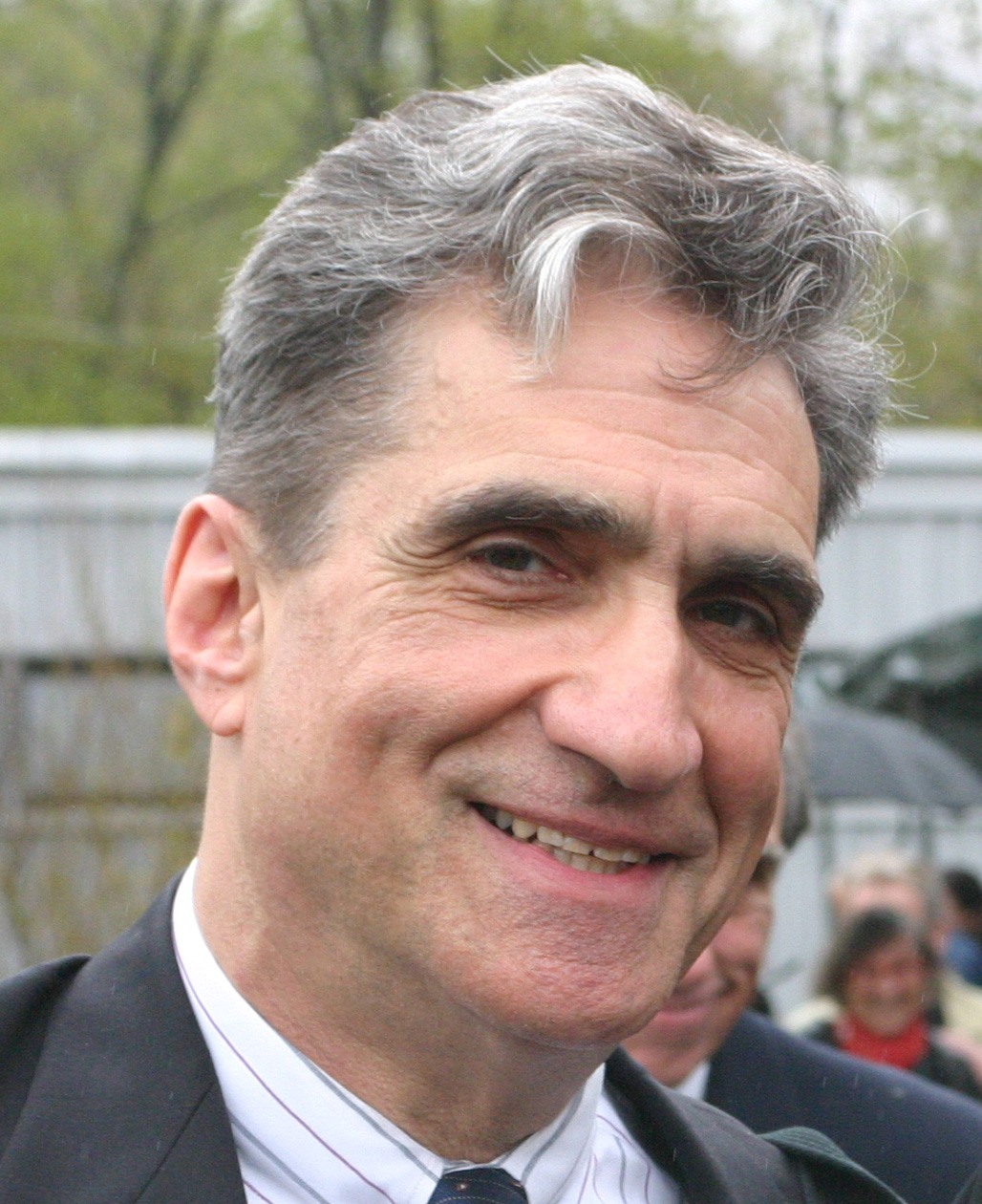
Robert Pinsky (born October 20, 1940) is an American poet, essayist, literary critic, and translator. He was the first United States Poet Laureate to serve three terms. Recognized worldwide, Pinsky's work has earned numerous accolades. Pinsky is a professor of English and creative writing in the graduate writing program at Boston University. In 2015, the university named him a William Fairfield Warren Distinguished Professor, the highest honor bestowed on senior faculty members who are actively involved in teaching, research, scholarship, and university civic life.

Key Information

Biography

[edit]

Early life and education

[edit]

Pinsky was born in Long Branch, New Jersey, to Jewish parents, Sylvia (née Eisenberg) and Milford Simon Pinsky, an optician.[1] He attended Long Branch High School.[2] He received a B.A. from Rutgers University in New Brunswick, New Jersey, and earned both an M.A. and PhD from Stanford University, where he was a Stegner Fellow in creative writing.[3] He was a student of Francis Fergusson and Paul Fussell at Rutgers and Yvor Winters at Stanford.[4]

Personal life

[edit]

Pinsky married Ellen Jane Bailey, a clinical psychologist, in 1961. They have three children.[5] Pinsky taught at Wellesley College and at the University of California at Berkeley, and since 1989 has lived in Cambridge, Massachusetts, and teaches in the graduate writing program at Boston University.[6]

Career

[edit]

Early on, Pinsky was inspired by the flow and tension of jazz and the excitement that it made him feel. As a former saxophonist, he has said that being a musician was a profoundly influential experience that he has tried to reproduce in his poetry. The musicality of poetry was and is extremely important to his work.[7] Additionally, Pinsky revealed in a 1999 interview with Bomb Magazine that he enjoys jazz for its "physical immediacy, improvisation and also the sense that a lifetime of suffering and study and thought and emotion is behind some single phrase."[8]

Pinsky has acknowledged that his poetry would change somewhat depending on the particular subjectivity of each reader. Embracing the idea that people's individuality would fill out the poem, he has said, "The poetry I love is vocal, composed with the poet's voice and I believe its proper culmination is to be read with a reader's imagined or actual voice. The human voice in that sense is not electronically reproduced or amplified; it's the actual living breath inside a body—not necessarily an expert's body or the artist's body. Whoever reads the poem aloud becomes the proper medium for the poem."[8] Pinsky observes 'the kind of poetry I write emphasizes the physical qualities of the words'[9] for poetry to Pinsky, is a vocal art, not necessarily performative, but reading to one self or recalling some lines by memory.[10] Pinsky comments 'all language is necessarily abstract' .[11] No aspect of a poem, he observes, is more singular, more unique, than its rhythm, for there are no rules.[12]

Pinsky (right) with Gerald Stern at the Miami Book Fair International 2011

He received a National Endowment for the Humanities Fellowship in 1974, and in 1997 he was named the United States Poet Laureate and Consultant in Poetry to the Library of Congress;[13] he was the first poet to be named to three terms.[14] As Poet Laureate, Pinsky founded the Favorite Poem Project, in which thousands of Americans of varying backgrounds, all ages, and from every state share their favorite poems. Pinsky believed that, contrary to stereotype, poetry has a strong presence in the American culture. The project sought to document that presence, giving voice to the American audience for poetry.[15]

The Shakespeare Theatre of Washington, D.C. commissioned Pinsky to write a free adaptation of Friedrich Schiller's drama Wallenstein. The Shakespeare Theatre presented the play, starring Stephen Pickering in the title role, directed by Michael Kahn, in 2013. Premiering on April 17 of that year, the play had a sold-out run, in repertory with Coriolanus.[16] Pinsky also wrote the libretto for Death and the Powers, an opera by composer Tod Machover. The opera received its world premiere in Monte Carlo in September 2010 and its U.S. premiere at Boston's Cutler Majestic Theater in March 2011.[17] Pinsky is also the author of the interactive fiction game Mindwheel (1984) developed by Synapse Software and released by Broderbund.[18]

Pinsky guest-starred in an episode of the animated sitcom The Simpsons TV show, "Little Girl in the Big Ten" (2002), and appeared on The Colbert Report in April, 2007, as the judge of a "Meta-Free-Phor-All" between Stephen Colbert and Sean Penn.

Since 2000, Farrar, Straus and Giroux have published four books of his poetry Jersey Rain (2000), Gulf Music (2007) Selected Poems (2011) and At the Foundling Hospital (2016).[19][20][21]

In 2012, Circumstantial Productions released the CD, PoemJazz by Robert Pinsky and Laurence Hobgood. In 2015, House Hour: PoemJazz II was released.[22][23]

Pinsky served as editor of the 25th anniversary volume of The Best of American Poetry anthologies called The Best of the Best of American Poetry (2013), and is the former poetry editor of Slate. He edited Singing School (2014), The Mind Has Cliffs of Fall: Poems at the Extremes of Feeling (2019) and The Book of Poetry for Hard Times (2021).

In 2023, W.W. Norton published Pinsky's memoir Jersey Breaks: Becoming an American Poet.

Bibliography

[edit]

Honors and awards

[edit]

Pinsky has received honorary doctorates from numerous institutions such as Northwestern University (2000),[25] Binghamton University (2001),[26] the University of Michigan (2001),[27] Lake Forest College (2007),[28] Emerson College (2012),[29] Southern New Hampshire University (2014)[30] University of Massachusetts Dartmouth (2016),[31] and Merrimack College (2016)[32]

References

[edit]
[edit]
Revisions and contributorsEdit on WikipediaRead on Wikipedia
from Grokipedia
Robert Pinsky (born October 20, 1940) is an American , essayist, literary critic, translator, and educator renowned for his innovative contributions to and public literary engagement, including his tenure as the 39th Consultant in Poetry to the from 1997 to 2000. Born in , Pinsky grew up in a working-class family and attended local schools before pursuing higher education at , where he earned a BA in 1962, and , where he received an MA and PhD in philosophy in 1966 as a Stegner Fellow in . Throughout his career, Pinsky has authored numerous collections of poetry that blend personal narrative with historical and cultural reflection, such as Sadness and Happiness (1975), The Figured Wheel: New and Collected Poems, 1966–1996 (1996), Gulf Music (2007), and his most recent, Proverbs of Limbo (2024). His prose works, including the memoir Jersey Breaks: Becoming an American Poet (2022) and critical volumes like The Sounds of Poetry: A Brief Guide (1998) and Democracy, Culture and the Voice of Poetry (1999), explore the role of poetry in American society. As a translator, Pinsky is celebrated for his verse rendition of Dante's The Inferno (1994), which earned the Los Angeles Times Book Prize and the Harold Morton Landon Translation Award from the Academy of American Poets. Pinsky's academic career spanned institutions including , the , and , where he served as the Robert and Rena Weaver Professor of and directed the graduate program in until his retirement as Professor Emeritus in 2025. During his terms, he founded the Favorite Poem , a national initiative encouraging Americans to share and record their favorite poems, resulting in the anthology Americans' Favorite Poems (2000) and an enduring online archive at favoritepoem.org. His honors include being a finalist for The Figured Wheel, the Lenore Marshall Poetry Prize, the Prize, the Shelley Memorial Award, the Award, the PEN/Voelcker Award for Poetry, and fellowships from the Guggenheim Foundation and the ; he is also a member of the American Academy of Arts and Sciences and the American Academy of Arts and Letters.

Biography

Early life and education

Robert Pinsky was born on October 20, 1940, in , to a Jewish family of modest means. His father, Milford Simon Pinsky, worked as an , while his mother, Sylvia Eisenberg Pinsky, was a homemaker. Raised in a lower-middle-class neighborhood amid a mix of Jewish, Italian, , and Irish residents in a declining town, Pinsky's early years were shaped by the vibrant, improvisational voices of his community, including bar talk from his paternal grandfather's Prohibition-era tavern and the rhythms of everyday speech. This working-class environment exposed him to literature through family discussions and visits, fostering an early fascination with language and sound patterns, as noted in his first-grade report card for "dreaming and talking to himself." Music also played a pivotal role in his childhood; at age thirteen, he began exploring melodies and rhythms via radio broadcasts of figures like Count Basie, alongside classical composers such as and , which influenced his developing sense of oral expression. During his high school years at Long Branch High School, where he graduated in 1958, Pinsky deepened his engagement with music and writing. He took up the , performing at school dances and bar mitzvahs, and was voted "Most Musical" by his peers, an pursuit that helped channel his energetic focus amid a period of academic unevenness. It was here that he began composing early poetic experiments, often orally through humming, muttering, and improvising with remembered phrases, drawing initial inspiration from neighborhood cadences and folk songs rather than formal writing. This period marked the start of his lifelong interest in poetry as a vocal, rhythmic art form, influenced by the improvisational spirit of . Pinsky pursued undergraduate studies at in , earning a B.A. in English in 1962. There, he immersed himself in literary pursuits, participating in campus activities that honed his critical engagement with poetry and prose, amid a broadening exposure to modernist works. For graduate work, Pinsky attended , where he received both an M.A. and Ph.D. in philosophy in 1966, supported by fellowships including the , , and Fulbright awards. Under the mentorship of poet-critic Yvor Winters, he focused on 19th-century British literature, refining his analytical approach to poetry through Winters's rigorous emphasis on form and precision. At Stanford, Pinsky's early poetic experiments evolved, incorporating influences from modernist poets such as , whose philosophical lyricism resonated with his interest in and , and , whose emphasis on American vernacular and objectivist clarity shaped his attention to everyday speech and perception. These formative years laid the groundwork for his transition into academic teaching and publishing.

Personal life

Pinsky married Ellen Jane Bailey, a clinical , in 1961 after meeting her while both were students at . The couple settled primarily in the area in the Boston suburbs, including Newton, where they raised their family and where Pinsky has resided for much of his adult life. They have three daughters: Nicole, who assisted with annotations for Pinsky's translation of Dante's Inferno; Caroline, a at the Wayland Animal Hospital; and Elizabeth, a pediatric . A lifelong enthusiast of jazz, Pinsky played the during high school and college, aspiring briefly to a career as a jazz musician before turning to . He has described music and poetry as "sister arts," noting how the improvisational rhythms of jazz inform the musicality in his own writing. In reflections on aging, Pinsky, who turned 84 in 2024, has spoken of his decision to retire from long-held commitments as influenced by the passage of time, stating that "the number tells me: better now than waiting." He has also shared a personal tendency to "live in the past," prioritizing family and close relationships amid life's later stages. Outside his professional endeavors, Pinsky has supported local literary communities in the area, including participation in initiatives like the Wayland Reads program to encourage engagement among residents.

Career

Academic positions

Robert Pinsky began his academic career as an of English at , where he taught from 1968 to 1980, emphasizing poetry workshops that encouraged students to explore contemporary verse through writing and discussion. In 1980, Pinsky joined the faculty at the , as a of English, serving until 1988 and contributing to the department's focus on and creative expression during a period of expanding interest in . Pinsky moved to in 1989 initially as a visiting , where he quickly became a core faculty member, eventually serving as director of the graduate program and professor of English and until his retirement in 2025. As the Fairfield Warren from 2015 onward, he mentored numerous MFA students in workshops, guiding them in crafting original work informed by historical and modern influences. Throughout his tenure at , Pinsky developed innovative courses that delved into the musicality of language, including explorations of sound in through rhythmic and sonic elements, as seen in his online "The Art of Poetry" series, which highlighted how auditory features shape verse from the to the present. He also taught on , drawing from his own work with Dante's Inferno to illustrate how poets adapt foreign sounds and structures into English equivalents, fostering students' understanding of cross-cultural poetic adaptation. Additionally, his classes on American verse traditions examined evolving forms from Whitman to contemporary voices, emphasizing 's role in and democratic expression. Pinsky's academic efforts extended to publications that reflected his pedagogical insights, such as essays on the challenges and rewards of teaching , including discussions in The Paris Review on balancing analysis with the oral performance of verse to engage reluctant readers. His book The Sounds of Poetry: A Brief Guide (1998), derived from his lectures and workshops, offered practical guidance on prosody and voice, influencing educators beyond his classrooms. Pinsky's influence on students was profound, with over 1,000 writers passing through his workshops at , many crediting his emphasis on revision and musicality for their development. Notable alumni include poets , a finalist and chancellor of the , and Erin Belieu, known for her acclaimed collections exploring identity and form, both of whom studied under Pinsky and later participated in events honoring his legacy. Upon his 2025 retirement, former students organized tribute readings, with testimonials praising his mentorship as transformative, fostering not just technical skill but a lifelong commitment to poetry's communal power.

Public service roles

Robert Pinsky served as the 39th Consultant in Poetry to the from 1997 to 2000, becoming the first individual appointed to three consecutive one-year terms in the role. During his tenure, Pinsky emphasized poetry's integration into daily American life, seeking to broaden its accessibility beyond academic and literary circles. He expanded the position's public profile through frequent media engagements, including appearances on programs like , where he discussed poetry's cultural resurgence and its relevance to contemporary society. One key extension of his efforts was the Favorite Poem Project, which documented Americans' personal connections to poetry and reinforced its role in public discourse. Following his Laureate service, Pinsky continued national advocacy as a Chancellor of the from 2004 to 2010, advising on initiatives to promote poetry education and appreciation across the . He has remained active in policy discussions on arts funding and education, notably addressing these topics in a 2025 interview on GBH's The Culture Show, where he advocated for sustained public investment in cultural programs amid ongoing budgetary challenges. Pinsky has also represented American poetry internationally, participating in events such as the International Writers Festival in 2011 and the Premio Capri in in 2009, where he showcased U.S. literary traditions to global audiences. These engagements highlighted poetry's diplomatic potential, aligning with his broader vision of it as a vital component of national and cross-cultural identity.

Collaborative initiatives

One of Robert Pinsky's most prominent collaborative initiatives is the Favorite Poem Project, which he founded in 1997 shortly after becoming the 39th Poet Laureate of the United States. The project invites Americans to submit and recite their favorite poems, aiming to document and celebrate poetry's role in everyday lives across diverse backgrounds. It officially launched in April 1998 with a five-city tour featuring public readings in New York, Washington D.C., Boston, St. Louis, and Los Angeles, drawing immediate national attention. During its initial one-year open call, the project received 18,000 submissions from individuals aged 5 to 97, representing every state and a wide range of occupations and educational levels. Following its early success, the Favorite Poem Project expanded significantly after 2000, incorporating online archives, educational resources, and community-based programs to sustain public engagement with . The initiative produced 50 short documentary videos featuring selected participants reciting their chosen poems, alongside two anthologies compiling submissions and related materials. Online platforms now host an ever-growing archive of videos, accessible for free, allowing ongoing submissions and encouraging users to explore recitations by poets such as and . School programs integrate these videos into classrooms, fostering interactive lessons where students record and share their own favorite poems, thereby reaching thousands of learners annually through vocal and personal connections to . By 2025, the project had inspired nearly 1,000 community reading events nationwide, strengthening local ties to while maintaining its core mission of democratization. In 2012, Pinsky launched the PoemJazz series, a multimedia collaboration with jazz pianist and composer Laurence Hobgood, blending spoken poetry with improvised accompaniment. The inaugural album, PoemJazz, released on Circumstantial Productions, features Pinsky reciting 13 of his original poems and translations—plus one by —set against Hobgood's piano and occasional guest musicians, treating the voice as an instrument in a jazz . This partnership emphasizes spontaneity, with live performances adapting the pieces anew each time, and has extended to subsequent recordings and tours, including appearances at venues like the in . The series highlights Pinsky's interest in poetry's musicality, drawing on Hobgood's background with vocalist to create accessible fusions of literary and improvisational arts. Pinsky has also fostered ongoing community partnerships through participatory readings and events that extend the Favorite Poem Project's ethos. These include collaborative gatherings where diverse groups— from students to public figures—share poems, as seen in the April 27, 2025, event at ArtsFalmouth, , featuring 12 local residents. A notable example is Pinsky's April 10, 2025, reading at the Poetry Center, where he presented works like "" and "" in dialogue with audience reflections, underscoring 's communal power. Such initiatives continue to amplify , with the project's resources archived at and the for enduring educational and cultural impact.

Literary Works

Poetry

Robert Pinsky's poetry is renowned for its engagement with the textures of everyday , weaving personal and collective histories into a tapestry that underscores human vulnerability and resilience. His work frequently explores mortality through meditations on loss and oblivion, often drawing on his to invoke concepts like and Gehinnom as metaphors for liminal states between life and death. Themes of history permeate his verses, linking mundane objects to broader narratives of exploitation and survival, while a rhythmic vitality influenced by infuses his lines with improvisational energy and sonic play. Pinsky's stylistic hallmarks include a conversational tone that democratizes complex ideas, the frequent use of tercets to create interlocking transitions and momentum, and the incorporation of techniques—honed through his renderings of Dante and others—to layer original poems with intertextual echoes. In his debut collection, Sadness and Happiness (1975), Pinsky established a foundation in introspective , probing the interplay of emotions in domestic and philosophical contexts, as seen in the title poem's examination of joy and sorrow as intertwined forces shaping . This early work reflects a pragmatic, worldly rooted in his lower-middle-class upbringing, prioritizing clear, discursive language over abstraction to capture the immediacy of . He followed with An Explanation of America (1979), an ambitious verse epistle addressing and personal roots. By History of My Heart (), Pinsky refined his approach, employing tercets to heighten rhythmic flow and facilitate seamless shifts between memory and reflection, marking a maturation toward more structured yet fluid explorations of identity and time. The continued in The Want Bone (1990), where historical depth intensified, blending personal voice with public reckoning to address collective traumas. A standout example is "Shirt" from The Want Bone, a tour de force that meditates on the Holocaust through the lens of a simple garment, tracing its production from Korean sweatshops to the 1911 Triangle Shirtwaist Factory fire and even slavery in South Carolina, thereby rhizomatically connecting consumer objects to histories of labor and atrocity. The poem's tercet structure propels its ekphrastic momentum, using noun phrases like "The back, the yoke, the yardage" to evoke the shirt's materiality while unfolding layers of human cost, earning widespread acclaim as a classic of contemporary American verse for its innovative fusion of the personal and historical. Pinsky's later collections, such as The Figured Wheel (1996), further evolved this synthesis, incorporating jazz-like variations in sound and rhythm to mimic the unpredictability of memory and cultural inheritance. Subsequent volumes, including Jersey Rain (2000), Gulf Music (2007), and At the Foundling Hospital (2016), continued to delve into themes of place, war, and human origins with rhythmic innovation and historical resonance. Pinsky's most recent work, Proverbs of Limbo (2024), extends this trajectory into realms of contemporary uncertainty, mining "limbal regions"—borders between health and illness, freedom and compulsion, intimacy and community—to confront aging, technological obsolescence, and societal fractures. Drawing on proverbial traditions akin to Blake's Proverbs of Hell and his Jewish heritage, the collection employs elliptical, unpunctuated lines and associative digressions to blend humor, erudition, and grief, as in "Poem of Names" and "Obituary," which honor the dead through repeated invocations against oblivion. Critics have praised it as a vital injunction against despair, affirming poetry's role in preserving shared memory amid existential limbo.

Translations and adaptations

Robert Pinsky's most celebrated translation is his 1994 rendering of Dante Alighieri's Inferno, the first part of the Divine Comedy, which captures the original's epic journey through Hell in a bilingual edition with facing Italian and English text. Praised for its rhythmic vitality and contemporary idiom, the translation employs slant and near rhymes to approximate Dante's interlocking terza rima structure while maintaining natural English flow, making the medieval narrative vivid and approachable for modern readers. This work earned the Los Angeles Times Book Prize for Poetry in 1995 and the Harold Morton Landon Translation Award from the Academy of American Poets in 1995, underscoring its impact on bringing classical Italian literature to English-speaking audiences. In addition to Dante, Pinsky adapted Friedrich Schiller's Wallenstein trilogy into a verse play in 2013, commissioned by the in This adaptation condenses Schiller's 18th-century German drama about the general into a cohesive English script, preserving the original's philosophical depth and political intrigue through heightened poetic language suitable for stage performance. Directed by Michael Kahn, the production ran at the Sidney Harman Hall, highlighting Pinsky's ability to adapt historical European theater for contemporary American stages. Pinsky's approach to and emphasizes formal elements like and meter to evoke the source material's sonic texture, alongside cultural adaptations that convey emotional and thematic resonance without literal fidelity. In the Inferno, for instance, he prioritizes equivalents that balance Dante's moral intensity with accessible, idiomatic phrasing, ensuring the poem's visceral energy translates across linguistic and temporal divides. Similarly, in Wallenstein, verse structures amplify the characters' internal conflicts, fostering a sense of tragic inevitability akin to Schiller's iambic patterns. Pinsky's translations have influenced literary education and performance, with the Inferno frequently adopted in university curricula for its clarity and poetic fidelity, as seen in syllabi for courses on and . Stage adaptations, including a 1998 production of the Inferno at the directed by Robert Scanlan, demonstrate its adaptability to spoken-word formats. As recently as April 2025, Pinsky's work continues to be highlighted in public readings and academic discussions, affirming its enduring role in revitalizing classical texts for diverse audiences.

Essays and criticism

Robert Pinsky's essays and criticism articulate poetry's vital role in engaging with cultural, social, and personal dimensions of human experience, positioning him as a prominent public intellectual who bridges literary analysis with broader societal concerns. His prose often defends poetry's relevance amid perceived cultural shifts, emphasizing its performative and communal aspects while critiquing historical and contemporary literary trends. In his 1988 collection Poetry and the World, Pinsky explores the connections between poets and the external world, examining how their personal and societal stances shape their work. The essays analyze figures such as , whose avant-garde style reflected working-class life, and , noted for her sociable presence and moral force, to offer critiques of American literary history and poetry's interplay with glamour, brutality, and immediacy. Published by , the book underscores themes of poetry's adaptation to modern realities through sinuous, insightful prose. Pinsky's The Sounds of Poetry: A Brief Guide (1998), issued by , delves into the auditory and performative elements of verse, portraying poetry as a "vocal, which is to say a bodily, " that employs —through the chest, , and —to shape sounds. The work covers sonic components like accent, duration, , line breaks, and patterns of likeness and unlikeness, drawing on examples from over 50 poets including Shakespeare, , and to illustrate how these "technologies" enable poetry's internal performance when read aloud. Addressing broader cultural debates, Democracy, Culture, and the Voice of Poetry (2002), based on Pinsky's Tanner Lecture and published by , counters the notion that is diminished by mass entertainment or prosaic public discourse. Pinsky argues that thrives in due to its intimate scale, which honors individual dignity and mediates between personal consciousness and communal life via rhythms and cadences, rejecting portrayals of and as adversarial. Pinsky has enriched periodicals with his criticism, contributing to The New York Review of Books and The Atlantic on literature's intersections with culture. These include reflections on poetry's societal function, such as his 1999 Atlantic essay "Poetry and American Memory," which frames poetry as a tool for preserving collective identity amid fragility. He has also written on translation's challenges and rewards, as in pieces tied to his own Dante work, and on jazz-poetry fusion, notably in a 2011 Slate essay exploring shared improvisational qualities between musical and poetic forms, inspired by his saxophone-playing youth. Complementing his critical output, Pinsky's 2022 memoir Jersey Breaks: Becoming an American Poet, published by W.W. Norton, interweaves personal narrative with poetic reflection, tracing his Jewish American upbringing in 1940s —from family dynamics and early struggles with reading to how local voices and music fostered his development as a . The highlights poetry's role in navigating life's challenges, including his mother's brain injury, while evoking a distinctly American tradition of self-invention. In recent work up to 2025, Pinsky continues to affirm poetry's consolatory power, as seen in his curation of The Book of Poetry for Hard Times (2021, W.W. Norton), where introductory analyses provide insight into poems addressing grief, despair, and rage across centuries, from Shakespeare to , demonstrating poetry's capacity to process extreme emotions. His 2022 essay "Change Trains at Summit" in The Yale Review reflects on personal origins and poetic emergence, while a 2025 Atlantic piece, "Old News," further examines cultural memory through verse. These efforts reinforce his ongoing advocacy for poetry amid societal pressures.

Recognition

Awards

Robert Pinsky's poetry has earned him several distinguished awards, highlighting his contributions to through innovative verse and linguistic precision. His 1996 collection, The Figured Wheel: New and Collected Poems, 1966–1996, was a finalist for the in Poetry, recognizing its comprehensive assembly of his early and mature work. The same volume also received the Lenore Marshall Poetry Prize from the National Book Critics Circle in 1997, an honor that underscores its critical acclaim for advancing poetic craft and cultural reflection. It also won the Award from the Poetry Society of America. In 1996, Pinsky received the Shelley Memorial Award from the Poetry Society of America for his contributions to poetry. In 2004, Pinsky was awarded the by , a lifetime achievement prize celebrating a whose body of work exemplifies sustained excellence and influence in contemporary American letters. This recognition affirmed his role as a pivotal figure in modern poetry, bridging personal narrative with broader societal themes. He also received fellowships from the Guggenheim Foundation (1974) and the . Pinsky's international stature is evident in awards such as the Manhae Foundation Prize from Korea in 2006, which honored his global poetic impact and humanistic vision, and Italy's in 2009, awarded for his translations and original that resonate across cultures. Additionally, his 2007 collection Gulf Music won the Memorial Poetry Prize in 2008, praising its musicality and engagement with American history and identity.

Honors and influence

Pinsky has received multiple honorary doctorates recognizing his contributions to literature and education, including a from in 2000, a from in 2012, a from in 1999, a from in 2006, and a from the in 2001. In 1998, he was honored with the Golden Plate Award from the American Academy of Achievement for his role as and his efforts to promote poetry in public life. Pinsky is a member of the American Academy of Arts and Sciences (elected 2003) and the American Academy of Arts and Letters (elected 2000). Through his long tenure as a professor of English and at , where he led graduate workshops until his retirement in 2025, Pinsky mentored generations of emerging poets, fostering a legacy of innovative and accessible verse. His initiatives, particularly the Favorite Poem Project, advanced inclusive by inviting diverse participants to share personal connections to verse, thereby shaping contemporary poets and broadening the form's appeal across social divides. Pinsky's cultural legacy lies in revitalizing public engagement with , exemplified by the Favorite Poem Project, which garnered over 18,000 submissions from Americans of varied ages and backgrounds, produced 50 video documentaries archived at the , and spurred nearly 1,000 community readings nationwide. This effort markedly increased the Library's resources utilization in education and public programs, underscoring poetry's communal power. In the post-2020 era, his anthologies The Mind Has Cliffs of Fall: Poems at the Extremes of Feeling (2019) and The Book of Poetry for Hard Times (2021) have addressed emotional and societal upheavals, offering verse as a tool for navigating crisis and promoting empathy.

References

Add your contribution
Related Hubs
User Avatar
No comments yet.