Hubbry Logo
RoundhayRoundhayMain
Open search
Roundhay
Community hub
Roundhay
logo
8 pages, 0 posts
0 subscribers
Be the first to start a discussion here.
Roundhay
Roundhay
from Wikipedia

Roundhay is a large suburb in north-east Leeds, West Yorkshire, England. Roundhay had a population of 22,546 in 2011.[1]

Key Information

It sits in the Roundhay ward of Leeds City Council and Leeds North East parliamentary constituency.

History

[edit]

Etymology

[edit]

Roundhay's name derives from Old French rond 'round' and the Old English word (ge)hæg 'enclosure', denoting a round hunting enclosure or deer park.[2][3] The Roundhay estate map of 1803 showed its circular shape.[4]

12th century

[edit]

Roundhay does not appear in the Domesday Book of 1086, but seems to have been formed soon afterwards, the first mention being in about 1153.[2] It was formerly a hunting park for the De Lacy family of Pontefract Castle. Coal and iron ore were mined and a smelting furnace was recorded in 1295.[2] Once these were exhausted (and woodland had been cleared for fuel) the area turned to farming.

16th century–18th century

[edit]

Roundhay was historically a township and chapelry[5] in the ancient parish of Barwick in Elmet, except for a small area in the east around Roundhay Grange (originally a grange of Kirkstall Abbey), which was a detached part of the township of Shadwell in the parish of Thorner.[6] Roundhay was a hamlet until 1803 when the park estate was bought by Thomas Nicholson who started a programme of landscaping and built the Mansion House. Housing was built for workers and more land sold on which other gentry built houses.[2]

19th century – Turnpike

[edit]

Until 1810, Gipton Wood was Gibton Forest separating Leeds from Roundhay Park and a turnpike road was constructed "from Sheepscar to Roundhay Bridge".[7][8] After the road was built the population increased from 84 in 1801 to 186 in 1822, mainly in grand houses for wealthier citizens of Leeds.[7]

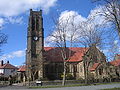
St John's Church (Anglican) 1826

In 1826, St John's Church was established to serve the population of Roundhay, Shadwell and Seacroft, a combined population of about 1100, who would otherwise have had to travel up to three miles to worship.[7] This made the area more attractive, the population rose to 300 in the 1830s in the form of a "township and genteel village" with "elegant villas, walks and plantations".[2][7]

In 1866, Roundhay and Shadwell both became separate civil parishes.[9]

City of Leeds

[edit]

In 1872, Roundhay Park estate was purchased by the City of Leeds and opened as a public park by His Royal Highness Prince Arthur on 19 September 1872.[10] At the time, there was much opposition as many considered the park was too far out of Leeds for the majority of the population to enjoy, and the park had just one access road and led to the park being dubbed a 'white elephant' in its early years.[11]

Redundant tram pylons in Roundhay

However, there was interest in developing housing, and a suburb began to develop around Lidgett Park.[12] Development was accelerated in 1884 by the provision of a horse-drawn public omnibus service between Leeds and Roundhay Park, then a horse-drawn tram and, on 11 November 1891, the first public electric tram service, which by 1894 provided a quarter-hourly service from 6 a.m.[7] The city sold surplus land, but placed restrictions in its use, stipulating stone for building and the prohibition of offensive trades.[2]

The area acquired a Post Office in 1868 and by the start of the 20th century some parts were lit by electricity. Brick-built detached and semi-detached housing was created along new roads such as The Avenue.

Pioneer movie footage

[edit]

On 14 October 1888, Louis le Prince recorded his short film Roundhay Garden Scene, in the garden of Oakwood Grange, the home of his parents-in-law, Joseph and Sarah Whitley, (the parents of John Robinson Whitley).[citation needed] This is believed to be the oldest surviving film in existence. (See External links)

20th century

[edit]

In 1901, a second Anglican Church and in 1902 a Congregational Church were established to provide worship within walking distance for the new working class population.[12][13] Lidgett Park Wesleyan Church followed in 1906.[2]

Roundhay, looking towards the park in 1963.

Lido

[edit]

In June 1907, an open-air swimming pool or 'lido' opened, at a cost of just over £1,600, built mainly by unemployed citizens. During the 1950s and 1960s, about 100,000 people a year visited the Roundhay 'swimming baths'.[4] On 9 November 1912, the civil parishes of Roundhay and Shadwell were abolished, and Roundhay became part of Leeds.[9] In 1911 the parish had a population of 2594.[14]

First World War

[edit]

During the First World War, Roundhay was used as a gathering place for soldiers, hence land by Prince's Avenue is known as Soldiers Field. After the war, new estates were built to the south and west of the park. Roundhay School for Boys was opened in 1926, and the School for Girls in 1932. After the Second World War housing filled available spaces, with smaller residences built in the grounds of larger ones, and large converted to flats.[2]

Country estates

[edit]

Roundhay Park Mansion

[edit]
J. Thorp's map of Roundhay, near Leeds c. 1819–21, including Roundhay Park Mansion (c. 1811), its lodge (c. 1815, later Elmete Hall) and nearby Goodman House (later Beechwood, c. 1820)
Roundhay Park Mansion, built c. 1811, later known as The Mansion House
The Mansion House viewed from the park.[15]
Elmete Hall, first built c. 1815 as Roundhay Lodge

In 1811, John Clarke (died 1857) of York, architect of the Commercial Buildings in Leeds city centre, was commissioned by Thomas Nicholson to design the Mansion House.[16] Formally known as Roundhay Park Mansion, the large mansion was built in ashlar stone in classical Georgian style; of two storeys with seven bays, the centre three set behind an iron portico.[17] Thomas's son, Stephen Nicholson Esq., inherited the house and became the Lord of the Manor of Roundhay. Roundhay township's 1,467 acres were recorded in 1842 as being "mostly the property of Stephen Nicholson".[15]

The Mansion House was unused for many years after the departure of catering firm, Gilpin's. Events and catering company 'Dine' was appointed by Leeds City Council to run the Mansion, and in 2009, after refurbishment and gaining a civil ceremony licence, the Mansion re-opened to the public. The venue contains a restaurant and cafe, and hosts private functions.[18]

Elmete Hall

[edit]

Like Roundhay Park Mansion (c. 1811), Elmete Hall (1865) and Beechwood (c. 1820) are also Grade II listed and feature in J. Thorp's c. 1819–21 map. Elmete Hall was first built c. 1815 as Roundhay Lodge for the Nicholson family of Roundhay Park Mansion. In 1865, the lodge was rebuilt by architects Charles Roberts Chorley (1829–1912) and John (or Jeremiah) Dobson in the Victorian style for James Kitson (1807–1885). The estate consisted of 65 acres. James Kitson was the father of James Kitson, 1st Baron Airedale and was also a Mayor of Leeds (1860–62) and friend of George Stephenson. Kitson's son, John Hawthorn Kitson (1843–1899) inherited Elmete Hall. It was later bought by Bertram J. Redman, who did further improvements to it as well as planning out an up-to-date garden on the west terrace.[19] For over two decades from 1957, Elmete Hall was used as a school and hostel for the deaf and was renovated in 2007. In 2025, the building houses a number of offices.[20][21][22][23]

Beechwood

[edit]
Beechwood Estate, Roundhay, photgraphed by Aerofilms c. 1925

Beechwood was originally known as Goodman House and was built (c. 1820) for Benjamin Goodman (1763–1848) whose son, Sir George Goodman inherited it. It is a late Georgian structure.[24] It was described in 2023 as set in an "attractive parkland setting". Lupton House is a large Victorian wing attached to Beechwood and is named after the Lupton family.[25]

The family of Olive Middleton (née Lupton), the great-grandmother of Catherine, Princess of Wales, acquired the estate after George's death and named it Beechwood. The family owned Beechwood from 1860, selling the mansion itself in 1998. However, in 2023, the great-nephews and niece of Olive Middleton's first cousins, spinster sisters Elinor and Elizabeth Lupton, still owned some of the estate which was originally around 200 acres of farmland. Olive Middleton's unmarried sister, Anne Lupton lived for at time at Beechwood which later became a college for the co-operative movement and then offices. Elinor and Elizabeth Lupton remained at Beechwood until their deaths in the late 1970s, before which they had placed a protective covenant on Asket Hill, part of the estate that they wished to be preserved for nature. The sisters ran a rare breed goat farm at Beechwood and regularly opened their gardens to the public during the 1940s and 50s. Scottish architect George Corson designed a large wing known today as Corson House at Beechwood.[26][27][28]

In 1873, Corson won a competition to design a number of substantial villas along Park Avenue – "the jewel in Leed's crown" – and West Avenue on the fringe of Roundhay Park. The villas were built on plots of an acre or more with separate coach houses, stables and servants' quarters at the back so as not to be seen from the park. Woodlands Hall (known originally as Roundhay Mount and later as Carr Head), Parc Mont and several other mansions along Park Avenue are architecturally significant.[28]

Roundhay Park

[edit]
Waterloo Lake, Roundhay Park

Roundhay Park (700 acres (2.8 km2)), is a Victorian park, the second largest city park in Europe after the Englischer Garten (910 acres (3.7 km2)), in Munich, Germany.

Roundhay Park comprises parkland, lakes and woodland. The park has scented gardens for the blind, National Plant Collections, Canal Gardens, the Monet and Alhambra Gardens and Tropical World which attracts visitors all year round. In 2005 the Friends' Garden was opened, alongside Canal Gardens and the Rainbow Garden.

Woodpeckers, common warblers in spring and summer, mute swans, visiting whooper swans, great-crested grebes and herons can be found at the park. The Upper Lake is maintained as a wildlife area, and the larger Waterloo Lake is used for fishing. Roundhay Park provides the venue for special events including sporting events, flower and animal shows, music festivals and a bonfire and firework display on 5 November, (Guy Fawkes Night).

Facilities include tennis courts, skateboard ramps, sports pitches, bowling greens, a sports arena, a golf course and fishing. A cafe overlooking Waterloo Lake was damaged by fire in 2007 but restored and re-opened in 2008.[29]

Roundhay Park was the first location an aircraft landed in Leeds, after a flight from Amsterdam in the Netherlands. The Park late had an aerodrome with one of the earliest air passenger services comprising regular flights every half hour to Bradford. Aircraft were manufactured at the nearby Olympia aircraft works opened by Robert Blackburn in 1914. The aerodrome operated until 1920. The factory continued until the 1960s, the previous factory site now being occupied by a large Tesco supermarket.

Tropical World is located to the west of the park and contains many rare birds and butterflies.

The park has hosted numerous outdoor concerts including Michael Jackson, The Rolling Stones, Bruce Springsteen, U2, Robbie Williams and Ed Sheeran.

Sport and culture

[edit]

The Leeds Tykes rugby union club was founded after the merger of the Headingley and Roundhay clubs. Roundhegians RFC was the old boys' association of Roundhay School but now operates as a rugby club for the whole of Roundhay. The club plays at Chelwood Drive at the west end of Roundhay, near Moortown. Leeds Golf Club "Cobble Hall" as it is more affectionately known locally is situated on the edge of Roundhay park it has The Leeds Cup – The Oldest Trophy in Professional Golf Worldwide. The famous golf architect Doctor Alastair MacKenzie was a member of Leeds Golf Club between 1900 and 1910. There is also Roundhay Golf Club within Roundhay Park which is reputably designed by Dr MacKenzie and has a restaurant ("Del Verde").

Amenities

[edit]
Street Lane

The area is served by First West Yorkshire circular services 2 (via Chapel Allerton) and 12 (via Harehills) from Leeds city centre. These operate at a 10–15 minute frequency during the daytime on weekdays and Saturdays, and 30 minute frequency on evenings. Daytime frequency on Sundays is 30 minutes also.[30] The closest main line rail station is Leeds (approx 4.5 miles (7.2 km)).

Housing

[edit]
Victorian terrace housing in Roundhay

Roundhay has a wide variety of housing. There is a mixture of Victorian through terraces, villas and 20th-century detached and semi detached housing. Because there has never been any mass house building in Roundhay at any one time, there is no consistent style throughout the area. There are many Victorian villas and flats adjacent to the park and along the northern edge of Roundhay.

Religion

[edit]

According to the 2011 census[31] 22,546 people were counted, of whom 46.64% gave their religion as Christian, 25.60% as No religion, 7.40% religion not stated, 12.58% Muslim, 1.89% Jewish, 3.40% Sikh, 1.78% Hindu, 0.34% Buddhist, 0.35% Others.

The first post-Reformation Catholic church in Leeds was the Roundhay Mission.[32]

The Rev. Thomas Davis, a Church of England hymn-writer, was Vicar of Roundhay in the mid 19th century.

Education

[edit]

Notable people

[edit]
  • Field Marshal William Nicholson, 1st Baron Nicholson (1845–1918), soldier, was born at Roundhay Park, and took his peerage title from Roundhay.[33]
  • Jimmy Savile, media figure and predatory sex offender, lived in a penthouse apartment at Lake View Court, Roundhay for 30 years until his death in 2011.[34]

Location grid

[edit]

See also

[edit]

References and notes

[edit]
[edit]
Revisions and contributorsEdit on WikipediaRead on Wikipedia
from Grokipedia
Roundhay is a large and affluent suburb situated in the north-east of , , , encompassing both residential areas and the prominent , one of Europe's largest urban parks spanning over 700 acres of parkland, lakes, woodlands, and gardens. As of the 2021 United Kingdom census, the Roundhay ward had a of 23,808 residents. The area is characterized by its mix of grand Victorian and , tree-lined streets, and green spaces, forming the largest conservation area in the district at approximately 500 hectares, where soft landscapes dominate alongside formal park elements. Roundhay serves as a desirable residential location for families and professionals due to its proximity to the city center—about three miles away—excellent educational facilities, and recreational amenities, while maintaining a relatively low deprivation profile compared to other parts of . Historically, Roundhay traces its origins to the in 1066, when the land was granted as a royal deer park to Ilbert , a supporter of , and it remained a estate under the family of . Earlier medieval industrial uses included iron mining starting around 1160 and until 1628; by the , had declined, leading to further . The estate was purchased in 1803 by Quaker businessmen Samuel Elam and Thomas Nicholson, who initiated landscaping and constructed the Mansion House in Greek Revival style in 1812; it was later acquired by the Corporation in 1871 for £139,000 and opened to the public on 19 September 1872 by Prince Arthur. In the late 19th and early 20th centuries, Roundhay transitioned from a sparsely populated — with only 583 inhabitants in 1871—into a developed , spurred by improved transport infrastructure including Europe's first in 1891 and road enhancements like Princes Avenue in 1878. The 's growth included the arrival of in the early 1900s and the establishment of local services, solidifying its status as a leafy, upper-middle-class enclave within . Today, remains central to the suburb's identity, featuring attractions like the Tropical World indoor zoo, Waterloo Lake, and the Canal Gardens, while hosting major events such as concerts and the (including the 2025 edition on 27 July), drawing nearly one million visitors annually.

Geography and Demographics

Location and Topography

Roundhay is situated in the north-east of , within , , approximately 3 miles (5 km) north of the . The encompasses the LS8 and corresponds to the OS grid reference SE330382 at its location. This positioning places Roundhay within the broader metropolitan area of , contributing to its role as an affluent residential . The of Roundhay consists of gently undulating terrain typical of the landscape, with elevations ranging from 68 to 158 meters (223 to 518 feet) above and an average of about 119 meters (390 feet). The varied and rolling contours provide a scenic backdrop, influencing local drainage and patterns. Roundhay's boundaries align with those of the surrounding electoral wards and suburbs, including Alwoodley to the north, Moortown to the west, Cross Gates and Whinmoor to the east, and and Gipton to the south. A prominent natural feature is the adjacent , spanning over 700 acres (2.8 km²) of parkland, woodlands, and lakes such as Waterloo Lake, along with the Tropical World conservatory, which defines much of the area's open and green character.

Population and Composition

According to the , Roundhay had a of 22,546, which increased to 23,808 by the , reflecting an annual growth rate of 0.55% over the decade. This growth equates to a of 2,708 people per square kilometer across the ward's 8.791 km² area. The suburb's proximity to has supported this modest expansion by attracting residents seeking suburban amenities with urban access. The 2021 census reveals a diverse ethnic composition in Roundhay, with 65.1% of residents identifying as , 22.8% as Asian (predominantly South Asian groups such as Pakistani and Indian), 5.0% as mixed or multiple ethnicities, 4.1% as , 0.8% as Arab, and 2.3% as other ethnic groups. Within the White category, the majority are . This diversity underscores Roundhay's evolution as a multicultural community within . Religiously, the 2021 census indicates that 34.6% of residents are Christian, 35.2% report no , 17.2% are Muslim, 3.4% are Sikh, 1.6% are Hindu, 1.5% are Jewish, 0.5% are Buddhist, and 0.3% follow other religions, with 5.7% not stating a religion. These figures highlight a shift toward alongside significant minority faith communities, particularly Muslim and Jewish populations. Socioeconomically, Roundhay functions as a middle-class characterized by low overall deprivation (as of the 2019 Index of Multiple Deprivation), with many of its lower super output areas (LSOAs) ranking in the least deprived national decile. Note that the 2025 IMD provides updated measures. The ward's IMD profile shows an above-average rating, with only isolated LSOAs in higher deprivation brackets, contributing to stable community profiles. Home ownership is prevalent, at around 70% of households, reflecting economic security and preference for owner-occupied housing in this area.

History

Etymology and Early Settlement

The name Roundhay derives from the term "hæg," meaning an enclosure or hedged area, combined with the "rond" introduced by the , translating to "round enclosure." This refers to the circular deer park established in the area by the late for purposes. The earliest recorded mention of the name appears in 1153 as "Lerundeheia" in a granted by to the monks of , confirming its use as a hunting preserve within the de Lacy family's estates. Prior to the , the Roundhay area formed part of the ancient Kingdom of , a post-Roman Brythonic realm that encompassed much of the from roughly the 5th to 7th centuries, before its conquest by the Anglo-Saxon kingdom of in 617. Archaeological evidence from the broader vicinity indicates activity dating back to around 750–400 BCE, including hilltop settlements associated with the Celtic tribe, though specific finds in Roundhay itself remain limited. The landscape likely supported early agrarian communities amid forested terrain. Following the of 1066, Roundhay was incorporated into larger manorial estates granted by to Ilbert de Lacy, though it is not explicitly named in the of 1086. Under Norman control, the area transitioned to structured land use, including farmland for agricultural production and early mining operations; by the 1160s, monks from held rights to extract and from deposits beneath the southern portions, marking the onset of industrial activity in the region. This dual purpose of enclosure, farming, and resource extraction laid the groundwork for its medieval development.

Medieval to 18th Century

In the , Roundhay was granted as a manor to the Norman Ilbert by following the suppression of a northern in 1069, forming part of the extensive Lacy estates in . The area was developed into a deer park known as a "hay," with the first documentary reference appearing in 1153 as "Lerundeheia" in a by Henry de Lacy, Ilbert's grandson, confirming a grant of land adjacent to the enclosure to the monks of . This medieval hunting preserve, enclosed by a substantial approximately 20 feet wide and deep along a 6-mile perimeter, served primarily for royal and noble pursuits, including a notable 1212 hunt by King John involving 200 hounds. Basic supported the estate, with rights for such as 40 cows, sheep, and swine allocated in 1200 by Robert , while the park's woodlands provided timber, fuel, and fodder. From the 13th to 15th centuries, Roundhay functioned as part of the larger Barwick in parish, where the small population, centered on tenant farming and estate labor, sustained a rural . dominated, with open fields and used for arable crops and , but the region also featured early industrial activity through small-scale and beneath the southern half of Roundhay and nearby . monks operated bloomeries from around 1160, extracting ore via bell-pits and smelting it with locally produced charcoal, though operations declined by the late 13th century due to resource strain and finances; extraction continued under later owners until supplies were exhausted by 1628. The etymological roots of "Roundhay," deriving from terms for a rounded , reflect this era's emphasis on bounded and pastoral lands. By the 16th to 18th centuries, Roundhay held formal status within Barwick in , remaining a sparsely populated rural outpost with under 500 residents focused on . The decline of the deer park led to widespread by the , transitioning the landscape to enclosed fields for arable and pastoral use, with progressive informal enclosures consolidating common lands into hedged plots by the . Local governance involved manorial oversight, with ownership passing through noble lines including the Darcy family in the 16th century and the Stourton family by the late 18th, who retained game rights amid agricultural shifts. Key landholding families, such as the de Lacys earlier and regional gentry like the Gascoignes of nearby Parlington who influenced the broader manor, maintained feudal ties, though growth remained limited by the area's isolation from emerging urban centers.

19th Century Development

In the early , Roundhay transitioned from a fragmented rural estate following the legacy of 18th-century enclosures that had consolidated land holdings for potential sales. In 1803, the Roundhay estate, encompassing approximately 1,300 acres of the former medieval deer park, was purchased by two -born Quaker businessmen, Thomas Nicholson and Samuel Elam, who divided the property between them. This acquisition marked a shift toward private estate management, with Nicholson developing portions for residential use. Improved accessibility came with the construction of a turnpike road from Sheepscar in through Roundhay to the Road near Kiddal Lane End, authorized around 1807 and completed by 1810, which reduced travel time and encouraged settlement. By mid-century, Roundhay experienced notable population growth, rising from 84 residents in 1801 to 186 in 1822, primarily through the construction of grand houses attracting wealthier Leeds citizens seeking rural retreats. This expansion continued, reaching 583 by 1871 amid broader suburbanization trends. A pivotal development occurred in 1871 when the Nicholson family, amid a legal dispute over inheritance, auctioned the estate; Leeds City Council, led by Mayor John Barran, purchased 774 acres for £139,000 with strong public backing, including petitions signed by 40,000 to 70,000 residents demonstrating community demand for green space. The park opened to the public on September 19, 1872, officially inaugurated by Prince Arthur in a ceremony attended by about 100,000 people, establishing Roundhay as a key recreational asset for Leeds. Connectivity further advanced in 1891 with the introduction of Britain's first public electric tram service from central Leeds to Roundhay Park on October 29, operated by the Leeds Tramways Company using overhead power. In the late 19th century, housing development accelerated to accommodate middle-class commuters, with speculative builders laying out streets like and West Avenue in for high-status villas and estates such as Carr Head and Parc Mont. These stone-built detached homes, often set in landscaped grounds, appealed to professionals and industrialists escaping urban , fostering a predominantly middle-class structure by the 1890s. This suburban growth integrated Roundhay into ' expanding footprint, as improved transport and the park's allure drew residents from the industrial core, transforming the area from isolated estates to a connected commuter while preserving its rural character.

20th Century Suburbanization

In the early , Roundhay underwent significant administrative and infrastructural changes that facilitated its integration into as a burgeoning . The , previously part of the Leeds Rural District since 1894, formally merged into the municipality in 1912, marking a pivotal step in its suburban expansion. This period also saw the opening of an open-air , or lido, in on 27 June 1907, constructed at a cost of £1,657 as part of to employ the unemployed; the facility featured stepped concrete sides and attracted visitors until its closure in the 1980s. The interwar years brought a housing boom, driven by speculative development, with extensive construction of semi-detached and detached homes in areas like Oakwood West and Gipton Wood during the 1920s and 1930s, transforming former open spaces into residential neighborhoods. Following , Roundhay's accelerated with further residential development, including the completion of estates like Brackenwood between 1933 and 1968, which incorporated homes and low-rise flats to accommodate growing families. This era reflected broader post-war housing initiatives in , where private builders contributed to suburb creation, including in Roundhay, amid a shift toward spacious, owner-occupied properties that appealed to the . The 19th-century foundation of provided enduring public green space that enhanced the suburb's attractiveness for residential growth. By the mid-20th century, these developments had driven substantial increases, solidifying Roundhay's role as a desirable commuter area. In the late , efforts focused on conserving Roundhay's green spaces amid ongoing suburban pressures, with areas like Gipton Wood—gifted to the public in —maintained as woodland reserves, and designated as a Grade II listed to preserve its 700 acres of parkland, lakes, and gardens. This conservation emphasis coincided with ' broader decline in heavy industry influence during the mid- to late , reducing urban and reinforcing Roundhay's appeal as a leafy, low-density insulated from industrial decay. Despite some losses of playing fields and gardens to infill housing, these measures helped balance expansion with .

Notable Historical Events

In October 1888, French inventor filmed Roundhay Garden Scene at Oakwood Grange in Roundhay, capturing a brief sequence of four individuals—his father-in-law Joseph Whitley, wife , son Adolphe Le Prince, and family friend Harriet Hartley—walking and laughing in the garden. This 2.1-second clip, shot using Le Prince's single-lens camera on paper-based film, is recognized as the oldest surviving motion picture in history. The footage, recovered and preserved after Le Prince's mysterious disappearance in 1890, marked a pioneering step in and highlighted Roundhay's early role in . During the First World War, Roundhay contributed significantly to Britain's war effort, with numerous local residents enlisting through recruitment drives across . The area's Soldiers' Field, adjacent to the park near Prince's Avenue, served as a key training and assembly ground for troops, including the Leeds Rifles, reflecting its longstanding military use dating back to the late . Local churches erected memorials to honor the fallen: St. John's Church commemorates 41 parishioners who died, while St. Edmund's Church remembers 36, underscoring the heavy toll on the community. In the park itself, a prominent mound known as Hill 60 was named to pay tribute to Leeds soldiers killed during the 1915 Battle of Hill 60 near , , where intense fighting claimed thousands of lives from the West Riding regiments. Roundhay Park's open-air swimming pool, commonly referred to as the Lido, opened on 27 June 1907, at the southern end of Waterloo Lake, providing a 100-foot-long facility with diving boards and a separate paddling pool for public recreation at a construction cost of £1,657. It quickly became a beloved summer attraction, drawing crowds for swimming and social gatherings amid the early 20th-century lido boom in Britain. By the late 1970s and 1980s, however, visitor numbers dwindled due to competition from indoor pools and escalating maintenance expenses, leading to its closure in 1988. Community debates over the closure and potential restoration emerged in the late 20th century, fueled by nostalgia and concerns about losing historic amenities, though efforts to reopen it faltered amid financial constraints.

Historic Estates

Roundhay Park Mansion

Roundhay Park Mansion, also known as The Mansion, is a neoclassical country house located within in , . Constructed primarily between 1811 and 1826, it was commissioned by Thomas Nicholson, a wealthy banker and Quaker who acquired the Roundhay estate in 1803. The building was designed by architect John Clark in the Greek Revival style, featuring stone construction with a slate roof, and stands as a two- to three-storey structure overlooking the Upper Lake. The mansion's principal facade comprises seven bays with a central three-bay supported by giant fluted Ionic columns, sash windows on the ground floor, and French casements above, emphasizing its symmetrical and classical proportions. Interiors include notable features such as a cantilevered with a wrought-iron balustrade, fireplaces in principal rooms, and an ornate conservatory with cast-iron trusses added to the service wing. These elements reflect the Regency-era architectural influences prevalent in early 19th-century , with the house serving as Nicholson's family residence until his death in 1817. Later additions, including Ionic porches to side entrances, enhanced its functionality while preserving the original design integrity. The mansion is designated as a Grade II listed building, first listed on 19 October 1951 for its architectural and historical significance. Following the death of Nicholson's son William in 1868, the estate, including the mansion, was sold at auction. It was acquired by Leeds industrialist John Barran, who purchased it on behalf of Corporation with the intent of donating the surrounding 700 acres as a public park. The park, encompassing the mansion, formally opened to the public on 19 September 1872 in a attended by Prince Arthur, Duke of Connaught. From 1872 to 1881, the mansion stood empty under council ownership, after which it was let to various tenants for catering and refreshment services, marking the beginning of its transition from private residence to public amenity. In the late 19th and 20th centuries, the mansion functioned primarily as a venue for park visitors, with tenants like William Henry Craven from 1884 providing teas and events, evolving into a prominent catering business under the Gilpin family by the 1890s. A fire in 1964 necessitated renovations, after which it continued as a popular site for weddings and social functions, hosting up to four wedding parties weekly by the 1990s. The Gilpin tenancy ended in 2003, leading to a period of closure, but in 2008, Leeds City Council granted a lease to Dine Contract Catering. The mansion reopened in 2009 as a dedicated events venue, specializing in weddings, conferences, and private functions, with preserved interiors including the original staircase and fireplaces contributing to its appeal. Today, it accommodates up to 250 guests and remains a key feature of Roundhay Park, managed under council ownership while maintaining its historical character.

Elmete Hall

Elmete Hall, a Grade II listed country house in , , originated in the early as Roundhay Lodge, constructed around 1815 by the Nicholson family on elevated ground within the historical region of , an ancient British kingdom that encompassed parts of present-day . The site's selection was influenced by its proximity to , providing commanding views over the landscape. In 1865, the engineer James Kitson purchased the property for £17,000 from the Nicholsons and oversaw a major rebuild and extension, transforming it into a substantial Italianate-style using dressed , white brick, and features such as a two-storey tower, a grand hallway with a neo-Jacobean carved wooden , and a stained-glass dome over a spiral . The project, designed by architects John Dobson and Charles , incorporated elements of the original structure in the south-eastern corner while adding extensive new wings. Historically, Elmete Hall served as a private residence for local , primarily the Kitson family, who occupied it from 1865 until the early ; James Kitson renamed it Elmete Hall, and his son John Hawkins Kitson resided there until 1899, followed by the widow until 1921. After periods of vacancy, including use for billeting soldiers during , the property was acquired by in 1956 and repurposed for institutional roles, functioning as Elmete Hall School for the Deaf from 1957 to 1987, and subsequently as local authority offices and educational facilities until the early 1990s. In 1996, Elmete Hall was designated a Grade II listed building for its architectural and historical significance. By 2005, it was sold to developer Rushbond, who restored the structure and added contemporary extensions, converting it into approximately 2,000 square meters of high-quality while preserving features like the iconic 'peacock' ; this adaptation earned a Architecture Award in 2007. As of 2025, the hall continues to operate as office accommodation, with parts of the site, including the adjacent Kitson House, recently sold in 2024 to Industruct Limited for ongoing commercial use, though it remains closed to the public.

Beechwood

Beechwood is a Grade II-listed Georgian mansion constructed around 1820 on the outskirts of , , exemplifying early 19th-century architectural elegance with its symmetrical facade and classical proportions. In 1860, the estate was acquired by Francis Lupton, a prominent Leeds woollen manufacturer and civic leader, establishing it as the for generations of the Luptons, who were influential in local and social . The resided at Beechwood for over a century, with notable members including Frances Lupton, who actively campaigned for women's and in the late , and her descendants who continued involvement in charitable and political endeavors. Key events in the estate's history include the subdivision of surrounding farmland in the 1950s to accommodate housing developments like , which reduced the original acreage while preserving core elements of the grounds. The last family residents, sisters Elinor and Elizabeth Lupton, occupied the house until the late 1970s, after which it transitioned from private residence to commercial use. Today, Beechwood forms part of the Roundhay Conservation Area, where its house and grounds are maintained as a well-preserved example of early 19th-century estate design, with portions adapted into private homes and office spaces to ensure ongoing viability. The estate's historical ties to the , including their contributions to society, are recognized through local heritage documentation and site features emphasizing its legacy. As one element in Roundhay's broader 19th-century estate landscape, Beechwood highlights the area's evolution from rural retreats to suburban integration.

Roundhay Park

Development and Features

Roundhay Park's development as a began in 1871 when the estate was purchased at auction from the heirs of the Nicholson family for £139,000 by John Barran, the Mayor of , who remortgaged his own home to secure the land for the city's benefit. The acquisition was formalized through the Leeds Improvement Act of 1872, after which the council undertook extensive landscaping to transform the private estate into an accessible , incorporating existing features like gardens and lakes while adding pathways and recreational areas. The park officially opened to the public in 1872, presided over by Prince Arthur, marking a pivotal shift from elite ownership to communal use. The park's core landscape elements trace back to the early under Thomas Nicholson, who acquired the land in 1803 and initiated improvements, including the creation of Waterloo Lake—originating around 1812 and completed by 1815 as a 33-acre with a 60-foot waterfall and rustic bridges. Council-led enhancements post-1872 preserved these Victorian-era designs, such as follies like the Old Castle (built 1821) and The Hermitage, which contribute to the park's , romantic aesthetic inspired by 19th-century landscaping principles. Spanning over 700 acres of rolling parkland, lakes, woodlands, and formal gardens, features the Tropical World conservatory, a glasshouse attraction housing diverse exotic plants and animals in themed zones like and desert environments. Visitors can explore extensive woodland trails winding through mature trees and meadows, alongside sports facilities including football and rugby pitches, cricket grounds, tennis courts, and a grass cycling track. The Mansion, originally built in as the estate's centerpiece, now serves as a prominent entrance point and event venue overlooking the lakes. The park supports rich habitats, particularly around its lakes and woodlands, providing breeding grounds and foraging areas for various bird such as tufted ducks, coots, greylag geese, and great crested grebes, as well as diverse insects including and dragonflies. These ecosystems emphasize the park's role in urban conservation, with ongoing management to protect native flora and fauna amid its recreational demands.

Events and Recreation

Roundhay Park has long served as a hub for recreational activities, beginning with the opening of an open-air , known as the Lido, in June 1907 at a cost of £1,657. This facility, located south of Waterloo Lake, featured stepped sides, a springboard, and a children's paddling pool, attracting large crowds during summer months until its closure in the late due to declining usage and maintenance costs. The site was later cleared, leaving remnants visible until the area was repurposed into a car park, though local campaigns have periodically called for its revival. The park's tradition of hosting major concerts began prominently in the late 20th century, exemplified by Michael Jackson's performance on August 29, 1988, during his Bad World Tour, which drew thousands to the open-air venue for an 18-song set including hits like "Wanna Be Startin' Somethin'" and "Billie Jean." This event marked a milestone in the park's evolution as a concert site, building on earlier uses for public gatherings. In August 2025, Leeds City Council approved an increase in the park's event capacity from 19,999 to 69,999 attendees, allowing up to two large outdoor concerts annually to revitalize its role as a premier music venue while managing local impacts. This expansion directly enabled the announcement of the Roundhay Festival in September 2025 by AEG Presents, a new 69,999-capacity event scheduled for summer 2026, with Scottish singer Lewis Capaldi confirmed as the inaugural headliner for July 4 and Pitbull as headliner for July 3 with special guest Kesha. Recreational sports and leisure pursuits remain central to the park's appeal, with facilities supporting and rugby pitches, courts, and extensive walking paths that encircle the lakes and woodlands, offering over 700 acres for leisurely strolls and fitness activities. The lakes facilitate water-based , such as the 2.4-mile swim leg of the IRONMAN Leeds , which made its debut on July 27, 2025, with the full course—including bike loops and a run through the park—headquartered at Roundhay and attracting professional and age-group athletes from around the world. This event underscores the park's growing prominence in endurance sports, complementing casual pursuits like and played on dedicated grounds year-round.

Community and Society

Sport and Culture

Roundhay is home to several established sports clubs that contribute to the area's active community life. The Roundhegians Rugby Football Club, founded in 1926 and based at their grounds in Alwoodley, Roundhay, competes in regional leagues and emphasizes both competitive play and social engagement for players of all ages. Leeds Golf Club, established in 1896 on Elmete Lane in Roundhay, is one of the city's oldest golfing institutions, featuring an 18-hole course that hosts local tournaments and has preserved historic elements like the Leeds Cup, the area's oldest golf competition. Additionally, Roundhay Golf Club, opened in 1922 within Roundhay Park, provides a 9-hole public course that supports casual and organized golfing activities amid the park's natural landscape. The suburb's cultural scene is enriched by local arts groups and dramatic societies that foster creative participation. RoCo Dramatic Society, an amateur theater group affiliated with St. Andrew's Church in Roundhay, has been staging plays, musicals, and murder mysteries for over 60 years, drawing residents for rehearsals and performances that promote community involvement in the . Roundhay Artists, a of professional and semi-professional visual artists based in the area, organizes annual Open Studios Art Trails and markets, such as the Autumn Art Market, where members exhibit paintings, sculptures, and crafts to local audiences and visitors. These initiatives highlight Roundhay's emphasis on accessible, resident-led cultural expression. Community centers in Roundhay serve as hubs for ongoing events and gatherings that blend sports and arts. The Roundhay Parochial Hall, located on Fitzroy Drive, hosts a variety of classes, clubs, and social events, including art workshops and fitness groups, supporting the suburb's cultural and recreational fabric. Recent developments, such as the integration of major concerts in —like the inaugural Roundhay Festival planned for 2026 with capacities up to 70,000—have elevated the area's cultural profile by attracting global artists and complementing local traditions. Park facilities, including open spaces for informal sports, further enable these community-oriented activities.

Amenities and Transport

Roundhay residents rely on bus services for primary public transportation, with First Bus operating key routes such as the 12, 13, and 13A that connect the suburb to Leeds city centre and surrounding areas. These services run frequently, providing access to major hubs like Leeds Bus Station in approximately 15-20 minutes. The area lacks its own railway station, making Leeds railway station the nearest option at roughly 4.5 miles away, reachable by bus or taxi in about 16-18 minutes. Cycling infrastructure supports sustainable travel, with dedicated paths like the Wyke Beck Way linking Roundhay to the city centre and other eastern suburbs. Local amenities on Roundhay Road include a variety of shops and services catering to daily needs, such as convenience stores like Roundhay Convenience Store and supermarkets including Eastern Foods and Abu Bakr Supermarket. Cafes along the road, including Aisha's Cafe and Tasty Kitchen, offer casual dining and coffee options for residents. The nearby Oakwood Library provides access to books, digital resources, and community events as part of the Leeds Libraries network. Healthcare facilities are accessible through local GP practices, such as Roundhay Road Surgery at 171-173 Roundhay Road, which offers general medical services and clinics for promoting , and Street Lane Practice in the heart of Roundhay. These practices are rated good by the and accept new patients. Post-2020 enhancements to bus infrastructure have improved connectivity, including new peak-time bus lanes on the A58 Roundhay Road corridor to prioritize services and reduce journey times to employment areas like the . These changes, part of the West Yorkshire Bus Service Improvement Plan, aim to enhance reliability and access for commuters. The suburb's amenities complement its proximity to Roundhay Park, enhancing leisure options alongside practical services.

Housing and Architecture

Roundhay's residential landscape developed primarily during the late 19th and early 20th centuries, with the suburb's expansion driven by Leeds' industrial growth and the opening of in 1872. Victorian terraces and villas emerged from the onward, particularly along the park's fringes, featuring grand stone-built properties in areas like Park Villas and Lidgett Park that catered to affluent professionals. These were supplemented by Edwardian houses, often detached or , incorporating Arts and Crafts influences with detailed brickwork and expansive gardens. The interwar period saw further , with 1920s and 1930s developments introducing homes and bungalows in brick, characterized by uniform designs and occasional Tudor detailing in neighborhoods such as Oakwood West and Gledhow. Post-World War II housing included garden suburb-style estates like Brackenwood, featuring and low-rise , while bungalows became common for older residents seeking single-level living. Architectural styles predominantly reflect Edwardian and interwar suburban aesthetics, emphasizing , pitched roofs, and integration with green surroundings; subtle elements appear in select shopfronts and boundary features, though residential examples are rarer. Modern infill development within Roundhay's two conservation areas—Roundhay and Gledhow Valley—focuses on sensitive additions like extensions and small-scale new builds, often replacing outbuildings or underutilized plots while adhering to guidelines for scale and materials to preserve historic character. Recent projects include bespoke detached homes and apartment conversions overlooking the park, balancing demand with heritage protection. The area's median property price was £356,000 as of 2023, reflecting its desirability. Housing trends show high demand fueled by proximity to green spaces like , with a shortage of available stock across property types; approximately 77% of dwellings in the Outer North East sub-area, including Roundhay, are owner-occupied, underscoring strong homeownership preferences.

Religion and Education

Roundhay is home to a diverse array of religious institutions reflecting its multicultural population. The Anglican St. John's Church, constructed between 1824 and 1826 in Gothic Revival style by architect Thomas Taylor, serves as a central for the Christian community and was originally built for the Nicholson family of Mansion. The church was extended with a and vestry in 1885 to accommodate growing attendance. According to the 2021 census, Christians form the largest religious group in the Roundhay ward, comprising 36.7% (8,242 residents) of residents. The area's Jewish community, one of the most established in Leeds, centers around Sinai Synagogue on Roman Avenue in Roundhay, a congregation founded in 1944 primarily by refugees fleeing Nazi in and . This migration significantly bolstered the local Jewish population, which had been growing northward from central since the late , with Roundhay emerging as a key residential hub by the mid-20th century. account for about 1.5% (353 residents) of the ward's population per the 2021 census. The actively engages in interfaith initiatives, such as those organized by the Leeds-based Concord Interfaith Fellowship, which promotes dialogue across faiths through events including peace services and multicultural banners in the Roundhay area. Reflecting broader diversity, Islamic worship is supported by mosques like the Afghan Mosque and at 229 Roundhay Road, which serves the local population, and Masjid-e-Shah Jalal on Ellers Road, both integral to community life in the Harehills-Roundhay vicinity. represent 18.3% (4,101 residents) of Roundhay ward residents according to 2021 census data. Sikh communities, comprising 3.4% (811 residents) of the population, participate in regional gurdwaras such as the nearby Board Gurdwara in , with interfaith events like educational programs held at fostering Sikh engagement. Education in Roundhay is anchored by , a co-educational all-through serving ages 4 to 18, which originated as a boys' in 1923 before admitting girls in 1932 and transitioning to comprehensive status in 1972. The , now an since 2011, emphasizes a broad and has maintained strong performance, with its primary phase integrated into the all-through model. options include Alwoodley Primary School, rated Good by in 2024 for quality of education and outstanding for behavior and attitudes, and Moortown Primary School, which received an Outstanding rating in both its 2011 and 2024 inspections. These schools contribute to Roundhay's reputation for high educational standards, supported by diverse pupil intakes that mirror the area's religious and .

Notable People

Historical Figures

Thomas Nicholson (c. 1765–1821) was a prominent Leeds merchant and estate owner who significantly shaped the landscape of . Born locally to a Quaker family, he amassed a fortune through trade before acquiring the Roundhay estate in 1803, transforming what was then unproductive agricultural land into a picturesque parkland featuring artificial lakes, tree clumps, and winding paths in line with the era's landscape gardening trends. Nicholson commissioned the construction of Roundhay Mansion in 1811, designed by architect John Clark, which served as the centerpiece of the estate and remains a notable landmark today. Upon his death in 1821 at age 56, he was buried in the Quaker burial ground at Camp Lane Court in , leaving the developed estate to his nephew, William Nicholson Nicholson. Sir John Barran, 1st Baronet (1821–1905), was a pioneering industrialist in the Leeds clothing trade and a key advocate for public access to . Born in to a gunmaker, Barran moved to at age 21 and established a men's outfitting business on Briggate in , revolutionizing the industry by mass-producing ready-made using innovations like the band-saw for cutting cloth (introduced in 1858) and Singer machines (adopted in 1851). His firm expanded to employ over 3,000 workers by 1904, with major factories at Park Row and Chorley Lane. As a Liberal MP for North (1876–1885) and later , and as of (1870–1871), Barran led the 1872 campaign to purchase the 770-acre estate from the Nicholson family for the city, personally mortgaging his home to secure funds amid public opposition, ensuring it became a public green space. He died in 1905 at age 83, remembered as the "Grand Old Man of " for his philanthropy in and temperance. Field Marshal William Gustavus Nicholson, 1st Baron Nicholson (1845–1918), was a distinguished officer born at , the youngest son of William Nicholson Phillips (who adopted the surname Nicholson in 1827) and Martha Rhodes. Educated at and the Royal Military Academy, he was commissioned into the Royal Engineers in 1865 and served in major campaigns, including the Second Anglo-Afghan War (1878–1880), the (1882), the Third Anglo-Burmese War (1886–1887), and the Second Boer War (1899–1900), earning multiple decorations such as the Companion of the . Rising to Chief of the Imperial General Staff (1908–1912), he played a crucial role in pre-World War I military reforms before his promotion to in 1911 and elevation to the peerage as Baron Nicholson of Roundhay in 1912. Married to Victorie d'Allier since 1871 with no children, he died in on 13 September 1918.

Modern Residents and Alumni

Jimmy Savile (1926–2011), born in , was a prominent broadcaster and charity fundraiser who maintained strong ties to Roundhay throughout much of his adult life, residing in a penthouse apartment in for over 30 years until his death. Known for hosting programs such as and , Savile raised millions for charities, including significant contributions to Leeds hospitals and . However, following his death, investigations revealed he had sexually abused hundreds of victims, including children, over decades, leading to widespread condemnation and the of his Roundhay flat in 2016 to erase his legacy. Liz Truss (born 1975), who attended in the late and early , rose to become the UK's shortest-serving from September to October 2022. During her time at the in the affluent suburb, Truss later reflected on its challenges amid underfunding, though the institution has since been rated "outstanding" by . Her political career, marked by roles as Foreign Secretary and positions advocating free-market policies, highlights Roundhay's role in educating future leaders. Roundhay School has also produced notable figures in media and arts, underscoring the suburb's connections to global broadcasting and music. (born 1962), a known for hosting Quest Means Business, was educated at before studying law at the . Similarly, Arthur Brown (born 1942), the influential rock musician dubbed the "God of Hell " for his 1968 hit "" and theatrical performances, attended Roundhay Grammar School in his youth. These exemplify Roundhay's contributions to international media personalities and innovative artists.

References

Add your contribution
Related Hubs
User Avatar
No comments yet.