



Community hub
Recent from talks
Contribute something
Nothing was collected or created yet.
Russian mafia
View on Wikipedia
Братва (Bratva) | |
| Founding location | Moscow, Russian SFSR |
|---|---|
| Years active | Late 1980s–present[1] |
| Territory | Post-Soviet states, European Union, Israel, United States, Australia |
| Ethnicity | Primarily Russians but also from other Post-Soviet states. |
| Criminal activities | Human trafficking, racketeering, drug trafficking, extortion, murder, robbery, smuggling, arms trafficking, gambling, prostitution, pornography, money laundering, fraud, financial crime, terrorism |
| Notable members | List of members |
The Russian mafia (Russian: ру́сская ма́фия, romanized: russkaya mafiya [ˈruskəjə ˈmafʲɪjə] or росси́йская ма́фия, rossiyskaya mafiya [rɐˈsʲijskəjə ˈmafʲɪjə]),[2] also known as bratva (братва́, bratva [brɐtˈva]; lit. 'brothers' clique'), is a collective of various organized crime related elements originating and operating in Russia. Any of the mafia's groups may be referred to as an "Organized Criminal Group" (OPG, from Russian "организованная преступная группа"). This is sometimes modified to include a specific name, such as the Orekhovskaya OPG. Sometimes, the Russian word is dropped in favour of a full translation, and OCG is used instead of OPG.
In December 2009, Timur Lakhonin, the head of the National Central Bureau of Interpol within Russia, stated that "Certainly, there is crime involving our former compatriots abroad, but there is no data suggesting that an organized structure of criminal groups comprising former Russians exists abroad" on the topic of international Russian criminal gangs.[3] In August 2010, Alain Bauer, a criminologist from France, said that the Russian mafia "is one of the best structured criminal organizations in Europe, with a quasi-military operation" in their international activities.[4]
The Russian mafia, according to Mark Galeotti, an expert in modern Russia, is a highly organized and global criminal network that emerged and expanded significantly after the collapse of the Soviet Union in the 1990s. During this time, Russian criminals sought to establish themselves on the international stage, anticipating political instability and economic collapse in Russia. Their activities initially focused on the illicit trade of goods, such as Afghan heroin, which they transported across Europe to sell to local gangs rather than directly selling on the streets. Over the years, Russian gangsters evolved into skilled intermediaries, working alongside other major criminal organizations, adapting to local markets and focusing on providing services rather than attempting to control entire territories. While the Russian mafia remains focused on making money, their relationships with the state have evolved over time. The Russian government has used criminal networks as a geopolitical tool, leveraging their capabilities for state interests. However, Galeotti emphasizes that the connection between the Russian government and organized crime is not one of direct control, but rather a pragmatic approach where the state sets boundaries for these groups and occasionally enlists their services. This reflects a broader shift from the 1990s, when the political elite and organized crime were more intertwined, to the present day, where the state is attempting to distance itself from direct associations with criminal groups while still utilizing them when necessary.[5]
Terminology
[edit]The term "Russian mafia" is a general label used to describe a broad and complex network of organized crime groups that originated in Russia and other former Soviet republics. While this term is widely recognized in both public discourse and media portrayals, particularly in the Western world, it does not reflect the nuanced internal classifications and terminology employed within these criminal structures or by law enforcement and criminologists. In summary, "Russian Mafia" is a convenient umbrella term, the actual structure is more like a loose network of autonomous criminal organizations with their own codes, leaders, and spheres of influence.[6]
A central concept in the nomenclature of Russian organized crime is "Vory v Zakone", which translates to "Thieves in Law". This designation refers to a high-ranking, elite status within the criminal hierarchy. Individuals who hold this title are bound by a strict moral code and are expected to reject cooperation with state authorities. Their role is both symbolic and practical, often acting as arbiters and authority figures within the criminal community. They are typically identified by extensive and symbolically significant tattoos that represent their status, personal history, and adherence to the code.[7][8]
In contrast, the term "Bratva", meaning "brotherhood," is more colloquial and is commonly used within the criminal environment to refer to fellow group members or associates. It does not denote a specific hierarchical status but rather conveys solidarity and group affiliation.[9]
Law enforcement agencies, particularly in Russia and former Soviet states, use more technical terminology. Notably, OPG (Organizovannaya Prestupnaya Gruppa) and OPS (Organizovannoye Prestupnoye Soobshchestvo) are formal terms that translate to "organized crime group" and "organized crime community," respectively. These terms are often employed in legal and investigative contexts to classify and prosecute criminal organizations.[10]
Moreover, many of these groups are named according to their regional origins, such as the Solntsevskaya Bratva (from the Solntsevo District in Moscow), the Tambovskaya Bratva (from Tambov Oblast), the Izmaylovskaya gang (from the Izmaylovo District), among other. While they may operate independently, these groups often maintain alliances or engage in competition, depending on their economic interests.[11]
History
[edit]Origins
[edit]Background
[edit]The main form of organized criminal activity up until the 1930s in Russia was political banditry, represented in the 17th and 18th centuries by peasant gangs led by bandit chieftains, like Stenka Razin and Yemelyan Pugachev, and in the 19th and early 20th centuries by groups pursuing revolutionary and later counter-revolutionary goals, such as the Bolsheviks, Socialist Revolutionary gangs and Counter-revolutionary gangs. The authorities in power always sought to suppress them completely, sometimes using very brutal methods.[12][13]
By the early 1930s, the activity of politically organized criminal groups had been suppressed by harsh repressive measures. The curtailment of the NEP policy led to the virtual disappearance of economic criminals, who were equated with state criminals and were also subjected to repression. A new criminal world was formed, in which the main unifying force was the tendency for non-political opposition and disobedience to authority, the elite of which were the so-called "Thieves in law", who called themselves the guardians of the criminal traditions of pre-revolutionary Russia.[12]
At the same time, a subculture of a criminal society was formed with its own language ("fenya" or "blatnaya muzyka"), code of conduct, customs and traditions, which included a complete rejection of social norms and rules, including those related to the family (a thief in law should under no circumstances have permanent relationships with women) and an equally complete ban on any cooperation with government agencies: both in the form of participation in public events held by them, and assistance to judicial and investigative bodies in the investigation of crimes.[14]
In the 1940s, these traditions eventually led to the "beginning of the end" of this criminal society: during the Great Patriotic War, many of the criminals responded to the authorities' offer to join the Red Army in order to defend their homeland from the Nazi threat. After the victory over the Nazis, they returned to the camps, where the so-called "Bitch Wars" began between them and the "thieves in law" who did not deviate from the traditions of the criminal environment, as a result of which both sides suffered extremely significant losses. The difficult economic situation in post-war society led to an increase in banditry and crime in general, as a result of which the criminal world was replenished with fresh blood, and the new prisoners no longer considered it necessary to honor the old criminal traditions, creating their own codes of conduct that did not exclude mutually beneficial cooperation with the state.[15]
The factor that determined the entry of crime into a new stage was the economic situation of the 1950s and 1960s, when the first signs of the inability of the Soviet planned economy to function within the legal framework given to it began to appear. In order to ensure the necessary economic indicators, methods such as blat (obtaining the necessary goods and services through personal connections) and eyewash (deliberate deception) began to be used; the need arose for so-called pushers—specialists in concluding favorable contracts and "knocking out" scarce goods, raw materials and equipment; phenomena such as shortages, "nesuny" (practically universal petty theft) and speculation became common.[16]
The first signs indicating the emergence of organized crime as a social phenomenon appeared in the mid-1960s, when the weakening of control in the economic sphere led to the emergence of opportunities for individuals ("Tsekhovik") to concentrate large sums of money in their hands, investing them in illegal production structures; at the same time, traditional professional criminals began to parasitize on these shadow entrepreneurs, and later, to assist them in their activities, receiving their share of the income and thus forming a symbiotic criminal structure.[17]
During this period, a kind of symbiosis arose between the political elite and the criminal world: the political elite used the criminal world to obtain goods and services that were not available legally, in exchange for providing patronage and protection from law enforcement agencies; this symbiosis was partially exposed during the anti-corruption campaign launched by Yuri Andropov after his election as General Secretary of the CPSU Central Committee, but this was only the tip of the iceberg.[18]
Late 1980s – present
[edit]The rise to power of Mikhail Gorbachev coincided with a new crisis in the Soviet economy. In order to accelerate economic growth by increasing labor productivity, a campaign against alcohol consumption was launched, which led to a rapid growth in the illegal production and sale of alcohol, providing a large number of "entrepreneurs" working in this area with money.[19]
In the late 1980s, during the period of "perestroika" of social relations, these phenomena were further developed as a result of the political and economic reforms undertaken by the state (in particular, laws on state enterprises and cooperatives) making it possible to legalize and protect criminal capital, and to use the media and other public structures to protect the interests of organized criminal groups. All this was facilitated by the fact that, in the context of the economic crisis and constant reforms, the effectiveness of law enforcement agencies significantly decreased, as a result of which a significant portion of citizens began to turn to "shadow" sources of income. In the early 1990s, these trends only intensified due to the fact that opportunities for cross-border interaction opened up, including through illegal trade and the export of capital abroad, and methods were developed for corrupting state and public structures, and for criminals to promote their own people to government positions.[20][21]
Organized crime of this period mainly ensured its existence through organized racketeering; in addition, it began to master various forms of legal, semi-legal and illegal economic activity: the hotel business, gambling, prostitution, export of raw materials, and so on. Nevertheless, during this period, crime had not yet subjugated political and social institutions, remaining in a vulnerable position before state bodies.[22]
However, the trends of its development were negative: one of the theses of the economic reform program also played a role here, according to which one of the main sources of resources for the reform should be the conversion and legalization of shadow capital. The activities of foreign states related to the use of criminal groups to protect their interests in the Russian Federation for the formation of a certain socio-political system also had a negative impact. At the same time, "assistance" in the fight against organized crime was expressed in the intensification of the activities of foreign special services on the territory of Russia, in the desire to take the decision on the fate of the leaders of Russian criminal groups outside the jurisdiction of the Russian Federation.[23]
Organized crime became politicized in the 1990s. Organized criminal groups sought to "promote" their trusted persons to government positions of varying importance: for example, during the 1999 legislative election, several hundred cases were identified in which criminal groups nominated their own candidates and provided financial and organizational support to political parties and movements. Where it was not possible to directly promote their people to government positions, organized crime achieved its goals by corrupting government and other employees, including by paying them regular salaries without specifying the services that might be required of them.[24][25]
There was a merger of legitimate and criminal capital. In the Resolution of the State Duma "On Overcoming the Crisis in the Economy of the Russian Federation and on the Strategy for the Economic Security of the State" adopted in March 1998, it was noted that criminal groups controlled up to 40% of enterprises based on private ownership, 60% of state enterprises and up to 85% of banks. In general, by the beginning of the 21st century, organized crime began to be built on the so-called oligarchic model, striving for the maximum degree of legalization: armed units of criminal organizations received legal registration as detective and security agencies, funds were stored in banks controlled by criminal organizations, and their source became "roof" controlled enterprises.[26]
Activities and operations
[edit]During the early 1990s, Russian crime groups began to expand their involvement in more illegal activities, which included drug and arms trafficking, extortion, contract killings, prostitution, and money laundering, but also deeply invested in legal businesses such as banks, oil, casinos, real estate, and import/export ventures. Some groups controlled entire sectors, like the Tambovskaya’s grip on Saint Petersburg’s energy market or Solntsevskaya’s dominance over Moscow’s casinos and transportation hubs. These organizations were known for their extreme violence, internal power struggles, and sophisticated methods of infiltrating politics and law enforcement. Leaders like Semion Mogilevich, Sergei "Sylvester" Timofeev, and Alexander Khabarov forged ties with politicians, police, and even intelligence agencies. The Uralmash gang, for example, openly supported political candidates and formed a public movement to gain legitimacy.[27][28][29]
Initially operating only within Russia and soon after in other countries of the former Soviet Union, some of the Russian criminal organizations quickly expanded their reach in the 1990s. Taking advantage of open borders and the increasing globalization of markets, they extended their operations beyond the former Soviet republics, establishing strongholds in Western European countries such as United Kingdom, Spain, Italy, Germany and France, as well as in Hungary and Israel and Czech Republic. Their presence abroad was often facilitated by connections with local political and economic elites, the use of front companies, and infiltration into legitimate markets, making their operations particularly difficult to detect and dismantle.[30][31][32][33][34]
In 1992, it was agreed that Vyacheslav "Yaponchik" Ivankov would be sent to Brighton Beach, U.S., allegedly because he was killing too many people in Russia and also to take control of Russian organized crime in North America.[35] Within a year, he built an international operation that included but was not limited to narcotics, money laundering, and prostitution and made ties with the American Mafia and Colombian drug cartels, eventually extending to Miami, Los Angeles, and Boston.[36] Prior to Ivankov's arrival, Balagula's downfall left a void for America's next vory v zakone. Monya Elson, leader of Monya's Brigada (a gang that similarly operated from Russia to Los Angeles to New York), was in a feud with Boris Nayfeld, with bodies dropping on both sides.[37] Ivankov's arrival virtually ended the feud, although Elson would later challenge his power as well, and a number of attempts were made to end the former's life.[38] Nayfield and Elson would eventually be arrested in January 1994 (released in 1998)[39] and in Italy in 1995, respectively.[40]
According to FBI reports, the crime boss Semion Mogilevich had alliances with the Camorra, in particular with Salvatore DeFalco, a lower-echelon member of the Giuliano clan. Mogilevich and DeFalco would have held meetings in Prague in 1993.[41][42] Semion Mogilevich's net worth is estimated to be 10 billion dollars.[43]
Ivankov's reign also ended in June 1995 when a $3.5 million extortion attempt on two Russian businessmen, Alexander Volkov and Vladimir Voloshin, ended in an FBI arrest that resulted in a ten-year maximum security prison sentence.[44][36] Before his arrest and besides his operations in America, Ivankov regularly flew around Europe and Asia to maintain ties with his fellow mobsters (like members of the Solntsevskaya Bratva), as well as reinforce ties with others. This did not stop other people from denying his growing power. In one instance, Ivankov allegedly attempted to buy out Georgian boss Valeri "Globus" Glugech's drug importation business. Soon after the latter refused the offer, he and his top associates were shot dead. A summit held in May 1994 in Vienna rewarded him with what was left of Glugech's business. Two months later, Ivankov got into another altercation with drug kingpin and head of the Orekhovskaya gang, Segei "Sylvester" Timofeyev, ending with the latter murdered a month later.[45]
In 1995, the Camorra cooperated with the Russian mafia in a scheme in which the Camorra would bleach out US$1 bills and reprint them as $100s. These bills would then be transported to the Russian mafia for distribution in 29 post-Eastern Bloc countries and former Soviet republics. In return, the Russian mafia paid the Camorra with property (including a Russian bank) and firearms, smuggled into Eastern Europe and Italy.[46]
A report by the United Nations in 1995 placed the number of individuals involved in organized crime in Russia at 3 million, employed in about 5,700 gangs.[47]
In May 1995, Semion Mogilevich held a summit meeting of Russian mafia bosses in his U Holubu restaurant in Anděl, a neighborhood of Prague. The excuse to bring them together was that it was a birthday party for Victor Averin, the second-in-command of the Solntsevskaya Bratva. However, Major Tomas Machacek of the Czech police got wind of an anonymous tip-off that claimed that the Solntsevskaya were planning to assassinate Mogilevich at the location (it was rumored that Mogilevich and Solntsevskaya leader Sergei Mikhailov had a dispute over $5 million), and the police successfully raided the meeting. 200 guests were arrested, but no charges were put against them; only key Russian mafia members were banned from the country, most of whom moved to Hungary.[48] One person who was not there was Mogilevich himself. He claimed that, "[b]y the time I arrived at U Holubu, everything was already in full swing, so I went into a neighboring hotel and sat in the bar there until about five or six in the morning."[49][50] Mikhailov would later be arrested in Switzerland in October 1996 on numerous charges,[38] including that he was the head of a powerful Russian mafia group, but was exonerated and released two years later after evidence was not enough to prove much.[51][52]
The global extent of Russian organized crime was not realized until Ludwig "Tarzan" Fainberg was arrested in January 1997, primarily because of arms dealing. In 1990, Fainberg moved from Brighton Beach to Miami and opened up a strip club called Porky's, which soon became a popular hangout for underworld criminals. Fainberg himself gained a reputation as an ambassador among international crime groups, becoming especially close to Juan Almeida, a Colombian cocaine dealer. Planning to expand his cocaine business, Fainberg acted as an intermediary between Almeida and the corrupt Russian military. He helped him get six Russian military helicopters in 1993, and in the following year, helped arrange to buy a submarine for cocaine smuggling. Unfortunately for the two of them, federal agents had been keeping a close eye on Fainberg for months. Alexander Yasevich, an associate of the Russian military contact and an undercover DEA agent, was sent to verify the illegal dealing, and in 1997, Fainberg was finally arrested in Miami. Facing the possibility of life imprisonment, the latter agreed to testify against Almeida in exchange for a shorter sentence, which ended up being 33 months.[36][35]
The FreeLance Bureau (FLB.ru) published a website in 2000 containing Philipp Bobkov's MOST Group Security Database along with files from RUOP and other departments and special services.[53]
Vanuatu was a preferred location for Russian mafia laundering money.[54]
As the 21st century dawned, the Russian mafia remained after the death of Aslan Usoyan. New mafia bosses sprang up, while imprisoned ones were released. Among the released were Marat Balagula and Vyacheslav Ivankov, both in 2004.[55][56] The latter was extradited to Russia, but was jailed once more for his alleged murders of two Turks in a Moscow restaurant in 1992; he was cleared of all charges and released in 2005. Four years later, he was assassinated by a shot in the stomach from a sniper.[56] Meanwhile, Monya Elson and Leonid Roytman were arrested in March 2006 for an unsuccessful murder plot against two Kyiv-based businessmen.[57]
In 2009, FBI agents in Moscow targeted[clarification needed] two suspected mafia leaders and two other corrupt businessmen. One of the leaders is Yevgeny Dvoskin, a criminal who had been in prison with Ivankov in 1995 and was deported in 2001 for breaking immigration regulations; the other is Konstantin "Gizya" Ginzburg, who was reportedly the current "big boss" of Russian organized crime in America before his reported assassination in 2009,[58] it being suspected that Ivankov handed over control to him.[59][60]
In the same year, Semion Mogilevich was placed on the FBI Ten Most Wanted Fugitives list for his involvement in a complex multimillion-dollar scheme that defrauded investors in the stock of his company YBM Magnex International, swindling them out of $150 million.[61] He was indicted in 2003 and arrested in 2008 in Russia on tax fraud charges, but because the US does not have an extradition treaty with Russia, he was released on bail.[62] Monya Elson said, in 1998, that Mogilevich is the most powerful mobster in the world.[63]
Russian organized crime was reported to have a strong grip in the French Riviera region and Spain in 2010; and Russia was branded as a virtual "mafia state" according to the WikiLeaks cables.[4][64]
According to recordings released in 2015, Alexander Litvinenko, shortly before he was assassinated, claimed that Semion Mogilevich has had a "good relationship" with Vladimir Putin since the 1990s.[65]
On 7 June 2017, 33 Russian mafia affiliates and members were arrested and charged by the FBI, US Customs and Border Protection and NYPD for extortion, racketeering, illegal gambling, firearm offenses, narcotics trafficking, wire fraud, credit card fraud, identity theft, fraud on casino slot machines using electronic hacking devices; based in Atlantic City and Philadelphia, murder-for-hire conspiracy and cigarette trafficking.[66] They were also accused of operating secret and underground gambling dens based in Brighton Beach, Brooklyn, and using violence against those who owed gambling debts, establishing nightclubs to sell drugs, plotting to force women associates to rob male strangers by seducing and drugging them with chloroform, and trafficking over 10,000 pounds of stolen chocolate confectionery; the chocolate was stolen from shipment containers.[67][68] It is believed that 27 of the arrested are connected to the Russian mafia Shulaya clan which are largely based in New York.[69]
On 26 September 2017, as part of a 4-year investigation, 100 Spanish Civil Guard officers carried out 18 searches in different areas of Málaga, Spain, related to Russian mafia large scale money laundering.[70] The raids resulted in the arrests of 11 members and associates of the Solntsevskaya and Izmailovskaya clans. Money, firearms and 23 high-end vehicles were also seized. The owner of Marbella FC, Alexander Grinberg, and manager of AFK Sistema, a Spanish football club in Málaga, were among those arrested.[71]
On 19 February 2018, 18 defendants were accused of laundering over $62 million through real estate, including with the help of Vladislav Reznik, former chairman of Rosgosstrakh, one of Russia's largest insurance companies. The accused stood trial in Spain.[72] The Tambov and Malyshev Russian mafia organisations were involved.[73]
Alexander Torshin is allegedly a high ranking Russian mafia boss.[74][75]
In September 2025, a record cocaine seizure in Russia has highlighted the country’s growing role as a key destination for drug shipments originating from Ecuador, now the world’s largest exporter of cocaine. Russian authorities recently confiscated over 1.5 metric tons of cocaine hidden in banana crates from Ecuador, reflecting a broader trend identified by international organizations such as CIMCON and the World Customs Organization (WCO). These reports indicate a sharp increase in cocaine trafficking to Russia, largely through banana shipments, as traffickers adapt to stricter controls in Western Europe. Russia, now the largest single-country importer of Ecuadorian bananas, is increasingly seen as both a rising consumer market and a transit point for cocaine heading to Europe.[76]
Structure and composition
[edit]The Bratva is not a strictly hierarchical organization like other criminal groups. While it has ranks and respected roles, its structure is often decentralized and fluid. Power is distributed across various regional groups and leaders, and influence is earned through reputation, loyalty, and connections rather than fixed titles. This flexible setup makes the Bratva more adaptable and harder for law enforcement to dismantle. However, it still employs certain titles and roles that are commonly recognized within its ranks.[77]
At the top of the organization is the Pakhan (Пахан), the supreme boss who oversees the entire operation. He rarely involves himself in day-to-day activities, preferring to stay behind the scenes to avoid law enforcement attention. Other important role in the Bratva's structure if that of the Obshchak (Общак) or treasurer, who is responsible for managing the group’s finances. The Obshchak controls the communal fund, which is used to support various criminal activities, pay off officials, finance legal defense, and support the families of imprisoned or deceased members.[78][79]
Below the leadership level, the Bratva is divided into operational units called brigades. Each brigade is led by an Avtoritet (Авторитет), who reports directly to the Pakhan or an intermediary. The Avtoritet manages a team of Boeviks (Бойцы) who carry out criminal operations such as drug trafficking, smuggling, and illegal gambling. The Boeviks swear loyalty to their Brigadier, and through him, to the Pakhan.[80][81]
At the lowest level are the Shestyorka (Шестерка), or "sixes." These are junior associates or errand boys who perform minor tasks, run errands, deliver messages, or gather intelligence. They are often in a probationary stage, not yet full members of the organization, and are expected to prove their loyalty and usefulness.[82]
A unique and important role within the Bratva is that of the "Vor v zakone". This is a prestigious title awarded to highly respected and influential members of the criminal underworld. Not every Bratva member is a Vor, but those who are hold significant moral and strategic authority. They are the guardians of the criminal code, mediators of serious disputes, and often wield influence that transcends individual brigades. The title is not self-appointed; it must be granted by other vors, making it a symbol of deep respect within the criminal world.[7]
The Bratva operates under a strict code of conduct, especially among its upper ranks. Loyalty, silence, and never cooperating with law enforcement are essential principles. While the structure is hierarchical, its decentralization allows it to adapt quickly and survive even when individual cells or leaders are taken down.[83]
Notable Russian mafia bosses
[edit]- Zakhary Kalashov (born 1953): currently widely believed to be one of the most prominent members of the Russian mafia.[84]
- Vyacheslav Ivankov (1940–2009): believed to have connections with Russian state intelligence organizations and their organized crime partners.[85]
- Vladimir Kumarin (born 1956): former deputy president of the Petersburg Fuel Company (PTK) between 1998 and 1999, and the boss of the criminal Tambovskaya Bratva (Tambov gang) of Saint Petersburg.[86]
- Sergei Mikhailov (born 1958): businessman and leader of the Solntsevskaya Bratva criminal syndicate.[87]
- Semion Mogilevich (born 1946): described by agencies in the European Union and United States as the "boss of all bosses" of most Russian Mafia syndicates in the world.[88]
- Aslan Usoyan (1937–2013): according to operational data and media materials, he was the leader of Caucasian criminal groups, in particular, the "Tbilisi" and "Yazidis" clans, as well as one of the most powerful criminal leaders and thieves in law in Russia.[89][better source needed]
- Tariel Oniani (born 1952): believed to be the leader of the "Kutaisi gang", considered the most influential organized crime group in Russia.[90]
- Sergei Timofeev (1955–1994): leader of the Orekhovskaya gang.[91]
- Sergei Butorin (born 1964): important member of the Orekhovskaya gang. Sentenced to life imprisonment.[92][better source needed]
- Lom-Ali Gaitukayev (1958–2017): Chechen crime boss and businessman, a defendant in a number of high-profile criminal cases.[93]
- Valery Dlugach (1955–1993): once one of the leaders of the Moscow criminal world, a thief in law, and the leader of the Bauman organized crime group. In the early 1990s, he was one of the five most influential criminal authorities in Moscow.[94]
- Leonid Zavadskiy (1947–1994): Russian crime boss who controlled most of Moscow's prostitution scene in the early 1990s.[95]
- Sergei Ivannikov (1954–1993): Russian crime boss, the founder and leader of the Uralmash gang, one of the most influential organized crime groups in the city of Yekaterinburg in the 1990s.[96]
- Otari Kvantrishvili (1948–1994): one of Moscow's leading organised crime figures during the early 1990s.
- Amiran Kvantrishvili (1944–1993): well-known crime boss of the early 1990s, the older brother of Otari Kvantrishvili.[97]
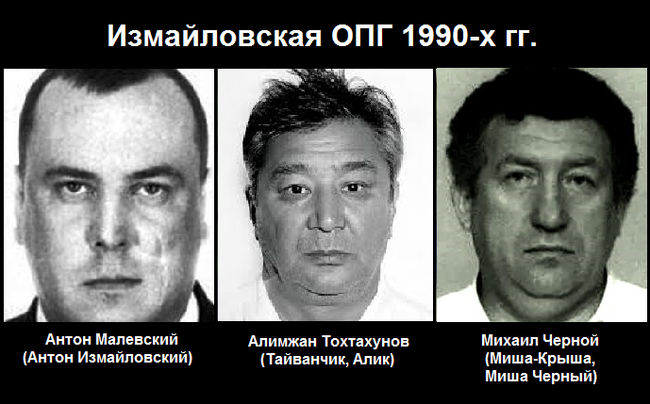
- Anton Malevsky (1967–2001): was a Russian crime boss, multimillionaire, nicknamed the "aluminum king of Russia", and the leader of the Izmaylovo gang since the late 1980s.[98]
- Sergei Mamsurov (1959–1995): well-known Moscow crime boss of the first half of the 1990s.[99]
- Yuri Pichugin (born 1965): influential Russian crime boss, thief in law, repeatedly convicted of theft and robbery, was one of the leaders of the criminal world of the Komi Republic, where he acted as a "criminal judge" in the analysis of various conflicts.[100]
- Dmitry Ruzlyaev (1963–1998): Russian crime boss from the city of Tolyatti, nicknamed "Dima Bolshoi", leader of the famous "Volgovskaya gang", one of the main players in the notorious Tolyatti crime war.[101]
- Kamo Safaryan (born 1961): influential crime boss, thief in law, who had criminal interests in Moscow, Nizhny Novgorod and Crimea (especially in the Greater Yalta region ), as well as extensive connections in the criminal world of most of the former Soviet republics.[102]
- Vladimir Tyurin (born 1958): thief in law, and considered one of the most important russian crime bosses active in Spain.[103]
- Sergei Tsapkov (1976–2014): leader of the Tsapkov gang, based in Kushchyovskaya. Tsapkov was sentenced to life imprisonment and died in prison.[104]
- Lasha Shushanashvili (born 1961): thief in law, who had significant influence in the criminal world of Moscow, Moscow Oblast, Chuvashia, Kirov Oblast, Ukraine and Spain. Shushanashvili is considered one of the most important ethnic Georgian members of the Russian mafia.[105]
Notable individual groups
[edit]Groups based in and around the City of Moscow:
- The Orekhovskaya gang: founded by Sergei "Sylvester" Timofeyev, this group reached its height in Moscow in the 1990s. When Timofeyev died, Sergei Butorin took his place. However, he was sentenced to jail for life in 2011.[106][107]
- Lyuberetskaya Bratva (Russian: Люберецкая ОПГ) or Lyubery (Russian: Люберы): one of the largest criminal groups with around 3,000 members in late 1990s until today. Based in (and originating from) Lyubertsy district of Moscow. Led by Denis Sergin (Fraser) since the 2000s.
- Solntsevskaya Bratva (Russian: Солнцевская ОПГ): led by Sergei "Mikhas" Mikhailov, it is Russia's largest criminal group with about 5,000 members, and is named after the Solntsevo District.[108][109]
- The Izmaylovskaya gang: one of Russia's oldest modern gangs, it was started in the mid- to late-1980s by Oleg Ivanov; it has around 200–500 members in Moscow alone, and is named after the Izmaylovo District.[110] Izmailovskaya has good relations with the Podolskaya gang.[111][112][113] Anton Malevsky was the leader until his death in 2001.[114] The Ismailovskaya mafia is closely associated with Oleg Deripaska, Matvey Yozhikov, Andrey Bokarev, Michael Cherney, and Iskander Makhmudov through their Switzerland based "Blonde Investment Company" and is closely associated with Oleg Andreevich Kharchenko (Russian: Олег Андреевич Харченко)[115][116] and Vladimir Putin's SP AG (Russian: Санкт-Петербургское общество недвижимости и долевого участия, lit. 'Saint-Petersburg Agency Group'). Liechtenstein police proved that Rudolf Ritter (brother to Michael Ritter, a Financial Minister[117]) a Liechtenstein-based lawyer, jurist who practiced in offshore businesses (identification evasion), and financial manager for the accounts of both Putin's SPAG and the Ismailovskaya mafia and that Alexander Afanasyev ("Afonya") was connected to both SPAG and the Ismailovskaya mafia through his Panama registered Earl Holding AG.[118][119] Also, Rudolf Ritter signed for Earl Holding, Berger International Holding, Repas Trading SA and Fox Consulting.[120] The Colombia-based Cali KGB Cartel supplied cocaine to the Ismailovskaya mafia, too. Rudolf Ritter was arrested in May 2020 on money laundering charges.[121][122]
- The Podolskaya gang: was one of the most notorious gangs in Russia, active primarily in the Podolsk region and surrounding areas of Moscow in the 1990s. Led by Sergey "Lalak" Lalakin, the gang was involved in a wide range of criminal activities, including extortion, kidnapping, robbery, and contract killings. It controlled several major businesses, both legal and illegal, such as car service centers, real estate development, and the oil industry. The gang had strong connections to both legitimate commercial enterprises and underground operations. For instance, they were known to have exploited the Soviet-era economic structure, and their criminal influence extended to the film industry, where they laundered money through production companies. At the height of their power, the Podolsk gang had control over most of the businesses in the area, making it a significant criminal entity within Moscow and its suburbs. In addition to their involvement in various illegal enterprises, the gang engaged in brutal power struggles with other criminal groups, resulting in a series of violent clashes and murders. These internal conflicts, including the death of key figures like Sergey "Psych" Fedyaev, allowed for shifts in power within the group, and members such as Nikolai "Sobol" Sobolev and others competed for dominance. Despite the ongoing violence, Lalakin's influence expanded, and he managed to secure connections with politicians, businessmen, and even high-ranking members of the Russian military. In the late 1990s, after several legal issues and an arrest in 1995, Lalakin distanced himself from the criminal world, focusing on legal business ventures like sports clubs and charity work. However, his past remained tied to the group's legacy.[123][124]
Groups based in other parts of Russia and the former Soviet Union:
- The Dolgoprudnenskaya gang.[109] Originally from the City of Dolgoprudny.
- The Tambov gang of Saint Petersburg is very closely aligned with Nikolai Aulov, who is the head of the Federal Drug Control Service; Alexander Bastrykin, who is the head of the Investigative Committee; Japanese yakuza from Kobe and Osaka; and with the political rise of Vladimir Putin.[125][126][127] Putin's long time personal body guard, Victor Zolotov is very close to this group as well. the man most associated with them is Vladimir Kumarin.[110]
- The Komarovskaya organized criminal group (leader - Komar) controls the St. Petersburg-Vyborg highway (A181) called Scandinavia or the Russia part of the European highway E18, which includes everything along the road (hotels, repair garages, cafes and restaurants, etc.) and the transportation process as well as St. Petersburg's trucking businesses. Komarovskaya OPG steal automobiles, commit robberies, provide protection racketeering, and receive strong support from the Usvyatsov-Putyrsky gang and its AOZT "Putus" to organize the supply of cocaine from South America into Russia, Finland, Scandinavia and Europe and the trade in counterfeit dollars.[128][129][130]
- The Usvyatsov-Putyrsky gang (AOZT "Putus") led by Vladimir Putyrsky (Vova-One-armed) and Leonid Ionovich Usvyatsov (Lenya-Sportsman) organizes both the supply of cocaine from South America into Russia, Finland, Scandinavia and Europe and the trade in counterfeit dollars and works closely with the Komarovskaya organized criminal group. Both Putyrsky and Usvyatsov have large estates in the Czech Republic where they enjoy hunting. During the 1980s, sambo coach "Trud" Usvyatsov, who was imprisoned for rape, robbery and theft, coached Vladimir Putin, Arkady Rotenberg, Boris Rotenberg and Nikolai Kononov.[129]
- The Uzbek criminals in Litvinenko's Uzbek file, including Michael Cherney, Gafur Rakhimov, Vyacheslav Ivankov, and Salim Abduvaliev (also spelled Salim Abdulaev); are Uzbek origin KGB and later FSB officers at Moscow including Colonel Evgeny Khokholkov; were organized by Vladimir Putin while Putin was Deputy Mayor for Economic Affairs of St Petersburg in the early 1990s; and control Afghanistan origin drug trade through St Petersburg, Russia, and then to Europe. Boris Berezovsky told Litvinenko to brief his Uzbek file about corrupt FSB officers to the future Head of the FSB Putin, which Litvinenko did on 25 July 1998 and, later, Litvinenko was imprisoned.[131][132] Robert Eringer, head of Monaco's Security Service, confirmed Litvinenko's file about Vladimir Putin as a kingpin in Europe's narcotics trade.[133] The Colombia-based Cali KGB Cartel supplied cocaine to this network, too.
- The Slonovskaya gang was one of the strongest and violent criminal groups in CIS in the 1990s. It was based in Ryazan city. It had a long-term bloody wars with other active criminal groups in the city (Ayrapetovskaya, Kochetkovskie, etc.) with which it initially coexisted peacefully. The gang virtually disappeared by 2000 as its members were getting hunted down and imprisoned by local Russian Police.
- The Uralmash gang of Yekaterinburg.
- The Chechen mafia is one of the largest ethnic organized crime groups operating in the former Soviet Union next to established Russian mafia groups.
- The Georgian mafia is regarded as one of the biggest, powerful and influential criminal networks in Europe, which has produced the biggest number of thieves in law in all former USSR countries.
- The Mkhedrioni was a paramilitary group involved in organised crime[134] led by a thief in law Jaba Ioseliani in Georgia in the 1990s.
- The city of Kazan was known for its gang culture, which later progressed into more organised, mafiaesque groups. This was known as the Kazan phenomenon.
Groups based in other areas:
- The Brothers' Circle: headed by Temuri Mirzoyev, this multi-ethnic transnational group is "composed of leaders and senior members of several Eurasian criminal groups largely based in countries of the former Soviet Union but operating in Europe, the Middle East, Africa, and Latin America". In 2011, US President Barack Obama and his administration named it one of four transnational organized crime groups that posed the greatest threat to US national security, and sanctioned certain key members and froze their assets. A year later, he extended the national emergency against them for another year.
- The Semion Mogilevich organization: based in Budapest, Hungary and headed by the crime boss of the same name, this group numbered approximately 250 members as of 1996. Its business is often connected with that of the Solntsevskaya Bratva and the Vyacheslav Ivankov Organization. Aleksey Anatolyevich Lugovkov is the second-in-command, and Vitaly Borisovich Savalovsky is the "underboss" to Mogilevich.[135]
See also
[edit]
References
[edit]- ^ The 'Russian Mafia' as an organized crime group started in the late 1980s, as we can see in the creation of the most powerful gangs from the country such as the Solntsevskaya Bratva, Tambovskaya Bratva, Orekhovskaya gang and Uralmash gang
- ^ "В Испании ликвидирована "российская мафия"" (in Russian). Rossiyskaya Gazeta. 16 June 2008. Archived from the original on 9 October 2016. Retrieved 24 October 2016.
- ^ "Russian mafia abroad is a myth – head of Russian Interpol bureau". Interfax.com.ua. 23 December 2009. Archived from the original on 5 July 2012. Retrieved 16 July 2012.
- ^ a b "Russian mafia taking over French Riviera". The Telegraph. 31 August 2010. Archived from the original on 15 August 2012. Retrieved 16 July 2012.
- ^ ""Темное зеркало общества". Профессор Марк Галеотти о российских бандитах". BBC News Русская служба (in Russian). 30 April 2019. Retrieved 14 April 2025.
- ^ "«РУССКАЯ МАФИЯ»: МИФЫ И РЕАЛЬНОСТЬ » ИНТЕЛРОС". www.intelros.ru (in Russian). Retrieved 14 April 2025.
- ^ a b Nekrasov, Vladimir Filippovich (2002). МВД России : энциклопедия (in Russian). ОЛМА Медиа Групп. p. 91. ISBN 978-5-224-03722-3.
- ^ ՄԱՄՈՒԼ․ամ (28 December 2016). "Понятие "вор в законе" - история, правила, коронация, блатные санкции". mamul.am (in Armenian). Retrieved 14 April 2025.
- ^ "Могучая сила братвы: откровения криминального авторитета о позитивном будущем оргпреступности". 1001.ru (in Russian). 26 February 2018. Retrieved 14 April 2025.
- ^ "Что такое ОПГ и существуют ли они сейчас. Объясняем простыми словами". Рамблер/развлечения и отдых (in Russian). 27 December 2023. Retrieved 14 April 2025.
- ^ Коля. "МаринкинД.Н. МаринкинаЮ.А. Уголовно-правовая характеристика бандитизма". www.jurvestnik.psu.ru (in Russian). Retrieved 14 April 2025.
- ^ a b Williams, Phil. Russian organized crime: the new threat?. Kron-Press. pp. 72–75.
- ^ "От татей к главарям: история организованной преступности в России • Arzamas". Arzamas (in Russian). Retrieved 15 April 2025.
- ^ Williams, Phil. Russian organized crime: the new threat?. p. 76.
- ^ Williams, Phil. Russian organized crime: the new threat?. pp. 82–83.
- ^ Williams, Phil. Russian organized crime: the new threat?. pp. 84–85.
- ^ Криминология: Учебник / Под ред. проф. Н. Ф. Кузнецовой, проф. В. В. Лунеева. — 2-е изд., перераб. и доп (in Russian). Wolters Kluwer Russia. 2004. pp. 405–406. ISBN 978-5-466-00019-1.
- ^ Williams, Phil (1997). Russian organized crime: the new threat?. Routledge. p. 89. ISBN 0714647632.
- ^ Williams, Phil (17 June 2014). Russian Organized Crime. Routledge. pp. 91–92. ISBN 978-1-135-25109-3.
- ^ Криминология: Учебник / Под ред. проф. Н. Ф. Кузнецовой, проф. В. В. Лунеева. — 2-е изд., перераб. и доп (in Russian). Wolters Kluwer Russia. 2004. p. 535. ISBN 978-5-466-00019-1.
- ^ "Российская организованная преступность (мафия) как форма социальной организации жизни". rikmosgu.ru. Retrieved 15 April 2025.
- ^ Williams, Phil (17 June 2014). Russian Organized Crime. Routledge. pp. 96–97. ISBN 978-1-135-25109-3.
- ^ Криминология: Учебник / Под ред. проф. Н. Ф. Кузнецовой, проф. В. В. Лунеева. — 2-е изд., перераб. и доп (in Russian). Wolters Kluwer Russia. 2004. p. 536. ISBN 978-5-466-00019-1.
- ^ Криминология: Учебник / Под ред. проф. Н. Ф. Кузнецовой, проф. В. В. Лунеева. — 2-е изд., перераб. и доп (in Russian). Wolters Kluwer Russia. 2004. p. 400. ISBN 978-5-466-00019-1.
- ^ Состояние и тенденции преступности в Российской Федерации: Криминологический и уголовно-правовой справочник (in Russian). Экзамен. 2007. pp. 26–27. ISBN 978-5-377-00024-2.
- ^ Dolgova, Azalia Ivanovna. Криминология: Учебник для юрид. вузов (in Russian). pp. 223–226.
- ^ "Солнцевские взяточники". www.kommersant.ru (in Russian). 18 April 1997. Retrieved 11 April 2025.
- ^ "Барсуков (Кумарин), Владимир". Lenta.RU (in Russian). Retrieved 11 April 2025.
- ^ "УБОП Свердловской области предлагал лишить "уралмашевского" лидера А.Хабарова депутатского мандата". Уралинформбюро (in Russian). Retrieved 11 April 2025.
- ^ "dossier5_10". legislature.camera.it. Retrieved 11 April 2025.
- ^ Verkaik, Robert (5 January 2018). "The real life McMafia: London 'a haven' for Russian crime gangs". The i Paper. Retrieved 11 April 2025.
- ^ ""Русская мафия" в Германии уступает только арабским кланам – DW – 24.09.2019". dw.com (in Russian). Retrieved 11 April 2025.
- ^ valencia, regina laguna (21 March 2010). "Mafia rusa, sol y playa". Levante-EMV (in Spanish). Retrieved 11 April 2025.
- ^ "Des membres de la mafia russe arrêtés dans l'Est de la France - ici". ici, le média de la vie locale (in French). 10 April 2015. Retrieved 11 April 2025.
- ^ a b "Russian Mafia's Worldwide Grip". CBS News. 11 February 2009. Archived from the original on 18 July 2012. Retrieved 18 July 2012.
- ^ a b c Molly Thompson (Writer/Producer) (2001). Russian Mafia: Organized Crime (TV). United States: The History Channel. Archived from the original on 4 June 2016. Retrieved 28 July 2016.
- ^ Jerry Capeci, Gene Mustain (22 April 1997). "2 Dance Bullet Ballet". New York Daily News. Archived from the original on 28 October 2012. Retrieved 20 July 2012.
- ^ a b "IN THE UNITED STATES DISTRICT COURT FOR THE DISTRICT COURT OF DELAWARE" (PDF). 31 May 2005. Archived (PDF) from the original on 8 November 2011. Retrieved 18 July 2012.
- ^ Smillie, Ian, Lansana Gberie, Ralph Hazleton The Heart of the Matter: Sierra Leone, Diamonds and Human Security. Diane Pub, 2000, p. 44-45.
- ^ Claffey, Mike (24 August 1996). "RUSSIAN IN MOB RAP". New York Daily News. Archived from the original on 28 October 2012. Retrieved 18 July 2012.
- ^ Federal Bureau of Investigation (1996). SEMION MOGILEVICH ORGANIZATION EURASIAN ORGANIZED CRIME (1996).
- ^ C. Williams, Robert (2019). Useful Assets. Dorrance Publishing Co. Inc. p. 25.
- ^ "Top 10 Richest Gangster of All Time!". 7 February 2021.
- ^ Mallory, Stephen L. Understanding Organized Crime. Jones and Bartlett Publishers, 2007, p. 73-87.
- ^ Friedman, Robert I. Red Mafiya: How the Russian Mob Has Invaded America. Warner Books, 2000.
- ^ Richards, James R. (1998). Transnational Criminal Organizations, Cybercrime, and Money Laundering. CRC Press. p. 7. ISBN 9781420048728.
- ^ Shvarts, Alexander (2002). "Russian Mafia: The Explanatory Power of Rational Choice Theory" (PDF). University of Toronto. p. 26.
- ^ "Czech police arrest internationally wanted mafia boss". Prague Daily Monitor. 8 March 2011. Archived from the original on 13 March 2011. Retrieved 18 July 2012.
- ^ Glenny, Misha McMafia: A Journey Through the Global Criminal Underworld. House of Anansi Press, 2008.
- ^ "Transcript – Panorama "The Billion Dollar Don"". BBC. Archived from the original on 30 July 2012. Retrieved 18 July 2012.
- ^ Bohlen, Celestine (10 January 1999). "The World; To Sicilians, Russia Has No Mafia. It's Too Wild". The New York Times. Archived from the original on 6 June 2013. Retrieved 18 July 2012.
- ^ Paddock, Richard C. (13 December 1998). "Russian Calls Swiss Verdict a Win for Fellow Businessmen". The Los Angeles Times. Archived from the original on 13 October 2012. Retrieved 18 July 2012.
- ^ "БРАТВАубийственная война "славян" с "лаврушниками" и "зверями". Наиболее полная база данных в Интернете о становлении организованной преступности в России за период с середины 80-х до 1997 года (по справкам РУОП, ФСНП и прочих "силовых" ведомств и спецслужб)" [BROTHER The murderous war of the "Slavs" with the "Lavrushniki" and "Beasts". The most complete database on the Internet on the formation of organized crime in Russia for the period from the mid-80s to 1997 (according to the RUOP, FSNP and other "power" departments and special services)]. Журналистское агентство Free Lance Bureau (FLB) (flb.ru) (in Russian). 18 August 2000. Archived from the original on 18 August 2001. Retrieved 9 March 2021.
- ^ Behar, Richard (12 June 2000). "Capitalism in a cold climate". Fortune (in Russian). Archived from the original on 19 October 2014. Retrieved 19 August 2021.
The story of Trans World's aluminum empire is filled with bribes, shell companies, profiteers, and more than a few corpses. Then again, in today's Russia, that's pretty much par for the course.
Archived as Капитализм в холодном климате in Russian at compromat.ru on 21 June 2000. - ^ "Russian mobster to be released". 24 September 2004. Archived from the original on 18 February 2012. Retrieved 20 July 2012.
- ^ a b "Top Russian mobster Ivankov dies". The Sidney Morning Herald. 10 October 2009. Archived from the original on 16 February 2013. Retrieved 20 July 2012.
- ^ "TWO RUSSIAN ORGANIZED CRIME FIGURES CHARGED IN PLOT TO MURDER BUSINESSMEN". United States Attorney's Office. 24 March 2006. Archived from the original on 26 June 2012. Retrieved 20 July 2012.
- ^ "Russian mob boss laid to rest". 14 October 2009. Archived from the original on 1 August 2016. Retrieved 10 May 2017.
- ^ "FBI agents in Moscow on trail of Russian mafia bosses". EN.RIAN.ru. 23 April 2009. Archived from the original on 12 June 2013. Retrieved 20 July 2012.
- ^ Schwirtz, Michael (30 July 2008). "In a River Raid, a Glimpse of Russia's Criminal Elite". The New York Times. Archived from the original on 4 June 2013. Retrieved 29 October 2013.
- ^ "Top Ten Fugitives: Global Con Artist and Ruthless Criminal". FBI. 21 October 2009. Archived from the original on 1 July 2012. Retrieved 18 July 2012.
- ^ Meserve, Jeanne (21 October 2009). "FBI: Mobster more powerful than Gotti". CNN. Archived from the original on 19 January 2013. Retrieved 18 July 2012.
- ^ Friedman, Robert I. (26 May 1998). "The Most Dangerous Mobster in the World". The Village Voice. Archived from the original on 12 June 2013. Retrieved 20 July 2012.
- ^ "Wikileaks: Russia branded 'mafia state' in cables". BBC News. 2 December 2010. Archived from the original on 29 October 2012. Retrieved 20 July 2012.
- ^ Listen: Alexander Litvinenko's apparent warning before his death Archived 19 March 2016 at the Wayback Machine By Lyndsey Telford, Edward Malnick and Claire Newell. 23 January 2015
- ^ "More Than 30 Alleged Russian Mobsters Indicted in Odd Case Involving 10,000 Pounds of Chocolate". Joe Valiquette. NBC News. 7 June 2017. Archived from the original on 9 January 2018. Retrieved 9 January 2018.
- ^ "Busted Russian casino hackers had an appetite for drugs and chocolate". The Register. Archived from the original on 9 January 2018. Retrieved 9 January 2018.
- ^ "Russian mobsters arrested for peddling stolen chocolate". The New York Post. 8 June 2017. Archived from the original on 9 January 2018. Retrieved 9 January 2018.
- ^ "Members And Associates Of Russian Crime Syndicate Arrested For Racketeering, Extortion, Robbery, Murder-For-Hire Conspiracy, Fraud, Narcotics, And Firearms Offenses". The United States Department of Justice. 7 June 2017. Archived from the original on 2 December 2017. Retrieved 9 January 2018.
- ^ "TWO MAIN RUSSIAN MAFIA GROUPS DISMANTLED IN SPAIN WITH EUROPOL'S SUPPORT". Europol. Archived from the original on 9 January 2018. Retrieved 8 January 2018.
- ^ "Police arrest 11 Russians in Marbella for money laundering". The Local Spain. 27 September 2017. Archived from the original on 9 January 2018. Retrieved 8 January 2018.
- ^ "Spain Demands Prison Terms for 18 Gangsters linked to Russian Mafia". The Moscow Times. 19 February 2018. Archived from the original on 28 January 2019. Retrieved 21 February 2018.
- ^ "BBC: Major Russian mafia trial opens in Spain". UNIAN. 20 February 2018. Archived from the original on 20 February 2018. Retrieved 21 February 2018.
- ^ Nemtsova, Anna (23 February 2018). "What's the Truth About the NRA's Man in Moscow?". The Daily Beast. Archived from the original on 7 December 2018.
- ^ "Russian Politician Who Reportedly Sent Millions to NRA… — ProPublica". 19 January 2018. Archived from the original on 7 December 2018.
- ^ "Record Cocaine Bust in Russia Highlights New Trafficking Route From Ecuador". OCCRP. Archived from the original on 26 September 2025. Retrieved 1 October 2025.
- ^ James O. Finckenauer and Elin Waring. "Challenging the Russian Mafia Mystique" Archived 6 March 2016 at the Wayback Machine. National Institute of Justice Journal. April 2001.
- ^ Russian Organized Crime: Organization and Structure Archived 13 August 2016 at the Wayback Machine 1993
- ^ Зугумов, Заур (5 September 2017). Русскоязычный жаргон. Историко-этимологический толковый словарь преступного мира (in Russian). Litres. ISBN 978-5-04-043397-1.
- ^ "Проникшие в повседневную речь и ставшие общепринятыми некоторые термины и выражения из уголовного жаргона". Пикабу (in Russian). 21 August 2017. Retrieved 15 April 2025.
- ^ "ТОЛКОВЫЙ СЛОВАРЬ УГОЛОВНЫХ ЖАРГОНОВ" (PDF) (in Russian).
- ^ "Именем братвы. Шестая серия". lib.fontanka.ru. Retrieved 15 April 2025.
- ^ Stephen L. Mallory. Understanding Organized Crime. 2007. pp. 76–78.
- ^ Waal, Thomas de (22 December 2010). "Mafiosi in the Caucasus". The National Interest. Retrieved 2 May 2024.
- ^ Anderson, Julie (2006). "The Chekist Takeover of the Russian State". International Journal of Intelligence and CounterIntelligence. 19 (2): 237–288. doi:10.1080/08850600500483699. ISSN 0885-0607.
- ^ "Новости Руспрес - Показать содержимое по тегу: Кумарин:Барсуков Владимир Сергеевич "Кум"". 15 October 2017. Archived from the original on 15 October 2017. Retrieved 2 May 2024.
- ^ Шрек, Карл; Шароградский, Андрей (2 October 2014). "Михась похвастался президентскими часами". Радио Свобода (in Russian). Retrieved 2 May 2024.
- ^ . 25 July 2015 https://web.archive.org/web/20150725015518/https://www.fbi.gov/wanted/topten/semion-mogilevich/mogilevich-russian. Archived from the original on 25 July 2015. Retrieved 2 May 2024.
{{cite web}}: Missing or empty|title=(help) - ^ "Усоян, Аслан Криминальный авторитет". lenta.ru. Retrieved 2 May 2024.
- ^ "Вор в загоне". www.kommersant.ru (in Russian). 5 October 2009. Retrieved 2 May 2024.
- ^ ""Убирал всех, кто стоял на пути": как лидер крупнейшей ОПГ Москвы стал королем мафии". Газета.Ru (in Russian). 2 March 2025. Retrieved 2 March 2025.
- ^ "Пожизненное для Оси Вынесен приговор лидеру "ореховской" группировки". Lenta.RU (in Russian). Retrieved 2 March 2025.
- ^ "В колонии скончался организатор убийства Анны Политковской". РБК (in Russian). 13 June 2017. Retrieved 2 March 2025.
- ^ "Длугач Валерий Яковлевич (Глобус)". www.primecrime.ru. Retrieved 2 March 2025.
- ^ ""Бубновый Батя": что случилось с самым авторитетным московским вором 90-х". sso.passport.yandex.ru. Retrieved 2 March 2025.
- ^ ""Уралмаш". Часть 1. Сообщество авторитетных ребят". Коммерсантъ (in Russian). 3 May 2021. Retrieved 2 March 2025.
- ^ "Амиран Квантришвили". www.mzk2.ru. Retrieved 2 March 2025.
- ^ "Антон Малевский: как еврейский десантник стал паханом измайловской братвы". sso.passport.yandex.ru. Retrieved 2 March 2025.
- ^ "Гангстеры. Сергей Мамсуров(Мансур)". sso.passport.yandex.ru. Retrieved 2 March 2025.
- ^ "Суд приговорил к пожизненному вора в законе и лидера "банды Пичугина"". РБК (in Russian). 15 June 2023. Retrieved 2 March 2025.
- ^ "Покушение на лидера тольяттинской ОПГ Дмитрия Рузляева (Дима Большой)". bezpekavip.com (in Russian). Retrieved 2 March 2025.
- ^ www.primecrime.ru http://web.archive.org/web/20240715082145/https://www.primecrime.ru/news/2021-11-24_7842/. Archived from the original on 15 July 2024. Retrieved 2 March 2025.
{{cite web}}: Missing or empty|title=(help) - ^ "Право.ru: законодательство, судебная система, новости и аналитика. Все о юридическом рынке". ПРАВО.Ru (in Russian). Retrieved 2 March 2025.
- ^ "Главарь кущевской банды Сергей Цапок умер в СИЗО". BBC News Русская служба (in Russian). 7 July 2014. Retrieved 2 March 2025.
- ^ ""Вор в законе" Лаша Руставский обвинил председателя суда Салоник в "предвзятости"".
- ^ "Leader of Orekhovskaya gang sentenced to life in jail". ITAR-TASS. 9 June 2011. Archived from the original on 3 June 2013. Retrieved 18 July 2012.
- ^ "Russian crime gang leader gets life in jail". Kyiv Post. 7 September 2011. Archived from the original on 27 May 2015. Retrieved 18 July 2012.
- ^ Bleifuss, Joel (7 September 2007). "Business as Usual: The Rise of the Russian Mafia". FocusFeatures.com. Archived from the original on 11 May 2012. Retrieved 18 July 2012.
- ^ a b Bleifuss, Joel (1 April 1998). "So who are the Russian mafia ?". BBC News. Archived from the original on 6 April 2012. Retrieved 18 July 2012.
- ^ a b "The Russian Mafia – Part Three". UnreportedCases.com. 11 March 2011. Archived from the original on 27 October 2012. Retrieved 18 July 2012.
- ^ Иванидзе, Владимир (Ivanidze, Vladimir); Шихаб, Софи (Shihab, Sophie) (28 November 2002). "Владимир Путин в окружении мафии" [Vladimir Putin surrounded by the mafia]. Le Monde (in Russian). Retrieved 29 November 2023.
{{cite news}}: CS1 maint: multiple names: authors list (link)[dead link] Alt URL This is a Russian translation of a French article in Le Monde. - ^ Волчек, Дмитрий (Volchek, Dmitry) (25 July 2018). "Гексогеновые годы. Владимир Путин во главе ФСБ" [Hexogen years. Vladimir Putin heads the FSB]. Радио Свобода (svoboda.org) (in Russian). Retrieved 29 November 2023.
{{cite news}}: CS1 maint: multiple names: authors list (link) - ^ "Антон Малевский и Измайловская ОПГ 1990-х годов" [Anton Malevsky and the Izmailovskaya organized crime group of the 1990s.]. cs9.pikabu.ru (in Russian). 30 October 2017. Archived from the original on 29 November 2023. Retrieved 29 November 2023.
- ^ "Подольская ОПГ: Славянские оргпреступные группировки в Московской области" [Podolsk organized crime group: Slavic organized crime groups in the Moscow region]. "FreeLance Bureau" (flb.ru) (in Russian). 18 November 2000. Archived from the original on 29 November 2023. Retrieved 10 June 2021.
- ^ "ХАРЧЕНКО ОЛЕГ АНДРЕЕВИЧ" [KHARCHENKO OLEG ANDREEVICH]. «Российская академия художеств» (rah.ru) (in Russian). 2015. Archived from the original on 25 April 2015. Retrieved 29 November 2023.
- ^ Dawisha, Karen (2014). Putin's Kleptocracy: Who Owns Russia?. Simon & Schuster. p. 153 see note. ISBN 978-1-4767-9519-5.
- ^ "Mitglieder der Regierung des Fürstentums Liechtenstein 1862-2021". www.regierung.li. Retrieved 25 October 2021.
- ^ Показания Хайдарова: Измайловская преступная группировка, Махмудов, Черный, Малевский, Козицын, Бокарев. (Khaidarov's testimony: Izmailovskaya criminal group, Makhmudov, Cherny, Malevsky, Kozitsyn, Bokarev.) Retrieved 10 June 2021.
- ^ Кириленко, Анастасия (Kirilenko, Anastasia) (1 October 2015). "Мафия на госзаказе - 2. Что связывает Кремль с измайловской группировкой" [Mafia on state order - 2. What connects the Kremlin with the Izmailovo group]. The Insider. Archived from the original on 4 October 2015. Retrieved 20 December 2020.
{{cite news}}: CS1 maint: multiple names: authors list (link) - ^ "Расследование. Колумбийский кокаин в "общаке" Путина" [Investigation. Colombian cocaine in Putin's common fund]. CRiME (crime-ua.com) (in Russian). 2 November 2015. Retrieved 18 August 2021.
- ^ "NEWSWEEK DETAILS PUTIN'S ALLEGED ORGANIZED CRIME TIES…". Jamestown. Retrieved 25 October 2021.
- ^ "Five arrested in Liechtenstein on money laundering charges". SWI swissinfo.ch. 13 May 2000. Retrieved 25 October 2021.
- ^ "История "Подольской" ОПГ". sso.passport.yandex.ru. Retrieved 12 March 2025.
- ^ "Подольская ОПГ". flb.ru. Retrieved 12 March 2025.
- ^ Иванидзе, Владимир (Ivanidze, Vladimir) (8 February 2012). "Кому Нева дала шанс: Игорный бизнес в Санкт-Петербурге начинали российские ОПГ и японские якудза. Под контролем мэрии. Уникальное свидетельство непосредственного участника событий" [To whom the Neva gave a chance: the gambling business in St. Petersburg was started by Russian organized crime groups and Japanese yakuza. Under the control of the city hall. Unique evidence of a direct participant in the events]. Novaya Gazeta. Archived from the original on 9 February 2012. Retrieved 20 December 2020.
{{cite news}}: CS1 maint: multiple names: authors list (link) - ^ Кириленко, Анастасия (Kirilenko, Anastasia) (21 April 2016). "Путин глазами якудзы. Японский мафиози рассказал о своем бизнесе в Петербурге" [Putin through the eyes of the Yakuza. Japanese mafiosi spoke about his business in St. Petersburg]. The Insider (in Russian). Archived from the original on 23 April 2016. Retrieved 20 December 2020.
{{cite news}}: CS1 maint: multiple names: authors list (link) - ^ Кириленко, Анастасия (Kirilenko, Anastasia) (2 July 2015). "Мафия на госзаказе. Как новые кремлевские олигархи связаны с преступным миром" [Mafia at the state order. How are the new Kremlin oligarchs connected with the underworld]. The Insider (in Russian). Archived from the original on 3 July 2015. Retrieved 20 December 2020.
{{cite news}}: CS1 maint: multiple names: authors list (link) - ^ Захаров, А. (Zakharov, A.) (3 June 2014). "Крупнейшие преступные сообщества и группировки Санкт-Петербурга" [The largest criminal communities and groups in St. Petersburg]. Falculty of Law Saint Petersberg State University (in Russian). Archived from the original on 25 June 2014. Retrieved 25 September 2021.
{{cite web}}: CS1 maint: multiple names: authors list (link) - ^ a b Канев, Сергей (Kanev, Sergey) (7 October 2019). ""Бандитский Ротенберг", или За кого не стыдно Владимиру Путину" ["Gangster Rothenberg", or for whom Vladimir Putin is not ashamed]. МБХ медиа (in Russian). Archived from the original on 8 December 2019. Retrieved 25 September 2021.
The author Sergey Kanev is from Центр «Досье» (dossier.center).
{{cite news}}: CS1 maint: multiple names: authors list (link) Archived on compromat.ru on 9 October 2019 as Как расцвел "Путус" Вовы-Однорукого и Лени-Спортсмена: История питерского "авторитета" Владимира Путырского и бывшего тренера Путина дзюдоиста-рецидивиста Леонида Усвяцова (How Vova-One-Armed and Leni-Sportsman's "Putus" blossomed: The story of the St. Petersburg "authority" Vladimir Putyrsky and the former coach of Putin, the judoka-recidivist Leonid Usvyatsov). - ^ "Привет из 90-х: "Убили, отсидели и стали бизнесменами"" [Greetings from the 90s: "They killed, served and became businessmen"]. progorod33.ru (in Russian). 22 March 2021. Archived from the original on 25 March 2021. Retrieved 25 September 2021.
- ^ Кириленко, Анастасия (Kirilenko, Anastasia) (21 January 2016). "Путин и мафия. За что убили Александра Литвиненко" [Putin and mafia. Why Alexander Litvinenko was killed]. The Insider (in Russian). Archived from the original on 23 January 2016. Retrieved 18 December 2020.
{{cite news}}: CS1 maint: multiple names: authors list (link) - ^ Khaknazarov, Usman (20 February 2003). "Renascence of "Power Broker" of Uzbek Policy: Or how Uzbek president Islam Karimov is reverting to the hands of his first master". muslimuzbekistan.com. Archived from the original on 26 May 2006. Retrieved 21 December 2020.
- ^ Кириленко, Анастасия (Kirilenko, Anastasia) (16 December 2013). "Путин на "личной службе" у князя Альбера" [Putin on "personal service" with Prince Albert]. Радио Свобода (Radio Svoboda). Archived from the original on 9 October 2016. Retrieved 20 December 2020.
{{cite news}}: CS1 maint: multiple names: authors list (link) - ^ Bonner, Raymond (1 November 1993). "Georgian Fighter Wields Guns, Money and Charm". New York Times. Retrieved 6 May 2020.
- ^ "Semion Mogilevich". United States Department of State. Retrieved 14 April 2025.

Sources
[edit]- "The Russian mafia and its impact on the Russian economy". Archived from the original on 27 December 2013.
- "Russian mafia controls economy and politics uexpress.com Sept 30, 1997".
Further reading
[edit]- Galeotti, Mark. 2018. The Vory. Yale University Press.
- Mironova, Vera (2023). Criminals, Nazis, and Islamists: Competition for Power in Former Soviet Union Prisons. Oxford University Press. ISBN 9780197645680.
- Morcillo, Cruz; Muñoz, Pablo (26 October 2010). Palabra de Vor: Las mafias rusas en España (in Spanish). Espasa Forum. ISBN 978-8467034356.
- Varese, Federico (2005). The Russian Mafia. Oxford University Press. ISBN 978-0198297369.