Hubbry Logo
search
logo
Rutuli
Rutuli
current hub
2006872

Rutuli

logo
Community Hub0 Subscribers
Read side by side
from Wikipedia
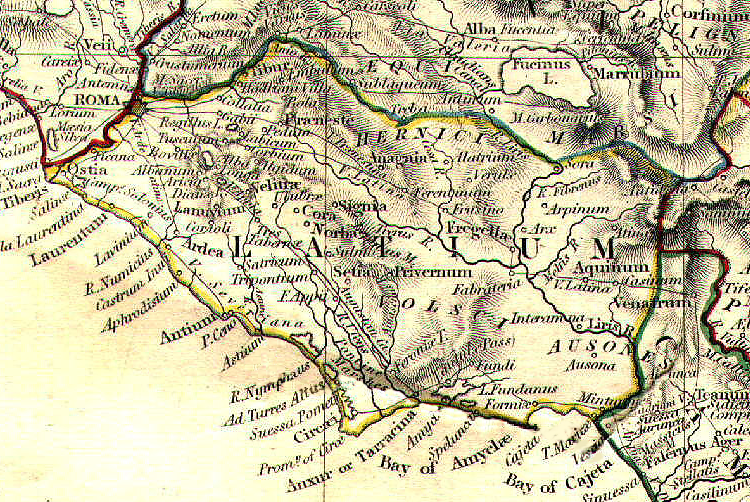
A map of central Italy is depicted
Map of Roman Latium

The Rutuli or Rutulians were an ancient people in Italy. The Rutuli were located in a territory whose capital was the ancient town of Ardea, located about 32 km (20 miles) southeast of Rome.[1]

Thought to have been descended from the Umbri and the Pelasgians, according to modern scholars they were most likely connected with the Etruscan or Ligurian peoples.[2]

Mythological history

[edit]

In Virgil's Aeneid, and also according to Livy,[3] the Rutuli are led by Turnus, a young prince to whom Latinus, king of the Latins, had promised the hand of his daughter Lavinia in marriage. When the Trojans arrived in Italy, Latinus decided to give his daughter to Aeneas instead because of instructions he had received from the gods to marry his daughter to a foreigner. Turnus was outraged and led his people as well as several other Italian tribes against the Trojans in war. Virgil's text ends when Aeneas defeats Turnus in single combat and therefore confirms his right to marry Lavinia. In some other accounts of the story of Aeneas, Latinus is later killed in a subsequent battle with the Rutuli.[4]

War with Rome under Tarquinius Superbus

[edit]

During the 6th century BC, in Rome's early semi-legendary history, Rome's seventh and final king Lucius Tarquinius Superbus went to war with the Rutuli. According to Livy, the Rutuli were, at that time, a very wealthy and powerful people. Tarquinius was desirous of obtaining the booty that would come with victory over the Rutuli.[5]

Tarquin unsuccessfully sought to take Ardea by storm, and subsequently began an extensive siege of the city. The war was interrupted by the revolution that overthrew the Roman monarchy. The Roman army, camped outside Ardea, welcomed Lucius Junius Brutus as their new leader, and expelled the king's sons. It is unclear as to the eventual outcomes of the siege and the war.[6]

See also

[edit]

References

[edit]
Revisions and contributorsEdit on WikipediaRead on Wikipedia
from Grokipedia
The Rutuli were an ancient Italic people who inhabited a coastal territory in southern Latium, central Italy, with their capital at the city of Ardea, located approximately 37 kilometers (23 miles) southeast of Rome.[1] Ardea served as a significant port for the region despite being inland, and the Rutuli were known for their wealth, particularly in the 6th century BCE, which drew the attention of expanding Roman power.[2] In Roman mythology, as depicted in Virgil's Aeneid, the Rutuli played a central role in the legendary Trojan War in Italy, led by their king Turnus, who sought to marry Lavinia, daughter of King Latinus, and waged war against the Trojan exile Aeneas and his followers.[3] Turnus, described as a powerful and noble warrior of Rutulian lineage, rallied his people against the newcomers, resulting in fierce battles that symbolized the clash between indigenous Italians and Eastern settlers.[4] This epic portrayal, set in the mythical era before Rome's founding, underscores the Rutuli's position as a prominent local power in pre-Roman Latium. Historically, the Rutuli engaged in conflict with early Rome during the reign of King Tarquinius Superbus around 534 BCE, when the Romans besieged Ardea to seize its riches amid domestic tensions.[2] The siege failed to yield a quick victory, leading to a prolonged encirclement with fortifications, during which an incident involving Roman nobles—comparing their wives' virtues—indirectly precipitated the rape of Lucretia and the subsequent overthrow of the Roman monarchy.[2] By the mid-5th century BCE, the Rutuli allied with Rome against the Volsci,[5] and in 442 BCE, Rome established a colony at Ardea, integrating the Rutuli more closely into the Roman sphere.[6] The Rutuli likely represented an early Indo-European group in the region, with origins possibly tracing to Bronze Age settlements.[7] As part of the broader Latin ethnic and cultural landscape, they participated in regional alliances and festivals, contributing to the cultural mosaic of ancient Latium before their distinct identity gradually merged with the expanding Roman state during the 4th and 3rd centuries BCE.

Name and Etymology

Derivation of the name

The name Rutuli is most commonly derived from the Latin adjective rutilus, meaning "red" or "fiery red," often applied to hair color with a golden or auburn tint, suggesting the tribe may have been characterized by red- or blond-haired individuals in ancient perceptions. This etymology traces back to the Proto-Indo-European root reudh-, denoting redness, as seen in related terms like ruber (red) and rudis (raw or ruddy). Scholars interpret Rutuli as a collective ethnonym implying "the Red Ones" or "the Blondes," reflecting physical traits or a symbolic association with fire or vitality in Italic naming conventions.[8] Ancient Roman sources provide early attestations of the name without explicit etymological explanation, treating Rutuli as a tribal self-designation tied to their territory around Ardea in Latium. Cato the Elder, in his Origines, lists the Rutuli among the ancient peoples of Italy, indicating their established presence as an indigenous group predating Roman expansion. This reference, preserved through the grammarian Priscian, underscores the name's antiquity and association with pre-Latin Italic communities. Greek and Roman historians offered varying interpretations of the Rutuli's origins, sometimes linking the name to broader regional or migratory contexts. Strabo describes Ardea as a colony of the Rutuli, connecting the ethnonym to local Latian geography and place names like the Rutulian plain, implying a derivation from indigenous toponyms rather than external imposition. Appian of Alexandria explicitly identifies the Rutuli as an "Etruscan" tribe in his account of Aeneas's conflicts, suggesting possible Etruscan linguistic influences on the name.[9]

Linguistic classification

The Rutuli are classified as an ancient Italic people belonging to the Latino-Faliscan branch of the Italic languages, closely aligned with Latin speakers in central Italy's Latium region.[10] As one of the approximately thirty tribes comprising the Latini, their dialect would have shared phonological, morphological, and lexical features with early Latin, such as the retention of initial /p/ in words like pater (father) and the use of the -os nominative ending, distinguishing it from the Osco-Umbrian group's innovations like /p/ to /f/ shifts.[10] This placement is supported by ancient tribal catalogs, including Cato the Elder's Origines, which lists the Rutuli of Ardea alongside other Latin communities like Tusculum and Lanuvium in a federation under Latinus.[11] Due to their geographic proximity to Etruria, the Rutuli likely experienced Etruscan linguistic influences, particularly in vocabulary related to trade, religion, and administration, as Etruscan was a dominant non-Indo-European language in neighboring areas. Some scholars propose possible Etruscan connections to the name, related to concepts of "red" in Etruscan-Latin interactions.[12] Some researchers propose possible pre-Indo-European or Ligurian roots for certain Rutulian elements, based on the tribe's inclusion in ancient lists alongside non-Latin Italic groups, potentially indicating an earlier migratory layer before full assimilation into the Latin sphere. Debates persist among linguists regarding the distinctiveness of the Rutuli dialect from neighboring Volscian (an Osco-Umbrian variety) and standard Latin, primarily inferred from toponymic evidence like Ardea, whose name derives from Indo-European *h₂er- ("high" or "steep"), aligning more closely with Latino-Faliscan patterns than Volscian's Sabine-like features such as medial /f/ for /bʰ/.[10] No direct texts in the Rutuli dialect survive, with knowledge derived instead from Latin sources containing inferred loanwords, such as potential Etruscan-derived terms for local flora or rituals preserved in Virgil's accounts of Rutulian customs.[12] This scarcity underscores ongoing discussions about whether the Rutuli represented a transitional dialect bridging Latin and southern Italic varieties.[13]

Geography

Territory and settlements

The Rutuli occupied a core territory in southern Latium, centered on the ancient city of Ardea, located approximately 37 kilometers south of Rome along the Tyrrhenian coast.[1] This region bordered the lands of the Volsci to the southeast and the Latin tribes to the north and northwest, forming a distinct Italic enclave amid the broader Latium landscape. The territory's strategic position facilitated interactions with neighboring peoples while providing natural defenses through its proximity to hilly interiors and marshy lowlands. The Rutuli domain extended across a coastal plain in southern Latium, incorporating a strip from near Lavinium in the north to areas approaching the Volscian lands near Antium in the south, with inland expanses along early routes like the future path of the Appian Way. Smaller settlements dotted this landscape, including the coastal site of Castrum Inui (modern Fosso dell'Incastro), a fortified harbor, and numerous rural villages that supported subsistence economies. These communities emphasized agriculture on the fertile plains and fishing along the shoreline, leveraging the region's access to the sea for trade and livelihood. Ardea functioned as the primary urban center amid this network of hamlets. Environmentally, the Rutuli territory benefited from volcanic soils derived from the Alban Hills, which enhanced agricultural productivity in the ancient period. Its location also placed it near the expansive Pontine Marshes to the south, a wetland area that influenced local hydrology and settlement patterns while posing challenges for expansion.[14] Strategic coastal access further underscored the area's importance, enabling maritime connections across the Tyrrhenian Sea despite Ardea's position approximately 4 kilometers inland.

Principal city: Ardea

Ardea served as the political and cultural heart of the Rutuli, an ancient Italic people inhabiting southern Latium. According to mythological traditions, the city was founded by Danae, the mother of Perseus, who married the local king Pilumnus and established the settlement for Argive immigrants; this lineage connected the Rutuli to Turnus, their legendary king depicted as Danae's descendant in Virgil's Aeneid.[15] Alternative legends attribute its origins to Ardeas, a son of Odysseus and Circe, emphasizing early Greek influences in the region's mythic history. As a pre-Latin settlement, Ardea traces its permanent habitation to around 1000 BCE, coinciding with the emergence of Latial culture and marking the transition from sporadic Late Bronze Age activity to structured communities.[16] The urban layout of Ardea reflected its strategic defensibility and ritual importance, centered on a fortified acropolis atop a small plateau that formed the nucleus of early development. This elevated citadel, constructed during the Early Iron Age (c. 950–700 BCE), housed key public structures and overlooked the surrounding terrain, typical of proto-urban sites in Latium. Temples dedicated to deities like Juno underscored the city's religious role, with sanctuaries proliferating after 1000 BCE as part of the shift to formalized city-state organization. Necropoleis dating from the Bronze Age onward surrounded the urban core, featuring tombs and cremation rites characteristic of Latial practices, which highlighted communal identity and continuity from prehistoric times.[17][16] Ardea's coastal proximity, approximately 4 kilometers from the sea with access to the harbor at Castrum Inui, positioned it as a vital trade hub in the Tyrrhenian network. The fertile Latian plains supported agriculture, facilitating exports of grain and wine, while its location enabled commerce in metals sourced from nearby Etruria and beyond, integrating the Rutuli into broader Italic exchange systems. This economic centrality bolstered Ardea's strategic value amid interactions with neighboring peoples. Throughout its history, Ardea endured cycles of destruction and rebuilding, reflecting the turbulent dynamics of central Italy. Following early conflicts, the city recovered and expanded under Roman influence, maintaining its urban fabric into the Imperial era; post-Roman recovery efforts in late antiquity preserved elements of its infrastructure amid regional instability, though it gradually declined due to environmental factors like malaria by the early Middle Ages.[18]

Origins and Early History

Prehistoric and legendary origins

The Rutuli are believed to have inhabited the coastal region of southern Latium in prehistoric times, contemporaneous with the consolidation of other early Italic groups amid broader migrations across the Italian peninsula.[19] Ancient traditions attribute their legendary origins to Greek mythological figures, reflecting possible migratory influences from the eastern Mediterranean following the Trojan War era around 1200 BCE. Dionysius of Halicarnassus reports that Ardea, the Rutuli's principal city, was founded by Ardeias (or Ardeus), one of three sons born to Odysseus and the enchantress Circe after the hero's return from Troy; the other sons, Romus and Anteias, purportedly established Rome and Antium, respectively.[20] This narrative, drawn from the second-century BCE historian Xenagoras, underscores a heroic, seafaring ancestry linking the Rutuli to Homeric epics and suggesting divine or semi-divine progenitors for their royal lineage, including Turnus, the tribe's fabled king.[20] Further legendary ties connect the Rutuli to non-Indo-European elements in early Italy, particularly through associations with the Etruscans. Cato the Elder, in his Origines, describes the Rutuli inhabiting Italy alongside the Latins and Etruscans (Tyrrhenians) from ancient times, with alliances such as that between Rutulian leader Turnus and Etruscan king Mezentius during conflicts with Trojan settlers.[21] This proximity implies cultural exchanges or shared origins, potentially incorporating a pre-Indo-European substrate akin to the Etruscan language, which differed from surrounding Italic dialects. The Rutuli are classified as an Italic people, likely part of the Latin or Osco-Umbrian branch, consistent with their integration into the linguistic landscape of ancient Latium.

Archaeological evidence

Archaeological investigations at Ardea, the primary center of the Rutuli, have uncovered material remains spanning the Late Bronze Age to the Iron Age, revealing a material culture rooted in Italic traditions with external influences from Etruscan and Mediterranean sources. Early finds from the 9th-8th century BCE, corresponding to the transition from the Late Bronze Age to the Early Iron Age, include biconical urns and bronze weapons typical of the proto-Villanovan phase in Latium, suggesting Etruscan stylistic influences through shared cremation practices and incised geometric decorations on ceramics. These artifacts indicate an emerging elite warrior class, with weapons such as spears and daggers pointing to defensive or ritual functions within local communities.[22] Settlements from the Iron Age, particularly in the 8th-7th centuries BCE, yield abundant pottery in impasto ware and iron tools like sickles and fibulae, demonstrating continuity in Italic subsistence patterns focused on agriculture and pastoralism. These sites also feature early epigraphic evidence, representing precursors to Latin script adoption in the region through phonetic and alphabetic borrowing. Such finds underscore the Rutuli's integration into broader central Italic networks, with tools reflecting technological advancements in ironworking inherited from proto-Villanovan predecessors.[23] Necropoleis around Ardea, active from the 8th to 6th centuries BCE, provide key insights into Rutuli funerary practices, dominated by inhumations in simple fossa or chamber tombs. Burials often contain grave goods such as bronze fibulae for fastening clothing, amber and glass beads, and imported Greek ceramics like Attic black-figure vases, evidencing elite status and long-distance trade links via ports like those at Fosso dell'Incastro. Skeletal analyses from these sites reveal a population with average lifespans of 30-40 years, showing signs of manual labor and occasional violence, consistent with a semi-urban Italic society. Representative examples include a 7th-century BCE tomb with a warrior's iron sword and Corinthian aryballos, highlighting cultural exchanges with Greek colonists in southern Italy.[24][25] Beyond Ardea, rural sites in the Pontine plain and coastal hinterland have exposed villas and farmsteads dated to the 8th-5th centuries BCE, featuring agricultural tools such as iron hoes, sickles, and grinding stones that attest to intensive cereal cultivation and olive processing. These discoveries, including storage pits with carbonized grains, illustrate the economic base supporting Rutuli urban centers and their resilience amid regional conflicts.[26]

Mythology

In Virgil's Aeneid

In Virgil's Aeneid, composed between 29 and 19 BCE under the patronage of Emperor Augustus, the Rutuli are depicted as a fierce Italic tribe whose conflict with the Trojan exile Aeneas forms the epic's climactic narrative arc, symbolizing the inevitable triumph of Roman destiny over local resistance.[27] The poem's second half (Books 7–12) portrays the Rutuli as antagonists in the foundation myth of Rome, led by their king Turnus, a bold warrior and suitor to Lavinia, the daughter of King Latinus of the Latins. Turnus's refusal to accept Latinus's alliance with Aeneas—prompted by an oracle favoring the Trojan stranger—ignites a brutal war, framing the Rutuli as defenders of indigenous rights against foreign incursion.[28] The key events unfold with the Trojans' landing in Latium, where Aeneas seeks refuge after fleeing Troy's fall; Latinus initially welcomes them and offers Lavinia's hand, but Turnus rallies the Rutuli and other Italic tribes in opposition, leading to escalating hostilities.[28] Battles erupt near Laurentum, Latinus's capital, with vivid scenes of Rutulian warriors clashing against Trojan forces in ambushes, sieges, and naval assaults—Turnus himself attempts to burn the Trojan ships anchored at the mouth of the Tiber, only for them to miraculously transform into sea nymphs under divine intervention. The conflict culminates in a ritual duel between Aeneas and Turnus on the plains before the city, where Aeneas slays Turnus after spotting the belt of the slain Trojan youth Pallas on his foe, sealing the Rutuli's defeat and paving the way for Trojan-Latin union.[28] Symbolically, the Rutuli embody pre-Roman Italic resistance, their portrayal underscoring themes of fate (fata) versus human defiance in Virgil's imperial ideology, which justifies Augustus's consolidation of power by linking it to Aeneas's pious conquest.[29] Turnus, hailing from the Rutulian capital Ardea—a coastal stronghold described as a seat of ancient kingship—represents heroic valor tinged with hubris, his warriors arrayed in gleaming bronze armor and swift chariots that evoke the martial prowess of Italy's tribal past.[30] The Rutuli's ships, formidable vessels crewed by allied forces, highlight their maritime strength along Latium's shores, yet their ultimate subjugation reinforces the poem's message of unity under Roman hegemony.[28]

Accounts in other sources

In Livy's Ab Urbe Condita (Book 1), the Rutuli appear as a prominent Italic people allied with the early Latins through shared conflicts and treaties, though their portrayal blends mythical and historical elements distinct from Virgil's epic narrative. Turnus, king of the Rutuli, is depicted as having been promised Lavinia in marriage by Latinus before Aeneas's arrival, prompting him to wage war against both the Trojan leader and the Latin king; this conflict escalates when the Rutuli seek Etruscan aid from Mezentius of Caere after initial defeats, ultimately leading to their subjugation and the unification of Trojans and Aborigines under the name Latins. Later, in a more historical vein around 500 BCE, Livy describes the Rutuli as part of the Latin league assembling at the grove of Ferentina, where Turnus Herdonius of nearby Aricia incites a revolt against Roman dominance under Tarquinius Superbus, highlighting their role as collective Latin allies resisting external overreach.[31][32] Dionysius of Halicarnassus, in his Roman Antiquities (Book 1), emphasizes the Rutuli's status as an indigenous Latin people predating the Trojan arrival, portraying them as ancient neighbors of the Aborigines who inhabited the region around Ardea long before Aeneas's settlement. Unlike Virgil's focus on a personal rivalry over Lavinia, Dionysius recounts the Rutuli's revolt against Latinus, led by a figure named Tyrrhenus (a variant possibly linked to Turnus), which draws in the newly arrived Trojans as allies to the Aborigines; Latinus perishes in the ensuing battle with the Rutuli, after which Aeneas secures a treaty granting the Trojans land and facilitating their integration, with the Rutuli eventually subdued and incorporated into the emerging Latin polity. This account underscores the Rutuli's deep-rooted autochthony and their conflicts as internal Italic struggles rather than a unified opposition to foreign invaders.[33] Cato the Elder, in his Origines, lists the Rutuli among the earliest Italic tribes, depicting them as ancient neighbors to the Sabines and other central Italian groups, with etymological ties suggesting origins linked to local geography and possibly Etruscan influences; these fragments, preserved in later commentaries, portray the Rutuli not as mythical antagonists but as foundational elements in Rome's pre-Trojan ethnic mosaic. Servius, drawing on Cato in his commentary on Virgil, elaborates on Rutulian etymologies, connecting their name to regional features or tribal migrations and reinforcing their role as longstanding Sabine-adjacent peoples whose alliances shaped early Latin ethnogenesis, differing from the Aeneid's dramatic portrayal by emphasizing historical continuity over heroic conflict. Greek geographer Strabo, in his Geography (Book 5), provides notes on the Rutuli as a maritime-oriented people centered at Ardea, located about 70 stadia inland from the Tyrrhenian coast but within easy reach of sea trade routes, distinguishing them from more inland tribes and highlighting their strategic position in Latium's coastal plain. This geographical emphasis portrays the Rutuli as economically vital through proximity to the sea, contrasting with Virgil's inland-focused battles by underscoring their role in broader Hellenistic views of Italic connectivity via maritime networks.[19]

Historical Interactions

War with Rome under Tarquinius Superbus

The war between the Rutuli and Rome under Lucius Tarquinius Superbus, the seventh and final king of Rome, erupted in the late 6th century BCE as part of Rome's expansionist ambitions in Latium. Tarquinius, seeking to amass wealth and placate a Roman populace weary from his tyrannical rule and burdensome public works, targeted the prosperous Rutuli, whose territory included the wealthy city of Ardea. According to Livy, the Romans launched an initial assault on Ardea but failed to breach its defenses, prompting Tarquinius to shift to a prolonged siege, entrenching his forces around the city to starve out the defenders.[34] The siege, dated circa 509 BCE near the close of Tarquinius's reign (traditionally 535–509 BCE), highlighted the Rutuli's resilient fortifications and the Romans' reliance on blockade tactics typical of early Italic warfare. Livy describes how the extended standoff relaxed Roman discipline, allowing officers—including Tarquinius's sons Titus, Aruns, and Sextus—to take furloughs, during which interpersonal rivalries festered. A notable betrayal emerged when Sextus Tarquinius, inflamed by lust after observing the chaste Lucretia (wife of the Roman noble Lucius Tarquinius Collatinus) during a visit to Collatia, returned secretly and raped her under threat of false accusation of adultery with a slave. Lucretia's subsequent suicide exposed the outrage, igniting internal Roman unrest that undermined the campaign. No specific casualties from the siege are recorded, though the failed storming implies losses on the Roman side from Rutulian resistance.[34][35][36] Key events unfolded rapidly as news of the rape reached the Roman camp at Ardea. Lucius Junius Brutus, Lucretia's kinsman, rallied the army against the Tarquin dynasty, convincing soldiers to abandon the siege and march on Rome. Tarquinius rushed back but found the gates barred by Brutus, who had already swayed the senate to expel the king and his family into exile. Livy notes the conflict's unresolved status, with the Rutuli holding firm and no decisive Roman victory achieved before the monarchy's collapse in 509 BCE.[37][38] In the aftermath, a temporary truce effectively ended active hostilities, as the fled Tarquinius sought Etruscan aid elsewhere, leaving the Rutuli intact but foreshadowing Rome's eventual dominance in Latium through republican conquests. This episode, preserved primarily in Livy's annalistic tradition, underscores the Rutuli's role as a formidable local power resisting early Roman hegemony.[38]

Relations with other Italic peoples

The Rutuli, an ancient Italic tribe centered in the region of Ardea in southern Latium, maintained close diplomatic and military ties with the Latins through their participation in the Latin League, a confederation of city-states formed in the 7th or 6th century BCE for mutual defense against external threats, particularly the expanding Etruscan influence from the north during the 6th and 5th centuries BCE.[11] As members of this league, the Rutuli contributed to collective efforts that resisted Etruscan encroachments into Latium, with Ardea serving as a key southern stronghold in these alliances. Historical accounts indicate that the Rutuli's ethnic identity gradually merged with that of the broader Latin population by the 5th century BCE, reflecting deepening political integration. By the mid-5th century BCE, the Rutuli had allied with Rome against the Volsci, an Italic people to the south who posed a threat to Latin territories.[39] This alliance marked a shift toward closer ties with Rome amid ongoing regional conflicts. Cultural exchanges among Italic peoples, including the Rutuli, were reinforced through the Latin League's institutions, which granted rights of intermarriage (conubium) and commerce (commercium), promoting social bonds and shared religious practices that enhanced pre-Roman Italic unity prior to intensified Roman involvement.[40] These mechanisms likely included participation in communal festivals, such as those honoring Latin deities, which served to solidify alliances and cultural cohesion across tribes like the Latins, Volsci, and Sabines.[40]

Culture and Society

Language and inscriptions

The linguistic evidence for the Rutuli primarily consists of short inscriptions on grave markers from Ardea, dating to the 6th–4th centuries BCE, which feature Etruscan-influenced Rutuli names and formulae. These artifacts, cataloged in the Corpus Inscriptionum Latinarum (CIL I²), reveal personal names like those incorporating Etruscan-style genitives and onomastic elements, suggesting cultural exchange in funerary practices.[41] One notable example is an Etruscan inscription from Ardea, dated circa 475–425 BCE, recording a name in the Etruscan script, as documented in Helmut Rix's Etruskische Texte: Editio Minor. This indicates the integration of Etruscan orthography into local Rutuli contexts, likely for elite burials. The Rutuli likely spoke a dialect of archaic Latin, part of the Latino-Faliscan group, with possible regional influences from neighboring Italic languages. Toponyms like Ardea preserve these traits; the name derives from an Indo-European root *ar(d)- meaning "high" or "elevated place," reflecting the site's topography on a coastal height. Such elements highlight the dialect's position within the broader Italic spectrum, blending Latino-Faliscan core with potential substrata from neighboring peoples. Bilingualism characterized Rutuli society, as evidenced by trade goods from Ardea bearing mixed Etruscan-Latin scripts, including bucchero pottery and amphorae stamps from the 6th–5th centuries BCE. These artifacts, analyzed in archaeological reports, point to commercial interactions with Etruscan centers like Tarquinia, fostering a multilingual environment for economic and diplomatic purposes.[42] By the 3rd century BCE, the Rutuli language had been fully assimilated into Latin amid Roman expansion and the Latin League's consolidation, leaving no extended texts or literary works preserved. This Latinization process, accelerated by political subjugation after conflicts like the siege of Ardea, exemplifies the broader supplanting of peripheral Italic dialects.[43]

Religion and customs

The Rutuli adhered to a polytheistic religion typical of early Latin tribes, emphasizing deities associated with war, fertility, and protection. Central to their worship were Italic gods such as Mars, revered across central Italy as a guardian of agriculture and martial prowess, with evidence of his cult in dedicatory inscriptions and iconography from the region. Ardea emerged as a key cult center for Juno, the divine protector of women, marriage, and the state, whose temples underscored the city's religious prominence in pre-Roman Latium. Archaeological excavations at Ardea have uncovered evidence of three major temples dating to the Archaic period (6th to 4th centuries BC), located on the acropolis, Casarinaccio (Civita area), and Colle della Noce, featuring architectural elements like terracotta antefixes depicting protective deities such as Potnia Theron, suggesting a blend of local Italic and Etruscan influences in sanctuary decoration.[44] Literary sources, including accounts of Latin religious practices, indicate that Rutulian rituals involved communal sacrifices to appease these gods and ensure communal prosperity, often held at sacred groves or urban sanctuaries. As members of the broader Latin tribal confederation, the Rutuli participated in shared annual festivals that combined animal sacrifices, feasting, and athletic games to honor deities and foster social cohesion, mirroring observances like the Lupercalia—a February rite originating in Latin pastoral traditions, where priests sacrificed goats and dogs for purification and fertility, followed by ritual processions and symbolic lustration. These events reinforced communal bonds and agricultural cycles, with offerings of livestock and libations directed to gods like Mars for victory in warfare and bountiful harvests. Rutulian society was structured around tribal kingship, with monarchs leading both political and religious affairs, as evidenced in historical narratives of conflicts with early Rome, such as the siege of Ardea under King Tarquinius Superbus around 535 B.C., where local rulers mobilized defenses and alliances. Warrior elites, drawn from noble families, dominated the social hierarchy, embodying the martial ethos of Italic peoples through oaths of loyalty and participation in raids and defenses. Burial customs reflected these values, with archaic graves in Latium— including those near Ardea—featuring inhumations or cremations accompanied by grave goods like pottery vessels, weapons, iron tools, and personal ornaments to provision the deceased for the afterlife, a practice widespread in central Italian necropoleis from the 8th to 5th centuries B.C.

Decline and Legacy

Roman assimilation

Following the expulsion of the last Roman king in 509 BCE, the Rutuli, centered in their capital Ardea, were incorporated into the Latin League, a confederation of Latin cities that included Rome as an ally against external threats such as the Aequi and Volsci; this alliance was dissolved after the Latin War of 340–338 BCE, after which Ardea maintained a separate treaty with Rome, positioning it as a buffer against Volscian incursions and granting it Latin rights, which encompassed commercial privileges and intermarriage with Romans.[45][46] The Latin War of 340–338 BCE marked a turning point, as Rome dissolved the League and restructured its relations with former allies; Ardea, having sided with Rome, retained its Latin colony status from 442 BCE with associated rights, which integrated its inhabitants into the Roman legal and military framework while preserving local administration.[47] This facilitated cultural Latinization, with Ardea's elite adopting Roman customs, language, and religious practices, such as shared cults like that of Juno, leading to a gradual erosion of distinct Rutulian traditions. By the late 4th century BCE, direct oversight by Roman magistrates further embedded it within the Roman state and diminished its autonomy.[48] Demographic changes accelerated this assimilation, as Latin rights enabled intermarriage between Rutulians and Romans, supplemented by migration of Roman settlers along the newly constructed Appian Way, which connected Ardea to Rome and boosted economic ties; by the 1st century BCE, these factors had significantly diluted the Rutuli's ethnic identity, blending it into the broader Roman population of Latium.[48] Full Roman citizenship was extended to Ardea's residents in 90 BCE via the lex Julia amid the Social War, completing the legal integration and eliminating any remaining semi-autonomous status.

Modern significance

During the Renaissance, renewed interest in Virgil's Aeneid spurred artistic and historiographical explorations of ancient Latium, portraying the Rutuli as emblematic of pre-Roman Italic valor and conflict. Humanist scholars and artists drew on the epic's depiction of Turnus, king of the Rutuli, to evoke themes of destiny and cultural fusion in Italy's classical past, influencing works like the early 16th-century painting Pandarus and Bitias Fight the Rutuli Before Turnus by the Master of the Aeneid, which dramatized battles from Book IX to celebrate Aeneas's heroic lineage. This revival extended to epideictic rhetoric in early Italian humanism, where encomia of Aeneas reframed Rutuli encounters as foundational to Roman identity, as analyzed in studies of Virgilian reception.[49] Archaeological excavations at Ardea, the ancient Rutuli capital, intensified in the 19th and 20th centuries, yielding insights into Italic material culture and enriching broader studies of pre-Roman Latium. Initial digs under papal auspices in the mid-19th century uncovered Rutuli-era fortifications and artifacts, while efforts accelerated from 1939 to 1942 under Mussolini's regime revealed temple complexes linked to the cult of Juno, a deity central to Rutuli worship.[1] Post-World War II scholarship by Italian archaeologists, including analyses of Iron Age pottery and urban planning, has informed debates on Rutuli societal organization and interactions with neighboring Etruscans, as evidenced in recent publications on hybrid artifacts like Etrusco-Italic antefixes from the site.[44] In contemporary Italy, the Rutuli symbolize the region's pre-Roman ethnic diversity, integrated into Lazio's cultural heritage through sites in modern Ardea. The town's archaeological park and museum preserve Rutuli remnants, such as cyclopean walls and necropoleis, promoting narratives of Italic resilience amid Roman expansion and attracting visitors to highlight Lazio's multifaceted ancient tapestry.[50] This legacy underscores Ardea's role in regional identity, where annual events and educational programs draw on Rutuli history to foster appreciation for non-Roman contributions to Italian heritage. Ongoing scholarly debates center on the Rutuli's ethnic origins, weighing Italic indigeneity against potential Etruscan influences in linguistics and genetics. While traditionally classified as Osco-Umbrian speakers within the Italic branch, some ancient sources like Appian suggest Etruscan ties, prompting modern analyses of bilingual inscriptions and artifacts indicating cultural exchange from the 6th century BCE.[9] Genetic studies from the 2010s, including 2021 genomic data from central Italy, reveal steppe-related ancestry in both Etruscans and neighboring Italic groups like the Latins, supporting prolonged admixture rather than distinct migrations, though Rutuli-specific samples remain limited. As of 2024, analyses of ancient DNA from Roman-era sites in Italy highlight diverse ancestries in Latium, reinforcing admixture patterns without distinct Rutuli samples.[51][52] These discussions continue to refine understandings of pre-Roman population dynamics in Latium.

References

User Avatar
No comments yet.