


Community hub
Recent from talks
Contribute something
Nothing was collected or created yet.
T-Mobile Park
View on Wikipedia
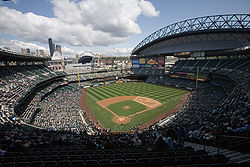
T-Mobile Park is a retractable roof ballpark in Seattle, Washington, United States. It is the home stadium of the Seattle Mariners of Major League Baseball and has a seating capacity of 47,929.[1] It is in Seattle's SoDo neighborhood, near the western terminus of Interstate 90 and is owned and operated by the Washington State Major League Baseball Stadium Public Facilities District. The first game at the stadium was played on July 15, 1999.
Key Information


During the 1990s, the suitability of the Mariners' original stadium—the Kingdome—as an MLB facility came under question, and the team's ownership group threatened to relocate the team. In September 1995, King County voters defeated a ballot measure to secure public funding for a new baseball stadium. Shortly thereafter, the Mariners' first appearance in the MLB postseason and their victory in the 1995 American League Division Series (ALDS) revived public desire to keep the team in Seattle. As a result, the Washington State Legislature approved an alternate means of funding for the stadium with public money. The site, just south of the Kingdome, was selected in September 1996 and construction began in March 1997. The bonds issued to finance the stadium were retired on October 1, 2011, five years earlier than anticipated.[6]
T-Mobile Park is also used for amateur baseball events, including the Washington Interscholastic Activities Association high school state championships and one Washington Huskies game per season. Major non-baseball events that have been held at T-Mobile Park include the 2001 Seattle Bowl and WrestleMania XIX in 2003, which attracted the stadium's record attendance of 54,097.
The stadium was originally named Safeco Field under a 20-year naming-rights deal with Seattle-based Safeco Insurance. T-Mobile acquired the naming rights on December 19, 2018, and the name change took effect on January 1, 2019.[7][8]
Location and transportation
[edit]T-Mobile Park is in the SoDo district of downtown Seattle, bounded by Dave Niehaus Way (a block of 1st Avenue S.) to the west, Edgar Martínez Drive (formerly S. Atlantic Street)[9] to the south, Royal Brougham Way to the north, and BNSF railroad tracks to the east.
Parking is available at the stadium's parking garage across Edgar Martínez Drive, the Lumen Field garage to the North, and other privately operated lots in the area. Sounder commuter rail serves nearby King Street Station.[10] T-Mobile Park is also served by the 1 Line of Sound Transit's Link light rail system and local King County Metro and Sound Transit Express bus routes at the nearby Stadium station.
Events at T-Mobile Park are scheduled to avoid conflicts with Lumen Field, which is directly north of the stadium. The Mariners have priority for schedule slots per an agreement reached with the Seattle Seahawks, who play at Lumen Field.[11]
A dedicated ride-hailing lot opened in June 2023 along 3rd Avenue; it cost $2.8 million to construct and opened ahead of the 2023 MLB All-Star Game.[12]
History
[edit]On March 30, 1994, county executive Gary Locke appointed a task force to assess the need for a new baseball stadium to replace the rapidly deteriorating Kingdome. Many feared that the Mariners would leave Seattle if a new stadium was not built. In January 1995, the 28-member task force recommended to the King County Council that the public should be involved in financing the stadium. The task force concluded that a sales tax increase of 0.1% (to 8.3%) would be sufficient to fund the stadium. King County held a special election on September 19, asking the public for this sales tax increase;[13] the measure led early,[14][15] but was narrowly defeated by one-fifth of one percent.[16][17][18]
On October 14, a special session of the state legislature authorized a different funding package for a new stadium that included a food and beverage tax in King County restaurants and bars, car rental surcharge in King County, a ballpark admissions tax, a credit against the state sales tax, and sale of a special stadium license plate.[18] Nine days later, the King County Council approved the funding package,[19] and established the Washington State Major League Baseball Stadium Public Facilities District to own the ballpark and oversee design and construction.[20][21] Taxpayer suits opposing the legislative actions and the taxes failed in the courts.[22]
Initial concepts for the new stadium, developed under the working name of New Century Park, were unveiled by architecture firm HOK in March 1995. The design included a retractable roof split into four sections and a seating capacity of 45,000 seats on four levels.[23] On September 9, 1996, the site was selected for the new stadium, just south of the Kingdome.[24] In late fall, several members of the King County Council wrote a letter to the Seattle Mariners, requesting a postponement of the projected $384.5-million stadium project.[25]

The Kingdome is visible in the background.
Construction officially began in 1997, with a groundbreaking ceremony on March 8 featuring Mariners star Ken Griffey Jr.[26] The construction, overseen by chief financial officer (and former team president and minority owner) Kevin Mather,[27] continued through the beginning of the 1999 season. Its first game was on July 15,[28][29] immediately after the All-Star break; the Mariners lost 3–2 to the San Diego Padres with 44,607 in attendance.[30][31] Longtime team broadcaster Dave Niehaus threw out the ceremonial first pitch at the game to Tom Foley, the former Speaker of the United States House of Representatives.[32]
The naming rights were sold in June 1998 to Seattle-based Safeco Insurance, which paid $40 million for a 20-year deal.[33][34] The 2018 season was the last played under this name, and the Safeco signage was removed from the ballpark beginning that November.[35] The naming rights were awarded to T-Mobile, whose U.S. headquarters are based in nearby Bellevue on December 19, which paid $87.5 million for an agreement that will last 25 years,[36] and the name change officially took effect on January 1, 2019.[37]
Ken Griffey Jr. returned to Safeco Field in 2007 with the Cincinnati Reds (where he had been traded after the 1999 season) to a hero's welcome.[38][39] In commemoration of Griffey's achievements with the team, the Mariners unveiled a new poster that declared Safeco Field "The House That Griffey Built."[40]
The Mariners moved the fences at Safeco Field closer to home plate before the 2013 season "to create an environment that is fair for both hitters and pitchers," according to General Manager Jack Zduriencik.[41] Safeco Field had been considered one of the most pitcher-friendly ballparks in the majors since it opened.[42][43] The center field scoreboard and ad panels were replaced with an 11,435 square foot (1,062.3 m2) board during renovations, becoming the largest among all stadium scoreboards in the major leagues at the time.[44][45]
After the 2017 season, the field surface, in place since the stadium opened in 1999, underwent its first full replacement. The infield and foul territory were redone in 2012, but the outfield had not been replaced before the resodding.[46]
.jpg)
On January 1, 2024, the National Hockey League (NHL) hosted the 2024 NHL Winter Classic, where the Seattle Kraken won over the Vegas Golden Knights 3–0.[47]
Features
[edit]
There previously was technology that allowed spectators to monitor special game-time features with Nintendo DS receivers.[48]
Layout
[edit]There are five main levels to the stadium: Field (or Street), Main Concourse (100 level – 20,634 seats[49]), Club Level (200 level – 4,585 seats[49]), Suite Level (1,945 seats[49]), and Upper Concourse (300 level – 15,955 seats[49]). Two bleacher sections are above left field and below the center field scoreboard, with 3,706 seats.[49] The Broadcast Center (press box) is on the Club Level and sub-level between it and the Main Level. As the field is approximately at street level, entry into any of the main gates requires visitors to ascend a flight of stairs, escalator, or elevator to access the main concourse, with the exception of the Right Field Entry, which opens onto the main concourse. Stairs, escalators, elevators, and ramps around the park provide access to all levels.[50]
Seating capacity
[edit]| Years | Capacity |
|---|---|
| 1999–2002 | 46,621[51][52] |
| 2003 | 47,772[51] |
| 2004–2008 | 47,447[51] |
| 2009–2011 | 47,878[53] |
| 2012 | 47,860[54] |
| 2013–2014 | 47,476[55] |
| 2015 | 47,574[56] |
| 2016–2017 | 47,943[57] |
| 2018 | 47,715[58] |
| 2019–present | 47,929[1] |
Food service
[edit]T-Mobile Park offers greater food and beverage selection than typical ballparks.[48] It includes concession stands operated by chain as well as local restaurants, such as Ivar's, Kidd Valley, and Salt & Straw.[59][60] Patrons could previously order food with a Nintendo DS app called Nintendo Fan Network.[48] The ballpark debuted "Walk-Off Market", the first cashierless store in an MLB stadium, in May 2022 using technology supplied by Amazon. Three additional locations the following season and include grab-and-go food and beverages.[61]
Retractable roof
[edit]
In the open position, the roof rests over the BNSF Railway tracks that bound the stadium to the east, with part of it hanging over the stands in right field. This has the effect of echoing the whistles from passing trains into the stadium. Train horns were often heard inside the stadium throughout the 2000s, but abated significantly when an overpass was built for Royal Brougham Way, the street that bounds the stadium to the north which previously crossed the tracks.[62] Unlike other stadiums with retractable roofs, the roof at T-Mobile Park does not fully enclose the ballpark; this allows the wind and temperatures to still impact the game with the roof closed.[63][64]
The roof covers approximately 9 acres (3.6 ha) and weighs 22 million pounds (10,000,000 kg). It moves with 128 wheels that move along rails on the north and south side of the ballpark. The top of the roof is 269 feet (82 m) above field level, while the bottom is 217 feet (66 m) high.[65][66] The roof takes 10 to 20 minutes to open and is moved 300 to 500 times per year, mostly to manage the stadium's grass.[65] The Mariners play an average of 17 to 18 games per season with the roof closed, the least among MLB ballparks with retractable roofs.[63] From 1999 to 2020, the roof had been used for 367 games—22 percent of those played at the stadium—with a maximum of 25 games during the 2010 season. The Mariners had a 692–632 record in games with the roof open, 116–109 with it closed, and 76–66 in games where the roof moves.[64][67]
Scoreboards
[edit]T-Mobile Park features a manual scoreboard, the second-largest HD video display scoreboard in MLB, a color LED out-of-town scoreboard, and LED ribbon boards along the terraces.[68][69] The main scoreboard, which replaced the original monochrome scoreboard and separate video screen above the center field bleachers before the 2013 season, is more than 11,000 square feet (1,000 m2) in area. The board can be used either all at once, such as for live action or video replays, or split into sections for displaying information such as statistics and advertisements.[70]
Mariners Hall of Fame
[edit]Co-located with the Baseball Museum of the Pacific Northwest, the Mariners Hall of Fame features bronze plaques of the eleven inducted members: Alvin Davis (1997), Broadcaster Dave Niehaus (2000), Jay Buhner (2004), Edgar Martínez (2007), Randy Johnson (2012), Dan Wilson (2012), Ken Griffey Jr. (2013), Lou Pinella (2014), Jamie Moyer (2015), Ichiro Suzuki (2022), and Félix Hernández (2023). The plaques describe their contributions to the franchise, as well as murals and television screens showing highlights of their careers with the Mariners.[71]
The 'Pen
[edit]The 'Pen, known for sponsorship purposes as "The T-Mobile 'Pen", is a standing-room only area adjacent to the bullpens, where spectators can watch relief pitchers warm up before entering the game.
When the stadium opened during the 1999 season, the area was called the "Bullpen Market". In 2013, the Mariners' vice president of ballpark operations described the Bullpen Market as a dark and unwelcoming place that needed a remodel to be more attractive to fans.[72]
Prior to the 2011 season, the Mariners brought in three celebrity chefs to introduce special concession stands with exclusive food options.[73] In the first season under its new branding, per-capita fan spending in The 'Pen increased by 87% from the previous season. In 2013, Edgar's Cantina, named for Hall of Fame Mariners player Edgar Martínez, opened. Sports Business Journal called The 'Pen "one of the liveliest social scenes in Major League Baseball" in 2013, when fan spending in The 'Pen had risen 42% year over year, which a team spokeswoman credited primarily to Edgar's Cantina.[72]
Local Mexican restaurant Poquitos opened a stand in The 'Pen during the 2017 season, and quickly gained national fame for selling chapulines, toasted grasshoppers, at every game.[74] Poquitos sold over 900 orders of chapulines at the first three home games, at $4.00 for a 4-US-fluid-ounce (120 ml) cup.[75][76]
In 2019, the Mariners opened The 'Pen two and a half hours before the first pitch of Mariners home games, offering happy hour specials to encourage fans to arrive early. As many as 3,000 fans come to The 'Pen during each game.[77]
The 'Pen attracts large and often rowdy crowds due to its food and drink options.[78] On April 13, 2013, a man was injured and required reconstructive surgery after a fight broke out over a table in The 'Pen. Two men turned themselves in, one of whom faced a felony assault charge. A team spokesperson said that the Mariners assign more uniformed police officers, private security guards, and alcohol enforcement officials to The 'Pen during special events, such as College Night.[79]
Artwork
[edit] | This section needs additional citations for verification. (September 2021) |
T-Mobile Park and its adjoining parking garage feature extensive public art displays, including:[80]
- "The Tempest", a chandelier made of 1,000 resin baseball bats above the home plate entry. A companion 27-foot diameter compass rose mosaic at the home plate rotunda captures a number of elements in the history of baseball. It was created by Linda Beaumont, Stuart Keeler, and Michael Machnic.[81]
- "Quilts" depicting each MLB team logo, made from recycled metal including license plates from the respective teams' states (or the province of Ontario in the case of the Toronto Blue Jays, or the District of Columbia in the case of the Washington Nationals).[81] The collection also includes references to the history of baseball in the Pacific Northwest.[81]
- Stainless steel cutouts of players in various poses while catching, batting, fielding, and pitching, integrated into the fences at the stadium's four main gates.
- Six Pitches, a series of metal sculptures depicting hands gripping baseballs for various types of pitches along the west facade of the garage.[81]
- A 9-foot-tall (2.7 m) bronze baseball glove, The Mitt by Gerard Tsutakawa, that has become an icon for T-Mobile Park.
- The Defining Moment, a mural by Thom Ross depicting Edgar Martínez's famed "The Double".[81]
- Children's Hospital Wishing Well, which features a bronze statue of a child in batting position, and includes a geyser effect that was used at the end of the national anthem.[81]
- Porcelain enamel on steel flag-mounted banner-panels depicting "Positions of the Field".[81]
Statues
[edit]A bronze statue of Mariners broadcaster Dave Niehaus (1935–2010) was unveiled on September 16, 2011.[82] The statue captures the broadcaster honored by the Baseball Hall of Fame with the Ford C. Frick Award in 2008, and who broadcast 5,284 Mariners games over 34 seasons (1977–2010),[83][84] at a desk, behind a microphone, wearing headphones with his Mariners scorebook in front of him. His scorebook is opened to the box score for Game 5 of the 1995 American League Division Series, when Edgar Martínez hit "The Double". There is an empty seat next to the statue, so fans can sit next to Niehaus and pose for photos. His longtime broadcast partner Rick Rizzs presided over a private ceremony to unveil the statue. The Dave Niehaus Broadcast Center is on the Club Level behind home plate. When Niehaus died, his headset and microphone were placed by his empty seat in the Broadcast Center as a tribute.[85]
In April 2017, a statue of Ken Griffey Jr. by sculptor Lou Cella was unveiled outside the Home Plate Entrance to the ballpark.[86] After the 2017 season, the bat was broken off in an attempt to steal it, but a bystander from the office building across the street ran down the perpetrator and recovered the bat, which was subsequently reattached.[87]
A bronze statue of Martínez, also made by Cella, was installed in August 2021 on the south side of the stadium near Griffey's statue.[88]
On August 9, 2025, the Mariners announced a statue of Ichiro will be built for the 2026 season.
Notable events
[edit]
Major League Baseball
[edit]On April 21, 2012, Chicago White Sox pitcher Philip Humber pitched the 21st perfect game in Major League Baseball history against the Mariners in his second start of the season. It was the 3rd perfect game in White Sox history joining Charlie Robertson in 1922 and Mark Buehrle in 2009.[89]
Nearly 4 months later on August 15, 2012, Mariners pitcher Félix Hernández pitched the 23rd perfect game in Major League Baseball history and the first perfect game in Mariners history. This marked the second perfect game and third no-hitter at the park, all of which occurred in the 2012 season.[90]
The stadium has hosted the Major League Baseball All-Star Game twice: in 2001 as Safeco Field and 2023 as T-Mobile Park. The 2001 edition was won by the American League—featuring eight players from the Mariners—in front of 47,364 spectators.[91] The 2023 edition was won by the National League with 47,159 in attendance.[92] The event used nearby Lumen Field for several events, including a fan festival and the MLB player draft.[93]
Minor league baseball
[edit]The stadium has been temporarily used by local minor league teams for playoff games when their normal venues were unavailable. The Tacoma Rainiers played their 2010 Pacific Coast League playoff semifinal games at then-Safeco Field while Cheney Stadium underwent off-season renovations.[94] The Rainiers won their series and advanced to the PCL Championship, which was played entirely on the road due to Safeco Field being unavailable.[95]
The Everett AquaSox of the Class A Northwest League played one game in the 2016 playoffs against the Spokane Indians at Safeco Field.[96] The move was arranged after a rainstorm rendered the outfield at Everett Memorial Stadium unusable for several days.[97]
College baseball
[edit]On May 4, 2007, an NCAA Pacific-10 Conference baseball attendance record was set when the Washington Huskies hosted defending National Champion Oregon State in front of 10,421 spectators.[98] Washington won the game, 6–2.
College football
[edit]The stadium hosted the 2001 Seattle Bowl, the first edition of the short-lived Seattle Bowl college football game, on December 27, 2001. Georgia Tech defeated 11th-ranked Stanford, 24–14, before 30,144 fans.[99]
Soccer
[edit]The stadium hosted several soccer matches before the opening of Lumen Field, which was designed for soccer. To prepare for soccer matches, the field has to be sodded to cover and replace the dirt infield.[100]
On March 2, 2002, the United States men's national soccer team played Honduras in a friendly match, winning 4–0 in front of a then-record crowd of 38,534.[101] The stadium hosted four matches during the 2002 CONCACAF Women's Gold Cup in November, including two matches featuring the United States women's national soccer team, as part of qualification for the 2003 FIFA Women's World Cup.[102] The first U.S. match, against Panama, had an attendance of 21,522; the second match, against Costa Rica, was attended by 10,079 fans.[103]
Seattle Sounders FC, a Major League Soccer team that plays at adjacent Lumen Field, once drafted plans to play a 2018 CONCACAF Champions League match at then-Safeco Field due to a potential scheduling conflict.[104]
| Date | Winning Team | Result | Losing Team | Tournament | Spectators |
|---|---|---|---|---|---|
| March 2, 2002 |  United States United States |
4–0 |  Honduras Honduras |
International Friendly | 38,534 |
| November 2, 2002 |  Mexico Mexico |
2–0 |  Trinidad and Tobago Trinidad and Tobago |
2002 CONCACAF Women's Gold Cup First Round | — |
| United States |
9–0 |  Panama Panama |
21,522 | ||
| November 6, 2002 |  Canada Canada |
2–0 | Mexico |
2002 CONCACAF Women's Gold Cup Semifinal | — |
| United States |
7–0 |  Costa Rica Costa Rica |
10,079 |
Wrestling
[edit]On March 30, 2003, the stadium hosted WrestleMania XIX, which set an all-time record attendance for the facility of 54,097.
Ice hockey
[edit]The 2024 NHL Winter Classic on January 1 was held at T-Mobile Park and was contested by the Seattle Kraken and the Vegas Golden Knights. The Kraken won 3–0 in front of 47,313 spectators.[105]
Concerts
[edit]| Date | Artist | Opening act(s) | Tour / Concert name | Attendance | Revenue | Notes |
|---|---|---|---|---|---|---|
| September 16, 2008 | The Beach Boys | — | — | — | — | The stadium's first concert, although it was not open to the public. |
| July 19, 2013 | Paul McCartney | — | Out There Tour | 45,229 / 45,229 | $4,525,200 | The stadium's first public concert, it also featured former Nirvana members on a performance of the song "Cut Me Some Slack".[106] |
| July 30, 2014 | Beyoncé Jay-Z |
— | On the Run Tour | 40,615 / 40,615 | $4,339,642 | |
| May 20, 2016 | Billy Joel | Gavin DeGraw | Billy Joel in Concert | 36,582 / 36,582 | $4,045,000 | |
| August 19, 2017 | Tom Petty & The Heartbreakers | The Lumineers | 40th Anniversary Tour | 42,199 / 46,050 | $3,665,292 | |
| August 8, 2018 | Pearl Jam | — | Pearl Jam 2018 Tour | 88,142 / 91,918 | $7,829,518 | This was the first time in five years since the band last played in their hometown.[107][108] |
| August 10, 2018 | ||||||
| August 31, 2018 | Zac Brown Band | OneRepublic | Down the Rabbit Hole Live | TBA | TBA | |
| September 1, 2018 | Foo Fighters | Giants in the Trees and The Joy Formidable | Concrete and Gold Tour | 37,825 / 49,131 | $2,913,484 | The surviving members of Nirvana reunited for a few songs. |
| October 19, 2019 | The Who | Liam Gallagher | Moving On! Tour | — | — | |
| September 6, 2021 | Green Day Fall Out Boy Weezer |
The Interrupters | Hella Mega Tour | 37,709 / 37,709 | $4,000,109 | Originally scheduled for July 25, 2020, and later, July 17, 2021. |
| August 3, 2022 | Red Hot Chili Peppers | The Strokes Thundercat |
2022 Global Stadium Tour | 41,706 / 41,706 | $5,489,712 | [109] |
| August 18, 2024 | Foo Fighters | Pretenders Alex G |
Everything or Nothing at All Tour | |||
| September 4, 2024 | Def Leppard Journey |
Cheap Trick | The Summer Stadium Tour | |||
| September 23, 2024 | Green Day The Smashing Pumpkins |
Rancid The Linda Lindas |
The Saviors Tour | |||
| May 24, 2025 | Stray Kids | Dominate World Tour | ||||
| June 26, 2025 | Post Malone Jelly Roll |
Big Ass Stadium Tour | ||||
| July 11, 2025 | My Chemical Romance | Violent Femmes | Long Live The Black Parade |
Other
[edit]- The stadium was the home to the Microsoft annual employee meeting until 2012, attracting over 20,000 employees.[110]
- Bernie Sanders held a rally for his 2016 presidential campaign on March 25.[111]
- The stadium hosted Nitro Circus Live on September 16, 2017.[112]
- On September 15, 2018, Russell M. Nelson, then President of the Church of Jesus Christ of Latter-day Saints, along with his wife, Wendy Watson Nelson, and Second Counselor Henry B. Eyring, held a devotional that was attended by 49,089 church members, friends, and members of the community.[113]
- Several local high schools and universities have held graduation ceremonies at the stadium.[114][115][116][117] Issaquah High School's class of 2000 was the first to graduate at the stadium.[118]
See also
[edit]
References
[edit]- ^ a b c "T-Mobile Park". 2019 Seattle Mariners Information Guide. MLB Advanced Media. February 21, 2019. p. 304. Archived from the original on March 29, 2019. Retrieved February 25, 2019.
- ^ 1634–1699: McCusker, J. J. (1997). How Much Is That in Real Money? A Historical Price Index for Use as a Deflator of Money Values in the Economy of the United States: Addenda et Corrigenda (PDF). American Antiquarian Society. 1700–1799: McCusker, J. J. (1992). How Much Is That in Real Money? A Historical Price Index for Use as a Deflator of Money Values in the Economy of the United States (PDF). American Antiquarian Society. 1800–present: Federal Reserve Bank of Minneapolis. "Consumer Price Index (estimate) 1800–". Retrieved February 29, 2024.
- ^ "Safeco Field". Vosk Group. Archived from the original on July 28, 2013.
- ^ a b c "Safeco Field". Ballparks.com. Archived from the original on March 2, 2018. Retrieved June 1, 2012.
- ^ "Flack+Kurtz: Safeco Field". WSP Global. Archived from the original on February 9, 2013.
- ^ Grygiel, Chris (September 27, 2011). "Safeco Field taxes to end (finally) on Saturday". Seattle Post-Intelligencer. Archived from the original on August 26, 2012. Retrieved August 15, 2013.
- ^ Divish, Ryan (June 13, 2017). "Safeco Field, home of the Mariners, is getting a name change". The Seattle Times. Archived from the original on June 15, 2017. Retrieved June 14, 2017.
- ^ Johns, Greg (December 19, 2018). "Mariners' home facility renamed T-Mobile Park". Mariners.com. MLB Advanced Media. Archived from the original on December 20, 2018. Retrieved December 21, 2018.
- ^ Thiel, Art (September 30, 2004). "Seattle to Rename Street After Edgar Martínez". Seattle Post-Intelligencer. Archived from the original on October 16, 2021. Retrieved September 30, 2004.
- ^ Gutierrez, Scott (June 14, 2011). "Appeals court allows Metro shuttle to Seahawks/Mariners games". Seattle Post-Intelligencer. Hearst Seattle Media. Archived from the original on June 3, 2013. Retrieved May 24, 2013.
- ^ Condotta, Bob (September 27, 2025). "How Mariners playoff schedule could impact Seahawks kickoff times". The Seattle Times. Retrieved September 28, 2025.
- ^ Timotija, Filip (June 27, 2023). "Ride-hailing lot opens at T-Mobile Park". The Seattle Times. Retrieved June 27, 2023.
- ^ "Seattle vote on stadium a close one". Eugene Register-Guard. Associated Press. September 20, 1995. p. 1B. Archived from the original on April 5, 2023. Retrieved October 4, 2019.
- ^ "Stadium plan leads by 310 votes". Eugene Register-Guard. Associated Press. September 22, 1995. p. 4C. Archived from the original on April 5, 2023. Retrieved October 4, 2019.
- ^ "Seattle scrambles to keep the Mariners if vote fails". Eugene Register-Guard. Associated Press. September 23, 1995. p. 2D. Archived from the original on April 5, 2023. Retrieved October 4, 2019.
- ^ "Stadium vote falls behind". Eugene Register-Guard. Associated Press. September 26, 1995. p. 3D. Archived from the original on April 5, 2023. Retrieved October 4, 2019.
- ^ "Final vote has leaders scrambling on stadium". Eugene Register-Guard. Associated Press. September 29, 1995. p. 1D. Archived from the original on April 5, 2023. Retrieved October 4, 2019.
- ^ a b "King County not yet sold on new stadium". Lewiston Morning Tribune. Associated Press. October 16, 1995. p. 4B. Archived from the original on April 5, 2023. Retrieved October 4, 2019.
- ^ "King County Council approves ballpark financing". Moscow-Pullman Daily News. Associated Press. October 24, 1995. p. 2B. Archived from the original on April 5, 2023. Retrieved October 4, 2019.
- ^ "Another win for the Mariners: a stadium". Eugene Register-Guard. (New York Times). October 24, 1995. p. 1A. Archived from the original on April 5, 2023. Retrieved October 4, 2019.
- ^ "Safeco Field History". Archived from the original on November 29, 2014. Retrieved March 19, 2014.
- ^ "Voters reject a stadium for the Seattle Mariners on September 19, 1995". HistoryLink.org. Archived from the original on March 19, 2014. Retrieved March 19, 2014.
- ^ Birkland, Dave (March 23, 1995). "Mariners unveil vision of new stadium". The Seattle Times. Retrieved February 13, 2024.
- ^ "Mariners' stadium plan advances". Spokesman-Review. September 10, 1996. p. C2. Archived from the original on April 5, 2023. Retrieved October 4, 2019.
- ^ Almond, Elliot; Schaefer, David; Seven, Richard; Clutter, Stephen (December 15, 1996). "Mariners Put Up For Sale – Owners Blame Council Members For Discussing Ballpark Delay". The Seattle Times. Archived from the original on October 3, 2012. Retrieved September 15, 2011.
- ^ "Great Moments at Safeco Field". The Seattle Times. July 12, 2009. Archived from the original on September 18, 2016. Retrieved July 10, 2016.
- ^ "$n$ Mariners CFO visits Walla Walla". Walla Walla Union-Bulletin. Union-bulletin.com. March 30, 2012. Archived from the original on January 23, 2014. Retrieved January 23, 2014.
- ^ "Mariners welcome grass, sky". Spokesman-Review. Associated Press. July 15, 1999. p. C1. Archived from the original on April 5, 2023. Retrieved October 4, 2019.
- ^ Welch, Craig (July 16, 1999). "Pricey park boasts priceless views". Spokesman-Review. p. A1. Archived from the original on April 5, 2023. Retrieved October 4, 2019.
- ^ Kepner, Tyler (July 16, 1999). "Field of dreams; nightmare result". Eugene Register-Guard. (Seattle Post-Intelligencer). p. 1C. Archived from the original on June 2, 2022. Retrieved October 4, 2019.
- ^ Cour, Jim (July 16, 1999). "The dome is no longer Mariners home". Moscow-Pullman Daily News. Associated Press. p. 1B. Archived from the original on June 2, 2022. Retrieved October 4, 2019.
- ^ Drayer, Shannon (May 4, 2020). "Drayer: Mariners' Safeco Field opener in 1999 was a curveball for the team". Seattle Sports Radio. Retrieved September 15, 2023.
- ^ "Safeco pays big bucks to name M's new stadium". Moscow-Pullman Daily News. Associated Press. June 4, 1998. p. 1D. Archived from the original on April 5, 2023. Retrieved October 4, 2019.
- ^ "Ballpark christened Safeco Field". Lewiston Morning Tribune. Associated Press. June 5, 1998. p. 3B. Archived from the original on April 5, 2023. Retrieved October 4, 2019.
- ^ Spedden, Zach (November 12, 2018). "Safeco Field Signage Comes Down". Ballpark Digest. August Publications. Archived from the original on November 13, 2018. Retrieved November 12, 2018.
- ^ Divish, Ryan (December 19, 2018). "Goodbye, Safeco Field. The Mariners' stadium is now called T-Mobile Park". The Seattle Times. Archived from the original on December 19, 2018. Retrieved December 19, 2018.
- ^ "Goodbye Safeco Field: Mariners ballpark officially becomes T-Mobile park on Tuesday". Q13 Fox News. December 31, 2018. Archived from the original on January 1, 2019. Retrieved January 1, 2019.
- ^ Bell, Gregg (June 23, 2007). "The Kid, now 37, returns to the house that he built". Eugene Register-Guard. Associated Press. p. 1. Archived from the original on April 5, 2023. Retrieved October 4, 2019.
- ^ Blanchette, John (June 23, 2007). "Junior's journey 'home'". Spokesman-Review. p. A1. Archived from the original on April 5, 2023. Retrieved October 4, 2019.
- ^ Bell, Gregg (June 23, 2007). "Griffey takes a trip down memory road with visit to Seattle". Moscow-Pullman Daily News. Associated Press. p. 3B. Archived from the original on April 5, 2023. Retrieved October 4, 2019.
- ^ Baker, Geoff (October 2, 2012). "Mariners Moving Fences in at Safeco Field in 2013". The Seattle Times. Retrieved October 3, 2012.
- ^ Gleeman, Aaron (September 29, 2004). "Park Factoring". The Hardball Times. Archived from the original on January 29, 2013. Retrieved October 3, 2012.
- ^ Cockcroft, Tristan H. (March 18, 2010). "Ranking The Ballparks". ESPN.com. Archived from the original on March 28, 2013. Retrieved October 3, 2012.
- ^ "Baseball stadiums by the board" (PDF). PDF Graphic. Chicago Tribune. April 14, 2012. Archived (PDF) from the original on April 15, 2013. Retrieved April 15, 2013.
- ^ Booth, Tim (April 8, 2013). "Mariners open new-look Safeco Field tonight". The Herald. Archived from the original on March 4, 2016. Retrieved April 9, 2013.
- ^ Hill, Craig (November 10, 2017). "Mariners show you how to build a baseball field in 20 tweets". The News Tribune. Archived from the original on October 14, 2018. Retrieved October 14, 2018.
- ^ Rosen, Dan (January 1, 2024). "Daccord has 1st shutout in Winter Classic history, Kraken top Golden Knights". NHL.com. Retrieved April 19, 2024.
- ^ a b c "Seattle fans can take DS out to the ballgame". NBC News. July 24, 2007. Archived from the original on July 13, 2015. Retrieved April 24, 2013.
- ^ a b c d e "2010 Seattle Mariners Media Guide" (PDF). Major League Baseball Advanced Media. Archived from the original (PDF) on December 26, 2010. Retrieved April 4, 2010.
- ^ "Safeco Field Seating and Pricing". Major League Baseball Advanced Media. Archived from the original on November 7, 2011. Retrieved November 11, 2011.
- ^ a b c Lowry, Phil (2006). Green Cathedrals: The Ultimate Celebrations of All 273 Major League and Negro League Ballparks Past and Present. New York City: Addison Wesley Publishing Company. ISBN 0-201-62229-7.
- ^ "FLORIDA STATE seminoles" (PDF). October 27, 2001.
- ^ "Games of April 14, 2009". USA Today. November 30, 2007. Archived from the original on September 2, 2011. Retrieved September 15, 2011.
- ^ Elliott, Jason (April 18, 2012). "Left With An Empty Feeling in Seattle". Coeur d'Alene Press. Archived from the original on January 18, 2013. Retrieved June 1, 2012.
- ^ "2013 Seattle Mariners Information Guide". Major League Baseball Advanced Media. p. 322.
- ^ "2015 Seattle Mariners Media Guide" (PDF). Major League Baseball Advanced Media. February 22, 2015. Archived from the original (PDF) on March 4, 2016. Retrieved March 6, 2015.
- ^ "2016 Seattle Mariners Media Guide" (PDF). Major League Baseball Advanced Media. February 18, 2016. p. 330. Archived (PDF) from the original on April 10, 2016. Retrieved March 28, 2016.
- ^ "Safeco Field" (PDF). 2018 Seattle Mariners Information Guide. MLB Advanced Media. February 12, 2018. p. 304. Archived from the original (PDF) on February 27, 2018. Retrieved February 27, 2018.
- ^ "Seattle Mariners unveil new local food options for 2022 season at T-Mobile Park". Fox 13 News. March 30, 2022. Retrieved January 31, 2025.
- ^ Didion, Alex (March 28, 2023). "2023 Opening Day: What to know before attending Mariners game at T-Mobile Park". KING 5 News. Retrieved January 31, 2025.
- ^ Schlosser, Kurt (March 28, 2023). "Amazon's tech is a hit: Seattle Mariners add three more stadium stores featuring 'Just Walk Out'". GeekWire. Retrieved January 31, 2025.
- ^ Gilmore, Susan (April 11, 2010). "New overpass may silence train whistle near Safeco Field". The Seattle Times. Archived from the original on January 24, 2022. Retrieved January 24, 2022.
- ^ a b Sistek, Scott (March 29, 2023). "Which MLB team uses their retractable roof the most? It's backward weather logic". Fox Weather. Retrieved July 1, 2024.
- ^ a b Kramer, Daniel (February 11, 2021). "How often do Mariners use ballpark roof?". MLB.com. Retrieved January 27, 2025.
- ^ a b Farley, Glenn (April 8, 2016). "Behind the scenes of Safeco's roof". KING 5 News. Retrieved July 1, 2024.
- ^ "Stats class: The stadium roof". Seattle Daily Journal of Commerce. June 17, 1999. Retrieved July 1, 2024.
- ^ "Inside the Numbers on the Safeco Field Retractable Roof". Seattle Mariners. January 15, 2015. Retrieved July 1, 2024.
- ^ "Daktronics to Provide Fully Integrated Stadium Information System for Seattle Mariners' New SAFECO FIELD". Daktronics. Archived from the original on October 21, 2012. Retrieved September 22, 2010.
- ^ "LED Video Display System Brightens SAFECO Field For 2011". Archived from the original on April 10, 2011. ANC Sports
- ^ Johns, Greg (November 15, 2012). "Safeco to Be Home of MLB's largest Video screen". Major League Baseball Advanced Media. Archived from the original on November 18, 2012. Retrieved November 15, 2012.
- ^ "Mariners Hall of Fame". MLB.com. Archived from the original on January 4, 2011. Retrieved September 24, 2013.
- ^ a b Muret, Don (October 14, 2013). "Edgar's keeps things hopping at Safeco Field 'Pen". Sports Business Journal. Archived from the original on April 1, 2023. Retrieved March 31, 2023.
- ^ Reichard, Kevin (January 27, 2011). "Mariners upgrading concessions: "the anti-fast food"". Ballpark Digest. Archived from the original on April 1, 2023. Retrieved March 31, 2023.
- ^ Rovell, Darren (April 7, 2017). "M's to offer toasted grasshoppers at Safeco". ESPN.com. Archived from the original on April 1, 2023. Retrieved March 31, 2023.
- ^ Rovell, Darren (April 14, 2017). "M's to limit sales of popular toasted grasshoppers". ESPN.com. Archived from the original on April 1, 2023. Retrieved March 31, 2023.
- ^ Schilken, Chuck (April 11, 2017). "Mariners fans can't get enough toasted grasshoppers during Monday's home opener at Safeco Field". Los Angeles Times. Archived from the original on April 1, 2023. Retrieved March 31, 2023.
- ^ Spanberg, Erik (July 8, 2019). "The push to get fans to arrive early". Sports Business Journal. Archived from the original on April 1, 2023. Retrieved March 31, 2023.
- ^ McLain, Casey (May 28, 2011). "Seattle Mariners: The 'Pen Is an Awful Additon [sic] to Safeco Field". Bleacher Report. Archived from the original on April 1, 2023. Retrieved March 31, 2023.
- ^ Kruse, Brandi (May 27, 2013). "Assault at Safeco Field raises safety concerns at The 'Pen". Seattle Sports. Archived from the original on April 1, 2023. Retrieved March 31, 2023.
- ^ "Art in the Park". Seattle Mariners. Archived from the original on September 7, 2021. Retrieved September 7, 2021.
- ^ a b c d e f g Brown, Andrea (June 12, 2017). "There's more to take in at Safeco Field than the Mariners". The Everett Herald. Archived from the original on September 7, 2021. Retrieved September 7, 2021.
- ^ "Bronze Dave Niehaus Statue Unveiled at Safeco Field Today". Archived from the original on October 24, 2011.
- ^ Stone, Larry (November 10, 2010). "Mariners Broadcaster Dave Niehaus Dies". The Seattle Times. Archived from the original on November 13, 2010. Retrieved November 11, 2010.
- ^ "Loss of a Legend: Dave Niehaus, Voice of the Mariners, Dies at 75". KOMO. November 10, 2010.
- ^ "Loss of a Legend: Photo of Niehaus' Seat in Broadcast Center". KOMO. November 10, 2010. Archived from the original on October 21, 2013. Retrieved November 11, 2010.
- ^ Jenks, Jayson (April 13, 2017). "Mariners unveil statue of Ken Griffey Jr. at Safeco Field". The Seattle Times. Archived from the original on September 7, 2021. Retrieved September 7, 2021.
- ^ "Ken Griffey Jr.'s bat is back: Workers repair statue outside Safeco Field". The Seattle Times. February 3, 2018. Archived from the original on March 27, 2019. Retrieved March 26, 2019.
- ^ Yamashita, Andy (August 11, 2021). "Cast in bronze, Edgar Martinez immortalized by Mariners with statue outside T-Mobile Park". The Seattle Times. Archived from the original on September 7, 2021. Retrieved September 7, 2021.
- ^ "Philip Humber throws 21st perfect game in MLB history". ESPN. Associated Press. April 21, 2012. Archived from the original on October 6, 2014. Retrieved April 21, 2012.
- ^ Stone, Larry (August 16, 2012). "Perfect! Mariners' Felix Hernandez Throws Perfect Game". The Seattle Times. Archived from the original on August 16, 2012. Retrieved August 16, 2012.
- ^ Stone, Larry (July 7, 2023). "No one can recreate the magical 2001 MLB All-Star Game for Seattle". The Seattle Times. Retrieved February 13, 2024.
- ^ Divish, Ryan (July 11, 2023). "The NL takes down the AL in MLB All-Star Game that sped by on perfect Seattle night". The Seattle Times. Retrieved February 13, 2024.
- ^ Ray, Benjamin (July 7, 2023). "2023 MLB All-Star Week: Play Ball Park is a home run for fans". Bellevue Reporter. Retrieved February 13, 2024.
- ^ Cothran, Jeremy (September 11, 2010). "Safeco no advantage for Rainiers". The Olympian. Retrieved September 15, 2023.
- ^ Hill, Benjamin (September 20, 2010). "Rainiers, Clippers vie for Triple-A title". Minor League Baseball. Retrieved September 15, 2023.
- ^ Geleynse, Jesse (September 10, 2016). "AquaSox blank Indians 8-0 to advance to NWL title series". The Everett Herald. Retrieved September 15, 2023.
- ^ Horton, Josh (September 9, 2016). "Spokane Indians players excited for opportunity to play at Safeco Field". The Spokesman-Review. Retrieved September 15, 2023.
- ^ "Huskies win record-setting night at Safeco Field". Archived from the original on July 29, 2012.
- ^ "Georgia Tech's defense stiffens against Stanford". CNN Sports Illustrated. December 27, 2001. Archived from the original on January 3, 2002. Retrieved April 8, 2023.
- ^ "Infield of Safeco Field Being Sodded for US-Honduras Match on March 2". U.S. Soccer. February 12, 2002. Archived from the original on March 8, 2016. Retrieved July 22, 2017.
- ^ Sherwin, Bob (March 3, 2002). "U.S. struts its stuff against Honduras". The Seattle Times. Archived from the original on March 6, 2018. Retrieved July 22, 2017.
- ^ Evans, Jayda (October 27, 2002). "Cup quest: Chastain, team make qualifying stop in Seattle". The Seattle Times. p. D7.
- ^ Evans, Jayda (November 7, 2002). "U.S. women a head above: Americans steamroll to victory and clinch a World Cup berth". The Seattle Times. p. D1.
- ^ Baker, Geoff (March 14, 2018). "Had Sounders advanced over Chivas, they would have been forced to play Champions League semi at Safeco Field". The Seattle Times. Retrieved June 2, 2023.
- ^ Baker, Geoff (January 1, 2023). "Kraken's Joey Daccord shines in shutout win over Vegas in NHL Winter Classic at T-Mobile Park". The Seattle Times. Retrieved January 1, 2023.
- ^ Cross, Charles R. (July 20, 2013). "McCartney concert: a moment in history". The Seattle Times. Archived from the original on September 24, 2015. Retrieved April 18, 2015.
- ^ "Pearl Jam Announce First Seattle Shows in Five Years". Spin. January 22, 2018. Archived from the original on January 23, 2018. Retrieved January 23, 2018.
- ^ "Pearl Jam Announce Seattle Stadium 'Home Shows' to Fight Homelessness". Rolling Stone. January 22, 2018. Archived from the original on January 23, 2018. Retrieved January 23, 2018.
- ^ "2022 GLOBAL STADIUM TOUR UPCOMING DATES". redhotchilipeppers.com. Archived from the original on October 14, 2021. Retrieved October 19, 2021.
- ^ "Microsoft Holds Annual Employee Meeting At Safeco". Archived from the original on October 11, 2010.
- ^ Le, Phuong; Baumann, Lisa (March 25, 2016). "Bernie Sanders holds Safeco Field rally before caucuses". KOMO. Archived from the original on April 8, 2023. Retrieved April 8, 2023.
- ^ Cedeno, Jose (September 13, 2017). "Nitro Circus makes a stop in the Emerald City". KING. Archived from the original on April 8, 2023. Retrieved April 8, 2023.
- ^ "President Nelson shares 5 lessons 'life has taught me' with 49,000 in Safeco Field". September 16, 2018. Archived from the original on January 14, 2019. Retrieved July 18, 2019.
- ^ Hunter, Steve (July 14, 2022). "Nearly 1,500 WGU students to attend graduation at T-Mobile Park". Kent Reporter. Archived from the original on April 8, 2023. Retrieved April 8, 2023.
- ^ "Lake Washington School District to host graduations at T-Mobile Park". KIRO. March 22, 2021. Archived from the original on April 8, 2023. Retrieved April 8, 2023.
- ^ Gracey, Celeste (June 13, 2011). "Issaquah School District celebrates commencement at Safeco". Issaquah Reporter. Archived from the original on April 8, 2023. Retrieved April 8, 2023.
- ^ "Grads all score at Safeco Field commencement". University of Washington Bothell. June 14, 2018. Archived from the original on April 8, 2023. Retrieved April 8, 2023.
- ^ "Issaquah High graduation will be at Safeco Field". The Seattle Times. April 3, 2000. Archived from the original on April 8, 2023. Retrieved April 8, 2023.
External links
[edit]
- Stadium site on MLB.com
- Video of Safeco Field – shows the roof open and close in time lapse
- Safeco Field Seating Chart
- ESPN Review
| Events and tenants | ||
|---|---|---|
| Preceded by | Home of the Seattle Mariners 1999 – present |
Succeeded by current
|
| Preceded by | Host of the All-Star Game 2001 2023 |
Succeeded by |
| Preceded by | Host of WrestleMania 2003 (XIX) |
Succeeded by |
| Preceded by | Host of the NHL Winter Classic 2024 |
Succeeded by |
| Subsidiaries and affiliates |
|  | ||||
|---|---|---|---|---|---|---|
| Absorbed companies | ||||||
| Branding and sponsorships | ||||||
| Related | ||||||

| Buildings | |
|---|---|
| Culture | |
| Infrastructure | |
| Sports | |
| National | |
|---|---|
| Geographic | |
