


Community hub
Recent from talks
Contribute something
Nothing was collected or created yet.
SCT Logistics
View on Wikipedia
SCT Logistics is an Australian interstate transport company operating rail and road haulage, with facilities in Brisbane, Sydney, Parkes, Melbourne, Adelaide and Perth.
Key Information


History
[edit]


SCT Logistics was founded in 1974 as Specialised Container Transport.[1][2]
In the mid-1990s, National Rail decided to discontinue the use of refrigerated vans, louvred vans, and boxcars on its trains. At the same time, Australia's rail network was being opened up to enable private operators the use of publicly owned railway track.
SCT had a customer base who wished to retain their use, so a number of surplus covered wagons were acquired, and hook and pull agreements were agreed with V/Line Freight (Melbourne to Adelaide) and Australian National (Adelaide to Perth) to haul the trains.[3] In July 1995, SCT began operating a weekly service from Melbourne to Perth.[4][5][6] The initial terminals for the service were at Dynon in Melbourne, Keswick in Adelaide and Kewdale in Perth. These were later replaced by purpose-built facilities at Laverton North, Penfield and Forrestfield.[7]
In October 2000, Freight Australia was awarded a contract to haul the services from Melbourne through to Perth with G class locomotives and specially equipped fuel tankers to replenish on the move. Crew vans were also introduced, for the accommodation of train crew on the long journey across the Nullarbor Plain.[3][8][9] The company also owned and operated its own locomotives for shunting wagons in its terminals.[10] In November 2006, SCT commenced running trains from a new terminal in Parkes, New South Wales to Perth.[11][12]
In February 2007, SCT purchased nine G class locomotives and leased three NR class locomotives from Pacific National until SCT's own fleet of SCT locomotives were delivered.[13][14][15] This was to comply with an undertaking given by Toll Holdings to the Australian Competition & Consumer Commission as part of it acquiring control of Pacific National.[16]
In February 2010, SCT Logistics commenced operating services between Melbourne and Brisbane with its wagons included in Aurizon operated services.[17][18]
In September 2010 Specialised Bulk Rail was formed as a subsidiary to haul iron ore from Cairn Hill Mine, Coober Pedy to Outer Harbor for IMX Resources.[19][20] In June 2014, due to low iron ore prices, the Cairn Hill mine was closed, ceasing SBRs Iron Ore contract.
In January 2017, it began operating its own Melbourne to Brisbane services having opened a terminal in Bromelton.[21]
In 2020, SCT Logistics was ranked 169th in the Australian Financial Review "Top 500 Private Companies in Australia", recording an annual revenue of AUD390 million, up 4% from the previous year. As of 2020, SCT employed approximately 2,000 people.
In January 2022, SCT Logistics commenced operating bulk trains of steel products from Melbourne to Adelaide and Perth under contract to BlueScope.[22]
In February 2024, SCT Logistics hired Seymour Railway Heritage Centre locomotives C501 and X31 which were recently converted to Standard-gauge. These locomotives were hired for use on the Dooen Freight in western Victoria.
2024 will see SCT leasing 6 RailFirst CF class locomotives for a period of 12 months or possibly longer.
locomotive fleet
[edit]| Class | Image | Type | Gauge | Top speed (km/h) |
Built | Number | Units | Notes |
|---|---|---|---|---|---|---|---|---|
| Owned Fleet | ||||||||
| CSR class | 
|
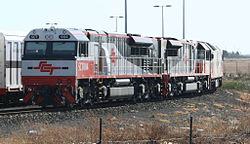
Diesel-electric | Standard | 115 | 2010-2022 | 24 | CSR001 - CSR024 | New build.
CSR002 & CSR003 have become parts donors to keep other units of its class operational. First Chinese-built Locomotives to operate in Australia |
| SCT class | 
|
Diesel-electric | Standard | 115 | 2007-2008 | 15 | SCT001 - SCT015 | New build.
First locomotives built new for SCT Logistics |
| H class | Diesel-Electric | Standard | 105 | 1964-1965 | 4 | H1, H2, H3, H5 | H1 stored, Dynon
H2, H3, H5 stored, Forrestfield | |
| K class | 
|
Diesel-Electric | Standard | 130 | 1966-1969 | 3 | K201, K208, K209 | K201 and K209 stored, Dynon
K208 SCT Kewdale shunter |
| J class | 
|
Diesel-Electric | Standard | 62 | 1966 | 2 | J102, J103 | J102 and J103 SCT Parkes shunters |
| T class | 
|
Diesel-electric | Standard | 100 | 1955-1968 | 2 | T345, T414 | T345 SCT Penfield shunter
T414 SCT Barnawartha shunter |
| X Class | 
|
Diesel-Electric | Standard | 133 | 1975-1976 | 2 | X47, X51 | X47 SCT Forrestfield shunter
X51 SCT Bromelton shunter |
| 80 class | 
|
Diesel-Electric | Standard | 130 | 1980 | 1 | 8026 | 8026 SCT Laverton shunter |
| Leased Fleet | ||||||||
| CF class | 
|
Diesel-Electric | Standard | 115 | 2011 - 2025 | 6 | CF4410, CF4428, CF4429, CF4431, CF4432, CF4433 | Leased from Rail First |
| EL class | 
|
Diesel-Electric | Standard | 115 | 1990 - 1991 | 2 | EL53, EL55 | Leased from Rail First |
| GL Class | 
|
Diesel-Electric | Standard | 115 | 1970 – 1973 as the 442 class
2003 – 2004 as the GL class |
3 | GL102, GL103, GL105 | Leased from Rail First |
| Previous Fleet | ||||||||
| G class |
|
Diesel- Electric | Standard | 115 | 1984 - 1989 | 9 | G511 - G515, G521, G532, G533, G535 | G511 to Watco, G512 + G515 to CFCLA, G513 + G514 to SSR, G521 + G532 to Qube, G533 + G535 to Aurizon[23] |
| X200 class | 
|
Diesel-Electric | Standard | 39 | 1963 | 1 | X209 | Scrapped, January 2026 |
| RT class | 
|
Diesel-Mechanical | Broad | 15 | 1962 | 1 | RT32 | Static Display, Mounted outside SCT Laverton[24] |
Queensland Intermodal Freight Hub
[edit]In August 2017, the company opened a new freight hub in Queensland, Bromelton Intermodal Estate. The opening was led by then-Deputy Prime Minister of Australia Barnaby Joyce and MP Scott Buchholz. The new freight hub is located adjacent to the Sydney–Brisbane rail corridor.
The project cost $35.2 million (AUD), with the Australian Federal Government investing $9.6 million (AUD) towards the cost of the terminal as a means to help provide local jobs in the area.
The 10 ha (25 acres) terminal has warehouses, loading facilities, and 6 km (3.7 mi) of track.[25]
Motorsport
[edit]2013-2019 V8 Supercars Sponsorship Alongside Supercheap Auto
In 2013, SCT announced its sponsorship plans with Supercheap Auto's Holden Commodore (VF), operated by Walkinshaw Racing Team. The #66 was driven by Russell Ingall, who finished the season 15th, with a 3rd-place finish at the Gold Coast 600.
From 2014 to 2015, SCT continued its sponsorship with the Supercheap Auto sponsored Holden Commodore (VF), Ingall was replaced by Tim Slade. Slade finished 17th with 3 podium finishes in 2014 and 13th with 1 podium in 2015.
In 2016, Supercheap Auto announced it would switch to Prodrive Racing Australia run under Rod Nash Racing with 2014 Bathurst 1000 winner Chaz Mostert behind the wheel. After a difficult season, Mostert managed to win a race at the Gold Coast 600.
In 2017 Mostert continued with Rod Nash Racing and won 3 races and the Pirtek Enduro Cup with co-driver Steve Owen after winning the Gold Coast 600. Mostert finished the championship in 5th position.
In 2018, another reshuffle of Prodrive Racing Australia saw them, and the Rod Nash Racing entry, renamed to Tickford Racing However, the team had a difficult season and Mostert only took one victory, another win at the Gold Coast 600.
In 2019, Tickford Racing upgraded to the new Ford Mustang GT. It was a moderately successful year, with a single win at Albert Park and several podiums.
Chaz announced that he was leaving Tickford Racing, for Walkinshaw Andretti United after being with the team for 7 years. SCT Logistics terminated its sponsorship agreement with Tickford after Mostert's plans to depart the team, despite Supercheap Auto staying on as Title Sponsor for the following season, bringing to an end a 7-year association with the retail giant.
2020–present
SCT Logistics is the naming rights sponsor for the No.4 Brad Jones Racing Holden Commodore ZB driven by Jack Smith in the 2022 Supercars Championship.[26] It also supports Tommy Smith, who is competing in the 2023 FIA Formula 3 Championship.[27]
SCT also sponsors Honda Racing Australia in the Australian Supercross Championship and Australian ProMX Championship .
References
[edit]- ^ Company Overview SCT Logistics
- ^ The rise and rise of SCT Track & Signal May 2014 pages 24/25
- ^ a b Peter Clark (June 2003). "The SCT Refrigeration Car Fleet". Australian Model Railway Magazine. 21 (3): 36–40.
- ^ Private train arrives early Daily Commercial News 19 July 1995
- ^ Interstate freight race starts Railway Gazette International September 1995 page 539
- ^ Open access brings Railway Gazette International 1 March 2003
- ^ Locations Archived 4 January 2014 at the Wayback Machine SCT Logistics
- ^ Freight Australia Hooks up SCT Railway Digest October 2000 page 7
- ^ Here & There Australian Railway Historical Society Bulletin issue 759 January 2001 page 32
- ^ SCT Railway Digest December 2007 page 21
- ^ Premier endorses Parkes as the hub of the nation Archived 1 March 2016 at the Wayback Machine Champion-Post (Parkes) 23 October 2006
- ^ SCT opens Parkes terminal Railway Digest December 2006 page 15
- ^ SCT Logistics gains part of Toll's rail divestments Rail Express 16 February 2007
- ^ SCT secure PN starter kit Rail Express issue 77 March 2007
- ^ SCT launches G class Kevin Sheedy Express Archived 4 January 2014 at the Wayback Machine Railway Digest September 2007 page 5
- ^ Toll-Pacific National Starters Kit SCT Logistics 16 February 2007
- ^ SCT Logistics Commences North South Rail Trials SCT Logistics 12 February 2010
- ^ News in Brief Railway Gazette International March 2010 page 7
- ^ SCT breaks into the bulk rail market The SCT Express May 2011
- ^ SCT orders Australia's first Chinese built locomotives and enters mineral haulage market Railway Digest November 2010 page 6
- ^ SCT Logistics hopes to capture freight from road with new east coast service International Railway Journal January 2017 pages 53-55
- ^ SCT confirmed for Bluescope steel east-west contract, Qube wins north - south work Railway Digest June 2020 page 6
- ^ SCT Acquires PN Locos Motive Power issue 51 April 2007 page 6
- ^ Wong, Marcus. "Rail tractor RT32 in SCT livery on a plinth outside the offices at Altona". Wongm's Rail Gallery. Archived from the original on 30 August 2024. Retrieved 4 February 2026.
- ^ Carter, Mark (30 August 2017). "SCT Logistics opens Queensland freight hub". International Rail Journal. Archived from the original on 27 September 2022. Retrieved 27 September 2022.
- ^ Brad Jones Racing retain Jack Smith for 2022 Auto Action 25 November 2021
- ^ Van Amersfoort Racing sign Australian rookie Smith for 2023 Archived 28 January 2023 at the Wayback Machine FIAFormula3® - The Official F3® Website. 22 December 2022


External links
[edit] Media related to SCT Logistics at Wikimedia Commons
SCT Logistics
View on GrokipediaCompany Profile
Founding and Ownership
SCT Logistics was founded in 1974 by Peter Smith as Specialised Container Transport, initially operating out of Melbourne, Australia, focusing on rail freight forwarding services.[1][3] The company remains privately owned by the Smith family, with founder Peter Smith serving as chairman and his sons Geoff and Glenn Smith holding key positions on the board. Geoff Smith acts as Managing Director, overseeing strategic direction and operations. Glenn Smith serves as Chief Executive Officer.[8][9] Headquartered in Altona, Victoria, SCT Logistics employed approximately 2,000 people as of 2020 and generated revenue of AUD 300 million that year.[10] As of 2024, the company generated revenue of approximately AUD 540 million.[11] From its origins as a specialized transport provider, the company has expanded into a major interstate logistics operator, offering multi-modal freight solutions across Australia.[1]Services and Operations
SCT Logistics provides a comprehensive range of freight services across Australia, specializing in rail and road linehaul operations that integrate multi-modal transport solutions. The company offers intermodal container handling, enabling seamless transfers between rail, road, and port logistics for efficient cargo movement. Additionally, SCT delivers refrigerated transport services for temperature-sensitive goods, utilizing specialized rail vans and facilities in key locations such as Melbourne, Sydney, Brisbane, and Perth. These services support both time-critical deliveries and bulk freight, including innovative solutions like high-capacity tipping trailers for commodities such as sugar cane.[12][13] The operational network spans major Australian cities, with facilities in Brisbane, Sydney, Parkes, Melbourne, Adelaide, and Perth, strategically positioned to serve high-volume interstate corridors. SCT focuses on key routes including the Melbourne-Perth East-West line and the East Coast network, providing reliable linehaul services that connect capital cities and regional hubs. This multi-modal approach, pioneered by the company since the 1970s as a container transport specialist, combines rail for long-haul efficiency with road for flexibility in last-mile distribution. Contract warehousing complements these operations, offering over 232,000 square meters of modern storage, including bonded and refrigerated options, with integrated management systems for inventory tracking and container stuffing.[1][14][15] In a recent enhancement, SCT Logistics entered a three-year agreement with Aurizon in 2025 to increase rail service frequency and speed on the East Coast, improving containerized freight delivery times for customers. This partnership underscores SCT's commitment to optimizing operational efficiency across its network, ensuring competitive solutions for diverse freight needs without relying on exhaustive numerical benchmarks.[16]Historical Development
Establishment and Early Expansion
SCT Logistics, originally known as Specialised Container Transport, was established in 1974 in Melbourne by Peter Smith as a family-owned enterprise focused on road-based container transport services along Australia's east-west corridor.[1][3] Initially operating as a freight forwarder, the company utilized state-based railway services for container haulage while building its road transport network to meet growing demand for efficient interstate logistics.[17] This foundation in multimodal coordination allowed SCT to handle container movements from Melbourne to Perth and other key routes, establishing a niche in non-bulk freight.[18] The company's entry into direct rail operations marked a significant shift, beginning with the launch of its inaugural Melbourne-Perth rail service in July 1995.[19] As the first private, non-government rail operator in Australia, SCT capitalized on newly introduced open access regulations to interstate tracks, running weekly intermodal trains between the two cities without relying on government carriers for the full journey.[20][21] This service, initially supported by hook-and-pull arrangements with V/Line and later Freight Australia, expanded SCT's capacity for time-sensitive container freight and solidified its role in national supply chains.[22] Early interstate expansions continued into the mid-2000s, with SCT opening a dedicated $15 million rail terminal in Parkes, New South Wales, and commencing a Parkes-Perth service in November 2006.[23] This twice-weekly route enhanced connectivity to Sydney markets, allowing SCT to shuttle freight via road from Parkes to inland and coastal hubs, thereby diversifying its network beyond the original Melbourne focus.[5] By integrating these expansions, SCT grew its operational footprint while maintaining emphasis on reliable, container-centric rail haulage. In September 2010, SCT formed Specialised Bulk Rail as a subsidiary to enter the bulk commodities market, initially hauling iron ore from the Cairn Hill Mine near Coober Pedy to Outer Harbor for IMX Resources.[24][25] This move represented a strategic broadening of services into resource transport, leveraging SCT's established rail infrastructure to support mining operations in South Australia.[5]Key Milestones and Challenges
In February 2010, SCT Logistics launched an experimental rail van service on the Melbourne-Brisbane corridor, marking its initial foray into north-south interstate freight operations using vans attached to existing services.[26] This initiative expanded the company's rail portfolio beyond its established east-west routes, leveraging partnerships to test demand for intermodal solutions in a competitive market.[27] By June 2014, subsidiary Specialised Bulk Rail (SBR), formed in 2010 to handle iron ore haulage from the Cairn Hill mine in South Australia, ceased operations under its primary contract due to a sharp decline in global iron ore prices that led to the mine's closure.[28] The downturn, triggered by oversupply and reduced Chinese demand, forced IMX Resources into administration, halting the multi-million-dollar rail service that SBR had provided from the mine to Port Adelaide.[24] This event highlighted the vulnerabilities of bulk commodity rail to volatile market conditions, prompting SCT Logistics to pivot toward more diversified freight segments.[29] In January 2017, SCT Logistics opened its Bromelton intermodal terminal in Queensland, enabling the company to commence independent Melbourne-Brisbane rail services and reduce reliance on third-party operators.[30] The facility supported weekly return trains, enhancing efficiency in containerized freight movement across the corridor.[31] SCT Logistics entered the bulk steel sector in January 2022 through a joint contract with Qube Logistics to transport BlueScope Steel products from Western Port, Victoria, to destinations including Whyalla in South Australia and Perth in Western Australia.[32] This 10-year agreement, commencing on 1 January, involved dedicated trains for steel slabs and coils, diversifying SCT's operations into non-intermodal bulk haulage and strengthening its position in industrial supply chains.[33] To bolster its fleet capacity amid growing demand, SCT Logistics leased two standard-gauge locomotives—C501 and X31—from the Seymour Railway Heritage Centre in February 2024.[33] These additions, recently converted for interstate use, supported enhanced operations on key routes, including the Dooen freight services.[19] In March 2025, SCT Logistics acquired CRE Solutions Logistics, a Burnie-based company in Tasmania, expanding its national footprint into the island state and enhancing supply chain services across Australia.[34] In October 2025, SCT opened a $45 million logistics hub in Forrestfield, Western Australia, designed to improve freight security, support regional businesses, and increase capacity for refrigerated and general cargo through advanced cross-docking facilities.[35]Infrastructure and Facilities
Terminals and Hubs
SCT Logistics operates a national network of intermodal terminals and hubs designed to facilitate seamless rail-to-road freight transfers across key Australian cities. These facilities support the company's integrated logistics operations by enabling efficient container handling, storage, and distribution for dry, refrigerated, and bulk cargoes. The primary terminals are located in Brisbane, Sydney, Parkes, Melbourne, Adelaide, and Perth, each strategically positioned near major rail corridors and highways to optimize connectivity.[36][14] In Brisbane, the terminal at Bromelton functions as a central intermodal hub for Queensland operations, handling high-volume transfers between rail and road networks. Sydney's facility in Minchinbury serves as a key eastern seaboard node, processing inbound and outbound containers for distribution across New South Wales and beyond. The Parkes terminal, situated at the intersection of major east-west and north-south rail lines, acts as a critical inland interchange for cross-country freight routing to ports and regional centers. Melbourne's Altona site supports Victoria's import-export flows with direct access to the Port of Melbourne, while Adelaide's Penfield terminal, spanning over 52 hectares, integrates rail sidings with road access for South Australian and interstate shipments. Perth's Forrestfield hub anchors Western Australia's operations, linking to the eastern states via rail and providing essential cross-docking capabilities.[36][37][38] Across these sites, SCT Logistics incorporates standardized infrastructure features to enhance operational efficiency, including dedicated warehousing for secure storage, multiple track sidings for rail unloading and loading, and integrated road-rail interfaces that allow for rapid container transfers using overhead cranes and specialized equipment. These elements enable the company to manage diverse freight types while minimizing dwell times and supporting just-in-time delivery models. Warehousing capacities vary by location but emphasize temperature-controlled options where needed, complemented by seamless digital tracking systems for inventory management.[14][39][14] A significant recent enhancement to the network is the $45 million temperature-controlled cross-dock and storage facility opened at the Forrestfield terminal in October 2025. This state-of-the-art addition integrates refrigerated rail freight arrival, dispatch, and storage on a single site, significantly improving the handling of perishable goods and bolstering supply chain resilience in Western Australia by reducing reliance on long-haul trucking through Perth.[40][41][42] In November 2025, SCT Logistics marked the 20th anniversary of its sugarcane haulage contract in Northern NSW, with infrastructure at supporting hubs like Sydney and Parkes facilitating the integration of road collections into the broader rail network; to meet seasonal demands, the company bolstered its operational capacity with eight new trucks.[43]Queensland Intermodal Freight Hub
The Queensland Intermodal Freight Hub, located at Bromelton approximately 65 km south of Brisbane, officially opened on August 23, 2017, as a key infrastructure investment by SCT Logistics. The facility was developed at a total cost of A$35.2 million, with A$9.6 million funded by the Australian federal government through the National Stronger Regions Fund. This intermodal terminal serves as an anchor for the broader Bromelton State Development Area, enabling efficient rail-road freight transfers and supporting regional economic growth.[44] Spanning 10 hectares within a larger 134-hectare site, the hub features a 10,500 m² cross-dock transit warehouse, a 5,000 m² hardstand area for container handling and storage, and over 7.3 km of internal rail sidings connected directly to the Australian Rail Track Corporation's Sydney-Brisbane main line. These specifications allow for the handling of up to 1.3 million tonnes of annual rail freight, including container loading, unloading, and storage operations designed for seamless intermodal transfers. The infrastructure supports train lengths of up to 1.5 km, facilitating high-volume operations without disrupting the national rail network.[45][46] Strategically positioned, the hub plays a pivotal role in the Melbourne-Brisbane rail corridor by shifting freight from roads to rail, thereby reducing congestion on key highways; for instance, full utilization could eliminate approximately 18,500 truck journeys annually. It integrates with the national freight network, including future connections to the Inland Rail project, to handle both containerized intermodal loads and wagonload bulk commodities such as those from primary producers and agribusiness sectors. This capability enhances supply chain efficiency for intrastate, interstate, and export markets, positioning Bromelton as a critical node in Australia's east coast logistics landscape.[44][46][45]Rolling Stock
Current Locomotive Fleet
SCT Logistics operates a diverse fleet of over 60 diesel-electric locomotives as of November 2025, tailored for interstate freight operations on Australia's standard gauge (1,435 mm) rail network. The majority are heavy-haul units suited for intermodal container and bulk transport across east-west and north-south corridors, with auxiliary older models used for shunting and yard duties at key terminals. All locomotives in the fleet are diesel-electric types, providing reliable power for long-distance hauls while complying with Australian rail standards and environmental regulations.[47] In February 2025, SCT leased six CF class locomotives from Rail First to enhance capacity on major corridors.[48] Recent expansions also include the leasing of two ACD class locomotives in August 2025 from Aurizon to bolster capacity amid growing demand for efficient freight services on services such as MB9 and BM9. These additions complement the core fleet, enabling SCT to maintain high utilization rates and reduce transit times on major routes.[49] The fleet composition is summarized in the following table:| Class | Number of Units | Build Years | Top Speed (km/h) |
|---|---|---|---|
| CSR Class | 24 | 2010-2022 | 115 |
| SCT Class | 15 | 2007-2008 | 115 |
| CF Class (leased) | 6 | 2025 | 115 |
| T Class | 2 | 1955-1968 | 100 |
| H Class | 4 | 1964-1965 | 105 |
| J Class | 2 | 1966 | 62 |
| K Class | 3 | 1966-1969 | 130 |
| X200 Class | 2 | 1963 | 39 |
| X Class | 2 | 1975-1976 | 133 |
| 80 Class | 1 | 1980 | 130 |
| ACD Class (leased) | 2 | 2025 | 115 |