


Recent from talks
Contribute something
Nothing was collected or created yet.
Suburban Mobility Authority for Regional Transportation
View on Wikipedia
 | |
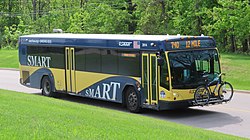
 SMART bus in Farmington Hills | |
| Founded | 1967 |
|---|---|
| Headquarters | Buhl Building Downtown Detroit, Michigan |
| Locale | Detroit |
| Service area | Metro Detroit counties of Wayne, Oakland and Macomb |
| Service type | Local bus service, express bus service, paratransit |
| Alliance | RTA |
| Routes | 44 |
| Hubs | Spirit Plaza Jason Hargrove Transit Center Royal Oak Transit Center Dearborn Transit Center Macomb Mall |
| Fleet | 262 |
| Daily ridership | 23,875 (2024)[1] |
| Fuel type | Biodiesel Electric |
| General Manager | Tiffany Gunter (interim) |
| Website | smartbus |

The Suburban Mobility Authority for Regional Transportation (SMART) is the public transit operator serving the suburbs of Detroit, Michigan, United States. Beginning operations in 1967 as the Southeastern Michigan Transportation Authority (SEMTA), the agency was reorganized and renamed SMART in 1989. SMART operates 45 bus routes (supplementing the Detroit Department of Transportation), plus paratransit and microtransit services.[2]
History
[edit]1967–1989: SEMTA
[edit]The Michigan Legislature passed the Metropolitan Transportation Authorities Act of 1967, which included the creation of the Southeastern Michigan Transportation Authority (SEMTA). SEMTA was charged to take over the ownership and operations of the fractured regional transit systems in Macomb, Oakland, and Wayne counties, including the city of Detroit.[3]
The new authority acquired several suburban transit bus operations including Lake Shore Coach Lines (1971), Pontiac Municipal Transit Service (1973), Dearborn's Metropolitan Transit (1974), Birmingham's Great Lakes Transit (1974), and Royak Oak's Martin Lines (1975). However, the 1967 transportation act did not provide the regional authority with any means to levy taxes.[4] By 1974, the Detroit Department of Street Railways (DSR) had been reorganized as a city department of Detroit, leaving SEMTA only coordination over the suburban services.[3] That same year, SEMTA acquired a commuter train service between downtown Detroit and Pontiac from the Grand Trunk Western Railroad. Due to declining ridership and a lack of funding, the commuter rail service was discontinued in October 1983.[citation needed]
In 1979, SEMTA approved a regional transit plan, which included improved bus service and new rail transit, but the plan was never implemented due to lack of funds.[3] The last commuter rail service was a former Penn Central route, named the Michigan Executive, that ran from the Michigan Central Depot in Detroit to Jackson. Its final operator was Amtrak, as funded by the State of Michigan. The already pared down Executive service ended in 1984.[citation needed]
Beginning in 1983, SEMTA oversaw the construction of the Detroit People Mover, which was conceived as part of a much larger project of light rail lines and a downtown subway. Mismanagement of the project resulted in tens of millions of dollars in cost overruns, causing the federal government to pull out of the project. In 1985, with the half-built project in limbo, the city of Detroit negotiated with SEMTA to take over the project, and it was transferred to the newly created Detroit Transportation Corporation.[5]
1989–2009: Reorganization as SMART, opt-out system
[edit]
With little interest in the suburbs for expanding mass transit and Detroit not interested in joining the system, SEMTA was restructured as SMART in 1989, reducing the authority's service area from seven counties to four and excluding the city of Detroit.[3] Mike Duggan, then Wayne County's deputy county executive and vice chair of SMART's board of directors, was named the agency's general manager in February 1992.[6]
The first millages to fund SMART passed by wide margins in Macomb and Wayne counties in May 1995,[7][8] followed by a similar millage in Oakland County the following June.[9] While the Macomb millage was levied countywide, the millages in Wayne and Oakland were only voted upon by communities whose councils opted to participate. Other communities chose to leave SMART to avoid the new property tax, setting up the "opt-out" system that remained in place for much of SMART's history.[8]
In October 1994, SMART introduced Job Express, a shuttle service (similar to microtransit) which transported workers from SMART hubs to nearby workplaces. The service was offered in three areas, extending one mile each from the Royal Oak Transit Center, Fairlane Town Center, and Macomb Mall.[10] Initial plans called for up to fifteen such service zones, though only two were added (one spurring from Lakeside Mall, and another serving Somerset Collection), and the Macomb Mall area was expanded to cover much of Groesbeck Highway.[11]
Livonia opted out of SMART in 2005, as the first, and so far only, community to leave the system since 1995.[12][13] Walled Lake rejoined the following year.[2][14]
In order to prevent possible service cuts, SMART raised its fares by $0.50 on December 1, 2009; there was also a $0.50 charge added to regional monthly pass users and DDOT transfers.[15]
2011–2017: Service cuts
[edit]In October 2011, SMART discontinued 22% of its scheduled service and laid off 123 employees. This was widely attributed to declining property values (following the Great Recession) which led to reduced property tax revenue, and the inability of the authority to reach an agreement with its unions.[3]
In January 2012, the Farmington City Council voted 4-1 to opt out of SMART, though they unanimously reversed their decision two weeks later. Meanwhile, neighboring Farmington Hills narrowly voted to remain in the system.[16]
Lathrup Village, which had opted out of SMART in 1995, rejoined the system in 2014.[17]
2018–2022: Expansion, integration, and rebranding
[edit]On January 1, 2018, SMART began operating three high frequency, limited-stop FAST bus services, connecting downtown Detroit to suburban communities with frequent service.[18] FAST represented the first major expansion of the system since the 2011 service cuts.
In May 2019, SMART and DDOT unified their fare structures and introduced Dart, a common fare payment system, with regional passes and mobile ticketing.[19][20] The QLINE joined Dart the following October.[21]
In March 2021, SMART began offering Flex, a microtransit service, operated by Via Transportation under contract. Flex was initially offered in three small zones within SMART's service area, with one covering Dearborn and most of Taylor alongside portions of surrounding communities, another serving portions of Troy and surrounding cities, and the third serving communities along M-59 in Macomb County. Two more zones were added in August 2021 and May 2022, covering Auburn Hills and Pontiac, and Farmington and Farmington Hills, respectively.[22]
In February 2022, the Auburn Hills City Council voted 5-2 to opt out of SMART.[23][24] The city's exit was blocked by a judge in May, however, and Auburn Hills remained a member until the opt-out system's abolition in 2023.[25] Macomb Township's board of trustees similarly passed a resolution in March expressing interest in opting out of SMART services.[26]
2022–present: Rebranding and Oakland County expansion
[edit]2022 saw a renewed push for a countywide expansion of SMART in Oakland County, ahead of the scheduled millage renewal that August. The Oakland County Board of Commissioners proposed replacing the existing SMART millage with a new ten-year .95 millage, levied on all homes in the county, not just in existing member communities.[27] Approved by voters in November 2022,[28] the millage abolished opt-out system in Oakland County, allowing for the expansion of SMART services to the far reaches of Metro Detroit.[27][29] Work is underway for new routes to begin operations in 2023.[30]

SMART unveiled a new logo and branding in August 2022, coinciding with a new advertising campaign.[31] The following month, SMART introduced their first electric bus, one of four Proterra ZX5 units purchased by the agency with a Federal Transit Administration grant.[32][13]
In February 2023, the original Dart payment app was discontinued, as its creator, Passport, exited the transit payments market. Mobile Dart passes were moved to the Token Transit app.[20][33]
Millage and opt-out system
[edit]Since 1995, SMART has been funded in large part by a millage,[8] renewed by voters in member communities in midterm election years through 2022. The millage has historically been approved by wide margins in every member community in Oakland and Wayne counties, though less so in Macomb County, passing there by a narrow margin of 39 votes in 2018.[34] The millage was extended from four to five years in Wayne and Macomb counties, and to ten years in Oakland County, beginning in 2022.
SMART is notable among US transit systems for the ability of individual communities to "opt out" of the system. Opted-out communities are not subject to the taxes levied by the SMART millage, but as a result do not receive SMART's services. Some of these communities are members of smaller transit agencies providing paratransit services for seniors and disabled residents, but lack scheduled fixed-route bus service.
17 communities in Wayne County currently opt out of SMART service, of which all but one (Livonia) opted out with the first millage in 1995.[12] Detroit is one such community, as its own DDOT provides fixed-route bus service to the city, though it is served by SMART's FAST limited-stop routes, as well as other routes during peak hours.
Communities in Macomb County and Oakland County are not able to opt out of SMART, as their millages have been levied countywide since 1995 and 2023, respectively. Four Oakland County communities opted out in 1995 but later rejoined: Bloomfield Township and West Bloomfield (both 1996), Walled Lake (2006),[14] and Lathrup Village (2014).[17] The 34 remaining opted-out Oakland County communities were added to the system in 2023.[35]
2022 changes & Oakland County expansion
[edit]In 2022, the SMART millage in Macomb and Wayne counties was extended to five years, and moved to the November general election ballot.[36][37] Both were approved by wide margins.[28]
In Oakland County, the SMART millage was replaced with a ten-year countywide public transit millage, which abolished the opt-out system in Oakland County, and funds three smaller paratransit providers (the North Oakland Transportation Authority, Western Oakland Transportation Authority, and Older Persons' Commission) alongside SMART.[27][29] The county's Board of Commissioners approved the new millage proposal on August 10, 2022 in a bipartisan vote, with two Republicans joining all 13 Democrats on the board.[29] The proposal appeared on the November 2022 general election ballot in all Oakland County communities, and passed with 57% of the vote.[28][35] As a result, SMART's service area expanded to all of Oakland County on January 3, 2023, though new services in portions of the county (Novi, Bloomfield Hills, and Wixom) did not begin operation until September 2023, with initialization of further services in 2024.[30]
Wayne County member communities
[edit]- Allen Park
- Dearborn
- Dearborn Heights
- Ecorse
- Garden City
- Grosse Pointe
- Grosse Pointe Farms
- Grosse Pointe Park
- Grosse Pointe Shores
- Grosse Pointe Woods
- Hamtramck
- Harper Woods
- Highland Park
- Inkster
- Lincoln Park
- Melvindale
- Redford
- River Rouge
- Riverview
- Romulus
- Southgate
- Taylor
- Trenton
- Wayne
- Westland
- Wyandotte
Services
[edit]Fixed-route buses
[edit]SMART is the primary public transit operator serving Detroit's suburbs, and fixed-route bus services comprise the majority of its service. 44 routes of various types operate across SMART's three-county service area.
FAST
[edit]
Frequent Affordable Safe Transit (FAST) is SMART's flagship service; its limited-stop bus routes serve as the main arteries of the network, connecting the suburbs with downtown Detroit. Five FAST routes currently operate along three major Metro Detroit avenues - Gratiot, Michigan, and Woodward - with service every 30 minutes on weekdays, and stops roughly every mile for most of their lengths.[18]
| Route Name | # | Termini | Length | Headway (minutes) | Notes | |||
|---|---|---|---|---|---|---|---|---|
| Mon-Fri | Sat | Sun | ||||||
| FAST Michigan | 261 | Spirit Plaza | Detroit Metro Airport | 22.1 miles (35.6 km) | 30 | 60 | 60 | |
| FAST Woodward | 461 | Troy Civic Center | 24 miles (39 km) | 60 | 60 | 60–110 | Concurrent from Birmingham south, with service every 30 minutes combined; local stops in Pontiac on 462 | |
| 462 | Great Lakes Crossing Outlets/Auburn Mile | 32.5 miles (52.3 km) | 60 | 60 | 120 | |||
| FAST Gratiot | 563 | Gratiot + 23 Mile | 27 miles (43 km) | 30 | 30 | 60 | ||
| 562 | Wayne State University | Harrison Township | 24.1 miles (38.8 km) | 2 trips daily | - | - | Weekday rush hour only; concurrent with 563 from Warren Avenue to Mt. Clemens | |
Local routes
SMART's 33 local routes serve as the main public transit connection between Detroit's suburbs.[2] Each is classified as either a high-ridership "main corridor" route, a long-distance "crosstown" route, or a "community" route focused on serving denser areas. Almost all connect to FAST, enabling connections to downtown Detroit. Most local routes run hourly, though a few are more frequent.[38]
| # | Route Name | Termini | Length | Headway (minutes) | Notes | |||
|---|---|---|---|---|---|---|---|---|
| Mon-Fri | Sat | Sun | ||||||
| 125 | Fort Street/Eureka Road | W Jefferson Avenue + Coolidge Highway | Detroit Metro Airport | 22.1 miles (35.6 km) | 30 | 60 | 60 | |
| 140 | Southshore | Dearborn Transit Center | Southgate Meijer | 16.8 miles (27.0 km) | 60 | - | - | Interlined with 250 |
| 160 | Downriver | West Road + Grange Road (Trenton) | 26.4 miles (42.5 km) | 60 | 60 | - | ||
| 200 | Michigan Avenue Local | Fairlane Town Center | Michigan Avenue + John Hix Road (Wayne) | 11.4 miles (18.3 km) | 90 | 120 | 120 | Concurrent from Wayne Road east
Select late-night trips start and end at Michigan + Schaefer |
| 210 | Westland Meijer | 16.8 miles (27.0 km) | 90 | 120 | 120 | |||
| 250 | Ford Road | Dearborn Transit Center | 14.4 miles (23.2 km) | 60 | - | - | Interlined with 140 | |
| 275 | Telegraph - Taylor/Tel-Twelve | 12 Mile + Telegraph Road (Southfield) | Southland Center/Taylor Meijer | 27.4 miles (44.1 km) | 40–60 | 60 | - | Overlaps with 375 from 7 Mile to 12 Mile |
| 280 | Western Wayne Crosstown | Old Redford Meijer (Northwest Detroit) | Detroit Metro Airport Evans Terminal | 23 miles (37 km) | 60 | 75 | 75 | Only services Evans Terminal at Metro Airport |
| 305 | Grand River | Wixom Meijer | 16.1 miles (25.9 km) | 60 | 60 | 60 | ||
| 375 | Telegraph - Old Redford/Pontiac | Amazon Pontiac | 24.4 miles (39.3 km) | 60 | 60 | - | Overlaps with 275 from 7 Mile to 12 Mile | |
| 405 | Northwestern Highway | Jason Hargrove Transit Center | Henry Ford West Bloomfield Hospital | 21.4 miles (34.4 km) | 60 | 60 | - | |
| 415 | Greenfield | Northland | Meijer Royal Oak | 8.7 miles (14.0 km) | 70 | 70 | 45 | Interlined on weekdays and Saturdays |
| 420 | Southfield | 9.1 miles (14.6 km) | 70 | 70 | - | |||
| 430 | Main Street | Royal Oak Transit Center | Crooks Road + I-75 (Troy) | 9.4 miles (15.1 km) | 60 | - | - | Select trips at peak hours divert to Royal Oak High School |
| 450 | Woodward Local - Pontiac | Jason Hargrove Transit Center | Phoenix Center (Pontiac) | 16.9 miles (27.2 km) | 60 | 60 | 120 | Concurrent from southern terminus to 10 Mile, and from 11 Mile to Maple; 460 diverts from Woodward to service downtown Royal Oak |
| 460 | Woodward Local - Somerset | Somerset Collection | 11.8 miles (19.0 km) | 60 | 60 | 120 | ||
| 492 | Rochester | Oakland University | 28.1 miles (45.2 km) | 60 | 60 | - | ||
| 494 | Dequindre | Beaumont Hospital-Troy (Sterling Heights) | 15.1 miles (24.3 km) | 60 | 60 | - | ||
| 495 | John R | Oakland Mall | 8.7 miles (14.0 km) | 30 | 45 | 45 | ||
| 510 | Van Dyke | Bel Air Shopping Center (Detroit) | Lakeside Mall | 15.8 miles (25.4 km) | 20–30 | 30 | 60 | Trips alternate between northern termini |
| Shelby TownshipWalmart | 19.2 miles (30.9 km) | |||||||
| 525 | Groesbeck | Clinton Township Meijer | 18.3 miles (29.5 km) | 60 | - | - | ||
| 550 | Garfield | Macomb Mall | Lakeside Mall | 12 miles (19 km) | 60 | - | - | Interlined with 615 |
| 560 | Gratiot Local | Gratiot + 8 Mile | 23 Mile + Altman Road (New Baltimore) | 21.1 miles (34.0 km) | 20 | 30 | 60 | Most runs end at Gratiot & 23 Mile; one trip per hour continues to New Baltimore |
| 610 | Kercheval-Harper | Jefferson Avenue + Alter Road | 15 Mile + Gratiot (Clinton Township) | 17 miles (27 km) | 60 | 60 | 65 | |
| 615 | Jefferson | Moross Road + Mack Avenue (Detroit/Grosse Pointe Farms) | Macomb Mall | 11 miles (18 km) | 60 | - | - | Interlined with 550 |
| 710 | 9 Mile Crosstown | 9 Mile + Telegraph (Southfield) | 20.7 miles (33.3 km) | 45 | 60 | 45 | First eastbound trip daily starts at 9 Mile + Woodward
No Sunday service west of Lodge Freeway (truncated to 10 Mile + Evergreen) | |
| 730 | 10 Mile Crosstown | 10 Mile + Telegraph (Southfield) | 28.9 miles (46.5 km) | 60 | 60 | - | First two trips daily start, and last two end, at Royal Oak Transit Center | |
| 740 | 12 Mile Crosstown | 13 Mile + Little Mack Avenue (Roseville) | Wixom Meijer | 41.9 miles (67.4 km) | 60 | 60 | 60 | Select trips start and end in Royal Oak
No Sunday service west of Woodward Avenue (truncated to Detroit Zoo) |
| 759 | Highland Road | Oakland University | Bogie Lake Road (White Lake) | 19.7 miles (31.7 km) | 50 | 50 | - | |
| 760 | 13 Mile/14 Mile Crosstown | 13 Mile + Little Mack Avenue | 12 Mile + Telegraph Road (Southfield) | 26.4 miles (42.5 km) | 60 | - | - | Last westbound trip daily ends at Oakland Mall |
| 780 | 15 Mile Crosstown | 15 Mile + Gratiot | Maple Road + Orchard Lake Road | 28.3 miles (45.5 km) | 50 | 60 | - | Last 3 westbound trips daily end at Somerset Collection |
| 790 | Pontiac Crosstown | Columbia Avenue + Baldwin Avenue, Pontiac | Adams Marketplace (Rochester Hills) | 17 miles (27 km) | 60 | 60 | 60 | Most weekday trips divert to serve Oakland County Courthouse |
| 796 | Perry-Opdyke | Phoenix Center | Auburn Hills Marriott (Pontiac) | 12.2 miles (19.6 km) | 60 | - | - | |
Commuter routes
In addition to FAST and local routes, SMART operates seven commuter express routes between Downtown Detroit and the suburbs during weekday rush hours. They run toward Detroit in the morning, and toward the suburbs in the afternoon; all seven follow roughly the same path through Downtown Detroit, serving Spirit Plaza and the Rosa Parks Transit Center.[2]
Routes 255, 530, 620, and 635 run primarily on local roads, twice daily, while routes in the 800-series run primarily on freeways, three times daily. A 50¢ surcharge applies to all fares and passes when riding 800-series routes.
| # | Route Name | Suburban terminus | Length | Daily
trips |
Notes |
|---|---|---|---|---|---|
| 255 | Ford Road Express | Westland Police Department | 20.1 miles (32.3 km) | 2 | Signed only as "Express" on headsign |
| 530 | Schoenherr | Lakeside Mall | 23.4 miles (37.7 km) | 2 | |
| 620 | Charlevoix | Macomb Mall | 20.4 miles (32.8 km) | 2 | |
| 635 | Jefferson Express | Crocker Boulevard + Metro Parkway (Harrison Township) | 23.4 miles (37.7 km) | 2 | |
| 805 | Grand River Park & Ride | 12 Mile + Novi Road (Novi) | 35.9 miles (57.8 km) | 3 | Concurrent with 305 from downtown Farmington to Novi Road |
| 830 | Downriver Park & Ride | West Road + Grange Road (Trenton) | 22.8 miles (36.7 km) | 3 | Concurrent with 160 from Dix/I-75 to Dix/Northline, and from Trenton/Eureka to southern terminus |
| 851 | West Bloomfield-Farmington Hills Park & Ride | Orchard Lake Road + Lone Pine Road (West Bloomfield) | 33.6 miles (54.1 km) | 3 | Breaks from freeway route to serve intermediate stops in Midtown Detroit and Southfield |
Fares
[edit]SMART and DDOT share a unified fare structure, known as Dart, with most of their passes accepted by both agencies.[19][21] A four-hour pass (the equivalent of a single bus ride) costs US$2 for most riders, with a reduced fare of 50¢ for riders aged 6–18 or over 64, as well as disabled riders. Daily, weekly, and monthly passes are also available, either as physical tickets, or digital passes through the Token Transit app.[39]
Current bus fleet
[edit]Fixed routes are operated with a fleet of 262 buses, consisting mostly of biodiesel-powered 40-foot Gillig BRT units, as well as some articulated New Flyer Xcelsior and battery-electric Proterra ZX5 buses. Three terminals, one in each county of the service area, store and maintain the fleet.[13]
Dial-a-ride and paratransit
[edit]Connector
[edit]
Connector is a dial-a-ride service available across the SMART service area, which requires a reservation made by telephone at least one day in advance. It is available to residents of all ages, provided they live more than 1/3 of a mile away from a fixed route, though the distance requirement is waived for seniors (65 or older) and disabled riders.[40]
Connector services are operated using a fleet of propane-powered Champion Challenger minibuses.[13]
_2012_Champion_Challenger_32106.jpg)
Community Transit
[edit]Community Transit is a similar paratransit service, available only to seniors and disabled riders. Unlike Connector, which is operated directly by SMART, Community Transit is operated by the municipal governments of member communities, as well as some nonprofit organizations.
Community Transit is operated with a fleet of Champion and ElDorado minibuses, and Ford E-Series and Transit vans, painted white with red-and-orange stripes.[13]
Microtransit
[edit]
Flex is an on-demand microtransit service, operated under contract by Via Transportation.[41][42] The service operates similar to ridesharing; a passenger books a ride via telephone or through the Flex smartphone app, and a marked minivan picks them up and takes them to their destination.[43] Flex was launched in March 2021, and currently operates in five designated zones across the service area, covering all or part of 20 communities.
Flex vehicles are driven by independent contractors, referred to by Via as "driver partners."[44] The fleet used for Flex, owned by Avis Budget Group,[44] consists mostly of Chrysler Pacifica and Toyota Sienna minivans. Each vehicle seats three to five Flex passengers, and some are equipped to transport wheelchairs.
Flex fares are distance-based, ranging from $2 to $8, and paid through the Flex app with a major credit or debit card. Dart passes are also accepted on Flex.
Special event services
[edit]
SMART operates shuttle buses during the Woodward Dream Cruise, which is held annually in August along Woodward Avenue in Oakland County. To promote the shuttle service and the Dream Cruise, SMART applies graphics of flames to select buses in its fleet, paying homage to classic car paint schemes.[45][46]
Governance
[edit].jpg)
SMART is headquartered in the Buhl Building in downtown Detroit.[47] It is governed by a seven-member Board of Directors, consisting of two members each from Wayne, Oakland and Macomb Counties, and one from Monroe County, appointed by their respective county executives.[43][48]
Board of Directors members
[edit]Wayne County
- Assad Turfe, Deputy County Executive
- Curtis Ivery, Chancellor, Wayne County Community College District
Oakland County
- Diana McBroom, Director of Risk Management
- Eli Cooper, Transit Manager (vice chair)
Macomb County
- John Paul Rea, Deputy County Executive (chair)
- Sheila Cote, Director, Office of Senior Services
Monroe County
- Royce Maniko, former Chief Finance Officer
Labor relations
[edit]The majority of SMART's workforce is unionized. Fixed-route bus drivers are represented by Amalgamated Transit Union Local 1564,[49] Connector drivers by Teamsters Local 247, mechanics by UAW Local 771,[50] and dispatchers and supervisors by AFSCME Local 1786.[51]
The independent contractors employed by Via Transportation for SMART Flex, as well as SMART's salaried administrative staff, are not unionized.
References
[edit]- ^ "FY 2024 Ridership Summary" (PDF). smartbus.org. Retrieved June 3, 2025.
- ^ a b c d "System Map" (PDF). Suburban Mobility Authority for Regional Transportation. September 11, 2023.
- ^ a b c d e "History of Regional Transit in Southeast Michigan". Suburban Mobility Authority for Regional Transportation. Archived from the original on August 4, 2012.
- ^ "Southeastern Michigan Transportation History Part II: The New Regional Transportation Authority Moves Forward". Detroit Transit History. Retrieved November 11, 2018.
- ^ Barron, James (November 23, 1984). "Flaws Slowing People Mover Project". The New York Times. ISSN 0362-4331. Retrieved July 17, 2022.
- ^ "Saving SMART". Detroit Free Press. Knight Ridder. February 29, 1992. pp. 8A – via Newspapers.com.
- ^ Waldmeir, Pete (May 28, 1995). "Big SMART victory was no plot; just a case of voters doing the decent thing". The Detroit News. Gannett – via Newspapers.com.
- ^ a b c Ourlian, Robert; Seymour, Liz (May 29, 1995). "SMART checking ways to improve routes". The Detroit News. Gannett. pp. 10A – via Newspapers.com.
- ^ "SMART Approval". Detroit Free Press. Knight Ridder. June 8, 1995. pp. 10A.
- ^ Pullen, Ginger; Thurtell, Joel (November 1, 1994). "Van service gives commuters a lift'". Detroit Free Press. Knight Ridder. pp. 5C – via Newspapers.com.
- ^ Selinger, Marc (June 18, 1996). "Macomb to add to bus services". Detroit Free Press. Knight Ridder. pp. 1B – via Newspapers.com.
- ^ a b Bello, Marisol (December 30, 2005). "Detroit is bracing for a lean new year". Detroit Free Press. Gannett. pp. 1A – via Newspapers.com.
- ^ a b c d e "Suburban Mobility Authority for Regional Transportation". CPTDB Wiki. Canadian Public Transit Discussion Board.
- ^ a b "Election 2006". Detroit Free Press. Gannett. July 9, 2006. pp. 2B – via Newspapers.com.
- ^ "Public Notices". Suburban Mobility Authority for Regional Transportation. Archived from the original on September 26, 2009.
- ^ "Farmington City Council Reverses Decision and Stays in SMART". WDIV. January 31, 2012. Retrieved October 3, 2022.
- ^ a b "This Suburb Opted In to SMART After 19 Years". Motor City Freedom Riders. March 4, 2015.
- ^ a b Runyan, Robin (December 28, 2017). "Ride to the airport for $2.00 on new SMART bus service". Curbed Detroit. Retrieved May 28, 2022.
- ^ a b Lawrence, Eric D. (April 17, 2019). "DDOT, SMART to launch unified payment system to cut hassle for Detroit bus riders". Detroit Free Press. Gannett. Retrieved October 2, 2022.
- ^ a b "Detroit launches Dart app for mobile transit payments and passes, powered by Passport". Michigan Chronicle. September 9, 2019.
- ^ a b Lawrence, Eric D. (August 20, 2019). "QLINE to join DDOT, SMART unified payment system beginning in October". Detroit Free Press. Retrieved October 2, 2022.
- ^ "SMART Flex Service Has On Demand Transit in Pontiac, Auburn Hills, and Troy". Oakland County Times. December 21, 2021.
- ^ Laitner, Bill (February 22, 2022). "Auburn Hills council votes to drop SMART bus service". Detroit Free Press. Gannett.
- ^ Rowe, Corey. "Auburn Hills Transit: Call to Action". Rochester Riders.
- ^ Lawrence, Eric D. (May 18, 2022). "Auburn Hills wants to leave SMART bus system — but judge's ruling becomes major hurdle". Detroit Free Press. Gannett. Retrieved October 2, 2022.
- ^ Tuttle, Nicole (March 12, 2022). "Macomb Township seeks to opt out of SMART". The Macomb Daily.
- ^ a b c Lawrence, Eric D. (August 10, 2022). "Oakland County commissioners OK countywide transit millage for ballot". Detroit Free Press. Gannett.
- ^ a b c Hall, Christina; Lawrence, Eric D. (November 9, 2022). "Oakland County all in on transit as millage passes; Macomb, Wayne voters also show support". Detroit Free Press. Gannett. Retrieved December 4, 2022.
- ^ a b c McNichol, Peg (August 12, 2022). "Oakland County voters will decide countywide transit millage". The Oakland Press. Retrieved October 3, 2022.
- ^ a b Yazbeck, Thomas (February 10, 2023). "New SMART Bus Routes Coming in 2023!". Transportation Riders United.
- ^ "Board of Directors Meeting - August 25, 2022" (PDF). Suburban Mobility Authority for Regional Transportation. August 24, 2022.
- ^ McLenon, Alex (September 27, 2022). "SMART acquires its first electric buses". WDET. Retrieved October 2, 2022.
- ^ Lawrence, Eric D. (February 22, 2023). "DDOT, SMART bus riders to use new app for digital passes". Detroit Free Press. Gannett. Retrieved March 24, 2023.
- ^ Hall, Christina (August 17, 2018). "It's official: SMART millage passes in Macomb Co. by a whole 39 votes". Detroit Free Press. Gannett. Retrieved October 3, 2022.
- ^ a b "Oakland County voters pass millage to expand public transportation". WXYZ. November 9, 2022.
- ^ Lawrence, Eric D. (August 11, 2022). "Wayne County board OKs SMART millage for ballot in opt-in communities". Detroit Free Press. Gannett. Retrieved October 6, 2022.
- ^ Lawrence, Eric D. (July 14, 2022). "Macomb County voters will get to decide fate of SMART transit millage". Detroit Free Press. Gannett. Retrieved October 3, 2022.
- ^ "Schedules by Route". Suburban Mobility Authority for Regional Transportation. Retrieved December 3, 2022.
- ^ "Fares". Suburban Mobility Authority for Regional Transportation. Retrieved October 2, 2022.
- ^ "Using Connector Service". www.smartbus.org. Retrieved May 28, 2022.
- ^ "SMART launches SMART Flex, Detroit's first on-demand transit service with Via". Via Transportation. March 28, 2021. Retrieved May 28, 2022.
- ^ Marini, Miriam (March 24, 2021). "SMART's new van service will help riders with shorter trips". Detroit Free Press. Gannett. Retrieved May 28, 2022.
- ^ a b Vision for Mobility. Suburban Mobility Authority for Regional Transportation. 2022.
- ^ a b "Detroit First Day". Drive With Via. Retrieved March 24, 2023.
- ^ "The SMART Way to the Woodward Dream Cruise". SMART. Retrieved March 24, 2025.
- ^ "SMART Bus is Hot!". SMART. August 11, 2014. Retrieved March 24, 2025.
- ^ "Contact". Suburban Mobility Authority for Regional Transportation. Retrieved July 21, 2022.
- ^ "Board of Directors". Suburban Mobility Authority for Regional Transportation. Retrieved March 4, 2024.
- ^ Lawrence, Eric D. "Pay, scheduling causes widespread SMART, DDOT driver shortage, missed routes". Detroit Free Press. Gannett. Retrieved April 16, 2023.
- ^ "UAW Local 771". Union Facts. Retrieved September 22, 2023.
- ^ "SMART Facts & History". Suburban Mobility Authority for Regional Transportation. Retrieved May 4, 2023.
External links
[edit]


| Topics | .jpg) | |
|---|---|---|
| Detroit | ||
| Municipalities over 80,000 | ||
| Municipalities 40,000 to 80,000 | ||
| Cultural enclaves | ||
| Satellite cities | ||
| Counties in MSA | ||
| Counties in CSA | ||
.svg) | ||

Suburban Mobility Authority for Regional Transportation
View on GrokipediaHistory
Origins as SEMTA (1967–1989)
Many current SMART routes trace their origins to electric interurban railway lines consolidated into the Detroit United Railway, which were gradually replaced by bus services over time.[6] The Southeastern Michigan Transportation Authority (SEMTA) was established on July 10, 1967, through the Michigan State Legislature's passage of the Metropolitan Transportation Authorities Act (Public Act 204 of 1967), which authorized the creation of regional transit authorities to consolidate and improve fragmented public transportation systems.[7][8] Covering seven counties—Macomb, Monroe, Oakland, St. Clair, Washtenaw, Wayne, and later Livingston—SEMTA aimed to acquire and operate services from approximately 18 independent bus operators, primarily addressing the financial distress of suburban providers outside Detroit proper.[7] Initially lacking authority to levy taxes, the agency depended on state grants, federal matching funds, and ad hoc local subsidies, which limited its ability to stabilize operations amid rising costs and declining private-sector viability.[7][9] Early operations focused on absorbing failing suburban carriers to prevent service gaps; for instance, SEMTA acquired Lake Shore Coach Lines on September 1, 1971, incorporating 44 buses across four routes serving Grosse Pointe communities and St. Clair Shores, with approximately 7,000 daily passengers.[7] This takeover, funded by a $156,000 federal grant and $78,000 local contribution, exemplified SEMTA's role in subsidizing losses—up to $5,000 monthly per community initially—while communities covered deficits until at least December 1972.[7] By the mid-1970s, SEMTA had assumed control of five major suburban bus companies, including entities like Great Lakes Transit and DeLuxe Motor Stages, alongside initiating commuter rail services in 1974 via contracts with Grand Trunk Western Railroad for Detroit-Pontiac routes, expanding to Detroit-Ann Arbor by 1976.[10][8][11] Amendments to Michigan's Act 51 in 1973 provided modest relief through a half-cent-per-gallon allocation from the state motor vehicle highway fund, enabling some route coordination but not resolving underlying revenue shortfalls.[8] Persistent financial challenges eroded SEMTA's viability throughout the 1970s and 1980s, as reliance on inconsistent private and local contributions failed to offset operational deficits, leading to service reductions and layoffs in 1979 following subsidy cuts.[8][9] Commuter rail expansions proved unsustainable without dedicated funding, resulting in the termination of Detroit-Pontiac service in 1983 and Detroit-Ann Arbor in 1984.[8][11] The absence of legislative empowerment for millage authority exacerbated these issues, as SEMTA struggled to maintain unified regional coverage amid suburban resistance to taxes and Detroit's parallel reorganization of its Department of Street Railways into the Detroit Department of Transportation in 1974.[9][8] By the late 1980s, these pressures culminated in a 1988 restructuring under amendments to Public Act 204, paving the way for SEMTA's dissolution effective January 17, 1989, and the formation of a successor focused on suburban operations.[8]Reorganization into SMART and Opt-Out Framework (1989–2009)
In December 1988, the Michigan Legislature amended Public Act 204 of 1967 through Public Act 481, restructuring the Southeastern Michigan Transportation Authority (SEMTA) by limiting its jurisdiction to Macomb, Oakland, and Wayne counties while excluding the City of Detroit and the four other counties previously served.[3][11] This change addressed SEMTA's chronic financial shortfalls, operational inefficiencies, and ongoing disputes with Detroit's Department of Transportation, which had effectively withdrawn participation years earlier due to disagreements over funding and service priorities.[12] The reorganization shifted focus to suburban mobility, renaming the agency the Suburban Mobility Authority for Regional Transportation (SMART), with operations commencing under the new structure on January 17, 1989.[11][13] A core feature of the reorganization was the introduction of an opt-out provision, empowering individual municipalities within the three counties to decline participation in SMART's funding millage—a property tax levy—thereby forgoing regular fixed-route service in favor of potential local alternatives or no regional transit subsidy.[14][15] This mechanism, embedded in Public Act 481, reflected a decentralized approach to transit governance, prioritizing local voter and municipal discretion amid SEMTA's prior overreach and underfunding, which had strained suburban participation.[16] Funding for SMART thus relied on county-level millage renewals, initially ad hoc but stabilizing into four-year cycles by the mid-1990s, with opt-out communities representing a growing share of non-participation as fiscal pressures mounted. In the 1990s, voters approved SMART's first dedicated transit millage in 1995, providing stable local funding, though attempts to merge with Detroit's Department of Transportation failed despite establishing a common regional bus pass in 1996.[17][13] During the 1990s and 2000s, the opt-out framework facilitated fragmented service patterns, with dozens of communities—such as those in western Wayne and parts of Oakland counties—electing to opt out, citing low ridership, preference for automobile dependency, or dissatisfaction with millage rates that hovered around 0.95 to 1.5 mills. In the 2000s, SMART expanded services with new technologies and enhanced routes while renewing funding sources through millage cycles.[18][15][13] By the early 2000s, opt-outs encompassed over 40 municipalities, reducing SMART's tax base and prompting service adjustments, including reliance on contracts with local providers for dial-a-ride in opted-out areas.[19] This period saw modest expansions in core corridors but persistent challenges from state funding shortfalls and economic downturns, culminating in millage renewal debates by 2009 that highlighted tensions between regional connectivity and local fiscal autonomy.[20] The framework's emphasis on voluntary participation preserved suburban buy-in but contributed to uneven coverage, with non-opt-out areas sustaining a fleet of approximately 300 buses serving key radial routes to Detroit.[13]Era of Service Contractions (2011–2017)
In the aftermath of the Great Recession, the Suburban Mobility Authority for Regional Transportation (SMART) encountered acute funding shortages primarily from diminished revenues generated by its 0.59-mill property tax, which fell due to a 24 percent decline in regional property values since 2009, projecting an additional 11 percent drop in 2012 and resulting in a $14 million operating deficit.[21] This fiscal pressure was intensified by the opt-out mechanism allowing suburban municipalities to forgo participation in the millage, thereby shrinking SMART's taxable base; by 2015, 51 communities across the service area had opted out, depriving the agency of broader revenue support.[18] To address the shortfall, SMART's board approved a 22 percent reduction in fixed-route bus service in October 2011, impacting 30 of its 53 routes and necessitating the layoff of 123 employees, including drivers and mechanics.[22] The cuts took effect on December 12, 2011, eliminating 15 full routes outright and restricting service within Detroit to peak rush hours only, thereby severing midday and evening connections for suburban commuters reliant on transfers to the city's Detroit Department of Transportation system.[23] These reductions, equivalent to nearly one-quarter of scheduled service hours, disproportionately affected low-income riders without access to personal vehicles, exacerbating regional mobility gaps amid persistently weak state and federal transit subsidies.[24] The contractions persisted through the mid-2010s, with service levels remaining suppressed as millage collections stabilized at lower levels and additional opt-outs, such as Auburn Hills in 2014, further eroded funding potential. Ridership on fixed routes declined amid the reduced network, though paratransit demand held steadier; by fiscal year 2017, ongoing budget constraints limited expansions or restorations, setting the stage for later revitalization debates. Public opposition manifested in protests urging preservation of essential links, highlighting tensions between fiscal realism and transit equity in a region marked by suburban autonomy over regional needs.[25] Revitalization Efforts and Rebranding (2018–2022)
In August 2018, voters in Macomb, Oakland, and Wayne counties approved a renewal of the 1-mill property tax levy supporting SMART operations, providing approximately $71.4 million annually across the three counties and averting further service reductions after years of contractions.[26] The measure passed decisively in Oakland County with 77% support, while Wayne County approval was similarly strong, but Macomb County's margin was razor-thin at 39 votes after a recount, reflecting localized resistance to transit funding amid perceptions of underutilization.[27] This funding stability enabled targeted service enhancements, marking a shift from austerity toward incremental recovery. A cornerstone of these efforts was the January 1, 2018, launch of the FAST (Frequent Affordable Safe Transit) network, introducing three high-frequency, limited-stop bus rapid transit corridors along Woodward, Gratiot, and Michigan Avenues to connect suburbs directly to downtown Detroit without transfers.[28] These routes featured branded buses, priority signaling where feasible, and service intervals as frequent as every 15 minutes during peak hours, representing SMART's first major route overhaul in over two decades.[29] Initial ridership on FAST lines surged, with system-wide passenger counts rising 5% from 2018 to 2019 and overall growth of 20% over the subsequent two years, driven by improved reliability and accessibility for commuters.[30][31] Complementary changes included fare integrations with Detroit Department of Transportation (DDOT), such as eliminating transfer penalties and simplifying pass options from 25 to six, which streamlined regional travel and boosted usage.[32] By 2022, amid partial ridership recovery from pandemic lows—reaching 75% of pre-2020 levels despite fuel cost pressures—SMART undertook a comprehensive rebranding to reposition itself as a forward-looking mobility provider.[33] Announced in September, the initiative introduced a new logo, the tagline "LIFE. SMART. YOU," and an updated mission emphasizing integration into daily routines, with advertising campaigns depicting the system as essential for work, education, and errands.[34] This overhaul aimed to enhance public perception, underscore reliability goals, and align branding with expansions like additional FAST routes and microtransit pilots, though it coincided with ongoing debates over service equity in opt-out communities.[35]Contemporary Expansions Amid Fiscal Constraints (2023–Present)
Following the approval of a 10-year millage by Oakland County voters in November 2022, SMART's service area expanded to encompass the entire county effective January 3, 2023, enabling subsequent route implementations.[36] This funding measure ended the opt-out framework for local communities, providing a stable revenue base for service growth despite ongoing regional transit funding debates.[36] On September 11, 2023, SMART launched significant expansions in Oakland County, adding 68 new bus stops, route extensions, and changes primarily in Novi, Wixom, and Bloomfield Hills.[37] Key modifications included extending Route 305 Grand River to Wixom and realigning segments along Grand River Avenue, alongside enhancements to connect underserved areas.[38] These changes aimed to improve access to employment centers and regional connectors, with initial rollout focusing on fixed-route reliability.[39] Further expansions were planned for 2024, including new fixed routes from Troy to Rochester and from Pontiac to Waterford and White Lake Township along M-59, building on the Oakland millage's momentum.[40] In June 2024, SMART unveiled proposals under the SMARTer Mobility initiative, outlining additional route enhancements and integration with local providers after months of planning.[41] Amid these service growth efforts, SMART faced fiscal pressures from declining ridership, which fell to approximately 700,000 annual rides by 2023 from 1.4 million in 2008, partly due to post-pandemic recovery challenges.[42] In Wayne County, 17 of 43 communities had opted out of funding contributions, limiting revenue; Wayne County Transit Authority collected $87.8 million for SMART in the fiscal year ending June 30, 2023.[42] To address such constraints, House Bill 6088, signed into law during the December 2024 lame-duck session, eliminated opt-out options for communities in Wayne and Oakland counties and removed the five-year limit on transit millages, aiming to stabilize funding post-expiration of existing levies.[42] This legislative shift sought to support ongoing expansions without immediate tax hikes, though critics noted potential burdens on residents amid rising costs.[42]Funding Model
Millage System and Community Opt-Outs
The Suburban Mobility Authority for Regional Transportation (SMART) primarily relies on a voter-approved property tax millage levied on taxable property within participating communities in Wayne, Oakland, and Macomb counties to fund operations.[3] This millage, typically around 1 mill (equivalent to $1 per $1,000 of assessed property value), has been renewed in four-year increments since its first millage approval in 1995, generating tens of millions annually for bus services, maintenance, and expansions.[17][3] For instance, Wayne County's 2022 renewal of a 0.9949-mill rate for 2022–2025 was projected to yield $87.8 million in fiscal year operations funding from opt-in areas.[43][44] Under Michigan's public transit authority framework, individual communities retain the option to opt out of the countywide millage via local voter approval, exempting residents from the tax while forgoing SMART fixed-route service eligibility, though paratransit may remain available in some cases.[42] This opt-out provision, embedded in state law since SMART's reorganization, has resulted in fragmented participation: as of 2025, 17 of Wayne County's 43 communities—home to approximately 500,000 residents—have opted out, often citing low ridership and preference for tax savings over subsidized service.[42][45] In contrast, Oakland County's 2022 millage renewal at 0.9765 mills eliminated opt-outs entirely, mandating countywide participation to enhance service continuity and generate $33.3 million initially for SMART routes.[46][47] Opt-outs have persisted as a point of contention, with proponents arguing they preserve fiscal autonomy for low-density suburbs where transit demand is minimal, potentially saving millions in taxes—as claimed by Canton Township officials since their 1990s exit—while critics, including Wayne County Executive Warren Evans, contend the system undermines regional connectivity by creating funding shortfalls and service gaps.[45][48] In December 2024, the Michigan House passed House Bill 6088 to abolish opt-outs in Wayne County, requiring uniform countywide millage votes starting in 2026, a move supported by transit advocates for stabilizing revenue but opposed by some opting-out municipalities fearing forced taxation without proportional benefits.[49][50] This legislative shift reflects ongoing debates over balancing local control with the economies of scale needed for efficient regional transit, amid SMART's reliance on millage for about half its budget alongside fares and state aid.[42]Expansions into Oakland and Wayne Counties
In November 2022, Oakland County voters approved a 10-year, 0.95-mill property tax millage dedicated to public transit, projected to generate over $66 million in its first year, enabling SMART to expand fixed-route bus services across the entire county for the first time and eliminating previous community opt-outs that had limited coverage.[51][52] This funding supported the launch of new routes, such as Route 492 serving Rochester, Rochester Hills, Ferndale, and Royal Oak, which began operations on April 22, 2024, marking the first SMART fixed-route service through Rochester Hills.[53] Route 759, connecting Auburn Hills, Pontiac, Waterford, and White Lake along M-59, commenced service by mid-2024 with weekday operations from 6 a.m. to 10 p.m. and limited Saturday hours.[54] Additional expansions included extensions of existing lines: Routes 305, 740, and 805 were lengthened by approximately 5 miles to reach Novi and Wixom, with Route 740 specifically extended along 12 Mile Road starting in late 2023; Route 851 gained about 3 miles to cover Orchard Lake, Sylvan Lake, and Keego Harbor; and Route 790 was rerouted for improved access in Pontiac and Auburn Hills.[36][55] These changes, some implemented as early as July 2023, increased route mileage and frequency, adding new stops such as FAST-designated ones in Bloomfield Hills along Woodward Avenue, directly tied to the millage's allocation for SMART operations.[36][56] In Wayne County, voters renewed a four-year, 0.994-mill SMART millage in November 2022, providing sustained funding amid ongoing opt-outs by 17 communities that restricted service to participating areas only.[47] This renewal facilitated modest route expansions and efficiency improvements across the county starting January 2023 as part of the broader SMARTer Mobility initiative, though specific new fixed routes were fewer compared to Oakland, with emphasis on enhancing connections to Detroit Department of Transportation services and maintaining hourly frequencies on core lines.[57] The millage supported operational expansions in coordination with state funding discussions, but persistent opt-outs limited full-county penetration, contrasting with Oakland's comprehensive rollout.[42]State Funding Dependencies and Recent Debates
The Suburban Mobility Authority for Regional Transportation (SMART) relies on state funding for approximately 25% of its operating budget, primarily through operating assistance grants administered by the Michigan Department of Transportation (MDOT).[58] This funding is allocated formulaically among eligible Michigan transit agencies based on submitted eligible operating expenses, with SMART requesting the maximum available amount annually as part of its budgeting process.[59] In fiscal year 2025, state sources were projected to contribute significantly to SMART's revenue assumptions, alongside federal grants, local millage, and fares, underscoring the agency's structural dependence on Lansing for baseline operational stability amid fluctuating local opt-in participation.[59] Recent debates over state transit funding intensified during Michigan's fiscal year 2026 budget negotiations, with SMART facing potential cuts exceeding $8 million due to proposed reductions in MDOT's mass transit operating assistance amid competing priorities like road repairs.[58] Agency leadership warned that such losses could necessitate service reductions, echoing broader concerns about a statewide transit funding crisis where stagnant or declining state allocations fail to keep pace with inflation and rising costs, despite essential services for low-income and disabled riders.[60] Critics, including fiscal conservatives, argued that increased state subsidies—such as the $160 million statewide transit boost ultimately approved in the October 2025 budget—have not yielded proportional ridership gains for SMART, with passenger numbers remaining below pre-pandemic levels even as funding rose.[42][61] These discussions highlighted tensions between expanding service ambitions, like SMART's recent route enhancements, and fiscal realism, as advocates pushed for sustained or higher allocations while lawmakers scrutinized efficiency metrics and return on taxpayer investment.[61] The FY2026 budget's transit increase, passed after delays on October 3, 2025, averted immediate cuts for SMART but left unresolved long-term dependencies, with ongoing calls for formula reforms to tie funding more directly to performance outcomes rather than expense-based entitlements.[61][42]Services
Fixed-Route Bus Networks Including FAST
The fixed-route bus network of the Suburban Mobility Authority for Regional Transportation (SMART) consists of scheduled bus services operating along predetermined paths in Macomb, Oakland, and portions of Wayne counties in Southeast Michigan, providing connections between suburban communities and key destinations including Detroit.[62] These routes include local services that follow major streets with stops at designated locations, feeder lines serving residential areas, and express options for longer distances, all adhering to fixed timetables for pickups and drop-offs.[62] As of 2023, the system encompasses multiple numbered routes, reflecting standardization introduced during SEMTA's integration of private operators in the 1970s, with many tracing origins to interurban rail lines consolidated by the Detroit United Railway and later converted to bus operations.[6][7] Schedules are available for planning via official tools, and operations extend seven days a week on select corridors.[63] [64] Within this network, FAST (Frequent All-Day Service Transit) represents SMART's premium limited-stop express service, designed for higher speeds and reliability on high-demand corridors.[65] Launched in late 2017, FAST operates along three primary arteries: Michigan Avenue (Route 261), Gratiot Avenue (Route 677), and Woodward Avenue (Route 689), linking suburban origins to downtown Detroit and Detroit Metropolitan Airport with fewer intermediate stops.[66] [67] Buses on FAST routes run every 15 to 20 minutes during peak hours and every 30 minutes off-peak, with service available seven days a week, including late evenings and weekends, and features such as WiFi connectivity.[65] [66] These routes utilize dedicated bus lanes where available and priority signaling to enhance efficiency, serving as a bridge between local fixed routes and regional travel needs.[2] The integration of FAST into the broader fixed-route system allows for seamless transfers at hubs like the State Fair Transit Center, supporting commuter flows from suburbs such as Warren, Royal Oak, and Livonia toward urban centers.[67] Fleet vehicles for these services include low-floor models equipped for accessibility, with real-time tracking available via apps and text for riders.[68] While fixed-route services emphasize affordability and coverage, FAST prioritizes frequency and directness to reduce travel times, though actual speeds can vary due to traffic conditions on shared roadways.[69] Overall, the network's design reflects efforts to balance suburban sprawl with efficient public transit, supplementing Detroit Department of Transportation services, though coverage gaps persist in opted-out communities.[2]Paratransit, Dial-a-Ride, and Connector Options
SMART's ADA paratransit service provides origin-to-destination, curb-to-curb transportation for certified riders whose disabilities prevent independent use of fixed-route buses.[70] Eligibility requires submission of an application evaluating functional limitations in navigating fixed-route systems, such as inability to board independently or travel to stops; mere possession of a disability does not qualify applicants.[71] Certification is granted for up to three years, with options for temporary eligibility during recovery from conditions like surgery, and appeals available for denials.[72] Service operates Monday through Friday, 6:00 a.m. to 6:00 p.m., excluding major holidays, within the same geographic area as comparable fixed-route trips, ensuring trip times remain equivalent to bus alternatives.[73] Reservations must be booked by telephone at (866) 962-5515 up to six days in advance, with same-day requests accommodated if capacity allows; no trip limits apply per day, though illegal trips—such as those beyond fixed-route boundaries or for convenience—may be denied.[74] [75] Fares match fixed-route levels, typically $2.00 for adults, with reduced rates for seniors and disabled riders, and personal care attendants ride free.[76] Complementing ADA paratransit, SMART's Connector service functions as a dial-a-ride option, offering advance-reservation, curb-to-curb rides in smaller vehicles equipped with wheelchair lifts, primarily targeting seniors and individuals with disabilities while open to all residents in the service area.[77] Unlike ADA service, Connector eligibility does not require certification, allowing travel to any origin and destination within a 10-mile radius of the rider's location, facilitating connections to fixed routes for work, medical appointments, shopping, or other needs.[78] Operating hours align with paratransit, Monday through Friday from 6:00 a.m. to 6:00 p.m., with bookings via (866) 962-5515 up to two days ahead, providing a 30-minute pickup window; the MyConnector system enables online and phone account management for trip history and preferences.[79] [80] Vehicles, including models like Champion Challenger minibuses, accommodate up to 10 passengers and emphasize accessibility, with all connector buses featuring lifts since fleet integration efforts.[2] Dial-a-ride operations under SMART encompass both ADA and Connector modes, with recent enhancements introducing digital on-demand booking through partnerships like Moovit's platform to replace legacy dial-a-ride scheduling, improving efficiency in shared-ride dispatching across Macomb, Oakland, Wayne, and select Livingston County communities.[81] These services utilize a fleet of approximately 120 paratransit and connector vehicles, with over 95 converted to propane autogas by 2015 for reduced emissions, though maintenance and fleet composition details remain tied to operational demands serving nearly 11 million annual combined riders across all modes.[4] [3] Transfers from fixed-route or flex services to dial-a-ride incur no additional fare with valid passes, promoting seamless integration, while rider policies limit packages to manageable loads and enforce no-smoking, no-alcohol rules.[82] Community-specific shuttles, such as those in Taylor for seniors, extend dial-a-ride availability for targeted local needs like center visits.[83]Microtransit and Specialized Event Services
![SMART Flex Chrysler Pacifica][float-right] SMART operates SMART Flex, an on-demand microtransit service launched on March 24, 2021, in partnership with Via Transportation, marking the first such service in Detroit's suburbs.[84] This service provides shared rides within designated zones, using minivans such as Chrysler Pacificas, to connect riders to fixed-route bus stops or local destinations, representing part of the evolution to modern diverse transit options supplementing Detroit Department of Transportation services.[85] Available zones include Dearborn, Troy and Clawson, Auburn Hills and Pontiac, the Hall Road corridor, and Farmington and Farmington Hills, with operations from 6:00 a.m. to 9:00 p.m. daily.[86] Rides are booked via the Ride SMART Flex mobile app or by calling (734) 212-8429, with fares starting at $2 and capping at $8 based on distance, plus $2 per additional passenger.[85] [87] The microtransit model aims to fill gaps in fixed-route coverage by offering flexible, technology-matched rides without detours or delays, integrating with SMART's broader network for seamless transfers.[84] Independent contractors drive the vehicles under Via's contract, ensuring scalability during peak demand. As of 2025, the service continues to expand access in Wayne, Oakland, and Macomb counties, supporting first- and last-mile connectivity.[88] For specialized event services, SMART provides targeted shuttle operations, notably during the annual Michigan State Fair at the Suburban Collection Showplace in Novi.[89] Attendees can board at marked stops extending from Wixom Road westward to the Meijer store at Lahser Road and McNichols in northwest Detroit, with routes converging at the Jason Hargrove Transit Center near the former fairgrounds for efficient transfers.[89] [2] These services accommodate increased ridership during the event, which spans late August to early September, by deploying additional buses and adjusting routes to manage traffic congestion around Woodward Avenue.[90] Such event-specific enhancements demonstrate SMART's role in facilitating access to cultural and recreational gatherings beyond standard schedules.[3]Governance
Board of Directors and Appointment Processes
The Suburban Mobility Authority for Regional Transportation (SMART) is governed by a seven-member Board of Directors responsible for setting policies, overseeing financial resources, and directing operations.[91][3] Board members are appointed by the chief elected executives of Macomb, Oakland, Wayne, and Monroe counties, with two appointments each from Macomb, Oakland, and Wayne counties and one from Monroe County, in accordance with Section 10(2) of the Metropolitan Transportation Authorities Act of 1967 (Act 204, P.A. 1967).[91][92] The appointments reflect the authority's multi-county service area spanning primarily Wayne, Oakland, and Macomb counties, with Monroe's representation stemming from the enabling legislation despite limited operational presence there.[92] Qualifications, terms of office, and procedures for filling vacancies are also prescribed by Section 10(2) of the Act.[91] The board annually elects a chairperson and vice-chairperson at its October meeting, with the positions ineligible for members from the same county and required to rotate across counties.[91] Regular meetings occur at least quarterly, including an annual meeting in October, while special meetings may be called by the chairperson or upon request of four members.[91] As of 2025, board members include representatives such as Eli Cooper and Bret Rasegan from Oakland County, Sheila Cote and John Paul Rea from Macomb County, Curtis Ivery and Assad Turfe from Wayne County, and Royce Maniko from Monroe County.[93]Executive Leadership and Organizational Structure
The Suburban Mobility Authority for Regional Transportation (SMART) operates as a regional public transit authority under Michigan state law, with governance centered on a Board of Directors comprising appointees from Macomb, Oakland, and Wayne counties. The board establishes organizational policies, oversees fiscal management, and assesses the performance of executive leadership, while the general manager directs day-to-day operations including service delivery, fleet maintenance, and strategic initiatives.[3] This structure reflects SMART's role as a multi-jurisdictional entity formed to coordinate suburban bus services outside Detroit's core urban transit system.[94] The board includes six primary members representing the constituent counties: John Paul Rea (Chairperson, Macomb County Deputy Executive), Sheila Cote (Macomb County), Eli Cooper (Vice-Chairperson, Oakland County Transit Division Manager), Diana McBroom (Oakland County), Curtis Ivery (Wayne County), Assad Turfe (Wayne County), and Royce Maniko (Wayne County associate).[93] Appointments are made by county executives or commissions, ensuring alignment with local priorities amid ongoing debates over millage funding and service opt-outs in certain municipalities. Board meetings occur monthly, typically on the fourth Thursday, to address operational approvals, budget reviews, and expansions like FAST routes.[95] Executive leadership reports to the board and emphasizes operational efficiency and community engagement. Tiffany J. Gunter serves as General Manager and CEO, appointed unanimously by the board on July 24, 2025, effective August 1, following Dwight Ferrell's resignation after four years; Gunter brings over 25 years in public transit and is noted as the first Black woman in the role.[96][97] Supporting her are Harmony Lloyd as Deputy General Manager and Chief Operating Officer, appointed in September 2025 to oversee core functions like route planning and rider services, and Cassandra Whitfield as Chief Information Officer, promoted concurrently to manage technology integration and data systems.[98] Additional key roles include Kesha McKinney as Vice President of Strategic Initiatives, focusing on partnerships and funding advocacy.[99] This lean executive team has prioritized recent internal promotions amid fiscal pressures and ridership recovery post-pandemic.[100]Operations and Infrastructure
Fleet Composition, Maintenance, and Technology Integration
The Suburban Mobility Authority for Regional Transportation (SMART) maintains a fleet comprising fixed-route buses and demand response vehicles for paratransit and connector services. As of the latest operational data, SMART deploys 234 fixed-route buses on 47 routes, including 40-foot and 60-foot models primarily from manufacturers Gillig and New Flyer.[3] These buses operate with a peak requirement of 94 vehicles in maximum service, supported by a spare ratio of 67.3%, reflecting a total fixed-route fleet capacity that accounts for maintenance and redundancy needs.[101] The average age of the bus fleet stands at 6.6 years, with propulsion dominated by diesel engines and incorporation of diesel-electric hybrids to mitigate emissions.[101] [13] Demand response operations, including Connector paratransit, utilize 165 vehicles in maximum service, drawn from a broader revenue vehicle total of 436 across all modes.[101] These consist of cutaway buses such as Champion Challenger models, with 61 propane autogas-equipped units added to the fleet in 2015 to enhance fuel efficiency in door-to-door services.[102] The average age for demand response vehicles is 7.0 years, ensuring compliance with operational demands while accommodating specialized accessibility features like wheelchair lifts.[101]
Maintenance activities occur at three primary facilities located in Clinton Township, Inkster, and Troy, Michigan, where mechanics perform routine preventative inspections every 3,000 miles per vehicle to uphold safety and reliability standards.[103] [104] These checks encompass mechanical, electrical, and structural assessments, supported by in-house staffing dedicated to fleet upkeep across fixed-route and paratransit units. Technology integration emphasizes operational efficiency and rider convenience, with every bus equipped with two-way radios for driver communication and GPS-based vehicle locator systems for fleet management.[103] Real-time tracking is facilitated through third-party mobile applications including Google Maps, Apple Maps, Transit, Moovit, and Via, allowing users to monitor bus positions and estimated arrival times.[105] [68] Additional features include text-based queries using stop IDs for arrival updates and digital displays at FAST shelters for on-site information. Security enhancements feature onboard cameras across the entire fleet, with recent acquisitions incorporating 11 cameras per bus for 360-degree surveillance to deter incidents and aid investigations.[106]
Fare Structures, Accessibility Features, and Rider Policies
SMART operates a tiered fare structure for its fixed-route bus services, with cash fares set at $2.00 for general adult riders aged 19-64 and reduced fares of $0.50 for youth aged 6-18, seniors aged 65 and older, and individuals with disabilities who qualify via application.[107] Ticket-based one-way fares are $2.50 for general riders and $1.00 for reduced-fare categories, with children under 6 riding free when accompanied by a paying adult.[107] Multi-ride passes, daily passes, weekly passes, and monthly passes are available for purchase online or at select locations, offering cost savings for frequent riders; for example, monthly passes provide unlimited rides within the system.[107] Payment methods include exact cash, contactless cards via the DART card system (valid for four hours across SMART and connecting services like Detroit Department of Transportation with free transfers), and mobile apps, though exact change is required for cash payments to operators.[2] For ADA complementary paratransit services, which provide curb-to-curb shared-ride transportation for eligible riders unable to use fixed routes due to disabilities, the fare is $3.00 per one-way trip, including transfers, with reservations required up to 14 days in advance but no same-day service.[70] Eligibility requires certification through SMART's application process, confirming functional limitations in using accessible fixed-route services; personal care attendants accompany riders at no additional charge, and service animals are permitted.[108] Reduced fares for fixed routes extend to certified disabled individuals via state-issued cards or SMART applications, prioritizing equity for verified needs over universal discounts.[109] All SMART fixed-route buses feature wheelchair lifts or ramps, securement areas for mobility devices up to 30 inches wide by 48 inches long and weighing up to 800 pounds, and priority seating for passengers with disabilities, ensuring compliance with federal ADA standards.[110] Low-floor designs and kneeling mechanisms facilitate boarding for those using canes, walkers, or scooters, while audio-visual announcements and high-contrast signage aid visually impaired riders.[110] For paratransit, door-to-door assistance is available upon request for special circumstances, though standard service remains curb-to-curb to balance efficiency and accommodation.[111] Rider policies emphasize mutual respect under SMART's Passenger Code of Conduct, requiring passengers to treat operators, fellow riders, and vehicles with courtesy, refrain from disruptive behaviors, and maintain clean facilities.[112] Prohibited actions include smoking, consuming alcohol or illegal drugs, harassment, and damaging property, with violations subject to warnings, removal by operators, or bans enforced by transit security and local law enforcement.[112] Operators may refuse service to intoxicated or uncooperative individuals, and repeated infractions can result in suspension from the system, prioritizing safety and operational reliability over unrestricted access.[112] Bicycles are allowed in designated racks on most buses, limited to two per vehicle on a first-come basis, while large items must not obstruct aisles.[1]Performance and Economic Impact
Ridership Statistics, Efficiency Metrics, and Cost Analyses
In fiscal year 2023, the Suburban Mobility Authority for Regional Transportation (SMART) recorded 6,053,170 unlinked passenger trips, marking an increase from 4,827,519 trips in fiscal year 2022, reflecting partial recovery from pandemic-era declines.[101][5] Passenger miles traveled rose to 48,784,608 in 2023 from 45,670,297 the prior year, with vehicle revenue miles at 12,554,344.[101][5] Projections for fiscal year 2025 anticipate approximately 4,914,499 fixed-route passengers, indicating stabilized but modest demand in suburban areas.[113] Efficiency metrics from National Transit Database reporting show operating expenses of $111,967,424 in 2023, yielding a cost of $18.50 per unlinked passenger trip and $2.30 per passenger mile traveled.[101] These figures improved from 2022's $106,800,992 in expenses, $22.12 per trip, and $2.34 per passenger mile, driven by higher ridership amid stable service levels of about 752,000 vehicle revenue hours.[5][101] Operating expense per vehicle revenue mile stood at $8.92 in 2023, with labor comprising the majority of costs at roughly 70%.[101][5]| Metric | FY 2022 | FY 2023 |
|---|---|---|
| Unlinked Passenger Trips | 4,827,519 | 6,053,170 |
| Passenger Miles Traveled | 45,670,297 | 48,784,608 |
| Operating Expenses | $106,800,992 | $111,967,424 |
| Cost per Trip | $22.12 | $18.50 |
| Cost per Passenger Mile | $2.34 | $2.30 |