


Community hub
Recent from talks
Contribute something
Nothing was collected or created yet.
QLine
View on Wikipedia
| QLine | ||||||||||||||||||||||||||||||||||||||||||||||||||||||||||||||||||||||||||||||||||||||||||||||||||||||||||||||||||||||||||||||||||||||||||||||||||||||||
|---|---|---|---|---|---|---|---|---|---|---|---|---|---|---|---|---|---|---|---|---|---|---|---|---|---|---|---|---|---|---|---|---|---|---|---|---|---|---|---|---|---|---|---|---|---|---|---|---|---|---|---|---|---|---|---|---|---|---|---|---|---|---|---|---|---|---|---|---|---|---|---|---|---|---|---|---|---|---|---|---|---|---|---|---|---|---|---|---|---|---|---|---|---|---|---|---|---|---|---|---|---|---|---|---|---|---|---|---|---|---|---|---|---|---|---|---|---|---|---|---|---|---|---|---|---|---|---|---|---|---|---|---|---|---|---|---|---|---|---|---|---|---|---|---|---|---|---|---|---|---|---|---|
.svg) | ||||||||||||||||||||||||||||||||||||||||||||||||||||||||||||||||||||||||||||||||||||||||||||||||||||||||||||||||||||||||||||||||||||||||||||||||||||||||
.jpg) QLINE tram near Little Caesars Arena in 2025 | ||||||||||||||||||||||||||||||||||||||||||||||||||||||||||||||||||||||||||||||||||||||||||||||||||||||||||||||||||||||||||||||||||||||||||||||||||||||||
| Overview | ||||||||||||||||||||||||||||||||||||||||||||||||||||||||||||||||||||||||||||||||||||||||||||||||||||||||||||||||||||||||||||||||||||||||||||||||||||||||
| Owner | RTA | |||||||||||||||||||||||||||||||||||||||||||||||||||||||||||||||||||||||||||||||||||||||||||||||||||||||||||||||||||||||||||||||||||||||||||||||||||||||
| Locale | Detroit, Michigan | |||||||||||||||||||||||||||||||||||||||||||||||||||||||||||||||||||||||||||||||||||||||||||||||||||||||||||||||||||||||||||||||||||||||||||||||||||||||
| Termini |
| |||||||||||||||||||||||||||||||||||||||||||||||||||||||||||||||||||||||||||||||||||||||||||||||||||||||||||||||||||||||||||||||||||||||||||||||||||||||
| Stations | 20 stops (12 locations) | |||||||||||||||||||||||||||||||||||||||||||||||||||||||||||||||||||||||||||||||||||||||||||||||||||||||||||||||||||||||||||||||||||||||||||||||||||||||
| Website | qlinedetroit | |||||||||||||||||||||||||||||||||||||||||||||||||||||||||||||||||||||||||||||||||||||||||||||||||||||||||||||||||||||||||||||||||||||||||||||||||||||||
| Service | ||||||||||||||||||||||||||||||||||||||||||||||||||||||||||||||||||||||||||||||||||||||||||||||||||||||||||||||||||||||||||||||||||||||||||||||||||||||||
| Type | Streetcar | |||||||||||||||||||||||||||||||||||||||||||||||||||||||||||||||||||||||||||||||||||||||||||||||||||||||||||||||||||||||||||||||||||||||||||||||||||||||
| Operator(s) | Transdev (2017–2021) M-1 Rail (2021–2024)[1] RTA (2024–present) | |||||||||||||||||||||||||||||||||||||||||||||||||||||||||||||||||||||||||||||||||||||||||||||||||||||||||||||||||||||||||||||||||||||||||||||||||||||||
| Rolling stock | 6 Brookville Liberty Modern Streetcars | |||||||||||||||||||||||||||||||||||||||||||||||||||||||||||||||||||||||||||||||||||||||||||||||||||||||||||||||||||||||||||||||||||||||||||||||||||||||
| Daily ridership | 2,629 (2023, Jan. - Aug.)[2][3] | |||||||||||||||||||||||||||||||||||||||||||||||||||||||||||||||||||||||||||||||||||||||||||||||||||||||||||||||||||||||||||||||||||||||||||||||||||||||
| History | ||||||||||||||||||||||||||||||||||||||||||||||||||||||||||||||||||||||||||||||||||||||||||||||||||||||||||||||||||||||||||||||||||||||||||||||||||||||||
| Opened | May 12, 2017[4] | |||||||||||||||||||||||||||||||||||||||||||||||||||||||||||||||||||||||||||||||||||||||||||||||||||||||||||||||||||||||||||||||||||||||||||||||||||||||
| Technical | ||||||||||||||||||||||||||||||||||||||||||||||||||||||||||||||||||||||||||||||||||||||||||||||||||||||||||||||||||||||||||||||||||||||||||||||||||||||||
| Line length | 3.3 mi (5.3 km)[4] | |||||||||||||||||||||||||||||||||||||||||||||||||||||||||||||||||||||||||||||||||||||||||||||||||||||||||||||||||||||||||||||||||||||||||||||||||||||||
| Track gauge | 4 ft 8+1⁄2 in (1,435 mm) standard gauge | |||||||||||||||||||||||||||||||||||||||||||||||||||||||||||||||||||||||||||||||||||||||||||||||||||||||||||||||||||||||||||||||||||||||||||||||||||||||
| Electrification | Overhead line or onboard lithium-ion batteries, 750 V DC | |||||||||||||||||||||||||||||||||||||||||||||||||||||||||||||||||||||||||||||||||||||||||||||||||||||||||||||||||||||||||||||||||||||||||||||||||||||||
| Operating speed | 30 mph (48 km/h)[5] | |||||||||||||||||||||||||||||||||||||||||||||||||||||||||||||||||||||||||||||||||||||||||||||||||||||||||||||||||||||||||||||||||||||||||||||||||||||||
| ||||||||||||||||||||||||||||||||||||||||||||||||||||||||||||||||||||||||||||||||||||||||||||||||||||||||||||||||||||||||||||||||||||||||||||||||||||||||


The QLINE is a 3.3-mile-long (5.3 km) streetcar system in Detroit, Michigan, United States. Opened in 2017, it connects Downtown Detroit with Midtown and New Center, running along Woodward Avenue for its entire route.[4] It is supplemented by the Detroit People Mover, which serves as a circulator route in downtown Detroit, Detroit Amtrak station and also connects to DDOT and SMART bus routes as part of a comprehensive network of transportation in metropolitan Detroit.[6]
Uniquely among U.S. rail transit systems, the QLINE was developed and constructed by a public–private partnership,[7][8] and initially owned by a private nonprofit organization, known as M-1 Rail.[9] Since 2024, the system has been owned and operated by the Regional Transit Authority of Southeast Michigan.[10]
In December 2011, city and state leaders announced a plan to offer bus rapid transit service for the city and metropolitan area instead of light rail as had previously been proposed. Soon afterwards, M-1 Rail, a consortium of private and public businesses and institutions in the region, announced the plan for a streetcar line along part of the same route as the cancelled light rail plan, connecting the downtown Detroit People Mover to the Amtrak railway station in New Center and the proposed Ann Arbor–Detroit Regional Rail system. Rocket Mortgage (then known as Quicken Loans) bought the naming rights to the line, and announced the name in March 2016.[11]
History
[edit]Antecedents
[edit]1863–1956
[edit]
Detroit's first streetcar service began in 1863 with horsecars. Electrification of the streetcar system followed, starting in 1886. Detroit's streetcar lines eventually saw their operations consolidated under the privately owned Detroit United Railway. Municipal takeover and control of the streetcar network by Detroit's Department of Street Railways followed in 1922.[12] Detroit Mayor Hazen S. Pingree had led the charge years before to have the city take over operations. Since that gave the companies reason to believe the rail lines would be taken over, they were discouraged from maintaining the lines, which meant that Detroiters had "inherited a giant money pit" when the city eventually voted to buy them.[13] That and the Department of Street Railways' introduction of buses from 1925 ultimately led to the demise of the original streetcar system in 1956.[12][14]
Downtown heritage trolley
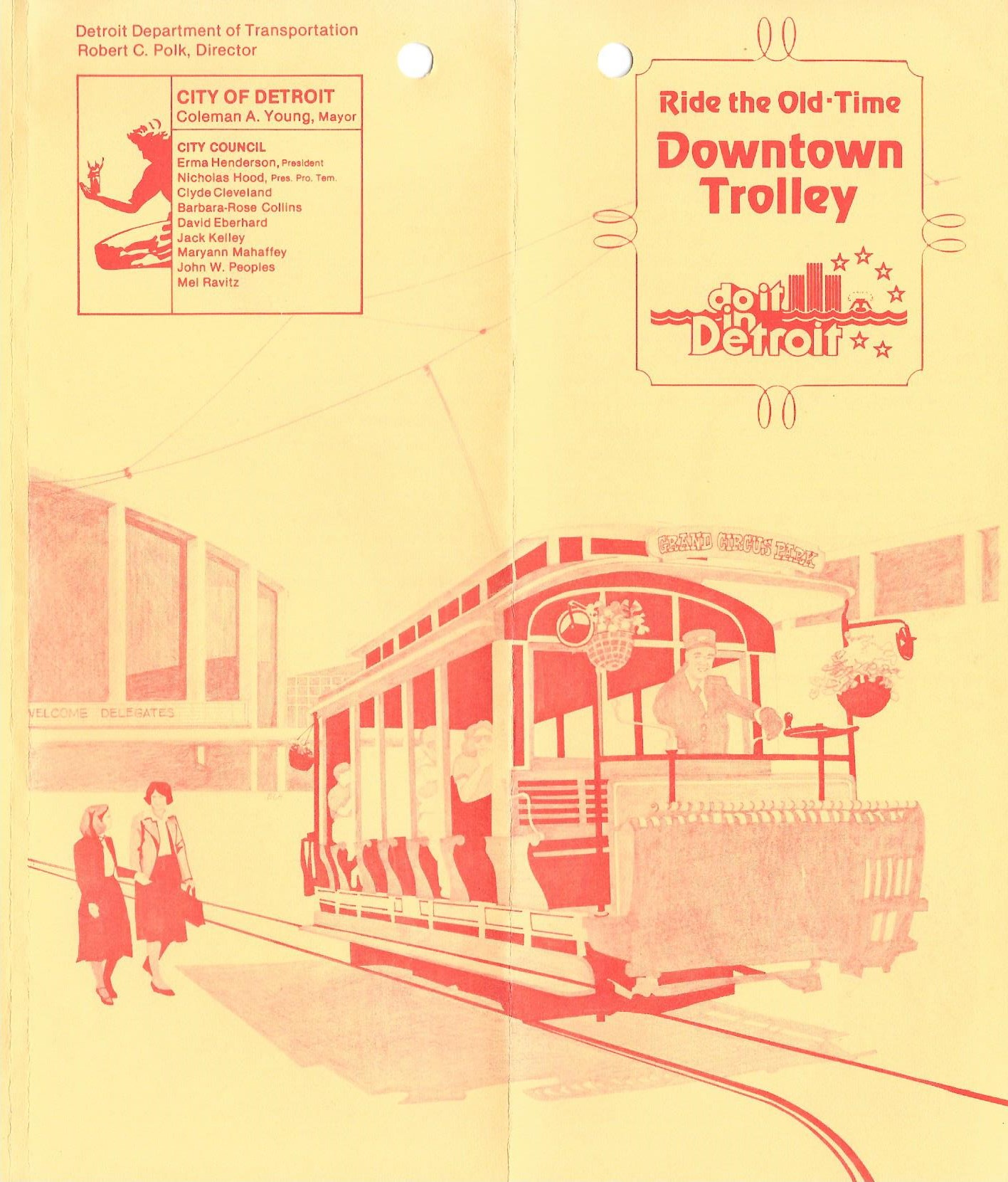
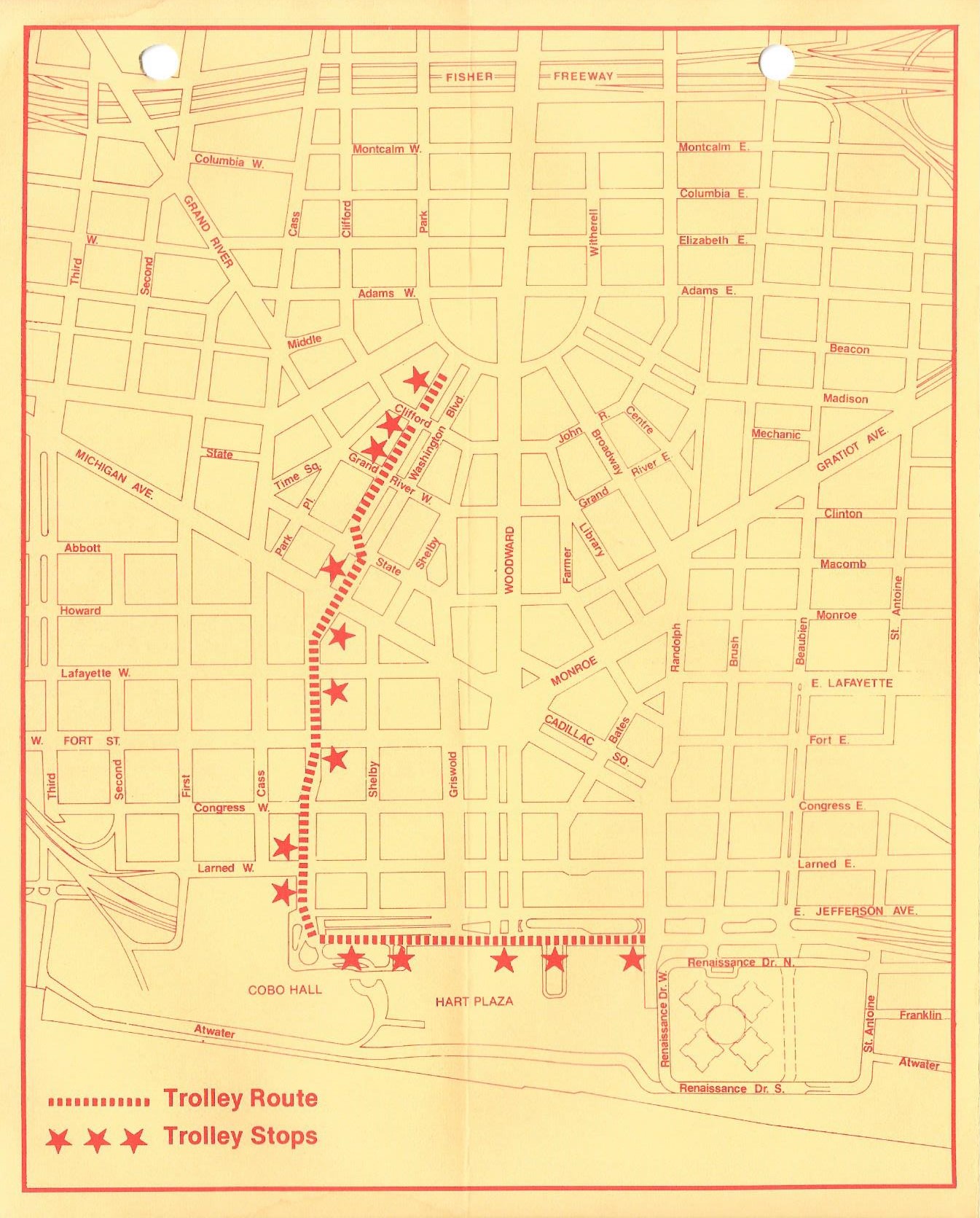
[edit]A short 0.7-mile (1.1 km) vintage streetcar gauge line in 900 mm (2 ft 11+7⁄16 in) gauge opened in 1976 along Washington Boulevard, using seven former Lisbon tramcars and two from England and Switzerland, all originally built in the early 20th century.[15] Built at a cost of roughly $1.5 million (equivalent to $6.42 million in 2024[16]), the line initially ran between Grand Circus Park and Philip A. Hart Plaza near Cobo Center.[17][18] The line was extended a further 0.3 miles (0.48 km) along Jefferson Avenue in 1980.[19] It ended service in 2003.[15] Ridership at one time had seen 800 daily passengers, but declined to under 200 after the 1987 opening of the competing Detroit People Mover system.[20]
M-1 Rail Line
[edit]
In 2006 the Detroit Department of Transportation (DDOT) commissioned a study to determine expanded mass transit options along Woodward Avenue.[21] Concurrently, a private group of local business leaders decided to provide matching funds to government dollars to develop a $125 million, 3.4-mile (5.5 km) line through central Detroit (similar to the Tacoma Link) called the M-1 Rail Line. After much wrangling between the private investors and the DDOT, the two groups decided to work in tandem on developing DDOT's 9.3-mile (15.0 km) line.
The proposed line ran 9.3 miles (15.0 km) along Woodward Avenue from the Rosa Parks Transit Center to the old State Fairgrounds along 8 Mile Road.[22] The line would have had 19 stops with 10 cars running at a time in two-car trains; each train would carry 150 people. The trains would run in a dedicated right-of-way in the median from 8 Mile to Adams Street at the north end of downtown. South of Adams, the trains would run in mixed traffic along the sides of the street.
The estimated cost for the proposed line was $500 million.[22] The Kresge Foundation awarded a $35 million grant to the city for the project in March 2009.[23] It received $25 million in funding from the United States Department of Transportation in February 2010.[24][25] The Detroit City Council approved the sale of $125 million in bonds on April 11, 2011.[26] The Federal Transit Administration (FTA) and the City of Detroit signed an environmental impact study on July 1, 2011.[21] Finally, on August 31, 2011, the FTA signed a record of decision allowing the project to move forward.[27]
In December 2011, the federal government withdrew its support for the proposed line, in favor of a bus rapid transit system which would serve the city and suburbs.[28] This decision arose out of discussions between federal Secretary of Transportation Ray LaHood, Detroit Mayor Dave Bing and Governor Rick Snyder. The private investors who had initially supported the smaller three-mile (4.8 km) M-1 Rail line to New Center stated that they would continue developing that project through the nonprofit M-1 Rail Consortium.[29] The cancelled 9.3-mile (15.0 km) proposal would have featured seven additional stops north of Grand Boulevard, where the QLine now ends.[30]
Construction
[edit]On January 18, 2013, U.S. Department of Transportation Secretary Ray LaHood announced that M-1 Rail would receive $25 million in federal grant support for the streetcar project.[24][25][31] He had previously committed to the funds on the condition that a regional transit authority was created for the Detroit area.[32] In late 2012, the Regional Transit Authority of Southeast Michigan was created by state law,[33] which enabled LaHood's approval.[34]
On April 22, 2013, the project received final environmental clearance from the federal government, with construction expected to start in the fall.[35]
On December 20, 2013, M-1 Rail began underground utility relocation work along Woodward Avenue, the first step toward full-fledged construction activities of the 3.3-mile (5.3 km) streetcar line, with construction scheduled to start in mid-2014.[36] Stacy & Witbeck were formally awarded the contract to construct the M-1 Rail streetcar line on July 31, 2013.[24][25][37] M-1 Rail officials announced on July 3, 2014, that the Woodward Avenue overpasses for both I-75 and I-94 freeways will be demolished during construction of the rail line, and that new wider bridges will be built.[38]
On July 20, 2014, the Ilitch family, owner of Olympia Development of Michigan, and major investor in M-1 Rail, announced that the streetcar line would include a stop at the new Little Caesars Arena in Midtown.[39]

M-1 Rail officially started construction on July 28, 2014.[40] The streetcar line would stretch from downtown Detroit to Grand Boulevard in New Center. There would be 20 different stations serving 12 stops, with most of the stations being curbside on either side of Woodward Avenue going uptown or downtown, but changing to center road stations at the north and south ends of the system. At the time, the streetcar line was expected to be operational in late 2016.[41]
During the planning of the service, Detroit businessman Dan Gilbert advocated strongly for a curb-running design. One participant said, "They were not looking for speed or reliability... their number one goal was the boost in property values."[42]
On September 9, 2014, the US DOT announced that M-1 Rail would receive an additional $12.2 million in federal grant money to complete the financing of the M-1 Rail project.[43] US Transportation Secretary Anthony Foxx gave the keynote address at a rail signing ceremony on September 15, 2014, at Grand Circus Park.[44][45][46][47] Local officials were in attendance as were executives of local businesses who were sponsoring stations near their places of business. A new official map was made public.[48]
Approximately 60 percent of the line is not equipped with overhead electrical wires, and the streetcars are powered solely from lithium-ion batteries on that section.[49]

On February 15, 2015, M-1 Rail reported that the Penske Tech Center was under construction in New Center. The $6.9 million, 19,000-square-foot (1,800 m2) structure serves as the M-1 Rail headquarters, the operations center, and the streetcar maintenance facility. The tech center building is sited close to Woodward Avenue, and located between Bethune and Custer streets north and east of Grand Boulevard with the streetcar storage yard behind. The exterior is made of reddish brick to mimic the historical look and feel of the surrounding neighborhood,[50] and was completed in May 2016.
In August 2015, M-1 Rail officials said that the opening of the line would be delayed until around mid 2017, partially because of new federal safety standards that are coming into effect, as well as a construction slowdown during the previous winter and delays in building the rolling stock.[51] QLine was announced as the official name for the line in March 2016, after Quicken Loans bought naming rights, but the non-profit organization that is overseeing the project continues to be named M-1 Rail.[52]
The first streetcar was delivered in September 2016.[53] The first test move over the line took place on December 13, and the streetcar was initially towed[54] (not yet run under its own power, except at the maintenance facility).[55] Transdev was awarded a five-year contract to operate the line.[56]
Opening
[edit]The QLine opened for public use on May 12, 2017.[4] Although initially slated to be free only for the first weekend, the streetcar's free period was later extended for a week, and later until July 1, and again until Labor Day 2017.[57] Ridership for the opening week was 50,000, with a peak of 8,300 during the weekend and 5,120 Monday through Thursday.[58] Daily ridership dropped to 3,000 when the payment service began on September 5, 2017. The percentage of riders actually paying was 40 percent, which QLine spokesman Dan Lijana said is higher than the 32.5 percent national average of similar downtown city rail systems.[59]
COVID-19 shutdown and reopening
[edit]On March 28, 2020, the QLINE suspended service, due to low ridership amid the COVID-19 pandemic.[60] Service resumed in September 2021 without fares, with financial support from Penske and The Kresge Foundation.[61] In November 2021, QLINE ended its contract with Transdev and became directly operated.[1] In 2022, a 17-year, $5 million annual subsidy was approved by the Michigan Legislature and signed by Governor Gretchen Whitmer, which will keep the QLINE free to ride through 2039.[62][63]
Rolling stock
[edit]

Crain's Detroit Business reported that the line would cost $137 million, including the purchase of six streetcar vehicles.[64] Bids were expected to include low-floor, air-conditioned vehicles, capable of transporting passengers in wheelchairs. The vehicles have operator's controls at both ends—eliminating the need for the vehicles to turn around for their return trips.
On November 4, 2014, M-1 announced that Czechia-based Inekon had been awarded a $30 million contract for six vehicles.[65] Upon that deal falling apart, M-1 Rail instead awarded a $32 million contract to Pennsylvania-based Brookville Equipment Corporation.[49] The purchase includes six articulated, three-section, 66-foot-long (20.12 m) cars, equipped with 750-volt rechargeable lithium-ion batteries for off-wire movement on sections of the line not equipped with overhead wire.[49]
The first Brookville-built streetcar was delivered in September 2016,[53] with the last two of the six cars delivered in March 2017.[66] The last car of Detroit's previous streetcar system was numbered 286, so it was decided to number the new cars 287-292, to pick up where the old number series had left off.[67]
Operation
[edit]Route
[edit]
The QLine traverses Woodward Avenue in its entirety from downtown through Midtown to New Center. The line begins at the southern terminus at Congress Street in the median before tracks swing to the curbside for most of its length. (Some parts of the line have tracks running down the middle travel lane of Woodward in downtown.) After traveling in the curbside travel lane, the line swings back into the inside travel lane (median) at Amsterdam all the way to the line's northern terminus at Grand Boulevard. Non-revenue tracks continue two blocks to the M-1 Rail Penske Tech Center, which serves as headquarters for the QLine and the garage for the streetcars. In September 2021, the southbound curb lane from Temple Street to I-75 was converted to a transit-only lane to be used by the QLine, DDOT and SMART to increase headways.[68]
List of stations
[edit]
| Stop | Neighborhood(s) | Connections |
|---|---|---|
| Congress Street | Downtown, Financial District | Detroit People Mover; DDOT 3, 5, 6, 9, 40, 52, & 67;
SMART 261 FAST Michigan, 461/462 FAST Woodward, 563 FAST Gratiot, 255, 530, 620, 635, 805, 830, & 851 |
| Campus Martius | Downtown | |
| Grand Circus | Downtown, Grand Circus Park | Detroit People Mover; SMART 261 FAST Michigan & 461/462 FAST Woodward |
| Montcalm Street | Downtown, Foxtown | |
| Sproat Street/Adelaide Street | Midtown, Brush Park, Cass Park | SMART 461/462 FAST Woodward |
| Martin Luther King Boulevard/Mack Avenue | Midtown, Brush Park, Cass Corridor | DDOT 31 Mack & 42 Mid-City Loop; SMART 461/462 FAST Woodward |
| Canfield Street | Midtown, Medical Center | |
| Warren Avenue | Midtown, Cultural Center, Wayne State University | DDOT 8 Warren; SMART 461/462 FAST Woodward & 562 FAST Gratiot |
| Ferry Street | Midtown, Cultural Center, East Ferry | |
| Amsterdam Street | New Center | |
| Baltimore Street | New Center | Amtrak; SMART 461/462 FAST Woodward & 851 |
| Grand Boulevard | New Center | SMART 851 |
Headways and operational span
[edit]
The QLine generally operates four trains at a time, with trains arriving every 15 minutes or less. Service runs seven days a week, beginning at 8 a.m. daily: trains run through midnight Monday-Saturday, and through 9 p.m. on Sundays.[69][70]
Fares
[edit]There is currently no charge to ride the QLine, as its operations are supported by a subsidy from the State of Michigan.[63] The system's original fare, instituted in September 2017, was $1.50; it was raised to $2 in October 2019, when the QLine joined the Dart payment system used by SMART and DDOT.[61][71]
Towing
[edit]M-1 Rail is a licensed towing operator.[72] State legislation permits the agency to tow parked vehicles which block its tracks; vehicles are taken to City of Detroit-owned impound lots. Towing operations began in June 2022, when a Florida towing company donated a truck to M-1 Rail.[70]
See also
[edit]

References
[edit]- ^ a b "QLine streetcars on track to resume service in late summer". The Detroit News. Retrieved July 21, 2023.
- ^ Eric D. Lawrence (September 28, 2023). "QLINE ridership up in 2023: What annual report showed". Detroit Free Press.
- ^ Guillen, Joe (October 24, 2022). "QLINE ridership rebounds". Axios Detroit. Cox Enterprises. Retrieved October 26, 2022.
- ^ a b c d Lawrence, Eric D.; Allen, Robert (May 12, 2017). "All Aboard! Detroit's QLine Is Open for Streetcar Riders". Detroit Free Press. Retrieved May 13, 2017.
- ^ "FAQ". M-1 Rail. Retrieved May 13, 2017.
- ^ "Ann Arbor to Detroit Regional Rail Project". Southeast Michigan Council of Governments.
- ^ "New Detroit streetcar system, the QLINE, opens to the public". The Kresge Foundation. May 4, 2017. Retrieved September 15, 2025.
- ^ "Feedback: QLINE transformed Woodward corridor, benefits Detroit, region". Detroit Free Press. Retrieved September 15, 2025.
- ^ "QLINE Annual Report 2024" (PDF). M-1 Rail.
- ^ "RTA to assume ownership of Detroit QLine streetcar". Trains. September 20, 2024. Retrieved September 20, 2024.
- ^ Lawrence, Eric D. (March 24, 2016). "Detroit's M-1 Rail Line Now to Be Called the QLINE". Detroit Free Press. Retrieved March 24, 2016.
- ^ a b Schramm, Kenneth (2006). Detroit's Street Railways. Images of Rail. Charleston, SC: Arcadia Publishing. pp. 7–8, 11–13. ISBN 0-7385-4027-7.
- ^ Austin, Dan. "How Metro Detroit Transit went from Best to Worst". Detroit Free Press. Retrieved May 10, 2017.
- ^ Kurlyandchik, Mark (May 2012). "After 50+ Years, Streetcars Could Come Back to Woodward". Hour Detroit. ISSN 1098-9684. Archived from the original on June 19, 2012. Retrieved August 20, 2012.
- ^ a b "U.S. Streetcar Systems- Michigan". Railway Preservation Resources. July 2, 2018. Retrieved February 12, 2019.
- ^ Johnston, Louis; Williamson, Samuel H. (2023). "What Was the U.S. GDP Then?". MeasuringWorth. Retrieved November 30, 2023. United States Gross Domestic Product deflator figures follow the MeasuringWorth series.
- ^ Stuart, Reginald (September 21, 1976). "Trolley Returns to the Motor City, and Mayor Foresee Revitalization". The New York Times. Retrieved August 16, 2022.
- ^ "Washington Boulevard Historic District". Detroit Historical Society. Retrieved August 16, 2022.
- ^ 1982 leaflet with former Lisbon car 247/397 on the cover and downtown map showing route and stops
- ^ "Detroit, MI". American Public Transportation Association. Archived from the original on January 3, 2024. Retrieved August 16, 2022.
- ^ a b "Project Overview". Woodward Light Rail. Retrieved October 17, 2011.
- ^ a b "Woodward Light Rail Project Cancelled, M-1 Streetcar Still in the Works". Transportation Riders United. Archived from the original on July 20, 2012.
- ^ "Kresge Foundation Awards Nearly $73 Million in Grants in the First Quarter of 2009" (Press release). Council of Michigan Foundations. March 9, 2009. Archived from the original on June 15, 2011.
- ^ a b c "Detroit Streetcar Construction Contract Awarded". Railway Gazette International. August 2, 2013. Archived from the original on November 9, 2013. Retrieved September 5, 2014.
- ^ a b c "Detroit Light Rail Project Gets Grant". Railway Gazette International. February 22, 2013. Archived from the original on August 27, 2013. Retrieved September 5, 2014.
- ^ "City Council Approves Detroit Light Rail Project". Southfield, Michigan: WWJ-TV. April 12, 2011.
- ^ "Detroit's Woodward Ave. Light Rail Project Moves Forward, but Still Has Long Road to Completion". MLive.com. Detroit: Booth Newspapers. September 6, 2011. Archived from the original on October 19, 2013. Retrieved December 15, 2011.
- ^ Bing, Dave (December 18, 2011). "Rapid Bus System Is a Win for Metro Detroit". Detroit Free Press. Retrieved December 18, 2011.
- ^ Helms, Matt; Egan, Paul; Gallagher, John (December 14, 2011). "Detroit Light-Rail Plan Is Dead: Buses Will Be Used Instead". Detroit Free Press.
- ^ Marable, Kamau C.; Roseboom, Tim; Ryan, Mark (September 15, 2011). "Woodward Light Rail Transit Project". NAMC Detroit Transportation Symposium. p. 4 – via slideplayer.com.
- ^ Helms, Matt (January 18, 2013). "Transportation Secretary Ray LaHood Brings $25 Million in Federal Aid for M-1 Rail Project". Detroit Free Press. Retrieved January 28, 2013.
- ^ Cwiek, Sarah (October 15, 2012). "LaHood: Metro Detroit, State Need to Move on Regional transit Authority". Michigan Radio. Retrieved January 27, 2016.
- ^ "Senate Bill No. 909" (PDF). Michigan State Legislature. Archived from the original (PDF) on September 25, 2013. Retrieved September 17, 2013.
- ^ "M1 Rail: Ray LaHood, U.S. Transit Secretary, Announces $25 Million in Funding for Detroit Transit Plan". The Huffington Post. January 18, 2013. Retrieved January 27, 2016.
- ^ Helms, Matt (April 22, 2013). "M-1 Rail Project Gets Final OK from Federal Government". Detroit Free Press. Retrieved October 21, 2013.
- ^ "M-1 Rail Begins Underground Utility Relocation Work, Shutdown of Woodward Avenue Is Not Required: Utility Relocations Will Not Prevent Customer Access to Businesses on Woodward" (Press release). M-1 Rail. December 2013. Archived from the original on January 4, 2014. Retrieved January 3, 2014.
- ^ Bowen, Douglas John (July 31, 2013). "Stacy and Witbeck win Detroit M1 contract". Railway Age. Archived from the original on August 19, 2013. Retrieved September 6, 2014.
- ^ Walker, Marlon A. (July 3, 2014). "M-1 Rail Construction to Close Freeways as Woodward Overpasses Are Rebuilt". Detroit Free Press. Archived from the original on July 14, 2014. Retrieved July 11, 2014 – via M-1 Rail.
- ^ Shea, Bill (July 20, 2014). "Detroit Rink City: Ilitches' Grand Plan to Supersize the Entertainment District". Crain's Detroit Business. Retrieved July 23, 2014.
- ^ "Detroit Streetcar Breaks Ground". Railway Gazette International. July 28, 2014. Archived from the original on August 9, 2014. Retrieved September 5, 2014.
- ^ "Construction Starts on Detroit Rail". The Mining Journal. Marquette, Michigan. Associated Press. July 28, 2014. p. 5A.
- ^ DeVito, Lee (March 20, 2018). "Dan Gilbert, private interests steered QLine plans, study finds". Metro Times. Archived from the original on May 7, 2018. Retrieved May 6, 2018.
- ^ Spangler, Todd & Gallagher, John (September 9, 2014). "Feds Give M-1 Rail $12.2 Million". Detroit Free Press. Archived from the original on September 11, 2014. Retrieved September 11, 2014.
- ^ "Officials participate in track signing ceremony celebrating Detroit streetcar project". The Republic. Columbus, Indiana. Associated Press. September 15, 2014. Archived from the original on September 17, 2014. Retrieved September 16, 2014.
- ^ "Detroit light rail receives more TIGER funding". Railway Gazette International. September 16, 2014. Archived from the original on September 17, 2014. Retrieved September 16, 2014.
- ^ "USDOT's Foxx, Detroit officials sign ceremonial track for M-1 Rail streetcar". Progressive Railroading. September 16, 2014. Archived from the original on September 17, 2014. Retrieved September 16, 2014.
- ^ Williams, AJ (September 16, 2014). "U.S. DOT Secretary Foxx Announces $12.2 Million for M-1 RAIL in Detroit". Michigan Chronicle. Detroit. Archived from the original on September 17, 2014. Retrieved September 16, 2014.
- ^ Walsh, Tom (September 16, 2014). "Tom Walsh: M-1 Rail Makes Noise as New Donors Push Line Ahead". Detroit Free Press. Archived from the original on September 16, 2014.
- ^ a b c Shepardson, David (June 8, 2015). "M-1 Rail Buying 6 Off-Wire Streetcars for $32M". The Detroit News. Retrieved June 11, 2015.
- ^ Gallagher, John (February 15, 2015). "M-1 Rail's Tech Center Under Construction". Detroit Free Press. Retrieved February 15, 2015.
- ^ "Detroit Streetcar Project M-1 Delayed through 2017". Trains. August 6, 2015. Retrieved August 16, 2015.
- ^ "QLINE announced as official name of Detroit's modern streetcar". M-1 Rail. March 24, 2016. Retrieved December 14, 2016.
- ^ a b Shea, Bill (September 12, 2016). "First M-1 Rail streetcar arrives in Detroit". Crain's Detroit Business. Retrieved December 14, 2016.
- ^ Detroit Free Press web team (December 13, 2016). "See the Test of Detroit's New QLine Streetcar along Woodward Avenue". Detroit Free Press. Retrieved December 14, 2016.
- ^ Shea, Bill (December 13, 2016). "M-1 Rail Takes First QLine Streetcar out for a Test Run in Detroit". Crain's Detroit Business. Retrieved December 14, 2016.
- ^ "In brief". International Railway Journal. July 2016. p. 10.
- ^ "QLINE, I Love You But We Need to Talk". Daily Detroit. June 18, 2017. Archived from the original on September 19, 2017. Retrieved September 19, 2017.
- ^ Lawrence, Eric D. (May 19, 2017). "Amid Deluge of Riders, QLine Announces Free Rides until July 1". Detroit Free Press. Retrieved May 19, 2017.
- ^ Livengood, Chad (September 22, 2017). "40% of QLine riders paying as ridership falls". Crain's Detroit Business. Retrieved January 1, 2018.
- ^ Lawrence, Eric D. (March 27, 2020). "QLINE shutting down after Sunday service close as coronavirus saps demand". Detroit Free Press. Retrieved May 14, 2023.
- ^ a b Lawrence, Eric D. (March 30, 2022). "QLINE free rides to continue through end of 2022: How it's possible". Detroit Free Press. Retrieved May 14, 2023.
- ^ Guillen, Joe; Robinson, Samuel (December 5, 2022). "Motor City Transit: Legislation would extend QLine funding". Axios Detroit.
- ^ a b LeBlanc, Beth (December 29, 2022). "Whitmer signs off on $85M tax subsidy for Detroit's QLine". The Detroit News. Retrieved May 14, 2023.
- ^ Shea, Bill (October 14, 2013). "M-1 Rail to Bidders: Contract will begin Dec. 1; Streetcar Service will begin February 2016". Crain's Detroit Business. Archived from the original on May 7, 2018. Retrieved February 12, 2014.
- ^ "Detroit Streetcar Project Selects Inekon to Supply Vehicles". Trains. November 4, 2014. Retrieved November 5, 2014.
- ^ Brookville Equipment Corporation (April 12, 2017). "Brookville Completes Delivery of Off-Wire Capable Liberty Streetcar Vehicles to Detroit for QLINE Ahead of Schedule" (Press release). Brookville Equipment Corporation. Archived from the original on May 17, 2018. Retrieved May 17, 2018.
- ^ Raven, Benjamin (September 21, 2016). "Take a peek inside Detroit's first QLine streetcar". MLive.com. Retrieved December 14, 2016.
- ^ Lawrence, Eric D. (September 18, 2021). "QLine, buses get transit-only lane in front of Little Caesars Arena". Detroit Free Press. Retrieved November 19, 2021.
- ^ "QLINE announces extended streetcar service hours". WXYZ-TV. June 15, 2022. Retrieved May 14, 2023.
- ^ a b "QLine hours extended beginning this weekend". The Detroit News. June 15, 2022. Retrieved May 14, 2023.
- ^ Lawrence, Eric D. (August 20, 2019). "QLINE to join DDOT, SMART unified payment system beginning in October". Detroit Free Press.
- ^ "Company Snapshot: M-1 RAIL TOWING LLC". Federal Motor Carrier Safety Administration. Retrieved May 14, 2023.
External links
[edit]
QLine
View on GrokipediaHistorical Background
Antecedent Streetcar Systems (1863–1956)
Public transportation in Detroit commenced with horse-drawn streetcars operated by the Detroit City Railway Company, which laid tracks beginning June 30, 1863, along Jefferson Avenue near Bates Street using standard steam railroad gauge.[12] Regular service started on August 4, 1863, with eight small cars pulled by horses, each 16 feet long and equipped with oil lanterns and straw flooring for passengers.[13][14] Expansion followed to Woodward, Gratiot, and Michigan Avenues by the late 1860s and 1870s, with fares at 5 cents per ride, fostering urban development along these corridors.[15] By the late 19th century, approximately 29 independent companies had emerged, operating both horse-drawn and early electric lines amid rapid city growth.[16] Electrification began transitioning the system, with the first electric streetcars appearing in the 1890s, replacing horses on key routes for greater efficiency and capacity.[16] These companies consolidated in 1901 into the Detroit United Railway (DUR), which managed an extensive network of streetcars and interurban lines serving Detroit and surrounding areas, including high-speed operations reaching 50-80 mph outside city limits.[17][18] The DUR expanded service along major arteries like Woodward Avenue, integrating local streetcars with regional interurbans to handle peak ridership exceeding hundreds of thousands daily by the 1910s.[16] Municipal acquisition occurred in stages, with Detroit voters approving the purchase of DUR's city streetcar operations in 1920; the Department of Street Railways (DSR) assumed control by 1922, operating over 400 miles of track with modernized fleets including Peter Witt and later PCC cars for improved reliability.[19] Under DSR, the system peaked in the 1920s-1940s, supporting industrial commuting and wartime mobility, though maintenance challenges and rising automobile competition prompted gradual bus substitutions post-World War II.[20] Remaining lines, including Gratiot Avenue (discontinued March 25, 1956, after 93 years) and Woodward Avenue, featured PCC cars like #210 and #223 in final operations.[20] Streetcar service terminated entirely on April 8, 1956, marked by a ceremonial "Last Day of Streetcars" parade along Woodward Avenue, where cars bore farewell signs before conversion to buses, ending nearly a century of rail-based transit dominance in Detroit.[21][20] This shift reflected broader U.S. trends favoring rubber-tire vehicles amid suburbanization and highway expansion, though the legacy of these systems laid foundational infrastructure patterns still evident in modern routes like Woodward.[20]Postwar Decline and Heritage Trolley Initiatives
Following World War II, Detroit's streetcar system faced mounting pressures from rapid automobile adoption and suburban expansion, despite wartime boosts in ridership from fuel and tire shortages limiting bus operations.[21] The Detroit Department of Street Railways invested in modernization by purchasing 186 Presidents' Conference Committee (PCC) streetcars, delivered in 1947 and 1949, to serve high-volume routes such as Woodward, Michigan, and Jefferson avenues.[22] However, postwar economic growth favored private vehicles, eroding streetcar usage as commuters preferred flexible, door-to-door travel over fixed rail schedules.[23] Infrastructure deterioration compounded the issue, with high maintenance demands for tracks and overhead wires outweighing buses' lower upfront costs and adaptability to changing urban patterns.[23] By the early 1950s, declining revenues and public preference for autos rendered the system obsolete, prompting a full conversion to diesel buses despite the recent PCC acquisitions.[20] The final streetcar service ended on April 8, 1956, with the last run on Woodward Avenue celebrated via a "Last Day of Streetcars in Detroit Parade," symbolizing the closure of nearly a century of rail transit.[21] This shift reduced capacity on former trunk lines and contributed to fragmented service, as buses proved less efficient for peak loads but aligned with the era's car-centric infrastructure investments.[24] Heritage efforts in the late 20th century aimed to preserve and evoke this lost rail tradition through tourist-oriented replicas. The Detroit Downtown Trolley, initiated in 1976 as a U.S. Bicentennial commemoration, became the first purpose-built vintage trolley system in the United States.[25] Operating under the Detroit Department of Transportation, it featured a 1-mile L-shaped route with 14 stops connecting downtown landmarks like Grand Circus Park, Cobo Hall (later Huntington Place), and the Renaissance Center, using single track with two passing sidings mostly on sidewalk rights-of-way.[25] The fleet consisted of nine single-truck, narrow-gauge (900 mm) trolleys sourced primarily from Lisbon, Portugal, providing year-round, low-capacity service focused on visitors rather than commuters.[25] Initial ridership reached about 75,000 annually in 1979, supported by a $2.72 million investment including a dedicated carbarn, but fell sharply to 3,350 by 1998 amid downtown stagnation and competition from other modes.[25] Operations halted on June 21, 2003, with formal closure in November of that year; the trolleys were sold, the carbarn demolished, and the route converted to rubber-tired buses.[25] Though limited in scope and longevity, the project underscored persistent cultural affinity for streetcars and informed later transit discussions by demonstrating feasible small-scale rail revival.[25]Planning and Development
Formation of M-1 Rail
M-1 Rail was established in 2007 as a non-profit organization tasked with overseeing the design, construction, and eventual operation of a 3.3-mile modern streetcar line along Woodward Avenue in Detroit, connecting Downtown to New Center.[1][26] The initiative stemmed from private sector and philanthropic leaders' recognition of Detroit's inadequate public transportation infrastructure, particularly exposed during Super Bowl XL in February 2006, when unreliable transit options hindered mobility for visitors and locals alike.[27] This formation marked one of the largest private investments in urban transit in the United States at the time, emphasizing a public-private partnership model to bypass traditional government-led delays.[28] Key founders included prominent Detroit-area business figures and foundations, with early support from entities like the Kresge Foundation and involvement from real estate developers seeking to catalyze urban revitalization along the corridor.[29] The organization's structure positioned it as an independent entity capable of securing private funding while coordinating with the City of Detroit for rights-of-way and regulatory approvals, reflecting a deliberate shift from past failed public transit proposals in the region that had stalled due to fiscal constraints and political fragmentation.[28] By 2008, M-1 Rail had formalized agreements with the city and begun feasibility studies, laying the groundwork for federal grant pursuits and corporate sponsorships that would fund over half the project's costs.[29]Funding Model and Private Investment
The QLine's funding model was structured as a public-private partnership emphasizing private sector leadership to minimize public debt and taxes for initial development and construction. M-1 Rail, a 501(c)(3) nonprofit formed in 2011 by a consortium of corporate, philanthropic, and civic leaders, raised the majority of capital through private donations and commitments rather than municipal bonds or general obligation funding typically used in public transit projects.[30] This approach secured over $150 million in cumulative philanthropic and private contributions, including pro bono services valued in the millions, enabling construction without direct taxpayer-backed debt.[31] Construction costs totaled approximately $142 million for the 3.3-mile system, with private sources providing the bulk through equity-like investments from over 100 donors.[32] Key private contributors included automotive giants General Motors, Ford Motor Company, and Chrysler (now Stellantis), logistics firm Penske Corporation, and real estate developer Mike Ilitch's organizations, alongside major foundations such as the Kresge Foundation—which provided tens of millions—and the John S. and James L. Knight Foundation.[33] These investments were framed as strategic bets on Detroit's economic revival, with donors committing to cover initial operating deficits and maintain fare-free service to boost ridership and downtown connectivity.[30] Public contributions supplemented private funds but were limited to grants without ongoing fiscal liability. Federal support included a $25 million TIGER grant from the U.S. Department of Transportation in 2012, plus additional Transportation Investments Generating Economic Recovery (TIGER) awards totaling around $37 million. The state of Michigan provided $10 million, while Wayne and Oakland counties contributed smaller amounts for infrastructure coordination.[34] This hybrid model allowed M-1 Rail to complete the project by 2017, but operational shortfalls later prompted state subsidies starting in 2022, including an $85 million commitment over 17 years primarily for fare-free operations, shifting some burden to taxpayers despite the original private-heavy intent.[35]Construction Phase
Timeline and Engineering Challenges
Construction of the QLine, operated by M-1 Rail, commenced with preparatory work on December 20, 2013, including initial utility relocations and site assessments along Woodward Avenue.[36] Full-scale groundbreaking and the first phase began in July 2014, focusing on the North End and New Center districts, which involved reconstructing the I-94 bridge and laying tracks from West Grand Boulevard to Bethune Street while establishing the M-1 Rail Tech Center.[37] The second phase covered the Midtown district from Sibley Street to Canfield Street, incorporating additional I-94 bridge modifications, while the third phase addressed the Downtown district from Campus Martius south to Sibley Street, including I-75 bridge reconstruction.[37] The most extensive construction segment, spanning multiple districts, accelerated in April 2015.[38] Track installation concluded on December 1, 2016, followed by the arrival of the first streetcar on September 12, 2016, and initial test runs in December 2016.[36][39] The entire 3.3-mile double-track system was completed within approximately 27 months, enabling revenue service to launch on May 12, 2017.[37] Engineering efforts centered on a $141 million construction-management/general-contractor model to build 2.5 miles of full-width dedicated lanes amid urban constraints.[40] Key challenges included coordinating bridge overhauls over interstate highways (I-94 and I-75) to accommodate the streetcar alignment without prolonged closures, necessitating phased traffic management and structural reinforcements.[37] The route's mixed configuration—curbside running for most segments to leverage existing medians, transitioning to central median tracks at the northern and southern termini—required precise geometric design to ensure smooth vehicle navigation and integration with vehicular traffic at street speeds.[37] A notable innovation addressed aesthetic and maintenance concerns in the Midtown section between Henry and Canfield streets by implementing off-wire operation using lithium-ion batteries for up to 60% of travel distance, eliminating overhead catenary wires in a historic district while maintaining propulsion reliability.[37] Utility conflicts in Detroit's aging infrastructure, dense development along Woodward Avenue, and minimizing disruptions to daily commuters posed logistical hurdles, resolved through sequential phasing and collaboration with city agencies.[41] Overall, the project avoided major delays despite preceding setbacks like the 2013 municipal bankruptcy, adhering to the 2016 completion target through private-sector oversight.[36]Infrastructure and Track Installation
The QLine's infrastructure consists of a 3.3-mile (5.3 km) double-track alignment along Woodward Avenue, totaling 6.6 miles (10.6 km) of rail embedded in the street surface for at-grade operation in mixed traffic.[40][37] The tracks utilize standard gauge of 1,435 mm (4 ft 8+1⁄2 in), consistent with modern North American streetcar systems to accommodate the Alstom APS vehicles.[37] Installation formed part of a broader $141 million construction management/general contracting effort led by Stacy and Witbeck, which integrated rail laying with 2.5 miles of full-width roadway reconstruction, 0.8 miles of partial reconstruction, utility relocations, and replacement of two bridges spanning I-75 and I-94.[40] Track laying commenced in July 2014 with initial segments in downtown Detroit, progressing northward through Midtown amid ongoing street closures and coordination with vehicular traffic limited to 35 mph.[42] Crews worked seven days a week, installing rail sections that were subsequently aligned and secured using over 1,000 thermite welds to form continuous runs.[43] The process emphasized embedding grooved rails directly into the pavement: after positioning and welding, approximately 34,000 feet (10,363 m) of rail—reinforced with nearly 400,000 pounds (181,437 kg) of rebar—was encased in over 12,000 cubic yards (9,170 m³) of concrete poured in phases, allowing for settling periods of up to one week per section to ensure stability.[42][43] This method avoided traditional ballasted track, opting instead for direct fixation to concrete slabs integrated with the roadway to minimize disruption in the urban corridor while supporting the line's off-wire battery operation capability over 60% of the route.[40][44] Final welding occurred on November 11, 2016, at the southbound track near Woodward Avenue and Amsterdam Street, marking completion of rail installation ahead of spring 2017 testing and revenue service.[43][42] Post-installation steps included final concrete encasement, surface grinding for smoothness, and integration with overhead catenary systems (OCS) and traction power infrastructure installed concurrently by specialized subcontractors.[40] Engineering challenges centered on maintaining traffic flow during pours—such as the initial 900 cubic yards (688 m³) in October 2014—and adapting to Woodward Avenue's historic pavement, which required breaking and repaving to accommodate the embedded rails without compromising structural integrity.[45] The resulting setup supports speeds up to 35 mph, with rails designed for durability in a high-traffic urban environment shared with automobiles and pedestrians.[42]Launch and Early Operations
Opening in May 2017
The QLine streetcar system commenced public operations on May 12, 2017, following a decade of planning and construction by M-1 Rail, a nonprofit consortium.[3] The 3.3-mile route along Woodward Avenue connected downtown Detroit to Midtown, serving 12 stations with dedicated lanes and priority signaling to facilitate speeds of 25 to 30 mph.[46] This launch revived streetcar service in the city after a 61-year absence, since the discontinuation of the previous system in 1956.[2] A grand opening ceremony at Grand Circus Park station began at 9:00 a.m., including a ribbon-cutting attended by local officials and investors, followed by a ceremonial inaugural ride carrying dignitaries along the full route.[47] Passenger boarding opened immediately after, with festivities extending through the weekend, including promotional events and partnerships with nearby businesses offering discounts to riders.[48] The system's 16 articulated, low-floor vehicles, each with a capacity of 125 passengers (34 seated), handled initial demand effectively during peak hours.[49] Opening-week ridership exceeded expectations at nearly 50,000 passengers, averaging 8,300 daily over the launch weekend and 5,120 on weekdays, leading M-1 Rail to extend free fares—originally planned only for the debut weekend—through June 30 to sustain momentum.[50] Service operated from 6:00 a.m. to midnight on weekdays and extended weekend hours, integrating with regional transit options at endpoints like Congress Street and West Grand Boulevard.[51] Proponents highlighted the QLine's role in linking economic hubs, including Comerica Park, Little Caesars Arena, and Wayne State University, to foster urban revitalization.[52]Initial Mechanical and Operational Issues
The QLine experienced mechanical difficulties shortly after its public opening on May 12, 2017, including power charging problems that affected two streetcars on May 13, requiring on-site repairs to restore service.[53] During the first winter of operation (late 2017–early 2018), battery charging failures became recurrent, leading to frequent service halts and passengers stranded in cold weather, as the vehicles' batteries failed to hold charge adequately in low temperatures.[7] These issues contributed to broader reliability concerns, though specific breakdown frequencies were not publicly quantified in early reports beyond anecdotal service interruptions. Operational challenges were more pervasive, primarily arising from the system's shared use of Woodward Avenue with vehicular traffic, lacking dedicated lanes. In the first year (May 2017–May 2018), the QLine recorded 267 stoppages, averaging over five per week, mostly caused by illegally parked vehicles blocking tracks and traffic congestion, particularly near Little Caesars Arena.[6] Approximately 30% of these (around 80) occurred in December 2017 and January 2018, exacerbated by snow piles that forced drivers to park on tracks; one two-week winter period alone saw over 50 such incidents.[6] Additional delays stemmed from emergency vehicles, delivery trucks, roadwork, and crashes requiring track clearance.[7] Collisions further disrupted operations, with 46 accidents involving QLine vehicles recorded from 2017 to 2018, predominantly minor fender-benders that caused temporary halts but limited structural damage.[7] Notable early incidents included a July 24, 2017, collision at Woodward and Ferry Street where a Jeep clipped a streetcar while turning, resulting in slight damage to the vehicle, and a November 6, 2017, multi-vehicle crash at Woodward and Canfield involving a QLine streetcar, DDOT bus, and car, which halted service for hours and caused minor injuries.[54][55] These events underscored vulnerabilities in mixed-traffic environments, where motorists unfamiliar with streetcar right-of-way contributed to disruptions, though QLine safety rates remained higher than comparable bus services.[56]COVID-19 Suspension and Restart (2020–2021)
In response to plummeting ridership caused by COVID-19 lockdowns and public health restrictions, the QLine suspended passenger service on March 29, 2020, following the end of operations at 8:00 p.m. that day.[57][58][59] The decision prioritized employee and customer safety amid statewide stay-at-home orders in Michigan, with daily ridership having fallen to under 100 passengers by late March from pre-pandemic averages exceeding 4,000.[60][58] During the 18-month suspension, M-1 Rail shifted operations in-house, ending its contract with the previous operator to cut costs and enhance control over maintenance and staffing.[61] Vehicle testing resumed on March 29, 2021, focusing on mechanical inspections, track repairs, and system upgrades deferred due to the hiatus, with plans initially targeting a late-summer relaunch contingent on improving pandemic conditions.[62][59] This period also saw infrastructure enhancements, including station cleaning and preparation for enhanced sanitation protocols upon reopening. Service restarted on September 27, 2021, with fares eliminated through the end of the year to encourage ridership recovery and offset ongoing pandemic-related hesitancy toward public transit.[63][64][65] Operations returned to the full 3.3-mile Woodward Avenue route with 12 stations, running every 15-20 minutes during peak hours, though initial post-restart ridership remained below pre-2020 levels due to hybrid work patterns and lingering health concerns.[66][67]Vehicle and Technical Specifications
Rolling Stock Details
The QLine utilizes a fleet of six Liberty modern streetcars manufactured by Brookville Equipment Corporation of Brookville, Pennsylvania.[68][27] Brookville secured the contract in 2015 to supply these off-wire-capable vehicles for the 3.3-mile Woodward Avenue route, with delivery completed ahead of schedule in 2016 and 2017.[68][69] Each streetcar measures 66 feet in length, weighs approximately 87,000 pounds, and accommodates up to 125 passengers in comfortable conditions, including about 30 seated positions and space for standing.[70] In peak scenarios, capacity can reach twice that figure under crush load.[71] The vehicles feature a low-floor design for enhanced accessibility, including space for up to four bicycles per car, complimentary Wi-Fi, and climate control systems.[71][72] Power is primarily supplied via an overhead catenary system delivering 750 volts DC, supplemented by onboard batteries that enable extended off-wire operation—the longest such capability among U.S. streetcars at the time of deployment.[70][40] This hybrid setup supports seamless travel through areas without overhead wiring, such as construction zones or heritage districts, while minimizing visual infrastructure impact.[73] Each vehicle cost roughly $3 million, reflecting custom features like advanced AC propulsion and modular construction for maintenance efficiency.[70][73]Propulsion, Signaling, and Safety Features
The QLine streetcars employ a hybrid electric propulsion system powered primarily by an overhead catenary wire delivering 600-volt DC electricity, supplemented by onboard lithium-ion batteries that enable off-wire operation for approximately 60% of the 3.3-mile route.[74][70] This capability, implemented in the Central Business District and other sections to minimize visual clutter from wires, allows vehicles to travel up to 2 miles without catenary contact, with intermittent charging stations supporting recharging during stops.[40] Regenerative braking captures kinetic energy during deceleration, converting it to electrical charge for the batteries, which enhances energy efficiency and reduces reliance on external power.[74] The six bi-directional Liberty-model streetcars, manufactured by Brookville Equipment Corporation, feature permanent magnet motors driving eight wheels, achieving a top speed of 31 mph under ideal conditions, though street-shared operations limit average speeds to 7-10 mph.[74][37] Signaling relies on a centralized system integrating transit signal priority (TSP) at 26 intersections, where streetcars communicate via radio frequency with traffic controllers to extend green lights or shorten cycles, reducing dwell times by up to 10-15 seconds per crossing.[75] Embedded powered track switches, equipped with heaters for winter operation, enable automatic routing without manual intervention, while a fiber optic backbone supports real-time data transmission for vehicle positioning and diagnostics.[76] The system, designed and installed by Modern Railway Systems, includes interfaces with municipal Department of Transportation cabinets but lacks full automatic train control or positive train control, depending instead on operator monitoring via onboard displays and cab signals.[76] Safety features emphasize collision avoidance in mixed-traffic environments, with vehicles equipped with prominent LED brake lights integrated into the rear to alert following drivers, audible chimes and illuminated indicators for door operations, and low-floor (100% level boarding) design minimizing step gaps at platforms to prevent falls.[77][37] Onboard CCTV cameras and emergency call boxes at stations facilitate surveillance and rapid response, while track-embedded signals provide visual cues for operators at switches and crossings.[76] Operational protocols require crossing tracks at 90-degree angles for bicycles and pedestrians to avoid wheel entrapment, and the system's off-wire segments reduce overhead wire hazards during maintenance.[78] Despite these measures, the absence of dedicated right-of-way or barriers exposes the system to street risks, with safety relying on driver education campaigns and low-speed limits enforced by GPS-linked governors.[79]Route and Infrastructure
Overall Route Description
The QLine operates as a 3.3-mile (5.3 km) at-grade streetcar line along Woodward Avenue, Detroit's historic north-south arterial corridor, connecting the northern terminus at Penske Station (Woodward Avenue and West Grand Boulevard) with the southern terminus at Congress Street in Downtown Detroit.[80][37] The route utilizes dedicated tracks embedded in the avenue's median for most of its length, facilitating bidirectional service through mixed-traffic segments where streetcars share lanes with vehicles at intersections and crossings.[37][81] Spanning four primary districts—New Center, North End, Midtown, and Downtown—the line passes landmarks including the New Center's Fisher Building, Wayne State University's campus, the Detroit Institute of Arts, the Michigan Science Center, and Little Caesars Arena, enabling access to educational, cultural, and entertainment destinations.[80][82] It features 12 stops with platforms on both sides of the tracks, totaling 20 station boarding points, designed for level boarding to accommodate passengers efficiently.[82][83] The path aligns with Woodward Avenue's right-of-way, a designation rooted in its role as M-1 (Michigan Highway 1) in segments, integrating rail infrastructure with urban roadway elements like traffic signals and pedestrian crossings while avoiding grade separations.[81][37] This configuration supports connectivity to regional transit, including People Mover links downtown and DDOT bus routes along the corridor, though the streetcar operates independently without direct transfers to commuter rail.Station Locations and Design
The QLine operates 12 stations along its 3.3-mile dedicated median right-of-way on Woodward Avenue, extending from the southern terminus at Congress Street in Downtown Detroit to the northern terminus at Grand Boulevard in the New Center neighborhood.[80] The stations, positioned at key intersections, facilitate access to cultural, educational, commercial, and residential areas across Downtown, Midtown, North End, and New Center districts. Traveling northward from the southern end, the stations are: Congress Street, Sproat Street, Montcalm Street, Temple Street, Mack Avenue, Martin Luther King Jr. Boulevard, Canfield Drive, Warren Avenue, Ferry Street, Amsterdam Street, Baltimore Street, and Grand Boulevard.[84] [85] Stations are spaced approximately every quarter-mile on average, with closer intervals in denser urban segments like Downtown and Midtown to serve high pedestrian traffic near landmarks such as Campus Martius Park, the Detroit Institute of Arts, Wayne State University, and the Fisher Building.[83] Station platforms consist of high-level surfaces aligned with the low-floor streetcars for level boarding, reducing the step gap to under 2 inches and enhancing accessibility for wheelchairs and strollers without ramps or lifts.[86] Each platform measures about 98 feet in length to accommodate the 66-foot vehicles plus dwell space, constructed primarily from precast concrete in an L-shaped canopy form joined by transparent glass panels for weather protection, visibility, and natural light.[87] [88] The design, led by Detroit-based firm Rossetti, integrates modern minimalism with local heritage through accents of Pewabic tile—handcrafted ceramic pottery originating in early 20th-century Detroit—in distinct colors unique to each station, evoking the city's Arts and Crafts architectural tradition.[89] [90] Amenities standardize across stations to support rider convenience and safety, including free Wi-Fi provided via Rocket Fiber infrastructure, radiant heating elements in the canopy floors for winter operability, closed-circuit security cameras, emergency intercom phones, and digital displays showing real-time next-arrival information.[88] [91] Platforms feature tactile paving for visually impaired users, bicycle racks at select locations, and integration with adjacent sidewalks for seamless pedestrian flow, though some stations incorporate temporary fencing during construction phases to manage track proximity.[92] The overall aesthetic prioritizes durability against Detroit's harsh weather while maintaining an open, urban-integrated profile that avoids obstructing street views or historic sightlines along Woodward Avenue.[89]Operational Parameters
Service Schedules and Headways
The QLine operates daily with service commencing at 8:00 a.m. and concluding at midnight from Monday through Saturday, while Sunday service runs from 8:00 a.m. to 9:00 p.m..[80][93] These hours accommodate peak commuting periods and evening activities along the Woodward Avenue corridor, with no late-night or early-morning extensions reported as of 2025. Streetcars arrive at stations every 15 minutes or less throughout the operating window, providing consistent bidirectional service without differentiated peak and off-peak headways..[93] This frequency supports the system's design capacity using a fleet of modern low-floor vehicles, enabling reliable intervals even during moderate demand fluctuations. Temporary adjustments, such as increased headways for maintenance, have occurred— for instance, in June 2025— but standard operations revert to 15-minute service once resolved..[94] Schedules are displayed in real-time at platforms via digital signage, and riders can track arrivals through the QLine website or mobile apps integrated with regional transit data..[72] No seasonal or event-based variations beyond routine maintenance are systematically applied, ensuring predictability for users connecting to buses, Amtrak, or other Detroit transit modes.Fare Structure and Accessibility
The QLine operates on a fare-free basis for all riders, a policy implemented starting in early 2020 and maintained through at least 2025 to encourage usage and support regional transit integration.[80][10] No tickets or payments are required to board, eliminating traditional fare collection methods such as kiosks, mobile apps, or onboard cash validators that were used prior to the policy change.[72] Riders board at designated stops and request their stop by pressing a button inside the vehicle.[72] This structure simplifies access but relies on public subsidies and sponsorships for operational funding, with no caps or discounts needed given the zero-cost model.[95] Accessibility features comply with Americans with Disabilities Act standards, including level boarding achieved through low-floor streetcars and raised platforms that minimize the gap between vehicle and station.[72] All 12 stations provide wheelchair-accessible entry via ramps or elevators where elevation changes occur, and vehicles include designated reserved spaces for mobility devices, elderly passengers, and those with disabilities.[93] Priority seating is available, and the system's design supports independent boarding without assistance for most users of wheelchairs or scooters, though service animals are permitted and staff can provide help upon request.[96] Visual and auditory announcements aid those with sensory impairments, contributing to the QLine's recognition as part of Detroit's broader accessible transit network.[97]Vehicle Towing and Traffic Integration
The QLine streetcars operate in mixed-traffic conditions along Woodward Avenue, sharing dedicated travel lanes with automobiles, cyclists, and emergency vehicles while pedestrians cross at designated points.[98] This integration requires streetcars to adhere to standard traffic rules, including stopping at red lights, yielding to cross-traffic, and navigating around double-parked vehicles or obstructions, which can contribute to average end-to-end travel times of 45-60 minutes for the 3.3-mile route.[99] To mitigate delays, the system employs transit signal priority (TSP) technology, which detects approaching streetcars and extends green lights by up to 8 seconds at equipped intersections, allowing passage without full stops. Initially limited to five locations focused on left turns and route endpoints as of 2017, TSP expanded to 26 intersections by late 2022, reducing dwell times at signals and improving overall reliability.[98][99] Dedicated tow trucks patrol the route to clear illegal parking or debris from tracks, ensuring unobstructed passage; for instance, in the first two months of operation in 2017, transit police towed seven vehicles and issued 30 tickets for blocking the right-of-way.[100][101] Despite these measures, traffic congestion and driver non-compliance—such as entering streetcar lanes—persist as challenges, prompting ongoing enforcement and public awareness campaigns.[102] In the event of a streetcar breakdown, towing procedures prioritize minimal disruption to service: vehicles can be coupled to an operational streetcar for relocation, towed by an M-1 Rail maintenance truck, or removed via commercial towing services.[98] A single breakdown halts trailing streetcars due to the linear track layout without passing sidings, potentially delaying the entire system until clearance, as occurred during early operations when mechanical issues required on-site recovery or full evacuation.[98] Maintenance teams conduct routine inspections at the Congress Street carbarn to prevent such incidents, with post-2020 enhancements including predictive diagnostics to reduce towing frequency.[99]Ridership and Usage Patterns
Pre- and Post-Pandemic Data
In its first operational year from May 2017 to April 2018, the QLine recorded over 1.3 million rides, with average daily ridership reaching 4,660 during the warmer months of May to October 2017 and declining to 2,700 during the colder months of November 2017 to April 2018.[103] By 2018, the full-year average daily ridership stood at 3,376, though it fell to 2,431 in 2019 amid operational challenges and the end of fare-free introductory periods.[7] Service suspension from March 28, 2020, to September 2021 due to the COVID-19 pandemic severely impacted ridership, with national transit patterns showing a 74% drop overall.[102] Post-resumption, annual ridership totaled 624,497 in 2022 (average daily: 1,720) and rose to 1,003,975 in 2023 (average daily: 2,765), reflecting a 62% year-over-year increase through August 2023.[31][61] In 2024, ridership surpassed 1 million by late in the year, with a daily average of 3,185—up 25% from 2023 and approaching pre-pandemic levels from 2018—bolstered by events like the NFL Draft, which drew 68,377 riders over three days.[61][104]| Year | Annual Ridership | Average Daily Ridership |
|---|---|---|
| 2022 | 624,497 | 1,720 |
| 2023 | 1,003,975 | 2,765 |
| 2024 | >1,000,000 | 3,185 |
Factors Influencing Ridership Trends
Ridership on the QLine has fluctuated due to operational challenges inherent to its street-running design, including frequent delays from mixed traffic and vehicle collisions, with state data recording at least 30 such incidents between 2017 and 2021.[102] These disruptions reduced service reliability in early years, contributing to ridership falling short of initial projections of around 5,000 daily users shortly after the 2017 opening.[102] Improvements such as traffic signal priority at 26 intersections and reduced vehicle blockages—down to one every five days by 2023—have since enhanced on-time performance to 71% of trips completing in 15 minutes or less, aiding a 62% ridership increase in 2023 over 2022.[31][75] Rider surveys conducted by M-1 Rail reveal primary motivations for usage, with 42% of trips work-related and 85% of respondents citing convenience as a key factor, alongside high satisfaction among frequent users (28% riding 6-7 days per week).[31] However, 85% of surveyed riders expressed interest in greater usage if the route were extended, highlighting the constraint of the fixed 3.3-mile corridor, which limits appeal for regional commuters reliant on parallel DDOT bus routes offering faster point-to-point service.[31] The introduction of fares at $0.75 per ride in January 2019, after two years of free service, correlated with an initial drop in boardings, though recovery has occurred through incentives like the RIDE, SCAN, SAVE program promoting discounts at local businesses.[7][75] External economic and social dynamics have also shaped trends, including post-pandemic remote work reducing downtown office demand and thus weekday peaks, mirroring broader national transit declines of 74% from pre-2020 levels.[106][102] Special events, such as the 2024 NFL Draft, provided temporary surges via expanded park-and-ride options and targeted promotions, helping exceed 1 million annual riders for the first time since 2019.[107] Despite these gains, structural critiques persist regarding the system's high operating costs—over three times those of equivalent bus service—and limited integration with regional networks, which deter broader adoption beyond core urban corridors.[108][102]Economic and Urban Impact
Development Catalyzed Along Woodward Avenue
The announcement of the M-1 Rail project in 2013, later rebranded as the QLine, coincided with accelerated private investment along the 3.3-mile Woodward Avenue corridor from Downtown Detroit to New Center. Proponents, including project organizers, attribute this to the streetcar's role in signaling improved transit connectivity, which encouraged developers to pursue transit-oriented projects in previously underutilized areas. By May 2017, just prior to the QLine's public opening, reports documented over $7 billion in committed or realized investments across more than 200 projects, spanning residential, commercial, retail, and mixed-use developments.[109][3] Key examples include multifamily housing expansions in Midtown, such as the rehabilitation and new construction of apartment buildings near Wayne State University and the cultural district, which benefited from enhanced access to downtown amenities. In New Center, the QLine's terminus facilitated integration with the 2017 opening of Little Caesars Arena, a $862.9 million sports and entertainment complex that drew ancillary retail and hospitality investments within walking distance of the Amtrak Station stop.[3][109] Commercial revitalization featured office conversions and ground-floor retail activations, with property owners citing the dedicated right-of-way and frequent service as factors reducing perceived transit risks for pedestrian-oriented designs.[110] This influx built on pre-existing momentum from initiatives like the Woodward Corridor Initiative but was amplified by the QLine's visibility as a fixed-guideway investment, contrasting with bus-dependent alternatives. Development density increased notably between Mack Avenue and Grand Boulevard, where zoning incentives and public-private partnerships supported over 1,000 new housing units by 2018.[111] However, while aggregate figures suggest catalysis, independent assessments note that broader market recovery post-2008 recession and anchor institutions like Wayne State University also drove activity, with the streetcar serving more as a connector than sole initiator.[112]Measured Outcomes Versus Projections
Prior to its opening in May 2017, M-1 Rail projected average daily ridership for the QLine of 3,000 to 5,000 passengers.[113] In its first operational year from May 2017 to April 2018, the system recorded over 1.3 million total rides, equating to an average of approximately 3,560 daily passengers, which aligned with the lower end of projections but fell short of the upper target.[103] Full-year data for 2018 showed a decline to an average of 3,376 daily riders, while 2017's partial-year average reached 4,405, reflecting initial novelty effects that waned over time.[7] By 2019, pre-pandemic averages hovered around 3,000 daily, indicating sustained underperformance relative to optimistic forecasts amid operational challenges like traffic interference and limited route utility.[114] Post-COVID recovery has seen annual ridership rebound to over 1 million in 2023 (averaging roughly 2,740 daily) and surpassing that in 2024, yet these figures remain below pre-opening high-end expectations when adjusted for population and urban growth.[107]| Year | Projected Daily Average | Actual Daily Average | Notes |
|---|---|---|---|
| 2017 (partial) | 3,000–5,000 | 4,405 | Initial surge from launch hype.[7] |
| 2018 (full) | 3,000–5,000 | 3,376 | Decline post-novelty.[7] |
| 2019 (pre-pandemic) | 3,000–5,000 | ~3,000 | Stabilized but below upper projections.[114] |
| 2023 (post-recovery) | N/A | ~2,740 | Annual total >1M; growth from pandemic lows but not exceeding early benchmarks.[115] |