Hubbry Logo
SacristanSacristanMain
Open search
Sacristan
Community hub
Sacristan
logo
8 pages, 0 posts
0 subscribers
Be the first to start a discussion here.
Sacristan
Sacristan
from Wikipedia
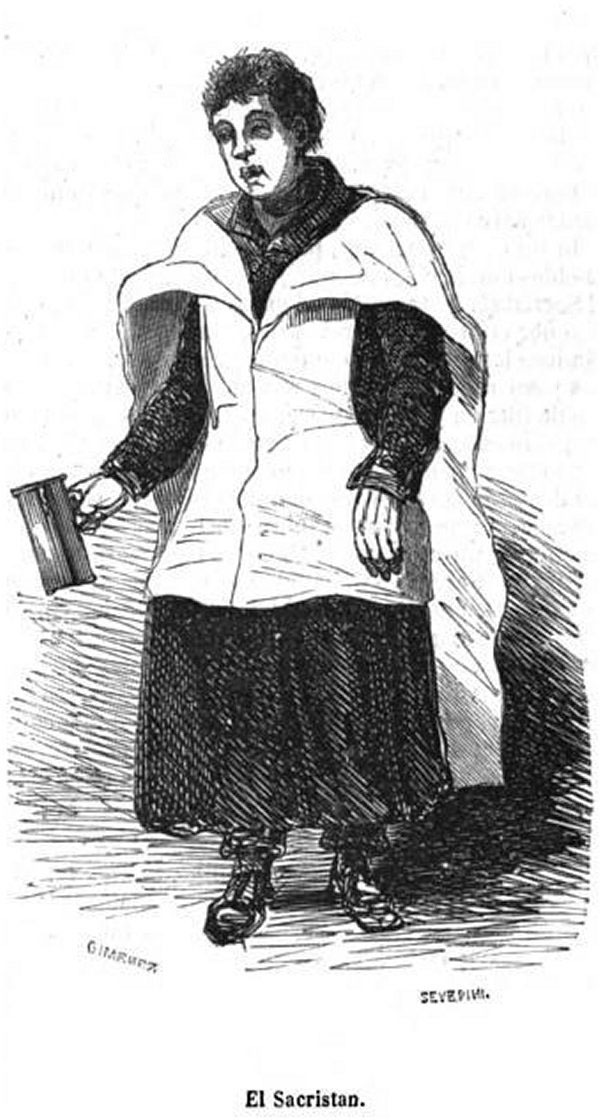
A sacristan

A sacristan is an officer charged with care of the sacristy, the church, and their contents.

In ancient times, many duties of the sacrist were performed by the doorkeepers (ostiarii), and later by the treasurers and mansionarii.[1] The Decretals of Gregory IX[2] speak of the sacristan as if he had an honourable office attached to a certain benefice, and say that his duty was to care for the sacred vessels, vestments, lights, etc. Nowadays the sacristan is elected or appointed. The Cæremoniale Episcoporum prescribed that in cathedral and collegiate churches the sacristan should be a priest, and describes his duties in regard to the sacristy, the Blessed Eucharist, the baptismal font, the holy oils, the sacred relics, the decoration of the church for the different seasons and feasts, the preparation of what is necessary for the various ceremonies, the pregustation in pontifical Mass, the ringing of the church bells, the preservation of order in the church, and the distribution of Masses; finally it suggests that one or two canons be appointed each year to supervise the work of the sacrist and his assistants.

In the Old Testament, the office and duties of the sacristan are assigned to the Levites. 1 Chronicles 23-26 describes how David assigned them duties such as temple doorkeepers, guardians, singers and musicians.

Custos

[edit]
Le bedeau de Kerlaz, painting by Jules Breton (1868)

The under-sacristan is also mentioned in the Decretals.[3] He was the assistant of the sacristan, was subject to the archdeacon and discharged duties very similar to those of the sacristan. By the early twentieth century, the office was hardly ever attached to a benefice and so usually a salaried position. The Council of Trent desired that according to the old canons, clerics should hold such offices; but in most churches, on account of the difficulty or impossibility of obtaining clerics, laymen perform many of the duties of the sacristan and under-sacristan.

In some European medieval contexts, a custos was given the more important roles of keeping the safety of the church, its relics, its treasure, and its archives, but was also responsible for the perception of capitationes, symbolic head-taxes that associated freemen with a religious institution.[4]

Altar societies

[edit]

Altar societies were once commonly organised within most Catholic parish churches. Member duties vary according to circumstances, and in some instances include tasks that ordinarily fall within the sacristan's province, such as the vestments and altar vessels, making ready for the priest's Mass. In general, they consist of the payment of yearly dues into a fund for maintenance and repair of accessories used in Church ceremonies, and usually also include a certain amount of labour for this purpose. Altar societies differ from tabernacle societies in that they work for the benefit of the church they are attached to while tabernacle societies work for the benefit of many different poor churches.

Eastern Churches

[edit]

In the Eastern Churches, the sacristan is known as the ecclesiarch, particularly in monasteries. In large monasteries he may be assigned an assistant known as the paraecclesiarch. An analogous office is that of the skeuophylax. In parishes, however, the sacristan is called sexton. In addition to the tasks and responsibilities mentioned above, if an individual has a message for the priest while serving in the sanctuary, it is given to the sexton to give to the priest or deacon.

Academia

[edit]

Many Christian-faith schools appoint sacristans as members of their prefect bodies, particularly in public schools and institutions founded on the English model. For instance, the University of the South in Sewanee, Tennessee, an Episcopal university, hosts a student Sacristans Guild. Sacristans aid the school's chaplain in the day-to-day running of the chapel and promotion of a Christian ethos in the school. In terms of seniority, they are often regarded as second only to the school captains.[citation needed]

See also

[edit]

References

[edit]
[edit]
Revisions and contributorsEdit on WikipediaRead on Wikipedia
from Grokipedia
A sacristan is a church , typically in Catholic, Anglican, and other liturgical Christian traditions, tasked with the care and preparation of the —a for storing sacred vessels, vestments, and liturgical items—as well as overseeing the church's contents to ensure readiness for worship services. The term derives from the Latin sacer, meaning "sacred," reflecting the role's focus on handling holy objects with reverence. This position supports the and liturgical ministers by managing behind-the-scenes preparations, emphasizing silence and order in the during services. In the Roman Catholic Church, the sacristan's duties are outlined in the General Instruction of the (GIRM, no. 105), which states that the sacristan "carefully arranges the liturgical books, the vestments, and other things necessary in the celebration of ." Key responsibilities include preparing elements such as chalices, ciboria, linens, candles, incense, hosts, and wine; maintaining the and ; ensuring the cleanliness of and vessels; and properly disposing of liturgical items, such as pouring the first wash water of altar linens into a sacrarium. The Ceremonial of Bishops (no. 37) expands this to include ringing bells, overseeing the washing of linens, and preserving vestments and furnishings in good condition. In practice, sacristans often work under the direction of the or , contributing to the overall solemnity of worship without direct participation in the itself. Historically, the sacristan's role evolved from early church practices where duties like guarding church entrances and handling sacred items were performed by doorkeepers (ostiarii) or acolytes in the first few centuries. By the 13th century, the position was formalized in canon law through the Decretals of Pope Gregory IX (1234), distinguishing it as a dedicated office separate from treasurers or other minor roles. For many centuries, especially in monastic communities, sacristans were often younger priests, seminarians, or those in minor orders, reflecting the role's importance in clerical formation. Today, the position is frequently filled by lay volunteers, adapting to the broader involvement of the laity in parish life while retaining its essential liturgical focus.

Etymology and Definition

Etymology

The term "sacristan" derives from sacristānus, meaning "keeper of sacred things," formed from sacrista (a term linked to the or sacred repository) and ultimately tracing to the Latin sacer ("sacred") combined with the agentive -ista, denoting a person associated with a place or office. This Latin form sacristānus appears in medieval texts, including monastic rules and glossaries, from the onward, marking its early adoption in describing custodians within Christian communities. By the , the term influenced vernacular adaptations across , such as sacristain and forms like sakristan or sagrestano in other Romance and , reflecting the spread of terminology.

Core Definition

A sacristan is an officer in liturgical Christian traditions charged with the care of the —a dedicated for storing sacred vessels, vestments, and other liturgical items—and related contents for worship. In the , according to the General Instruction of the , the sacristan diligently arranges liturgical books, vestments, and all necessary elements for the celebration of , ensuring proper preparation under the direction of the . This role is distinct from that of an , who actively assists the priest and during the by performing tasks at , such as carrying candles or the . The sacristan's duties may overlap with those of a sexton, who often handles general maintenance of church facilities, including cleaning, repairs, and groundskeeping, in addition to liturgical preparations. The sacristan's scope of authority thus centers on fostering reverence for liturgical objects and spaces. Historically a formal clerical office, the position of sacristan has evolved in contemporary practice to frequently be a lay volunteer role within parishes, allowing dedicated parishioners to contribute to liturgical readiness.

Historical Development

Ancient and Early Church

In the early Christian Church, from the 1st to 4th centuries, duties akin to those of a later sacristan emerged primarily through the minor order of porters, or ostiarii, who were responsible for guarding church entrances and protecting sacred objects within. These roles developed as part of the Church's hierarchical structure, with the ostiarius first attested in the mid-3rd century, as noted in a letter from Pope Cornelius in 251 AD, which listed 52 ostiaries among the Roman clergy. The porters received the church keys during ordination, symbolizing their accountability for securing the building and its contents, including liturgical items, against unauthorized access, particularly by the unbaptized. This guardianship extended to basic maintenance of sacred spaces, laying the groundwork for more specialized care in subsequent eras. Early texts further illustrate the assignment of vessel and artifact care to higher like deacons and subdeacons, reflecting an informal distribution of sacristan-like responsibilities. The , a 4th-century compilation of church regulations, directs subdeacons to handle the "vessels of ministry" under the oversight of bishops and presbyters, including preparing vessels and ensuring their purity during services. Deacons, meanwhile, were tasked with managing the distribution of Eucharistic elements and related sacred items, acting as ministers who brought offerings to and oversaw their proper use. These provisions underscore a approach to sacred object in the , where such duties supported the evolving without a dedicated sacristan . The emergence of these practices was influenced by Roman religious and domestic traditions, particularly the adaptation of pagan custodial roles for Christian purposes. In Roman society, aeditui served as temple keepers, responsible for opening and closing sacred buildings, maintaining , and guarding votive offerings and cult objects. Early Christians repurposed similar functions, transforming the household —originally a slave guarding private entrances—into the porter, who applied these guardianship principles to church doors and altars as equivalents to pagan shrines. This facilitated the integration of into the Roman cultural framework, bridging informal duties toward more formalized structures in later centuries.

Medieval Period and Beyond

During the medieval period, the role of the sacristan began to formalize within the Catholic Church's clerical structure, often aligning with or functioning as an extension of the minor order of . By the late 11th and 12th centuries, rites for the sacristan appeared in regional liturgical texts, such as the Mozarabic Liber Ordinum, where candidates received a key ring symbolizing authority over the church's sacred spaces and contents. This development reflected a broader of in the Western Church, culminating in the 13th-century Pontificale Romanum compiled by William Durandus, which outlined ceremonies for including those akin to the sacristan's duties of guardianship and preparation. Although not universally listed among the four canonical (porter, , , ), the sacristan's position was treated as a clerical step, typically conferred on tonsured clerics, emphasizing custodial responsibilities over liturgical items. In monastic communities, particularly among from the 13th to 15th centuries, the sacristan held a prominent role in overseeing altars, vestments, and relics, as detailed in customary texts and obedientiary accounts. These documents highlight the sacristan's for the church's material and spiritual , including the secure storage and of relics, which were central to monastic devotion and economies. For instance, at , the sacristan's duties encompassed managing reliquaries and ensuring their ritual use, underscoring the office's integration into daily liturgical life and community governance. This oversight extended to maintaining the sanctity of sacred spaces, aligning with Benedictine emphases on stability and ordered . The Protestant Reformation in the prompted significant shifts in the sacristan's role, particularly in emerging Protestant traditions where clerical hierarchies were simplified. In Lutheran and Anglican contexts, sacristan duties often merged with those of the sexton, a lay officer responsible for broader church maintenance, including grounds and bells, reflecting a reduced emphasis on distinct sacred custodianship. Conversely, in Catholic settings, persisted as a clerical role, affirmed by the (1545–1563), which permitted married clerics to serve but retained its formal status until the , when Paul VI's 1972 motu proprio Ministeria Quaedam suppressed minor orders. The suppression did not affect the sacristan role, which, not being a formal minor order, continued primarily as a lay ministry open to volunteers.

Roles and Responsibilities

Liturgical Preparation

In the Roman Catholic Church, the sacristan plays a central role in the liturgical preparation for and other worship services by ensuring all necessary elements are arranged in accordance with the rubrics of the . This involves diligently setting out liturgical books such as the and , which contain the prayers, readings, and ceremonial instructions for the celebration. Vestments appropriate to the liturgical season or feast—such as white for or violet for —are selected and laid out for the , reflecting the Church's use of color to signify theological themes. Sacred vessels, including chalices, patens, cruets for wine and water, and ciboria for hosts, are prepared and placed on the or to facilitate the Eucharistic rite. The sacristan verifies the quantity of unconsecrated hosts and wine based on expected attendance, ensuring they align with the rubrics for the fraction rite and distribution of Communion. , coals, and the are readied if the calls for incensation, as specified in the General Instruction for solemn occasions. Prior to the service, the sacristan sets the altar by arranging corporals, purificators, and pall, while lighting candles and the to create the sacred atmosphere. Coordination with the includes assisting in the and in the , confirming seasonal adaptations like Advent wreaths or Lenten veils, and addressing any special requirements for feasts or solemnities. These tasks ensure seamless adherence to liturgical norms under the direction of the church rector.

Maintenance of Sacred Items

The sacristan is responsible for the regular cleaning and polishing of sacred vessels, such as chalices and ciboria, to ensure they remain in pristine condition for liturgical use. This includes cleaning vessels after use with appropriate solutions and sending them for professional repair or regilding when necessary to maintain their sanctity and functionality. Altar linens, including purificators and corporals, must be laundered under the sacristan's oversight, with the initial wash water disposed of in a sacrarium to respect their consecrated nature; worn linens are to be burned rather than discarded. Vestments are stored properly to prevent damage from moths, dust, or light exposure. Inventory management falls under the sacristan's purview to safeguard church artifacts beyond immediate liturgical needs, ensuring their secure placement. The sacristan orders and maintains supplies such as candles, altar wine, hosts, , and oils, replenishing stocks like sanctuary lamp oil and to avoid shortages. Repairs to damaged items, from embroidered chasubles to cracked cruets, are coordinated as needed, often involving consultation with the or specialists to preserve historical or artistic value.

Catholic Tradition

Clerical Roles

In the Catholic Church, sacristan duties historically overlapped with those of minor orders such as the porter, evolving into a distinct office by the time of the Decretals of Gregory IX in the 13th century, often tied to a benefice and performed by clerics or laymen. Historically, sacristans were entrusted with duties including assisting the clergy in the blessings of liturgical items such as holy oils and relics, as well as participating in ecclesiastical processions to ensure the proper handling and presentation of sacred objects. Following the Second Vatican Council, Pope Paul VI's Ministeria Quædam in 1972 suppressed the (porter, , , and ) as formal steps in clerical formation, replacing them with instituted ministries open to laypersons to promote broader participation in liturgical service. The sacristan role persists today, often filled by lay volunteers, though it continues in some traditionalist communities that retain pre-conciliar practices. Lay extensions of these responsibilities are further explored through altar societies.

Lay Involvement and Altar Societies

Lay involvement in sacristan duties within the Catholic Church expanded significantly during the 19th century, particularly through the formation of pious associations known as altar societies, which enabled non-ordained parishioners—often women—to assist in liturgical preparation and maintenance. These groups emerged amid a period of Catholic revival and immigration in the United States and Europe, where growing parishes needed organized lay support to sustain church operations. For instance, the Altar and Rosary Society traces its origins to the mid-1800s in places like St. Francis de Sales in Chelsea, Massachusetts, where women gathered for prayer and practical aid to the altar. Similarly, St. Mary's Altar Society in Victoria, Texas, was established on October 1, 1863, specifically to decorate and clean the parish's altar. In Europe, parallel devotional societies formed during the same era, reflecting the ultramontane movement's emphasis on lay piety and parish beautification. Altar societies typically undertake rotating shifts to prepare the for , including arranging vestments, linens, candles, and sacred vessels, thereby fulfilling core sacristan responsibilities under clerical oversight. Members also engage in efforts to acquire and repair liturgical items, such as new vestments or cloths, ensuring the reverence due to sacred spaces. Beyond practical tasks, these groups promote community education on liturgical care, often through workshops or shared devotions that teach proper handling of Eucharistic elements and foster a deeper appreciation for the . Representative examples include the Ladies of the Altar societies, which focus on women's contributions to altar upkeep and often emphasize domestic virtues in service to the Church. Membership in such groups involves commitments like daily prayers or vows of reverence, underscoring the spiritual dimension of lay service. The Knights of the Altar, primarily for boys and young men, similarly emerged in organized form in , when laymen were increasingly permitted to assist at the altar, training members in sacristan duties while instilling chivalric ideals of and . These societies continue to embody lay collaboration, bridging clerical direction with devotion in Catholic parishes.

Eastern Christian Traditions

Orthodox Practices

In the , the role of the sacristan is less formalized than in Western traditions, lacking a dedicated minor order and often integrated into the responsibilities of other lower or lay assistants. This position typically involves overseeing the preparation and maintenance of liturgical elements within the , ensuring the is ready for worship with reverence and order. Unlike distinct clerical ranks for such tasks in Catholicism, Orthodox sacristans operate within a collaborative framework where duties support the overall liturgical life of the . The sacristan's responsibilities are frequently combined with those of readers or subdeacons, who serve as servants of the altar and handle multiple supportive roles during services. Readers, for instance, not only proclaim the scriptures but also assume sacristan-like tasks such as taper-bearing and general care of altar items, reflecting the multifunctional nature of minor orders in Orthodoxy. Subdeacons may extend this oversight to include handling items near the Holy Table, though lay faithful, including altar boys, often share these burdens in practice. This integration emphasizes communal service over specialized hierarchy, allowing the sacristan to focus on practical support without formal ordination for the role alone. Key duties center on preparing the church for the and other services, including care for the , , and vestments. The sacristan ensures icons on the are clean and properly positioned, using soft cloths for dusting and handling them reverently with both hands to preserve their sanctity. preparation involves cutting the blessed bread into appropriate sizes—such as 2-inch cubes in Greek style or 1 cm cubes in Slavic tradition—for distribution as antidoron, with any remnants disposed of by burning or burial outside the church. Vestments are meticulously folded and stored, with the sticharion requiring a specific six-step process to maintain cleanliness and readiness. Specific tasks also include setting up the proskomedia table before the begins, where the prepares the gifts; the sacristan arrives early to vest and arrange items like the , , and sponge, while collecting requests from the faithful. Maintaining oil lamps entails filling them to within 1 cm of the top, trimming wicks to ¼ inch, and ensuring hands are washed to prevent oil residue on other sacred objects. During the , assistance extends to practical aids like providing hot water for the 's ablutions or managing the and candles, all performed without entering restricted areas unless ordained. These actions support the rite's emphasis on mystical participation, allowing to focus on . Historically, the sacristan's duties trace back to early Christian lower clergy orders, such as doorkeepers and chanters, whose roles included safeguarding church contents and preparing for worship; remnants of these prayers persist in some Greek parishes. Over centuries, these responsibilities have evolved, gradually shifting from specialized clerical tasks to broader lay involvement in modern parishes, as outlined in liturgical guidelines that promote shared oversight among the faithful. This development aligns with the Orthodox typika—church rule books that detail service preparations—adapting to parish needs without rigid specialization. In contemporary settings, lay sacristans predominate, fostering a sense of collective stewardship in line with the Church's conciliar ethos.

Other Eastern Churches

In the , roles equivalent to the sacristan are primarily fulfilled by deacons, who assist in preparing the , arranging the paten, and maintaining during the of St. Basil, the most commonly used Eucharistic service. Deacons ensure is properly set with items such as the , , and candles, light the altar candles during key moments like the Anaphora and prayers, and clean the and after services to preserve its sanctity. Similarly, in the , the Grand Sacristan oversees all matters related to liturgical services at major cathedrals, drawing from ancient traditions adapted to the church's unique rite. This role emphasizes meticulous care for sacred items to facilitate uninterrupted worship, often involving deacons in hands-on tasks such as chalice arrangement and vesting. Unique aspects of these roles appear in the Ethiopian Tewahedo Church, where duties are deeply integrated into monastic life, with monks responsible for preserving ancient vestments and censers stored in the church to maintain purity. Vestments, blessed specifically for use, are kept clean and unused outside liturgical contexts, reflecting a commitment to historical continuity in monastic communities that safeguard artifacts. In modern adaptations, lay sacristans and altar servers have emerged in diaspora communities of , such as Coptic and Armenian parishes in and , where they assist with basic preparations like setting and handling vestments, blending traditional duties with local customs while remaining rooted in the miaphysite theology established after the 5th-century schism at the . In the , similar responsibilities fall to deacons, who support the priest in censing and preparing Eucharistic elements during the Anaphora of Addai and Mari.

Modern and Educational Aspects

Training and Academia

In pre-1972 Catholic seminaries, training for liturgical roles, including those akin to sacristan duties, was integrated into the rigorous formation for and the sub-diaconate, emphasizing strict adherence to rubrics as part of the post-Tridentine monastic-like discipline that prepared seminarians for priestly ordination. This curriculum required seminarians to master the precise rubrics governing preparation, vestments, and sacred vessels through practical exercises and law studies, ensuring devotional precision in liturgical execution before advancing to major orders. Such formation fostered a deep understanding of rubrics related to services like High and , where sacristans handled items symbolizing theological concepts, such as the three altar linens representing the . Post-Vatican II, formal liturgical preparation has shifted to specialized institutes, with modern equivalents including programs at the Pontifical Liturgy Institute (PIL) at Sant'Anselmo in , which offers courses on Western liturgical books, Christian initiation rites, and proficient Latin for liturgists to equip participants with rubric knowledge applicable to sacristan responsibilities like managing sacred texts and items. These two-year license programs in sacred liturgy emphasize practical and theoretical training in liturgical disciplines, promoting accurate preparation of rites and fostering reverence for sacred objects in contemporary contexts. In Orthodox seminary programs, preparation for such as readers and subdeacons includes liturgical training focused on typology—interpreting prefigurations of realities—and sacristy management, as seen in the curriculum at Holy Trinity Orthodox Seminary, which provides comprehensive theological, liturgical, and pastoral instruction for ordination candidates. Courses cover practical skills like articulating liturgical texts and serving in the altar, where readers handle Epistle readings with clear enunciation and subdeacons manage items such as processional candles and vessels during hierarchical services, ensuring orderly sacristy operations. The Diaconate Program at Hellenic College Holy Cross Greek Orthodox School of Theology further reinforces these elements through studies in liturgical practices and canonical traditions, preparing minor clerics for roles involving typology-informed service and maintenance of sacred spaces. Key resources for sacristan training include the 20th-century manual A Guide for Sacristans in the Orthodox Church by Father Geoffrey Korz, which instructs on prayerful duties such as preparing vestments, icons, and candles 30 minutes before services, while emphasizing , consultation with , and reverent handling of holy objects like the during Proskomedia. In the Catholic tradition, practical guidelines aligned with USCCB documents such as the General Instruction of the Roman Missal, as provided in the third edition (2021) of Christina Neff's Guide for Sacristans published by Liturgy Training Publications, offer comprehensive protocols for liturgical ministers, stressing ongoing formation in rubric adherence, vessel care, and assembly participation to support active involvement in the 's directives.

Contemporary Volunteer Roles

In the wake of the Second Vatican Council, the role of the sacristan has shifted significantly toward lay volunteers, aligning with the Council's emphasis on active participation of the faithful in liturgical life. This post-conciliar development expanded opportunities for lay men and women to assume responsibilities previously held primarily by clergy or religious, including preparing vestments, vessels, and books for celebrations. Today, sacristans serve as essential behind-the-scenes ministers in parishes, ensuring orderly worship while fostering a sense of communal stewardship. Training for these volunteer sacristans has adapted to contemporary needs through workshops, diocesan formation programs, and online resources. For instance, guidelines from various dioceses in the 2020s stress initial orientation, periodic workshops, and ongoing education to equip volunteers with liturgical knowledge and practical skills. These efforts, often including webinars and digital guides, help volunteers navigate the complexities of diverse liturgical seasons and rites. Contemporary sacristans face challenges in balancing core duties with evolving demands, such as coordinating for multicultural celebrations and maintaining reverence amid volunteer shortages. In Western parishes, there is a growing emphasis on inclusivity, recruiting diverse volunteers from varied ethnic and cultural backgrounds to reflect congregational demographics and enrich liturgical participation. In developing regions like and , lay sacristans frequently extend their service to community outreach, integrating church maintenance with social support in areas facing shortages. This adaptation underscores the sacristan's role as a bridge between and broader across global traditions.

References

Add your contribution
Related Hubs
User Avatar
No comments yet.