Hubbry Logo
Sam ChildersSam ChildersMain
Open search
Sam Childers
Community hub
Sam Childers
logo
8 pages, 0 posts
0 subscribers
Be the first to start a discussion here.
Sam Childers
Sam Childers
from Wikipedia

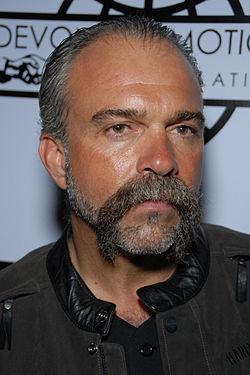
Sam Childers (born 1963), also known as the Machine Gun Preacher, is an American motorcyclist, author, and Christian. A member of the Highwaymen Motorcycle Club, Childers became well known after Dateline NBC broadcast a profile of him by Keith Morrison and Tim Sandler that documented his interactions with Joseph Kony, the leader of the Lord's Resistance Army in 2005. Childers subsequently dedicated his life and resources to rescuing children in the war zone of South Sudan. Childers and his wife Lynn founded and operate Angels of East Africa, the Children's Village Orphanage in Nimule, South Sudan, where they currently have around 185 children in their care. Childers also has orphanages and homes in Uganda and Ethiopia with another 160 children in his organisation's care.

Key Information

In 2013, Childers received the Mother Teresa Award for Social Justice.[1][2]

Early life

[edit]

Childers was born in Grand Forks, North Dakota, the son of Paul Childers, an ironworker and former Marine.[3] Childers had two older brothers, Paul Jr. and George. He also had a sister, Donna, who died of a heart problem before she was a year old. While he was growing up, his parents moved the family from place to place, following construction projects.[citation needed]

In the spring of 1974, shortly before Childers turned 12, his family moved to Grand Rapids, Minnesota. Going into seventh grade he discovered cigarettes, marijuana, alcohol and heroin, which led to many years of drug addiction, drug dealing, and alcoholism. Childers also developed a love for motorcycles and the lifestyle that led him to become a member of the Highwaymen Motorcycle Club.[4][5][6][7]

Childers married a woman named Lynn before converting to Christianity, and had a daughter (Paige) and a son.[citation needed]

Career

[edit]

Childers converted to Christianity in mid-1992, with the help of his 1st wife, during a revival meeting at an Assembly of God church. That same evening Childers' pastor allegedly prophesied that he would go to Africa. At the end of 1997, Childers made his first trip to Sudan. In that first trip and the many that followed, he was exposed to the acts of the Lord's Resistance Army (LRA),[8] which he described as atrocious.

Not long after his first trip to Sudan, Childers and his then wife Lynn founded the Angels of East Africa, the Children's Village in Southern Sudan.[9] The Children’s Village currently houses and educates over 180 (figures update 2021) orphans,[10] with over a thousand children rescued since its conception.[11] The staff at the Children's Village are primarily Sudanese orphans and widows themselves.

Childers details the events of his life and his experiences in Africa in his book Another Man's War.[12] The book bears the endorsement from South Sudan President Salva Kiir Mayardit: "The Reverend Sam Childers has been a very close friend to the government of South Sudan for many years and is a trusted friend."[13]

In November 2009, Childers appeared on Debra Peppers' television show Outreach Connection in Quincy, Illinois. He revealed that he also rescues children abducted in northern Uganda.[citation needed]

[edit]

In 2011, Relativity Media released a biopic about Childers entitled Machine Gun Preacher, which was based on Childers' book Another Man's War. The film was written by Jason Keller and directed by Marc Forster. The cast featured Gerard Butler in the title role, Michelle Monaghan as Childers' wife Lynn, and Michael Shannon as his best friend Donnie.

In 2014, a documentary with the same title was produced by Angels of East Africa, and filmed/edited by Australians Kevin Evans and Zac Simpson. It was released globally by Heritage Films in Australia and in North America by Vision Films (US).

Childers did a speaking tour of UK churches, organisations, businesses, rehab centers, and prisons in 2018. He was interviewed on video in Tamworth, UK.[14]

Criticisms

[edit]

Childers has faced criticism over his actions and representation of himself. Foreign Policy cast doubt on Childers' stories of rescue, stating that "[i]t would take a miracle for all of Childers’s claims to be completely true." It also asserted that the operations of other aid workers are imperiled by Childers' actions. Additionally, the SPLA distanced itself from Childers, stating via a spokesman that "The SPLA does not know Sam Childers."[15]

In 2014, Childers' home and ministry properties were the subjects of a raid by the FBI and the IRS.[16][17] In 2019, Childers was cleared of all charges by the FBI and the IRS.

Other criticism includes allegations that orphanages started by Childers have been poorly run, and that Childers has not made a visit in years.[18][19] A Vanity Fair profile compared Childers' demeanor toward some villagers as "bullying."[20]

References

[edit]
[edit]
Revisions and contributorsEdit on WikipediaRead on Wikipedia
from Grokipedia
Sam Childers (born 1963) is an American former biker, drug dealer, and Christian minister who founded the Angels of organization to operate and children from warlords in . Following a in the mid-, Childers established his first orphanage in Nimule, , in the late , expanding to support approximately 350 children through and vocational training. Known as the "," he has conducted armed patrols against the (LRA), claiming to have personally thousands of abducted children over more than two decades. Childers received the Mother Teresa Memorial International Award for in 2013 for his efforts. His work, however, has drawn , with critics alleging exaggeration of numbers, staging of photographic , and inadequate conditions in his orphanages, including reports of malnourishment and disrepair prior to improvements. Childers maintains that such issues stemmed from internal mismanagement by former staff and denies any neglect or fabrication.

Early life and background

Childhood and family origins

Sam Childers was born in 1963 in , to Paul Childers, an ironworker and former U.S. Marine Corps veteran. His family originated from rural Pennsylvania, with deep ties to the Central City area in Somerset County, where Childers spent his formative childhood years amid a working-class, blue-collar environment marked by economic challenges and limited formal educational opportunities. The Childers household was characterized by frequent relocations driven by his father's itinerant trade, including periods in and other states, which exposed young Sam to instability and the rigors of manual labor communities. Raised in a solidly Christian home under a God-fearing , Childers grew up in Pennsylvania's hilly, resource-scarce regions, where life revolved around traditional values, , and the hardships of industrial decline in post-war America. These early surroundings, steeped in rural Protestant and the cultural toughness of Appalachia-adjacent townships, provided a baseline of discipline and community bonds, though formal schooling remained rudimentary, reflecting broader patterns in such locales during the 1960s and 1970s.

Involvement in crime and biker culture

In his youth, Sam Childers engaged in drug use and sales starting from his early teens, escalating into a pattern of addiction and criminality that included dealing narcotics and participating in violent acts. During the 1980s, Childers affiliated with the Detroit chapter of the Highwaymen Motorcycle Club, an outlaw biker gang known for involvement in drug trafficking, theft, and assaults, where he adopted the lifestyle of a 1%er outlaw biker. As a member, he immersed himself in the club's subculture, which emphasized heavy drug consumption—particularly heroin and methamphetamine—and routine violence, including bar fights and inter-club rivalries that contributed to his physical deterioration and legal troubles. Childers faced multiple convictions stemming from his criminal activities, including periods of incarceration for offenses related to drug dealing and , as detailed in his self-reported accounts. These experiences exacerbated personal strains, such as deteriorating family relationships with his Lynn and , amid near-fatal overdoses and escalating that left him in a state of chronic dependency and aggression.

Conversion to Christianity

In the summer of 1992, Sam Childers, then immersed in a life of drug dealing and biker gang affiliations, attended a revival service at a local Assembly of God church, prompted by his wife Lynn's recent . During the event, Childers reported undergoing a profound personal transformation, marking an abrupt end to his and criminal pursuits. This shift facilitated immediate reconciliation with his family, including Lynn, and prompted Childers to engage actively in church life, leveraging his background in to assist with local building initiatives. Over the ensuing months, he founded the Sheffield Family Life Center, a church in , where he began preaching and proselytizing, redirecting his energies toward faith-based community outreach. These early steps reflected a crisis-driven reevaluation of his priorities, grounded in and familial restoration, without initial indications of overseas engagement.

Ministry and operations

Initial mission work in East Africa

In 1998, Sam Childers undertook his first mission trip to southern during the Second , initially joining a church group to repair war-damaged huts in the village of Yei. The journey, funded by his personal savings, placed him near the border, where cross-border violence from the (LRA) exacerbated the conflict's devastation on civilians. Sudanese government forces and rebel groups like the Sudan clashed amid widespread instability, leaving local authorities unable to safeguard villages from raids and displacement. During the five-week expedition, Childers collaborated with local leaders and volunteers to perform roofing and reconstruction tasks in affected communities, distributing basic aid in areas reeling from bombings and incursions. He encountered stark evidence of suffering, including stumbling upon the mutilated body of a killed by a landmine, an incident that underscored the indiscriminate toll of the warfare. These observations highlighted the vulnerability of children in the region, as displaced families recounted tales of villages razed and youth of LRA tactics, though systematic abductions became more apparent in subsequent exposures. The trip revealed governmental neglect in protecting remote populations, with aid efforts filling voids left by ineffective state presence and international inaction during the protracted conflict. Childers' initial logistics involved coordinating with on-the-ground contacts for safe passage and material transport, laying groundwork for future engagements without formal organizational structure. This foundational experience shifted his focus toward the human cost of the LRA's , which preyed on unguarded settlements in the war-torn borderlands.

Founding and expansion of Angels of East Africa

Sam Childers established Angels of East Africa as a 501(c)(3) in in 1999, with initial operations commencing in 2000 through the of a small called the Children's Village in Nimule, . This facility, located near the border, provided shelter and basic care for orphaned children displaced by regional conflicts. The startup phase relied on self-funding, as Childers sold his U.S. business to finance the project without external grants or loans at the outset. Expansion accelerated in the mid-2000s, extending operations to additional sites in and , with facilities incorporating schools and rehabilitation centers for former child soldiers. By this period, the organization had developed infrastructure such as feeding programs and agricultural projects on approximately 600 acres of land to promote self-sufficiency among residents. Further growth included outposts in , focusing on community centers and educational initiatives. Funding for this development derived primarily from private U.S. donations, church-affiliated networks, and personal appeals by Childers, supplemented by proceeds from his books and speaking engagements. These sources enabled the scaling of operations without reliance on government aid, though annual IRS filings indicate ongoing dependence on individual contributions reported as program expenses.

Armed patrols and child rescue efforts

Childers adopted an armed approach to around 2001, leading patrols in southern and northern equipped with AK-47s and other firearms to deter (LRA) abductions in areas with minimal government presence. These operations involved collaboration with local Sudanese (SPLA) militias, forming a security team of about 15 men armed with sniper rifles and rocket-propelled grenades, patrolling in vehicles to intercept LRA movements. The tactic addressed the practical void left by ineffective state forces and nearby UN camps, which failed to halt LRA raids despite their mandate. Specific confrontations included an interception near Maridi in 2009, where Childers' team arrived hours after an LRA attack that killed 12 villagers and abducted children, narrowly missing LRA leader . Another incident involved an with snipers targeting Kony's group near during stalled peace talks. Childers reported personally engaging and killing over 10 LRA fighters in such encounters. These efforts contrasted with broader international interventions, such as the International Criminal Court's 2005 for Kony, which did not yield captures amid operational setbacks like Uganda's failed 2008 bombings. Rescue operations yielded recoveries like 23 children from a militia-held zone in , , during joint patrols with government soldiers. By 2010, Childers claimed to have freed over 200 children from LRA control, corroborated by accounts from rescued individuals such as , recovered in 2007 after being shot. Local SPLA officers described him as essential in these ungoverned spaces, where abductions persisted unchecked by formal authorities. The "Machine Gun Preacher" moniker arose from these frontline tactics, emphasizing direct deterrence over reliance on distant diplomatic or prosecutorial measures.

Achievements and impacts

Verified humanitarian outcomes

Angels of East Africa operates multiple orphanages providing long-term shelter to displaced children in conflict-affected regions of , , and . As of 2024, the organization reports caring for approximately 350 children across these facilities, with the primary home in Nimule, , accommodating around 175 residents on a 24/7 basis. These numbers reflect current capacity rather than cumulative totals, corroborated by the nonprofit's registration as a 501(c)(3) entity and as NGOs in host countries, enabling sustained operations since the early . Rehabilitation programs emphasize and vocational to promote self-sufficiency among former child soldiers and orphans. Facilities such as the MGP and Ranch in northern , spanning over 1,000 acres, serve as hubs where children learn agricultural and practical skills alongside formal schooling. Organizational reports indicate these initiatives have enabled participants to transition to , though specific alumni success rates lack independent quantification; visitor accounts from journalists and supporters affirm the programs' implementation and focus on psychological and economic restoration. The charity's financial transparency, with program expenses at 79% of total spending per evaluator assessments, supports the delivery of these outcomes amid regional . While direct causal links to broader deterrence of incursions remain unquantified by external audits, the consistent sheltering of vulnerable children represents a verifiable baseline of humanitarian impact in areas historically targeted by groups like the .

Infrastructure development and rehabilitation programs

Angels of East Africa, founded by Sam Childers, has constructed multiple orphanages and supporting facilities in and , including the Children's Village in Nimule, , which houses approximately 185 children and incorporates residential homes, a , medical care provisions, and a church hall. Additional orphanages operate in , northern , accommodating up to 20 children under house mothers, and in , , supporting 15-20 advanced students pursuing higher education. By 2019, the organization had built five orphanages, seven , and recent training centers across , northern , and to provide structured environments for war-affected youth. Rehabilitation programs emphasize trauma recovery through routine, , and vocational tailored to former soldiers and orphans, aiming to equip them with skills to escape cycles of violence. At facilities like Nimule, children engage in hands-on activities such as crafting toys from materials like tins and wood, promoting and practical . Job initiatives include farming, , , and , often integrated into facility operations to foster employable abilities among participants, including war victims and refugees. Sustainability efforts center on agricultural projects to minimize external dependency, exemplified by the MGP and in Nwoya, northern , established in 2013 on over 1,000 acres, with 600 acres dedicated to crops like —yielding 90 tons in one distributed to orphanages, camps, and villagers—alongside rearing of , pigs, goats, sheep, poultry, and ducks. The farm employs and trains around 80 individuals at a time, sells surplus produce to wholesalers and retailers, and supplies food internally, enabling self-funding elements while supporting broader feeding programs in , , and .

Broader influence on anti-LRA efforts

Childers' Angels of East Africa maintained operational alliances with the Sudan People's Liberation Army (SPLA), including the provision of arms, ammunition, and intelligence via shortwave radio communications to track LRA movements in South Sudan and Uganda border regions. These efforts involved recruiting SPLA fighters into his personal militia for joint patrols aimed at disrupting LRA activities, with Childers designated as an honorary commander by the Southern Sudan government, facilitating on-ground coordination in Nimule since the orphanage's founding in 2001. Such collaborations complemented broader regional military operations, including those by U.S.-backed forces pursuing Joseph Kony, by supplying localized intelligence on rebel positions derived from Childers' patrols and informant networks. In addition to tactical support, Childers contributed to international legal scrutiny of the LRA through his 2004 invitation to testify before the in on LRA atrocities, providing firsthand accounts of child abductions and operations in affected areas. This engagement aligned with the ICC's issuance of arrest warrants for Kony and four senior commanders on July 8, 2005, for crimes including the of over 2,000 children under 15 since 2002. His advocacy, disseminated through evangelical speaking circuits, amplified awareness of LRA tactics among Western donors and policymakers, indirectly bolstering shifts toward direct intervention funding and military advisories in . The sustained presence of Childers' armed patrols in LRA-affected zones, often in with SPLA units, formed part of a multifaceted deterrence that pressured the group's operational along the Uganda-South frontier, where abductions peaked in the early before declining amid combined local and international pressures post-2005. While not attributable solely to any single actor, these non-state efforts provided supplementary and humanitarian buffers that informed larger hunts, such as U.S. advisory deployments starting in , enhancing the overall efficacy of anti-LRA coalitions without supplanting state-led initiatives.

Controversies and scrutiny

Challenges to claims of rescues and operations

Journalists and aid workers have questioned the verifiability of Sam Childers' claims regarding child rescues from the (LRA). In a 2011 investigation, South Sudanese community leader Okumu asserted that Childers' purported rescues were fabricated, stating, "He claimed to be rescuing kidnapped children from the LRA... But it was false. He just took pictures of the children in around the ." Similarly, reports highlighted staged or context-lacking photographs used to depict rescues, with critics noting inconsistencies in visual evidence presented by Angels of . Childers has self-reported rescuing thousands of children over decades, yet independent assessments have verified far fewer instances, often tallying in the low hundreds at most, due to reliance on anecdotal accounts without third-party corroboration. Aid organizations and bloggers, such as those cited in analyses, have pointed to empirical gaps, including unverified combat engagements and child recoveries, arguing that claims escalate over time without supporting documentation. These discrepancies persist amid broader from humanitarian professionals who view Childers' narratives as potentially exaggerated to garner support. The warzone conditions in and have precluded comprehensive independent audits or on-site verifications by neutral observers, contributing to ongoing uncertainty. Despite this scrutiny, Childers' operations have continued without definitive disproof of core activities, though the evidentiary threshold remains a point of contention among critics.

Criticisms of methods and vigilantism

Critics of Sam Childers' operations have characterized his armed patrols as reckless that exacerbates risks to civilians and humanitarian workers in LRA-affected regions. Aid organizations and observers contend that Childers' independent armed incursions, often involving confrontations with LRA fighters, provoke retaliatory attacks and undermine coordinated efforts, potentially increasing civilian casualties in already unstable areas. An anonymous aid worker highlighted the perils, stating that such indiscriminate firing "increases the likelihood that I or someone I care about is going to get shot," as it heightens local suspicions and disrupts safe access for relief operations. These methods have also drawn scrutiny for lacking formal ties to state forces; the Sudan People's Liberation Army (SPLA) has denied any collaboration with Childers' patrols, with a spokesperson asserting, "The SPLA does not know Sam Childers," contradicting his claims of joint missions. Critics from humanitarian and policy circles argue this lone-wolf approach bypasses rule-of-law principles, fostering escalation in conflict zones where actions can perpetuate cycles of rather than resolve them, particularly given Childers' reported killings of LRA members in double digits. In response to pacifist-leaning critiques emphasizing non-violent aid, defenders invoke causal realities of failed states, where Ugandan and Sudanese authorities exerted limited control over LRA territories, and major NGOs like curtailed operations due to pervasive insecurity from abductions and ambushes. The LRA's documented brutality—abducting at least 66,000 children for forced , , and between 1986 and 2005—underscored the inadequacy of withdrawal or prayer-alone strategies, as the group evaded international interventions for decades. In such vacuums, Childers' patrols arguably filled a deterrent role, holding contested areas against LRA incursions where state or multilateral forces faltered, though empirical verification of net civilian protection remains contested amid reports of operational hazards. In February , FBI and IRS agents raided the home, business, and donation warehouse of Sam Childers, founder of Angels of , as part of an investigation into financial irregularities. Childers stated the probe stemmed from allegations against a relative, who reportedly embezzled thousands of dollars from the nonprofit over two years, rather than his own overseas activities. Authorities seized computers and examined shipments, including items bound for African orphanages, which Childers claimed were damaged during the search, but no criminal charges were filed against him personally, and the matter concluded without formal accusations of wrongdoing on his part. A 2011 report in Christianity Today raised allegations of neglect at Childers' orphanage in Nimule, , citing witnesses who claimed children suffered from inadequate food, medical care, and supervision amid a focus on armed patrols against the . Critics, including local aid workers, argued that resource strains from a sudden influx of refugees—over 400 children at peak—exacerbated conditions, prompting calls to close the facility and transfer operations to established ministries. Childers denied the claims, asserting that on-site inspections by journalists, including from Christianity Today, confirmed sufficient provisions, and attributed issues to wartime disruptions rather than mismanagement. Public nonprofit filings for Angels of East Africa, a 501(c)(3) organization founded in 1998, have shown consistent reporting of revenues—$1.2 million in 2022 alone—primarily from donations supporting orphanages and relief efforts, though some observers noted limited detailed breakdowns of overseas expenditures typical of small international nonprofits operating in conflict zones. No regulatory findings of fraud emerged from U.S. tax authorities, and the organization's sustained operations, including facility expansions, alongside continued donor support and awards, indicate that allegations did not result in shutdowns or disqualifications, despite scrutiny over accountability in high-risk environments.

Media portrayal and public life

Books, film, and documentaries

Sam Childers authored the autobiography Another Man's War: The True Story of One Man's Battle to Save Children in the Sudan, published on January 1, 2009, by Thomas Nelson. The book chronicles his personal transformation from a former gang biker and drug dealer to a Christian missionary focused on rescuing children from conflict zones in Sudan, emphasizing his encounters with child soldiers and orphans amid the Second Sudanese Civil War. The narrative gained wider visibility through the 2011 biographical film , directed by and starring as Childers. Released on September 23, 2011, in limited theaters, the film depicts Childers' armed patrols and orphanage-building efforts in collaboration with Sudanese forces against the , drawing directly from the book's account. It earned mixed critical reception, with a 28% approval rating on based on 113 reviews, and grossed $537,600 domestically against a $30 million production budget. Subsequent documentaries have extended coverage of Childers' activities, including the 2023 short film Machine Gun Preacher uploaded to YouTube, which portrays his shift from personal struggles to advocacy for enslaved children in East Africa over 13 years. In 2024, Never Stop: 25 Years a Missionary or a Mercenary premiered, chronicling Childers' two-and-a-half decades of operations, from initial trips to Sudan to ongoing missions, highlighting his persistence in volatile regions. These works have amplified awareness of his self-described role in child rescue efforts, though they primarily rely on Childers' perspectives and footage from his Angels of East Africa organization.

Awards, speaking engagements, and recognition

In 2013, Sam Childers received the Memorial International Award for , presented on October 27 in , , by the Mother Teresa Charity Trust; he was the first and only American recipient to date. The award cited his direct involvement in child rescue operations against the in and . Childers has undertaken global speaking tours, delivering addresses at churches, community events, rehabilitation centers, and prisons, with a focus on his transformation from outlaw biker to anti-child soldier activist. These engagements, promoted through his organization's world tour schedule, have included tours in the United States, in 2018, and in 2023.

Ongoing activities as of 2025

As of 2025, Angels of , founded by Sam Childers and his wife Lynn, continues to manage the Children's Village Orphanage in Nimule, , sheltering over 300 children displaced by regional conflicts. The organization sustains 3–4 annual mission trips to and , supporting school feeding initiatives around and child extraction from active war zones in Eastern Africa. In October 2025, operations included integrating 15 additional orphans into the program and infrastructure efforts such as to address local shortages amid persistent instability. Childers' ministry has expanded agricultural projects, including farms that supply food to thousands in , adapting to fragmented militant threats beyond the diminished by prioritizing community sustenance and . These efforts occur against the backdrop of 's ongoing ethnic violence and resource disputes, which displaced over 2 million people as of 2024 data from humanitarian trackers. For awareness and funding, Childers conducted U.S. speaking tours in July–August 2025 and Australian engagements in March 2025, sharing updates on expansions and logistics via platforms like and . Documentaries released in 2024, such as those chronicling 25 years of interventions, underscore the shift toward preventive measures like and relocation for at-risk in volatile border areas.

References

Add your contribution
Related Hubs
User Avatar
No comments yet.