


Community hub
Recent from talks
Contribute something
Nothing was collected or created yet.
Nonlinear gameplay
View on Wikipedia
A video game with nonlinear gameplay presents players with challenges that can be completed in a number of different sequences. Each may take on (or even encounter) only some of the challenges possible, and the same challenges may be played in a different order. Conversely, a video game with linear gameplay will confront a player with a fixed sequence of challenges: every player faces every challenge and has to overcome them in the same order.
A nonlinear game will allow greater player freedom than a linear game. For example, a nonlinear game may permit multiple sequences to finish the game, a choice between paths to victory, different types of victory, or optional side-quests and subplots. Some games feature both linear and nonlinear elements, and some games offer a sandbox mode that allows players to explore an open world game environment independently from the game's main objectives, if any objectives are provided at all.
A game that is significantly nonlinear is sometimes described as being open-ended or a sandbox, and is characterized by allowing players to measure progress through self-determined goals, independent of scripted game elements.[1][2][3]
Level design
[edit]
A game level or world can be linear, nonlinear or both. In a linear game, there is only one path the player can take through a level, but in games with nonlinear gameplay, players might have to revisit locations or choose from multiple paths to finish the level.
As with other game elements, linear level design is not absolute. While a nonlinear level can give the freedom to explore or backtrack, there can be a sequence of challenges that a player must solve to complete the level. If a player must confront the challenges in a fixed order nonlinear games will often give multiple approaches to achieve said objectives.
A more linear game requires a player to finish levels in a fixed sequence to win. The ability to skip, repeat, or choose between levels makes this type of game less linear. Super Mario Bros. is an early example of this, where the player had access to warp zones that skipped many levels of the game.
In some games, levels can change between linear design and free roaming depending on the objective of the stage. Super Mario 64 is an example where the main stages are free roam, while the levels where Bowser is encountered follow a straight path to the end.
Open worlds and sandbox modes
[edit]When a game is sufficiently large and open-ended, it may be described as an open world or as a sandbox game.[4] Open-world game designs have existed in some form since the 1980s, such as the space trading game Elite, and often make use of procedurally generated environments.
In a game with a sandbox mode, a player may turn off or ignore game objectives, or have unlimited access to items.[5] This can open up possibilities that were not intended by the game designer. A sandbox mode is an option in otherwise goal-oriented games and is distinguished from open-ended games that have no objectives, such as SimCity,[5] and Garry's Mod.[6]
Branching storylines
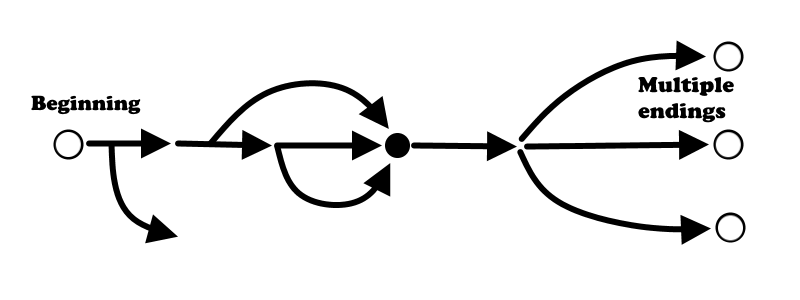
[edit]Games that employ linear stories are those where the player cannot change the story line or ending of the story. Many video games use a linear structure, thus making them more similar to other fiction, but it is common for such games to use interactive narration in which a player needs to interact with something before the plot will advance, or nonlinear narratives in which events are portrayed in a non-chronological order. Many games have offered premature endings should the player fail to meet an objective, but these are usually just interruptions in a player's progress rather than actual endings. Even in games with a linear story, players interact with the game world by performing a variety of actions along the way.[7]
More recently, some games have begun offering multiple endings to increase the dramatic effect of moral choices within the game, although early examples also exist.[7] Still, some games have gone beyond small choices or special endings, offering a branching storyline (also known as an interactive narrative outside of a video game context), that players may control at critical points in the game. Sometimes the player is given a choice of which branch of the plot to follow, while sometimes the path will be based on the player's success or failure at a specific challenge.[7] For example, Black Isle Studios' Fallout series of role-playing video games features numerous quests where player actions dictate the outcome of the story behind the objectives. Players can eliminate in-game characters permanently from the virtual world should they choose to do so, and by doing so may actually alter the number and type of quests that become available to them as the game progresses. The effects of such decisions may not be immediate. Branches of the story may merge or split at different points in the game, but seldom allow backtracking. Some games even allow for different starting points, and one way this is done is through a character selection screen.[7]
Linear stories cost less time and money to develop, since there is only one fixed sequence of events and no major decisions to keep track of.[7] For example, several games from the Wing Commander series offered a branching storyline,[8] but eventually they were abandoned as too expensive.[7] Nonlinear stories increase the chances for bugs or absurdities if they are not tested properly, although they do provide greater player freedom.[7] Some players have also responded negatively to branching stories because it is hard and tedious for them to experience the "full value" of all the game's content.[7] As a compromise between linear and branching stories, there are also games where stories split into branches and then fold back into a single storyline. In these stories, the plot will branch, but then converge upon some inevitable event, giving the impression of a nonlinear gameplay through the use of nonlinear narrative, without the use of interactive narratives. This is typically used in many graphic adventure games.[7]
A truly nonlinear story would be written entirely by the actions of the player, and thus remains a difficult design challenge.[9] As such, there is often little or no story in video games with a truly nonlinear gameplay.[9] Facade, a video game often categorized as an interactive drama, features many branching paths that are dictated by the user's text input based on the current situation, but there is still a set number of outcomes as a result of the inherent limitations of programming, and as such, is nonlinear, but not entirely so.
Visual novels
[edit]Branching storylines are a common trend in visual novels, a subgenre of interactive narrative and adventure games. Visual novels frequently use multiple branching storylines to achieve multiple different endings, allowing nonlinear freedom of choice along the way. Decision points within a visual novel often present players with the option of altering the course of events during the game, leading to many different possible outcomes.[10][11][unreliable source] Visual novels are popular in East Asia, especially in Japan where they account for nearly 70% of personal computer games released there.[12] An acclaimed example is 999: Nine Hours, Nine Persons, Nine Doors, where nearly every action and dialogue choice can lead to entirely new branching paths and endings. Each path only reveals certain aspects of the overall storyline and it is only after uncovering all the possible different paths and outcomes through multiple playthroughs that everything comes together to form a coherent well-written story.[13]
It is not uncommon for visual novels to have morality systems. A well-known example is the 2005 title School Days, an animated visual novel that Kotaku describes as going well beyond the usual "black and white choice systems" (referring to video games such as Mass Effect, Fallout 3 and BioShock) where the players "pick a side and stick with it" while leaving "the expansive middle area between unexplored". School Days instead encourages players to explore the grey, neutral middle-ground in order to view more interesting, "bad" endings.[14]
It is also not uncommon for visual novels to have multiple protagonists giving different perspectives on the story. C's Ware's EVE Burst Error (1995) introduced a unique twist to the system by allowing the player to switch between both protagonists at any time during the game, instead of finishing one protagonist's scenario before playing the other. EVE Burst Error often requires the player to have both protagonists co-operate with each other at various points during the game, with choices in one scenario affecting the other.[15] Fate/stay night is another example that features multiple perspectives.[16] Chunsoft sound novels such as Machi (1998) and 428: Shibuya Scramble (2008) develop this concept further, by allowing the player to alternate between the perspectives of several or more different characters, making choices with one character that have consequences for other characters.[17][18] 428 in particular features up to 85 different possible endings.[18]
Another approach to nonlinear storytelling can be seen in Cosmology of Kyoto. The game lacks an overall plot, but it instead presents fragmented narratives and situations in a nonlinear manner, as the player character encounters various non-player characters while wandering the city. These narratives are cross-referenced to an encyclopedia, providing background information as the narratives progress and as the player comes across various characters and locations, with various stories, situations and related information appearing at distinct locations.[19] It provides enough freedom to allow for the player to experiment with the game, such as using it as a resource for their own role-playing game campaign, for example.[20]
Role-playing games
[edit]
Branching storylines are also often used in role-playing video games (RPGs) to an extent. An early example, published in 1999, is the fantasy role-playing game Might and Magic VII: For Blood and Honor, where players have to choose between Light and Dark. While the dark side wants to destroy the world of Enroth, the light side tries to save it. The choice determines which grandmaster levels the player characters can obtain and the quests they have to do in that part of the game. Earlier in the game, the player already has to choose sides in a border conflict between Elves and Humans, or remain neutral. This affects the flag in their Castle Harmondale and a few quests, but not the outcome.
A second example is Obsidian Entertainment's Fallout: New Vegas, where the player's decisions influence whether one of three different factions gain control of the area surrounding post-apocalyptic Las Vegas. These factions include Caesar's Legion, a group of Roman-esque slavers; the New California Republic (NCR), an expansionist military government; and Mr. House, the enigmatic de facto ruler of New Vegas, in command of an army of robots that patrols the city. Each of the three sides aim to control Hoover Dam, which is still operational and supplying the American Southwest with power and clean, non-irradiated water; thus, control of the dam means effective control of the region. A fourth option, siding with a robot named Yes Man and prevailing upon or eliminating the other faction leaders, enables the player to go solo and take over the Hoover Dam for themselves.
Another RPG example is tri-Ace's Star Ocean series, where the storyline is not affected by moral alignments like in other role-playing games, but inspired by dating sims, by friendship and relationship points between each of the characters.[21] Star Ocean: The Second Story in particular offers as many as 86 different endings[22] with hundreds of permutations, setting a benchmark for the number of possible outcomes of a video game.[21] Another unique variation of this system is the Sakura Wars series, which features a real-time branching choice system where, during an event or conversation, the player must choose an action or dialogue choice within a time limit, or not to respond at all within that time; the player's choice, or lack thereof, affects the player character's relationship with other characters and in turn the direction and outcome of the storyline. Later games in the series added several variations, including an action gauge that can be raised up or down depending on the situation, and a gauge that the player can manipulate using the analog stick depending on the situation.[23] A similar type of conversation system later appeared in a more recent action role-playing game also published by Sega, Alpha Protocol.[24]
Another unique take on the concept is combining nonlinear branching storytelling with the concepts of time travel and parallel universes. Early attempts at such an approach included Squaresoft's Chrono role-playing game series (1995–1999)[25] and ELF's visual novel YU-NO: A girl who chants love at the bound of this world (1996).[26] Radiant Historia takes it further by giving players the freedom to travel backwards and forwards through a timeline to alter the course of history, with each of their choices and actions significantly affect the timeline. The player can return to certain points in history and live through certain events again to make different choices and see different possible outcomes on the timeline.[25][27] The player can also travel back and forth between two parallel timelines,[28][29] and can obtain many possible parallel endings.[30] The PSP version of Tactics Ogre featured a "World" system that allows players to revisit key plot points and make different choices to see how the story unfolds differently.[31] Final Fantasy XIII-2 also features a similar nonlinear time travel system to Radiant Historia.[32]
Early examples
[edit]Early examples (pre-1983) of nonlinear gameplay include:
- Colossal Cave Adventure (1976)[33]
- Zork (1977/1980)[34]
- MUD1 (1978)[35]
- Akalabeth (1979)[36]
- Star Raiders (1979)[37]
- Superman (1979)[38]
- Temple of Apshai (1979)[39]
- Computer Bismarck (1980)[40]
- Flight Simulator (1979/1980)[41]
- Mystery House (1980)[42]
- The Prisoner (1980)[43]
- Rogue (1980)[44]
- Adventure (1980)[45][38]
- 005 (1981)[46]
- Bosconian (1981)[47]
- Castle Wolfenstein (1981)[48]
- Crush, Crumble and Chomp! (1981)[49]
- Ultima (1981)[50]
- Star Warrior (1981)[51]
- Venture (1981)[38]
- E.T. the Extra-Terrestrial (1982)[38]
- Haunted House (1982)[38]
- The Hobbit (1982)[52]
- Pitfall! (1982)[53]
- Raiders of the Lost Ark (1982)[38]
- Snipes (1982)[54]
- Time Pilot (1982)[55][56]
- Ultima II (1982)[50]
See also
[edit]References
[edit]- ^ "About Kenshi". 25 August 2014.
- ^ "Elite Dangerous - Frontier Store".
- ^ "New Study: Understanding the Impact of Minecraft in the Math Classroom | Minecraft Education Edition".
- ^ Schoppmeier, Sören (2023). Playing American: Open-World Videogames and the Reproduction of American Culture. De Gruyter. p. 29. ISBN 9783111317755.
- ^ a b Adams, Ernest (November 1, 2007). "50 Greatest Game Design Innovations". Next Generation Magazine. Archived from the original on September 22, 2010. Retrieved 2009-12-14.
- ^ Pearson, Craig (2012-08-29). "A Brief History Of Garry's Mod: Count To Ten". Rock, Paper, Shotgun. Retrieved 2017-09-28.
- ^ a b c d e f g h i Rollings, Andrew; Ernest Adams (2006). Fundamentals of Game Design. Prentice Hall. pp. 194–204.
- ^ "The Designer's Notebook: How Many Endings Does a Game Need?". gamasutra.com. Archived from the original on February 27, 2008. Retrieved 4 April 2018.
- ^ a b Sorens, Neil (2008-02-14). "Stories from the sandbox". Gamasutra. Retrieved 2008-04-29.
- ^ Stefanescu, Tudor (24 July 2006). "The First Free Visual Novel Engine Released". softpedia.com. Retrieved 4 April 2018.
- ^ Dani Cavallaro (2010), Anime and the visual novel: narrative structure, design and play at the crossroads of animation and computer games, pp. 78–9, McFarland & Company, ISBN 0-7864-4427-4
- ^ "AMN and Anime Advanced Announce Anime Game Demo Downloads". Hirameki International Group Inc. 2006-02-08. Retrieved 2006-12-01.
- ^ 999: 9 Hours, 9 Persons, 9 Doors Review, IGN, November 16, 2010
- ^ Eisenbeis, Richard (August 28, 2012). "How A Visual Novel Made Me Question Morality Systems in Games". Kotaku. Retrieved 28 August 2012.
- ^ Commodore Wheeler. "EVE Burst Error". RPGFan. Archived from the original on 14 December 2011. Retrieved 3 September 2011.
- ^ Chris Klug; Josiah Lebowitz (March 2011). Interactive Storytelling for Video Games: A Player-Centered Approach to Creating Memorable Characters and Stories. Burlington, MA: Focal Press. pp. 194–7. ISBN 978-0-240-81717-0. Retrieved 20 February 2012.
- ^ Ray Barnholt. "The Weird World of Japanese "Novel" Games". Archived from the original on 2012-10-18. Retrieved 2011-03-08.
- ^ a b "428 - The greatest experiment in non-linear story telling". Destructoid. 2009-12-17. Retrieved 27 August 2012.
- ^ AUUG Conference Proceedings, September 1995, pages 398-399
- ^ Rolston, Ken; Murphy, Paul; Cook, David (June 1995). "Eye of the Monitor". Dragon (218): 59–64.
- ^ a b Brendan Main, Hooking Up in Hyperspace Archived 2012-03-15 at the Wayback Machine, The Escapist
- ^ Star Ocean: Till The End Of Time [dead link], Gameplanet
- ^ "Sakura Wars ~So Long My Love~ Interview". RPGamer. 2010. Archived from the original on 2012-05-11. Retrieved 2011-03-30.
- ^ Spencer (March 17, 2010). "Alpha Protocol Has A Touch Of Sakura Wars". Siliconera. Retrieved 7 March 2012.
- ^ a b "Radiant Historia Gives Off a Distinct Chrono Trigger Vibe". 1up.com. 1UP. Archived from the original on 2012-12-10. Retrieved 4 April 2018.
- ^ WooJin Lee. "YU-NO". RPGFan. Archived from the original on 13 August 2011. Retrieved 3 September 2011.
- ^ "To those of you that asked about Radiant Historia". destructoid.com. 10 January 2011. Retrieved 4 April 2018.
- ^ "Radiant Historia's Full Official Site Opens". andriasang.com. Andriasang. Archived from the original on 2010-08-05. Retrieved 4 April 2018.
- ^ "Review: Radiant Historia". destructoid.com. 2 February 2011. Retrieved 4 April 2018.
- ^ Radiant Historia Has "Many" Endings, Siliconera
- ^ Tactics Ogre: Let Us Cling Together, GamesRadar, February 15, 2011
- ^ Schreier, Jason (September 8, 2011). "Time-Travel Gameplay Could Save Final Fantasy XIII-2". Wired. Retrieved 18 October 2011.
- ^ Moss, Richard (March 25, 2017). "Roam free: A history of open-world gaming". Ars Technica. Retrieved October 6, 2017.
Amazingly, open-world games can be traced back to the days of mainframes—namely, to the 1976 text-only game Colossal Cave Adventure for the PDP-10. Adventure at its core wasn't much different to the GTAs, Elites, and Minecrafts of today: you could explore, freely, in any direction, and your only goals were to find treasure (which is scattered throughout the cave) and to escape with your life.
- ^ Morganti, Emily (April 19, 2013). "Mystery House". Adventure Gamers. Archived from the original on October 15, 2017. Retrieved October 15, 2017.
Zork was another inspiration—both brothers had played it, and liked how it presented a non-linear world to explore.
- ^ Kelly, Kevin; Rheingold, Howard (March 1, 1993). "The Dragon Ate My Homework". Wired. Retrieved October 15, 2017.
MUD is very much like the classic game Zork, as well as any of the hundreds of text-based adventure video games that have flourished on personal computers . . . Your job is to explore the room and its objects and discover treasures hidden in the labyrinth of other rooms connected to it. You'll probably need to find a small collection of treasures and clues along the way to win the mother-lode booty, a search that may involve breaking a spell, becoming a wizard, slaying a dragon, or escaping from a dungeon.
- ^ Burke, Ron (May 5, 2015). "How The Witcher 3 changes open worlds forever". GamingTrend. Retrieved October 15, 2017.
Open-world games are not exactly new. Akalabeth: World of Doom (precursor to the Ultima series) was arguably first...
- ^ Retro Gamer Team (February 17, 2014). "Top Ten Atari 8-Bit Games". Retro Gamer. Retrieved October 14, 2017.
The granddaddy of the Elite-style 'space opera', it was also the world's first free-roaming first-person perspective game.
- ^ a b c d e f Wolf, Mark J.P. (July 22, 2010). "Formal Aspects of the Video Game: Adventure". The Medium of the Video Game. University of Texas Press. p. 118-19. ISBN 978-0-292-79150-3.
- ^ Derboo, Sam (December 17, 2010). "Dunjonquest". Hardcore Gaming 101. Retrieved October 15, 2017.
Temple of Apshai uses an open-ended structure, the quest merely being to plunder the temple and get filthy rich. So all the levels are accessible from the very beginning, although a fresh, uncheated character is likely to get slaughtered fast in the higher levels.
- ^ Suchar, Joseph T. (July 1980). "Capsule Reviews". The Space Gamer (29). Steve Jackson Games: 29–30.
This is a superb game. It has so many strategic options for both sides that it is unlikely to be optimized.
- ^ Barton, Matt; Bill Loguidice (April 7, 2009). "The History of Elite: Space, the Endless Frontier". Gamasutra. Retrieved 2009-12-27.
- ^ Van Es, Martijn (October 5, 2005). "Mystery House". Adventure Gamers. Archived from the original on August 22, 2013. Retrieved October 14, 2017.
- ^ Liddel, Bob (September 1981). "The Prisoner". BYTE. pp. 386–387. Retrieved 19 October 2013.
When you awaken, the game begins in room #6, which contains a time-consuming invisible maze that is never the same twice . . . [S]cenarios are contained within twenty 'buildings', each of which may be entered at any time.
- ^ Craddock, David L (August 5, 2015). "Chapter 2: "Procedural Dungeons of Doom: Building Rogue, Part 1"". In Magrath, Andrew (ed.). Dungeon Hacks: How NetHack, Angband, and Other Roguelikes Changed the Course of Video Games. Press Start Press. ISBN 978-0-692-50186-3.
Wichman likewise observed players inventing strategies for survival. Bats, for example, moved in a zigzag pattern meant to imitate their wild fluttering. Crafty players realized they could defeat bats easily by luring them into tight corridors. With no room to weave around, bats were helpless to dodge arrows. 'We didn't design the game or bat with that strategy in mind. It's just that bats flutter as bats do. People playing it came up with that strategy for beating them.' . . . 'All videogames, in the mind of my grumpy, curmudgeonly self, were: To win this game, just go up, up, left, right', Toy said. '[Games were] just a series of moves with timing in between them. Execute them in the right order and you win. Permadeath was an attempt to make that go away.'
- ^ Harris, John (September 26, 2007). "Game Design Essentials: 20 Open World Games". Gamasutra. Retrieved 2008-07-25.
- ^ "005". Hardcore Gaming 101.
You first face cops in the "maze" segment, where you must hightail your keister into a building. Usually, you start out pretty close to an available edifice, so these mazey bits are really more of a hub where you pick either the "forklift" or "ice skate" building to tackle first.
- ^ "Bosconian - Overview - allgame". 14 November 2014. Archived from the original on 14 November 2014. Retrieved 4 April 2018.
- ^ Alexandra, Heather (May 14, 2017). "The Hitman Series Has A Long History Of Excellence". Kotaku. Archived from the original on May 16, 2017. Retrieved 2017-10-15.
In many ways, the Hitman series draws a direct lineage to Silas Warner's original Castle Wolfenstein games, released in 1981. Both provide labyrinthine spaces, tasking the player to survive through a mixture of impersonation and intelligent planning. It's a strong foundation that led to a memorable game series.
- ^ Derboo, Sam (December 17, 2010). "Dunjonquest". Hardcore Gaming 101. Retrieved October 15, 2017.
There are five different goals to select from, like killing as much civilians as possible or destroying the whole city . . . When [the monster] finally succumbs to its hunters or starves, you'll be shown your final score, which once again represents the actual "goal" of the game - scoring better than your friends.
- ^ a b Moss, Richard (March 25, 2017). "Roam free: A history of open-world gaming". Ars Technica. Retrieved October 6, 2017.
On home computers, the influential role-playing series Ultima similarly captured the freedom, if not the liveliness, of Dungeons & Dragons. Even the first entry (1981) had no levels or "gates" to curb your wanderings through villages, towns, dungeons, and empty countryside in search of a time machine that would allow you to travel back in time a thousand years to kill an evil wizard.
- ^ Derboo, Sam (December 17, 2010). "Dunjonquest". Hardcore Gaming 101. Retrieved October 15, 2017.
The player can take part in this war in one of two possible tasks. The target in scenario 1 is it to cause as much wanton destruction as possible while proceeding to the far north. This is meant as a maneuver to distract from the actual target in Scenario 2, the military commander in control of the occupation. At the beginning of each scenario comes the choice between three combat suits, which differ in attack strength, shield power, special options and the like.
- ^ Sharwood, simon (November 18, 2012). "Author of '80s classic The Hobbit didn't know game was a hit". Eurogamer. Retrieved 2017-10-14.
'I wrote the game to be very general and to not restrict people from doing things', Megler recalls. 'Everything was an object. If you killed a dwarf you could use it as a weapon – it was no different to other large heavy objects. That was something you could not do with other games of the time, they had fixed possibilities.'
- ^ Parish, Jeremy (April 19, 2016). "Metroidvania Chronicles #005: Pitfall". YouTube. Retrieved October 15, 2017.
Pitfall! became the first action game that demanded its fans sit down and map out routes, breaking down the complex arrangement of what initially appears to be a simple linear path.
- ^ Edwards, Benj (March 10, 2016). "7 Classic PC Games With ASCII Graphics". PC Magazine. Retrieved 2017-10-15.
The founders of networking giant Novell designed this free-roaming shoot-em-up that inadvertently presaged the arcade classic Gauntlet...
- ^ Bishop, Sam (7 January 2000). "Konami Arcade Classics". ign.com. Retrieved 4 April 2018.
- ^ "Konami Classics Series: Arcade Hits - NDS - Review - GameZone.com". 11 July 2011. Archived from the original on 11 July 2011.
| Action |
|  | |||||||||
|---|---|---|---|---|---|---|---|---|---|---|---|
| Action-adventure | |||||||||||
| Adventure | |||||||||||
| Digital tabletop | |||||||||||
| Puzzle | |||||||||||
| Role-playing | |||||||||||
| Simulation |
| ||||||||||
| Strategy | |||||||||||
| Other genres | |||||||||||
| Related concepts |
| ||||||||||
Nonlinear gameplay
View on GrokipediaDefinition and Fundamentals
Core Principles
Nonlinear gameplay refers to game mechanics that enable players to influence progression, exploration, or outcomes through non-sequential structures, granting significant player agency—the capacity for players to make meaningful decisions that affect the game world or experience.[5] This approach incorporates elements such as multiple paths, where players can access content in varied orders, and replayability, which arises from the potential for diverse outcomes based on prior choices.[6] At its core, nonlinear gameplay prioritizes flexibility over rigid sequencing, allowing players to shape their journey rather than following a predetermined route.[7] Key mechanics include choice-based progression, where player decisions lead to divergent routes or consequences; open-ended objectives, which permit unstructured exploration or task completion without strict timelines; and dynamic world states, where the environment or non-player characters (NPCs) adapt reactively to player actions, such as through mood or attitude meters that track cumulative influences.[5] These elements foster immersion by integrating procedural generation—algorithmically created content—or conditional logic, such as weighted dialogue systems that numerically evaluate choices to alter interactions.[6] For instance, reactive NPCs can evolve behaviors based on past encounters, creating emergent interactions that feel personalized.[7] Conceptually, nonlinearity contrasts with scripted sequences by shifting emphasis from fixed, authorial narratives to procedural or conditional frameworks that respond to player input, enabling emergent storytelling where outcomes arise from interplay between rules and agency rather than preordained events.[2] This framework supports replayability through variability, as different decision sequences yield unique experiences. Basic archetypes include hub-based levels, where a central area connects to multiple optional zones accessible non-sequentially, and decision trees, which model branching choices as forked paths leading to varied endpoints. To illustrate a simple decision tree archetype:Start
|
v
Choice A --> Outcome 1
|
v
Choice B --> Outcome 2
|
v
Sub-choice --> Outcome 3
Start
 |
 v
Choice A --> Outcome 1
 |
 v
Choice B --> Outcome 2
       |
       v
     Sub-choice --> Outcome 3