Hubbry Logo
Computer wargameComputer wargameMain
Open search
Computer wargame
Community hub
Computer wargame
logo
8 pages, 0 posts
0 subscribers
Be the first to start a discussion here.
Computer wargame
Computer wargame
from Wikipedia
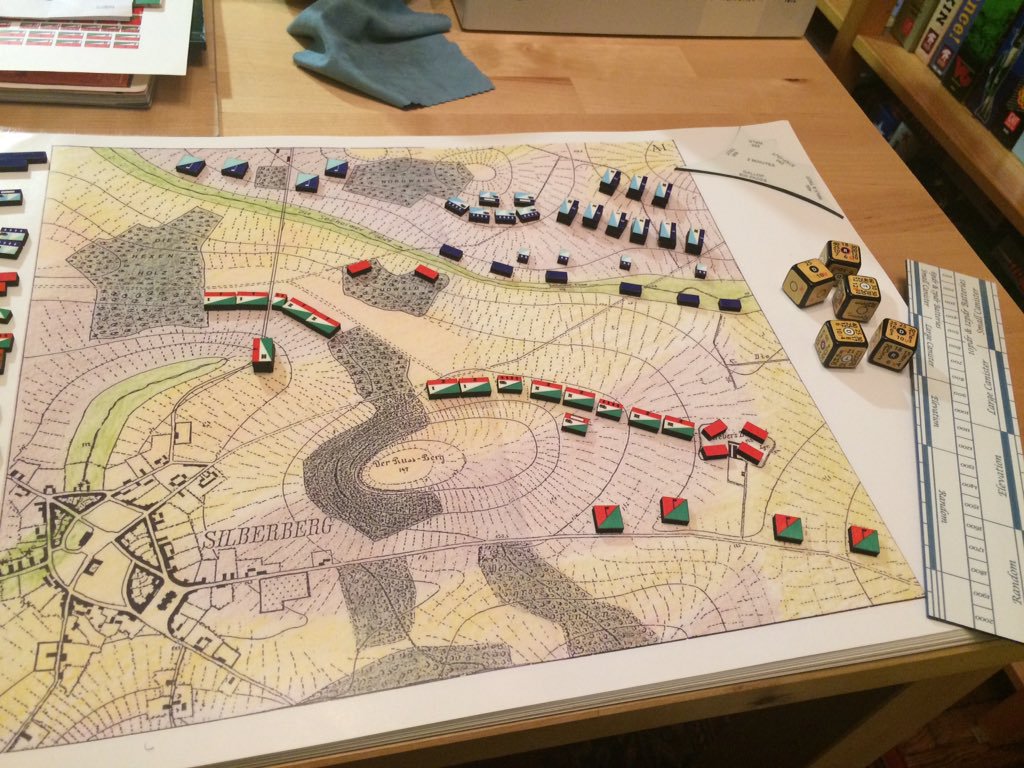
A computerized version of the Avalon Hill board wargame Squad Leader

A computer wargame is a wargame played on a digital device. Descended from board wargaming, it simulates military conflict at the tactical, operational or strategic level. Computer wargames are both sold commercially for recreational use and, in some cases, used for military purposes.

History

[edit]

Computer wargames derived from tabletop wargames, which range from military wargaming to recreational wargaming. Wargames appeared on computers as early as Empire in 1972. The wargaming community saw the possibilities of computer gaming early and made attempts to break into the market, notably Avalon Hill's Microcomputer Games line, which began in 1980 and covered a variety of topics, including adaptations of some of their wargames. In February 1980 Strategic Simulations, Inc. (SSI) was the first to sell a serious, professionally packaged computer wargame, Computer Bismarck, a turn-based game based on the last battle of the battleship Bismarck.[1][2]

Wargame designer Gary Grigsby joined the industry in 1982 with Guadalcanal Campaign, published by SSI.[3] It is cited as the first monster wargame developed for computers.[4][5][6] Grigsby became one of the most respected designers of computer wargames.[3] In 1997, he was described as "one of the founding fathers of strategy war games for the PC."[7] Computer Games Magazine later dubbed him "as much of an institution in his niche of computer gaming as Sid Meier, Will Wright, or John Carmack are in theirs."[8] By 1996 he had released 23 wargames with SSI,[9] including Steel Panthers, a commercial hit. In 2001, he co-founded the studio 2 by 3 Games with SSI's Joel Billings and Keith Brors, where they continued to work together on wargames.[10]

SSI and Strategic Studies Group (SSG) were computer game companies that continued the genre by specializing in games that borrowed from board and miniature wargames. The companies enjoyed a certain popularity throughout much of the 1980s and into the 1990s. TalonSoft started in 1995 with a similar focus, until purchased and later closed down by Take-Two Interactive in 2002. 021702102

Game design

[edit]

Computer wargames primarily focus on simulated battles. Because it is difficult to provide an intelligent way to delegate tasks to a subordinate, war games typically keep the number of units down to hundreds rather than hundreds of thousands.[11] The amount of realism varies between games as game designers balance an accurate simulation with playability.

Units are usually scaled to be disproportionately large compared to the landscape, in order to promote effective gameplay. These games usually use a much faster time line than reality, and thus wargames often do not model night time or sleep periods, though some games apply them, they can be time-consuming.[11]

Comparison with board wargames

[edit]

Tabletop wargames are usually categorized according to the scale of the confrontation (e.g., grand strategy wargame, strategic wargame, operational wargame, tactical wargame or man-to-man wargame). The qualifiers "real-time" and "turn-based" are not taken into account as all tabletop wargames are, by necessity, turn-based.

Notable computer wargames

[edit]

See also

[edit]

References

[edit]
Revisions and contributorsEdit on WikipediaRead on Wikipedia
from Grokipedia
A computer wargame is a digital simulation of operations involving opposing forces, employing rules, data, and procedures to model tactical, operational, or strategic aspects of warfare without using actual combatants. These simulations, which can range from analytical tools for professional training to entertainment-focused video games, allow participants to command units, make decisions, and observe outcomes in virtual conflicts, often emphasizing realism in tactics and . Originating from traditional board and miniature , computer wargames leverage computational power to automate complex calculations, enable multiplayer interactions, and visualize large-scale battles. The history of computer wargames traces back to the mid-20th century, with early military developments in the United States. The first known computerized wargame, the "Air Defense Simulation," was created in 1948 by the Army Operations Research Office at to model aerial threats and defenses using rudimentary algorithms. By 1953, the "Carmonette" series advanced this further, simulating ground combat scenarios on early computers to support tactical analysis and training. During the 1970s, networked simulations like the McClintic Theater Model at the Army War College introduced multiplayer elements, paving the way for collaborative strategic exercises. In the commercial realm, computer wargames emerged prominently in the late 1970s and 1980s as personal computing became accessible. Pioneering titles such as Tanktics (1978) by Chris Crawford introduced turn-based strategy mechanics for personal computers, marking an early shift toward consumer-oriented simulations. , Inc. (SSI) released Computer Bismarck in 1980, widely regarded as the first serious commercial computer wargame, which recreated the historical hunt for the using hex-grid maps and probabilistic combat resolution. This era saw rapid growth, with games like Eastern Front (1941) (1981) by simulating Eastern Front campaigns and competing directly with analog predecessors in depth and accessibility. Modern computer wargames blend military heritage with advanced technology, including (RTS) and turn-based strategy (TBS) formats. Titles such as StarCraft (1998) exemplify RTS wargames, where players manage resources and units in dynamic, competitive environments, influencing both and AI research for simulations. In professional contexts, tools like "DARWARS Ambush" (2000s) adapt commercial engines for immersive training, enhancing soldier readiness through and scenario-based learning. Overall, computer wargames continue to evolve, integrating , multiplayer networking, and high-fidelity graphics to explore warfare's complexities while fostering strategic thinking across civilian and military applications.

Definition and Scope

Core Definition

A computer wargame is a of digital simulation that models military conflict, , and operations through computational rules, , and procedures, without involving actual forces. These games typically depict armed conflict at tactical, operational, or strategic levels, utilizing digital mechanisms to adjudicate outcomes between opposing forces. Unlike broader games that may emphasize abstract or empire-building, computer wargames prioritize the realistic representation of warfare dynamics, including unit interactions and battlefield decision-making. Central to computer wargames are scenarios drawn from historical events, hypothetical situations, or fictional settings, where players engage in , unit control, and choices under conditions of and incomplete . This involves simulating elements such as troop movements, , and combat resolutions via algorithms that mimic real-world military complexities. The foundational purpose of computer wargames serves educational, recreational, or analytical ends, enabling exploration of warfare tactics and in a controlled environment. They facilitate learning about historical battles, testing strategic concepts, or providing entertainment through immersive conflict simulation. The term "wargame" originates from the early 19th-century Prussian "," a board-based exercise developed to teach officers tactics, which has since evolved into digital adaptations in computer formats.

Key Characteristics

Computer wargames emphasize realism by employing of outcomes through probabilistic models, which digitize traditional dice-roll simulations to replicate the uncertainties of . These models use random-number generators or dice equivalents to resolve engagements based on historical loss data and force ratios, such as favoring attackers at 3:1 odds while adjusting for variables like . This approach achieves higher fidelity, often nearing one percent accuracy in simulations compared to five percent in manual counterparts, by incorporating validated field tests and psychological factors. A defining trait is their capacity to manage complexity at large scales, utilizing algorithms to process vast numbers of units, terrain effects, and supply lines that would overwhelm analog systems. is modeled with movement costs and modifiers—such as doubled points for rough areas or defensive bonuses in mountains—while supply are abstracted through command points that limit activation and reconstitution of forces. Algorithms enable aggregation of units from squads to army groups across maps scaled from meters to hundreds of kilometers, balancing detailed mechanics like stacking limits and line-of-sight calculations without excessive player . Computational advantages stem from automation, particularly in implementing , where AI obscures enemy positions to simulate asymmetric information and uncertainty, using line-of-sight algorithms that account for distance, height, and obstructions like hills. AI opponents enhance solo play by managing multiple units with doctrine-driven routines, including random selection for unpredictability and for adaptive behaviors that mimic human decision-making across millions of simulated iterations. Dynamic campaigns leverage these features for evolving scenarios, allowing real-time adjustments, continuous action, and multi-player coordination via networked systems. Players assume command roles across echelons, from —overseeing national policies and theater-wide operations—to tactical levels involving squad maneuvers and immediate objectives like terrain capture. At operational scales, roles focus on coordinating battalions to divisions for regional campaigns, with asymmetric information enforced by to reflect real command hierarchies and incomplete intelligence. This spectrum allows simulation of diverse leadership perspectives, supported by hypertext interfaces for accessing detailed data without disrupting strategic flow.

Historical Development

Origins and Early Examples

The origins of computer wargames trace back to the , when U.S. military research institutions began integrating computers into to model complex warfare scenarios. The pioneered political-military wargames during this period, developing the "Cold War Games" series to explore nuclear deterrence and escalation dynamics. These simulations employed mathematical models for , such as quantifying population and capital losses from hypothetical H-bomb attacks (e.g., 30% population reduction in initial strikes), often processed via early computer systems like mainframes to handle numerical inputs for and combat outcomes. Concurrently, the Army's Operations Research Office (ORO) created Hutspiel in 1955, one of the earliest computer-based wargames, running on the analog Goodyear Electronic Differential Analyzer (GEDA). This theater-level adapted principles from traditional wargames like , allowing human players to input commands for conventional and atomic forces while the computer resolved battles and logistical movements in real-time, marking a shift from manual to automated adjudication. Such efforts began in the 1950s with models like CARMONETTE (1953), which simulated ground combat involving , armor, and air support, leveraging computers to reduce calculation times dramatically—from hours to seconds—thus enabling more intricate tactical explorations. In the 1970s, hobbyist programmers on university mainframes advanced these concepts into accessible games, fostering tactical simulations amid limited hardware. A landmark was Empire on the PLATO system, released in 1973 by John Daleske, which supported up to 30 players in real-time multiplayer space combat, blending strategy, resource management, and team alliances in a networked environment. Key pioneers emerged toward the decade's end, including Chris Crawford, who developed Tanktics in 1978—a turn-based armored warfare game for the Apple II that computerized board wargame mechanics like unit movement and terrain effects. That same year, Joel Billings founded Strategic Simulations, Inc. (SSI) in 1979, debuting with Computer Bismarck, which digitized naval pursuit simulations using algorithmic combat resolution. These efforts were shaped by technological constraints, including mainframe access via terminals, text-based interfaces for output, and minimal memory (e.g., 16K RAM), which prioritized abstract, rule-driven mechanics over graphics to fit within processing limits.

Expansion in the Personal Computing Era

The advent of affordable personal computers in the 1980s, such as the Apple II and Commodore 64, significantly expanded access to computer wargames, shifting them from mainframe exclusivity to home use. Strategic Simulations, Inc. (SSI), founded in 1979, capitalized on this by releasing its debut title, Computer Bismarck, in 1980 exclusively for the Apple II, simulating naval combat during World War II and establishing SSI as a pioneer in the genre. Designer Gary Grigsby contributed to the surge with Guadalcanal Campaign in 1982, an SSI release for the Apple II that introduced complex operational simulations of Pacific theater battles, appealing to enthusiasts seeking depth beyond simple arcade titles. Meanwhile, board game publisher Avalon Hill entered the digital space in 1980, developing computer adaptations of its analog wargames for platforms like the Apple II and TRS-80, which broadened the audience through familiar mechanics on accessible hardware. By the , the proliferation of technology enabled greater diversification in computer wargames, incorporating elements like enhanced graphics, sound effects, and video cutscenes to immerse players in historical contexts. This era saw a blend of traditional turn-based strategy with innovative features, exemplified by ' Close Combat series, which debuted in 1996 for Windows and Macintosh, focusing on at the squad level during campaign battles and emphasizing realistic morale and fog-of-war mechanics. Publishers like SSI continued to innovate, releasing titles that leveraged capacity for larger maps and more detailed unit animations, attracting both longtime wargamers and newcomers drawn to the richer sensory experience. Despite these advancements, computer wargames maintained a niche appeal amid the rise of mainstream genres like first-person shooters and games, sustaining a dedicated but limited audience through specialized publishers. SSI's Panzer General (1994) exemplified this market dynamic, selling over 250,000 copies by blending accessible hex-based strategy with themes, though such figures paled against blockbuster hits and highlighted the genre's steady rather than explosive growth. The overall market for computer wargames remained modest, with sales driven by hobbyist communities rather than broad commercial appeal, ensuring longevity for titles that prioritized fidelity over mass . Community involvement further extended the lifespan of these games through early and fan-created scenarios, particularly in the late and , as players modified code and designed custom battles to explore alternate histories or new theaters. SSI's (1995), a spanning multiple eras, became a hub for this activity, with fans producing thousands of additional scenarios via simple editing tools, fostering ongoing engagement and influencing subsequent design trends in the genre. This creativity not only preserved older titles but also built a collaborative culture that compensated for the niche market's constraints.

Contemporary Evolution

The 2000s and 2010s saw computer wargames evolve with advancements in graphics, AI, and online multiplayer, blending military simulations with broader strategy gaming. titles like series and franchise expanded tactical depth with large-scale battles and historical accuracy, while turn-based games from , such as (2000) and (2004), emphasized geopolitical and logistical complexity. Military training tools advanced with integrations, exemplified by DARWARS Ambush (2004), which used commercial game engines for immersive counter-insurgency scenarios. By the 2020s, the genre faced challenges including declining sales due to high complexity deterring casual players, yet independent developers sustained innovation through and digital distribution. Examples include Scourge of War: Gettysburg (2017) by Norb Development, supported by Matrix Games, offering detailed Civil War simulations, and emerging VR titles like Zero Caliber VR (2019) for tactical shooters. expanded via acquisitions, such as (2017) for Age of Wonders series and (2020) for , enhancing hybrid strategy-wargame offerings. As of 2025, the industry balances accessibility improvements with deep simulations, incorporating AI for dynamic scenarios amid ongoing military and applications.

Design Principles

Simulation Mechanics

Computer wargames employ core algorithms to model unit movement across maps, often using hexagonal (hex) grids or point-based systems to approximate real-world and distances. Hex grids divide the battlefield into equilateral hexagonal cells, allowing for more uniform movement in six directions compared to square grids, which can distort diagonal paths. Each hex typically represents a fixed scale, such as 1-5 kilometers in operational games, with movement points (MP) allocated to units based on type and ; for instance, might expend 1 MP in clear but 4 MP in forests, while roads reduce costs to 0.5 MP per hex. Point-based systems, alternatively, use vector calculations for free movement without grids, though hex grids remain prevalent in turn-based titles for simplifying and . Line-of-sight (LOS) calculations determine and firing ranges by tracing unobstructed paths between units, accounting for , obstacles, and . In hex-based systems, LOS is computed by checking intervening hexes for blocking features like hills or forests, often using ray-casting algorithms that sample points along the line at regular intervals (e.g., every 10 meters) to compare heights against unit eye levels. Probabilistic adjustments may apply for partial obstructions, such as a 50% visibility reduction in light woods. These computations enable realistic fog-of-war mechanics, where units beyond LOS remain hidden until scouted. Combat resolution relies on detailed probabilistic models to simulate outcomes, incorporating factors like unit strength, range, and modifiers. A common approach uses results tables (CRTs) modified by pseudo-random rolls to determine hits, where probabilities are adjusted by attacker and defender strengths, modifiers (e.g., for flanking), and . If the roll succeeds, is assessed via lookup tables for kill probabilities (SSPK), often drawn from empirical data like 0.3 upon hit in small-arms , with additional wounding outcomes. Advanced models, such as those in high-resolution simulations, employ bivariate normal distributions for accuracy: Phit=1eR22σ2P_{hit} = 1 - e^{-\frac{R^2}{2\sigma^2}}, where RR is target area and σ\sigma is dispersion at range. Resource and simulations track supply chains to influence unit effectiveness, modeling decay rates for , , and over time and distance. Supply lines connect depots to fronts, with consumption rates (e.g., 1 ton per day per division) leading to attrition if disrupted; out-of-supply units suffer reduced combat factors (e.g., -2 MP and halved attack strength). Decay mechanics apply exponential degradation, compounded by operational tempo. factors integrate as multipliers on performance, dropping unit initiative below adequate supply levels, forcing conservative tactics. Randomness is integrated via pseudo-random number generators (PRNGs) to mimic rolls, ensuring replayability and in outcomes like hits or event triggers. Linear congruential generators, common in early systems, produce sequences via Xn+1=(aXn+c)modmX_{n+1} = (a X_n + c) \mod m, seeded by for variability; modern implementations use for better distribution in large-scale battles. This replaces physical in CRT resolutions, where a generated value (0-1) compared against PhitP_{hit} determines success, preserving historical fog-of-war without predictability.

Strategic and Tactical Elements

Computer wargames incorporate a strategic layer focused on long-term planning, where players manage campaign objectives, build , and oversee economic resources to shape overarching conflict outcomes. Campaign objectives typically involve achieving broad military or political goals, such as securing key territories or disrupting enemy supply lines, often modeled through multi-phase scenarios that simulate extended operations. Alliance building emphasizes dynamics, requiring players to negotiate with simulated or human-controlled factions to coordinate joint forces and share , as seen in games like the Navy Global Games series, which test interagency and international in scenarios. Economic management entails allocating limited resources—such as budgets for unit production or chains—to sustain forces over time, influencing decisions like trade-offs in simulations like the Office of Naval Intelligence's SimBAT, where players balance air and sea asset investments against fiscal constraints. These elements encourage players to weigh opportunity costs and adapt to evolving threats, fostering a conceptual understanding of how macroeconomic factors underpin military success. The tactical layer complements this by emphasizing short-term maneuvers, including flanking attacks, ambushes, and precise unit positioning during engagements. Flanking involves positioning units to attack from vulnerable sides, often rewarded through modifiers that increase hit probabilities, as in Drive on Metz, where American forces exploit to encircle German regiments. Ambushes simulate surprise assaults by hiding units in obscured until optimal moments, altering battle dynamics through initiative bonuses or disruption effects on enemy morale. Unit positioning draws on grid-based systems, such as hexagonal maps, where effects charts adjust movement and defense values—for instance, forests providing cover that shifts odds favorably for defenders. These mechanics demand real-time or turn-based assessment of local conditions, promoting tactical innovation like coordination between infantry and armor to breach defensive lines. Fog of war and intelligence mechanics introduce uncertainty to both layers, compelling players to rely on and navigate potential . obscures enemy positions and intentions, typically implemented by revealing only areas within a unit's or sensor range, which forces strategic guesses about opponent campaigns and tactical adjustments based on incomplete data. units or actions, such as patrols in the Advanced Framework for Simulation, Integration, and Modeling (AFSIM), gather partial intel through probabilistic sensors that account for errors like range deviations up to 20 meters, enabling players to pierce the fog incrementally. arises from simulated communication delays or sensor noise, such as azimuth errors reducing engagement success rates by 2.5-3%, which can mislead players into erroneous flanking attempts or commitments. This layer heightens decision-making tension, as partial knowledge influences choices like committing reserves prematurely in tactical battles or reallocating economic resources amid uncertain threats. Victory conditions in computer wargames are multifaceted, often combining territorial control, mission completion, and narrative branching to evaluate player performance across scales. Territorial control might award points for holding objectives like cities or supply nodes, as in Drive on Metz, where capturing yields 20 points while exiting units off-map provides defensive bonuses. Mission completion focuses on discrete goals, such as destroying 50% of enemy forces in scenarios like TACWAR, tying tactical maneuvers directly to strategic success. Branching narratives emerge from cumulative decisions, where unmet economic thresholds or failed alliances trigger alternate paths, such as stalemates in simulations that assess equilibria based on public mood and resource equilibrium. These conditions, calculated dynamically via algorithms, ensure victories reflect balanced strategic foresight and tactical execution, with levels ranging from marginal to decisive based on point thresholds.
ElementDescriptionExample Impact on Play
Strategic LayerLong-term resource and alliance decisionsPlayers in SimBAT trade off naval assets for budget efficiency, altering campaign trajectories.
Tactical LayerImmediate positioning and attacksFlanking in Desert War uses terrain to double attack factors against exposed units.
Fog of WarLimited visibility and intel errorsAFSIM's sensor noise causes 125km positioning errors, forcing reconnaissance prioritization.
Victory ConditionsMulti-objective scoringBattle for Germany awards control points across competing factions, enabling draws or upsets.

Technical Implementation

Computer wargames have evolved significantly in their graphical rendering techniques, transitioning from simple 2D sprites and isometric views in early titles to sophisticated 3D engines that enable immersive battlefields and dynamic environments. In the , the shift from 2D to 3D revolutionized visual representation, allowing for depth, perspective, and realistic modeling essential for simulating maneuvers. This evolution was driven by hardware advancements like dedicated graphics cards, enabling developers to render complex scenes with polygons and textures rather than flat sprites. Modern computer wargames frequently employ versatile 3D engines such as Unity or to handle large-scale battles, procedural generation, and particle effects for explosions and weather, enhancing tactical visualization on consumer hardware. Pathfinding algorithms are crucial for unit movement in wargames, particularly on grid-based or hexagonal maps that mimic real-world . The A* algorithm, which combines actual path costs with estimates to find optimal routes, is widely implemented for efficient navigation around obstacles and allies. In hexagonal tactical wargames, A* has been adapted with cost models based on historical data to prioritize safer, maneuver-focused paths for combat units, reducing computational overhead while improving realism in simulations. AI design in computer wargames often relies on finite state machines (FSMs) to govern enemy behavior, where units transition between states like patrol, attack, or retreat based on triggers such as player proximity or availability. FSMs provide a structured, predictable framework for decision-making, avoiding the complexity of more advanced AI while ensuring responsive opponents in strategic scenarios. Scripting techniques, such as dynamic scripting, further enhance AI by adapting difficulty in real-time; these methods learn from player performance to adjust opponent tactics, selecting scripts that balance challenge and engagement without predefined difficulty levels. Multiplayer networking poses unique challenges in wargames, with real-time variants requiring robust latency handling to maintain command execution. Techniques like —where actions are simulated locally before server confirmation—and for smoothing unit movements mitigate delays, ensuring synchronized views despite network variability up to several hundred milliseconds. In turn-based online wargames, synchronization protocols emphasize authoritative servers that validate moves and broadcast state updates after each turn, using reliable TCP connections to prevent desynchronization from . Optimization remains a core challenge for large-scale simulations, where simulating thousands of units, environmental interactions, and probabilistic outcomes strains consumer hardware. Developers balance computational loads through techniques like level-of-detail rendering, which simplifies distant units, and parallel processing for AI calculations, allowing expansive battles without prohibitive frame drops. In next-generation systems, integrating intelligent modeling and addresses , enabling networked wargames to handle complex, real-time scenarios while maintaining performance.

Comparisons to Analog Wargames

Board Wargames

Board wargames, a foundational form of analog , utilize printed hexagonal grids to represent , allowing for standardized movement and positioning of units depicted as cardboard counters. These counters encode essential attributes such as strength, movement allowance, and , while outcomes of engagements are determined manually via results tables cross-referenced with dice rolls to introduce probabilistic elements reflecting uncertainty in warfare. A seminal example is Avalon Hill's D-Day (1961), which simulates the invasion and subsequent European campaign through such mechanics, marking an early milestone in hex-and-counter design. In contrast, computer wargames adapt these principles by automating the adjudication of movement, combat, and supply calculations, enabling scenarios of vastly greater scale and complexity than manual play could feasibly support, such as grand strategic campaigns spanning entire theaters of war. This automation eliminates the need for physical charts and dice, streamlining resolution but sacrificing the tactile feedback of manipulating counters on a physical , which can enhance spatial and player immersion in analog formats. Consequently, computer implementations often prioritize algorithmic precision over the interpretive flexibility inherent in rulings. Hybrid evolutions bridge these formats through digital ports that faithfully replicate board wargame rulesets while integrating computational enhancements like artificial intelligence for opponents. For instance, the 2000 video game Avalon Hill's Squad Leader, developed by Random Games and published by MicroProse, digitizes the tactical infantry combat of the original 1977 board game, preserving its scenario-based structure and line-of-sight mechanics but adding AI-driven foes to facilitate solo play. Similarly, tools like VASSAL provide modular software for online play of board wargames, including Squad Leader, maintaining core rules without altering physical components when used in hybrid setups. Computer wargames offer advantages in speed and accessibility, permitting rapid iteration through turns and enabling play against non-human opponents without requiring multiple participants, which expands solo engagement beyond the limitations of board setups. However, board wargames retain strengths in , as physical play encourages face-to-face , shared , and the sensory appeal of handling components, fostering deeper interpersonal connections absent in digital solitary experiences. These trade-offs highlight how computer adaptations enhance efficiency but may dilute the communal and kinesthetic essence of their analog predecessors.

Tabletop Miniatures

Tabletop miniatures wargames utilize three-dimensional figurines to represent troops, vehicles, and creatures, positioned on a physical board with custom-built to simulate battlefields. These games employ detailed rulesets to govern , movement, and interactions, with Warhammer Fantasy Battle serving as a seminal example since its first edition release in 1983 by , which blended historical wargaming principles with fantasy elements. Line-of-sight in these analog systems is assessed manually, typically by players aligning their eye at the figurine's base height to determine visibility over or around obstacles, often requiring tools like strings or lasers for precision and fostering interpretive disputes during play. The transition to computer wargames digitizes these physical elements, creating immersive 3D environments where and unit positions are rendered dynamically, allowing for fluid interactions like flying units navigating complex landscapes. Games such as the : Warhammer series adapt the 's fantasy setting by automating line-of-sight calculations through ray-tracing algorithms and instant distance measurements, eliminating manual verification and drastically cutting setup time from hours of terrain assembly to mere seconds of loading a . This automation enables larger-scale battles with thousands of units, contrasting the spatial constraints of a typical 4x6-foot . Both formats share foundational mechanics, including unit statistics that define attributes like attack strength, defense, and speed, as well as systems where units may under heavy casualties or failures. However, customization diverges significantly: tabletop players engage in hands-on assembly and painting of miniatures to personalize armies, enhancing visual appeal and ownership through artistic expression. In digital counterparts, players modify assets via community tools, such as the Asset Editor in , to create custom models, textures, and unit variants without physical materials. Community engagement highlights further contrasts in social dynamics. Tabletop miniatures foster in-person gatherings, with organized tournaments at venues like Warhammer World offering competitive play, painting contests, and awards for across scales from 1,000-point skirmishes to full army clashes. Conversely, computer wargames emphasize online formats, exemplified by community-led events like the : Warhammer World Championships (2022), where players compete in matches streamed globally, prioritizing rapid execution and digital leaderboard rankings over physical model presentation.

Subgenres and Variations

Turn-Based vs. Real-Time

Computer wargames are broadly divided into turn-based and real-time formats based on their pacing mechanics, which determine how players interact with the over time. In turn-based systems, proceeds in sequential phases where players alternate issuing commands, allowing for deliberate planning and execution without concurrent actions from opponents. This structure typically involves discrete units of time, such as turns representing hours or days, during which units move, engage, or reposition on a grid or , enabling players to analyze outcomes and adjust strategies methodically. Real-time wargames, by contrast, feature continuous action where all elements unfold simultaneously, often with options to pause for command input, emphasizing immediate and fluid tactical responses. Players must manage resources, units, and battles in an ongoing flow, simulating the unrelenting pace of conflict without artificial breaks, which can incorporate elements like or dynamic environments that evolve independently of player turns. This approach draws from action-oriented genres but retains strategic depth through layered command hierarchies and automation tools. The trade-offs between these mechanics highlight distinct design philosophies: turn-based formats prioritize and analytical precision, as players have unrestricted time for evaluation, fostering complex simulations of and long-term planning, though they may feel methodical or less immersive for some. Real-time systems introduce tension through timing and multitasking, enhancing realism in chaotic scenarios and appealing to reflexes alongside intellect, but they risk overwhelming players with or reducing opportunities for nuanced foresight. Hybrids, such as real-time modes with pause functions, attempt to balance these by blending uninterrupted flow with intermittent reflection. Historically, turn-based mechanics dominated early computer wargames due to hardware constraints in the and , where limited processing power necessitated pauses for calculations, mirroring the sequential nature of analog predecessors and allowing single-player or hot-seat multiplayer without real-time synchronization challenges. The shift toward real-time formats accelerated in the early with advancements in CPU speed and , enabling smoother simulations of simultaneous events and broader accessibility, though turn-based designs persisted for their computational efficiency and focus on cerebral engagement.

Strategic vs. Tactical Focus

Computer wargames are often distinguished by their scope of command, with strategic titles emphasizing macro-level decision-making that encompasses broad national or theater-wide objectives. These games simulate high-level elements such as empire management, resource allocation, industrial production, and diplomatic maneuvers to influence the overall course of conflicts. For instance, the series places players in the role of national leaders during , requiring oversight of economies, alliances, and large-scale military deployments across continents. In contrast, tactical wargames zoom in on micro-level engagements, focusing on the precise control of individual units, squads, or vehicles in immediate battlefield scenarios. Players issue detailed orders for maneuvers, positioning, and combat tactics, often at the or level, to achieve localized goals like capturing objectives or repelling assaults. The series exemplifies this approach, simulating squad-level infantry and armored actions with realistic line-of-sight, morale, and suppression mechanics in historical or hypothetical battles. Many computer wargames bridge these scopes through campaign modes that integrate tactical battles into larger strategic frameworks, allowing outcomes from ground-level fights to affect overarching maps and resource pools. This linkage enables players to experience how small-unit victories or defeats ripple upward, influencing supply lines, reinforcements, or even war-ending decisions in extended scenarios. From a perspective, strategic prioritize abstraction to manage vast scales and complex interactions, simplifying unit behaviors and probabilistic outcomes to maintain playability despite incomplete real-world data on high-level processes. Tactical games, however, demand granular control and detailed simulations to capture the nuances of , trading broader scope for depth in individual engagements. This reflects inherent challenges in modeling less predictable strategic dynamics compared to more observable tactical ones.

Hybrid and Emerging Forms

Hybrid forms of computer wargames integrate elements from multiple traditional subgenres, particularly blending grand with operational and tactical execution to simulate complex military campaigns. These hybrids, often categorized as operational-level wargames, emphasize the coordination of forces across theaters while incorporating detailed unit maneuvers and logistical challenges, allowing players to manage supply lines, weather impacts, and in a unified framework. A representative example is seen in games that model division-level movements during historical campaigns, where strategic decisions influence tactical outcomes, such as encircling enemy positions to disrupt reinforcements. This approach fosters where high-level objectives, like securing a front, require precise tactical interventions, distinguishing hybrids from purely strategic or tactical simulations. Emerging forms leverage advanced technologies to expand replayability and immersion beyond conventional designs. creates dynamic scenarios by algorithmically producing maps, unit deployments, and event chains, enabling infinite variations of battles without predefined scripts, which enhances in simulations of uncertain warfare. (VR) introduces first-person command perspectives, allowing users to immerse themselves in battlefield oversight, such as piloting vessels in mixed-reality environments or visualizing troop movements in 3D spaces. In military applications, VR wargames facilitate realistic by simulating joint operations, where participants experience and under simulated stress, improving tactical proficiency without physical risk. As of 2025, integration has advanced emerging forms, with large language models used to generate detailed, realistic scenarios in professional wargames, drawing from historical data to simulate open-ended conflicts and support in uncertain environments. Niche variants include asymmetric multiplayer modes, where one player commands human forces against AI-controlled teams representing adversaries, introducing imbalances like resource disparities or to model . Narrative-driven wargames incorporate storytelling elements, using branching scenarios and character arcs to contextualize strategic choices, thereby emphasizing and dilemmas alongside mechanics. Looking to the future, integration with platforms holds potential for collaborative simulations, enabling distributed players to engage in shared virtual battlefields for real-time wargaming across global networks. This could support multi-domain exercises, combining elements to refine doctrines in interconnected environments.

Notable Examples

Pioneering Titles

One of the earliest computer wargames, , developed by and first released in 1977 for the mainframe, pioneered multiplayer tactics in a turn-based of global conflict between two to eight players controlling empires through economic, diplomatic, and military means. The game's state allowed ongoing campaigns where territorial conquests and carried over turns, influencing later strategic depth in the genre. In 1981, Strategic Simulations, Inc. (SSI) published Gary Grigsby's Battle of Shiloh, a detailed turn-based of the battle, emphasizing historical accuracy through rated divisions for experience, strength, fatigue, and morale based on real events. Grigsby's design introduced complex AI for opponent decision-making, simulating Union and Confederate command challenges in a hex-grid , which set standards for operational-level realism in early 1980s wargames. The 1990s saw SSI's Panzer General (1994) popularize accessible hex-based strategy, blending tactical combat with persistent campaigns where player units gained experience, promotions, and upgrades across linked scenarios simulating from the Axis perspective. It achieved critical acclaim for its intuitive interface and replayability, becoming SSI's best-selling title with over 250,000 full-price units sold and spawning a series that broadened the genre's appeal beyond hardcore enthusiasts. Similarly, (1995), also from SSI and designed by and Keith Brors, advanced modular scenarios via an integrated editor that allowed players to create and share custom battles from 1939 to 1999, fostering community-driven content. The game's AI demonstrated notable depth for the era, adapting to terrain, unit types, and player tactics in real-time calculations during turns, while campaigns featured branching outcomes based on victory conditions. SSI's legacy as a pioneering developer stemmed from adapting traditional board wargame principles—such as hex grids, unit ratings, and scenario-based play—into digital formats without direct licensing, dominating the computer wargame market from the late through the with over 100 titles that emphasized fidelity.

Influential Modern Games

In the and , several computer wargames elevated the genre through innovative mechanics that bridged strategic planning with immersive real-time combat. Rome: Total War (2004), developed by , pioneered the integration of turn-based empire management with large-scale real-time battles, allowing players to command Roman legions in historical campaigns across and , and set a benchmark for historical accuracy in strategy titles. Company of Heroes (2006), created by , advanced (RTS) wargames by incorporating tactical depth such as destructible environments, line-of-sight mechanics, and unit-specific abilities in scenarios, earning critical acclaim for its focus on squad-based infantry and vehicle combat. Entering the 2020s, titles like (2020) from redefined dynastic by emphasizing elements within medieval , where players manage family lineages, alliances, and intrigue over centuries, achieving over 4 million sales and a peak concurrent player count of 98,872 on . Similarly, (2019), developed by Black Matter, innovated large-scale multiplayer wargaming with 100-player matches simulating fronts, featuring a dynamically shifting frontline, warfare, and roles like commanders coordinating and tanks, sustaining an average of around 4,000 concurrent players as of 2025. These games introduced key innovations that enhanced replayability and depth. Paradox's event scripting system in uses modular, condition-based code to generate emergent narratives, such as personalized dynasty events triggered by character traits or historical dates, allowing for thousands of procedurally varied scenarios without hardcoded repetition. In Hell Let Loose, multiplayer persistence maintains player progression across sessions, including squad leadership unlocks and statistic tracking, fostering long-term community engagement in objective-based matches that evolve over hours. Their cultural reach extended beyond PC, with adaptations to consoles broadening accessibility; for instance, launched on and Series X/S in 2022, while followed suit in 2021, enabling controller-optimized controls for tactical maneuvering. Integration into has also grown, particularly for 's competitive multiplayer modes, with organized tournaments highlighting team coordination in historical battles, drawing from the military's interest in for and simulations.

Cultural and Industry Influence

Impact on Broader Gaming

Computer wargames have profoundly shaped the genre through the cross-pollination of core mechanics, particularly , territorial expansion, and conquest simulations. Early titles like Empire: The Wargame of the Century (1987) introduced digital adaptations of principles, such as and unit-based combat, which directly informed the design of Sid Meier's Civilization (1991). This seminal game, which has sold more than 1.5 million copies, integrated these elements into a broader framework of exploration, expansion, exploitation, and extermination, establishing a blueprint for subsequent strategy titles that emphasized long-term empire-building and historical progression. Academic analyses highlight how wargame-derived mechanics, including technology trees originating from board games like Civilization (1980), evolved into staples, enabling players to navigate eras from antiquity to while managing resources like production and research. Design philosophies from computer , with their focus on and , have extended beyond the genre to influence open-world and sandbox titles, promoting emergent narratives and player-driven content. Series like , known for procedural campaign maps and randomized battles, achieve high by varying outcomes across playthroughs, a principle that has inspired open-world games to incorporate dynamic systems for prolonged engagement. communities in wargames, such as those for Total War: Rome II, have revitalized titles years after release by adding new factions, units, and scenarios, demonstrating how user-generated extensions enhance longevity and creativity—a model adopted industry-wide to foster community involvement and reduce development costs for expansions. This approach underscores wargames' role in normalizing as a core feature, with studies showing mods significantly boost through customized challenges and content. Culturally, computer wargames have popularized historical education in gaming by embedding simulated events and figures into interactive narratives, influencing how players perceive and discuss the past. Civilization series entries, for instance, cultivate esoteric knowledge of eras like or ancient civilizations, blending entertainment with factual elements to spark interest, though often prioritizing strategic fun over precision. These games have earned prestigious awards, including multiple BAFTA nominations for strategy innovation, alongside extensive media coverage in outlets like for their role in discourse. Such milestones have elevated wargames' visibility, encouraging broader adoption of historical themes in mainstream titles. Economically, the computer wargame subsector, embedded within the strategy games market valued at $15.23 billion in 2023 and projected to reach $37.68 billion by 2031, sustains innovation through niche appeal and loyal communities. This dedicated segment supports developers like and , funding iterative improvements and expansions that ripple into adjacent genres, ensuring wargames remain a viable driver of industry experimentation despite their specialized focus.

Military and Educational Uses

Computer wargames have been adapted for military training through advanced simulations that replicate tactical scenarios, enabling personnel to practice decision-making without real-world risks. The Janus simulation, developed in the 1980s by Lawrence Livermore National Laboratory, serves as a two-sided, interactive conflict model used for tactical training exercises, allowing multiple sides to engage in simulated battles with up to six participants and alliance options. Similarly, Virtual Battlespace (VBS), a 3D virtual environment from Bohemia Interactive Simulations, supports real-world scenario rehearsals for armed forces, including the U.S. Army, by providing immersive, geospecific training platforms for mission planning and force-on-force exercises. In educational settings, computer wargames facilitate the teaching of and strategic analysis by immersing students in complex historical and policy simulations. For instance, university courses at institutions like employ wargaming tools to explore strategic decision-making, drawing on to analyze and conflict dynamics. At Middlebury Institute, war games simulate geopolitical crises, allowing graduate students to apply theoretical knowledge to practical scenarios involving , , and . The application of computer wargames in military and educational contexts raises ethical concerns regarding the gamification of war, which can normalize violence and oversimplify moral complexities in conflict. Scholars argue that depicting war through game mechanics risks desensitizing users to real ethical dilemmas, such as civilian casualties and just war principles, potentially influencing public and military perceptions of warfare. Additionally, dual-use technologies from commercial wargames, including AI algorithms for strategic planning seen in titles like , have been adapted for military simulations, blurring lines between entertainment and defense applications while prompting debates on accountability and bias in automated decision systems. A prominent case study is the U.S. Army's , released in 2002 as a free that doubled as a and basic tool, exposing civilians to roles and procedures through virtual missions. The game, developed by the Army, reached millions of players and was credited with enhancing enlistment efforts by providing an interactive preview of service life, while also serving as a low-cost platform for skills like and weapons handling.

References

Add your contribution
Related Hubs
User Avatar
No comments yet.