Hubbry Logo
Saraland, AlabamaSaraland, AlabamaMain
Open search
Saraland, Alabama
Community hub
Saraland, Alabama
logo
8 pages, 0 posts
0 subscribers
Be the first to start a discussion here.
Saraland, Alabama
Saraland, Alabama
from Wikipedia

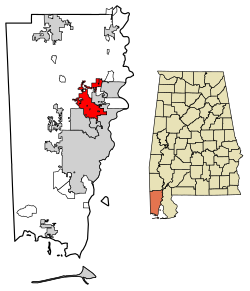
Saraland is a city in Mobile County, Alabama, United States, and a suburb of Mobile. As of the 2020 census, the population of the city was 16,171,[2] up from 13,405 at the 2010 census. Saraland, part of the Mobile metropolitan area, is the third largest city in Mobile County.

Key Information

Geography

[edit]

Saraland is located at 30°49′31″N 88°5′31″W / 30.82528°N 88.09194°W / 30.82528; -88.09194 (30.825186, -88.091932).[3] It is bordered to the southwest by the city of Prichard, to the south by Chickasaw, to the east by the undeveloped northern end of Mobile, and to the northeast by Satsuma and Creola.

U.S. Route 43 (Saraland Boulevard) and Interstate 65 are the main north–south routes through Saraland. U.S. 43 leads south 9 miles (14 km) to downtown Mobile and north 55 miles (89 km) to Jackson, while I-65 leads south 15 miles (24 km) to its terminus at Interstate 10 in southwestern Mobile, and northeast 157 miles (253 km) to Montgomery, the state capital.

According to the U.S. Census Bureau, Saraland has a total area of 32.4 square miles (84 km2), of which 0.32 square miles (0.83 km2), or 0.68%, are water.[1] The city is drained by Bayou Sara, an east-flowing tributary of the Mobile River.

History

[edit]

The land area that was to become the present-day Saraland was included in a Spanish land grant to Don Diego Alvarez. Hence, descendants of Alvarez were the ones to give the community its first name: Alvarez Station. Later land squatters moved into the area and were able, legally, in 1800 to begin purchasing property. In 1807, a land office was opened in St. Stephens to handle all land transactions. Some of the pioneer families who seized the opportunity to buy up sections were named Alvarez, Rice, Hartley, Moore, LaCoste, Williams, Tool and Cleveland. Eventually, Alvarez Station was called Cleveland Station. The present name of the city is reported to have been given by C.J. DeWitt, a retired minister editor who moved south in 1890 for health reasons. He opened the first post office on the Southern Railroad in 1895. The community is purported to be the namesake of his beloved wife, Sara.

Saraland was sparsely populated during the first part of the 20th century, until an industrial and population boom occurred in neighboring Mobile. Northward expansion of Mobile in the 1940s and 50s brought about the incorporation of Saraland in 1957. At the time of incorporation, the city reported only 125 residents. By the 1960 U.S. Census, annexations had swelled the population to 4,595. In 1980, census figures cited 9,844 Saraland residents. As of the 2020 census, Saraland's population had grown to 16,171.[2]

The worst rail disaster in the history of Amtrak occurred just east of Saraland on Big Bayou Canot on September 22, 1993. At approximately 2:53 AM, Amtrak's Sunset Limited train, powered by three locomotives, and en route from Los Angeles to Miami with 220 passengers and crew aboard, crossed the Bayou Canot bridge at high speed and derailed at a kink in the track caused by a barge captain who rammed the bridge by making a wrong turn in the waterway and failed to report the accident. 47 people, of whom 42 were passengers, were killed, many by drowning, others by fire. Much of the rescue efforts were average citizens of the community who journeyed out in the early morning hours in small fishing boats to help at the scene.

Demographics

[edit]
Historical population
CensusPop.Note
19604,595
19707,84070.6%
19809,83325.4%
199011,75119.5%
200012,2884.6%
201013,4059.1%
202016,17120.6%
U.S. Decennial Census[4]

2000 census

[edit]

At the 2000 census there were 12,288 people in 4,810 households, including 3,602 families, in the city. The population density was 560.9 inhabitants per square mile (216.6/km2). There were 5,138 housing units at an average density of 234.5 per square mile (90.5/km2). The racial makeup of the city was 88.50% White, 8.97% Black or African American, 0.56% Native American, 0.46% Asian, 0.01% Pacific Islander, 0.37% from other races, and 1.13% from two or more races. 1.17% of the population were Hispanic or Latino of any race.[5]

Of the 4,810 households 31.8% had children under the age of 18 living with them, 61.0% were married couples living together, 10.5% had a female householder with no husband present, and 25.1% were non-families. 21.2% of households were one person and 8.1% were one person aged 65 or older. The average household size was 2.55 and the average family size was 2.97.

The age distribution was 23.4% under the age of 18, 9.4% from 18 to 24, 29.3% from 25 to 44, 24.4% from 45 to 64, and 13.5% 65 or older. The median age was 37 years. For every 100 females, there were 95.4 males. For every 100 females age 18 and over, there were 92.2 males.

The median household income was $38,318 and the median family income was $43,471. Males had a median income of $35,431 versus $22,787 for females. The per capita income for the city was $19,470. About 7.4% of families and 9.0% of the population were below the poverty line, including 12.2% of those under age 18 and 8.9% of those age 65 or over.

2010 census

[edit]

At the 2010 census there were 13,405 people in 5,208 households, including 3,757 families, in the city. The population density was 558.5 inhabitants per square mile (215.6/km2). There were 5,828 housing units at an average density of 266.1 per square mile (102.7/km2). The racial makeup of the city was 83.7% White, 12.0% Black or African American, 0.8% Native American, 0.6% Asian, 0.1% Pacific Islander, 1.5% from other races, and 1.4% from two or more races. 2.5% of the population were Hispanic or Latino of any race.[6]

Of the 5,208 households 27.9% had children under the age of 18 living with them, 54.4% were married couples living together, 13.4% had a female householder with no husband present, and 27.9% were non-families. 22.8% of households were one person and 10.0% were one person aged 65 or older. The average household size was 2.57 and the average family size was 2.01.

The age distribution was 22.9% under the age of 18, 8.0% from 18 to 24, 25.8% from 25 to 44, 27.5% from 45 to 64, and 15.8% 65 or older. The median age was 40 years. For every 100 females, there were 97.7 males. For every 100 females age 18 and over, there were 101.9 males.

The median household income was $48,721 and the median family income was $54,845. Males had a median income of $44,201 versus $31,235 for females. The per capita income for the city was $22,192. About 8.8% of families and 14.9% of the population were below the poverty line, including 28.3% of those under age 18 and 7.0% of those age 65 or over.

2020 census

[edit]
Saraland racial composition[7]
Race Num. Perc.
White (non-Hispanic) 12,378 76.54%
Black or African American (non-Hispanic) 2,261 13.98%
Native American 225 1.39%
Asian 189 1.17%
Pacific Islander 6 0.04%
Other/Mixed 801 4.95%
Hispanic or Latino 311 1.92%

As of the 2020 United States census, there were 16,171 people, 5,171 households, and 3,615 families residing in the city.

Transportation

[edit]
SR 213 South Sign in Saraland

Economy

[edit]
  • Royal Dutch Shell used to operate the Saraland Refinery in Saraland, now owned by Vertex Energy.[8]
  • Alorica Telecommunications Center
  • China Doll, a brand of rice and beans.

Redwing Carriers, Inc. in Saraland had been identified as having a Superfund site which was at risk from climate change, due to high wildfire hazard potential, flood hazard, or potential for damage in Category 4 or 5 hurricanes.[9] As of September 2, 2014, Redwing Carriers, Inc. in Saraland was removed from the National Priorities List (NPL) because no hazardous waste remains on site.[10]

Education

[edit]

Primary and secondary schools

[edit]

Public schools

[edit]

Saraland is served by the Saraland Board of Education. Residents are zoned to Saraland Early Education Center, Saraland Elementary School, Saraland (formerly Adams) Middle School, and Saraland High School.[11]

In June 2006, the City of Saraland voted to break away from the Mobile County Public School System and form its own school system.[12] The school district came into effect in autumn 2008; at the time Saraland Elementary and Adams Middle were a part of the city district, but high schoolers had to attend county schools because Saraland High School was not yet open.[13] Prior to the split of the City of Saraland from the county system in 2009, Saraland was zoned to Satsuma High School.[14] 2011 was the final year in which Saraland residents were permitted by the county to attend county schools.[15]

Several years prior to 2009 officials of Saraland, Satsuma, and Chickasaw contemplated forming the "Delta School District."[16]

Private schools

[edit]

Private schools within Saraland include Evangel Christian School, North Mobile Christian School, and the Saraland Yeshiva right outside of the city limits.

Notable people

[edit]

References

[edit]
[edit]
Revisions and contributorsEdit on WikipediaRead on Wikipedia
from Grokipedia
Saraland is a suburban city in central , , situated approximately 15 miles north of the city of Mobile and serving as a for its commuters. Incorporated on July 18, 1957, with an initial population of 125 residents, Saraland originated from early 19th-century settlements on a Spanish land grant and was renamed in 1895 after the wife of a local minister. The city spans about 32 square miles, bisected by U.S. Highway 43 and located near , providing convenient access to the , regional airport, and port facilities. As of the , Saraland's population was recorded at 16,171, reflecting steady growth driven by its proximity to Mobile's industrial and economic hub; recent estimates project continued expansion to around 16,574 by 2025. Saraland operates under a mayor-council and maintains a thriving local economy centered on , education, healthcare, and professional services, supported by over 200 members and ongoing commercial development. The city is noted for its high-performing Saraland City Schools system, established in 2006 and ranked among Alabama's top districts, alongside recreational amenities including 10 municipal parks, a , and annual community events like the .

Geography

Location and Physical Features

Saraland is located in central Mobile County, southwestern Alabama, approximately 10 miles north of downtown Mobile, within the Mobile metropolitan area. The city lies at approximately 30.82°N latitude and 88.07°W longitude. As a suburb of Mobile, Saraland benefits from proximity to the Port of Mobile and Gulf Coast waterways, situated in the East Gulf Coastal Plain physiographic province. The city's land area spans 32.15 square miles as measured in the 2020 , reflecting boundary expansions from 23.18 square miles in 2010. Elevations average around 30 feet (9 meters) above , with minimal topographic relief typical of the region. Soils consist predominantly of sandy topsoils over clayey subsoils, which are highly weathered, nutrient-poor, and acidic, supporting pine-hardwood forests and wetlands in undeveloped areas. Hydrologically, Saraland is drained by Bayou Sara, an east-flowing tributary of the , which traverses the city's northern and central sections amid low-lying, water-influenced terrain featuring bayous, marshes, and flood-prone bottomlands. The landscape includes flat to gently undulating plains with scattered sandhills, contributing to a mix of forested uplands and riparian habitats, though has altered much of the natural cover.

Climate and Environmental Factors

Saraland experiences a classified as Köppen Cfa, characterized by hot, humid summers and mild winters with no distinct dry season. Average annual temperatures range from a low of 41°F in winter to a high of 91°F in summer, with marking the peak at an average high of 92°F and the coldest at an average low of 39°F. is abundant year-round, totaling approximately 66 inches annually, distributed fairly evenly but with higher rainfall in summer due to convective thunderstorms; snowfall is negligible, averaging near zero inches. The region's climate supports lush vegetation but contributes to environmental challenges, including frequent severe weather. Saraland, located inland from in Mobile County, faces elevated risks from tropical cyclones and associated flooding, as hurricanes and tropical storms track northward from the . Historical data indicate significant impacts from events like in 2005, which affected 255 properties through flooding, and more recent storms exacerbating riverine and risks. Local hazard assessments rate flood risk as severe, with 81% of the area classified under high vulnerability, driven by heavy rainfall overwhelming drainage systems rather than coastal surge. Other factors include occasional winter freezes that can damage and , though rare, and increasing potential in drier periods, affecting 7,474 properties over the next 30 years per risk models. Hurricane risks remain notable, with predictive maps showing exposure to sustained winds from Gulf-origin storms. These hazards are mitigated through county-level planning, including elevated structures and management, but variability amplifies long-term threats like intensified rainfall events.

History

Early Settlement and Pre-Incorporation Era

The land area encompassing present-day Saraland was included in a Spanish awarded to Don Diego Alvarez prior to U.S. territorial acquisition. Following the 1803 , which incorporated the region into and later , squatters began occupying the area as early as 1800, drawn by fertile lands near Bayou Sara and proximity to Mobile. These early settlers, often descendants or claimants linked to the Alvarez family, established a rudimentary community initially known as Alvarez Station, reflecting the original proprietor's influence. By the late 19th century, the settlement remained sparse and agrarian, with limited infrastructure beyond basic farming and rail connections via the Mobile and Ohio Railroad, which facilitated minor commerce. In 1890, C.J. DeWitt, a retired minister and editor from the North seeking milder for reasons, relocated to the area and contributed to its formalization. DeWitt established the first in 1895, renaming the community Saraland in honor of his wife, Sara, supplanting prior informal designations like Cleveland Station. Through the early , Saraland functioned as a small rural enclave within Mobile County, sustained by , timber, and subsistence activities, with estimates under 100 residents by the 1930s. No major industries or urban development emerged until post-World War II suburban pressures from Mobile's industrial boom prompted preliminary growth, including improved roads and housing, setting the stage for formal incorporation in with approximately 125 inhabitants. Prior to this, the area lacked municipal governance, relying on county oversight for basic services amid episodic flooding from nearby waterways.

Incorporation and Mid-20th Century Growth

Saraland incorporated as a in 1957 amid the northward suburban expansion of Mobile's population during the preceding two decades. This development stemmed from Mobile's industrial surge, particularly post-World War II economic activity in , , and port operations, which drew migrant labor and prompted residential spillover into adjacent rural areas. At incorporation, Saraland encompassed a modest core area with just 125 residents, primarily agricultural families and early commuters. Post-incorporation growth accelerated as Mobile's burgeoned, with Saraland annexing nearby territories to accommodate incoming households seeking near employment centers. The proximity to U.S. Highway 43 and emerging rail connections facilitated commuting, while basic like water and roads were established to support subdivision development. This era marked a transition from sparse rural settlement to a burgeoning bedroom community, driven by causal links to Mobile's labor demand rather than local industry. By the 1960 U.S. , Saraland's had surged to 4,595, a more than thirtyfold increase from incorporation levels, underscoring the velocity of mid-century in the Gulf Coast region. This expansion reflected broader national trends of post-war migration to the , amplified locally by Alabama's growth, though Saraland itself remained light on and focused on residential influx. Early investments, including schools and utilities, laid foundations for sustained viability amid rapid demographic shifts.

Late 20th and 21st Century Expansion

In the late , Saraland continued its trajectory as a suburban extension of Mobile, with population growth reflecting broader regional economic spillover from industrial and port activities. The city's population increased from approximately 10,809 in to 12,936 in and reached 13,870 by 2000, supported by annexation of adjacent lands and development along key transportation corridors like and the emerging interchange. This expansion was facilitated by residential subdivisions and light industrial zoning, attracting commuters seeking affordable housing outside Mobile's urban core while benefiting from proximity to the Alabama State Docks. Entering the , Saraland's growth accelerated, with the rising modestly from 13,943 in 2010 to 16,171 in 2020, and further to an estimated 16,304 by 2023, driven by new residential construction and family-oriented amenities. Major developments included proposals for large-scale subdivisions, such as the Southwind project, which adjusted plans in to build fewer than 750 homes amid community input on capacity. The establishment of an independent Saraland city in the early further bolstered appeal to young families, contributing to sustained inbound migration and a 1.21% increase between 2022 and 2023. Economically, the period saw diversification beyond traditional , with emphasis on and retail tied to Saraland's strategic position along and near the . The city's 2021 comprehensive master plan outlined strategies, including expanded industrial parks and utilities to accommodate projected employment shifts, though some sectors faced contraction risks. Recent milestones, such as the 2024 groundbreaking for mixed-use projects like The Land at Saraland and incoming restaurants, underscore ongoing commercial vitality, with population projections anticipating further increases supported by lower-than-average living costs and quality schools. ![Interstate 65 shield][float-right]

Demographics

Saraland's population has grown steadily since the late , reflecting its role as a suburban extension of the with industrial and residential development. The U.S. Bureau recorded 12,288 residents in the 2000 , increasing to 13,405 by 2010—a 9.1% decennial growth rate driven by and housing expansion. This upward trajectory accelerated in the following decade, reaching 16,171 in the 2020 , a 20.6% increase from 2010, outpacing Alabama's statewide growth of 5.1% over the same period and attributable to economic opportunities in nearby and sectors. Post-2020 estimates indicate moderated but positive growth, with the population estimated at 16,304 in 2023 per American Community Survey data, representing an approximate 0.4% to 1.2% annual rate amid regional migration patterns favoring affordable housing near urban centers.
Census YearPopulationDecennial % Change
200012,288-
201013,4059.1%
202016,17120.6%

Racial, Ethnic, and Socioeconomic Composition

As of the , Saraland's population of 16,171 was 79.4% non-Hispanic , 15.3% non-Hispanic or African American, 3.1% two or more races, 0.7% American Indian and Alaska Native, and 0.6% Asian. Hispanic or Latino residents of any race constituted 2.0% of the total. These figures reflect a predominantly with a notable minority, consistent with broader patterns in , where historical settlement and economic factors have shaped residential distributions. Socioeconomically, Saraland exhibits middle-class characteristics. The median household income reached $60,577 in 2023 estimates, exceeding Alabama's statewide median of approximately $59,000 while trailing the national figure of $75,000. The poverty rate was 9.3%, below both state (16.0%) and national (11.5%) averages, with at $39,669. Educational attainment is relatively high, with 90.8% of residents aged 25 and older holding at least a or equivalent, and 23.5% possessing a or higher—figures surpassing Alabama's 89.5% and 26.8% but lagging national benchmarks of 90.4% and 34.3%. Homeownership stands at 75.7%, indicative of stable family-oriented housing patterns.
Demographic IndicatorSaraland (%)Alabama (%)United States (%)
High School Graduate or Higher (Age 25+)90.889.590.4
or Higher (Age 25+)23.526.834.3
Rate9.316.011.5
Homeownership Rate75.770.066.0

Housing and Family Structure

Saraland maintains a high homeownership rate of 75.7 percent for the period 2019-2023, reflecting suburban stability and preference for single-family residences. The median value of owner-occupied units stood at $210,500 during this timeframe, lower than the national median but indicative of affordable entry for working-class families in the . stock primarily consists of detached single-family homes built predominantly between 1970 and 1999, with limited multifamily units contributing to lower rental occupancy rates around 24.3 percent. Market trends show appreciation, with median sale prices rising to $290,000 by September 2025, driven by proximity to Mobile and industrial growth. Household composition emphasizes traditional family units, with 6,711 households averaging 2.43 persons each as of 2019-2023. Family households comprise 66.8 percent of the total, surpassing non-family arrangements and aligning with the city's median age of 43.9 years. Married-couple families constitute 64 percent of households, supporting higher stability and dual-income structures common in blue-collar communities. Single-parent households, while present, remain a minority, with female householders without spouses estimated at under 10 percent based on regional patterns, though exact local breakdowns reflect broader trends of lower divorce rates in suburban areas. This structure correlates with elevated residential mobility, as 89.8 percent of residents lived in the same house one year prior.

Government and Politics

Municipal Governance Structure

Saraland operates under a mayor–council form of government, a structure common among municipalities where the mayor serves as the chief executive and the city council functions as the legislative body. This system divides municipal authority into three branches: legislative, executive, and judicial, mirroring broader U.S. governmental principles while adhering to the Code of . The city council, comprising five members elected to four-year staggered terms in nonpartisan elections, enacts local ordinances and approves budgets, serving as the legislative branch. Council members represent specific places rather than districts, with meetings held biweekly on the second and fourth Thursdays at 6:00 p.m. in the municipal , preceded by work sessions. The council president, selected from among its members, presides over proceedings but holds no additional power beyond standard voting. Recent elections in August and September 2025 saw changes, including the defeat of councilmember Veronica Hudson in Place 5 by challenger Jessee and contests for Place 1 involving candidates Chris Andrews, Marcus Rodgers, and Kali Oka. As head of the executive branch, the enforces ordinances, appoints department heads subject to approval, and manages daily operations including public safety and . Joe McDonald assumed the mayoralty in 2025 after defeating councilmember Wayne Biggs with 1,981 votes to 827 in the August 26 primary, marking the first leadership change in over a following Howard Rubenstein's long tenure since 2011. The proposes the annual budget and can veto actions, though such vetoes are subject to override by a vote. are supported by departments such as , fire, and police, housed in a new 95,000-square-foot municipal complex opened in June 2025, which consolidates city hall, chambers, courts, and offices. The judicial branch consists of the municipal court, which adjudicates violations of city ordinances, traffic infractions, and minor criminal matters under Alabama state law, with appeals directed to higher courts. Judges are appointed by the and confirmed by the , ensuring separation from legislative and executive influences. This structure promotes accountability through regular elections and public access to codified ordinances via platforms like Municode.

Political Leanings and Elections

Saraland demonstrates strong Republican leanings in federal elections, consistent with Mobile County's overall political composition. In the 2020 , county voters supported the Republican candidate at 55.3%, compared to 43.4% for the Democratic candidate, with the remainder for other options. This pattern reflects Saraland's location in a predominantly conservative suburban area north of Mobile, where registered Republicans outnumber Democrats and independent voters typically align with GOP outcomes in national contests. Municipal elections in Saraland are conducted on a non-partisan basis under Alabama law, emphasizing local issues such as growth management, infrastructure, and public safety over national party affiliations. The city's governance has historically favored long-term incumbents, signaling voter preference for continuity and . Dr. Howard Rubenstein held the mayoral office for 24 years, from 2000 until opting not to run again in 2025, marking the longest tenure in Saraland's history. The August 26, 2025, general municipal election introduced the first mayoral change in over a decade, with City Councilman Joe McDonald defeating fellow Councilman Wayne Biggs by a decisive margin of 1,981 votes to 827, equating to 70.6% of the vote. Council races saw incumbents face challenges, including the defeat of Place 5 Councilmember Dr. Veronica Hudson by challenger Jessee in the subsequent runoff on September 23, 2025. These results underscore a electorate prioritizing experienced local leadership amid rapid , with turnout reflecting engagement on development-related measures.

Public Services and Fiscal Policies

Saraland maintains public safety through the Saraland Police Department, which employs sworn officers supplemented by ten civilian staff organized into divisions handling , investigations, and . The department operates from a centralized facility and responds to routine calls, traffic enforcement, and criminal incidents within the city's approximately 16,000 residents. Fire protection is provided by the Saraland Fire Department, which staffs three stations—located at 716 Saraland Boulevard South, 7677 Ridge Road, and 7787 Celeste Road—for fire suppression, emergency medical response, and hazardous materials mitigation. Public works services encompass infrastructure maintenance, including roadway paving, signage installation, curb and gutter cleaning, and stormwater management, overseen by the dedicated to ensure functional streets and drainage systems. Parks and recreation facilities include ten municipal parks equipped with playgrounds, , and , and football fields, alongside a recreation center, , and senior center supporting community events, , and elderly programs. Utilities are managed separately through the Saraland Water and Sewer Service, which delivers potable , , and billing with payments due on the 15th of each month and collectible after the 21st, emphasizing reliable service amid regional growth. Fiscal policies rely heavily on ad valorem es, with Saraland's municipal component contributing to a total millage rate of 59.5 mills (5.95% per $1,000 assessed value), yielding a effective property tax rate of 0.56%—below the national of 1.02%. The council approves budgets via ordinances, with recent amendments including a 2.5% across-the-board pay raise for classified employees and contractors in 2024 to address retention amid , funded through revenue adjustments. investments, such as the $6.6 million municipal complex opened in 2025 housing administrative offices, chambers, and court functions, reflect priorities in balanced against operational costs. In November 2024, Saraland eliminated its police jurisdiction tax extension, streamlining local revenue collection to align with corporate limits.

Economy

Major Industries and Employment

Saraland's workforce totaled approximately 7,010 employed individuals in 2023, reflecting a labor force participation rate of 62.2% among its residents aged 16 and older. stands as the dominant sector, employing 1,286 workers, followed by and social assistance with 1,028 employees and retail trade with 878. These figures derive from the U.S. Bureau's , capturing resident employment across sectors. Average annual wages for workers in Saraland reached $49,597 as of the second quarter of 2021, marking a 6.1% increase from the prior year, according to data imputed from the ' Quarterly of Employment and Wages. The city's industrial base emphasizes and distribution, facilitated by its strategic position along and access to rail lines suitable for . Local operations include , coatings, and machine works, with firms such as Southeast Machine Works and Morris Industrial Corporation contributing to the sector. Proximity to Mobile's port and facilities influences patterns, as many Saraland residents commute to larger hubs in the county, though specific commuter for these roles remains limited in available records. Retail anchors like provide additional jobs, drawing over 200,000 monthly visitors and supporting distribution . Overall grew 6.0% year-over-year to 6,984 in 2021, underscoring steady expansion tied to regional industrial demand.

Business Development and Incentives

Saraland supports business development through its Industrial Development efforts, leveraging proximity to , the (15 minutes away), and rail infrastructure to attract , , and retail operations. The city offers available industrial sites in designated zoning districts along Highway 43, featuring direct rail access, , and electrical utilities suitable for large-scale projects, with affordable land costs contributing to lower overall development expenses. The expansion of Highway 158 to Highway 98, handling approximately 40,000 vehicles daily, enhances commercial accessibility and supports traffic-driven economic activity. Local incentives are provided on a project-specific basis via city council approvals, often involving rebates to encourage and . In May 2023, the Saraland City Council authorized a agreement with AJM, LLC Saraland AL, LLC, rebating 50% of non-educational revenues generated by the project to promote , stabilize the local tax base, and revitalize underdeveloped areas. Similar measures were enacted in July 2022, when the council approved economic incentives, including rebates, to recruit major retailers and stimulate commercial growth. These targeted rebates aim to offset initial development costs while ensuring long-term fiscal benefits through increased employment and property values. Saraland businesses also qualify for broader Alabama state incentives administered through programs like the Alabama Jobs Act, which provides performance-based refunds tied to job creation and capital investment thresholds. Additional state offerings include non-educational abatements for up to 20 years on qualifying industrial projects and exemptions on materials and machinery. As part of Mobile County, firms may access local options such as industrial development bond financing and investment tax credits to further reduce barriers to expansion. The Saraland Area coordinates promotional activities to foster business recruitment and retention in the region.

Labor Market and Cost of Living

The labor force in Saraland consists of approximately 6,649 civilians aged 16 and older, with a participation rate of 59.4% as of data. Prime-age participation (ages 25-54) stands at 83.4%, reflecting a relatively engaged working-age population. totaled 6,984 in the second quarter of 2021, marking a 6.0% year-over-year increase, with average annual wages of $49,597, up 6.1% from the prior period. The median household income was $60,577 in 2023, a slight decline from $62,802 in 2022. Unemployment data specific to Saraland is limited, but Mobile County, where the city is located, reported a rate of 3.3% in August 2025, down from 3.4% in . This aligns closely with 's statewide rate of 2.9% for the same month. Among Saraland residents, the largest employment sectors are (1,286 workers), and social assistance (938), and retail trade (872), indicating a reliance on blue-collar and service-oriented jobs. Saraland's cost of living index is 90, 10% below the national of 100. Housing costs are notably lower, with a typical priced at $205,300—39.3% less than the U.S. of $338,100—and monthly rent at $1,022, 37% below the national figure of $1,630 as of October 2025. Overall expenses are 8% lower than the national , driven by affordable housing and utilities, though groceries and transportation align more closely with broader trends that are 12% below U.S. norms. This affordability supports the local labor market by enabling retention of workers in moderate-wage sectors.

Education

Primary and Secondary Public Schools

Saraland City School District oversees public primary and in the city, having separated from Mobile County Public Schools in 2006 with operations commencing in 2008. The district enrolls approximately 3,488 students in through grade 12 across four schools, maintaining a student-teacher ratio of 17.62 to 1. Minority students comprise 30% of the enrollment, with 33.1% economically disadvantaged. Primary schools consist of Saraland Early Education Center, serving pre-kindergarten through grade 1 with 508 students, and Saraland Elementary School, covering grades 2 through 5. Saraland Elementary demonstrates strong foundational instruction, with 83% of students proficient or above in reading and 79% in mathematics on state assessments. Secondary schools include Saraland Middle School for grades 6 through 8 and Saraland High School for grades 9 through 12. The middle school ranks 14th out of 439 middle schools by test performance metrics. Saraland High School provides coursework to support college preparation. The district's overall structure emphasizes localized governance, contributing to enrollment growth from 1,535 students in its first year to over 3,500 currently.

School Performance and Sports Programs

Saraland City Schools, an independent district serving approximately 4,500 students across elementary, middle, and high school levels, consistently outperforms state averages in academic metrics. State-required assessments indicate district-wide proficiency rates of 58% in and 72% in reading, surpassing the state's figures of around 40% and 45%, respectively. The district's schools rank in the top 5% of Alabama public schools for overall testing, with elementary students achieving 83% proficiency in reading and 79% in . At Saraland Elementary School (grades 2-5), 79% of students meet or exceed math proficiency and 83% in reading, earning the school a top-5 statewide ranking and a 10/10 rating from based on test scores and equity measures. Saraland similarly exceeds state benchmarks, with 64-72% of students proficient in core subjects, contributing to the district's recognition for high achievement. Saraland High School recorded an overall accountability score of 89 out of 100 in the most recent State Department of evaluation, reflecting strong graduation rates above 95% and college readiness indicators. The district's sports programs, centered at Saraland High 's Spartans athletics, emphasize competitive success across multiple disciplines, earning Niche's top ranking for school districts producing athletes. Football stands out, with the team securing the 6A Region 1 championship on October 25, 2025, after defeating Theodore 412-178 in total yards, and reaching the 2024 AHSAA 6A state final, where it fell 28-17 to Parker. Standout performers include Ryan Williams, the first two-time ASWA Mr. Football winner in 2024, and multiple all-star selections in football, , and other sports. Programs in baseball, soccer, golf, tennis, swimming, cross country, and band have sustained histories of regional competition, supporting the school's 2023 designation as a CLAS of Distinction.

Higher Education Access and Libraries

Residents of Saraland access higher education primarily through commuting to institutions in nearby , located approximately 10 miles south via Interstate 65. The , a founded in 1963, enrolls over 13,000 students and offers more than 100 undergraduate and graduate programs across fields including , engineering, and business. The , a private Christian institution established in 1961, provides associate through doctoral degrees to around 1,500 students, with emphases on liberal arts, , and . options include Bishop State Community College, a historically college opened in 1927, which serves over 2,500 students annually with associate degrees and workforce training in areas like allied health and . Coastal Alabama Community College, part of the Alabama Community College System, extends access through its Fairhope campus, about 25 miles east, offering programs in maritime trades, , and general to support transfer to four-year universities. In March 2025, Saraland City Schools expanded a and professional development partnership with the , enabling high school students to earn college credits and providing tuition discounts for educators and staff. These arrangements reflect the absence of in-city postsecondary campuses, with most residents relying on short drives or online supplements via Alabama's ACCESS Virtual Learning program, which delivers over 120 high school-to-college preparatory courses statewide. The Saraland Public Library, situated at 111 Saraland Loop, functions as a branch of the Mobile Public Library system and serves as the primary public repository for educational resources in the city. Established to support Saraland's approximately 16,300 residents, it provides free access to books, , computers, and community programs including workshops and assistance. Operating hours are 10 a.m. to 6 p.m. on Mondays, Wednesdays, Fridays, and Saturdays, and 10 a.m. to 8 p.m. on Tuesdays and Thursdays, with contact via (251) 675-2879. The facility emphasizes local history collections and interlibrary loans, facilitating connections to broader academic materials from Mobile County resources.

Transportation and Infrastructure

Roadways and Highways

Interstate 65 serves as the principal north-south artery near Saraland, with two exits providing direct access to the city and facilitating connections to Birmingham approximately 250 miles north and Mobile 15 miles south. The route's proximity enhances Saraland's role as a transportation node, supporting industrial and commercial traffic in Mobile County. In July 2022, the Mobile Area Transportation Study approved a widening project for I-65 near Saraland to alleviate congestion and improve capacity along this corridor. U.S. Highway 43, designated as Saraland Boulevard within the , functions as the primary local north-south roadway, intersecting I-65 and extending southward toward Mobile. This route accommodates significant daily vehicular traffic, including heavy haul operations due to its linkage with regional ports and interstates. State Route 158 provides east-west connectivity, terminating at U.S. 43 in Saraland after a 22-mile course through northern Mobile County from the state line. Completed and opened to traffic on October 17, 2023, following 20 years of costing $200 million, SR 158 bypasses congested areas around Mobile, improving access to I-65 and promoting efficient cross-state travel. State Route 213 offers a shorter connector spanning 5.8 miles between Saraland and Prichard, aiding local commuting and freight movement within the . The city's comprehensive master plan emphasizes enhancements on these major roadways to integrate pedestrian, bicycle, and vehicular needs amid ongoing development.

Rail, Port Proximity, and Air Access

Saraland benefits from direct rail access provided by Norfolk Southern, which operates lines through the city, facilitating freight transport for local industries such as manufacturing and aggregates. A dedicated , operated by at 50 Sawmill Road, supports heavy industrial loading and unloading, with connectivity to broader networks including the Alabama & Gulf Coast . These lines link to Class I carriers serving the region, enabling 286,000-pound rail car access that supports cargo movement to and from nearby ports. The city's proximity to the Port of Mobile, approximately 10 to 13 miles southeast via major roadways like , positions Saraland as a hub for port-related activities. The offers intermodal connectivity to nine railroads, including those accessible from Saraland, enhancing efficiency for exports and imports via inland waterways, highways, and rail. This short distance allows trucking from Saraland sites to the port in under 30 minutes under normal conditions, supporting industries reliant on maritime trade. Air access is primarily through Mobile Regional Airport (MOB), located about 21 miles southwest of Saraland's center, providing commercial non-stop flights to five major hubs including , , and Charlotte. The airport features amenities like free and short-term parking, with drive times from Saraland typically ranging from 25 to 40 minutes depending on traffic along and U.S. Highway 90. For general aviation, Mobile Downtown Airport (BFM) offers an alternative roughly 13 miles away, though it lacks the scheduled passenger services of MOB.

Utilities and Public Works

The Department in Saraland maintains city streets, storm drainage systems, roadway signage, paving, and curbside cleaning to ensure safe and functional infrastructure. This includes routine repairs to prevent flooding and deterioration, guided by the city's Comprehensive Master Plan, which outlines policies for utilities, transportation, and development. Water and sewer services are managed by the independent Saraland Water & Sewer Service, established in 1960, which supplies potable water and to residents and operates from 307 Shelton Beach Road. The service maintains a master plan to upgrade sewer transportation and treatment capacity amid , addressing challenges like aging infrastructure through sustainable expansions. Billing options include online payments, office visits (open Monday-Thursday, 7 a.m.-6 p.m. as of January 2025), and emergency response via 251-675-5126 or after-hours at 1-877-894-3383. Electricity is provided by , a regulated utility serving the region with distribution infrastructure integrated into Saraland's grid. Natural gas distribution falls under , formerly Alabama Gas Corporation, which supports residential and commercial needs through local pipelines. These providers coordinate with city for any utility-related street disruptions, ensuring minimal impact on maintenance activities.

Public Safety and Notable Incidents

Law Enforcement Operations

The Saraland Police Department conducts routine through a structured division system focused on rapid response, investigation, and specialized enforcement. The Patrol Division manages first-responder duties, including initial incident assessments and scene security, ensuring quick emergency interventions across the city's approximately 16 square miles. Officers proactively to deter , with emphasis on high-traffic zones and areas reporting elevated incidents, supported by a fleet enabling swift deployment. Investigative operations are handled by the Criminal Investigative Division, which pursues follow-up probes into serious offenses such as capital murders, sexual assaults, property thefts, and financial frauds, employing forensic analysis and witness coordination for case resolution. The Narcotics Division targets drug possession, distribution, and trafficking, utilizing , informants, and inter-agency collaboration to dismantle local networks. With 37 sworn officers serving a exceeding 18,000, these units prioritize evidence-based tactics to reduce and community harm. Special Operations encompass traffic enforcement during events and peak congestion, aggressive patrolling in problem areas, and tactical responses via a 13-member team and K-9 unit for high-risk warrants, searches, and pursuits. The Support Services Division oversees administrative functions, , and to sustain 24/7 operations under Public Safety Director James C. West. Community engagement includes a tip line for anonymous reporting (251-459-8477), aiding proactive threat identification without compromising operational independence.

High School Sports Controversies

In 2022, Saraland High School's football program faced allegations of fielding an ineligible player, specifically star Eli Holstein, whose family had relocated from High School in Baldwin County to Saraland. The complaint, filed by a Baldwin County resident and parent affiliated with rival Spanish Fort High School, claimed the move violated the (AHSAA) bona fide residence rule, which requires genuine relocation for non-athletic reasons rather than athletic . A hired by the complainant examined the family's circumstances but concluded he could not substantiate any violation, stating the evidence supported a legitimate move. The AHSAA investigated promptly and ruled on November 2, 2022, that Saraland City Schools had not violated any bylaws, allowing the Spartans to proceed in the playoffs without forfeiture. Saraland's Central Board later unanimously upheld this clearance on November 10, 2022, amid an appeal from Baldwin County schools. The dispute escalated into legal action, with Saraland City Schools filing a lawsuit against the complainant and the , accusing them of , , and spreading misinformation about the school board and superintendent. The player's parents joined the suit on November 1, , alleging targeted . Saraland City Schools attorney Nash Campbell described the eligibility claims as "totally false," emphasizing compliance with AHSAA standards. No penalties were imposed on Saraland, and the team advanced in the postseason, highlighting tensions between competitive districts over player transfers in Alabama's closely regulated high school athletics. In August 2021, Saraland's newly hired wrestling coach, Jordan Countryman, became embroiled in controversy when named in a civil lawsuit related to the 2019 of a former wrestler he had coached at a previous . The suit alleged negligence in training practices contributing to the athlete's and subsequent , though Countryman maintained the claims were unfounded. Saraland superintendent Roach defended the hiring, noting Countryman's credentials and lack of prior findings of wrongdoing, but placed him on pending review. The incident drew local scrutiny to the school's vetting process for coaches amid broader concerns over athlete safety in contact sports. Additional incidents include the August 2025 suspension of E.J. Crowell by the AHSAA for an alleged amateurism rule violation, which prompted debate over the fairness of the penalty despite Saraland's on-field victory being upheld. Critics, including local commentators, argued the infraction did not warrant exclusion from team activities, viewing it as overly punitive enforcement. These cases reflect recurring challenges in Saraland's sports programs, often tied to AHSAA oversight of eligibility, conduct, and interstate coaching histories, though resolutions have generally favored the school without long-term sanctions.

Recent Criminal and Community Incidents

In October 2024, Saraland police fatally shot a man following a vehicle chase and standoff initiated by an attempt to serve warrants for Internet crimes against children; approximately 100 gunshots were exchanged during the incident. Later that month, on October 31, 2024, U.S. Marshals engaged in a shootout with a suspect in Saraland during an arrest attempt for a Florida warrant, resulting in one injury; the suspect, identified in court documents as a non-U.S. citizen, survived the exchange. In September 2024, four individuals—including Kyrie Shakur, Quinton Coleman, Javon Mo, and a 17-year-old—were arrested after a rolling battle and chase in Saraland, facing charges. A December 2024 shooting on in Saraland, stemming from an alleged gang-related dispute and revenge motive, injured a pregnant among others during a chase. On 13, 2025, a occurred on Juniper Street in Saraland, prompting a manhunt; suspect John David Henderson Jr., aged 55, surrendered the following day. In a separate 2025 case, a Saraland charged with in connection to a fentanyl overdose failed to appear for . Community incidents included a June 2025 boating collision on Bayou Sara that killed one woman and injured her husband and child. A July 2025 crash on Highway 158 involving a Mobile police vehicle resulted in minor injuries to the officer and the other driver. An August 2025 fiery two-vehicle crash in the area claimed two lives. October 2025 saw a two-vehicle collision on Shell Street between Daly Way and Weatherby Street South, with details on injuries undisclosed in initial reports. Saraland police also responded to an overturned semi-truck accident at Radcliff Road and Taits Lane in recent operations.

Culture and Notable Figures

Community Life and Events

Saraland's community life centers on civic organizations and recreational programs that foster resident engagement. The Saraland Lions Club, dedicated to community service initiatives such as vision screenings and youth programs, convenes bi-monthly on the first and third Tuesdays at Stillwater Church. The Woman's Club of Saraland functions as a nonprofit entity supporting local welfare efforts in northern Mobile County through and volunteer activities. Additional groups include the Boys & Girls Clubs of , which provide after-school programs for youth development, and the chapter, aiding veterans via advocacy and support services. The city promotes wellness and social activities through public classes, including Walk with Ease sessions for and line dancing instruction, held regularly at municipal facilities. These programs, coordinated by the Department, utilize venues like the Kali Oka Club House for gatherings and rentals accommodating community events. Annual events highlight seasonal traditions and local culture. The Saraland Parade, a longstanding fixture since at least 1968, draws participants and spectators for its holiday-themed procession, with the 57th iteration set for December 13, 2025. The Saraland Area organizes the Mistletoe Market, a vendor-focused holiday event, alongside sponsorship drives like Partners in Progress to bolster community partnerships. Other recurring gatherings include the Bayou Classic Car Show, reaching its fifth edition in 2025 with judging, prizes, and family activities, and Harvest Fest, featuring games, candy distribution, , and hayrides at local venues.

Sports Achievements Beyond Schools

Velus Jones Jr., a native of Saraland, advanced to professional after starring at the and the , where he was selected by the in the third round (71st overall) of the as a and . Jones has recorded 22 receptions for 366 yards and two touchdowns in regular-season games through the 2024 season, contributing on special teams with punt and kickoff returns. Cordale Flott, another Saraland product, progressed to the after playing cornerback at , earning selection by the in the fifth round (165th overall) of the . Flott has appeared in 25 games over his first two seasons, starting 10 and tallying 62 tackles, one , and five passes defended as a rotational defender. These two players represent Saraland's limited but notable contributions to professional football, with both remaining active in the as of the 2024 season amid a total of two alumni reaching that level from the city's high school program. No significant achievements in other or organized community leagues beyond youth and recreational levels have been documented for Saraland residents or teams.

Prominent Residents and Contributions

Velus Jones Jr., born in Saraland, Alabama, emerged as a standout and from Saraland High School, where he recorded 48 receptions for 945 yards and 10 touchdowns in his senior year. After playing at the , he was selected by the in the third round of the and later signed with the in 2025, contributing to special teams and offensive roles across his professional career. Cordale Flott, a Saraland native and three-year starter at Saraland High School, amassed 54 tackles, 20 pass breakups, and 2 interceptions during his senior season before attending . Drafted by the in the third round (81st overall) of the , Flott has established himself as a versatile , providing depth in the secondary with notable coverage skills. Matt Peacock, born on February 27, 1994, in Saraland, pitched for Saraland High School and later the University of South Alabama before being drafted by the Arizona Diamondbacks in the 23rd round of the 2017 MLB Draft. He debuted in Major League Baseball on April 6, 2021, appearing in relief roles and later signing with the Kansas City Royals organization, where he contributed as a right-handed pitcher in minor league systems. Jay Prosch, born August 21, 1992, in Saraland, played fullback at after earlier stints at and , earning recognition for his blocking prowess in college. Selected by the Houston Texans in the sixth round of the , Prosch spent five seasons in the league, including time with the , providing key contributions in short-yardage situations and special teams. Ann Casey, born Lucille Ann Casey on September 29, 1938, in Saraland, became a pioneering figure in under the ring name "." Trained by , she competed from the late 1950s through the 1970s, winning championships and breaking barriers as one of the era's top female wrestlers, including notable matches that advanced the visibility of the sport. Casey, who passed away on March 1, 2021, was recognized for her resilience, having overcome personal hardships to achieve success in a male-dominated industry.

References

Add your contribution
Related Hubs
User Avatar
No comments yet.