Hubbry Logo
Auricle (anatomy)Auricle (anatomy)Main
Open search
Auricle (anatomy)
Community hub
Auricle (anatomy)
logo
8 pages, 0 posts
0 subscribers
Be the first to start a discussion here.
Auricle (anatomy)
Auricle (anatomy)
from Wikipedia
Auricle
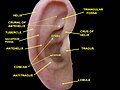
The auricula. Lateral surface.
Details
ArteryPosterior auricular, anterior auricular
NerveTrigeminal nerve, great auricular nerve, lesser occipital nerve
LymphTo pre- and post-auricular nodes, nodes of parotid and cervical chains
Identifiers
Latinauricula
MeSHD054644
TA98A15.3.01.002
TA2104, 6863
FMA56580
Anatomical terminology

The auricle or auricula is the visible part of the ear that is outside the head. It is also called the pinna (Latin for 'wing' or 'fin', pl.: pinnae), a term that is used more in zoology.

Structure

[edit]

The diagram shows the shape and location of most of these components:

  • antihelix forms a 'Y' shape where the upper parts are:
    • Superior crus (to the left of the fossa triangularis in the diagram)
    • Inferior crus (to the right of the fossa triangularis in the diagram)
  • Antitragus is below the tragus
  • Aperture is the entrance to the ear canal
  • Auricular sulcus is the depression behind the ear next to the head
  • Concha is the hollow next to the ear canal
  • Conchal angle is the angle that the back of the concha makes with the side of the head
  • Crus of the helix is just above the tragus
  • Cymba conchae is the narrowest end of the concha
  • External auditory meatus is the ear canal
  • Fossa triangularis is the depression in the fork of the antihelix
  • Helix is the folded over outside edge of the ear
  • Incisura anterior auris, or intertragic incisure, or intertragal notch, is the space between the tragus and antitragus
  • Lobe (lobule)
  • Scapha, the depression or groove between the helix and the anthelix
  • Tragus

Development

[edit]

The developing auricle is first noticeable around the sixth week of gestation in the human fetus, developing from the auricular hillocks, which are derived from the first and second pharyngeal arches. These hillocks develop into the folds of the auricle and gradually shift upwards and backwards to their final position on the head. En route accessory auricles (also known as preauricular tags) may be left behind. The first three hillocks are derived from the 1st branchial arch and form the tragus, crus of the helix, and helix, respectively. Cutaneous sensation to these areas is via the trigeminal nerve, the attendant nerve of the 1st branchial arch. The final three hillocks are derived from the second branchial arch and form the antihelix, antitragus, and lobule, respectively. These portions of the ear are supplied by the cervical plexus and a small portion by the facial nerve. This explains why vesicles are classically seen on the auricle in herpes infections of the facial nerve (Ramsay Hunt syndrome type II).[1]

The auricle's functions are to collect sound and transform it into directional and other information. The auricle collects sound and, like a funnel, amplifies the sound and directs it to the auditory canal.[2] The filtering effect of the human pinnae preferentially selects sounds in the frequency range of human speech.[citation needed]

Amplification and modulation

[edit]
The fennec fox uses its distinctive oversized pinnae to radiate excess heat and to amplify the sound of small prey burrowing under the desert sand.

Amplification of sound by the pinna, tympanic membrane and middle ear causes an increase in level of about 10 to 15 dB in a frequency range of 1.5 kHz to 7 kHz. This amplification is an important factor in inner ear trauma resulting from elevated sound levels.

Non-electrical hearing apparatuses which were designed to protect hearing (particularly that of musicians and others who work in loud environments) which fit snugly in the concha have been studied by the Institute of Sound and Vibration Research (ISVR) at the University of Southampton in the U.K. [3]

Notch of pinna

[edit]

Due to its anatomy, the pinna largely eliminates a small segment of the frequency spectrum; this band is called the pinna notch. The pinna works differently for low and high frequency sounds. For low frequencies, it behaves similarly to a reflector dish, directing sounds toward the ear canal. For high frequencies, however, its value is thought to be more sophisticated. While some of the sounds that enter the ear travel directly to the canal, others reflect off the contours of the pinna first: these enter the ear canal after a very slight delay. This delay causes phase cancellation, virtually eliminating the frequency component whose wave period is twice the delay period. Neighboring frequencies also drop significantly. In the affected frequency band – the pinna notch – the pinna creates a band-stop or notch filtering effect. This filter typically affects sounds around 10 kHz, though it can affect any frequencies from 6 – 16 kHz. It also is directionally dependent, affecting sounds coming from above more than those coming from straight ahead. This aids in vertical sound localization.[4]

Functions

[edit]
To an impala, the pinna is useful in collecting sound.

In animals, the function of the pinna is to collect sound, and perform spectral transformations to incoming sounds which enable the process of vertical localization to take place.[2] It collects sound by acting as a funnel, amplifying the sound and directing it to the auditory canal. While reflecting from the pinna, sound also goes through a filtering process, as well as frequency dependent amplitude modulation which adds directional information to the sound (see sound localization, head-related transfer function, pinna notch). In various species, the pinna can also signal mood and radiate heat.

Clinical significance

[edit]

There are various visible ear abnormalities:

In other species

[edit]

Visible pinnae are a common trait in therian mammals (placentals and marsupials), but are poorly developed or absent in monotremes. Marine mammals usually have either reduced pinnae or no pinnae due to sound travelling differently in water than in air, as well as the fact that auricles would potentially slow them down in the water. Skin impressions show large, mouse-like pinnae in Spinolestes.

External pinnae are absent in other tetrapod groups such as reptiles, amphibians, and birds.

Additional images

[edit]

See also

[edit]

References

[edit]
[edit]
Revisions and contributorsEdit on WikipediaRead on Wikipedia
from Grokipedia
The auricle, commonly known as the pinna, is the cartilaginous, shell-shaped structure that forms the visible external portion of the human ear, attached to the side of the head by ligaments and muscles. It consists of covered by and skin, with the exception of the soft, fleshy lobule at its inferior end, and plays a primary role in collecting and directing sound waves toward the external auditory canal.

Structure and Components

The auricle's intricate shape is defined by several key anatomical features formed by folds and ridges of . The helix forms the prominent outer rim, curving from the superior aspect down to the lobule, while the antihelix is a Y-shaped ridge parallel and anterior to the helix, creating the scapha (a narrow depression between them) and the triangular fossa (a depression bounded by the antihelix's crura and the helix). The concha, a deep concavity at the posterior entrance to the external auditory canal, is partially divided by the crus of the helix and bounded by the tragus (a small anterior projection over the canal) and the (a posterior prominence opposite the tragus). The lobule, lacking underlying , varies in size and attachment to the head, often serving as a site for piercings. Additional variations, such as —a small projection on the helix's posterior superior edge—occur in some individuals. Six intrinsic auricular muscles, remnants of more developed structures in other mammals, lie beneath the skin but are largely non-functional in humans.

Function

The auricle enhances and collection through its funnel-like shape, which amplifies certain frequencies via the pinna filtering effect and facilitates interaural time differences (ITD) for low-frequency sounds below 800 Hz and interaural level differences (ILD) for high frequencies above 1600 Hz. This structure aids in directional hearing, particularly for sounds originating from above or behind, by reflecting and channeling into the .

Development and Clinical Aspects

Embryologically, the auricle arises from six mesenchymal hillocks around the first pharyngeal cleft and groove during the fifth week of , with the external auditory forming later from the first cleft. Blood supply derives primarily from the posterior auricular artery (posteriorly) and (anteriorly), both branches of the , while sensory innervation comes from branches of the trigeminal (CN V), (CN VII), vagus (CN X), and cervical (C2-C3) nerves, with motor supply from CN VII. Clinically, the auricle is prone to conditions such as trauma-induced perichondritis (leading to ""), formation from piercings, and congenital anomalies like (underdevelopment) or macrotia (enlargement), which can be associated with genetic syndromes. Its exposed position also increases susceptibility to sunburn and skin cancers.

Anatomy

Gross anatomy

The auricle, also known as the pinna, is the external, cartilaginous portion of the that projects from the side of the head and functions to capture sound waves. It consists primarily of covered by and skin, providing flexibility and structural integrity, while the lobule is the only region lacking cartilage and composed mainly of fibrous tissue and fat. This composition allows the auricle to maintain its shape despite external forces, with the skin layer containing hair follicles, sebaceous glands, and subcutaneous fat that vary in thickness across regions. The auricle features several prominent landmarks that define its irregular, funnel-like shape. The forms the outer rim, curving superiorly and posteriorly from the lobule to end at the superior aspect near the . Parallel and medial to the lies the , a Y-shaped that bifurcates into superior and inferior crura, enclosing the triangular fossa superiorly. Anterior to the external acoustic is the tragus, a small cartilaginous flap, while the protrudes opposite it across the intertragic notch. The , a deep hollow adjacent to the , is subdivided into cymba and cavum regions by the crus of the , and the scaphoid fossa is the narrow depression between the and . The lobule hangs inferiorly as the soft, non-cartilaginous tip. In adults, the auricle measures approximately 6-7 cm in height from the superior helix to the inferior lobule and 3-4 cm in width at its broadest point, with notable : males typically exhibit larger dimensions than females. Variations in size, shape, and projection from the head are influenced by genetic factors, with genome-wide association studies identifying multiple loci affecting lobe attachment, rolling, and protrusion. Age-related changes include gradual elongation and increased projection due to cartilage growth and loss of elastic fibers, while ethnic and individual differences contribute to diverse morphologies without altering core functionality.

Development

The auricle, or external ear, begins to form during the fourth week of embryonic development as six mesenchymal swellings, known as the hillocks of His, emerge around the dorsal aspect of the first pharyngeal cleft. These hillocks arise from neural crest-derived and progressively fuse over weeks 4 to 8 of to shape the mature auricular contours. The first three hillocks originate from the first branchial arch and contribute to the formation of the tragus and the crus of the , while the remaining three from the second branchial arch develop into the descending portion of the , the , and the lobule. Postnatally, the auricle undergoes disproportionate growth, achieving approximately 80% of its adult size by age 6, though vertical dimensions continue to elongate into and beyond due to ongoing cartilage remodeling. This growth pattern reflects the auricle's framework, which expands preferentially in length and width throughout life, influenced by hormonal and mechanical factors. Genetic regulation is critical for auricular patterning, with homeobox genes such as directing the differentiation of derivatives into auricular structures. Similarly, Distal-less (Dlx) family transcription factors, including Dlx5 and Dlx6, orchestrate craniofacial and formation by modulating cell and condensation. Environmental teratogens can disrupt this process; for instance, exposure between days 20 and 36 of inhibits and limb/ear bud development, resulting in auricular or . Maternal mellitus elevates the risk of oculo-auriculo-vertebral spectrum disorders, which often manifest as asymmetric auricular malformations due to hyperglycemia-induced during early embryogenesis. In adulthood, aging induces progressive loss of elastic fibers in the auricular cartilage and overlying , leading to structural weakening and downward drooping of the auricle. This perichondrial degeneration contributes to the auricle's apparent enlargement and altered projection over time.

Blood supply and innervation

The auricle receives its primary arterial supply from the posterior auricular artery, a direct branch of the that provides blood to the posterior and superior aspects of the auricle. Anterior auricular branches from the supply the anterior and inferior regions, forming an anastomotic network that ensures robust perfusion. Venous drainage follows the arterial pattern, with the posterior auricular vein and anterior auricular veins draining the auricle and ultimately emptying into the . Lymphatic drainage from the auricle varies by region: the anterior and superior portions drain to preauricular and , while the lower and posterior parts direct to superficial cervical nodes. This drainage pattern supports immune surveillance but requires consideration in surgical interventions to avoid . Sensory innervation of the auricle arises from multiple nerves for comprehensive coverage: the (derived from C2-C3 roots) supplies the lower third and lobule, the (a branch of the mandibular division of the , CN V3) innervates the upper anterior helix and tragus, the (primarily from C2) provides sensation to the upper posterior auricle, and the auricular branch of the (CN X) innervates the and adjacent external auditory . The auricle's high pain sensitivity stems from its dense trigeminal (CN V) and cervical (C2-C3) nerve distribution, which facilitates acute responses to trauma but also enables from distant sites such as the or via shared neural pathways. Anatomical variations in the auricle's blood supply include or absence of the posterior auricular artery, which has been documented in select populations and can influence outcomes by altering reliance on alternative vessels like the .

Physiology

Sound localization

The auricle, or pinna, plays a crucial role in by providing spatial acoustic cues that allow the to determine the direction of sound sources in both the horizontal (azimuthal) and vertical planes. These cues arise from the auricle's interaction with incoming sound waves, which it filters and modifies based on the sound's angle of incidence relative to the head. Primarily, the auricle contributes to binaural cues—differences between the two ears—and monaural spectral cues that are unique to each ear, enabling precise localization even in complex acoustic environments. Interaural time differences (ITD) represent the delay in sound arrival between the ears, reaching a maximum of approximately 700 microseconds for sounds at 1 kHz, primarily due to the interaural path length across the head. Complementing ITD, interaural level differences (ILD) emerge from the head's , attenuating high-frequency sounds (>3 kHz) by up to 20 dB at the farther ear; low-frequency ILDs, particularly for judgments below 3 kHz, are modulated by effects from the head and . Spectral cues, generated by the auricle's complex shape, create frequency-dependent resonances and notches that encode elevation information; for instance, the concha produces prominent peaks between 2 and 5 kHz, which shift with sound source angle to distinguish vertical position. These shape-specific modifications are captured in the (HRTF), a describing the auricle's (along with the head and torso's) direction-dependent filtering of , with variations arising from individual auricle morphology that can alter localization accuracy. Neural processing of auricle-derived cues begins in the brainstem's (SOC), where binaural integration of ITD and ILD occurs via specialized nuclei—the medial superior olive for timing and the lateral for levels—while spectral cues from the auricle are incorporated to refine both azimuthal and vertical localization, projecting to higher centers like the for comprehensive spatial mapping.

Amplification and modulation

The auricle functions as a funnel-like collector of sound waves, directing them toward the and thereby increasing by approximately 10-15 dB for sources located frontally. This enhancement arises from the concha's bowl-shaped structure, which channels incoming waves efficiently into the , boosting sensitivity particularly for frequencies relevant to human speech. The overall amplification provided by the auricle and together contributes a gain of about 10-15 dB in the 2-5 kHz range, aiding the detection of sounds and environmental cues. Frequency-specific amplification occurs through structural resonances within the auricle, with the contributing to peaks around 2-3 kHz and the producing resonances at 4-5 kHz, each enhancing sound pressures by up to 10 dB in those bands. These resonances filter and amplify mid-to-high frequencies, improving the for speech intelligibility. Antiresonances, particularly at 7-8 kHz, introduce notches that attenuate certain frequencies, further shaping the spectral content before it reaches the tympanic membrane. The auricle exhibits directional sensitivity, providing a 6-10 dB gain for ipsilateral sounds that varies with source , achieving maximum amplification at 0° elevation in the horizontal plane. This azimuth-dependent response modulates incoming signals based on their angular position relative to the head. Modulation effects include significant of sounds from the rear by about 20 dB compared to frontal sources, which supports the distinction between front and back origins by creating spectral contrasts. These filtering actions refine the auditory input, reducing ambiguities in sound processing. In terms of matching, the auricle plays a preliminary role in minimizing reflection losses at the air-tissue interface, as quantified by pinna-related transfer functions that describe pressure transformations across frequencies. These functions reveal how the auricle's optimizes energy transfer to the , with gains peaking in speech-relevant bands to enhance overall auditory efficiency.

Clinical significance

Congenital anomalies

Congenital anomalies of the auricle arise from disruptions in the embryological development of the external , which forms from the fusion of six hillocks derived from the first and second branchial arches during the fifth to eighth weeks of . These defects can range from mild structural variations to complete absence of the pinna and are often isolated but may occur as part of broader craniofacial syndromes. typically involves clinical examination at birth, with prenatal detection possible through and genetic in syndromic cases. Microtia represents underdevelopment or of the auricle, affecting approximately 1 in 6,000 to 12,000 live births worldwide. It is classified into four grades based on severity: grade I involves a small but normally shaped ; grade II features a rudimentary structure with some recognizable features; grade III shows a remnant of without a developed lobe; and grade IV indicates anotia, or complete absence. Microtia is frequently associated with , a condition involving underdevelopment of one side of the face, occurring in up to 29% of cases, and is also linked to , an autosomal dominant disorder caused by mutations in the TCOF1 gene affecting craniofacial structures. Anotia, the complete absence of the external ear, is rarer than , with an estimated global incidence of about 1 in 28,000 births, and is usually unilateral, affecting 87% of cases. It shares embryological origins with and carries a higher risk in pregnancies complicated by maternal , where prevalence can increase up to fivefold due to teratogenic effects of on fetal development. Preauricular tags and pits are common accessory structures, occurring in 5 to 10 per 1,000 live births, resulting from incomplete fusion of the auricular hillocks during embryonic development. Tags are soft tissue appendages, while pits form as small sinus tracts or depressions near the ; both are typically benign but pits are prone to recurrent infections, such as abscesses or , in up to 10-25% of cases due to epithelial trapping. Cryptotia and bat ear (also known as prominent ear) involve positional deformities of the auricle due to abnormal cartilage folding or lack of antihelical development. Cryptotia features a buried superior auricle beneath the skin, often from anomalous muscle attachments, and is more prevalent in Asian populations with an incidence of about 1 in 400 births. Bat ear results in protrusion from a widened conchoscaphal , with a genetic basis in some cases showing autosomal dominant patterns within families. Diagnostic approaches for auricular anomalies include prenatal ultrasound starting from 18 weeks of gestation, which can detect structural defects like or in up to 19% of oculo-auriculo-vertebral spectrum cases, such as . , including chromosomal microarray or targeted sequencing for syndromes like Goldenhar (associated with in 94% of cases), is recommended when multiple anomalies are present to identify underlying mutations.

Acquired conditions

Acquired conditions of the auricle encompass a range of non-congenital disorders and injuries that can lead to , , or , often resulting from , trauma, environmental exposure, or autoimmune processes. These conditions typically present with localized pain, swelling, or cosmetic changes and require prompt intervention to prevent permanent damage to the or surrounding tissues. Perichondritis is an inflammatory of the covering the auricular , most commonly caused by bacterial pathogens such as , often triggered by minor trauma, ear piercing, burns, or surgical procedures. Symptoms include acute painful swelling, , and tenderness of the pinna, which may progress to formation or if untreated, distinguishing it from simple by its involvement of the cartilaginous framework. Treatment involves systemic anti-pseudomonal antibiotics, such as fluoroquinolones or antipseudomonal penicillins, with required for abscesses to prevent complications like or . Trauma from blunt injury can cause auricular , where shearing forces disrupt blood vessels between the and , leading to blood accumulation, pressure , and eventual organization into fibrocartilaginous tissue that results in the characteristic . , resulting from prolonged cold exposure, induces and formation in tissues, causing epidermal blistering, subepidermal , and potential full-thickness auricular damage in severe cases. Symptoms of both include swelling, ecchymosis, and pain, with additionally featuring numbness and pale or mottled skin. Prevention strategies for trauma emphasize protective headgear during contact sports, while protocols involve rapid rewarming in 40–42°C water baths and avoiding refreezing, alongside general measures like and limiting exposure in extreme cold. Acute management of requires incision, evacuation, and compression to restore perichondrial , ideally within 6–24 hours to avert . Skin cancers, particularly (BCC) and (SCC), frequently arise on the sun-exposed and of the auricle due to cumulative radiation damage. factors include fair skin, chronic sun exposure, advanced age, and , with BCC presenting as pearly nodules and SCC as ulcerated plaques that may invade . These lesions carry a high recurrence owing to the auricle's thin skin and , necessitating or Mohs micrographic surgery for precise margin control and tissue preservation, achieving cure rates of 94–99% for BCC and 95–99% for SCC. Relapsing polychondritis is a rare autoimmune disorder characterized by recurrent inflammation of cartilaginous structures, with auricular occurring in approximately 85–95% of cases, manifesting as painful, erythematous swelling of the pinna that spares the non-cartilaginous lobe. The condition arises from antibody-mediated destruction of proteoglycans in type II collagen-rich tissues, often involving multiple sites like the or tracheobronchial tree. Diagnosis relies on clinical criteria, such as recurrent in two or more sites, supported by showing perichondrial inflammation and cartilage loss, though is not always required. Treatment approaches for acquired auricular deformities include , a cartilage-sparing procedure that reshapes the pinna through suturing or scoring to correct prominence or , primarily for cosmetic restoration following resolved infections or minor trauma. For severe defects involving significant loss, such as post-necrosis or post-excision, employs autologous rib grafts to fabricate a framework, covered by local flaps or skin grafts, enabling functional and aesthetic reconstruction in staged procedures.

Comparative anatomy

In mammals

In mammals, the auricle, or pinna, exhibits significant structural and functional diversity adapted to various ecological niches, ranging from highly mobile and erectable forms in terrestrial predators to reduced or absent structures in aquatic species. Carnivores such as cats and dogs possess erectable pinnae supported by well-developed auricular muscles, enabling precise movements that enhance . These muscles, including the anterior, superior, and posterior auricular groups, allow for rotations of up to 180 degrees independently for each , funneling sounds toward the and adjusting the pinna's orientation to pinpoint noise sources with high accuracy. Herbivores like and feature large, mobile auricles that serve dual roles in and broad capture. In African elephants, the pinnae can span up to 1.8 meters in length and 1.5 meters in width, providing a surface area of approximately 2 m² per to dissipate through vascularized and convective airflow generated by flapping, which is crucial in hot environments. Horses similarly utilize their mobile pinnae to facilitate wide-angle detection for predator avoidance while aiding minor heat loss via ear twitching and blood flow modulation. Aquatic mammals show marked reductions in auricle size or complete loss, reflecting adaptations to over aerial hearing. In cetaceans like whales, the external auricle is vestigial or entirely absent, with no functional pinnae or open ear canals; instead, sound transmission relies on specialized middle and structures, such as the involucrum and fat-filled mandibular canals, to detect underwater vibrations efficiently. Among pinnipeds, eared seals (such as sea lions and fur seals) retain small external openings and rudimentary pinnae for terrestrial use during breeding and haul-outs, allowing aerial sound localization on land, while earless seals (true seals) and walruses lack pinnae but have small auditory openings; all depend on submerged jaw and throat adaptations for aquatic hearing. Evolutionary trends in mammals reveal a progressive loss of auricle mobility, particularly in , where reliance on visual cues diminished the need for ear orientation. In humans and other apes, the extrinsic auricular muscles, such as the rudimentary , persist as vestigial remnants but elicit only weak electromyographic responses during auditory attention or startle reflexes, without significant pinna movement. Functional variations are evident in chiropterans, where bats employ oversized auricles tailored for echolocation. These large pinnae, often exceeding 5 cm in length relative to body size, provide substantial gains (up to 20 dB) at ultrasonic frequencies, directing echoes to the while compensating for Doppler shifts in fluttering prey through precise spectral filtering and pinna adjustments during flight.

In non-mammals

In non-mammalian vertebrates and , structures analogous to the mammalian auricle are typically absent or highly modified, reflecting adaptations to diverse environments and modes of detection. Birds, for instance, lack a prominent external auricle or pinna, instead featuring a short external auditory that leads directly to the tympanic membrane. This is often covered by an operculum or feathers, which protect the opening while allowing transmission. In species like , specialized facial ruffs—feather arrangements surrounding the eyes and ears—enhance directionality by funneling and filtering acoustic signals, particularly aiding in the precise localization of prey in low-light conditions through interaural time and intensity differences created by asymmetric openings. Reptiles exhibit even more rudimentary external ear structures, with no true pinna or auricle present in most species. The tympanic membrane is exposed or recessed beneath scales, as seen in lizards such as the green iguana (Iguana iguana), where it collects airborne vibrations without cartilaginous support for amplification or directionality. Sound localization in these animals relies primarily on head movements to scan for intensity gradients or phase differences, supplemented by substrate-borne vibrations detected via the jaw and quadrate bones. Fossorial reptiles, like some burrowing lizards, may lack a visible tympanic membrane altogether, further emphasizing reliance on non-auditory cues. Aquatic and semi-aquatic non-mammals, including fish and amphibians, completely lack an auricle, as their hearing systems are optimized for underwater propagation where external flaps would provide no hydrodynamic advantage. In fish, sound detection occurs via the inner ear, with the lateral line system—a network of mechanoreceptors along the body—serving as the primary analog for vibration and near-field pressure detection, enabling responses to water movements from predators or conspecifics. Amphibians like frogs also forgo an external auricle, featuring instead a superficial tympanic membrane on the head's side for aerial sound capture during terrestrial phases; the lateral line persists in aquatic larvae but regresses in adults. Some anurans, such as various frog species, employ vocal sacs as inflatable analogs that amplify outgoing calls, indirectly supporting acoustic communication by enhancing signal detectability, though these do not directly aid reception. Among , tympanal organs provide functional equivalents to the auricle for directional hearing, but without any cartilaginous framework. In (Gryllidae), these organs are embedded in the forelegs' tibiae, consisting of thin cuticular membranes (tympana) that vibrate in response to sound waves channeled through tracheal tubes and spiracles. This setup allows for binaural comparison and phonotaxis toward conspecific calls, with the anterior and posterior tympanal membranes enabling sensitivity to specific frequencies around 4-5 kHz for mate location. Such structures evolved convergently in various insect orders, prioritizing lightweight, integrated designs over specialized external appendages. The emergence of auricle-like structures is closely linked to the evolutionary transition from aquatic to terrestrial habitats, where between air and body tissues necessitated external adaptations for sound collection. Fully aquatic , from to certain amphibians like , retain hearing mechanisms suited to water's higher , relying on body walls or internal cavities for transfer without external ears. In contrast, tympanic systems evolved independently in different lineages, earlier in amphibians during the and in amniotes during the , setting the stage for more complex auricles in later lineages, though non-mammals generally prioritize minimalism for mobility and environmental integration.

References

Add your contribution
Related Hubs
User Avatar
No comments yet.