Hubbry Logo
Shadow HandShadow HandMain
Open search
Shadow Hand
Community hub
Shadow Hand
logo
8 pages, 0 posts
0 subscribers
Be the first to start a discussion here.
Shadow Hand
Shadow Hand
from Wikipedia
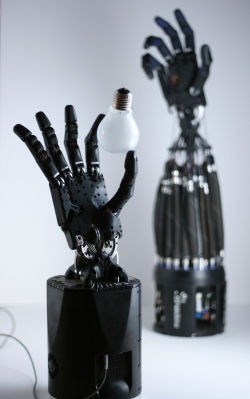
The Shadow C6M Smart Motor Hand in front of the Shadow C3 Dexterous Air Muscle Hand
Comparison of The Shadow Dexterous Hand with the human hand

The Shadow Dexterous Hand is a humanoid robot hand system developed by The Shadow Robot Company in London. The hand is comparable to a human hand in size and shape, and reproduces all of its degrees of freedom. The Hand is commercially available in pneumatic- and electric-actuated models and currently used in a wide range of institutions including NASA, Bielefeld University and Carnegie Mellon University, and EU research projects such as HANDLE.[1]

The Shadow Dexterous Robot Hand is the first commercially available robot hand from the company, and follows a series of prototype humanoid hand and arm systems.

Design

[edit]

The Shadow Dexterous Hand has been designed to be similar to the average hand of a human male. The forearm structure is slightly wider than a human forearm.

The Shadow Dexterous Hand has 24 joints. It has 20 degrees of freedom, greater than that of a human hand.[2] It has been designed to have a range of movement equivalent to that of a typical human being. The four fingers of the hand contain two one-axis joints connecting the distal phalanx, middle phalanx and proximal phalanx and one universal joint connecting the finger to the metacarpal. The little finger has an extra one-axis joint on the metacarpal to provide the Hand with a palm curl movement. The thumb contains one one-axis joint connecting the distal phalanx to the proximal phalanx, one universal joint connecting the thumb to the metacarpal and one one-axis joint on the bottom of the metacarpal to provide a palm curl movement. The wrist contains two joints, providing flex/extend and adduct/abduct.

The hand is available in both electric motor driven and pneumatic muscle driven models. The motor hand is driven by 20 DC motors in the forearm, whereas the muscle hand is powered by 20 antagonistic pairs of Air Muscles in the forearm.

All hands have Hall effect sensors integrated into every joint to provide precise positional feedback. The motor hand includes force sensors for each degree of freedom and the muscle hand includes pressure sensors for each muscle. There are also several options for tactile sensing on the hand from basic pressure sensors to the BioTac multimodal[3] tactile sensor from Syntouch Inc..

The Shadow Hand software system is based on Robot Operating System, through which configuration, calibration, simulation and control of the hand is implemented. A simulation of the Shadow hand can be downloaded and installed in ROS.[4]

See also

[edit]

Further reading

[edit]

References

[edit]
[edit]
Revisions and contributorsEdit on WikipediaRead on Wikipedia
from Grokipedia
The Shadow Dexterous Hand is an advanced humanoid robotic hand developed by the Shadow Robot Company, a London-based firm specializing in dexterous robotics, featuring 24 degrees of freedom (20 actuated) to closely replicate the kinematics, size, and manipulation capabilities of a human hand. Tendon-driven and equipped with over 100 sensors operating at 1 kHz, including tendon load sensors, an inertial measurement unit, and optional tactile fingertip sensors, it enables precise control for tasks such as tool handling and object manipulation in research environments. Weighing approximately 4.3 kg in its standard configuration, the hand integrates fully with the Robot Operating System (ROS) and supports teleoperation via systems like the Shadow Glove for intuitive human-robot interaction. Founded in as a hobbyist group and formally established as a in 1997, the Shadow Robot Company has invested over two decades in advancing robotic dexterity, with the Shadow Dexterous Hand emerging as its flagship product around 2000 as the first commercially available version following prototype development. The hand's design draws from extensive research into anthropomorphic , incorporating underactuated fingers for natural grasping and high-bandwidth /position control to achieve human-like precision, making it a benchmark for studies in and . Early applications included collaborations with organizations such as for tasks and pharmaceutical firms like GSK for , highlighting its versatility beyond academia. In recent years, the Shadow Dexterous Hand series has evolved with variants like the lighter models (e.g., Super Lite at 1.8 kg) for energy efficiency and affordability, alongside the DEX-EE version developed in partnership with Google DeepMind since around 2019 to support reinforcement learning in real-world manipulation. The DEX-EE emphasizes robustness, featuring high-speed tactile sensors with hundreds of taxels per finger, stereo camera-based 3D sensing, and resistance to impacts and aggressive use, enabling long-duration experiments without frequent maintenance. A parallel 2024 release, the New Shadow Hand, shifts toward modularity with self-contained finger units and GelSight-inspired optical tactile sensors, prioritizing durability over strict anthropomorphism while maintaining force exertion up to 8 N and joint speeds of 180°/s. In 2025, the company announced ARIA-funded projects (OGRES and UPWARD) to further advance dexterity and began exploring applications in care robotics. These advancements have earned the company accolades, including the 2019 AIconics Award for Best Innovation in AI Hardware and the Queen's Award for Enterprise in 2019.

History

Founding of Shadow Robot Company

The Shadow Robot Company traces its origins to 1987, when it began as an informal hobbyist group founded by Richard Greenhill in the attic of his home in , . Greenhill, a by trade with no formal background in or , gathered a group of about 12 enthusiasts who met weekly on Wednesdays to explore humanoid robotics. Driven by a passion for creating machines capable of human-like manipulation in everyday environments, the group focused on developing affordable components using scavenged materials, such as parts from skips and old printers, emphasizing open-source principles by freely sharing their knowledge and designs with the broader community. Initial projects centered on rudimentary prototypes, including basic wooden models of robotic hands and arms constructed from materials like sourced from local waste. These efforts were motivated by the members' lack of professional technical expertise, relying instead on self-taught experimentation to mimic human dexterity without relying on expensive commercial hardware. The group's early work highlighted a commitment to accessible tools, aiming to democratize humanoid robotics for academic and hobbyist applications. By the mid-1990s, the hobbyist collective had evolved into a more structured operation, formally registering as the Shadow Robot Company in 1997 following a commission to build a robotic leg component. This milestone marked the transition to a professional entity, enabling the pursuit of advanced through initial funding opportunities, such as a 1998 Smart award from the government that supported further innovation in dexterous manipulation systems. By the early , the company had secured additional resources to expand its R&D efforts, solidifying its role in the field of humanoid robotics.

Early Prototypes and Technological Evolution

The development of the Shadow Hand began in 1987 with the creation of the first prototype, a wooden model designed to mimic the anthropomorphic form of the human hand, constructed by a group of hobbyist enthusiasts. This initial design focused on replicating the basic structure and proportions of an adult human hand to explore foundational concepts in dexterous manipulation. Over the following years, the team iterated through a series of hand and arm prototypes, testing for enhanced dexterity and integrating early control systems to enable coordinated movements. These prototypes progressively addressed the integration of mechanical components with rudimentary software for basic task execution, laying the groundwork for more advanced systems. A significant advancement occurred in 2004 with the introduction of pneumatic "Air Muscle" actuators in the prototype design, which provided human-like force generation and compliance without relying on rigid electric motors. These actuators, inspired by McKibben-style muscles, allowed for softer, more adaptable movements that better simulated natural hand dynamics, marking a shift toward bio-inspired actuation in the prototypes. The 2004 Shadow Hand prototype, featuring 20 (DoF), exemplified this evolution and became available for research testing. Throughout this period, key challenges included achieving over 20 DoF within a compact, human-scale form factor comparable to an adult hand's dimensions, while ensuring reliability in dexterous tasks. Engineers addressed issues such as actuator compliance, joint precision, and overall to prevent bulkiness or loss of agility. A notable milestone came in 2007, when the demonstrated basic grasping capabilities, such as securely holding fragile objects through anthropomorphic manipulation, validating the design's potential for real-world dexterity.

Commercial Launch and Key Milestones

The Shadow Dexterous Hand was first commercially released in 2005 as the flagship product of the Shadow Robot Company, marking the transition from research prototypes to a market-available robotic manipulator designed for advanced dexterity studies. This launch enabled broader access for academic and institutional users, with the hand offered in pneumatic and electric variants to support diverse manipulation tasks. Early adoption included integration into the European Union's project (2009–2013), a FP7-funded initiative focused on replicating human-like grasping and in-hand manipulation, where the Shadow Hand served as the primary end-effector alongside a biomorphic arm for human-robot interaction research. In 2013, acquired a tactile-equipped Shadow Hand for its program at the , utilizing it for space manipulation experiments to enhance robotic dexterity in extraterrestrial environments. Key milestones in accessibility and demonstration included the 2010 integration with the (ROS), which standardized control interfaces and expanded its use in research by enabling seamless software reusability for dexterous tasks. This was followed in 2012 by public demonstrations showcasing human-like gestures, such as precise object handling, which highlighted the hand's anthropomorphic capabilities and garnered attention from the global robotics community. By the mid-2010s, the company expanded its offerings to include integrated arm-hand systems, with the Shadow Dexterous Arm introduced as a complementary platform emphasizing the hand's role in full upper-limb . Over the subsequent decade, iterative improvements—spanning more than 20 years since the initial commercial release—have positioned the Shadow Hand as a staple in dexterity research, adopted by numerous leading institutions worldwide, including for AI-driven manipulation studies.

Design and Specifications

Mechanical Structure and Degrees of Freedom

The Shadow Dexterous Hand features an anthropomorphic five-fingered structure designed to closely mimic the size and shape of a typical male hand, measuring approximately 20 cm in length with fingers of equal length and staggered knuckles for realistic fingertip positioning. This design enables precise manipulation tasks by replicating human-like proportions and joint arrangements. The hand incorporates 24 joints in total, providing 24 with 20 actuated. The thumb has 5 joints and 5 actuated (DoF): the interphalangeal (IP), metacarpophalangeal (MCP) flexion/extension, MCP abduction/adduction, and two carpometacarpal (CMC) joints for opposition and flexion. Each of the four fingers has 4 joints: metacarpophalangeal (MCP) flexion/extension, proximal interphalangeal (PIP), distal interphalangeal (DIP; coupled and underactuated to PIP), and MCP abduction/adduction, yielding 3 actuated DoF per finger (MCP flexion/extension, PIP flexion driving the coupled DIP, and MCP abduction/adduction). The little finger includes an additional actuated palm abduction joint for enhanced thumb opposition, giving it 4 actuated DoF. The integrated wrist contributes 2 actuated DoF (flexion/extension and abduction/adduction). This configuration supports 24 distinct movements overall, closely approximating hand dexterity, with the 4 underactuated DoF being the DIP joints of the fingers. The mechanical transmission employs a tendon-driven system, which contributes to the hand's compact and lightweight profile, with a total weight of 4.3 kg for the hand and assembly. The structure utilizes lightweight materials such as aluminum and alloys for the frame, acetyl and for joints and components, and for the synthetic flesh covering, ensuring durability during repetitive operations.

Actuation Mechanisms

The Shadow Dexterous Hand employs dual actuation paradigms—electric and pneumatic—to drive its 20 actuated , allowing researchers and engineers to select based on application needs for precision or compliance. The electric variant utilizes 20 high-precision DC motors, specifically Maxon EC flat series motors integrated into proprietary "Smart Motor" nodes, each equipped with gear reduction to amplify for fine joint control. These motors are mounted in the , providing backlash-free operation and enabling precise positioning suitable for tasks requiring high accuracy, such as delicate manipulation in . In contrast, the pneumatic variant relies on 20 pairs of contracting air muscles (40 total actuators) mounted in the , which contract linearly when pressurized to mimic biological muscle action and produce compliant motion for adaptive grasping. These air muscles, often McKibben-style or similar linear pneumatic actuators, offer inherent softness and shock absorption, making the hand ideal for interacting with fragile or irregularly shaped objects without rigid force application. The system's design ensures variable through antagonistic pairing, where opposing muscles balance tension for controlled compliance. Both variants transmit force via a routing system, where braided cables run from the forearm-mounted actuators through the palm to the finger and joints, facilitating natural curling and spreading motions that replicate human . This underactuated drive enables efficient force distribution across 24 total movements, with four underactuated for passive adaptation. Control is achieved at up to 1 kHz update rates using the protocol for real-time responsiveness, supporting closed-loop position or torque commands. The electric model requires a 48 V DC power supply at 2.5 A, while the pneumatic system needs at approximately 3.5–6 bar, with a maximum consumption of around 24 liters per minute under full load. These mechanisms highlight the hand's versatility: pneumatics excel in soft, adaptive scenarios, whereas electrics provide superior precision and repeatability without the need for air infrastructure.

Sensors and Tactile Feedback Systems

The Shadow Hand utilizes sensors to provide joint position feedback for all 20 actuated , enabling absolute positioning with a typical resolution of 0.2 degrees and 12-bit ADC sampling. These sensors measure rotations along each joint axis, ensuring precise tracking of hand configuration during manipulation tasks. Force and torque sensing in the Shadow Hand is implemented via strain gauge-based load cells on tendon pairs, with approximately 40 such sensors in the full model configuration. These allow detection of fingertip forces up to 10 , with a resolution of about 30 mN, supporting control and compliant grasping. Sampling occurs at 500 Hz for force data, contributing to responsive feedback in dynamic interactions. Tactile feedback systems in the Shadow Hand incorporate over 100 sensors overall, with options for advanced technologies to capture contact details. The BioTac sensors, developed by SynTouch and mountable on all five , deliver multimodal data including distribution (via 19 force outputs), , and , facilitating nuanced touch akin to . Alternatively, the proprietary Shadow Tactile Fingertips (STFs) employ 17 taxels per unit, each with three-axis sensing for 3D force vectors (normal and tangential), enabling detailed surface profiling and contact localization; standard setups include STFs on the thumb and index finger, with expandability to others. STF data is captured at 1000 Hz with 12-bit resolution, supporting high-fidelity tactile mapping for manipulation. Additional sensing includes a single (IMU) per hand for orientation and motion tracking, integrated into the sensor suite for enhanced spatial awareness. All primary sensors, including position, force, and tactile arrays, operate at a 1 kHz sampling rate via the bus, ensuring low-latency feedback for real-time control. This data can be processed within the (ROS) for higher-level integration.

Software and Control

Integration with Robot Operating System (ROS)

The Shadow Dexterous Hand has been fully compatible with the (ROS) since 2010, supporting ROS 1 through dedicated packages that enable joint control, trajectory planning, and . As of 2025, support remains primarily for ROS 1 (Noetic). The integration is facilitated by the open-source shadow_robot_ethercat stack, available on , which provides drivers for seamless hardware-software interfacing and allows users to extend functionality for custom applications. Communication between the hand and ROS occurs via an bus, an Ethernet-based protocol operating at 100 Mbps, enabling real-time command execution with low latency of approximately 1 ms for control loops running at 1 kHz on the host PC. This setup supports position control via PID on the host and control closed at 5 kHz within individual motor units, ensuring precise and responsive operation. For teleoperation, ROS APIs map human inputs from the Shadow Glove to the hand's joints, streaming glove data at up to 960 Hz with end-to-end latency as low as 1 ms, allowing intuitive replication of natural movements. Sensor data streams, such as position and tactile feedback at 1000 Hz, are published directly to ROS topics for integration into control pipelines. Safety features are embedded in the ROS nodes, including built-in torque limits, adjustable operational boundaries for and , and stop mechanisms that monitor current and thermal states in the smart motor units to prevent overload or damage. These protections integrate with ROS's layer, enabling safe trajectory execution and rapid motor resets when limits are approached.

Simulation Tools and Programming Interfaces

The Shadow Dexterous Hand integrates with , an simulator, to enable physics-based modeling of hand dynamics and interactions in virtual environments. Gazebo supports accurate simulation of the hand's 20 actuated , tendon-driven mechanisms, and sensor feedback, allowing researchers to test grasping, manipulation, and contact scenarios without physical hardware. Installation typically involves a Docker-based setup on with ROS Noetic, using commands like roslaunch sr_robot_launch srhand.launch sim:=true to launch unimanual or bimanual configurations, including optional arm integrations such as UR10. This setup facilitates custom scene loading for complex interactions, such as object manipulation in cluttered spaces, and incorporates GPU acceleration for enhanced performance. URDF models for the Shadow Hand are provided as modular xacro files, which generate Unified Robot Description Format descriptions for kinematics visualization and integration with the MoveIt! framework. These models define joint limits, link geometries, and collision properties, enabling path planning, solving, and collision avoidance in simulated environments. MoveIt! compatibility allows for pipelines tailored to the hand's anthropomorphic structure, supporting tasks like for dexterous reaching and grasping. Researchers can load these URDFs into the MoveIt Setup Assistant to configure semantic grasp planning and execute plans via ROS topics. Programming interfaces for the Shadow Hand include Python and C++ APIs accessible through the ROS ecosystem, facilitating scripting of complex manipulations such as multi-finger coordination and setups. The sr_hand ROS package provides nodes for joint control, trajectory following, and sensor data streaming, allowing developers to write custom controllers in Python for or C++ for performance-critical applications. These APIs support frameworks by exposing observation spaces (e.g., joint positions, velocities) and action spaces (e.g., commands), enabling training of policies for tasks like in-hand object reorientation. Dedicated simulation tools, such as the Shadow Hand Simulator based on , MuJoCo, and Isaac Sim, allow offline testing of grasping algorithms by replicating real-world physics and sensor noise. MuJoCo models from DeepMind's provide high-fidelity rigid-body dynamics for rapid iteration, while Isaac Sim offers GPU-accelerated environments for large-scale simulations. These tools generate synthetic datasets for algorithm validation, reducing hardware wear and accelerating development cycles. The Shadow Hand's simulation ecosystem supports integration with machine learning libraries like , enabling training on simulated data for tasks such as policy optimization via . Simulated environments produce diverse interaction data, which can be processed in for training, bridging the sim-to-real gap through domain randomization techniques. This compatibility has been demonstrated in seminal works on dexterous manipulation, where policies trained in simulation transfer to physical hardware with minimal fine-tuning.

Variants and Models

Standard Dexterous Hand

The Standard Dexterous Hand represents the flagship model in Shadow Robot's lineup, designed for high-precision manipulation tasks in research environments. It features a baseline configuration with 20 actuated degrees of freedom (DoF) driven by tendon mechanisms, enabling 24 joints across five fingers to closely replicate human hand kinematics. The system weighs 4.3 kg, including the integrated forearm, and employs 20 Maxon DC motors housed in smart motor units for precise control via PWM and PID algorithms. This tendon-driven architecture allows for underactuated movements, such as coupled distal interphalangeal joints in the fingers, supporting a wide range of joint angles (e.g., 0–90° for proximal finger flexion). Performance-wise, the hand excels in executing 24 distinct movements, including precision pinch grasps, power grasps for larger objects, and complex tool manipulations like pen handling or key insertion, thanks to its over 100 sensors providing position feedback at 0.2° resolution and 1000 Hz sampling. These capabilities make it suitable for advanced dexterity studies, such as in-hand object reorientation or bimanual coordination. Accessories enhance its versatility; it is compatible with a full robotic arm offering 7 DoF for extended reach and singularity avoidance during mounting on mobile bases or fixed setups. Pricing and availability are tailored for institutional users, with custom orders placed directly through Shadow Robot Company, starting at approximately €110,000 as of late 2022 estimates (including shipping, installation, training, and initial support). However, the model's limitations include elevated power consumption at 48 V and 2.5 A, alongside increased mechanical complexity from its full actuation, which demand more systems and maintenance compared to lighter variants.

Lite Series Configurations

The Lite series of the Shadow Dexterous Hand represents scaled-down variants designed to enhance for , , and prototyping applications by reducing complexity and cost while preserving essential dexterity. Introduced in , these configurations address budget constraints in settings where the full 20 (DoF) of the standard model may be excessive, offering a tendon-driven architecture that maintains compatibility with core control systems. The Lite configuration features 13 DoF across 16 joints, with three fingers and one thumb, enabling independent control for tasks requiring moderate precision; it weighs 2.4 kg and incorporates 13 motors to retain core finger functionality while simplifying wrist and palm mechanisms for improved energy efficiency. In contrast, the Extra Lite variant prioritizes essential grasping with 10 DoF across 12 joints, utilizing two fingers and one thumb powered by 10 motors, at a weight of 2.1 kg, by omitting advanced thumb opposition capabilities to further streamline design. The Super Lite model offers the most basic setup with 7 DoF across 8 joints, comprising one finger and one thumb driven by 7 DC motors, weighing 1.8 kg, and suited for simple manipulation tasks that demand minimal anatomical replication. Across all Lite series variants, the tendon-driven actuation system ensures reliable force transmission, and full integration with the Robot Operating System (ROS) supports seamless programming and simulation for educational and developmental workflows.
VariantDoF (Joints)Weight (kg)Fingers (+ Thumb)Actuators
Lite13 (16)2.43 + 113 DC motors
Extra Lite10 (12)2.12 + 110 DC motors
Super Lite7 (8)1.81 + 17 DC motors
These configurations collectively lower barriers to entry for users exploring humanoid robotics, building on the foundational design of the standard Dexterous Hand without compromising tendon-based precision.

Applications

Research and Academic Projects

In 2013, NASA acquired a Shadow Hand equipped with tactile sensing at the Johnson Space Center to experiment with grasping and manipulation algorithms, inspiring enhancements in the Robonaut's dexterity and enabling experiments in precise object handling that simulate in-orbit activities such as assembly and repair simulations during the 2000s and 2010s. These efforts contributed to developing humanoid robotic systems capable of performing complex manipulations in microgravity environments, though specific satellite repair demonstrations were exploratory rather than operational. In , the Shadow Hand was involved in the EU-funded HANDLE project (2010-2013), coordinated by Université Pierre et , which focused on replicating human-like grasping and in-hand manipulation for intuitive robotic control in everyday scenarios. The project integrated the Shadow Hand's 20 to study skilled movements, , and adaptive feedback systems, aiming to enable domestic robots to perform natural interactions like handling household items. Researchers used the hand to parameterize actions and optimize , demonstrating improved autonomy in dexterous tasks through bio-inspired models. Academic institutions have widely adopted the Shadow Hand for advancing AI-driven grasping and . At , researchers employed it in algorithms for force-closure grasps in cluttered environments, evaluating collision-free manipulation with high precision using the hand's multi-fingered design. Similarly, the University of Bielefeld's Group utilized pairs of Shadow Hands to investigate manual intelligence and self-learning in cognitive systems, integrating tactile sensors for exploring human-like and object . Key studies have leveraged (RL) on the Shadow Hand to achieve advanced in-hand manipulation, such as rotating and reorienting objects like cubes. OpenAI's 2018 work trained the hand via RL in before real-world transfer, enabling vision-based cube rotation with over 100 virtual years of practice, highlighting the platform's suitability for dexterous benchmarks. Numerous academic papers have cited the Shadow Hand, focusing on dexterity metrics like manipulation success rates and learning efficiency in such tasks.

Industrial and Teleoperation Uses

The Shadow Dexterous Hand is widely utilized in systems, particularly when paired with the Shadow Glove, which enables intuitive control by mapping human hand movements to the robotic hand in real-time. This setup allows operators to perform complex manipulations remotely, with applications in hazardous environments such as , where the hand facilitates safe handling of radioactive materials inside glove boxes without exposing personnel to radiation. The system's haptic feedback, provided through integrated tactile sensors, ensures precise force application, making it suitable for delicate tasks in sterile settings like . In the pharmaceutical sector, the Shadow Hand supports sterile production of and drugs by executing intricate operations such as pipetting, handling, and sealing zip-lock bags within isolator labs, operable from distances up to 5,000 miles to minimize risks and enhance operator safety during pandemics. The hand has potential applications in sectors including pharmaceuticals and farming. Notable case studies highlight practical implementations, such as the collaboration with , where via injection molding and CNC machining produced durable finger components and housings, accelerating development for industrial-scale production and testing. The hand's 20 actuated and 24 joint movements enable versatile tool use, such as operating screwdrivers or syringes, which reduces the reliance on custom-designed end-effectors and lowers costs for diverse industrial setups. This dexterity supports broader adoption across sectors, contributing to the projected growth of the dexterous hands market to over $10 billion by 2031, driven by demand in and remote operations.

Recent Developments

Collaborations and Partnerships

As part of its ongoing collaboration with Google DeepMind since around 2019, Shadow Robot Company developed the DEX-EE, a highly robust dexterous robotic hand optimized for AI training and reinforcement learning experiments, which was unveiled in 2024. This collaboration incorporated maxon DCX motors to enhance resilience against impacts and wear, enabling the hand to withstand thousands of hours of intensive operation without failure. In May 2025, Shadow Robot received funding from the UK's (ARIA) as part of its £57 million Robot Dexterity programme, leading two key projects: OGRES (Optimised General Robot End-effector System) and UPWARD (UnPrecedented actuators: Paving the Way for Advanced Robotic Dexterity). The UPWARD project specifically targets innovations in power distribution for robotic hands, aiming to enable more efficient joint actuation with fewer components while preserving compact form factors to boost overall dexterity in UK-based research applications. Additional collaborations have integrated specialized technologies into the Shadow Hand platform. In 2022, Shadow Robot worked with Polhemus to incorporate the VIPER electromagnetic motion tracking system, improving precision in and hand-glove for real-time control. Similarly, since 2013, integration with SynTouch's BioTac sensors has provided advanced tactile feedback, mimicking human fingertip sensations of force, vibration, and temperature across the hand's digits. These partnerships have resulted in enhanced system durability, supporting over of continuous operation in demanding environments, and have accelerated contributions via Shadow Robot's repositories as well as joint academic publications on dexterous manipulation advancements.

Advancements in Dexterity and Learning Capabilities

The DEX-EE model, introduced in 2024 by Shadow Robot in collaboration with Google DeepMind, represents a significant leap in the Shadow Hand's adaptability, incorporating touch and impact learning mechanisms that enable autonomous adaptation to novel objects during extended AI training sessions. This model embeds hundreds of tactile sensors per finger to capture detailed interaction data, allowing the hand to refine manipulation strategies through real-time feedback from physical contacts and collisions. The collaboration with DeepMind has particularly enhanced the hand's robustness for such learning tasks. High-resolution tactile upgrades in the DEX-EE provide hundreds of taxels across each fingertip and phalange, delivering precise force sensing from as low as 0.01 to 18 for discriminating fine textures and subtle pressure variations essential to dexterous tasks. These vision-based stereo camera sensors in the fingertips further enable of contact points, supporting advanced perception in unstructured environments. AI enhancements focus on pipelines tailored for the Shadow Hand series, where policies iteratively improve grasping stability and precision, often validated in simulations before transfer to hardware like the DEX-EE. Durability improvements include impact-resistant joints and a modular structure designed to endure aggressive trial-and-error cycles in learning experiments, minimizing downtime and enabling prolonged operation in settings. Looking to late 2025, Shadow Robot's roadmap emphasizes deeper AI integration, including potential synergies with large language models to interpret gesture semantics in human-robot interaction scenarios.

References

Add your contribution
Related Hubs
User Avatar
No comments yet.