


Community hub
Recent from talks
Contribute something
Nothing was collected or created yet.
Shadow mapping
View on Wikipedia

Shadow mapping or shadowing projection is a process by which shadows are added to 3D computer graphics. This concept was introduced by Lance Williams in 1978, in a paper entitled "Casting curved shadows on curved surfaces."[1] Since then, it has been used both in pre-rendered and realtime scenes in many console and PC games.
Shadows are created by testing whether a pixel is visible from the light source, by comparing the pixel to a z-buffer[2] or depth image of the light source's view, stored in the form of a texture.
Principle of a shadow and a shadow map
[edit]If you looked out from a source of light, all the objects you can see would appear in light. Anything behind those objects, however, would be in shadow. This is the basic principle used to create a shadow map. The light's view is rendered, storing the depth of every surface it sees (the shadow map). Next, the regular scene is rendered comparing the depth of every point drawn (as if it were being seen by the light, rather than the eye) to this depth map.
This technique is less accurate than shadow volumes, but the shadow map can be a faster alternative depending on how much fill time is required for either technique in a particular application and therefore may be more suitable to real-time applications. In addition, shadow maps do not require the use of an additional stencil buffer and can be modified to produce shadows with a soft edge. Unlike shadow volumes, however, the accuracy of a shadow map is limited by its resolution.
Algorithm overview
[edit]Rendering a shadowed scene involves two major drawing steps. The first produces the shadow map itself, and the second applies it to the scene. Depending on the implementation (and the number of lights), this may require two or more drawing passes.
Creating the shadow map
[edit]

The first step renders the scene from the light's point of view. For a point light source, the view should be a perspective projection as wide as its desired angle of effect (it will be a sort of square spotlight). For directional light (e.g., that from the Sun), an orthographic projection should be used.
From this rendering, the depth buffer is extracted and saved. Because only the depth information is relevant, it is common to avoid updating the color buffers and disable all lighting and texture calculations for this rendering, to save drawing time. This depth map is often stored as a texture in graphics memory.
This depth map must be updated any time there are changes to either the light or the objects in the scene, but can be reused in other situations, such as those where only the viewing camera moves. (If there are multiple lights, a separate depth map must be used for each light.)
In many implementations, it is practical to render only a subset of the objects in the scene to the shadow map to save some of the time it takes to redraw the map. Also, a depth offset which shifts the objects away from the light may be applied to the shadow map rendering in an attempt to resolve stitching problems where the depth map value is close to the depth of a surface being drawn (i.e., the shadow-casting surface) in the next step. Alternatively, culling front faces and only rendering the back of objects to the shadow map is sometimes used for a similar result.
Shading the scene
[edit]The second step is to draw the scene from the usual camera viewpoint, applying the shadow map. This process has three major components. The first step is to find the coordinates of the object as seen from the light, as a 3D object only uses 2D coordinates with axis X and Y to represent its geometric shape on screen, these vertex coordinates will match up with the corresponding edges of the shadow parts within the shadow map (depth map) itself. The second step is the depth test which compares the object z values against the z values from the depth map, and finally, once accomplished, the object must be drawn either in shadow or in light.
Light space coordinates
[edit]
To test a point against the depth map, its position in the scene coordinates must be transformed into the equivalent position as seen by the light. This is accomplished by a matrix multiplication. The location of the object on the screen is determined by the usual coordinate transformation, but a second set of coordinates must be generated to locate the object in light space.
The matrix used to transform the world coordinates into the light's viewing coordinates is the same as the one used to render the shadow map in the first step (under OpenGL this is the product of the model, view and projection matrices). This will produce a set of homogeneous coordinates that need a perspective division (see 3D projection) to become normalized device coordinates, in which each component (x, y, or z) falls between −1 and 1 (if it is visible from the light view). Many implementations (such as OpenGL and Direct3D) require an additional scale and bias matrix multiplication to map those −1 to 1 values to 0 to 1, which are more usual coordinates for depth map (texture map) lookup. This scaling can be done before the perspective division, and is easily folded into the previous transformation calculation by multiplying that matrix with the following:
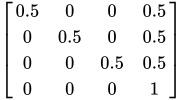
If done with a shader, or other graphics hardware extension, this transformation is usually applied at the vertex level, and the generated value is interpolated between other vertices and passed to the fragment level.
Depth map test
[edit]
Once the light-space coordinates are found, the x and y values usually correspond to a location in the depth map texture, and the z value corresponds to its associated depth, which can now be tested against the depth map.
If the z value is greater than the value stored in the depth map at the appropriate (x,y) location, the object is considered to be behind an occluding object and should be marked as a failure, to be drawn in shadow by the drawing process. Otherwise, it should be drawn lit.
If the (x,y) location falls outside the depth map, the programmer must either decide that the surface should be lit or shadowed by default (usually lit).
In a shader implementation, this test would be done at the fragment level. Also, care needs to be taken when selecting the type of texture map storage to be used by the hardware: if interpolation cannot be done, the shadow will appear to have a sharp, jagged edge (an effect that can be reduced with greater shadow map resolution).
It is possible to modify the depth map test to produce shadows with a soft edge by using a range of values (based on the proximity to the edge of the shadow) rather than simply pass or fail.
The shadow mapping technique can also be modified to draw a texture onto the lit regions, simulating the effect of a projector. The picture above captioned "visualization of the depth map projected onto the scene" is an example of such a process.
Drawing the scene
[edit]Drawing the scene with shadows can be done in several different ways. If programmable shaders are available, the depth map test may be performed by a fragment shader which simply draws the object in shadow or lighted depending on the result, drawing the scene in a single pass (after an initial earlier pass to generate the shadow map).
If shaders are not available, performing the depth map test must usually be implemented by some hardware extension (such as GL_ARB_shadow), which usually does not allow a choice between two lighting models (lit and shadowed), and necessitate more rendering passes:
- Render the entire scene in shadow. For the most common lighting models (see Phong reflection model) this should technically be done using only the ambient component of the light, but this is usually adjusted to also include a dim diffuse light to prevent curved surfaces from appearing flat in shadow.
- Enable the depth map test and render the scene lit. Areas where the depth map test fails will not be overwritten and will remain shadowed.
- An additional pass may be used for each additional light, using additive blending to combine their effect with the lights already drawn. (Each of these passes requires an additional previous pass to generate the associated shadow map.)
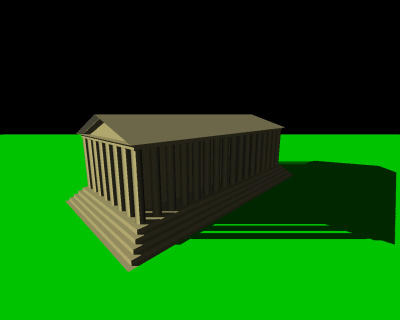
The example pictures in this article used the OpenGL extension GL_ARB_shadow_ambient to accomplish the shadow map process in two passes.
Shadow map real-time implementations
[edit]One of the key disadvantages of real-time shadow mapping is that the size and depth of the shadow map determine the quality of the final shadows. This is usually visible as aliasing or shadow continuity glitches. A simple way to overcome this limitation is to increase the shadow map size, but due to memory, computational or hardware constraints, it is not always possible. Commonly used techniques for real-time shadow mapping have been developed to circumvent this limitation. These include Cascaded Shadow Maps,[3] Trapezoidal Shadow Maps,[4] Light Space Perspective Shadow maps,[5] or Parallel-Split Shadow maps.[6]
Also notable is that generated shadows, even if aliasing free, have hard edges, which is not always desirable. In order to emulate real world soft shadows, several solutions have been developed, either by doing several lookups on the shadow map, generating geometry meant to emulate the soft edge or creating non-standard depth shadow maps. Notable examples of these are Percentage Closer Filtering,[7] Smoothies,[8] and Variance Shadow maps.[9]
Shadow mapping techniques
[edit]Simple
[edit]- SSM "Simple"
Splitting
[edit]- PSSM "Parallel Split" https://developer.nvidia.com/gpugems/GPUGems3/gpugems3_ch10.html
- CSM "Cascaded" http://developer.download.nvidia.com/SDK/10.5/opengl/src/cascaded_shadow_maps/doc/cascaded_shadow_maps.pdf
Warping
[edit]- LiSPSM "Light Space Perspective" https://www.cg.tuwien.ac.at/research/vr/lispsm/
- TSM "Trapezoid" http://www.comp.nus.edu.sg/~tants/tsm.html
- PSM "Perspective" http://www-sop.inria.fr/reves/Marc.Stamminger/psm/
- CSSM "Camera Space" http://bib.irb.hr/datoteka/570987.12_CSSM.pdf
Smoothing
[edit]- PCF "Percentage Closer Filtering" https://developer.nvidia.com/gpugems/GPUGems/gpugems_ch11.html
Filtering
[edit]- ESM "Exponential" https://discovery.ucl.ac.uk/id/eprint/10001/1/10001.pdf
- CSM "Convolution" https://doclib.uhasselt.be/dspace/bitstream/1942/8040/1/3227.pdf
- VSM "Variance" http://citeseerx.ist.psu.edu/viewdoc/download?doi=10.1.1.104.2569&rep=rep1&type=pdf
- SAVSM "Summed Area Variance" https://developer.nvidia.com/gpugems/gpugems3/part-ii-light-and-shadows/chapter-8-summed-area-variance-shadow-maps
- SMSR "Shadow Map Silhouette Revectorization" http://bondarev.nl/?p=326
Soft Shadows
[edit]- PCSS "Percentage Closer" http://developer.download.nvidia.com/shaderlibrary/docs/shadow_PCSS.pdf
- VSSM "Variance Soft Shadow Mapping" https://jankautz.com/publications/VSSM_PG2010.pdf
- SSSS "Screen space soft shadows" http://www.crcnetbase.com/doi/abs/10.1201/b10648-36
- FIV "Fullsphere Irradiance Vector" http://getlab.org/publications/FIV/
Assorted
[edit]- ASM "Adaptive" https://www.cs.cornell.edu/~kb/publications/ASM.pdf
- AVSM "Adaptive Volumetric" https://web.archive.org/web/20101208213624/http://visual-computing.intel-research.net/art/publications/avsm/
- CSSM "Camera Space" http://free-zg.t-com.hr/cssm/
- DASM "Deep Adaptive"
- DPSM "Dual Paraboloid" http://sites.google.com/site/osmanbrian2/dpsm.pdf
- DSM "Deep" http://graphics.pixar.com/library/DeepShadows/paper.pdf
- FSM "Forward" http://www.cs.unc.edu/~zhangh/technotes/shadow/shadow.ps
- LPSM "Logarithmic" http://gamma.cs.unc.edu/LOGSM/
- MDSM "Multiple Depth" http://citeseerx.ist.psu.edu/viewdoc/download?doi=10.1.1.59.3376&rep=rep1&type=pdf
- RTW "Rectilinear" http://www.cspaul.com/wiki/doku.php?id=publications:rosen.2012.i3d
- RMSM "Resolution Matched" http://www.idav.ucdavis.edu/func/return_pdf?pub_id=919
- SDSM "Sample Distribution" https://web.archive.org/web/20101208212121/http://visual-computing.intel-research.net/art/publications/sdsm/
- SPPSM "Separating Plane Perspective" http://image.diku.dk/projects/media/morten.mikkelsen.07.pdf
- SSSM "Shadow Silhouette" http://graphics.stanford.edu/papers/silmap/silmap.pdf
Miscellaneous
[edit]See also
[edit]- Shadow volume, another shadowing technique
- Ray casting, a slower technique often used in ray tracing
- Photon mapping, a much slower technique capable of very realistic lighting
- Radiosity, another very slow but very realistic technique
Further reading
[edit]- Smooth Penumbra Transitions with Shadow Maps Willem H. de Boer
- Forward shadow mapping performs the shadow test in eye-space rather than light-space to keep texture access more sequential.
References
[edit]- ^
Lance Williams. "Casting curved shadows on curved surfaces" (PDF). Retrieved 2020-12-22.
{{cite journal}}: Cite journal requires|journal=(help) - ^ Akenine-Mo ̈ller, Tomas; Haines, Eric; Hoffman, Naty (2018-08-06). Real-Time Rendering, Fourth Edition. CRC Press. ISBN 978-1-351-81615-1.
- ^
"Cascaded shadow maps" (PDF). NVidia. Retrieved 2008-02-14.
{{cite journal}}: Cite journal requires|journal=(help) - ^
Tobias Martin; Tiow-Seng Tan. "Anti-aliasing and Continuity with Trapezoidal Shadow Maps". Retrieved 2008-02-14.
{{cite journal}}: Cite journal requires|journal=(help) - ^
Michael Wimmer; Daniel Scherzer; Werner Purgathofer. "Light Space Perspective Shadow Maps". Retrieved 2008-02-14.
{{cite journal}}: Cite journal requires|journal=(help) - ^ Fan Zhang; Hanqiu Sun; Oskari Nyman. "Parallel-Split Shadow Maps on Programmable GPUs". GPU Gems 3. Archived from the original on January 17, 2010. Retrieved 2008-02-14.
- ^ "Shadow Map Antialiasing". NVidia. Retrieved 2008-02-14.
- ^
Eric Chan, Fredo Durand, Marco Corbetta. "Rendering Fake Soft Shadows with Smoothies". Retrieved 2008-02-14.
{{cite journal}}: Cite journal requires|journal=(help)CS1 maint: multiple names: authors list (link) - ^ William Donnelly; Andrew Lauritzen. "Variance Shadow Maps". Retrieved 2008-02-14.
- ^ "Common Techniques to Improve Shadow Depth Maps". Msdn.microsoft.com. Retrieved November 7, 2021.
- ^ "Cascaded Shadow Maps". Msdn.microsoft.com. Retrieved November 7, 2021.
- ^ Donnelly, William; Lauritzen, Andrew (14 March 2006). "Variance shadow maps". Proceedings of the 2006 symposium on Interactive 3D graphics and games - SI3D '06. Association for Computing Machinery. pp. 161–165. doi:10.1145/1111411.1111440. ISBN 159593295X. S2CID 538139. Retrieved 7 November 2021 – via ACM Digital Library.
External links
[edit]- Hardware Shadow Mapping, nVidia
- Shadow Mapping with Today's OpenGL Hardware, nVidia
- Riemer's step-by-step tutorial implementing Shadow Mapping with HLSL and DirectX
- Improvements for Shadow Mapping using GLSL
- NVIDIA Real-time Shadow Algorithms and Techniques
- Shadow Mapping implementation using Java and OpenGL
Shadow mapping
View on GrokipediaFundamentals
Definition and History
Shadow mapping is a rasterization-based computer graphics technique used to approximate hard shadows in rendered scenes by generating a depth map, known as the shadow map, from the viewpoint of a light source and then comparing depths during the primary scene rendering to determine shadowed regions.[5] This image-space method leverages depth buffering to efficiently handle occlusions without explicit ray tracing, making it suitable for both static and dynamic scenes.[6] The technique was invented by Lance Williams in 1978, detailed in his seminal SIGGRAPH paper "Casting Curved Shadows on Curved Surfaces," which introduced the core idea of projecting depth information from a light's perspective to cast shadows onto arbitrary surfaces, including curved ones.[5] Initially, shadow mapping found application in offline rendering for pre-computed animations and visual effects, particularly in the 1980s as computational power allowed for more complex scene illumination in film production. For instance, Pixar researchers extended the method in 1987 to handle antialiased shadows using depth maps for area light sources, enabling higher-quality results in ray-traced environments like those in early computer-animated films.[7] Shadow mapping transitioned to real-time rendering in the late 1990s and early 2000s, driven by advancements in graphics hardware that supported programmable shaders and depth textures. The NVIDIA GeForce 3 GPU, released in 2001, provided hardware acceleration for shadow maps via DirectX 8 and OpenGL extensions, allowing efficient implementation in interactive applications.[6] This milestone facilitated its adoption in video games, marking one of the earliest uses of real-time shadow mapping for dynamic shadows. By the mid-2000s, integration into standard rendering pipelines in OpenGL and DirectX enabled widespread use for handling multiple dynamic lights in real-time scenarios, evolving from its offline origins to a cornerstone of modern graphics engines.[6]Principles of Shadows and Shadow Maps
Shadows in optical physics arise from the occlusion of light by intervening geometry, preventing direct illumination from reaching certain surfaces. When an opaque object blocks rays from a light source to a receiver, it casts a shadow consisting of two distinct regions: the umbra, where the light source is completely obstructed and no direct light reaches the surface, and the penumbra, where partial occlusion occurs, allowing some light rays to graze the edges of the occluder and create a transitional zone of reduced intensity.[8] This formation depends on the relative positions of the light, occluder, and receiver, with the umbra being the darkest core and the penumbra providing a softer boundary.[9] The nature of shadows—hard or soft—fundamentally stems from the size and distance of the light source relative to the occluder. A point light source, idealized as having zero extent, produces sharp, hard shadows with no penumbra because all rays are either fully blocked or fully transmitted, resulting in binary occlusion.[8] In contrast, extended light sources, such as area lights with non-negligible size comparable to the occluder distance, generate soft shadows featuring prominent penumbrae, as varying portions of the source remain visible around the occluder's edges, blending the transition from full shadow to illumination.[9] Larger source sizes or closer occluder distances amplify the penumbra width, enhancing realism but increasing computational complexity in simulation.[8] In computer graphics, shadow maps digitally represent these occlusion principles as a 2D texture capturing the minimum depth from the light source to visible surfaces within its view frustum, serving as a proxy for determining shadowed regions during rendering.[10] This depth map encodes, for each texel (pixel in texture space), the closest distance along rays emanating from the light, effectively approximating the umbra and penumbra boundaries by comparing scene depths against stored values.[1] The technique relies on rasterization pipelines that employ projective geometry to transform world coordinates into the light's view space via view-projection matrices, which define the frustum as a perspective volume bounding the illuminated scene.[11] Depth buffering, a core prerequisite in this rasterization process, maintains a per-pixel buffer storing the minimum depth value encountered during scene traversal, resolving visibility by discarding fragments farther from the viewpoint (or light, in shadow map generation).[11] Projective geometry ensures accurate mapping by applying homogeneous transformations—combining view matrices (positioning the light as camera) and projection matrices (perspective or orthographic)—to clip and normalize coordinates within the frustum, enabling the shadow map to align seamlessly with the light's optical projection.[10] This foundation allows shadow maps to efficiently proxy real-world occlusion without explicit ray tracing of every light path.[1]Core Algorithm
Generating the Shadow Map
The generation of the shadow map constitutes the first pass of the shadow mapping algorithm, where the scene is rendered solely from the perspective of the light source to capture depth information about occluding geometry. This process utilizes the light's viewpoint to determine visible surfaces, storing their distances in a depth texture that serves as the shadow map. Introduced by Williams in 1978, this depth-only rendering leverages Z-buffer techniques to efficiently compute the nearest surface depth for each pixel in the light's view frustum.[12] To initiate the generation, the view matrix for the light is established by positioning a virtual camera at the light source and orienting it along the light's direction, transforming world-space coordinates into light-view space. The projection matrix is then configured based on the light type: an orthographic projection for directional lights to model parallel rays emanating from an infinite distance, and a perspective projection for spot lights to simulate the conical volume illuminated by the source with a defined field of view and angle. For point lights, which emit in all directions, a perspective projection is applied across multiple faces of a cubemap to encompass the full 360-degree surroundings, though basic implementations often limit this to simpler cases. The scene geometry is subsequently rendered using these matrices, employing a fragment shader or render state that discards color output and writes only the depth values to the attached depth buffer. These depths are stored in a 2D texture, typically at a resolution like 1024×1024 pixels, which provides a balance between shadow detail and rendering overhead.[13][14] During rendering, the depth value for each fragment is derived from the light-space position of the world vertex, computed asand then normalized and clamped to the [0,1] range suitable for texture storage, representing the relative distance from the light to the surface. This value records the minimum depth (closest occluder) per texel via depth testing, ensuring the shadow map encodes only the frontmost geometry visible to the light.[13] For scenes with multiple light sources, shadow maps are generated sequentially for each active light, producing distinct depth textures that can later be sampled independently during scene rendering. This per-light approach accommodates varying projection types and positions but scales the computational cost with the number of shadow-casting lights, often necessitating optimizations like limiting shadows to key sources in real-time applications.[6]