Recent from talks
Contribute something
Nothing was collected or created yet.
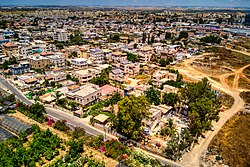
Lod (Hebrew: לוד, fully vocalized: לֹד), also known as Lydda (Ancient Greek: Λύδδα) and Lidd (Arabic: اللِّدّ, romanized: al-Lidd, or اللُّدّ, al-Ludd), is a city 15 km (9+1⁄2 mi) southeast of Tel Aviv and 40 km (25 mi) northwest of Jerusalem in the Central District of Israel. It is situated between the lower Shephelah on the east and the coastal plain on the west. The city had a population of 90,814 in 2023.[1]
Key Information
Lod has been inhabited since at least the Neolithic period.[2] It is mentioned a few times in the Hebrew Bible and in the New Testament.[3] Between the 5th century BCE and up until the late Roman period, it was a prominent center for Jewish scholarship and trade.[3][4] Around 200 CE, the city became a Roman colony and was renamed Diospolis (Ancient Greek: Διόσπολις, lit. 'city of Zeus'). Tradition identifies Lod as the 4th century martyrdom site of Saint George;[5][6] the Church of Saint George and Mosque of Al-Khadr located in the city is believed to have housed his remains.[3][7]
Following the Arab conquest of the Levant, Lod served as the capital of Jund Filastin; however, a few decades later, the seat of power was transferred to Ramla, and Lod slipped in importance.[3][8] Under Crusader rule, the city was a Catholic diocese of the Latin Church and it remains a titular see to this day.[citation needed]
Lod underwent a major change in its population in the mid-20th century.[9] Exclusively Palestinian Arab in 1947,[9] Lod was part of the area designated for an Arab state in the United Nations Partition Plan for Palestine; however, in July 1948, the city was occupied by the Israel Defense Forces, and most of its Arab inhabitants were expelled in the Palestinian expulsion from Lydda and Ramle.[10][11] The city was largely resettled by Jewish immigrants, most of them expelled from Arab countries.[12][13]
Today, Lod is one of Israel's mixed cities, with an Arab population of 30%.[14] Lod is one of Israel's major transportation hubs. The main international airport, Ben Gurion Airport, is located 8 km (5 miles) north of the city. The city is also a major railway and road junction.[3]
Religious references
[edit]The Hebrew name Lod appears in the Hebrew Bible as a town of Benjamin, founded along with Ono by Shamed or Shamer (1 Chronicles 8:12; Ezra 2:33; Nehemiah 7:37; 11:35). In Ezra 2:33, it is mentioned as one of the cities whose inhabitants returned after the Babylonian captivity. Lod is not mentioned among the towns allocated to the tribe of Benjamin in Joshua 18:11–28.[15]
The name Lod derives from a tri-consonental root not extant in Northwest Semitic, but only in Arabic (“to quarrel; withhold, hinder”). An Arabic etymology of such an ancient name is unlikely (the earliest attestation is from the Achaemenid period).[16]
In the New Testament, the town appears in its Greek form, Lydda,[17][18][19] as the site of Peter's healing of Aeneas in Acts 9:32–38.[20]
The city is also mentioned in an Islamic hadith as the location of the battlefield where the false messiah (al-Masih ad-Dajjal) will be slain before the Day of Judgment.[21]
History
[edit]Neolithic and Chalcolithic
[edit]The first occupation was in the Neolithic period.[22][23] Occupation continued in the Chalcolithic.[24][25][26] Pottery finds have dated the initial settlement in the area now occupied by the town to 5600–5250 BCE.[27]
Early Bronze
[edit]In the Early Bronze, it was an important settlement in the central coastal plain between the Judean Shephelah and the Mediterranean coast, along Nahal Ayalon.[28] Other important nearby sites were Tel Dalit, Tel Bareqet, Khirbat Abu Hamid (Shoham North), Tel Afeq, Azor and Jaffa.
Two architectural phases belong to the late EB I in Area B.[29] The first phase had a mudbrick wall, while the late phase included a circulat stone structure. Later excavations have produced an occupation later, Stratum IV.[30] It consists of two phases, Stratum IVb with mudbrick wall on stone foundations and rounded exterior corners. In Stratum IVa there was a mudbrick wall with no stone foundations, with imported Egyptian potter and local pottery imitations.
Another excavations revealed nine occupation strata. Strata VI-III belonged to Early Bronze IB. The material culture showed Egyptian imports in strata V and IV.[31]
Occupation continued into Early Bronze II with four strata (V-II). There was continuity in the material culture and indications of centralized urban planning.
Middle Bronze
[edit]North to the tell were scattered MB II burials.[32]
Late Bronze
[edit]The earliest written record is in a list of Canaanite towns drawn up by the Egyptian pharaoh Thutmose III at Karnak in 1465 BCE.[33]
Classical era
[edit]From the fifth century BCE until the Roman period, the city was a centre of Jewish scholarship[34] and commerce.[35]
According to British historian Martin Gilbert, during the Hasmonean period, Jonathan Maccabee and his brother, Simon Maccabaeus, enlarged the area under Jewish control, which included conquering the city.[36]
Roman era
[edit]
The Jewish community in Lod during the Mishnah and Talmud era is described in a significant number of sources, including information on its institutions, demographics, and way of life. The city reached its height as a Jewish center between the First Jewish-Roman War and the Bar Kokhba revolt, and again in the days of Judah ha-Nasi and the start of the Amoraim period. The city was then the site of numerous public institutions, including schools, study houses, and synagogues.[4]
In 43 BC, Cassius, the Roman governor of Syria, sold the inhabitants of Lod into slavery, but they were set free two years later by Mark Antony.[37][38]
During the First Jewish–Roman War, the Roman proconsul of Syria, Cestius Gallus, razed the town on his way to Jerusalem in Tishrei 66 CE. According to Josephus, "[he] found the city deserted, for the entire population had gone up to Jerusalem for the Feast of Tabernacles. He killed fifty people whom he found, burned the town and marched on".[4][39] Lydda was occupied by Emperor Vespasian in 68 CE.[40]
In the period following the destruction of Jerusalem in 70 CE, Rabbi Tarfon, who appears in many Tannaitic and Jewish legal discussions, served as a rabbinic authority in Lod.[41]
During the Kitos War, 115–117 CE, the Roman army laid siege to Lod, where the rebel Jews had gathered under the leadership of Julian and Pappos. Torah study was outlawed by the Romans and pursued mostly in the underground.[42] The distress became so great, the patriarch Rabban Gamaliel II, who was shut up there and died soon afterwards, permitted fasting on Ḥanukkah. Other rabbis disagreed with this ruling.[43] Lydda was next taken and many of the Jews were executed; the "slain of Lydda" are often mentioned in words of reverential praise in the Talmud.[44]
In 200 CE, emperor Septimius Severus elevated the town to the status of a city, calling it Colonia Lucia Septimia Severa Diospolis.[45] The name Diospolis ("City of Zeus") may have been bestowed earlier, possibly by Hadrian.[46] At that point, most of its inhabitants were Christian. The earliest known bishop is Aëtius, a friend of Arius.[37]
During the following century (200-300CE), it's said that Joshua ben Levi founded a yeshiva in Lod.
Byzantine period
[edit]In December 415, the Council of Diospolis was held here to try Pelagius; he was acquitted. In the sixth century, the city was renamed Georgiopolis[47] after St. George, a soldier in the guard of the emperor Diocletian, who was born there between 256 and 285 CE.[48]
The Church of Saint George and Mosque of Al-Khadr is named for him.[33] The 6th-century Madaba map shows Lydda as an unwalled city with a cluster of buildings under a black inscription reading "Lod, also Lydea, also Diospolis".[49] An isolated large building with a semicircular colonnaded plaza in front of it might represent the St George shrine.[50]
Early Muslim period
[edit]
After the Muslim conquest of Palestine by Amr ibn al-'As in 636 CE,[51] Lod which was referred to as "al-Ludd" in Arabic served as the capital of Jund Filastin ("Military District of Palaestina") before the seat of power was moved to nearby Ramla during the reign of the Umayyad Caliph Suleiman ibn Abd al-Malik in 715–716. The population of al-Ludd was relocated to Ramla, as well.[52] With the relocation of its inhabitants and the construction of the White Mosque in Ramla, al-Ludd lost its importance and fell into decay.[8]
The city was visited by the local Arab geographer al-Muqaddasi in 985, when it was under the Fatimid Caliphate, and was noted for its Great Mosque which served the residents of al-Ludd, Ramla, and the nearby villages. He also wrote of the city's "wonderful church (of St. George) at the gate of which Christ will slay the Antichrist."[53]
Crusader and Ayyubid period
[edit]The Crusaders occupied the city in 1099 and named it St Jorge de Lidde.[35] It was briefly conquered by Saladin, but retaken by the Crusaders in 1191. For the English Crusaders, it was a place of great significance as the birthplace of Saint George. The Crusaders made it the seat of a Latin Church diocese,[54] and it remains a titular see.[37] It owed the service of 10 knights and 20 sergeants, and it had its own burgess court during this era.[55]
In 1226, Ayyubid Syrian geographer Yaqut al-Hamawi visited al-Ludd and stated it was part of the Jerusalem District during Ayyubid rule.[56]
Mamluk period
[edit]
Sultan Baybars brought Lydda again under Muslim control by 1267–8.[57] According to Qalqashandi, Lydda was an administrative centre of a wilaya during the fourteenth and fifteenth century in the Mamluk empire.[57] Mujir al-Din described it as a pleasant village with an active Friday mosque.[57][58] During this time, Lydda was a station on the postal route between Cairo and Damascus.[57][59]
Ottoman period
[edit]

In 1517, Lydda was incorporated into the Ottoman Empire as part of the Damascus Eyalet, and in the 1550s, the revenues of Lydda were designated for the new waqf of Hasseki Sultan Imaret in Jerusalem, established by Hasseki Hurrem Sultan (Roxelana), the wife of Suleiman the Magnificent.[60]
By 1596 Lydda was a part of the nahiya ("subdistrict") of Ramla, which was under the administration of the liwa ("district") of Gaza. It had a population of 241 households and 14 bachelors who were all Muslims, and 233 households who were Christians.[61] They paid a fixed tax-rate of 33,3 % on agricultural products, including wheat, barley, summer crops, vineyards, fruit trees, sesame, special product ("dawalib" =spinning wheels[57]), goats and beehives, in addition to occasional revenues and market toll, a total of 45,000 Akçe. All of the revenue went to the Waqf.[62]
In 1051 AH/1641/2, the Bedouin tribe of al-Sawālima from around Jaffa attacked the villages of Subṭāra, Bayt Dajan, al-Sāfiriya, Jindās, Lydda and Yāzūr belonging to Waqf Haseki Sultan.[63]
The village appeared as Lydda, though misplaced, on the map of Pierre Jacotin compiled in 1799.[64]
Missionary William M. Thomson visited Lydda in the mid-19th century, describing it as a "flourishing village of some 2,000 inhabitants, imbosomed in noble orchards of olive, fig, pomegranate, mulberry, sycamore, and other trees, surrounded every way by a very fertile neighbourhood. The inhabitants are evidently industrious and thriving, and the whole country between this and Ramleh is fast being filled up with their flourishing orchards. Rarely have I beheld a rural scene more delightful than this presented in early harvest ... It must be seen, heard, and enjoyed to be appreciated."[65]
In 1869, the population of Ludd was given as: 55 Catholics, 1,940 "Greeks", 5 Protestants and 4,850 Muslims.[66] In 1870, the Church of Saint George was rebuilt. In 1892, the first railway station in the entire region was established in the city.[67] In the second half of the 19th century, Jewish merchants migrated to the city, but left after the 1921 Jaffa riots.[67]
In 1882, the Palestine Exploration Fund's Survey of Western Palestine described Lod as "A small town, standing among enclosure of prickly pear, and having fine olive groves around it, especially to the south. The minaret of the mosque is a very conspicuous object over the whole of the plain. The inhabitants are principally Moslim, though the place is the seat of a Greek bishop resident of Jerusalem. The Crusading church has lately been restored, and is used by the Greeks. Wells are found in the gardens...."[66]
British Mandate
[edit]

From 1918, Lydda was under the administration of the British Mandate in Palestine, as per a League of Nations decree that followed the Great War. During the Second World War, the British set up supply posts in and around Lydda and its railway station, also building an airport that was renamed Ben Gurion Airport after the death of Israel's first prime minister in 1973.[67][68]
At the time of the 1922 census of Palestine, Lydda had a population of 8,103 inhabitants (7,166 Muslims, 926 Christians, and 11 Jews),[69] the Christians were 921 Orthodox, 4 Roman Catholics and 1 Melkite.[70] This had increased by the 1931 census to 11,250 (10,002 Muslims, 1,210 Christians, 28 Jews, and 10 Bahai), in a total of 2475 residential houses.[71]
In 1938, Lydda had a population of 12,750.[72]
In 1945, Lydda had a population of 16,780 (14,910 Muslims, 1,840 Christians, 20 Jews and 10 "other").[73] Until 1948, Lydda was an Arab town with a population of around 20,000—18,500 Muslims and 1,500 Christians.[74][75] In 1947, the United Nations proposed dividing Mandatory Palestine into two states, one Jewish state and one Arab; Lydda was to form part of the proposed Arab state.[76] In the ensuing war, Israel captured Arab towns outside the area the UN had allotted it, including Lydda.
In December 1947, thirteen Jewish passengers in a seven-car convoy to Ben Shemen Youth Village were ambushed and murdered.[77][78]In a separate incident, three Jewish youths, two men and a woman were captured, then raped and murdered in a neighbouring village.[78] Their bodies were paraded in Lydda’s principal street.[78]
State of Israel
[edit]The Israel Defense Forces entered Lydda on 11 July 1948.[79] The following day, under the impression that it was under attack,[80] the 3rd Battalion was ordered to shoot anyone "seen on the streets". According to Israel, 250 Arabs were killed. Other estimates are higher: Arab historian Aref al Aref estimated 400, and Nimr al Khatib 1,700.[81][82]
In 1948, the population rose to 50,000 during the Nakba, as Arab refugees fleeing other areas made their way there.[67] A key event was the Palestinian expulsion from Lydda and Ramle, with the expulsion of 50,000-70,000 Palestinians from Lydda and Ramle by the Israel Defense Forces. All but 700[83] to 1,056[12] were expelled by order of the Israeli high command, and forced to walk 17 km (10+1⁄2 mi) to the Jordanian Arab Legion lines. Estimates of those who died from exhaustion and dehydration vary from a handful to 355.[84][85] The town was subsequently sacked by the Israeli army.[86] Some scholars, including Ilan Pappé, characterize this as ethnic cleansing.[87] The few hundred Arabs who remained in the city were soon outnumbered by the influx of Jews who immigrated to Lod from August 1948 onward, most of them from Arab countries.[12] As a result, Lod became a predominantly Jewish town.[75][88]
After the establishment of the state, the biblical name Lod was readopted.[89]
-
Lydda five months after Operation Danny. December 1948.
-
Lydda, 1948
-
Church of Saint George and Mosque of Al-Khadr, after the battle. 1948
-
Palmach 3 inch mortar in front of Lydda mosque. 1948
The Jewish immigrants who settled Lod came in waves, first from Morocco and Tunisia, later from Ethiopia, and then from the former Soviet Union.[90]
Since 2008, many urban development projects have been undertaken to improve the image of the city. Upscale neighbourhoods have been built, among them Ganei Ya'ar and Ahisemah, expanding the city to the east. According to a 2010 report in the Economist, a three-meter-high wall was built between Jewish and Arab neighbourhoods and construction in Jewish areas was given priority over construction in Arab neighborhoods. The newspaper says that violent crime in the Arab sector revolves mainly around family feuds over turf and honour crimes.[91] In 2010, the Lod Community Foundation organised an event for representatives of bicultural youth movements, volunteer aid organisations, educational start-ups, businessmen, sports organizations, and conservationists working on programmes to better the city.[92]

In the 2021 Israel–Palestine crisis, a state of emergency was declared in Lod after Arab rioting led to the death of an Israeli Jew.[93] The Mayor of Lod, Yair Revivio, urged Prime Minister of Israel Benjamin Netanyahu to deploy Israel Border Police to restore order in the city.[94][95] This was the first time since 1966 that Israel had declared this kind of emergency lockdown.[96][97] International media noted that both Jewish and Palestinian mobs were active in Lod, but the "crackdown came for one side" only.[98][99][100][101][102]
Demographics
[edit]
In the 19th century and until the Lydda Death March, Lod was an exclusively Muslim-Christian town, with an estimated 6,850 inhabitants, of whom approximately 2,000 (29%) were Christian.[103]
According to the Israel Central Bureau of Statistics (CBS), the population of Lod in 2010 was 69,500 people.[104]
According to the 2019 census, the population of Lod was 77,223, of which 53,581 people, comprising 69.4% of the city's population, were classified as "Jews and Others", and 23,642 people, comprising 30.6% as "Arab".[1]
Education
[edit]According to CBS, 38 schools and 13,188 pupils are in the city. They are spread out as 26 elementary schools and 8,325 elementary school pupils, and 13 high schools and 4,863 high school pupils. About 52.5% of 12th-grade pupils were entitled to a matriculation certificate in 2001.[citation needed]
Economy
[edit]
The airport and related industries are a major source of employment for the residents of Lod. Other important factories in the city are the communication equipment company "Talard", "Cafe-Co" - a subsidiary of the Strauss Group and "Kashev" - the computer center of Bank Leumi.
A Jewish Agency Absorption Centre is also located in Lod. According to CBS figures for 2000, 23,032 people were salaried workers and 1,405 were self-employed. The mean monthly wage for a salaried worker was NIS 4,754, a real change of 2.9% over the course of 2000. Salaried men had a mean monthly wage of NIS 5,821 (a real change of 1.4%) versus NIS 3,547 for women (a real change of 4.6%). The mean income for the self-employed was NIS 4,991. About 1,275 people were receiving unemployment benefits and 7,145 were receiving an income supplement.
Art and culture
[edit]In 2009-2010, Dor Guez held an exhibit, Georgeopolis, at the Petach Tikva art museum that focuses on Lod.[105]
Archaeology
[edit]
A well-preserved mosaic floor dating to the Roman period was excavated in 1996 as part of a salvage dig conducted on behalf of the Israel Antiquities Authority and the Municipality of Lod, prior to widening HeHalutz Street. According to Jacob Fisch, executive director of the Friends of the Israel Antiquities Authority, a worker at the construction site noticed the tail of a tiger and halted work.[106] The mosaic was initially covered over with soil at the conclusion of the excavation for lack of funds to conserve and develop the site.[107] The mosaic is now part of the Lod Mosaic Archaeological Center. The floor, with its colorful display of birds, fish, exotic animals and merchant ships, is believed to have been commissioned by a wealthy resident of the city for his private home.[108]
The Lod Community Archaeology Program, which operates in ten Lod schools, five Jewish and five Israeli Arab, combines archaeological studies with participation in digs in Lod.[109]
Sports
[edit]The city's major football club, Hapoel Bnei Lod, plays in Liga Leumit (the second division). Its home is at the Lod Municipal Stadium. The club was formed by a merger of Bnei Lod and Rakevet Lod in the 1980s. Two other clubs in the city play in the regional leagues: Hapoel MS Ortodoxim Lod in Liga Bet and Maccabi Lod in Liga Gimel.
Hapoel Lod played in the top division during the 1960s and 1980s, and won the State Cup in 1984. The club folded in 2002. A new club, Hapoel Maxim Lod (named after former mayor Maxim Levy) was established soon after, but folded in 2007.
Notable people
[edit]

- Rabbi Akiva, Talmudic sage
- Etti Ankri (born 1963), singer
- Oshri Cohen (born 1984), actor
- Artem Dolgopyat (born 1997), Olympic champion and world champion gymnast
- St George, Patron Saint of Beirut, Palestine, England, Russia, and Catalonia
- George Habash (1926–2008), founder of the Popular Front for the Liberation of Palestine
- Eliezer ben Hurcanus, Talmudic sage
- Joshua ben Levi, Talmudic sage
- Tamer Nafar (born 1979), rapper
- Suhell Nafar, rapper
- Rabbi Tarfon, Talmudic sage
- Salim Tuama (born 1979), footballer
- Sami Abu Shehadeh (born 1975), politician
Twin towns-sister cities
[edit]See also
[edit]References
[edit]- ^ a b c "Regional Statistics". Israel Central Bureau of Statistics. Retrieved 11 August 2025.
- ^ Commenge, Catherine. "Lod Newe Yarak: a roman pottery kiln and Pottery Neolithic A remains".
- ^ a b c d e "Lod | City, Israel, Palestine, & History | Britannica". britannica.com. Retrieved 25 June 2022.
- ^ a b c Corpus inscriptionum Iudaeae/Palaestinae: a multi-lingual corpus of the inscriptions from Alexander to Muhammad. Vol. IV: Iudaea / Idumaea. Eran Lupu, Marfa Heimbach, Naomi Schneider, Hannah Cotton. Berlin: de Gruyter. 2018. pp. 77–85. ISBN 978-3-11-022219-7. OCLC 663773367.
{{cite book}}: CS1 maint: others (link) - ^ Mahoney, Lisa (2020-04-14), "Art and efficacy in an icon of St George *", The Eloquence of Art, Abingdon, Oxon; New York, NY: Routledge, pp. 188–203, doi:10.4324/9781351185592-11, ISBN 978-1-351-18559-2, S2CID 218824016, retrieved 27 June 2022,
By 1099 crusading armies had captured the city of Lydda, the site of St George's martyrdom and tomb.
- ^ Howell, David (1969). "St. George as Intercessor". Byzantion. 39: 121–136. ISSN 0378-2506. JSTOR 44169945.
- ^ Walter, Christopher (1995). "The Origins of the Cult of Saint George". Revue des études byzantines. 53 (1): 295–326. doi:10.3406/rebyz.1995.1911. ISSN 0766-5598.
- ^ a b Le Strange, 1890, p. 308
- ^ a b Rabinowitz, Dan; Monterescu, Daniel (2008-05-01). "RECONFIGURING THE "MIXED TOWN": URBAN TRANSFORMATIONS OF ETHNONATIONAL RELATIONS IN PALESTINE AND ISRAEL - International Journal of Middle East Studies". International Journal of Middle East Studies. 40 (2): 208–210. doi:10.1017/S0020743808080513. ISSN 1471-6380. S2CID 162633906.
The Palestinian quarters of Safad, Tiberias, Haifa, Jaffa, and West Jerusalem and the Jewish quarter of the Old City of Jerusalem were in a state of sociological catastrophe, with no community to speak of to even bury the dead and mourn the old existence... By late 1949 only one of the five towns that had been effectively mixed on the eve of the war, namely, Haifa, still had a Palestinian contingent. Even there, however, the urban mix had been transformed beyond recognition. The 3,000 remaining Palestinians, now representing less than 5 percent of the original community, had been uprooted and forced to relocate to downtown Wadi Ninas... More relevant for our concerns here are Acre, Lydda, Ramle, and Jaffa, which, although exclusively Palestinian before the war of 1948, became predominantly Jewish mixed towns after. All of them had their residual Palestinian populations concentrated in bounded compounds, in one case (Jaffa) surrounded for a while by barbed wire. As late as the summer of 1949, all of these compounds were subjected to martial law.
- ^ Shapira, Anita, “Politics and Collective Memory: the Debate Over the 'New Historians' in Israel,” History and Memory 7 (1) (Spring 1995), pp. 9ff, 12–13, 16–17.
- ^ Blumenthal, 2013, p. 420
- ^ a b c M. Sharon, s.v. "Ludd," Encyclopedia of Islam, 2nd ed. Leiden: Brill, 1983, vol. 5, pp. 798-803; ISBN 978-90-04-07164-3
- ^ Morris, 2004, pp. 414-461.
- ^ Uploads (p. 18), Jerusaleminstitute.org. Accessed 1 November 2022.
- ^ Exell, J. S. and Spencer-Jones, H. (eds), Pulpit Commentary on 1 Chronicles 8, biblehub.com. Accessed 8 February 2020.
- ^ Marom, Roy (2023). "Early-Ottoman Palestinian Toponymy: A Linguistic Analysis of the (Micro-)Toponyms in Haseki Sultan's Endowment Deed (1552)". Zeitschrift des Deutschen Palästina-Vereins. 139 (2).
- ^ Bible Dictionary, "Lydda"
- ^ International Standard Bible Encyclopedia, "Lod; Lydda"
- ^ Palmer, 1881, p. 216
- ^ "Lod," Encyclopædia Britannica, 2009. "And it came to pass, as Peter passed throughout all quarters, he came down also to the saints which dwelt at Lydda", Acts 9:32–38
- ^ "Signs of the Appearance of the Dajjal". Missionislam.com. Retrieved 12 March 2013.
- ^ Yannai and Marder 2000
- ^ Brink 1999, 2002, Brink et al. 2015
- ^ Paz, Rosenberg and Nativ 2005:131–154
- ^ Yannai and Marder 2000
- ^ Schwartz, Joshua J. Lod (Lydda), Israel: from its origins through the Byzantine period, 5600 B.C.-640 A.D.. Tempus Reparatum, 1991, p. 39.
- ^ Amir Golani (2022) Early Bronze Age Remains at Tel Lod, 'Atiqot 108
- ^ Keplan 1977
- ^ Brink 1999, 2002; Brink et al. 2015
- ^ Paz, Rosenberg and Nativ 2005:131–154
- ^ Segal 2012
- ^ a b "Excursions in Terra Santa". Franciscan Cyberspot. Archived from the original on 23 October 2012. Retrieved 22 February 2007.
- ^ Rozenfeld, 2010, p. 52
- ^ a b "Lod," Encyclopædia Britannica, 2009.
- ^ Gilbert, Martin. Dearest Auntie Flori: The Story of the Jewish People. New York: Harper Collins 2002, p. 82; also see Josephus, Antiquities of the Jews 14: 208
- ^ a b c d Lydda, Catholic-hierarchy.org. Accessed 1 November 2022.
- ^ Josephus, "Jewish War", I, xi, 2; "Antiquities", XIV xii, pp. 2–5.
- ^ Rogers, Guy MacLean (2021). For the Freedom of Zion: the Great Revolt of Jews against Romans, 66-74 CE. New Haven: Yale University Press. p. 169. ISBN 978-0-300-24813-5.
- ^ Michael Avi-Yonah, s.v. "Lydda," Encyclopaedia Judaica. Accessed 1 November 2022.
- ^ Orlin, Eric (19 November 2015). Routledge Encyclopedia of Ancient Mediterranean Religions. Routledge. ISBN 978-1-134-62559-8 – via Google Books.
- ^ Holder, 1986, p. 52
- ^ Ta'anit ii. 10; Yer. Ta'anit ii. 66a; Yer. Meg. i. 70d; R. H. 18b
- ^ Pes. 50a; B. B. 10b; Eccl. R. ix. 10
- ^ Cecil Roth, Encyclopaedia Judaica, 1972, p. 619.
- ^ Smallwood, 2001, p. 241
- ^ Yoram Tsafrir, Leah Di Segni, Judith Green, Tabula Imperii Romani Iudaea-Palestina: Eretz Israel in the Hellenistic, Roman and Byzantine Periods; Maps and Gazetteer, p. 171. Israel Academy of Sciences and Humanities, 1994; ISBN 978-965-208-107-0
- ^ Frenkel, Sheera and Low, Valentine. "Why Lod, the other land of St George, isn't for the faint-hearted"[dead link], The Times, 23 April 2009.
- ^ The Madaba Mosaic Map, Jerusalem 1954, pp. 61–62
- ^ Donner, Herbert (1995). The Mosaic Map of Madaba: An Introductory Guide. Palaestina antiqua (7) (2nd print ed.). Kampen: Kok Pharos. p. 54. ISBN 978-90-390-0011-3. Retrieved 25 March 2020.
- ^ Le Strange, 1890, p. 28
- ^ Le Strange, 1890, p. 303
- ^ Le Strange, 1890 p. 493
- ^ Herbermann, Charles, ed. (1913). . Catholic Encyclopedia. New York: Robert Appleton Company.
- ^ Pringle, 1998, p. 11
- ^ Le Strange, 1890, p. 494
- ^ a b c d e Petersen, 2001, p. 203 Archived 2016-10-10 at the Wayback Machine
- ^ Moudjir ed-dyn, 1876, Sauvaire (translation), pp. 210-213
- ^ al-Ẓāhirī, 1894, pp. 118-119
- ^ Singer, 2002, p. 49
- ^ Petersen, 2005, p. 131
- ^ Hütteroth and Abdulfattah, 1977, p. 154
- ^ Marom, Roy (2022-11-01). "Jindās: A History of Lydda's Rural Hinterland in the 15th to the 20th Centuries CE". Lod, Lydda, Diospolis: 13–14.
- ^ Karmon, 1960, p. 171 Archived 2019-12-22 at the Wayback Machine
- ^ Thomson, 1859, pp. 292-3
- ^ a b Conder and Kitchener, 1882, SWP II, p. 252
- ^ a b c d Shahin, 2005, p. 260
- ^ "Ben Gurion Airport". Jerusalem Post. Retrieved 11 November 2021.
- ^ Barron, 1923, Table VII, p. 21
- ^ Barron, 1923, Table XIV, p. 46
- ^ Mills, 1932, p. 21
- ^ Village Statistics (PDF). 1938. p. 59.
- ^ Department of Statistics, 1945, p. 30
- ^ "Lod," 2 January 1949, IS archive Gimel/5/297 in Yacobi, 2009, p. 31.
- ^ a b Monterescu and Rabinowitz, 2012, pp. 16-17.
- ^ Sa'di and Abu-Lughod, 2007, pp. 91-92.
- ^ Jews and Arabs Die As Palestine Disorders Continue; Arab Legion Kills 12 Jews The Jewish Telegraphic Agency. 15 December 1947
- ^ a b c Shavit, Ari (2013). My Promised Land. Spiegel & Grau. p. 128. ISBN 978-0385521703.
- ^ For one account, interspersed with interviews with IDF soldiers, see Ari Shavit, My Promised Land: The Triumph and Tragedy of Israel. New York: Spiegel & Grau, 2013, pp. 99–132.
- ^ Tal, 2004, p. 311.
- ^ Sefer Hapalmah ii (The Book of the Palmah), p. 565; and KMA-PA (Kibbutz Meuhad Archives – Palmah Archive). Quoted in Benny Morris, The Birth of the Palestinian Refugee Problem, 1947–1949. New York: Cambridge University Press, 1987.
- ^ Morris, 2004, p. 205 Morris writes: "[...] dozens of unarmed detainees in the mosque and church in the centre of the town were shot and killed."
- ^ The figure comes from Bechor Sheetrit, the Israeli Minister for Minority Affairs at the time, cited in Yacobi, 2009, p. 32.
- ^ Spiro Munayyer, The Fall of Lydda( اللد لن تقع), Journal of Palestine Studies, Vol. 27, No. 4 (Summer, 1998), pp. 80–98. See also Yitzhak Rabin's diaries, quoted here [1].
- ^ Holmes et al., 2001, p. 64.
- ^ Morris, Benny "Operation Dani and the Palestinian Exodus from Lydda and Ramle in 1948", Middle East Journal 40 (1986), p. 88.
- ^ For the use of the term "ethnic cleansing", see, for example, Pappé 2006.
- On whether what occurred in Lydda and Ramle constituted ethnic cleansing:
- Morris 2008, p. 408: "although an atmosphere of what would later be called ethnic cleansing prevailed during critical months, transfer never became a general or declared Zionist policy. Thus, by war's end, even though much of the country had been 'cleansed' of Arabs, other parts of the country—notably central Galilee — were left with substantial Muslim Arab populations, and towns in the heart of the Jewish coastal strip, Haifa and Jaffa, were left with an Arab minority."
- Spangler 2015, p. 156: "During the Nakba, the 1947 [sic] displacement of Palestinians, Rabin had been second in command over Operation Dani, the ethnic cleansing of the Palestinian towns of towns of Lydda and Ramle."
- Schwartzwald 2012, p. 63: "The facts do not bear out this contention [of ethnic cleansing]. To be sure, some refugees were forced to flee: fifty thousand were expelled from the strategically located towns of Lydda and Ramle ... But these were the exceptions, not the rule, and ethnic cleansing had nothing to do with it."
- Golani and Manna 2011, p. 107: "The expulsion of some 50,000 Palestinians from their homes ... was one of the most visible atrocities stemming from Israel's policy of ethnic cleansing."
- ^ Yacobi, 2009, p. 29.
- ^ Yacobi, 2009, p. 29: "The occupation of Lydda by Israel in the 1948 war did not allow the realization of Pocheck's garden city vision. Different geopolitics and ideologies began to shape Lydda's urban landscape ... [and] its name was changed from Lydda to Lod, which was the region's biblical name"; also see Pearlman, Moshe and Yannai, Yacov. Historical sites in Israel. Vanguard Press, 1964, p. 160. For the Hebrew name being used by inhabitants before 1948, see A Cyclopædia of Biblical literature: Volume 2, by John Kitto, William Lindsay Alexander. p. 842 ("... the old Hebrew name, Lod, which had probably been always used by the inhabitants, appears again in history."); And Lod (Lydda), Israel: from its origins through the Byzantine period, 5600 B.C.E.-640 C.E., by Joshua J. Schwartz, 1991, p. 15 ("the pronunciation Lud began to appear along with the form Lod")
- ^ "Polishing a Lost Gem to Dazzle Tourists", New York Times. 8 July 2009.
- ^ Pulled Apart. The Economist, 14 October 2010.
- ^ Ron Friedman, Pushing for a better tomorrow in 8,000-year-old Lod, The Jerusalem Post, 8 April 2010. Accessed 25 March 2020.
- ^ "IDF enters Lod as city goes into emergency lockdown". The Jerusalem Post | Jpost.com. Retrieved 12 May 2021.
- ^ "Amid Gaza barrages, major rioting and chaos erupt in Lod; Mayor: It's civil war". Times of Israel. Archived from the original on 11 May 2021. Retrieved 12 May 2021.
- ^ "Arab politician warns Israel is 'on the brink of a civil war'". news.yahoo.com. 13 May 2021. Archived from the original on 13 May 2021. Retrieved 13 May 2021.
- ^ "IDF enters Lod as city goes into emergency lockdown". The Jerusalem Post | Jpost.com. Archived from the original on 13 May 2021. Retrieved 12 May 2021.
- ^ Schneider, Tal (11 May 2021). "Netanyahu declares state of emergency in Lod". The Times of Israel. Archived from the original on 13 May 2021. Retrieved 12 May 2021.
- ^ Jewish and Palestinian mobs dueled in Israeli towns — but the crackdown came for one side, Dalia Hatuqa, May 29 2021, The Intercept
- ^ Arab-Jewish coexistence in Israel suddenly ruptured, Isabel Kershner, May 13, 2021, The New York Times
- ^ ‘This is more than a reaction to rockets’: communal violence spreads in Israel, Peter Beaumont, Quique Kierszenbaum and Sufian Taha, 13 May 2021, The Guardian
- ^ Far-right Jewish groups and Arab youths claim streets of Lod as Israel loses control, Oliver Holmes and Quique Kierszenbaum, 15 May 2021, The Guardian
- ^ How Israeli police are colluding with settlers against Palestinian citizens, Oren Ziv, May 13, 2021, +972 Magazine
- ^ Palestine Exploration Fund, archive.org. Accessed 1 November 2022.
- ^ Israel Central Bureau of Statistics Annual Report 2010.
- ^ Neta Halperin, There's Art Outside of Tel Aviv, You Just Have to Look, Haaretz, 3 April 2012. Accessed 25 March 2020.
- ^ "Lod Mosaic tells nearly 2,000-year-old story from ancient Israel". Penn Today. 21 February 2013.
- ^ "Projects - Preservation". www.iaa-conservation.org.il.
- ^ Kershner, Isabel (2009-07-09). "Polishing a Lost Gem to Dazzle Tourists". The New York Times. ISSN 0362-4331. Retrieved 2024-02-25.
- ^ "Current Projects Archives". Archaeological Institute of America.
- ^ "Piatra Neamţ – Twin Towns". Piatra Neamţ. Archived from the original on 16 November 2009. Retrieved 27 September 2009.
Bibliography
[edit]- Barron, J. B., ed. (1923). Palestine: Report and General Abstracts of the Census of 1922. Government of Palestine.
- Blumenthal, M. (2013). Goliath: Life and Loathing in Greater Israel. Nation Books. ISBN 978-1-56858-634-2. - Profile at Google Books
- Conder, C. R.; Kitchener, H. H. (1882). The Survey of Western Palestine: Memoirs of the Topography, Orography, Hydrography, and Archaeology. Vol. 2. London: Committee of the Palestine Exploration Fund.
- Dauphin, C. (1998). La Palestine byzantine, Peuplement et Populations. BAR International Series 726 (in French). Vol. III : Catalogue. Oxford: Archeopress. ISBN 978-0-86054-905-5.
- Department of Statistics (1945). Village Statistics, April, 1945. Government of Palestine.
- Gorzalczany, Amir; et al. (2016-05-09). "Lod, the Lod Mosaic" (128). Hadashot Arkheologiyot – Excavations and Surveys in Israel.
{{cite journal}}: Cite journal requires|journal=(help) - Guérin, V. (1875). Description Géographique Historique et Archéologique de la Palestine (in French). Vol. 2: Samarie, pt. 2. Paris: L'Imprimerie Nationale. (p. 392)
- Hadawi, S. (1970). Village Statistics of 1945: A Classification of Land and Area ownership in Palestine. Palestine Liberation Organization Research Centre.
- Holder, Meir (1986). History of the Jewish People From Yavne to Pumbedisa. Mesorah Publications. ISBN 978-0-89906-499-4.
- Holmes, R.; Strachan, H.; Bellamy, C.; Bicheno, Hugh (2001). The Oxford companion to military history (Illustrated ed.). Oxford University Press. ISBN 978-0-19-866209-9.
- Hütteroth, W.-D.; Abdulfattah, K. (1977). Historical Geography of Palestine, Transjordan and Southern Syria in the Late 16th Century. Erlanger Geographische Arbeiten, Sonderband 5. Erlangen, Germany: Vorstand der Fränkischen Geographischen Gesellschaft. ISBN 978-3-920405-41-4.
- Karmon, Y. (1960). "An Analysis of Jacotin's Map of Palestine" (PDF). Israel Exploration Journal. 10 (3, 4): 155–173, 244–253. Archived from the original (PDF) on 2019-12-22. Retrieved 2017-09-09.
- Le Strange, G. (1890). Palestine Under the Moslems: A Description of Syria and the Holy Land from A.D. 650 to 1500. Committee of the Palestine Exploration Fund.
- Mills, E., ed. (1932). Census of Palestine 1931. Population of Villages, Towns and Administrative Areas. Jerusalem: Government of Palestine.
- Monterescu, Daniel; Rabinowitz, Dan (2012). Mixed towns, trapped communities: historical narratives, spatial dynamics, gender relations and cultural encounters in Palestinian-Israeli towns (Illustrated ed.). Ashgate Publishing, Ltd. ISBN 978-1-4094-8746-3.
- Morris, B. (2004). The Birth of the Palestinian Refugee Problem Revisited. Cambridge University Press. ISBN 978-0-521-00967-6.
- Moudjir ed-dyn (1876). Sauvaire (ed.). Histoire de Jérusalem et d'Hébron depuis Abraham jusqu'à la fin du XVe siècle de J.-C. : fragments de la Chronique de Moudjir-ed-dyn.
- Palmer, E. H. (1881). The Survey of Western Palestine: Arabic and English Name Lists Collected During the Survey by Lieutenants Conder and Kitchener, R. E. Transliterated and Explained by E.H. Palmer. Committee of the Palestine Exploration Fund.
- Petersen, Andrew (2001). A Gazetteer of Buildings in Muslim Palestine (British Academy Monographs in Archaeology). Vol. 1. Oxford University Press. ISBN 978-0-19-727011-0. Archived from the original on 2021-05-28. Retrieved 2018-12-18.
- Petersen, Andrew (2005). The Towns of Palestine Under Muslim Rule. British Archaeological Reports. ISBN 978-1-84171-821-7.
- Pringle, D. (1998). The Churches of the Crusader Kingdom of Jerusalem: L-Z (excluding Tyre). Vol. II. Cambridge University Press. ISBN 978-0-521-39037-8.
- Robinson, E.; Smith, E. (1841). Biblical Researches in Palestine, Mount Sinai and Arabia Petraea: A Journal of Travels in the year 1838. Vol. 3. Boston: Crocker & Brewster. (pp.49 −55)
- Rozenfeld, Ben Tsiyon (2010). Torah Centers and Rabbinic Activity in Palestine, 70–400 CE: History and Geographic Distribution. BRILL. ISBN 978-90-04-17838-0.
- Sa'di, A. H.; Abu-Lughod, L. (2007). Nakba: Palestine, 1948, and the claims of memory (Illustrated ed.). Columbia University Press. ISBN 978-0-231-13579-5.
- Shahin, Mariam (2005). Palestine: A Guide. Interlink Books. ISBN 978-1-56656-557-8.
- Singer, A. (2002). Constructing Ottoman Beneficence: An Imperial Soup Kitchen in Jerusalem. Albany: State University of New York Press. ISBN 978-0-7914-5352-0.
- Smallwood, E. M. (2001). The Jews under Roman rule: From Pompey to Diocletian: A Study in Political Relations. Leiden: Brill. ISBN 978-0-391-04155-4.
- Tal, D. (2004). War in Palestine, 1948: Strategy and diplomacy. London: Routledge. ISBN 978-0-7146-5275-7.
- Thomson, W. M. (1859). The Land and the Book: Or, Biblical Illustrations Drawn from the Manners and Customs, the Scenes and Scenery, of the Holy Land. Vol. 2 (1 ed.). New York: Harper & brothers.
- Yacobi, Haim (2009). Goliath:The Jewish-Arab City: Spatio-politics in a mixed community. Routledge. ISBN 978-1-134-06584-4.
- al-Ẓāhirī, Khalīl Ibn Shāhīn, Ghars al-Dīn Khalīl ibn Shāhīn (1894). Zoubdat kachf el-mamâlik: tableau politique et administratif de l'Égypte. E. Leroux.
{{cite book}}: CS1 maint: multiple names: authors list (link)
External links
[edit]- City council (in Hebrew)
- al-Lydd Palestine Remembered
- Lydda (Lod) Archived 2008-12-01 at the Wayback Machine, Jewish Agency for Israel
- Survey of Western Palestine, Map 13: IAA, Wikimedia commons
Etymology and Names
Historical Designations
The original Semitic name of the settlement is Lod, attested in the Hebrew Bible as a town founded by the sons of Elpaal from the tribe of Benjamin, specifically in 1 Chronicles 8:12, which states: "The sons of Elpaal: Eber, Misham, and Shemed, who built Ono and Lod with its towns."[10][11] This designation underscores its early association with Israelite tribal settlement in the coastal plain, reflecting linguistic roots tied to ancient Jewish patrimony. Under Hellenistic influence, the name evolved to Lydda in Greek transliteration, preserving the phonetic core while adapting to classical nomenclature.[9] In the Roman period, circa 200 CE, Emperor Septimius Severus granted the city colonial status and renamed it Diospolis ("City of Zeus"), as evidenced by contemporary coins and administrative records, though local usage of Lydda persisted among Jewish and early Christian communities.[9][12] Following the Arab conquest in the 7th century CE, the name shifted to Ludd or al-Ludd in Arabic, a direct adaptation of the Semitic form without fundamental alteration, as noted in early Islamic geographical texts.[13] This sequence of designations—Lod to Lydda, Diospolis, and Ludd—demonstrates phonetic and historical continuity from its biblical origins, despite imperial overlays, with the underlying Semitic identity linked to Jewish sources. In the modern era, after Israel's establishment in 1948, the Hebrew name Lod was reinstated officially, reviving the ancient biblical term used by pre-state Jewish residents and aligning with efforts to restore indigenous nomenclature rooted in scriptural heritage.[4]Geography
Location and Layout
Lod is situated in the Central District of Israel, approximately 15 kilometers southeast of Tel Aviv, with geographic coordinates of 31°57′N 34°54′E.[14] [15] The city's strategic positioning on the Plain of Sharon places it at a major transportation crossroads, adjacent to Ben Gurion International Airport and intersected by key highways such as Route 1 and Route 40, facilitating connectivity to Jerusalem, the coastal plain, and beyond.[16] [9] The urban structure of Lod encompasses a compact historic core expanded by post-1948 residential developments, industrial areas, and modern neighborhoods. Residential districts exhibit patterns of ethnic segregation, with Arab-majority areas concentrated in the older sections and peripheral quarters, contrasted by Jewish-predominant suburbs and newer housing projects.[17] [18] Proximity to the airport supports extensive industrial zones, including the Airport City complex, while ancient tells like Tel Lod lie within or near municipal boundaries, underscoring the site's layered occupational history amid contemporary expansion.[19] [20]Climate and Environment
Lod is situated in Israel's Shephelah region, experiencing a hot-summer Mediterranean climate (Köppen classification Csa) defined by prolonged dry summers and mild, wetter winters. Average high temperatures peak at approximately 31°C in July and August, with lows around 20°C, while January highs average 17°C and lows drop to 7°C.[21][22] Annual precipitation in Lod totals roughly 500–550 mm, with over 90% occurring between October and April, often in short, intense events that recharge soil moisture but pose flood risks in urbanized lowlands.[23] This seasonal pattern historically supported early agricultural settlements in the Lydda plain, enabling cultivation of drought-resistant crops like olives, grapes, and cereals during Bronze and Iron Age periods, when farmers employed rudimentary irrigation to buffer against periodic droughts spanning millennia.[24] Contemporary environmental challenges include urban heat island intensification from dense built environments and impervious surfaces, which can elevate nighttime temperatures by 2–5°C above rural surroundings, exacerbating summer discomfort and energy demands for cooling.[25] Water management relies on Israel's centralized infrastructure, integrating desalination (supplying over 70% of urban needs), recycled wastewater, and the National Water Carrier to counteract rainfall variability and population pressures, ensuring reliable supply despite regional aridity trends.[26][27]History
Prehistoric and Bronze Age Periods
Archaeological excavations at Tel Lod, an ancient mound in the city, have uncovered evidence of human activity dating back to the Pottery Neolithic A period, approximately 6500–5500 BCE, characterized by the presence of pottery sherds, flint tools, and structural remains including pit dwellings and silos.[28] These findings indicate small-scale sedentary communities engaged in early agriculture and herding, with disturbed layers suggesting later intrusions but confirming initial occupation layers beneath.[29] Chalcolithic remains (ca. 4500–3500 BCE) at the site include fragments of three mud-brick structures, storage installations, and a flint assemblage dominated by sickle blades and scrapers, pointing to intensified farming and possible craft production.[28] These layers, often mixed with overlying Early Bronze Age deposits, overlie the Neolithic strata and reflect continuity in settlement patterns along the coastal plain, though the site's scale remained modest compared to larger regional centers.[29] In the Early Bronze Age (ca. 3500–2000 BCE), Tel Lod shows evidence of urbanizing activity, including Egyptian-style artifacts such as scarabs and pottery imports, suggesting trade or administrative ties with Egypt during phases I–II.[29] Settlement appears sporadic in the later Early Bronze phases, with in situ remains like domestic structures and ceramics indicating reoccupation after potential abandonment, but no extensive fortifications have been identified.[30] Middle Bronze Age I evidence (ca. 2000–1750 BCE) includes limited architectural features and pottery, while Middle Bronze II activity is attested by pits and sherds, hinting at intermittent use possibly linked to broader regional fortifications elsewhere but not prominently at Lod itself.[28] Late Bronze Age (ca. 1550–1200 BCE) layers feature a rock-cut tomb with burial goods and scattered potsherds, reflecting continued but low-intensity habitation amid wider Levantine upheavals, without clear destruction horizons tied to specific campaigns.[20]Biblical and Iron Age Significance
Lod appears in the Hebrew Bible as a settlement associated with the tribe of Benjamin, specifically in 1 Chronicles 8:12, which attributes its founding to the sons of Elpaal: "And the sons of Elpaal: Eber, and Misham, and Shemed, who built Ono, and Lod, with its towns."[10] This reference situates Lod within the territorial allotments of Benjamin, near the coastal plain and the Shephelah, reflecting its position on the periphery of core Israelite territories during the early monarchic period.[31] Post-exilic lists in Ezra 2:33 and Nehemiah 7:37 record the returnees from Babylonian captivity who resettled Lod alongside Hadid and Ono, numbering 725 in Ezra and 721 in Nehemiah, indicating its repopulation as part of the restoration of Judean communities after 539 BCE.[10]Classical Antiquity: Hellenistic, Roman, and Byzantine Eras
In the Hellenistic period, following the conquests of Alexander the Great in 332 BCE, Lydda fell under Ptolemaic and subsequently Seleucid control as a town on the border between Judea and Samaria. In 145 BCE, Seleucid king Demetrius II granted the city to Jonathan the Hasmonean, integrating it into Jewish territory and marking a shift toward Hasmonean dominance in the region.[4] This period saw continuity in Jewish settlement, with the city serving as a provincial center amid Greco-Macedonian influences. Under Roman rule after Pompey's reorganization of the province of Judea in 63 BCE, Lydda functioned as a modest administrative town, participating in Jewish revolts including the First Jewish-Roman War (66–73 CE) and the Bar Kokhba revolt (132–136 CE). Around 200 CE, Emperor Septimius Severus elevated it to a Roman colony, renaming it Colonia Lucia Septimia Severiana Diospolis, reflecting imperial favor and the adoption of the Greek name "City of Zeus."[9] Post-70 CE destruction of Jerusalem, Lydda emerged as a hub of Jewish scholarship, hosting a prominent rabbinic academy that persisted despite Roman suppressions.[32] Lydda holds significance in early Christian tradition as the site where the Apostle Peter healed the paralytic Aeneas, as recorded in Acts 9:32–35, prompting many locals to convert to Christianity around 30–40 CE.[33] The city is also associated with the martyrdom of Saint George, a Cappadocian soldier executed there circa 303 CE during Diocletian's persecution, with his tomb becoming a focal point of veneration by the fifth century.[34] During the Byzantine era (fourth to seventh centuries CE), Lydda underwent Christianization, establishing an early diocese and constructing churches, including the Basilica of Saint George over the martyr's tomb by the mid-fifth century.[9] Mosaics and ecclesiastical structures attest to its role in Christian pilgrimage networks. Nonetheless, Jewish communities endured, maintaining scholarly institutions until suppressions like the Gallus revolt in 351–352 CE, when Roman forces under Constantius Gallus razed the city's Jewish quarter, underscoring tensions amid imperial Christian policies yet highlighting resilient demographic continuity.[9]Medieval Periods: Early Islamic, Crusader, Ayyubid, and Mamluk Rule
Following the Muslim conquest of the Levant after the Battle of Yarmouk in 636 CE, Lydda surrendered peacefully to forces led by Amr ibn al-As under the command of Abu Ubayda ibn al-Jarrah, with Caliph Umar ibn al-Khattab personally granting a covenant (ʿahd) to its residents, including Christians and Jews, exempting them from military service in exchange for jizya taxation and affirming their protection as dhimmis.[35] This agreement reflected pragmatic Rashidun administration, allowing continuity of local Christian institutions while integrating the city into the nascent Islamic provincial structure centered on nearby Ramla. A mosque was soon constructed over parts of a ruined Byzantine church, supervised by the appointed governor, marking the establishment of Islamic worship amid a predominantly Christian population subject to poll taxes that funded caliphal expansion.[36] Over subsequent centuries under Umayyad and Abbasid rule, demographic shifts occurred through gradual conversion, Arab settlement, and emigration of non-Muslims under fiscal pressures, though archaeological evidence indicates sustained Christian presence via maintained shrines until the 11th century. Lydda fell to Crusader forces in August 1099 CE, shortly after the capture of Jerusalem, with the city assigned as a Latin diocese under Bishop Robert of Rouen; its Muslim and Jewish inhabitants faced expulsion or massacre, replaced by Frankish settlers and pilgrims, shifting the demographic to a Christian majority under feudal lordship tied to Ramla.[37] The city served as a key waypoint on the Jaffa-Jerusalem road, benefiting from pilgrimage traffic but vulnerable to raids; heavy feudal taxation and corvée labor on fortifications strained the mixed populace of Latins, Eastern Christians, and residual Muslims. A major earthquake in June 1170 CE devastated the region, collapsing structures in Lydda and contributing to economic decline amid ongoing Fatimid-Crusader skirmishes.[38] Saladin's Ayyubid forces captured Lydda in September 1187 CE following the Crusader defeat at Hattin, with the city's Latin bishopric abandoned and Christian residents permitted ransom or exile, restoring Muslim administration and taxation systems favoring Islamic jurisprudence.[39] This brief interlude (1187–1191 CE) saw limited demographic reversal, as Ayyubid policy emphasized loyalty oaths over mass resettlement, though jizya resumption prompted some Christian flight. Richard I of England retook Lydda in September 1191 CE during the Third Crusade, with Saladin's garrison withdrawing without battle; the king repopulated it with approximately 3,000 freed Christian prisoners from Acre, enforcing conversion or expulsion of Muslims to consolidate Frankish control.[40] Lydda remained under Crusader rule until Mamluk Sultan Baybars conquered it in 1267–1268 CE, dismantling the Latin cathedral and reallocating its stones for fortifications, ending Frankish presence and enforcing dhimmi status on surviving Christians amid a Muslim-majority restoration.[35] Mamluk governance imposed iqtaʿ land grants and rigorous tax collection, exacerbating revolts in the hinterland due to fiscal burdens post-Crusader wars. A severe earthquake in 1293 CE inflicted widespread destruction on Lydda, collapsing walls and mosques, which, combined with recurrent seismic activity and military campaigns, perpetuated cycles of depopulation and reconstruction under centralized Mamluk oversight.[41] These events empirically underscore patterns of conquest-driven ethnic-religious turnover, with non-ruling groups facing expulsion, conversion, or emigration, interspersed by natural disasters that eroded urban infrastructure regardless of regime.Ottoman and British Mandate Eras
Under Ottoman rule, established after the conquest in 1516, Lod (known as Lydda or Ludd) functioned as a nahiya center within the Sanjak of Ramla, part of the larger Damascus Eyalet, and later the Mutasarrifate of Jerusalem. The town's population grew modestly during the late 19th and early 20th centuries, estimated at around 7,000 in 1906, predominantly consisting of Arab Muslims with a smaller Christian minority and negligible Jewish presence under the millet system, which granted religious communities semi-autonomous governance but reflected the overall Muslim dominance in the region.[42] Agricultural production, including grain and olives, supported the local economy, while the railway junction developed in the 1890s enhanced its strategic importance.[42] During World War I, Lydda saw Ottoman defensive preparations amid the Sinai and Palestine Campaign, but British forces of the Egyptian Expeditionary Force captured the town on November 15, 1917, with minimal resistance as part of the advance following the Battle of Beersheba and preceding the fall of Jerusalem.[43] The transition to British administration under the Occupied Enemy Territory Administration marked the end of Ottoman control, with the town serving as a key rail hub for Allied logistics. Following the 1920 San Remo Conference and League of Nations Mandate in 1922, Lydda remained an Arab-majority locale, with the 1922 census recording 8,103 residents (7,966 Muslims, 1,136 Christians, and 1 Jew), rising to 11,230 by 1931 (10,002 Muslims, 1,210 Christians, 28 Jews).[42] Jewish settlement remained sparse, limited to a handful of individuals amid broader Zionist efforts elsewhere. The British Mandate era witnessed escalating intercommunal tensions, exemplified by Arab riots in the 1920s and 1930s that included attacks on Jews and British forces. While Lydda's small Jewish population insulated it from the worst localized pogroms seen in places like Hebron in 1929, the town participated in the widespread unrest of the 1936–1939 Arab Revolt, involving strikes, sabotage of infrastructure like the railway, and assaults on Jewish passersby or property along key routes.[44] British responses included fortifying the local police headquarters and employing Jewish auxiliary forces, underscoring the Mandate's challenges in maintaining order amid Arab rejection of Jewish immigration and land purchases. By 1946, Lydda's population reached 16,780 (14,910 Muslims, 1,850 Christians, 20 Jews), highlighting persistent Arab predominance.[42]20th Century: 1948 War, Arab Exodus, and Early Statehood
Following the United Nations General Assembly's adoption of Resolution 181 on November 29, 1947, which proposed partitioning Mandatory Palestine into Jewish and Arab states, Arab leaders rejected the plan and initiated widespread violence against Jewish communities. In the Lydda (Lod) area, Arab irregulars used the town as a base for attacks on Jewish convoys and settlements during the ensuing civil war phase from December 1947 to May 1948, contributing to the deaths of dozens of Jews in ambushes and riots across the region.[45][46] Haganah forces responded defensively, but Lydda remained under Arab control, garrisoned by local militias and supported by Transjordanian elements, until the formal Arab invasion after Israel's declaration of independence on May 14, 1948.[47] In response to the Arab armies' offensive threatening Tel Aviv, the Israel Defense Forces (IDF) launched Operation Danny on July 9, 1948, aimed at capturing Lydda and nearby Ramle to secure the vital road to Jerusalem. After intense fighting on July 11, including street battles and a mob attack on IDF troops near Dahmash Mosque, IDF forces under Yigal Allon took control of Lydda, overcoming resistance from Arab Legion units and local fighters.[48][49] During the operation, approximately 250-400 Arabs were killed in combat, with claims of massacres unsubstantiated by primary IDF and Red Cross records, which document chaos but no systematic slaughter.[45] Fearing encirclement and reprisals amid the ongoing war—initiated by Arab rejectionism—much of the Arab population began fleeing even before full IDF entry, accelerated by direct expulsion orders on July 12-13 to mitigate security risks from a potential fifth column near Jordanian lines.[48] The exodus from Lydda and Ramle displaced around 50,000-70,000 Arabs, with UN estimates incorporating these into the total of over 700,000 Palestinian refugees by 1949, many directed eastward through arduous marches where some perished from dehydration.[50][51] This left Lydda with only a few hundred Arabs from its pre-war population of about 20,000, effecting a demographic reversal as Israel prevented their return post-hostilities to preserve military security and a Jewish majority in the captured areas.[45] The 1949 armistice with Jordan formalized Israeli sovereignty over Lydda, integrating it into the state's territory beyond the UN partition lines.[52] Concurrently, Jewish immigrants, primarily refugees expelled from Arab countries—numbering around 850,000 between 1948 and the 1970s—began settling in the vacated homes, rapidly repopulating the town and establishing it as a hub for Mizrahi communities from Iraq, Yemen, and North Africa.[53]Post-1948 Development under Israeli Sovereignty
Following the 1948 Arab-Israeli War, Lod was repopulated primarily by Jewish immigrants, with the city's population rising from approximately 1,200 residents (including 1,050 Arabs) at the end of 1948 to around 20,000 by early 1950, comprising mostly newcomers from Bulgaria, Yugoslavia, North Africa, and Romania.[4][54] These immigrants were part of Israel's broader mass absorption efforts in the 1950s, during which the young state housed over 600,000 arrivals from Europe and Muslim-majority countries amid rapid national population growth from 800,000 to two million between 1948 and 1958. In Lod, state initiatives focused on rebuilding infrastructure damaged during the war, including the establishment of a master plan in the mid-1950s that guided urban reconstruction and expansion.[55] The 1960s saw continued Jewish immigration and development, with Lod benefiting from its strategic location near the repurposed RAF airfield, which became Ben Gurion International Airport in 1948 and expanded as a major hub, providing employment and spurring ancillary industries.[4] A small Arab population, numbering about 2,300 in the Lod-Ramle area by 1950, was retained and granted Israeli citizenship under the 1952 Citizenship Law, affording them equal legal rights including voting and access to state services, though socioeconomic integration varied.[54][56] Post-1967 Six-Day War industrial expansion across Israel, driven by local demand and rising living standards, further boosted Lod through new manufacturing zones and transportation links, leveraging the city's railway junction status established earlier in the century.[57][4] By the 2000s, Lod underwent urbanization projects, including residential and commercial growth tied to its proximity to Tel Aviv and the airport, contributing to a population increase to 77,223 by the 2019 census. This growth reflected national trends, with Israel's population expanding over tenfold since 1948 due to immigration and natural increase, positioning Lod as a mixed urban center with a Jewish majority established through state-led settlement policies.[58]Religious Significance
Jewish Connections and Sites
Lod, known biblically as Lod, was allotted to the tribe of Benjamin following the Israelite conquest, with its founding attributed to Shamed, a descendant of Elpaal from Benjamin, as recorded in 1 Chronicles 8:12.[3] Post-exilic settlements reinforced this connection, as Lod appears in lists of returning Judeans in Ezra 2:33 and Nehemiah 7:37, and as a Benjamite town resettled under Nehemiah's reforms in Nehemiah 11:25.[59] These references establish Lod as an indigenous Jewish settlement in the Shephelah region, integral to the tribal framework of ancient Israel. In the post-Second Temple era, Lod emerged as a key center of Jewish scholarship and jurisprudence. It hosted a yeshiva led by Rabbi Eliezer ben Hyrcanus, a prominent tanna and student of Rabban Yochanan ben Zakkai, who relocated his academy there after disputes in Yavneh around 80-110 CE.[60] The Talmud (Sanhedrin 32b) identifies Lod as the seat of Rabbi Eliezer's Torah academy and judicial court, underscoring its role in preserving oral law amid Roman suppression.[61] Lod also served as a venue for the small Sanhedrin, handling intercalation of the calendar and other rabbinic deliberations, as noted in Talmudic sources like Jerusalem Talmud Sanhedrin 1:2.[62] This positioned Lod as a successor hub to Jerusalem's institutions, with evidence of Jewish public buildings active into the 4th century CE, including during the Gallus Revolt of 351-352 CE, where a hoard of 94 coins was buried in a destroyed structure.[63] Following the 1948 Arab-Israeli War and the expulsion of the Arab population during Operation Danny, Jewish authorities repopulated Lod with immigrants, reestablishing synagogues and community institutions on sites with historical Jewish continuity.[4] Archaeological finds, such as Roman-era mosaics and structures from Jewish revolts, affirm pre-Islamic layers of Jewish habitation, informing modern site preservations like the Lod Mosaic Center, though no verified ancient synagogue foundations have been directly rebuilt into contemporary ones.[64] These efforts reflect a deliberate reclamation of Lod's scriptural and rabbinic heritage, countering claims of non-indigenous origins by emphasizing empirical ties from biblical allotments through Talmudic-era scholarship.Christian Heritage
Lydda holds significance in early Christian tradition through the account in Acts 9:32-35, where the apostle Peter healed a paralyzed man named Aeneas who had been bedridden for eight years, prompting conversions among residents of Lydda and the plain of Sharon.[65] This event, dated to the mid-first century AD, marks one of the New Testament's recorded miracles establishing Christian communities in the region.[66] The city is traditionally associated with Saint George, venerated as a martyr executed around 303 AD during the Diocletianic Persecution, with his tomb purportedly located there, though historical evidence for his life and martyrdom remains largely hagiographic and unverified by contemporary records.[67] A basilica was constructed over the site shortly after his death, attracting pilgrims and affirming Lydda's role in early Christian veneration.[68] During the Byzantine era, Lydda featured as a bishopric, one of the earliest in the Holy Land, with churches including the basilica dedicated to Saint George rebuilt on earlier foundations.[69] The sixth-century Madaba Mosaic Map depicts Lydda among labeled settlements in Palestine, underscoring its prominence in Christian cartography and pilgrimage networks.[70] Crusaders reconstructed the Saint George church in the twelfth century, reinforcing its status as a key stop for pilgrims en route to Jerusalem, though the structure suffered damage in subsequent conflicts.[71] Today, a small Greek Orthodox community maintains the Church of Saint George, preserving relics and traditions amid Lod's predominantly Jewish and Muslim population, with Israel's overall Christian demographic at approximately 1.9% as of 2022, concentrated elsewhere.[9]Islamic Traditions
The Omar al-Khidr Mosque in Lod, constructed during the early Umayyad period, represents an early Islamic overlay on the city's religious landscape following the Muslim conquest of the Levant in 636–638 CE. Its building was commissioned by Caliph Sulayman ibn Abd al-Malik between 715 and 717 CE and completed under Caliph Umar ibn Abd al-Aziz around 720 CE, marking it as one of the oldest surviving mosques in the region associated with Umayyad architectural patronage.[72] Islamic veneration at the site centers on al-Khidr, a mystical figure described in the Quran (Surah al-Kahf 18:60–82) as a righteous servant endowed with divine knowledge, often interpreted in folk traditions as an immortal guide or prophet akin to Elijah. Local Muslim traditions syncretize al-Khidr with the Christian martyr Saint George, whose purported tomb in Lydda—traditionally dated to his execution around 303 CE under Roman Emperor Diocletian—forms the shrine's focal point, reflecting post-conquest adaptation rather than indigenous Islamic origins predating the 7th century.[73][74] This association facilitated shared reverence among Muslims, who viewed al-Khidr as a protector and healer, with pilgrims seeking intercession at the tomb during periods of Muslim governance. Under Ayyubid, Mamluk, and Ottoman rule, the shrine and mosque benefited from waqf endowments—inalienable charitable trusts in Islamic law dedicating property revenues to religious maintenance—ensuring their preservation amid successive conquests, though such endowments emphasized custodial continuity over foundational claims. These practices underscore the site's role in Islamic piety, with minimal evidence of independent pre-conquest Muslim roots, as the veneration emerged from interpretive fusion with preexisting Christian lore. In contemporary Lod, the mosque continues to function as a place of worship for the city's Arab Muslim residents, hosting daily prayers and occasional commemorations tied to al-Khidr's lore, amid a demographic where Muslims comprise a significant portion of the local population.[75]Demographics
Population Statistics and Trends
The population of Lod immediately following the 1948 Arab-Israeli War numbered approximately 1,200 residents, predominantly Arabs who had remained after the exodus of most of the city's prior inhabitants during military operations.[4] This figure marked a sharp decline from pre-war estimates of around 20,000, with subsequent demographic expansion driven primarily by Jewish immigration waves, including over 250,000 arrivals from Arab countries between 1948 and 1951 and further influxes from the Soviet Union in the 1990s.[4][76] By the 2019 census from Israel's Central Bureau of Statistics, Lod's total population had grown to 77,223, reflecting compounded annual increases from both natural growth and migration.[77] Estimates for 2021 indicate further rise to 82,629, with the city's land area of 12.11 km² yielding a density of about 6,822 inhabitants per square kilometer.[77] Demographic trends in Lod align with Israel's national pattern of sustained growth, supported by a total fertility rate of approximately 2.9 children per woman as of recent data—elevated relative to OECD averages and influenced by higher rates among certain subgroups.[78] While city-specific projections are limited, extrapolations from recent growth rates (around 1% annually) and national forecasts of Israel's population reaching 11.1 million by 2030 suggest Lod could approach 90,000–100,000 residents in that timeframe, assuming continued immigration and fertility-driven expansion.[79][7]Ethnic and Religious Composition
As of late 2021, Lod's population stood at approximately 82,629 residents, with Jews and others comprising 57,987 individuals (about 70%) and Arabs numbering 24,642 (about 30%).[80] This composition reflects a Jewish majority restored through post-1948 resettlement efforts following the near-total exodus of the pre-existing Arab population during the 1948 Arab-Israeli War.[81] The Arab community, predominantly Muslim (over 80% based on national patterns for similar urban settings), includes a small Christian minority centered around historical sites like the Church of Saint George.[82] It consists of descendants of the few hundred Palestinians who remained after 1948, supplemented by internal migrants from other Arab areas in Israel attracted by urban opportunities.[83] About 1% of residents fall into non-classified categories, such as non-Arab Christians or those without specified affiliation.[80] The Jewish population is ethnically diverse, encompassing Ashkenazi Jews of Central and Eastern European descent, Mizrahi Jews from Middle Eastern and North African backgrounds (who form a significant portion in central Israeli cities like Lod), and a notable contingent of immigrants from the former Soviet Union arriving primarily in the 1990s.[84] This mix contributes to varied cultural and socioeconomic profiles within the Jewish majority.[58]| Population Group | Approximate Percentage (2021) | Notes |
|---|---|---|
| Jews and Others | 70% | Includes diverse Jewish ethnicities; small non-Jewish non-Arabs |
| Arabs (mostly Muslim) | 30% | Predominantly descendants of 1948 remainers plus migrants; minor Christian presence |
| Non-Classified | ~1% | Unspecified or other minorities |