



Community hub
Recent from talks
Contribute something
Nothing was collected or created yet.
Shift JIS
View on Wikipedia| MIME / IANA | Shift_JIS |
|---|---|
| Alias(es) | MS_Kanji,[1] PCK[2][3] |
| Languages | Primarily Japanese, but also supporting English, Russian, Bulgarian, Greek |
| Standard | JIS X 0208:1997 Appendix 1 |
| Classification | Extended ISO 646,[a] variable-width encoding, CJK encoding |
| Extends | JIS X 0201 8-bit format |
| Transforms / Encodes | JIS X 0208 |
| Succeeded by | Shift_JIS-2004 (JIS) Windows-31J (web) |
Shift JIS (also SJIS, MIME name Shift_JIS, known as PCK in Solaris contexts)[2][3] is a character encoding for the Japanese language, originally developed by the Japanese company ASCII Corporation[b] in conjunction with Microsoft and standardized as JIS X 0208 Appendix 1.
Shift JIS is based on character sets defined within JIS standards JIS X 0201:1997 (for the single-byte characters) and JIS X 0208:1997 (for the double-byte characters).
As of January 2025[update], less than 0.05% of surveyed web pages used Shift JIS (actually decoded as its superset Windows-31J encoding), a decline from 1.3% in July 2014.[4] Shift JIS is the third-most declared character encoding for Japanese websites (though in effect it means its superset Windows-31J is used, so it is third-most popular), declared by 1.0% of sites in the .jp domain, while UTF-8 is used by 99% of Japanese websites.[5][6]
Shift JIS is also sometimes used in QR codes, though UTF-8 is often preferred.[7][8]
Structure
[edit]Shift JIS is an extension of the single-byte encoding JIS X 0201:1997, that uses unassigned code points in JIS X 0201 to encode the double-byte JIS X 0208:1997 character set. The lead bytes for the double-byte characters are "shifted" around the 64 halfwidth katakana characters in the single-byte range 0xA1 to 0xDF.
The single-byte characters 0x00 to 0x7F match the ASCII encoding, except for a yen sign (U+00A5) at 0x5C and an overline (U+203E) at 0x7E in place of the ASCII character set's backslash and tilde respectively (these deviations from ASCII align with JIS X 0201). The single-byte characters from 0xA1 to 0xDF map to the half-width katakana characters found in JIS X 0201.
For double-byte characters, the first byte is always in the range 0x81 to 0x9F or the range 0xE0 to 0xEF (these ranges are unassigned in JIS X 0201). If the first byte is odd, the second byte must be in the range 0x40 to 0x9E (but cannot be 0x7F); if the first byte is even, the second byte must in the range 0x9F to 0xFC.
Shift JIS only guarantees that the first byte of two-byte characters will be high-bit-set (0x80–0xFF); the value of the second byte can be either high or low. The appearance of byte values 0x40–0x7E as second bytes of code words makes reliable Shift JIS detection difficult, because the same codes are used for ASCII characters. Since the same byte value can be either first or second byte, string searches are difficult, since simple searches can match the second byte of a character and the first byte of the next, which is not a valid Shift JIS character. String-searching algorithms must be tailor-made for Shift JIS.
Compatibility
[edit]Shift JIS is fully backwards compatible with the JIS X 0201 single-byte encoding, meaning that any valid JIS X 0201 string is also a valid Shift JIS string.
Double-byte characters in JIS X 0208 need to be transformed in order to be encoded in Shift JIS. For a double-byte JIS X 0208 sequence ,[c] the transformation to the corresponding Shift JIS bytes is:


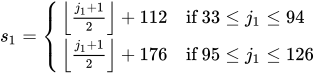
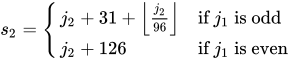
The competing 8-bit format EUC-JP, which does not support single-byte halfwidth katakana, allows for a cleaner and more direct conversion to and from JIS X 0208 code points, as all high-bit-set bytes are parts of a double-byte character and all codes from ASCII range represent single-byte characters.
Usage
[edit]HTML written in Shift JIS can still be interpreted to some extent when incorrectly tagged as ASCII, and when the charset tag is in the top of the document itself, since the important start and end of HTML tags and fields (<, >, /, ", &, ;) are encoded as the same bytes as in ASCII, and those bytes do not appear in two-byte sequences.
Shift JIS can be used in string literals in programming languages such as C, but a few things must be taken into consideration. Firstly, that the escape character 0x5C, normally backslash, is the half-width yen sign (¥) in Shift JIS. If the programmer is aware of this, it would be possible to use printf("ハローワールド¥n"); (where ハローワールド is Hello, world and ¥n is an escape sequence), assuming the I/O system supports Shift JIS output. Secondly, the 0x5C byte will cause problems when it appears as second byte of a two-byte character, because it will be interpreted as an escape sequence, which will mess up the interpretation, unless followed by another 0x5C.
Multiple versions
[edit]

Many different versions of Shift JIS exist. There are two areas for expansion:
Firstly, JIS X 0208 does not fill the whole 94×94 space encoded for it in Shift JIS, therefore there is room for more characters here—these are really extensions to JIS X 0208 rather than to Shift JIS itself.
Secondly, Shift JIS has more encoding space than is needed for JIS X 0201 and JIS X 0208 (see § Shift JIS byte map below), and this space can and is used for yet more characters (as either single-byte or double-byte characters).
Windows-932 / Windows-31J
[edit]The most popular extension is Windows code page 932 (a CCSID also used for IBM's extension to Shift JIS), which is registered with the IANA as "Windows-31J",[1] separately from Shift JIS. This was popularized by Microsoft, although Microsoft itself does not recognize the Windows-31J name and instead calls that variation "shift_jis".[9][10] IBM's code page 943 includes the same double-byte codes as Microsoft's code page 932, while IBM's code page 932 includes fewer extensions (excluding those which Microsoft incorporates from NEC), and retains the character order from the 1978 edition of JIS X 0208, rather than implementing the character variant swaps from the 1983 standard.[11]
Windows-31J assigns 0x5C to U+005C REVERSE SOLIDUS (the backslash), and 0x7E to U+007E TILDE, following US-ASCII.[12] However, most localised fonts on Windows display U+005C as a Yen sign for JIS X 0201 compatibility.[13][14] It includes several extensions, namely "NEC special characters (Row 13), NEC selection of IBM extensions (Rows 89 to 92), and IBM extensions (Rows 115 to 119)",[1] in addition to setting some encoding space aside for end user definition.[15]
Windows codepage 932 is the version used in the W3C/WHATWG encoding standard used by HTML5, which includes the "formerly proprietary extensions from IBM and NEC" from Windows-31J in its table for JIS X 0208,[16] and also treats the label "shift_jis" interchangeably with "windows-31j" with the intent of being "compatible with deployed content".[17]
MacJapanese
[edit]The version of Shift-JIS originating from the classic Mac OS (known as x-mac-japanese, Code page 10001[9] or MacJapanese) assigned the tilde to 0x7E (following US-ASCII, not JIS X 0201 which assigns the overline here), but the Yen sign to 0x5C (as in JIS X 0201 and standard Shift JIS). It also extended JIS X 0201 by assigning the backslash to 0x80 (corresponding to 0x5C in US-ASCII), the non-breaking space to 0xA0, the copyright sign to 0xFD, the trademark symbol to 0xFE and the half-width horizontal ellipsis to 0xFF. It also added extended double byte characters; including 53 vertical presentation forms in the Shift_JIS range 0xEB41–0xED96, at 84 JIS rows down from their canonical forms, and 260 special characters in the Shift_JIS range 0x8540–0x886D.[18] This variant was introduced in KanjiTalk version 7.[19]
However, certain Mac OS typefaces used other variants. Sai Mincho and Chu Gothic use a "PostScript" variant of MacJapanese, which included additional vertical presentation forms and a different set of extended special characters, based on the NEC special characters, some of which were only available in the printer versions of the fonts.[18] Older versions of Maru Gothic and Hon Mincho from System 7.1 encoded vertical presentation forms at 10 (not 84) JIS rows down from their canonical forms, and did not include the special character extensions, this was subsequently changed.[18][20] The typical variant used with KanjiTalk version 6 placed the vertical presentation forms 10 rows down, and also used the NEC extension layout for row 13.[21]
Shift_JISx0213 and Shift_JIS-2004
[edit]| Alias(es) | Shift_JISx0213 |
|---|---|
| Languages | Japanese, Ainu, English, Russian |
| Standard | JIS X 0213 |
| Extends | Shift_JIS (1997), JIS X 0201 (8-bit) |
| Transforms / Encodes | JIS X 0213 |
| Preceded by | Shift_JIS (1997) |
The newer JIS X 0213 standard defines an extended variant of Shift_JIS referred to as Shift_JISx0213 (in a previous version of the standard) or Shift_JIS-2004. It is a superset of standard Shift JIS.[22]
In order to represent the allocated rows on both planes of JIS X 0213, Shift_JIS-2004 uses the following method of mapping codepoints.[23]
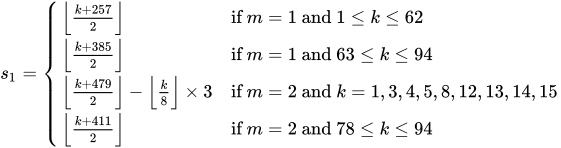

In the above, is a two-byte Shift_JIS-2004 sequence, is the plane (面, men; surface) number (1 or 2), is the row (区, ku; ward) number (1-94) and is the cell (点, ten; point) number (1-94). The ku and ten numbers are equivalent to and respectively, where is a two-byte JIS sequence referencing a given plane.


The same set of characters can be represented by EUC-JIS-2004, the EUC-JP based counterpart.
Some of the additions collide with popular Shift JIS extensions, including Windows codepage 932 which is used in web standards (see above). For example, compare plane 1 row 89 in JIS X 0213 (beginning 硃, 硎, 硏...)[24] to row 89 in the JIS X 0208 variant defined in web standards (beginning 纊, 褜, 鍈...).[25] In addition, some of the characters map to Unicode characters beyond the BMP.
Other variants
[edit]The space with lead bytes 0xF5 to 0xF9 (beyond the region used for JIS X 0208) is used by Japanese mobile phone operators for pictographs for use in E-mail.[26] KDDI goes further and defines hundreds more in the space with lead bytes 0xF3 and 0xF4.[27]
Beyond even this, there have been numerous minor variations made on Shift JIS, with individual characters here and there altered. Most of these extensions and variants have no IANA registration, so there is much scope for confusion, if the extensions are used.
A variant is the one that must be used if wanting to encode Shift JIS in source code strings of C and similar programming languages. This variant doubles the byte 0x5C if it appears as second byte of a two-byte character, but not if it appears as a single "¥" (ASCII: "\") character, because 0x5C is the beginning of an escape sequence. The best way of handling this is a special editor which encodes Shift JIS this way.
Shift JIS byte map
[edit]As defined in JIS X 0208:1997
[edit]The chart below gives the detailed meaning of each byte in a stream encoded in standard Shift JIS (conforming to JIS X 0208:1997).
|
| ||||||||||||||||||||||||||||||||||||||||||||||||||||||||||||||||||||||||||||||||||||||||||||||||||||||||||||||||||||||||||||||||||||||||||||||||||||||||||||||||||||||||||||||||||||||||||||||||||||||||||||||||||||||||||||||||||||||||||||||||||||||||||||||||||||||||||||||||||||||||||||||||||||||||||||||||||||||||||||||||||||||||||||||||||||||||||||||||||||||||||||||||||||||||||||||||||||||||||||||||||||||||||||||||||||||||||||||||||||||||||||||||||||||||||||||||||||||||||||||||||||||||||||||||||||||||||||||||||||||||||||||||||||||||||||||||||||||||||||||||||||||||||||||||||
| |||||||||||||||||||||||||||||||||||||||||||||||||||||||||||||||||||||||||||||||||||||||||||||||||||||||||||||||||||||||||||||||||||||||||||||||||||||||||||||||||||||||||||||||||||||||||||||||||||||||||||||||||||||||||||||||||||||||||||||||||||||||||||||||||||||||||||||||||||||||||||||||||||||||||||||||||||||||||||||||||||||||||||||||||||||||||||||||||||||||||||||||||||||||||||||||||||||||||||||||||||||||||||||||||||||||||||||||||||||||||||||||||||||||||||||||||||||||||||||||||||||||||||||||||||||||||||||||||||||||||||||||||||||||||||||||||||||||||||||||||||||||||||||||||||
With vendor or JIS X 0213 extensions
[edit]Some of the bytes which are not used for single-byte codes or initial bytes in JIS X 0208:1997 are used by certain extensions, resulting in the layout detailed in the chart below.
|
| ||||||||||||||||||||||||||||||||||||||||||||||||||||||||||||||||||||||||||||||||||||||||||||||||||||||||||||||||||||||||||||||||||||||||||||||||||||||||||||||||||||||||||||||||||||||||||||||||||||||||||||||||||||||||||||||||||||||||||||||||||||||||||||||||||||||||||||||||||||||||||||||||||||||||||||||||||||||||||||||||||||||||||||||||||||||||||||||||||||||||||||||||||||||||||||||||||||||||||||||||||||||||||||||||||||||||||||||||||||||||||||||||||||||||||||||||||||||||||||||||||||||||||||||||||||||||||||||||||||||||||||||||||||||||||||||||||||||||||||||||||||||||||||||||||
| |||||||||||||||||||||||||||||||||||||||||||||||||||||||||||||||||||||||||||||||||||||||||||||||||||||||||||||||||||||||||||||||||||||||||||||||||||||||||||||||||||||||||||||||||||||||||||||||||||||||||||||||||||||||||||||||||||||||||||||||||||||||||||||||||||||||||||||||||||||||||||||||||||||||||||||||||||||||||||||||||||||||||||||||||||||||||||||||||||||||||||||||||||||||||||||||||||||||||||||||||||||||||||||||||||||||||||||||||||||||||||||||||||||||||||||||||||||||||||||||||||||||||||||||||||||||||||||||||||||||||||||||||||||||||||||||||||||||||||||||||||||||||||||||||||
See also
[edit]Footnotes
[edit]- ^ Not in the strictest sense of the term, as ASCII bytes can appear as trail bytes.
- ^ The ASCII Corporation should not be confused with the ASCII encoding used elsewhere in this article.
- ^ In JIS X 0208, j1 and j2 are each in the range 33 (0x21) to 126 (0x7e) inclusive (i.e., 7-bit character values excluding control characters (0–31 (0x1f) and 127 (0x7f)) and space).
References
[edit]- ^ a b c "Character Sets". IANA.
- ^ a b "convutf8.c". OpenSolaris. Line 305. 2008-11-12.
- ^ a b "Additional Japanese iconv Modules". What's New in the Solaris 9 9/04 Operating Environment. Oracle Corporation.
- ^ "Historical trends in the usage of character encodings for websites, January 2025". w3techs.com. Retrieved 2024-01-07.
- ^ "Distribution of Character Encodings among websites that use .jp". w3techs.com. Retrieved 2024-12-10.
- ^ "Distribution of Character Encodings among websites that use Japanese". w3techs.com. Retrieved 2024-12-10.
- ^ "Is UTF-8 the encoding of choice for QR-codes with non ASCII chars by now?". Stack Overflow. Retrieved 2024-11-01.
- ^ "QR Code features". Archived from the original on 29 January 2013.
- ^ a b "Encoding.WindowsCodePage Property – .NET Framework (current version)". MSDN. Microsoft.
- ^ "Code Page Identifiers". Windows Dev Center. Microsoft. 7 January 2021.
- ^ "IBM-943 and IBM-932". IBM Knowledge Center. IBM.
- ^ "CP932.TXT". Unicode Consortium.
- ^ "3.1.1 Details of Problems". Problems and Solutions for Unicode and User/Vendor Defined Characters. The Open Group Japan. Archived from the original on 1999-02-03.
- ^ Kaplan, Michael S. (2005-09-17). "When is a backslash not a backslash?".
- ^ Kaplan, Michael S (2007-05-26). "The PUA outside of Unicode". Sorting it all out.
- ^ "5. Indexes (§ Index jis0208)". Encoding Standard. WHATWG.
- ^ "4.2. Names and labels". Encoding Standard. WHATWG.
- ^ a b c "JAPANESE.TXT: Map (external version) from Mac OS Japanese encoding to Unicode 2.1 and later". Apple Computer, Inc.; Unicode Consortium.
- ^ Lunde, Ken (2019-03-21). "A Brief History of Japan's Era Name Ligatures". CJK Type Blog. Adobe Inc.
- ^ "Encoding Variants for MacJapanese". Apple Developer Documentation. Apple.
- ^ Lunde, Ken (2008). "Appendix E: Vendor Character Set Standards" (PDF). CJKV Information Processing. O'Reilly Media. ISBN 9780596514471.
- ^ "JIS X 0213 Code Mapping Tables". x0213.org.
- ^ "JIS X 0213の代表的な符号化方式 § Shift_JIS-2004" (in Japanese). Hexadecimal numbers in the source have been converted to decimal for display.
- ^ Japanese Industrial Standards Committee (2004-04-13). Japanese Graphic Character Set for Information Interchange, Plane 1 (PDF). ITSCJ/IPSJ. ISO-IR-233.
- ^ "Index jis0208 visualization". Encoding Standard. WHATWG.
- ^ "Original Emoji from DoCoMo". FileFormat.info.
- ^ "Original Emoji from KDDI". FileFormat.info.
External links
[edit]- Shift-JIS Kanji Table – a table of the non-ASCII part of the codeset
- "Windows Codepage 932". Microsoft. May 1, 2005. Archived from the original on 2008-03-07. – Microsoft's definition
- Forms of Shift-JIS in ICU (International Components for Unicode)
| Early telecommunications | |
|---|---|
| ISO/IEC 8859 |
|
| Bibliographic use | |
| National standards | |
| ISO/IEC 2022 | |
| Mac OS Code pages ("scripts") | |
| DOS code pages | |
| IBM AIX code pages | |
| Windows code pages | |
| EBCDIC code pages | |
| DEC terminals (VTx) | |
| Platform specific |
|
| Unicode / ISO/IEC 10646 | |
| TeX typesetting system | |
| Miscellaneous code pages | |
| Control character | |
| Related topics | |

Shift JIS
View on GrokipediaHistory and Standardization
Origins and Development
Shift JIS, also known as Shift Japanese Industrial Standards, was invented in 1982 by the Japanese company ASCII Corporation.[6] It was initially developed to facilitate Japanese text processing in computing environments, particularly as an extension of the single-byte JIS X 0201 standard to incorporate double-byte kanji characters from JIS X 0208:1978.[6] This encoding was designed specifically for 8-bit byte systems, allowing seamless support for Romanized Japanese text alongside full-width characters, making it suitable for Western-oriented platforms like MS-DOS.[6] The first implementation of Shift JIS appeared in 1982 within MBASICplus, a variant of Microsoft's MS-BASIC interpreter, running on CP/M-86 operating systems with Mitsubishi's MULTI-16 hardware.[6] This marked an early milestone in its adoption for personal computing, unlike escape-sequence-based approaches like ISO-2022-JP by prioritizing a shift-based mechanism over escape sequences to optimize performance in resource-constrained environments.[6] By 1983, ASCII Corporation collaborated with Mitsubishi, Japan IBM, and Microsoft to formalize an agreement adopting Shift JIS as the standard internal representation for Japanese text on personal computers, solidifying its role in early Microsoft products during the mid-1980s expansion into Japanese markets.[6] These developments positioned Shift JIS as a proprietary solution tailored for the burgeoning PC ecosystem, addressing the limitations of 7-bit encodings in handling complex Japanese scripts without requiring full ISO-2022 compliance.[6] Its focus on compatibility with existing ASCII infrastructure while extending to kanji support enabled rapid integration into software like early MS-DOS applications, laying the groundwork for widespread use in Japanese computing before formal standardization efforts.[6]JIS Standardization
Shift JIS, originally developed by ASCII Corporation in conjunction with Microsoft in the early 1980s, received initial recognition through its alignment with the 1983 revision of JIS X 0208 by the Japanese Industrial Standards Committee (JISC).[7] This revision provided the foundational character set for the encoding, marking an early step toward its integration into official standards.[8] The formal standardization of Shift JIS occurred in 1997, when it was defined as Appendix 1 to JIS X 0208:1997, establishing it as an official variant for double-byte encoding of Japanese characters from JIS X 0201:1997 and JIS X 0208:1997.[8] Published by the Japanese Standards Association (JSA), this appendix specified the complete encoding rules, including mappings for kanji and other graphic characters, ensuring compatibility with the core JIS coded character sets.[9] Unlike the EUC-JP layout, which uses contiguous high-byte ranges starting from 0xA1, Shift JIS employs shifted byte ranges—lead bytes from 0x81 to 0x9F and 0xE0 to 0xEF, followed by trail bytes from 0x40 to 0xFC—to accommodate both single-byte ASCII and double-byte characters in a single 8-bit stream.[8] This approach, while proprietary in origin, was thus normalized for broader use in information interchange.[10] In 2004, Shift JIS was further updated to incorporate the expanded character set of JIS X 0213:2004, resulting in the variant known as Shift JIS-2004, which supports the 11,233 characters defined in JIS X 0213:2004 while maintaining backward compatibility with prior versions.[11][12] The JSA, in coordination with JISC, played a pivotal role in these developments by managing the technical committees and ensuring the standards aligned with industrial needs for consistent data handling.[13] This official adoption enhanced interoperability across Japanese software, hardware, and data exchange systems, reducing encoding ambiguities in PC environments and facilitating reliable text processing in applications like document management and web content.[10]Encoding Mechanism
Basic Structure
Shift JIS is a variable-width character encoding that utilizes 8-bit bytes to represent text, primarily designed for the Japanese language by combining single-byte and double-byte sequences without the need for explicit shift control codes.[14] The encoding operates on a stateless basis, where the decoder processes bytes sequentially: any byte not identified as a lead byte for a double-byte sequence is treated as a single-byte character, effectively "shifting" between modes implicitly based on byte values.[15] This state machine-like behavior ensures efficient parsing, with no null bytes (0x00) appearing within valid double-byte sequences due to the defined ranges excluding them.[15] Single-byte characters cover the range 0x00 to 0x7F, directly mapping to ASCII code points U+0000 to U+007F, except for 0x5C, which represents the yen sign (¥, U+00A5) rather than the backslash (, U+005C).[15] Additionally, the range 0xA1 to 0xDF encodes half-width katakana characters, mapping to Unicode U+FF61 to U+FF9F via the JIS X 0208 index (excluding pointers 8272 to 8835).[15] These single-byte options provide compatibility with basic Latin text and a compact representation for katakana. Double-byte sequences begin with a lead byte in the ranges 0x81 to 0x9F or 0xE0 to 0xEF, followed immediately by a trail byte in 0x40 to 0x7E or 0x80 to 0xFC, forming a pair that indexes into the JIS X 0208 character set for mapping to kanji, hiragana, full-width katakana, and other symbols.[16] The lead byte signals the decoder to consume the next byte as a trail, after which it reverts to single-byte mode; invalid pairs result in a replacement character (U+FFFD).[15] This structure supports a total capacity of approximately 6,355 kanji characters, alongside hiragana and katakana, drawn from the 8,352 entries in the JIS X 0208 index.[17]Character Coverage and Mapping
Shift JIS encodes the full set of characters defined in JIS X 0208, a Japanese Industrial Standard that specifies 6,879 graphic characters arranged in a 94-by-94 grid.[18] These include 6,355 kanji (2,965 in Level 1 and 3,390 in Level 2), 46 hiragana, 46 full-width katakana, and various symbols such as Greek letters, Cyrillic characters, and punctuation.[19][20] The encoding also provides partial support for JIS X 0201, incorporating its 94 single-byte graphic characters (Latin letters, digits, and symbols compatible with ASCII) and 63 half-width katakana characters.[21] In Shift JIS, single-byte characters occupy the range 0x00–0x7F for ASCII-compatible codes and 0xA1–0xDF for half-width katakana, allowing direct compatibility with 7-bit ASCII environments.[21] Double-byte sequences encode the JIS X 0208 characters, using lead bytes from 0x81–0x9F and 0xE0–0xEF paired with trail bytes from 0x40–0x7E and 0x80–0xFC, mapping the 94x94 grid to these variable-width byte pairs.[21] For example, the Latin capital letter A is represented as the single-byte 0x41, while its full-width equivalent A is encoded as the double-byte sequence 0x82A0.[21] A distinctive feature of Shift JIS mapping is the overlap between single-byte half-width katakana (0xA1–0xDF) and valid trail bytes for double-byte characters (0x80–0xFC), which can lead to ambiguous parsing without contextual state tracking to distinguish shifted modes. While the core encoding supports Greek and Cyrillic through the symbol subsets in JIS X 0208, additional characters like extended Latin or more Cyrillic forms are handled via vendor-specific extensions rather than the standard mapping.[18] This structure enables efficient representation of mixed Japanese and Latin text but requires careful implementation for unambiguous decoding.Compatibility and Variants
Compatibility with JIS Standards
Shift JIS provides full backwards compatibility with the single-byte characters defined in JIS X 0201:1997, allowing ASCII and half-width katakana to be encoded directly as single bytes in the range 0x00–0x7F and 0xA1–0xDF, respectively.[22][7] For double-byte characters, Shift JIS encodes the full repertoire of JIS X 0208:1997, mapping its 94×94 grid of kanji, hiragana, katakana, and symbols into two-byte sequences, thereby supporting the core Japanese Industrial Standard for graphic characters while integrating seamlessly with JIS X 0201 without requiring escape sequences.[22][7] The 1997 revision of JIS X 0208 addressed compatibility issues stemming from the 1983 version, which had introduced discrepancies in the graphic character set—such as additions and adjustments for Joyo Kanji and Jinmei Kanji—to align with updated national standards.[23] These changes in 1983 created interoperability challenges for earlier encodings, but the 1990 and 1997 revisions restored equivalence in the character repertoire and designation sequences, enabling Shift JIS to reference JIS X 0208:1997 directly for consistent mapping.[23] However, Shift JIS does not support JIS X 0212-1990, the supplementary standard for additional kanji, limiting its coverage to the primary JIS X 0208 set.[7] In contrast to EUC-JP, which employs contiguous byte ranges (A1–FE for both lead and trail bytes) to encode JIS X 0208 in a more compact, fixed-pattern structure, Shift JIS uses non-contiguous lead-byte ranges (81–9F and E0–EF) and trail-byte ranges (40–7E and 80–FC) to accommodate the single-byte half-width katakana from JIS X 0201 within the 8-bit space.[22] Both encodings permit mixing of single- and double-byte characters without length prefixes or shift controls, facilitating efficient byte-stream processing, though EUC-JP's design allows for optional 3-byte extension to JIS X 0212, which Shift JIS lacks.[22][7] Interoperability between Shift JIS and JIS-based systems can be complicated by its variable-width nature, where strings require byte-by-byte parsing to determine character boundaries, leading to discrepancies in length calculations—such as treating a double-byte kanji as two characters in some metrics versus one in others.[22] This variability demands careful handling in applications to avoid misalignment during data exchange with stricter encodings like EUC-JP.[22]Major Variants
Shift JIS has several platform-specific and extended variants that incorporate vendor-specific extensions or updates to accommodate additional characters, symbols, or compatibility requirements while maintaining backward compatibility with the base encoding. These variants diverge from the standard JIS X 0208 mapping by adding proprietary characters in unused code spaces, such as rows 89–92 and 115–119, or by extending the lead byte range.[8] Microsoft's implementation, known as Windows-31J (also referred to as CP932 or Windows-932), includes vendor-specific extensions such as NEC special characters (Row 13), NEC-selected IBM extensions (Rows 89–92), and IBM extensions (Rows 115–119), adding several hundred characters including mappings to positions like 0xED40–0xEEFC. This variant is based on JIS X 0201:1997 and JIS X 0208:1997 character sets and was standardized in 2001 through IANA registration to clarify behavioral differences from base Shift JIS, such as mapping 0x5C to U+005C (reverse solidus) while often displaying it as a yen sign. It remains widely used in Windows environments for Japanese text processing.[24][24] Apple's MacJapanese variant adapts Shift JIS for classic Mac OS systems, featuring distinct mappings for control codes and the 0x80–0x9F range to additional symbols and MacRoman compatibility characters, while half-width katakana remain in 0xA1–0xDF, along with Apple-specific extensions for symbols like box-drawing characters. This implementation, also known as x-mac-japanese or code page 10001, prioritizes compatibility with Macintosh Roman for single-byte characters while incorporating JIS X 0208 graphics, resulting in incompatibilities with other Shift JIS variants in areas like punctuation and line-breaking controls.[8] Shift_JIS-2004 represents an official extension of Shift JIS aligned with the JIS X 0213:2004 standard, incorporating the expanded repertoire of JIS X 0213:2004, which adds approximately 4,400 characters beyond JIS X 0208 for a total of over 11,000 characters, including expanded kanji, symbols, and compatibility ideographs. It achieves this by utilizing extended lead bytes in the range 0xF0–0xF9 for the new character plane, while preserving the original Shift JIS structure for legacy content, and is defined in Appendix 1 of JIS X 0213:2004 for mapping to Unicode. This variant supports modern Japanese typography needs but requires explicit handling in software to avoid conflicts with earlier encodings.[25] IBM variants, such as code page 932 (IBM-932), provide another extension of Shift JIS tailored for IBM systems by encoding the JIS X 0208:1983 character repertoire while preserving the 1978 code point ordering, and incorporating additional IBM-specific characters in extended rows. A related variant, IBM-943, uses the 1983 ordering for the JIS X 0208:1983 repertoire and includes NEC row extensions for broader compatibility in AIX and OS/2 environments. Mobile carrier variants in Japan, such as those developed for DoCoMo, au (KDDI), and SoftBank, extend Shift JIS with proprietary emoji and pictogram sets encoded as user-defined characters in carrier-specific code spaces, often using Shift JIS-compatible sequences for backward compatibility in early mobile networks. These implementations, prevalent in the 2000s, added hundreds of symbols but were later unified into Unicode emoji standards.[26]Byte-Level Details
Standard JIS X 0208 Mapping
Shift JIS encodes the 94×94 grid of characters defined in the JIS X 0208:1997 standard using two-byte sequences, where the lead byte determines the row (ku-ten position) and the trail byte determines the column. The lead byte occupies the ranges 0x81–0x9F for the first half (covering 62 rows via 31 possible lead bytes, each paired with two trail ranges) and 0xE0–0xEF for the second half (covering the remaining 32 rows via 16 lead bytes). This assignment ensures all 94 rows are represented without overlap in the byte space.[14] The trail byte for double-byte characters falls within 0x40–0x7E or 0x80–0xFC, providing 63 + 125 = 188 possible values, though only 94 are used per row to match the grid columns; the value 0x7F is excluded entirely to prevent conflicts with control codes in the ASCII range. The exact byte pair is computed using a pointer value: pointer = (r-1) × 94 + (c-1), where r is the row (1–94) and c is the column (1–94); lead_index = ⌊pointer / 188⌋; trail_index = pointer mod 188; lead byte = 0x81 + lead_index (if lead_index ≤ 30) or 0xE0 + (lead_index - 31) (if lead_index ≥ 31); trail byte = 0x40 + trail_index (if trail_index < 63) or 0x80 + (trail_index - 63) (otherwise).[27] Representative examples highlight the mapping's precision. The hiragana letter "あ" (U+3042), located at JIS row 4, column 2, is encoded as 0x82A0. The kanji "学" (U+5B66), at row 19, column 56, is encoded as 0x8A77. These assignments align directly with the JIS X 0208 grid positions via the standardized index.[28] The 94×94 grid organizes characters into distinct zones for efficient lookup. Rows 1–15 contain symbols, punctuation, Greek letters, and other non-Japanese scripts; rows 16–84 are allocated to the core set of 6,355 kanji characters; and rows 85–94 include additional symbols, Cyrillic letters, and box-drawing elements. This zoning supports the encoding's focus on Japanese text while accommodating supplementary glyphs.[29]| Zone | JIS Rows | Content Type | Example Characters |
|---|---|---|---|
| Symbols and Special | 1–15 | Punctuation, numbers, Latin/Greek | U+3000 (ideographic space), U+2460 (circled digit one) |
| Kanji | 16–84 | Hanzi/Kanji ideographs | U+4E00 (一), U+9FA5 (龥) |
| Additional Symbols | 85–94 | Box drawing, Cyrillic | U+2500 (box drawings light horizontal), U+0410 (CYRILLIC CAPITAL LETTER A) |
Extended Mappings and Extensions
Various vendor-specific extensions to Shift JIS introduce non-standard byte assignments to accommodate additional characters, particularly for legacy systems and specialized applications. Windows-932, Microsoft's implementation of Shift JIS used in Windows environments, incorporates extensions beyond the JIS X 0208 standard, including NEC special characters in row 13 (approximately 83 characters), NEC-selected IBM extended characters in rows 89 to 92 (374 characters), and IBM extended characters in rows 115 to 119 (388 characters).[30] For example, in Windows-932, the byte sequence 0x815C maps to the em dash (U+2015), which differs from standard JIS mappings and can affect compatibility.[25] IBM variants, such as IBM-932, similarly extend the encoding with characters in rows 89 to 94, prioritizing IBM-specific kanji selections to support enterprise data processing.[31] The JIS X 0213 standard, published in 2000 and revised in 2004, further extends Shift JIS through Shift_JIS-2004, adding support for Plane 2 characters using lead bytes in the range 0xF0 to 0xF9. This extension incorporates approximately 3,625 new kanji and other symbols beyond JIS X 0208, bringing the total number of kanji to 11,233 across both planes.[32][33] These mappings enable encoding of additional ideographs and diacritic-marked characters, with Plane 1 serving as a superset of JIS X 0208 (6,230 characters) and Plane 2 providing the bulk of the new additions.[34] Across variants, Shift JIS features over 100 distinct extension points in reserved byte ranges, such as rows 95–114 (lead bytes 0xF0–0xF9) for user-defined or vendor-specific assignments, allowing customization but introducing risks. Undefined bytes in these areas can lead to portability issues, including data corruption or misinterpretation (mojibake) when transferring files between systems adhering to different standards, as non-standard characters may render as garbage or fail to decode. For instance, the range starting at 0xFA40 is reserved for IBM extensions and user-defined characters, which some implementations use for custom pictographs or symbols resembling early emoji-like icons, though this varies by vendor and exacerbates interoperability challenges.[35]Usage and Applications
Historical Adoption
Shift JIS emerged in the early 1980s as a practical character encoding solution for Japanese text on personal computers, developed collaboratively by Microsoft, Digital Research, ASCII Corporation, and Mitsubishi Electric. This encoding method extended the JIS X 0201 and JIS X 0208 standards by using variable-length byte sequences—single bytes for ASCII-compatible characters and double bytes for kanji—allowing efficient handling of Japanese script without frequent escape sequences, which facilitated its integration into early PC software. Its design compatibility with existing 8-bit systems made it particularly suitable for the resource-constrained hardware of the era.[36][37] During the 1980s and 1990s, Shift JIS became the dominant encoding in Japan's computing landscape, powering MS-DOS implementations on platforms like the NEC PC-98 series, which captured over 90% of the domestic 16-bit PC market by 1987. It was integral to Windows 3.x, enabling widespread Japanese language support in graphical user interfaces and applications. Japanese software developers, including Just Systems, adopted Shift JIS for key productivity tools such as the Ichitaro word processor, released in 1985, which relied on this encoding for kanji input, conversion, and display, contributing to the PC-98's success in business and home use. This adoption extended to databases and legacy systems in sectors like finance and government, where Shift JIS ensured reliable data storage and retrieval for Japanese text-heavy operations.[37][38][39] The encoding's influence reached email and early internet applications, serving as a basis for JIS-based protocols while directly supporting PC-centric workflows. In web development, Shift JIS was commonly specified via the "Shift_JIS" HTTP charset parameter in early browsers like Netscape and Internet Explorer during the 1990s, allowing Japanese websites to render correctly on Windows systems prevalent in Japan. Although primarily confined to Japanese contexts, Shift JIS spread globally through exported software.[30]Modern Usage and Decline
As of November 2025, Shift JIS is employed by approximately 0.1% of all websites whose character encoding is known, marking a significant decline from its higher prevalence in earlier decades.[40] Despite this, it persists in niche applications such as QR codes, where the Kanji mode encodes double-byte characters using Shift JIS ranges from 0x8140 to 0x9FFC and 0xE040 to 0xEBBF to efficiently represent Japanese text.[41] Similarly, it remains relevant in embedded systems, where implementations like those in Arm C/C++ libraries support Shift JIS alongside UTF-8 for handling Japanese characters in resource-constrained environments.[42] In legacy Japanese applications, particularly older Windows-based software, Shift JIS continues to be required for compatibility, as these systems expect specific codepage mappings like Windows-31J, a superset of standard Shift JIS.[43] It also appears in certain printing workflows, including Japanese PDFs generated from legacy tools, where Shift JIS-encoded text must be properly handled to avoid garbled output during rendering.[44] The decline of Shift JIS accelerated with the dominance of UTF-8 since the early 2000s, as surveys indicate that by 2020, over 95% of Japanese web pages utilized Unicode/UTF-8 encoding.[7] Browser support for Shift JIS has been preserved mainly for decoding legacy content, but modern web standards prioritize Unicode, leading to deprecation of direct Shift JIS handling in favor of UTF-8 for new implementations.[3] In the 2020s, updates to the WHATWG Encoding Standard have clarified Shift JIS specifications primarily as a legacy format, ensuring interoperability while discouraging its adoption in contemporary development.[3] Consequently, Shift JIS is now rare in new software projects, with UTF-8 serving as the universal choice for Japanese text handling.[45]Challenges and Transition
Technical Limitations
Shift JIS encoding features overlapping ranges for single-byte and double-byte characters, leading to parsing ambiguities that require sequential, stateful decoding to correctly identify character boundaries. Specifically, the trail bytes of double-byte sequences (ranging from 0x40–0x7E and 0x80–0xFC) overlap with the lead bytes of subsequent double-byte characters (0x81–0x9F and 0xE0–0xEF), meaning a single-byte error, such as data corruption or truncation, can cause misalignment and propagate decoding errors throughout the string. This lack of self-synchronization makes recovery from errors challenging without re-decoding from the beginning.[22] A prominent example of such ambiguity arises with the byte 0x5C, which represents the yen sign (¥, U+00A5) in Shift JIS but the backslash (, U+005C) in ASCII; many implementations prioritize backslash interpretation for compatibility, especially in file paths or mixed ASCII-Japanese contexts, leading to misrendering of the yen sign as a backslash.[30] Similarly, 0x7E encodes an overline (‾, U+203E) in Shift JIS instead of the ASCII tilde (~, U+007E), exacerbating issues in mixed-language text where ASCII assumptions prevail.[30] Without a byte-order mark or other metadata to indicate the encoding, detecting and correctly parsing Shift JIS in heterogeneous environments becomes error-prone, often resulting in garbled output.[46] The variable-length nature of Shift JIS—using one byte for ASCII-like characters and two bytes for most Japanese glyphs—further complicates practical implementations, as determining the character length of a string requires full decoding rather than simple byte counting. This hinders operations like substring extraction or random access, where byte offsets do not align with character boundaries. Additionally, byte-level searches or regular expressions can inadvertently split multi-byte characters, producing invalid sequences or false matches due to the overlapping byte ranges.Security and Migration Issues
Shift JIS, as a legacy variable-width encoding, introduces several security risks primarily stemming from its handling of invalid byte sequences and inconsistent character mappings during parsing and conversion. In web browsers, mishandling of invalid Shift JIS sequences has enabled cross-site scripting (XSS) attacks, where malformed input could be interpreted as executable script rather than unknown characters, potentially allowing attackers to inject malicious code on sites declaring Shift JIS as the charset.[47][48] For instance, older versions of Firefox and Internet Explorer were vulnerable to such exploits, where invalid sequences bypassed security filters, leading to information disclosure or script execution.[49][50] Additionally, Shift JIS's ambiguous mappings, such as the byte 0x5C representing either a backslash (U+005C) or yen sign (U+00A5) depending on the implementation, can facilitate homograph-like attacks by enabling visually confusable characters that deceive users or systems during text comparison or rendering.[51] These inconsistencies heighten risks in security-sensitive contexts like domain names or filenames. Another concern arises from Shift JIS's lack of round-trip safety when converting to modern encodings like Unicode, where approximately 400 characters—particularly in extensions like CP932—map to the same Unicode code point, causing data loss or corruption.[52] This ambiguity can undermine security mechanisms relying on precise character identity, such as authentication tokens or access controls involving Japanese text.[53] Migration from Shift JIS to Unicode, particularly UTF-8, is driven by its limited character repertoire—standard JIS X 0208 supports only 6,879 graphic characters, with extensions like CP932 adding roughly 6,000 more for a total under 20,000—compared to Unicode's over 149,000 assigned characters, restricting support for diverse scripts and emojis essential for global applications. This limitation hampers internationalization, as Shift JIS is optimized solely for Japanese (hiragana, katakana, and kanji) and fails to handle multilingual content without additional encodings, increasing complexity in cross-border systems.[54] The WHATWG Encoding Standard explicitly discourages new use of legacy encodings like Shift JIS, recommending UTF-8 for compatibility and security in web protocols.[3] Common migration tools include the Unix iconv utility for batch conversions, such asiconv -f SHIFT_JIS -t UTF-8 input.txt > output.txt, which handles standard mappings efficiently but struggles with vendor-specific extensions.[55] In Python, the encode('shift_jis') and decode('shift_jis') methods in the standard library provide programmatic support, though they require careful error handling for non-standard bytes.[56] Challenges persist with extensions like CP932, where ambiguous or proprietary characters (e.g., IBM-specific additions) lack one-to-one Unicode mappings, necessitating custom tables or fallback strategies to avoid data corruption during conversion to UTF-8.[52] Post-conversion validation is crucial, as incomplete mappings can introduce mojibake or security gaps in legacy-dependent applications.
In the Japanese financial sector, Shift JIS remains prevalent for CSV data exchanges between banks and government agencies as of 2025, reflecting slow adoption due to entrenched legacy systems.[57] However, organizations like JustSystems have successfully migrated to Unicode since the late 1990s, enabling broader compatibility and reducing encoding-related errors in software products.[39] Broader industry efforts, aligned with ISO 20022 standards for financial messaging, are accelerating transitions to UTF-8 by 2025 to support global interoperability and mitigate legacy vulnerabilities.[58]