Hubbry Logo
Shore TempleShore TempleMain
Open search
Shore Temple
Community hub
Shore Temple
logo
8 pages, 0 posts
0 subscribers
Be the first to start a discussion here.
Shore Temple
Shore Temple
from Wikipedia

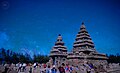
The Shore Temple (c. 725 AD) is a complex of temples and shrines that overlooks the shore of the Bay of Bengal. It is located in Mahabalipuram, about 60 kilometres (37 mi) south of Chennai in Tamil Nadu, India.[1][2]

Key Information

It is a structural temple, built with blocks of granite, dating from the 8th century AD. At the time of its creation, the site was a busy port during the reign of Narasimhavarman II of the Indian Pallava dynasty.[3] As one of the Group of Monuments at Mahabalipuram, it has been classified as a UNESCO World Heritage Site since 1984.[4] It is one of the oldest structural (versus rock-cut) stone temples of Southern India.[3]

History

[edit]

Marco Polo and the European merchants who came to Asia after him called the site Seven Pagodas. One of these is believed to be the Shore Temple. The temple probably acted as a landmark for seafarers. As it appears like a Pagoda, the name became familiar to the seafarers.[5]

This structural temple complex was the culmination of the architectural creations that were initiated by the King Narasimhavarman II in mid 7th century starting with the Cave temples and the monolithic Rathas.[2] Even though the architectural creation of sculpturing cut-in and cut-out structures continued during subsequent periods, as seen in the Atiranachanda cave, the Pidari rathas and the Tiger cave, the main credit for the architectural elegance of the Shore Temple complex in the category of structural temples goes to the King Rajasimha (700–28 AD), also known as Narasimhavarman II, of the Pallava Dynasty. It is now inferred that this temple complex was the last in a series of temples that seemed to exist in the submerged coastline; this is supported by the appearance of an outline of its sister temples off the coast during the Tsunami of 2004 which struck this coastline.[1] The architecture of the Shore Temple was continued by the Cholas (in the temples that they built) who ruled Tamil Nadu after defeating the Pallavas.[6]

The tsunami of December 2004 that struck the coastline of Coromandel exposed an old collapsed temple built entirely of granite blocks. This has renewed speculation that Mahabalipuram shore temple was a part of the Seven Pagodas described in the diaries of Europeans, of which six temples remain submerged in the sea. The tsunami also exposed some ancient rock sculptures of lions, elephants, and peacocks that used to decorate walls and temples during the Pallava period during the 7th and 8th centuries.[7]

Though the tsunami of 26 December 2004 that occurred in the Indian Ocean struck the temple and the surrounding garden, the Shore Temple was not badly damaged, as the water level returned to its normal level within a few minutes. The damage was to the foundation of the bali pitham (sacrificial altar) in front of the temple, the steps leading to the boat jetty, and the small shrine with the Varaha (Boar) sculpture at the basement of the Shore temple. As the temple foundation is on hard granite rock, it could sustain the waves created by the tsunami; the groynes erected around the temple area on the coastline also aided its protection.[8]

According to the two inscriptions found in the slab of smaller Shiva temple, the names of the three temples mentioned are as Kshatriyasimha Pallavesvara-gruham, Rajasimha Pallavesvara-gruham and Pllikondaruliya-devar. The entire temple complex is called as Jalashayana (lying in water). This confirms that the Vishnu shrine was the first shrine to be excavated here. The inscription on the lintel of the Vishnu shrine also mentions this as Narapatisimha Pallava Vishnu Griha where Narapatisimha is a title of Rajasimha.[5]

Architecture

[edit]
Shore temple floor plan.
The main temple

All the three Temples of the Shore Temple complex are built on the same platform. Viewed from the northern end, the temples appear to be a replica of the Dharmaraja Ratha.[5] The main Shore Temple, which faces east so that the sun rays shine on the main deity of Shiva Linga in the shrine, is a five-storied structural Hindu temple rather than rock-cut as are the other monuments at the site. Built with sculpted granite stones hauled from a nearby quarry, it is the earliest important structural temple in South India. Its pyramidal structure is 60 feet (18 m) high and sits on a 50 feet (15 m) square platform. There is a small temple in front which was the original porch. It is made out of finely cut local granite.[9]

The shore temple is one of the most popular temples in Mahabalipuram. Excavations in early 2000s have revealed new structures here under the sand.[10]

The temple is a combination of three shrines. The main shrine is dedicated to Shiva, as is the smaller second shrine. A small third shrine, between the two, is dedicated to a reclining Vishnu and may have had water channelled into the temple, entering the Vishnu shrine. The two Shiva shrines are orthogonal in configuration. The entrance is through a transverse barrel vault gopuram. The two shikharas have a pyramidal outline, each individual tier is distinct with overhanging eaves that cast dark shadows.[3] The outer wall of the shrine to Vishnu and the inner side of the boundary wall are extensively sculptured and topped by large sculptures of Nandi. The temple's outer walls are divided by pilasters into bays, the lower part being carved into a series of rearing lions. The temple walls are surrounded by sculptures of Nandi.[11]

Artwork and iconography

[edit]

The temple has a garbhagriha (sanctum sanctorum) in which the deity, Sivalinga, is enshrined, and a small mandapa surrounded by a heavy outer wall with little space between for circumambulation. At the rear are two shrines facing in opposite directions. The inner shrine dedicated to Ksatriyasimnesvara is reached through a passage while the other, dedicated to Vishnu, is facing outwards. The Durga is seated on her lion vahana. A small shrine may have been in the cavity in the lion's chest. The Shore Temples, like many major Hindu temples, include both Shaivism and Vaishnavism temples and iconography.[3]

The roofs of the temples have ornamentation similar to the Pancha Rathas. The roofs have finials on the top, indicative of its religious functional nature, as it was a completed temple. The octagonal shape of the shikaras of the two temples dedicated to Shiva are in the Dravidian architectural style.[5] Beneath the towers, the sanctuary walls are mostly blank without any decorations but the columns are carved over lion mounted bases.[12] The decorations on the outer faces of these shrines are similar to those seen on the Pancha Rathas, though due to their closeness to the sea, are partially eroded due to salty winds.

Somaskanda Panel with Shiva, Uma and their son Skanda

The most distinctive feature of the temple are the Dharalinga and the Somaskanda panel, which are enshrined in the interior walls of the sanctum of the east facing Kshatriyasimhesvara temple. The Dharalinga is deified in the garbhagriha, which is in square shape of 12 feet (3.7 m) and the height is 11 feet (3.4 m). The Dharalinga or Shivalinga is in Rajasimha style, carved out of black basalt stone. It has sixteen faces with slight fluting to create a crown at the top. The top portion of the linga is damaged. Its total height is 6 feet (1.8 m) with one foot embedded in the foundation to provide stability.[5] A bas-relief, which is a family image of Shiva and his consort Parvati with their child Kartikeya built over a stone slab is located in a small shrine in the temple. This is also called the Somaskanada panel, a carved stone panel. Two more similar panels are seen at the entrance porch of the temple. This type of panel is also depicted in the nearby Dharmaraja Ratha of the Paramesvarvarman's era.[5][13][14] The ardhamantapa or half chamber which is the first chamber before entering the sanctum sanctorum, also has sculptures of Brahma on the south wall and Vishnu on its north wall. Sculptures of Shiva as Tripurantaka and Durga are seen on the back side of the north wall of the main shrine. There is also a circumambulatory passage to go round the main shrine in a clockwise direction.[5]

A relief.

The smaller Shiva temple behind the main temple is a double storied structure with a stepped pyramidal tower with an octagonal shikhara built over a circular griva. A kalasa and finial are fitted above the shikhara. kudus (horseshoe-arch dormer like projections) and small shrines are part of the cornices at both levels of the structure. A Somaskanda panel decorates the back wall of the inner shrine. There is no mantapa (hall) in front of this shrine (probably damaged). The external walls display two panels. One is called Ekapadamurti, an eye-legged form of Shiva with Brahma and Vishnu emanating from his sides. The second panel is of Nagaraja (king of serpents) standing below a five-hooded serpent.[5]

Anantashayi Vishnu (reclining posture of Vishnu lying on the serpent Ananta) is enshrined in a small rectangular shrine between the large Kshatriyasimhesvara temple and the Rajasimha Pallaveshvara temple. Vishnu is depicted with four arms but his attributes are missing (damaged). The temple structure's rectangular tower is missing. The typical design of kudus and small square shrines are part of the cornice arrangement. The external walls have carvings of Krishna slaying the demon Kesi, Krishna dancing over Kaliya (the seven hooded serpent), and Vishnu seated on his vehicle Garuda in the act of saving Gajendra (elephant) from the mouth of a crocodile. Inscription noted in Pallava Grantha script is on the lintel indicating it as the earliest shrine of the complex.[5]

The entire compound wall surrounding the temples is sculpted with large sculptures of Nandi, the vehicle or mount of Shiva, and also with Yalis and Varahas (boars).[8]

Lion monolith

[edit]
Mahishasuramardini Durga lion shrine

A monolith sculpture of a partly carved and partly sculpted lion with a hole in its torso is erected within the compound wall of the temple complex. A miniature image of Durga is sculpted on the back of the image, which is a depiction of Durga as Mahishasuramardini. The open mouth of the lion is inferred as representation of its role as the favourite lion.[5]

Miniature Shrine

[edit]
Miniature shrine

In 1990, the Archaeological Survey of India (ASI) discovered a miniature shrine with the Bhuvaraha image in a well type enclosure. This is dated to the Pallava King Narasimhavarman Mamalla's (AD 638–660) reign. It was enclosed with an elliptical well built during Rajasimha's (AD 700–728) period. These are carved on the bedrock that also has the reclining Vishnu in the Shore Temple complex.[15] The miniature shrine is also dedicated to Shiva.[16][17]

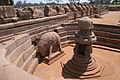
The water tank in Shore Temple complex

It has sixteen-sided base which is carved from bedrock. The circular wall and superstructure are of structural type. There are lions depicted on the pilasters. It is reported as a unique single tiered temple and not seen in other temples of the Pallava period. Its circular shikara, is in vesara style architecture.[18] The shikhara is erected on a circular griva, which has kudus and maha-nasikas on its four sides and each nasika has an image of Ganesha. The kalasa above the shikara is missing.[5] The carving of the Bhuvaraha depicts Varaha as the boar incarnation of Vishnu. This image is in unusual form, unlike another Varaha depictions in other regions of the country, as there is no Bhudevi shown nor an ocean. The depiction is in the form of Varaha performing a diving act into the ocean to rescue Bhudevi or mother earth. The symbolism of this act denotes the myth, only when the temple is submerged in water, as it is below the ground level.[5] The sculpture is seen broken and the base has an inscription referring to titles of the Pallava king Rajasimha. The wall that surrounds the shrine to prevent intrusion of sand from the sea also has an inscription on the topmost layer, in Pallava-Grantha script, which equates the king with Arjuna.[5][19]

Conservation

[edit]

ASI has constructed break-water wall all around the sea shore to save the temple from further damage.[5] The temple structures, affected by rough Sea and winds with salt content are being conserved by the Archaeological Survey of India by building protective groynes, treatment with wall paper pulp, and by planting casuarina trees along the affected coast line. The pulp treatment absorbs the saline water. In addition, chemical treatment is also given the monument to prevent water seepage into the rock. This kind of treatment is also reported to take out water stored inside the rock thus allowing the stone to breathe and preserve its strength. The area around the Shore Temple, has been beautified. The horticulture wing of the ASI has created a green lawn of 11 acres (4.4 hectares) around the Shore Temple. Fixing of signages with information on the monuments and creating fountains was also part of the beautification programme planned by ASI.[20]

Indian Dance Festival-Mamallapuram

[edit]

The Mamallapuram Dance Festival is held every year during Dec-Jan in Mamallapuram, Tamil Nadu. This dance festival is organised by Department of Tourism, Govt. of Tamil Nadu. Exponents of Bharatanatyam, Kuchipudi, Kathak, Odissi, Mohini Attam and Kathakali perform against this magnificent backdrop of the Pallava rock sculptures. It is vibrant festival of dance where enormous audience enjoys this one month long festival.[21]

[edit]

See also

[edit]
[edit]

References

[edit]
[edit]
Revisions and contributorsEdit on WikipediaRead on Wikipedia
from Grokipedia
The Shore Temple is a complex of three Hindu shrines located in Mahabalipuram, , , overlooking the , and is renowned as one of the oldest structural temples in , constructed from blocks during the CE. Built under the patronage of the Pallava king (also known as Rajasimha) between approximately 700 and 728 CE, the temple marks a significant transition in Pallava architecture from rock-cut monuments to freestanding stone structures, exemplifying early Dravidian style with its pyramidal vimanas and intricate carvings. The complex consists of two main temples—the larger Kshatriyasimhesvara facing east and the smaller Rajasimhesvara facing west—flanked by a smaller shrine (Nripatisimha Pallava Vishnugriha) featuring a reclining , all enclosed within concentric prakara walls that originally supported detailed friezes now largely eroded by seawater. As part of the , the Shore Temple was inscribed as a in 1984 under criteria (i), (ii), (iii), and (vi) for its outstanding universal value in representing Pallava artistic and architectural achievements, including thousands of sculptures glorifying and early examples of the Dravida layout. Its seaside location has contributed to its weathered beauty but also poses ongoing conservation challenges, with efforts by the including protective seawalls and recent excavations uncovering buried structures like a stepped and additional rock-cut figures to the south. The temple's enduring significance lies in its role as a major center of the cult during the Pallava era and as a testament to the dynasty's influence on later South Indian temple architecture.

Location and Significance

Site Description

The Shore Temple is situated on the in (also known as ), , , directly along the shore of the , approximately 60 km south of . This coastal positioning places the temple within the larger , a recognized since 1984 for its cultural significance. The temple complex is elevated on a natural rocky outcrop of , built on a square platform approximately 15 meters (50 feet) on each side, which provides a prominent vantage over the adjacent shoreline. The site encompasses a compact area enclosed by a compound wall, with pathways facilitating visitor access, and spans roughly the footprint of its structural elements integrated into the terrain. Its immediate surroundings feature the dynamic interplay of land and sea, with the temple oriented eastward to face the , exposing it to constant marine influences. Visible wave erosion from prolonged proximity to the ocean has sculpted the coastal edges and affected the base of the , while saline winds contribute to ongoing of the exposed surfaces. Within the broader Pallava complex, the Shore Temple stands as the sole surviving free-standing structural edifice, distinct from the nearby rock-cut monuments such as the Five Rathas, which are hewn directly from boulders in the surrounding landscape.

Cultural and Historical Importance

The Shore Temple, as part of the , was inscribed on the World Heritage List in 1984 under criteria (i), (ii), (iii), and (vi), recognizing its outstanding universal value as a masterpiece of early and Pallava artistry that exemplifies the transition to monumental stone construction in . Criterion (i) highlights the temple's status as a pinnacle of human creative genius in sculptural and architectural innovation, while (ii) underscores its role in the exchange of cultural influences across ancient trade routes; (iii) acknowledges its testimony to the Pallava dynasty's unique artistic traditions; and (vi) emphasizes its association with significant events in religious and cultural history. This designation has elevated the site's global profile, positioning it as a cornerstone of India's tangible and drawing international attention to the preservation of ancient maritime and religious landscapes. Religiously, the Shore Temple stands as an early exemplar of the synthesis between and in South Indian temple architecture, with two shrines dedicated to —the eastern Kshatriyasimnesvara and the western Rajasimnesvara—and a smaller one to as Sthalasayana Perumal, thereby symbolizing a rare harmony between these two major Hindu traditions during the Pallava era. This integration reflects the Pallava rulers' patronage of both sects, fostering a devotional space that bridged sectarian divides and influenced subsequent temple designs in the region, where deities from both pantheons were often venerated in proximity to promote spiritual unity. Historically, the temple marks a pivotal shift from the earlier rock-cut cave temples to freestanding structural temples in , serving as a prototype that profoundly shaped the evolution of under later dynasties such as the Cholas and . Its innovative use of granite blocks and towers laid foundational principles for the grand gopurams and expansive complexes seen in Chola temples like Brihadisvara and sites like Virupaksha, ensuring the Pallava legacy's enduring impact on South Indian sacred architecture. On a global scale, the Shore Temple attracts over 1.2 million visitors annually, contributing significantly to Tamil Nadu's economy, which accounts for a substantial portion of the state's revenue through heritage-based activities and international arrivals. This influx supports local livelihoods, conservation efforts, and the promotion of Tamil cultural identity, reinforcing the temple's role as a vital economic and educational asset in contemporary .

History

Origins and Construction

The Shore Temple was commissioned by Pallava king Narasimhavarman II, known as Rajasimha, who ruled from approximately 700 to 728 CE during the late 7th and early 8th centuries. This patronage reflects the king's emphasis on architectural innovation as part of the broader Pallava tradition of monumental construction at the ancient port city of Mahabalipuram. Intended as a royal seaside shrine dedicated primarily to Shiva, with a subsidiary shrine to Vishnu, the temple marked a pivotal evolution in South Indian temple building. The complex consists of two Shiva shrines—the larger Kshatriyasimhesvara facing east and the smaller Rajasimhesvara facing west—and a smaller Vishnu shrine (Nripatisimha Pallava Vishnugriha) featuring a reclining Vishnu sculpture. Unlike earlier Pallava works that relied on rock-cut techniques, the Shore Temple was erected as a structural edifice using locally quarried granite blocks precisely cut and interlocked without mortar, a method that demanded advanced masonry skills from regional artisans. This approach allowed for the temple's distinctive form, including two main vimanas (towers) facing east and west, set on a raised platform overlooking the Bay of Bengal. The construction likely proceeded in phases, with the smaller Vishnu shrine potentially predating the larger Shiva shrine by a short period, suggesting an initial focus on Vaishnava elements before expansion under Rajasimha's direct oversight. Inscriptions in Pallava Grantha script, engraved on the temple's walls and base elements such as the balipeethas (sacrificial platforms), provide key evidence of this royal dedication; one such verse praises Rajasimha as the builder of the shrine honoring and , underscoring the temple's role in affirming Pallava sovereignty and devotion. These epigraphs, composed in , highlight the king's virtues and the temple's purpose as a sacred maritime .

Associated Legends

The Seven Pagodas legend, a prominent piece of local surrounding the Shore Temple, posits that seven ornate Hindu temples—referred to as pagodas—were constructed by the Pallava kings along the Mahabalipuram shoreline during their reign. According to this narrative, divine intervention or a led to the submersion of six temples beneath the , leaving only the Shore Temple visible as a testament to the lost grandeur. In one variant of the myth, the god , envious of the city's celestial beauty rivaling that of his heavenly abode, unleashed a massive storm that flooded and sank the structures, sparing just the Shore Temple on its elevated rock outcrop. This tale underscores themes of and in , with the surviving temple serving as a beacon amid the waters. Local myths further associate the temple with efforts to appease turbulent sea forces, recounting how it was erected following the destruction of prior coastal edifices by raging waves, acting as a spiritual bulwark to pacify the ocean's wrath. These stories intertwine with nearby rock reliefs depicting the Descent of the , where the sage Bhagiratha's penance brings the sacred river to earth, symbolizing harmony between divine waters and human endeavors. Recent underwater archaeological studies resumed by the in August 2025 off the Mahabalipuram coast aim to explore submerged structures, potentially lending credence to the Seven Pagodas legend. Additionally, excavations have uncovered remains of additional temples south of the Shore Temple. Colonial-era European travelers amplified the submersion myth in their writings, contributing to its enduring allure. In the late , English astronomer John Goldingham described the site as the "Seven Pagodas," noting seafarers' traditions of vanished temples visible at , which fueled speculation among visitors. Early 19th-century accounts, such as that of Maria Graham, echoed this by recording indigenous lore of magnificent pagodas engulfed by the sea, with only ruins persisting, thus shaping Western perceptions of the site's mystical history. Tamil oral traditions portray the Shore Temple as a protective sentinel against oceanic perils, embedded in folk narratives passed down through generations that emphasize its role in warding off storms and guiding mariners, reinforcing its cultural significance as a guardian of the coast.

Architecture

Structural Features

The Shore Temple is constructed primarily from locally quarried hard grey blocks, marking it as one of the earliest structural stone temples in and an exemplar of early . The use of these durable blocks highlights the Pallava builders' reliance on precise stone-cutting techniques to achieve cohesion and longevity in a coastal environment. Key structural components include two pyramid-shaped vimanas serving as towers over the main shrines, each capped by an octagonal roof (griva) and a rounded (stupi), distinguishing the temple's form from the curvilinear spires of northern Nagara styles. The complex is enclosed by a perimeter wall (prakara) featuring balustrades with lion motifs for symbolic protection, alongside subsidiary elements such as water tanks that integrate with the site's hydraulic features. Engineering innovations emphasize stability through interlocking granite blocks, which interlock via tongue-and-groove joints. The entire structure is elevated on a substantial plinth, approximately 15 meters square, to mitigate the impact of rising sea levels and , a foresight attributed to its seaside placement. The main Shiva shrine reaches about 18 meters in height. This design, patronized by Pallava king Rajasimha, underscores a transition from rock-cut to freestanding temple forms.

Layout and Design

The Shore Temple complex is organized on a single platform measuring approximately 15 meters square, accommodating three interconnected shrines in a linear east-west alignment that optimizes space along the coastal edge. The eastern shrine, dedicated to and named Kshatriyasimnesvara, serves as the primary entrance point with its square sanctum housing a , flanked by a small pillared for ritual gatherings. The central shrine, rectangular in plan with a flat roof, originally featured a carved reclining idol and acts as a transitional space linking the two shrines, while the western shrine, a smaller version named Rajasimnesvara, also contains a in its compact sanctum. This tripartite layout promotes Shaiva-Vaishnava harmony by juxtaposing the deities' worship areas without hierarchical dominance, all within a footprint constrained by the site's proximity to the sea. Processional paths guide pilgrims through a transverse barrel-vaulted on the west side, directing movement into the forecourt and around the shrines via circumambulatory pradakshina routes that encircle each sanctum individually and the complex collectively. These paths align with cardinal directions, enabling eastward orientation for sunrise-aligned rituals overlooking the , where the sea view integrates symbolically into the daily worship flow. The forecourt includes an open assembly area with a supported by granite pillars, providing space for communal activities before access to the inner shrines. Subsidiary elements further define the functional spaces, including multiple monolithic Nandi bull idols positioned along the platform's edges and facing the Shiva shrines to denote sacred boundaries and devotional focus. These Nandis, carved from the same granite as the structure, frame the approaches and enhance the ritual pathway without obstructing the compact layout. The overall design reflects Pallava principles of verticality and enclosure, with the shrines' vimanas rising in stepped pyramidal forms to create a unified silhouette against the horizon, adapting to coastal winds and tides while maintaining ritual accessibility.

Art and Iconography

Sculptural Elements

The Shore Temple's sculptural elements are primarily executed in hard , employing techniques such as shallow and free-standing monolithic forms to create intricate details on both structural and subsidiary features. These carvings demonstrate the Pallava artisans' skill in working with durable stone, often resulting in low-relief panels that blend seamlessly with the temple's architecture. from coastal exposure has softened some finer details over centuries, particularly on exposed surfaces facing the . A striking entrance feature is the lion monolith, a large free-standing positioned to guard the southern approach, depicting a majestic with integrated warrior motifs in its mane and posture, carved from a single block. Inside the monolith's torso is a carving of as Mahishasuramardini slaying the buffalo demon. Along the perimeter enclosure wall, rows of Nandi bulls are incised in shallow , arranged in a continuous that encircles the complex, each bull rendered with compact bodies and alert expressions to emphasize their vigilant role. Local legends suggest there were originally 101 such bulls, though only about 27 remain intact today. The outer walls of the shrines host prominent relief panels, including depictions of Durga on the north wall of the large Shiva shrine, where the goddess is shown in dynamic combat pose with weapons raised, alongside panels of other deities like Vishnu and Shiva in attendant forms, all executed in low relief to highlight fluid lines and drapery folds. Yali balustrades, featuring mythical lion-like creatures with composite animal-human features—such as protruding tusks, fierce eyes, and muscular torsos—adorn the staircases and platforms, serving as protective railings with multiple figures in dynamic, rearing poses. A small miniature shrine nearby contains detailed friezes with narrative scenes, carved in finer scale to depict processions and divine assemblies within compact borders. Among specific artifacts, a panel depicting the Ekapadamurti stands out, showing a one-legged form with at the center, flanked by and , integrated into the external wall of a . Krishna-related motifs appear on subsidiary structures, including of the in scenes with cows and attendants, rendered in shallow carving on plinths and low walls adjacent to the main shrines. These elements are placed to enhance the temple's visual rhythm, complementing the overall layout without dominating the structural forms.

Symbolic Representations

The Shore Temple's religious iconography prominently features the in the main eastern shrine, symbolizing the cosmic pillar of creation and the generative force of the universe in Shaivite tradition. This aniconic form, paired with its base representing the feminine principle, underscores the temple's emphasis on as the eternal creator and destroyer, with the oriented to receive the first rays of the sun at dawn, enhancing its ritual potency. The central shrine, notably smaller and positioned between the two shrines without a prominent standing idol, evokes the deity's reclining form on the (), symbolizing the primordial oceanic origins of the universe and the temple's maritime context. This arrangement integrates Shaiva and Vaishnava motifs, promoting sectarian harmony under Pallava patronage by balancing devotion to and within a unified . Mythological themes in the temple's further emphasize protection and devotion. The near the southern serves as a guardian figure, embodying as the upholder of cosmic order and alluding to Durga's , which triumphs over chaos and evil. Rows of Nandi bulls along the prakara wall of the larger shrine denote unwavering devotion, as Nandi, 's sacred vehicle, represents the ideal bhakta whose gaze fixed on the lord signifies eternal loyalty and meditative focus. Yalis, the mythical lion-elephant composites carved on plinths and walls, symbolize vigilance and the warding off of malevolent forces, acting as divine sentinels that blend ferocity with sacred duty to safeguard the temple's sanctity. On a broader level, the temple functions as a microcosm of , Shiva's mythical abode, with its vimanas (towering superstructures) mimicking the mountain's jagged peaks to evoke the divine connecting earth and heaven. The sea-facing orientation links the complex to , the Vedic god of waters, symbolizing the temple's immersion in the and its role in harmonizing terrestrial devotion with aquatic primordiality. Pallava artistry in the Shore Temple blends local Tamil deities and motifs with pan-Indian epics like the and , as seen in Vishnu's reclining pose echoing Vishnu's cosmic rest, foreshadowing the inclusive movement's emphasis on personal devotion across sectarian lines.

Conservation and Preservation

Environmental Challenges

The Shore Temple, located directly on the Coromandel Coast along the , has endured persistent sea erosion since its construction in the 8th century CE, with waves gradually undermining the temple's foundation and contributing to the partial submersion of adjacent ancient structures. This natural battering has weakened the plinth and lower walls, particularly on the eastern facade exposed to and high , resulting in an estimated coastal retreat of approximately 0.5 meters per year in recent decades. Cyclones, such as those frequent in the region, intensify this process by depositing and saltwater, further eroding the shoreline and threatening the temple's stability. Seawater ingress exacerbates deterioration through salt weathering, where saline solutions penetrate the porous , leading to upon and subsequent expansion that fractures the stone. Analytical studies of deteriorated samples reveal high concentrations of and other marine salts within the temple's , causing flaking, pitting, and loss of surface detail on sculptures and carvings. Bio-deterioration compounds this damage, as , lichens, and marine organisms colonize damp surfaces, secreting acids that accelerate chemical breakdown of the mineral matrix. The temple's eastern exposure to sea spray amplifies these effects compared to the western side, sheltered by the compound . Human activities add to these environmental pressures, with increased footfall—drawing approximately 1.2 million visitors annually as of 2025—causing physical wear on pathways and bases through constant treading and inadvertent contact with fragile elements. amplifies these challenges, with post-2004 assessments highlighting accelerated along the shoreline due to rising sea levels and intensified storm surges, projecting potential further submergence of low-lying heritage features by mid-century under global warming scenarios. Recent studies as of 2023 indicate ongoing irrevocable decay in sculptures due to sea exposure and salt accumulation.

Restoration Initiatives

The (ASI) initiated major structural interventions in the 20th century to mitigate threatening the Shore Temple, including the construction of offshore breakwaters and to reduce wave impact and sediment loss. These measures, such as the massive wall built over a century ago, formed a foundational barrier against sea encroachment, preserving the temple's granite foundations from progressive undermining. Since the , ASI has employed chemical consolidation treatments to address salt accumulation, a primary deterioration factor exacerbated by marine exposure. Techniques like paper-pulp poultices, applied periodically, draw out soluble salts through , stabilizing the and preventing further flaking and pitting in the temple's walls and sculptures. For instance, in 2013 and subsequent efforts, cellulose-based coatings were left on surfaces for several days before gentle removal, effectively consolidating weathered areas without invasive damage. Following the site's inscription as a in 1984 as part of the , international collaborations have enhanced monitoring and preservation. 's World Heritage Centre has supported periodic reactive monitoring missions, providing technical advice on erosion risks and conservation strategies to ensure compliance with heritage standards. In the aftermath of the 2004 , which caused limited structural damage to the Shore Temple but revealed nearby submerged ruins, ASI undertook reinforcements in 2005, including assessments and targeted stabilizing works to bolster seaward facades against future surges. Modern techniques have integrated digital and sustainable innovations in the 2020s. The Kural Aram Foundation, backed by La Fondation Dassault Systèmes, launched and parametric modeling projects to create accurate digital replicas of the temple, documenting intricate carvings and enabling the revival of ancient Pallava construction methods through virtual simulations and artisan training. Since 2023, ASI has implemented systems, installing three 10-kilowatt solar plants to power site lighting and generate surplus for the grid, reducing reliance on fuels while supporting low-impact monitoring equipment. Cellulose-based poultices continue as a bio-derived method for sculptures, offering an eco-friendly alternative to harsher chemicals in ongoing maintenance. Foreign tourist arrivals to , including sites like Mahabalipuram, rose more than eight-fold to 1.17 million in 2023, underscoring the need for practices.

Cultural Role

Festivals and Tourism

The Mamallapuram Dance Festival, an annual cultural event organized by the , has been held since 2000 at the Shore Temple complex, showcasing performances of classical Indian dance forms such as , , , , , and , as well as folk traditions from various regions. Typically spanning late December to mid-January—for the 2025–2026 edition, from the third week of December 2025 to the second week of January 2026—the festival features evening shows on an open-air stage with the illuminated Shore Temple as a dramatic backdrop, attracting artists and audiences from across and abroad to celebrate the site's Pallava heritage through rhythmic and intricate . This event not only revives ancient artistic expressions but also integrates the temple into contemporary cultural narratives, drawing thousands of visitors during the winter months. Evening light and sound shows at the Shore Temple enhance nocturnal by projecting visuals and multilingual audio narrations that recount the monument's , legends of the , and its architectural significance, running daily after sunset for approximately 45 minutes. These spectacles, initiated to promote heritage and extend visitor hours beyond daylight, utilize eco-friendly lighting to illuminate the temple's facades against the , creating an immersive experience that complements daytime explorations. Visitor management at the Shore Temple includes an entry fee of ₹40 for Indian citizens and ₹600 for foreign nationals, with free access for children under 15 and persons with disabilities, while the site operates daily from 6:00 AM to 6:00 PM, seeing peak crowds from to March due to favorable weather. Guided tours, available through the (ASI) or private operators, provide contextual insights into the temple's and , often lasting 30-45 minutes and costing ₹500-₹1,000 per group. The site's integration into the Chennai-Mahabalipuram tourism circuit facilitates easy access via buses or taxis from (about 60 km away), supporting year-round visits with basic amenities like restrooms and shaded pathways. Accessibility features include flat terrain around the main complex, ramps for wheelchair users, and complimentary entry for disabled visitors, though some peripheral areas may require assistance due to uneven paths. Tourism at the Shore Temple significantly bolsters the local economy of Mahabalipuram, with the site attracting approximately 3 million visitors annually (as of 2025) and generating revenue through nearby accommodations, stone-carving artisan shops, and seafood eateries that cater to the influx. This activity sustains employment for local communities in hospitality and crafts, with the World Heritage status since 1984 further amplifying visitor numbers and funding for site maintenance.

Representation in Media

The Shore Temple has been featured in various Indian films, serving as a picturesque backdrop that highlights its scenic coastal location and architectural grandeur. For instance, it appears in the 2014 romantic drama 2 States, directed by , where the temple's silhouette enhances the climactic scenes overlooking the . Such cinematic portrayals have helped popularize the monument among global audiences, often symbolizing ancient Indian heritage in visual storytelling. In literature, the temple has inspired colonial-era documentation and modern narratives. British architectural historian James Fergusson referenced it extensively in his 1876 work History of Indian and Eastern Architecture, including detailed plans and diagrams that contributed to early Western understanding of Pallava architecture. More contemporary works include , such as the 2024 interactive book Sculpted Stones: Mysteries of by Ashwin Prabhu (Tulika Books), which explores the temple's history and carvings through engaging stories for young readers. These literary references often evoke themes of enduring spirituality and maritime mystery tied to local legends. The temple's iconography extends to philatelic representations by , underscoring its national cultural significance. A notable example is the 1983 commemorative stamp issued for , depicting the temple's twin shrines against the sea, valued at 1 and part of a series promoting peace and heritage. Similar stamps, such as those from the 2004 heritage series, have further immortalized its form on collectible media. In digital media, the Shore Temple has gained prominence through online platforms and virtual experiences. Google Arts & Culture hosts a dedicated exhibit since 2018, featuring high-resolution photographs, 360-degree views, and historical context from the Archaeological Survey of India, allowing global users to explore its details interactively. Additionally, the Tamil Nadu Tourism Department's virtual tour of Mahabalipuram, launched in 2020, includes immersive walkthroughs of the Shore Temple complex, promoting heritage accessibility amid travel restrictions. Viral imagery on social platforms, including drone footage and sunset photographs, has amplified its allure, often garnering millions of views and shares that blend aesthetic appeal with historical intrigue. The temple symbolizes lost antiquity in tourism campaigns, such as those by , where it represents Tamil Nadu's ancient maritime legacy in promotional videos and ads. However, its media presence has occasionally sparked controversies, including debates over nearby developments like modern constructions encroaching on the buffer zone, as reported in 2018, which threaten its visual integrity. Restoration initiatives, such as proposed protective caps against sea erosion, have also drawn public discourse in documentaries like Discovery+'s History Hunter (2023), which examines environmental threats alongside its cultural icon status.

References

Add your contribution
Related Hubs
User Avatar
No comments yet.