Hubbry Logo
GroyneGroyneMain
Open search
Groyne
Community hub
Groyne
logo
8 pages, 0 posts
0 subscribers
Be the first to start a discussion here.
Contribute something
Groyne
Groyne
from Wikipedia
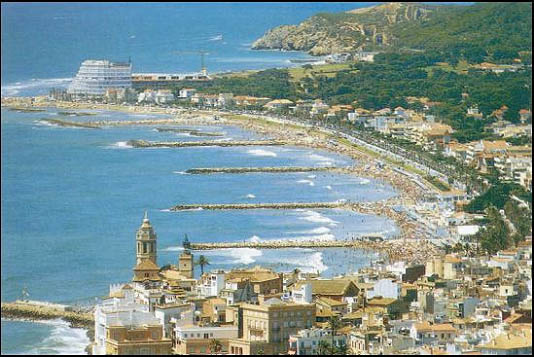
Groynes in Sitges, Catalonia, Spain

A groyne (in the U.S. groin) is a rigid aquatic structure built perpendicularly from an ocean shore (in coastal engineering) or a river bank, interrupting water flow and limiting the movement of sediment. It is usually made out of wood, concrete, or stone. In the ocean, groynes create beaches, prevent beach erosion caused by longshore drift where this is the dominant process and facilitate beach nourishment. There is also often cross-shore movement which if longer than the groyne will limit its effectiveness. In a river, groynes slow down the process of erosion and prevent ice-jamming, which in turn aids navigation.

All of a groyne may be underwater, in which case it is a submerged groyne. They are often used in tandem with seawalls and other coastal engineering features. Groynes, however, may cause a shoreline to be perceived as unnatural. Groynes are generally straight but could be of various plan view shapes, permeable or impermeable, built from various materials such as wood, sand, stone rubble, or gabion, etc.

Background

[edit]

Etymology

[edit]

The term groyne is derived from the Old French groign, from Late Latin grunium, "snout".[1]

History

[edit]

Ancient Egypt and Nubia

[edit]

A large number of groynes were found along a 1,000-kilometre stretch of the river Nile, between the first and the fourth cataract.[2] The earliest ones dated so far were found to be over 3,000 years old, but researchers are hypothesising that the technique might already have been understood in the fourth millennium BCE.[2] The newly discovered groynes are located in what are now Egypt (Aswan), but mainly in Sudan, in areas of ancient Nubia, some of them built by the Egyptian overlords and some possibly the work of local Nubians.[2]

16th- to 19th-century England

[edit]

One of the earliest mentions of groynes is in connection with the planned improvements to the silted-up Dover harbour, by one Fernando Poyntz in 1582.[3][4][5]

In 1713 the first wooden groyne to protect Brighton's seafront and coastline was built, which had been heavily damaged in the Great storm of 1703, and again in 1705.[6] In 1867, the first concrete groyne was built near East Street, Brighton as a promenade 195 feet (59 m) long.[7]

Mechanics

[edit]
Rock groyne at Sea Bright Beach, New Jersey.

Beach evolution and sedimentation accretion

[edit]

A groyne gradually creates and maintains a wide area of beach on its updrift side by trapping the sediments suspended in the ocean current. This process is called accretion of sand and gravel or beach evolution. It reduces erosion on the other, i.e. downdrift, side by reducing the speed and power of the waves striking the shore. It is a physical barrier to stop sediment transport in the direction of longshore drift (also called longshore transport). If a groyne is correctly designed, then the amount of material it can hold will be limited, and excess sediment will be free to move on through the system. However, if a groyne is too large it may trap too much sediment, which can cause severe beach erosion on the down-drift side.

Groyne fields

[edit]

Groynes are generally placed in series, generally all perpendicular to the shore. The areas between groups of groynes are groyne fields.

Terminal groyne syndrome

[edit]

A poorly designed groyne (too long and not suited to the unique features of the coast) can also accelerate the erosion of the downdrift beach, which receives little or no sand from longshore drift. This process is known as terminal groyne syndrome, because in a series of groynes it occurs after the terminal groyne (last groyne on the downdrift side of the beach or coastline).

Headland groyne / Headland breakwater

[edit]

A breakwater is an artificial offshore structure built parallel to the shore -- similar to naturally formed barrier islands -- that normally remains unattached to the shore. When a groyne is built to attach the breakwater to the shore, it is called a "headland groyne", also known as "bulkhead groyne", "headland breakwater", "T-head groyne", or "T-shaped groyne".

Usage

[edit]

Coastal management

[edit]
Wooden groyne, Mundesley, UK

A groyne's length and elevation, and the spacing between groynes is determined according to local wave energy and beach slope. Groynes that are too long or too high tend to accelerate downdrift erosion, and are ineffective because they trap too much sediment. Groynes that are too short, too low, or too permeable are ineffective because they trap too little sediment. If a groyne does not extend far enough landward, water (for example at a high tide combined with a storm surge) may flow past the landward end and erode a channel bypassing the groyne, a process known as flanking.

River management

[edit]
Aerial photograph of the Lumberville Dam on the Delaware River. Some water is pouring over the wing dams or groins; there is a navigation channel between them.

River groynes (spur dykes, wing dykes, or wing dams) are often constructed nearly perpendicular to the riverbanks, beginning at a riverbank with a root and ending at the regulation line with a head. They maintain a channel to prevent ice jamming, and more generally improve navigation and control over lateral erosion, that would form from meanders. Groynes have a major impact on the river morphology: they cause autonomous degradation of the river.[8]

They are also used around bridges to prevent bridge scour.

Types

[edit]
Submerged groin (US spelling), Hunting Island, South Carolina
A "Keep off the groynes" sign in Brighton, England, with a groyne showing in the background.

Groynes can be distinguished by how they are constructed, whether they are submerged, their effect on stream flow or by shape.[9]

By their planview shape

[edit]

Groynes can be built with different planview shapes. Some examples include straight groynes, hockey stick or curved, inverted hockey stick groynes, tail or checkmark shaped groynes, L head, straight groynes with pier head (seaward end raised on the stilts, since the pier head is raised on the stilts it does not act as the breakwater), T-head (headland groyne, breakwater attached to the shore with straight groyne, the head/breakwater itself could be shaped straight, Y-shaped, arrow or wing shaped head).

By cross-section based on material used

[edit]

Wooden groynes, sheetpile groynes, sandbag groynes, rubble mound or gabion groynes, etc.

By permeability

[edit]

Groynes can be permeable, allowing the water to flow through at reduced velocities, or impermeable, blocking and deflecting the current.

  • Permeable groynes are large rocks, bamboo or timber
  • impermeable groynes (solid groynes or rock armour groynes) are constructed using rock, gravel, gabions.

By whether they are submerged

[edit]

Groynes can be submerged or not under normal conditions. Usually impermeable groynes are non-submerged, since flow over the top of solid groynes may cause severe erosion along the shanks. Submerged groynes, on the other hand, may be permeable depending on the degree of flow disturbance needed.

By their effect on stream flow

[edit]

Groynes can be attracting, deflecting or repelling.

  • Attracting groynes point downstream, serving to attract the stream flow toward themselves and not repel the flow toward the opposite bank. They tend to maintain deep current close to the bank.
  • Deflecting groynes change the direction of flow without repelling it. They are generally short and used for limited, local protection.
  • Repelling groynes point upstream; they force the flow away from themselves. A single groyne may have one section, for example, attracting, and another section deflecting.
[edit]

See also

[edit]

References

[edit]

Notes

[edit]
[edit]
Revisions and contributorsEdit on WikipediaRead on Wikipedia
from Grokipedia
A groyne (also spelled in ) is a rigid, shore-perpendicular coastal extending from the into the water, designed to interrupt longshore and trap to protect against shoreline . The term derives from the "groign" meaning "snout," alluding to the 's protruding form. These structures are commonly deployed in areas with significant littoral drift, where waves carry sediment parallel to the , helping to maintain width and stability by accumulating material on the updrift side. Groynes serve primarily as a form of hard to mitigate caused by wave action and currents, particularly in medium- to high-energy environments like sandy beaches exposed to and . By dissipating wave energy and preventing the loss of beach material to downdrift areas, they facilitate efforts and can create recreational spaces, though their effectiveness depends on local hydrodynamic conditions such as wave direction and supply. Typically constructed in series along a coastline, groynes are engineered to be partially permeable to allow some water flow while retaining solids, with designs avoiding complete blockage of to minimize adverse effects elsewhere. Various types of groynes exist to suit different site conditions, including wooden palisades for temporary use, steel sheet piles for impermeable barriers, concrete units for durability, and rubble-mound structures made of stones or tetrapods for energy dissipation. Materials are selected based on lifespan, cost, and environmental compatibility; for instance, timber groynes offer low initial expense but require frequent maintenance due to decay, while rock-based ones provide longevity in harsh marine settings. Design parameters include length (often 40-50% of the surf zone width during storms), height (typically 0.5-1.0 meters above mean ), and orientation, which may be straight or shaped (e.g., L- or T-form) to optimize capture without excessive scour. Despite their protective benefits, groynes can have notable environmental drawbacks, such as accelerated on the downdrift side due to starvation, increased rip currents that pose hazards to swimmers, and potential loss of sand to deeper waters during storms. These impacts necessitate integrated , often combining groynes with beach replenishment or softer alternatives like dunes to balance protection and . Historically, groynes have been employed since ancient times but gained prominence in modern engineering during the 19th and 20th centuries, with notable applications along the Baltic Sea's and Ukraine's coast to combat chronic retreat.

Introduction and Background

Definition and Purpose

A groyne is a rigid built perpendicularly, or at a slight angle, to the shoreline or riverbank, extending into the water to interrupt longshore . These structures, also known as groins in , function as barriers that alter nearshore flow patterns and sediment dynamics along coastal or riverine environments. The primary purposes of groynes include trapping littoral drift to promote beach accretion on the updrift side, thereby stabilizing shorelines against , and reducing wave energy to protect adjacent such as harbors, dunes, or coastal developments. By interrupting the movement of and parallel to the shore, groynes help maintain beach width and mitigate risks in areas prone to sediment loss. They are particularly effective in managing budgets where erosion threatens coastal stability. Basic components of a groyne typically comprise a foundation for anchorage, a stem or main body that forms the barrier, and a head at the seaward end to withstand currents and waves. Lengths generally range from 50 to 200 meters, while heights vary from 1 to 5 meters, depending on local tidal ranges, beach profiles, and characteristics. Groynes are commonly deployed along temperate coasts with strong longshore currents but are less effective in high-energy, storm-prone areas without supplementary measures like . To understand groyne functionality, it is essential to grasp , the process by which waves approaching at an generate currents that carry parallel to the shoreline. Groynes interrupt this drift by creating a partial barrier, causing to accumulate updrift while potentially accelerating downdrift if not balanced.

The term "groyne" originates from the word groin, meaning "" or "," which evokes the structure's protruding form into the water like an animal's nose. This etymological root traces further to Latin grunnīre, "to grunt," suggesting an association with a pig's snout in early usages. The word derives ultimately from Latin grunnīre ("to grunt"), via Old French groin (""). The word entered English in the late , first recorded in , initially as a term for a projecting coastal barrier. In regional variations, predominantly uses "groyne," while favors "groin," reflecting spelling conventions that emerged in the 18th and 19th centuries. Related terms such as "spur dike" or "" appear in riverine or navigational contexts, but "groyne" specifically denotes coastal structures to the shore, distinguishing it from aids to navigation. In modern standardization, engineering texts like those from the Construction Industry Research and Information Association (CIRIA) consistently employ "groyne" for coastal applications, partly to differentiate from the anatomical meaning of "" and maintain clarity. This preference ensures precise communication in technical guidelines and avoids ambiguity in international contexts.

Historical Development

Ancient and Early Uses

The earliest known examples of groyne-like structures date to and around 2500–1500 BCE, where monumental stone walls were constructed along the River to manage regimes and deposition. These river groynes, identified through satellite and ground-based archaeological surveys, extended over approximately 500 kilometers from near in southern into ancient (modern-day ), with more than 1,000 individual structures documented. Built primarily of local and other durable stones by Egyptian pharaohs during the Old and Middle Kingdoms, they projected perpendicularly from the riverbanks to deflect flows, trap for agricultural enhancement, and facilitate by stabilizing channels during annual inundations. Archaeological evidence indicates these structures supported broader efforts, connecting Egyptian and Nubian communities through improved resource transport and flood control, though many now lie in arid desert landscapes as the Nile's course has shifted over millennia. No contemporary textual descriptions, such as those by , directly reference these groynes, but their design and placement align with known ancient practices for management in the Valley, predating similar coastal applications by thousands of years. In medieval Europe, particularly in the (modern and ), wooden groynes emerged in the as part of early coastal defense systems against sea encroachment and erosion. Documented in regional dike records and charters from organizations like the Dutch waterschappen, these structures were erected perpendicular to shorelines using timber piles driven into the sand to interrupt longshore and retain beach material. Initial applications focused on protecting low-lying polders and ports in areas vulnerable to storm surges, with examples noted in and provinces amid increasing efforts. Early designs in both ancient and medieval contexts relied heavily on locally available materials, such as stone in the Nile Valley or timber and reeds in , resulting in limited . Wooden medieval groynes typically lasted 10–25 years before succumbing to rot, wave action, and tidal scour, necessitating frequent reconstruction despite their permeable nature allowing some water passage. These rudimentary forms lacked the engineered refinements of later eras, prioritizing immediate site-specific protection over long-term dynamics.

Modern Evolution

The systematic construction of groynes in emerged in the 18th century, driven by the need to protect vulnerable coastlines from . Early examples included wooden structures built in starting in the 1720s, utilizing timber piles to combat severe after devastating storms in and 1705 that destroyed much of the town's lower areas. By the early , these timber designs proved insufficient against ongoing wave action, prompting a shift to more durable stone materials around the 1800s, as seen in extensions and reconstructions along the coast that enhanced longevity and effectiveness. In the , groyne engineering advanced significantly with the introduction of concrete and steel materials following , allowing for stronger, more resilient structures amid increasing coastal development pressures. The U.S. Army Corps of Engineers played a pivotal role, receiving congressional authorization for shore protection projects in that laid the groundwork for later implementations; large-scale groyne fields, such as those using rubble-mound designs, were constructed in the mid-20th century to stabilize beaches eroded by storms and human activity. heightened awareness of coastal vulnerabilities, leading to post-war reconstructions that standardized the use of groynes in strategies across , , and beyond. From the late into the 21st, groynes evolved through integration with soft engineering techniques, such as , to create hybrid systems that promote natural dynamics while minimizing environmental disruption; for instance, nourished beaches updrift of groynes have sustained wider shorelines in projects across the U.S. and since the 1980s. Recent innovations post-2010 include permeable eco-groynes, designed with gaps or porous materials to allow and passage, reducing downdrift compared to traditional impermeable barriers, as demonstrated in European and Asian trials emphasizing enhancement. trials, using containers for temporary or low-impact structures, have gained traction, with 2025 case studies in evaluating their role in dynamic at sites like Inverloch Surf Beach, where they facilitate adaptive responses to variable patterns. These developments reflect broader efforts, adapting groyne fields to rising levels—projected at 4-5 mm annually—through elevated crests and flexible designs to maintain efficacy amid intensified storms. Key milestones include the 1950s standardization efforts by the UK's Hydraulics Research Station (now HR Wallingford), which conducted model experiments establishing optimal groyne spacing and heights for sand and shingle beaches, influencing global design guidelines. In the 2020s, advancements in monitoring—such as drone and —have enabled precise maintenance assessments, exemplified by the 2016-2018 Raf Raf groyne project in , where tracked 2 km of nourished shoreline evolution and informed adjustments for long-term resilience.

Principles of Operation

Mechanics of Sediment Transport

, also known as littoral drift, occurs when waves approach the shore at an oblique angle, imparting a on the that generates a longshore current parallel to the coastline. This current transports along the shore, with the VV halfway in the approximated by V=1.17gHbsinθbcosθbV = 1.17 \sqrt{g H_b} \sin \theta_b \cos \theta_b
Add your contribution
Related Hubs
Contribute something
User Avatar
No comments yet.